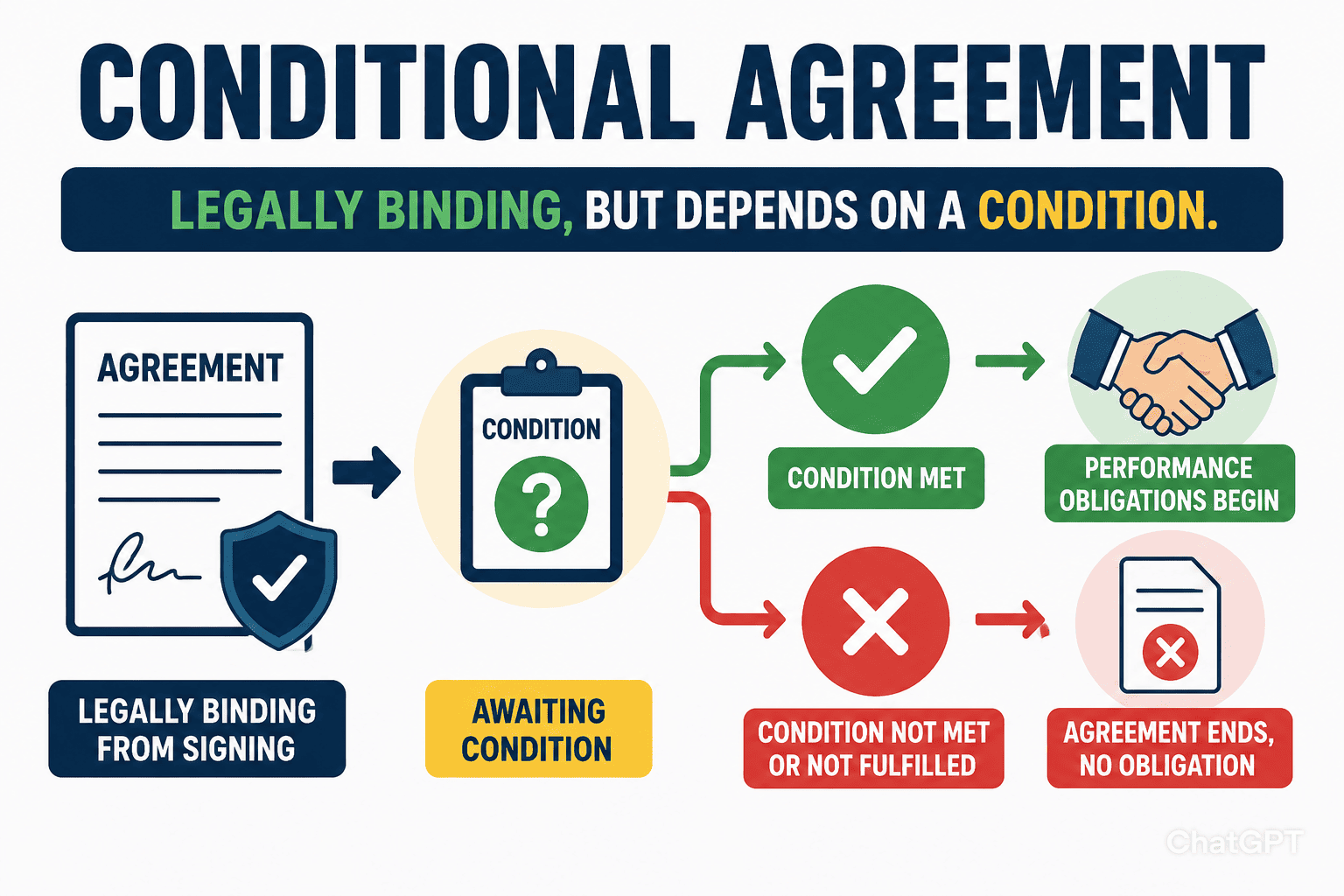
How a Conditional Agreement Works
Unlike a Memorandum of Understanding or a non-binding agreement, which record intent without creating enforceable obligations, a Conditional Agreement is fully binding from the moment the parties execute it. What is deferred is not the legal force of the agreement, but the obligation to perform the principal commercial act: the sale, the investment, the supply, the acquisition.
The mechanism works as follows: the parties define one or more conditions that must be satisfied within a specified period (the “condition period” or “long-stop date”). Once all conditions are met, the agreement becomes unconditional and the parties are obligated to perform. If the conditions are not met by the long-stop date, the agreement lapses, or one or both parties may terminate it, and the principal obligations are never triggered.
This structure is used extensively across international trade because it allows parties to commit to the substance of a transaction in a binding instrument while protecting themselves from having to perform until specific prerequisites, such as regulatory approval, financing confirmation, satisfactory due diligence, or planning consent, are secured. It is a risk-management tool as much as a contractual framework.
⚡ Critical Distinction
A Conditional Agreement is not the same as a non-binding pre-contractual document such as a Letter of Intent or Heads of Agreement. It is a fully binding contract. If a party wrongfully prevents a condition from being satisfied, for example, by refusing to cooperate with a required regulatory filing, courts across most jurisdictions will hold that party liable for breach. The conditional structure defers performance obligations; it does not dilute binding force.
Types of Conditions
Condition Precedent vs Condition Subsequent
The two principal types of conditions used in commercial agreements are conditions precedent and conditions subsequent. Understanding the difference is essential to structuring any conditional arrangement correctly, they operate in opposite directions, and they allocate risk in very different ways.
✅ Condition Precedent
Triggers the Obligation to Perform
An event or state of affairs that must occur before a party’s duty to perform arises. Until the condition is satisfied, no obligation to perform the principal act exists, but the agreement itself is binding.
- Regulatory or government approval obtained
- Financing confirmed and committed
- Satisfactory completion of due diligence
- Planning permission granted
- Third-party consent or waiver received
- Specified environmental or technical survey results
⚠️ Condition Subsequent
Terminates an Existing Obligation
An event that, once it occurs after performance obligations have already arisen, brings an existing duty to an end. Less common in commercial sale agreements; more frequently encountered in ongoing service or employment arrangements.
- Loss of required professional licence
- Regulatory status revoked post-execution
- Material adverse change clause triggered
- Counterparty insolvency or change of control
- Breach of ongoing performance covenant
- Failure to maintain agreed certification or accreditation
✨ Practical Guidance
In international commercial practice, conditions precedent are far more frequently used than conditions subsequent in transaction agreements. Conditions subsequent are more commonly found in ongoing commercial arrangements, long-term supply contracts, licensing agreements governed by a Master Services Agreement, and employment or partnership structures. Where a condition subsequent is intended, it must be drafted with precision: courts tend to construe them narrowly, and the burden of proving that the condition has occurred typically falls on the party seeking to use it to end their obligation.
When a Conditional Agreement Is Used
Where Conditional Agreements Are Used in International Business
Conditional Agreements are one of the most widely used transactional structures in cross-border commerce. They provide the legal certainty of a binding commitment while ensuring that neither party is forced into completion before the prerequisites for a sound transaction have been confirmed.
🏢
Mergers & Acquisitions
Share purchase and business acquisition agreements are almost always conditional, typically on regulatory merger clearance, shareholder approvals, and satisfactory completion of due diligence within a defined condition period.
🏗️
Real Estate & Land Development
Developers enter into binding contracts for the purchase of land conditional on satisfactory planning permission being obtained. This secures the land without obligating the developer to purchase unless the planning condition is met.
🌍
Cross-Border Distribution & Supply
A binding supply agreement may be made conditional on the supplier passing a quality audit, obtaining import licences, or achieving accreditation from a specified standards body before supply obligations commence.
💰
Project Finance & Investment Agreements
Investment commitments in infrastructure, energy, and capital projects are structured as conditional on financial close, the point at which all funding commitments, security arrangements, and pre-conditions are confirmed by lenders.
⚖️
Regulatory-Dependent Transactions
Any transaction requiring government or regulatory approval, financial services, telecommunications, pharmaceutical manufacturing, import/export licensing, is structured as conditional on that approval being granted within the condition period.
🤝
Joint Venture Formation
A binding joint venture agreement may be conditional on the parties securing specific third-party contracts, technology licences, or concession rights that are the economic rationale for the venture. Without those, the JV entity need never be formed.
Key Elements
Key Elements Every Conditional Agreement Must Address
A well-drafted Conditional Agreement does more than simply name the condition. It defines the condition with sufficient precision to eliminate disputes about whether it has been satisfied, allocates the responsibility for pursuing fulfilment, and specifies the consequences of satisfaction, failure, and waiver. The following elements are essential.
✓
Precise Condition Definition
The condition must be defined with sufficient specificity that both parties, and a court, can determine objectively whether it has been satisfied. Vague language creates disputes at the point of performance.
✓
Long-Stop Date
The date by which all conditions must be satisfied. If conditions are not met by this date, the agreement terminates. The long-stop date must be realistic given the complexity of the conditions involved.
✓
Obligations to Pursue Fulfilment
Clear allocation of which party is responsible for pursuing satisfaction of each condition, including the standard of effort required (reasonable endeavours, best endeavours, or absolute obligation).
✓
Notification Obligations
Each party’s obligation to update the other on the status of conditions, including timely notification if a condition becomes impossible to satisfy or if material progress has been achieved.
✓
Waiver Rights
The right of the benefiting party to waive one or more conditions and proceed to completion even if the condition has not been formally satisfied. Waiver provisions must be carefully limited to avoid inadvertent obligations.
✓
Termination Consequences
What happens to deposits, costs, confidential information, and any preparatory work if the agreement terminates due to condition failure, including which provisions survive termination.
✓
Conduct Pending Satisfaction
Obligations on both parties to maintain the status quo during the condition period, prohibitions on material changes to the business, assets, or contractual arrangements that are the subject of the agreement.
✓
Governing Law & Dispute Resolution
The law governing the agreement and the mechanism for resolving disputes about whether a condition has been satisfied. A binding clause specifying jurisdiction is essential in cross-border arrangements.
Risks & Drafting Pitfalls
Common Risks and Drafting Pitfalls
🚩
Vague or Subjective Condition Definitions
A condition defined in subjective terms, such as “satisfactory due diligence” or “acceptable planning permission” without clear criteria, creates disputes at the point of satisfaction. Courts will look to the contract language and the parties’ conduct; ambiguity is construed against the drafter. Conditions must be measurable and objectively verifiable.
🚩
Wrongful Prevention of Condition Satisfaction
A party that deliberately or negligently frustrates the satisfaction of a condition, for example, by withdrawing cooperation from a regulatory filing process or refusing to provide required documentation, may be held to have waived the condition or be liable for breach. Courts across major commercial jurisdictions apply a good faith principle that prevents a party from relying on a condition they themselves prevented from being fulfilled.
🚩
Unrealistic Long-Stop Dates
Setting a long-stop date that does not allow sufficient time for regulatory approvals, due diligence, or third-party consents creates commercial pressure that may force premature waiver of conditions or create disputes about whether adequate time was provided. Always model the realistic timeline for each condition and build in appropriate buffer.
🚩
Ambiguous Conduct Obligations During the Condition Period
Without clearly defined obligations on both parties to maintain the status quo, disputes arise about whether actions taken during the condition period, changes to business structure, new contracts, disposal of assets, constituted a breach of implied obligations or a material adverse change. Conduct obligations must be defined explicitly and comprehensively.
🚩
Confusing a Conditional Agreement With a Non-Binding Document
Parties, particularly in markets where MoUs and Expressions of Interest are commonly used as preliminary steps, sometimes mischaracterise a Conditional Agreement as non-binding. This creates exposure: the agreement is binding even if conditions have not yet been satisfied, and walking away without satisfying or waiving conditions may constitute a breach.
🚩
Undefined NDA Obligations During the Condition Period
The condition period often involves the sharing of sensitive commercial, financial, and technical information. Without a standalone binding NDA or explicit confidentiality provisions embedded in the Conditional Agreement, that information is unprotected if the conditions are not satisfied and the agreement terminates.
Conditional Agreement vs Pre-Contractual Documents
How a Conditional Agreement Compares to Other Pre-Contractual Documents
A Conditional Agreement is fundamentally different from the pre-contractual documents that typically precede it in the transaction lifecycle. Understanding where each document sits, and what it does and does not commit the parties to, is essential to managing risk at every stage of a cross-border deal.
| Dimension |
Conditional Agreement |
MoU |
LOI |
Heads of Agreement |
| Binding Nature |
Fully binding from execution; performance deferred pending condition |
Generally non-binding on commercial terms; select clauses binding |
Generally non-binding commercially; protective clauses binding |
Often non-binding commercially; can be structured as binding |
| Primary Purpose |
Commit parties to a transaction subject to defined prerequisites |
Record framework and intent before commercial terms are finalised |
Signal intent and outline proposed commercial terms |
Capture agreed principal terms before formal contract is drafted |
| Stage in Transaction |
Post-negotiation; binding commitment subject to conditions |
Early stage; framework alignment |
Early-to-mid stage; commercial term outline |
Mid stage; agreed terms before formal drafting |
| Consequence of Withdrawal |
Potential breach of contract; liability for breach of interim obligations |
Generally no liability (unless binding clauses breached) |
Generally no liability unless exclusivity or break-fee applies |
Depends on whether characterised as binding; may attract liability |
| Governing Law Clause |
Always essential |
Should be explicitly binding |
Should be explicitly binding |
Should be included and clearly labelled |
| Typical Use in International Trade |
M&A, real estate development, project finance, regulated industries |
Institutional partnerships, government cooperation, joint ventures |
Supply, distribution, manufacturing deals |
Asset purchases, corporate restructurings, complex commercial deals |
| Leads To |
Unconditional binding agreement (once conditions satisfied) |
Formal binding agreement |
Formal binding agreement |
Formal binding agreement |
✨ Note on Pre-Contractual Sequence
In most complex international transactions, the document sequence runs: Expression of Interest → MoU or LOI → Heads of Agreement → Conditional Agreement → Unconditional binding agreement. However, this sequence is not universal, in many transactions, particularly in regulated sectors and real estate development, parties move directly from an non-binding agreement on principal terms to a fully drafted Conditional Agreement, bypassing intermediate steps.
Satisfying & Completing
The Path From Conditional to Unconditional: Key Milestones
Once a Conditional Agreement is executed, both parties enter the condition period, a phase that requires active management, monitoring, and communication. The steps below represent the standard lifecycle through which a conditional transaction becomes unconditional.
01
Condition Period Commences
Both parties begin the activities required to pursue satisfaction of each condition, regulatory filings, due diligence programmes, third-party consent applications, financing processes. Each party’s specific obligations and timelines should be set out in the agreement.
02
Progress Monitoring & Notification
Both parties fulfil their notification obligations, updating each other on the status of conditions, escalating any emerging obstacles, and flagging any developments that could affect condition satisfaction or the underlying commercial rationale.
03
Conditions Satisfied or Waived
Each condition is either formally satisfied, through receipt of the required approval, confirmation, or result, or waived in writing by the party in whose favour the condition operates. Waiver should be documented in writing and explicitly state that it does not affect other provisions of the agreement.
04
Agreement Becomes Unconditional
Once all conditions are satisfied or waived, the agreement becomes unconditional and the principal performance obligations, completion of the sale, transfer of assets, execution of the supply arrangement, become due. A formal written notice confirming unconditional status is best practice.
05
Completion of Principal Obligations
The transaction completes, the land is transferred, the shares are purchased, the project commences, the supply arrangement is activated. All completion mechanics and post-completion obligations should have been drafted into the original agreement during the condition period so that completion is procedurally straightforward.
FAQ
Frequently Asked Questions
Q
Is a Conditional Agreement legally binding?
Yes. A Conditional Agreement is fully binding from the moment of execution, this is what distinguishes it from non-binding pre-contractual instruments such as an
MoU or
LOI. What is conditional is the obligation to perform the principal commercial act, to complete the purchase, to begin supply, to transfer assets, not the binding nature of the agreement itself. Ancillary obligations such as confidentiality, conduct during the condition period, and governing law apply immediately. If a party wrongfully prevents a condition from being fulfilled, courts may treat the condition as satisfied and hold that party liable for breach.
Q
What is the difference between a condition precedent and a condition subsequent?
A condition precedent is an event that must occur before a party’s duty to perform arises. In a conditional sale agreement, for example, the obligation to purchase is a condition precedent, it does not become enforceable until the specified event (planning approval, regulatory clearance, financing confirmation) has occurred. A condition subsequent is an event that, once it occurs after performance obligations are already in force, brings an existing obligation to an end. Conditions subsequent are more commonly found in ongoing commercial arrangements and employment structures. In transaction agreements, conditions precedent are by far the more common structure. The distinction is not merely academic: the burden of proof differs, courts interpret them differently, and the remedies available on failure differ.
Q
What happens if a condition in a Conditional Agreement is not satisfied?
If a condition precedent is not satisfied within the agreed condition period, or by the long-stop date, the agreement will typically terminate automatically or may be terminated by one or both parties. Neither party will be obligated to complete the principal transaction, and any deposits may be refunded subject to specific provisions. Importantly, certain provisions will survive termination, confidentiality obligations, costs allocation, and governing law clauses are typically drafted to survive. However, if one party is found to have wrongfully prevented the condition from being satisfied, by withdrawing cooperation, failing to file required documents, or acting in bad faith, courts may treat the condition as fulfilled and hold that party liable for breach of contract, including damages.
Q
Can a party waive a condition in a Conditional Agreement?
Yes, in most Conditional Agreements, the party in whose favour a condition operates has the right to waive it, meaning that they can elect to proceed to completion of the principal transaction even if the condition has not been formally satisfied. This is particularly common in real estate and M&A transactions: a developer may choose to proceed with a land purchase despite not having received the exact planning permission specified, or an acquirer may choose to proceed despite minor unresolved due diligence points. Any waiver must be given in writing, specifying the condition being waived and confirming that no other provisions of the agreement are affected by the waiver. Courts will scrutinise waiver carefully; oral waivers or conduct-based waivers create significant uncertainty.