Free for a limited time·Profile verification free·First collaboration free·100+ Companies Onboarded·15+ Collaborations Closed This Month!·No Commission & No Profit Share·Free for a limited time·Profile verification free·First collaboration free·100+ Companies Onboarded·15+ Collaborations Closed This Month!·No Commission & No Profit Share·Free for a limited time·Profile verification free·First collaboration free·100+ Companies Onboarded·15+ Collaborations Closed This Month!·No Commission & No Profit Share·
Home ›
Blog ›
Calcom Vision × Goldmedal LED Manufacturing Partnership
🟠 Partnership Spotlight🏭 Contract Manufacturing💡 LED Manufacturing India🇮🇳 Make in India
Calcom Vision × Goldmedal: A ₹20–25 Crore LED Deal That Every Indian Brand Must Study
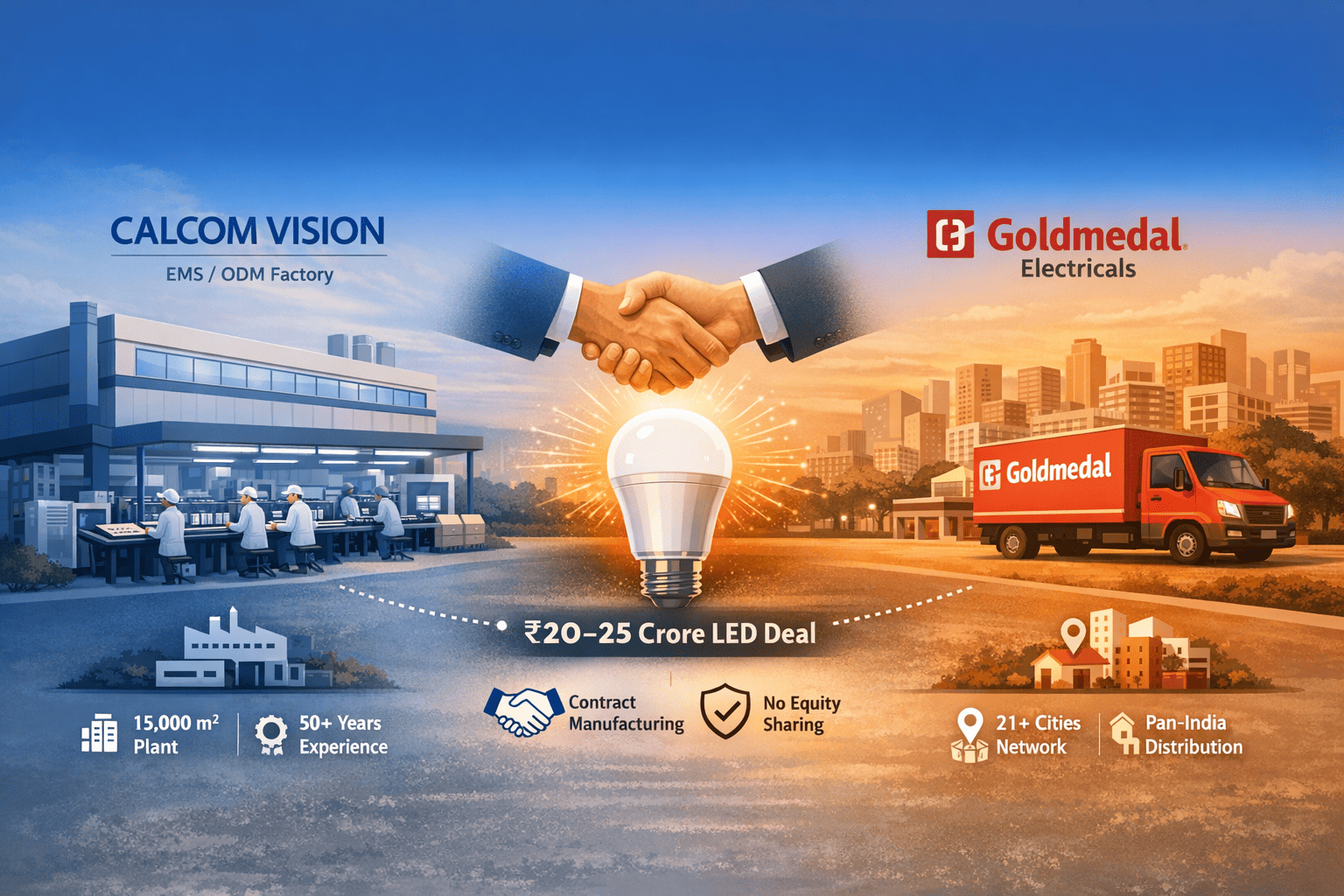
Calcom Vision Limited (BSE: 517236) — 50+ years of EMS/ODM excellence — has signed a contract manufacturing agreement with Goldmedal Electricals, one of India’s top FMEG brands, to produce LED lighting products at its Greater Noida facility. Expected annual revenue impact: ₹20–25 crore. Here’s the full story, why this deal works, and the exact playbook for any Indian brand or manufacturer looking to replicate it.
🎯 Direct Answer
Calcom Vision Limited has entered into a contract manufacturing partnership with Goldmedal Electricals, announced on March 10, 2026, to manufacture select LED lighting products at Calcom’s 15,000 sq. metre facility in Greater Noida, Uttar Pradesh. The deal is projected to contribute ₹20–25 crore in annual revenue to Calcom Vision once operations reach steady-state capacity. Under the agreement, Calcom manufactures to Goldmedal’s product specifications and quality standards, while Goldmedal handles all marketing and pan-India distribution across its network of 21+ cities, covering both residential and commercial segments. This is a textbook example of the Indian B2B manufacturing collaboration model: an asset-rich EMS company with underutilised capacity meets a fast-growing brand with distribution muscle but no factory of its own — and both win without the overhead of a joint venture.
📅 March 17, 2026⏱ 16 min read✍️ GTsetu Editorial Team📰 Electronics Manufacturing News + Analysis
🟠 DEAL ALERTCalcom Vision × Goldmedal Electricals sign LED manufacturing partnership — ₹20–25 crore annual revenue expected◆Calcom’s 15,000 sq. metre Greater Noida facility + Goldmedal’s 21+ city distribution network = India’s contract manufacturing playbook◆Announced March 10, 2026 — production at steady-state capacity imminent◆Find your Calcom Vision or your Goldmedal on GTsetu — verified EMS, ODM & FMEG partners across India and 100+ countries◆🟠 DEAL ALERTCalcom Vision × Goldmedal Electricals sign LED manufacturing partnership — ₹20–25 crore annual revenue expected◆Calcom’s 15,000 sq. metre Greater Noida facility + Goldmedal’s 21+ city distribution network = India’s contract manufacturing playbook◆Announced March 10, 2026 — production at steady-state capacity imminent◆Find your Calcom Vision or your Goldmedal on GTsetu — verified EMS, ODM & FMEG partners across India and 100+ countries◆
Expected Annual Revenue
₹20–25 Cr
Calcom Vision’s projected revenue addition at steady-state capacity
Deal Announced
Mar 10, 2026
Filed as official BSE Regulation 30 press release
Calcom Capacity
100M+ Units
Annual electronics manufacturing capacity across product categories
Goldmedal Distribution
21+ Cities
Pan-India FMEG distribution network — residential & commercial
Section 1 — The News
1 The Full Story: Calcom Vision × Goldmedal — LED Contract Manufacturing Partnership
Deal Alert — Announced March 10, 2026
India’s 50-Year EMS Veteran Meets One of FMEG’s Fastest-Growing Brands — In a ₹20–25 Crore Contract Manufacturing Agreement
On March 10, 2026, Calcom Vision Limited (BSE: 517236) — an Indian Electronics Manufacturing Services (EMS) and Original Design Manufacturer (ODM) with over five decades of manufacturing history — formally announced a business association with Goldmedal Electricals, one of India’s leading Fast Moving Electrical Goods (FMEG) companies, through a press release filed under BSE Regulation 30.
Under the partnership, Calcom Vision will manufacture select LED lighting products at its 15,000 sq. metre production facility in Greater Noida, Uttar Pradesh — to Goldmedal’s product specifications and quality standards. Goldmedal will handle all marketing and distribution through its pan-India distribution network, which covers 21+ cities and serves both residential and commercial lighting markets. The deal is projected to add an estimated ₹20–25 crore in annual revenue to Calcom Vision once production reaches steady-state capacity.
This marks a strategic addition to Calcom’s growing client roster — which already includes Panasonic, Bajaj, USHA, Great White, LEDvance, RR Kabel, Polycab, Opple Lighting, Amazon, and Anchor. For Goldmedal, the partnership extends its LED portfolio without requiring capital investment in manufacturing infrastructure — the defining advantage of the contract manufacturing model. Both companies gain what they lack without ceding equity, control, or brand identity to each other.
₹20–25 Cr
Expected annual revenue for Calcom Vision at steady-state capacity
50+ Years
Calcom Vision’s manufacturing experience — one of India’s longest-standing EMS companies
20+ Clients
Calcom’s existing OEM/FMEG customer base — Goldmedal is the newest addition
21+ Cities
Goldmedal’s pan-India distribution network for residential and commercial segments
“Goldmedal is a respected name in India’s electricals industry, and we are pleased to partner with them as part of our expanding customer portfolio. At Calcom Vision, our focus remains on building long-term, strategic relationships while continuously strengthening our engineering, R&D, and manufacturing capabilities.”
This deal is not a ₹20 crore news story. It is a blueprint. Calcom Vision has spent five decades building manufacturing capacity and certifications. Goldmedal has spent years building brand recognition and distribution muscle. Neither has the other’s asset. The contract manufacturing agreement unlocks both — without equity dilution, without a JV entity, without a years-long integration timeline. That is the precise reason contract manufacturing is the most underused collaboration tool for India’s FMEG and electronics brands. The question is not whether this model works — Calcom’s 20+ OEM/FMEG clients already answered that. The question is: have you identified the right manufacturing partner for your product category?
Section 2 — The Companies
2 Company Profiles: Who Are Calcom Vision and Goldmedal?
Understanding why this deal works starts with understanding what each company actually is. This is not two generic companies doing business — it is a highly specific capability match built over decades on both sides.
📅 1976 — Calcom Founded
Calcom Vision Begins as a Consumer Electronics Manufacturer
Founded in 1976 with a focus on consumer electronics. The company builds its foundational electronics manufacturing expertise — PCBs, resistors, connectors, SMPS power supplies — supplying multinational brands including Philips, Thomson, LG, and Samsung.
📅 2009 — Calcom Pivots to Lighting
Calcom Enters the LED and Lighting Electronics Segment
Calcom expands into lighting electronics — a strategic pivot that positions it for India’s shift from incandescent to LED. The company builds indoor and outdoor LED lighting, solar lighting, and BLDC fan manufacturing capabilities, growing its OEM and ODM client base across the lighting sector.
📅 ISO & SA Certifications
Calcom Achieves ISO 9001-2015, SA 8000:2014 and ISO 14001:2015 Certification
Calcom earns three major quality and sustainability certifications — essential for serving multinational OEM clients and qualifying for government procurement programmes including the PLI Scheme. These certifications become a core differentiator when FMEG brands evaluate manufacturing partners.
📅 PLI Upgrade — 2025
Calcom Upgrades PLI Commitment from ₹10 Crore to ₹25 Crore — Fully Deployed
Under the Government of India’s PLI Scheme for White Goods, Calcom upgrades its investment commitment from ₹10 crore to ₹25 crore — and deploys the entire amount ahead of the five-year timeline. The PLI-eligible portfolio expands to include LED drivers, modules, engines, mechanical housings, heat sinks, diffusers, and light management systems — exactly the components relevant to the Goldmedal partnership.
Calcom announces record Q3 FY26 revenue of ₹55.1 crore, up 23.4% year-on-year from ₹44.7 crore in Q3 FY25. The company is actively scaling professional and industrial lighting segments — LED bulbs and battens are strong revenue contributors. EBITDA margin compression noted due to new assembly line installation costs.
📅 March 10, 2026 — The Deal
Calcom Vision × Goldmedal Electricals LED Manufacturing Partnership Signed
Calcom Vision formally announces its manufacturing association with Goldmedal Electricals via BSE Regulation 30 filing. Manufacturing to begin at the 15,000 sq. metre Greater Noida facility to Goldmedal’s specifications, with Goldmedal managing pan-India distribution. Expected annual revenue contribution: ₹20–25 crore at steady-state capacity.
💡 Who Is Goldmedal Electricals?
Goldmedal Electricals is one of India’s prominent Fast Moving Electrical Goods (FMEG) brands, with a strong market presence across wiring devices, modular switches, LED lighting products, and electrical accessories. The company serves both residential and commercial markets through a pan-India distribution network covering 21+ cities. Its positioning in the FMEG space — alongside peers like Havells and Crompton — gives it brand and distribution assets that a pure contract manufacturer like Calcom does not possess. This complementarity is precisely what makes the partnership work.
Section 3 — The Anatomy
3 Anatomy of the Partnership — What Each Partner Brings to the Table
The Calcom × Goldmedal partnership works because each company brings precisely what the other lacks — and neither duplicates what the other already has. This is the first principle of any manufacturing collaboration worth doing. When you find perfect complementarity, neither party needs to build from zero or compromise their core business.
Existing assembly lines, trained workforce, tested LED manufacturing workflows
Immediate demand pull through distribution network
No ramp-up delay — Calcom can begin production as soon as specifications are locked
Section 4 — The Indian LED Market
4 Why Contract Manufacturing Is Exactly Right for India’s LED Lighting Boom
💡 India LED Manufacturing Opportunity 2025–2030
Why FMEG Brands Are Turning to Contract Manufacturing Partners — Right Now
India’s LED lighting market is in a structural shift: domestic brands are gaining share from imported products, government procurement (street lighting, public buildings) is actively favouring BIS-certified Indian manufacturers, and the PLI Scheme is accelerating domestic component production. For FMEG brands like Goldmedal, this means growing their LED portfolio rapidly — but building a factory from zero would take 3–5 years and ₹50+ crore. Contract manufacturing with an established EMS partner solves this instantly.
Calcom’s annual manufacturing capacity across LED and electronics product categories
₹25 Cr
Calcom’s PLI investment — fully deployed ahead of the 5-year scheme timeline
21+
Cities covered by Goldmedal’s pan-India FMEG distribution — the market reach Calcom needed
20+
OEM/FMEG clients already in Calcom’s portfolio — Goldmedal joins proven company
30,000 m²
Calcom’s full Greater Noida facility — the 15K sq. m allocated to Goldmedal is one part of total capacity
India’s LED market opportunity has three specific dynamics making contract manufacturing the rational choice for FMEG brands right now. First, speed to market — LED lighting product cycles are shortening; a brand that takes 3 years to build a factory loses category share to a brand that uses a contract manufacturer and launches in 3 months. Second, PLI advantage — manufacturers like Calcom who have already made PLI investments can offer cost-efficient production on eligible components that are expensive to set up independently. Third, certified compliance — Calcom’s ISO and SA certifications satisfy the quality requirements for FMEG brands supplying institutional and export markets, where an uncertified factory would disqualify a bid entirely.
🌐 GTsetu for Indian Manufacturing Partnerships
GTsetu’s verified partner network includes EMS companies, ODMs, contract manufacturers, and FMEG distributors across India and 100+ countries. If you are an FMEG brand evaluating a manufacturing partner — or an EMS/ODM company looking to expand your client portfolio with verified brand partners — GTsetu is where systematic partner discovery begins. Learn about contract manufacturing →
Section 5 — What Is CM
5 What Is Contract Manufacturing — And Why Do Indian Brands Use It?
🎯 Definition
Contract manufacturing is an arrangement where a brand company (like Goldmedal) outsources the physical production of its products to a specialist manufacturer (like Calcom Vision) under the brand’s own product specifications, design standards, and quality requirements. The manufacturer earns revenue per unit or batch produced; the brand retains full ownership of the product, the IP, and the customer relationship. No new legal entity is created, no equity is shared, and the brand does not need to invest in manufacturing infrastructure. In India’s electronics and FMEG sector, this model is how brands like Panasonic, Bajaj, Polycab, and now Goldmedal accelerate product portfolios without factory capex — and how EMS specialists like Calcom Vision monetise their manufacturing capacity at scale.
Why FMEG Brands Choose Contract Manufacturing — The 6 Drivers
Speed
First product to market in weeks, not years — a contract manufacturer is already set up and certified
Capex
Zero manufacturing infrastructure investment — the brand pays per unit, not per factory
Quality
Established certifications (ISO, BIS, PLI) that would take years to earn independently
Focus
Brand stays focused on its core: design, marketing, and distribution — not factory management
Scale
Instantly access 100M+ unit annual capacity without building or hiring manufacturing teams
Risk
Demand uncertainty stays with the brand; excess capacity risk stays with the manufacturer — risk is correctly assigned
Section 6 — Types of Collaboration
6 4 Types of Manufacturing Collaboration — Which Fits Your Business?
The Calcom × Goldmedal contract manufacturing model is the right structure for this specific deal — but it is not the only collaboration model. Depending on your strategic position, the right structure varies significantly. Here is how the four main models compare for Indian electronics and FMEG companies.
01
Contract Manufacturing
Brand outsources production to a specialist manufacturer under its own specifications. No equity sharing, no new entity, fastest to set up. The Calcom × Goldmedal model — optimal when the brand has strong distribution and the manufacturer has certified excess capacity. Both sides win without complexity.
💡 Calcom × Goldmedal Model
02
Joint Venture (JV)
A new co-owned legal entity is created by both partners. Highest commitment, full equity and risk sharing. Best when both parties have large complementary assets and a long-term strategic vision — like the Foxconn × Alrajhi Smart Mobility EV deal. Requires more capital and a longer setup timeline than contract manufacturing.
🤝 High-commitment model
03
Technology / IP Licensing
You license your product design or manufacturing IP to a production partner who builds under your technical specifications. Lower commitment than a JV, but the licensee gains more technical depth than a standard CM arrangement. Works well when the technology itself is the collaboration asset, not the manufacturing capacity.
🔬 Asset-light expansion
04
Distribution Partnership
You manufacture; a brand-strong partner handles sales and distribution in their market. The inverse of the Goldmedal model — where the manufacturer has surplus capacity but lacks distribution. Great for Indian EMS companies wanting to expand into new geographies or product categories through a partner’s existing channel relationships.
🌍 Channel-first entry
📊 Manufacturing Collaboration Model Comparison — Indian FMEG & Electronics Sector
Model
Capital Required
Speed to Production
Brand Retains IP?
Risk Shared?
Best For
GTsetu Support
Contract Mfg
Minimal
1–4 months
✓ Fully
✗ Minimal
FMEG brands with distribution but no factory; EMS with spare capacity
Manufacturers expanding to new cities or categories via partner channels
✓ Verified distributors in 100+ countries
Section 7 — How to Collaborate
7 How to Build a Contract Manufacturing Partnership: A 6-Step Indian Playbook
The Calcom × Goldmedal deal did not happen by accident — it followed a strategic logic that any FMEG brand or EMS company can replicate. Here is the six-step playbook, built from this deal and the pattern of Indian B2B manufacturing partnerships that succeed.
1
Define the Manufacturing Gap With Specificity
Before searching for a partner, answer three questions precisely: What product category do you want manufactured — and to what specification and certification standard? What is your volume requirement at steady-state, and what does ramp-up look like? And what does your distribution or go-to-market capability look like — because this determines whether you should be the brand or the manufacturer in the partnership. Goldmedal’s answer was precise: LED lighting products to their design spec, at a scale their distribution can absorb, with BIS certification maintained. Calcom’s facility already matched all three. Vague capability descriptions produce mismatched partnerships.
2
Identify and Verify Potential Partners Systematically — Not Through Referrals Alone
Most Indian manufacturing partnerships start with a referral from a shared contact or a trade fair introduction. Referrals surface whoever is most visible — not whoever is most capable or most strategically aligned. Calcom’s 50-year track record and its existing portfolio of 20+ OEM/FMEG clients makes it verifiable — but for every Calcom, there are hundreds of lesser-known manufacturers who overstate capacity, certifications, and quality systems. Use GTsetu’s multi-layer verified partner network to evaluate EMS and CM candidates whose manufacturing credentials, certifications, and operational capacity are documented before you invest time in conversation.
3
Protect Your Product Design and Brand IP Before Any Technical Disclosure
In a contract manufacturing arrangement, your product specifications, design files, BOM (Bill of Materials), and quality testing protocols are shared with the manufacturer. In Goldmedal’s case, this includes LED driver specifications, optics designs, housing specifications, and electrical performance standards — commercially sensitive material. An NDA must be executed and countersigned before any technical disclosure. In Indian manufacturing, this is not bureaucratic formality — it is the difference between protecting a product line and watching a knock-off appear in a competing channel six months later. GTsetu’s built-in NDA workflow enables this with a full audit trail before any sensitive information changes hands.
4
Validate Capability With a Controlled Pilot Before Full Commitment
Even with a manufacturer of Calcom’s pedigree — 50 years of experience, 20+ established clients, ISO certifications — a pilot batch is essential before committing to a steady-state production agreement. The pilot answers three questions that no manufacturer reference call can answer: Can they actually hold your specific quality standard at the tolerance your product requires? Can they maintain the delivery lead time they quoted under real production conditions? And does their facility layout, workforce, and QC process match what your product actually needs — not just what their marketing materials describe? A 1,000-unit pilot is cheap. Discovering a quality or capacity problem after you’ve distributed 50,000 units is expensive.
5
Structure the Manufacturing Agreement Formally — Every Commercial Term in Writing
The Calcom × Goldmedal deal was formally filed with BSE under Regulation 30 — that is governance and legal documentation from day one. Your contract manufacturing agreement must explicitly cover: product specifications and acceptable quality limits (AQLs), minimum order quantities and capacity guarantees, pricing structure and revision mechanisms, audit rights for quality inspection and certification verification, IP ownership (the manufacturer builds to your spec; they do not own what they build), confidentiality obligations post-termination, and exit clauses with production wind-down terms. Manufacturing agreements without explicit exit clauses become expensive renegotiations when demand forecasts change — and LED lighting demand forecasts always change.
6
Establish a Structured Review Cadence — Indian B2B Manufacturing Has Specific Communication Requirements
Contract manufacturing relationships in India have a well-documented failure pattern: initial enthusiasm, gradual quality drift, a missed delivery, a rushed renegotiation, and eventual termination. The root cause is almost always communication — specifically, the absence of a structured review cadence where quality metrics, capacity utilisation, and delivery performance are reviewed before they become problems. Establish from day one: weekly production reports, monthly quality review meetings, quarterly strategic reviews, and a named point of contact with decision-making authority on both sides. Calcom’s Executive Director commented publicly on this partnership — that level of senior engagement signals governance from the top. Build it into your operating model from the first month, not after the first quality complaint.
Section 8 — Dos and Don’ts
8 Dos and Don’ts of Indian B2B Manufacturing Collaboration
✅ Do These
✅ Verify the manufacturer’s actual certifications — not their stated certifications. ISO certificates have expiry dates and audit histories.
✅ Run a pilot batch before signing a steady-state supply agreement
✅ Sign an NDA before sharing any product design files, BOMs, or technical specifications
✅ Confirm PLI eligibility if the product category falls under relevant government schemes — cost advantages are real
✅ Define AQLs (Acceptable Quality Limits) explicitly in the manufacturing agreement
✅ Negotiate audit rights — the right to inspect the production facility at any time during the contract
✅ Include IP ownership clauses — product designs belong to the brand, not the manufacturer
✅ Establish a named operations contact on both sides — ambiguity in Indian CM relationships creates quality drift
✅ Build in minimum order quantity (MOQ) flexibility — demand forecasts for LED products change with seasons and competition
✅ Formalise the agreement with a signed contract before production begins — verbal commitments are unenforceable
❌ Avoid These
❌ Choose a manufacturing partner based solely on price per unit — quality and reliability are the total cost of manufacturing
❌ Share product specifications or design files before an NDA is signed and countersigned
❌ Skip the pilot batch because the manufacturer has an impressive client list — every product line has unique requirements
❌ Rely on a verbal or email-based manufacturing agreement for any order above ₹10 lakh
❌ Assume BIS certification held by the manufacturer automatically applies to your specific product variant — verify per SKU
❌ Choose a manufacturer with 100% utilised capacity — you need production buffer for demand spikes
❌ Allow the manufacturer to sub-contract to a third party without your explicit written consent
❌ Begin a new product category partnership without a facility visit — site inspections reveal equipment state, safety standards, and workforce quality that documents cannot
❌ Ignore the manufacturer’s financial health — a contract manufacturer under financial stress will prioritise higher-margin clients over your order
❌ Start production before a formal, signed agreement is in place — Indian contract manufacturing disputes without written contracts are expensive and slow
Section 9 — Common Misconceptions
9 Common Misconceptions That Kill Indian Manufacturing Collaborations
❌ Myth
“Contract manufacturing means losing control of our product quality.”
✅ Reality
Goldmedal’s agreement explicitly states that all manufacturing will follow Goldmedal’s product specifications and quality standards. The brand specifies AQLs, testing protocols, and inspection checkpoints — Calcom executes. Contract manufacturing with a formally contracted partner and embedded audit rights gives brands more consistent quality control than in-house production, where staffing variability, equipment downtime, and management attention constantly fluctuate.
❌ Myth
“We should build our own factory to protect our IP — contract manufacturers are a security risk.”
✅ Reality
IP risk in contract manufacturing is real — but it is a documentation and legal risk, not an inherent structural one. Calcom’s 20+ OEM client portfolio includes Panasonic, Polycab, and Amazon — companies with extremely strict IP protection requirements. They chose Calcom precisely because its contractual framework and certification track record satisfies their IP security standards. The right NDA, manufacturing agreement with sub-contracting restrictions, and an established EMS partner with reputational stakes eliminates the IP risk that an uncertified, unverified manufacturer would create.
❌ Myth
“₹20–25 crore is too small to build a formal partnership structure — we’ll keep it informal.”
✅ Reality
Calcom Vision filed this partnership formally with BSE under Regulation 30. A ₹20–25 crore annual revenue partnership was worth a formal press release and a legal contract structure. The deal size is not the threshold for documentation — the IP exposure and the production dependency are. If a manufacturing partner failing to deliver would disrupt your brand’s product availability for a week, that dependency requires a formal contractual framework regardless of the rupee value. Informal manufacturing arrangements always cost more than formal ones when problems arise — and problems always arise.
❌ Myth
“We can find a good contract manufacturer through a broker or trade fair — GTsetu is just another directory.”
✅ Reality
A broker earns a commission from the transaction — their incentive is to complete a deal, not to find the best-fit partner for your specific product specification. A trade fair surfaces whoever paid for a booth, not whoever has the best quality track record. GTsetu’s multi-layer verified partner profiles are built for systematic capability matching — certifications verified, capacity documented, client references available — with zero broker commission on any partnership formed. Calcom’s deal quality comes from 50 years of reputation-building; finding the equivalent for your category requires systematic search, not coincidence.
❌ Myth
“India’s LED market is too crowded — there’s no room for a new contract manufacturing partnership.”
✅ Reality
Calcom Vision’s Q3 FY26 revenue grew 23.4% year-on-year to ₹55.1 crore — its highest-ever quarterly revenue. And it just added Goldmedal to a portfolio that already includes Panasonic, Bajaj, and Polycab. The LED market is large, growing, and still underpenetrated in institutional, commercial, and rural residential segments. The constraint is not market size — it is finding a verified manufacturer with certified excess capacity and the right quality track record. That is a partner discovery problem, not a market saturation problem. GTsetu solves the former.
Section 10 — Comparison
10 Contract Manufacturing vs JV vs Licensing — Full Indian FMEG Comparison
Factor
Contract Mfg (Calcom × Goldmedal Model)
Joint Venture
IP Licensing
Distribution Partnership
Legal structure
Manufacturing services agreement — no new entity
New co-owned legal entity
License agreement — no new entity
Distribution or reseller agreement
Capital commitment (brand side)
Minimal — order-based
High — equity co-investment
Low — royalty payments only
Minimal — inventory terms only
Product IP ownership
✓ Brand retains fully
Shared per JV agreement
Shared during license term
✓ Manufacturer retains fully
Speed to first production
Fastest — 1–4 months
Slowest — 12–24 months
Medium — 3–9 months
Fastest — 1–3 months
Quality control
✓ Brand sets specs; manufacturer executes
Jointly managed
Licensee-managed
Manufacturer-managed
Revenue model
Per-unit manufacturing fee to Calcom
Profit share between entities
Royalty per unit sold
Distributor margin retained by partner
Best when…
Brand has distribution; needs manufacturing scale quickly without capex
Both parties have large complementary assets; long-term strategic vision
Manufacturer wants new geographies; brand wants local market access
GTsetu support
✓ 500+ verified CMs globally
✓ JV partner matching
✓ Licensing partner search
✓ Verified distributors in 100+ countries
Section 11 — GTsetu
11 How GTsetu Helps You Find the Right Manufacturing Partner
Goldmedal found Calcom Vision. The question for you is: where do you find your Calcom — or your Goldmedal? Most Indian FMEG brands and EMS companies still rely on personal networks, trade fair introductions, and broker referrals — which surface whoever is most visible, not whoever is most strategically aligned with your product, quality requirements, and production scale. GTsetu enables the same systematic, verified partner discovery process that Calcom’s 50-year reputation enables informally — but at any scale, in any electronics category, across India and 100+ countries.
🌐 Platform Spotlight — GTsetu
Find Verified EMS, ODM, and FMEG Manufacturing Partners — Before You Share a Single Product Specification
GTsetu is the verified B2B manufacturing discovery platform where brands and manufacturers find each other with transparent capability profiles — and zero broker fees on any partnership formed. Every partner is multi-layer verified: business registration, manufacturing certifications (ISO, BIS, SA, PLI eligibility), operational capacity data, and trade references. You evaluate capability before you commit a conversation. And you share nothing sensitive until an NDA is in place.
✅
Multi-Layer VerificationBusiness registration, ISO certifications, PLI eligibility, trade references — capability claims are verified, not self-reported.
🕵️
Anonymous DiscoveryEvaluate verified manufacturing profiles without revealing your brand identity until mutual interest is confirmed.
📄
Built-In NDA WorkflowShare product specs only after an NDA is executed — full audit trail, no external legal required for standard terms.
🚫
Zero CommissionNo broker fees. Your contract manufacturing deal or distribution agreement stays entirely between you and your partner.
🌍
India + 100 CountriesFind EMS partners, CMs, ODMs, and verified FMEG distributors across every major manufacturing region in India and globally.
🔐
Encrypted CollaborationShare product roadmaps, BOMs, and production specs securely between verified partners with complete access control.
What Goldmedal Did to Find Calcom — What GTsetu Enables for You
What Goldmedal Did to Find Calcom
What GTsetu Enables for You
Why This Matters
Identified an EMS company with 50+ years of verified manufacturing experience and 20+ established OEM clients
✓ Browse 500+ verified profiles with documented certifications and operational track records
No capability surprises after you’ve disclosed your product specifications and design files
Chose a manufacturer with PLI-upgraded production lines — relevant for LED component cost efficiency
✓ Filter partners by PLI eligibility, product category, certification type, and production capacity
Find manufacturers whose government scheme status translates directly to your cost-per-unit
Structured a formal, BSE-filed agreement before production began
✓ Built-in NDA and collaboration workflow before any IP disclosure
Product design and commercial terms protected from the first conversation
Chose a partner with complementary (not competing) capabilities — Calcom does not sell under its own brand
✓ Detailed capability profiles distinguish EMS-only manufacturers from those with competing brand interests
Contract manufacturing value depends entirely on the absence of channel conflict
Committed to zero broker intermediation — direct manufacturing partnership
✓ Zero commission — all partnerships are direct, between you and your partner
Your manufacturing margin stays between you and your partner, not split with an intermediary
FAQ
? Frequently Asked Questions
QWhat exactly is the Calcom Vision and Goldmedal Electricals partnership?
Calcom Vision Limited (BSE: 517236) has entered into a contract manufacturing agreement with Goldmedal Electricals, announced on March 10, 2026 via official BSE Regulation 30 filing. Under the deal, Calcom will manufacture select LED lighting products at its 15,000 sq. metre facility in Greater Noida, Uttar Pradesh, to Goldmedal’s product specifications and quality standards. Goldmedal handles all marketing and distribution through its pan-India network of 21+ cities. The partnership is expected to contribute ₹20–25 crore in annual revenue to Calcom Vision at steady-state production capacity. This is a contract manufacturing arrangement — no new legal entity, no equity sharing, and Goldmedal retains full brand ownership and IP of all products manufactured.
QWhy is this a contract manufacturing deal and not a joint venture?
A joint venture creates a new co-owned legal entity with equity shared between both parties — think Foxconn × Alrajhi’s Smart Mobility in Saudi Arabia. A contract manufacturing agreement is simpler: Goldmedal retains full ownership of the product, brand, and IP; Calcom earns revenue for manufacturing services. No new entity is created, no equity changes hands, and the arrangement can be scaled or wound down without the complexity of unwinding a shared company. Goldmedal chose this model because it needs production capacity, not a manufacturing co-investor. Calcom chose it because it monetises existing infrastructure without taking on distribution or brand-building risk. Both parties get exactly what they need without the overhead of a JV structure.
QWhat makes Calcom Vision a credible contract manufacturing partner?
Several compounding factors make Calcom one of India’s most credible EMS partners for LED and electronics manufacturing: 50+ years of manufacturing experience (founded 1976); three certifications — ISO 9001-2015, SA 8000:2014, and ISO 14001:2015; a 30,000 sq. metre Greater Noida facility with end-to-end R&D and backward integration; PLI Scheme participation with ₹25 crore fully deployed ahead of schedule; 100 million+ unit annual production capacity; and an existing portfolio of 20+ established OEM and FMEG clients including Panasonic, Bajaj, USHA, Polycab, Amazon, and Anchor. Any single one of these is a positive signal; the combination makes Calcom one of the most verified and commercially proven EMS companies in India’s LED sector.
QHow does a manufacturing collaboration like this affect Calcom Vision’s stock (BSE: 517236)?
Per BSE reports, Calcom Vision’s stock rose following the announcement of the Goldmedal partnership — a market response consistent with the deal’s revenue visibility. The ₹20–25 crore annual revenue projection represents meaningful incremental revenue against Calcom’s Q3 FY26 quarterly run rate of ₹55.1 crore. The market reaction reflects the deal’s importance: a formally contracted, brand-name FMEG client with 21+ city distribution reach reduces Calcom’s client concentration risk and validates its expansion into LED contract manufacturing for established consumer brands. That said, this article is not investment advice — past stock movements do not indicate future performance, and manufacturing ramp-up timelines and steady-state capacity achievement can vary from projections.
QHow can an FMEG brand or electronics company find a manufacturing partner like Calcom Vision on GTsetu?
GTsetu’s process for finding a contract manufacturing partner: (1) Define your objective — what product, what volume, what certifications (BIS, ISO, PLI eligibility), what quality standard? (2) Search verified profiles — GTsetu lists 500+ multi-layer verified manufacturers, EMS companies, and industrial partners across India and 100+ countries with documented capability profiles, not self-reported marketing claims. (3) Evaluate anonymously first — review partner profiles without revealing your brand identity or product specifications. (4) Execute NDA automatically — GTsetu’s built-in NDA workflow means you disclose nothing sensitive until a mutual NDA is countersigned with an audit trail. (5) Run a controlled pilot — validate capability claims under real production conditions before a full contract commitment. Zero broker commission on any partnership formed. Start your partner search on GTsetu →
QWhat are the biggest risks in Indian contract manufacturing partnerships?
The five most significant risks are: (1) Quality drift post-onboarding — manufacturers maintain high quality for the first few batches (when attention is high) but drift over time without contractual AQL enforcement and regular audits. (2) Product design IP leakage — product specifications and BOMs shared without NDA protection are commercially vulnerable, particularly if the manufacturer supplies competing brands. (3) Capacity over-commitment — manufacturers with 90%+ utilisation will deprioritise your order during demand spikes from larger clients; always verify actual available capacity, not theoretical maximum. (4) Sub-contracting without consent — some manufacturers sub-contract to third parties your agreement did not vet; your contract must explicitly prohibit this without prior written approval. (5) Financial health of the manufacturer — an EMS company under financial stress will prioritise cash flow over your delivery schedule; GTsetu’s verification includes financial standing assessment. Starting with a verified, thoroughly screened manufacturing partner from GTsetu’s network reduces all five risks before they surface.
Ready to Find Your Calcom — or Your Goldmedal? Start on GTsetu.
500+ verified EMS companies, contract manufacturers, ODMs, and FMEG partners across India and 100+ countries. Zero broker fees. Anonymous discovery before any IP disclosure. Built-in NDA workflows. Your next manufacturing partnership starts with a verified capability profile — not a broker referral.
They represents the product, and research team behind GTsetu, a global B2B collaboration platform built to help companies explore cross-border partnerships with clarity and trust. The team focuses on simplifying early-stage international business discovery by combining structured company profiles, verification-led access, and controlled collaboration workflows.
With a strong emphasis on trust, and disciplined engagement, Team GTsetu shares insights on global trade, partnerships, and cross-border collaboration, helping businesses make informed decisions before entering deeper commercial discussions.