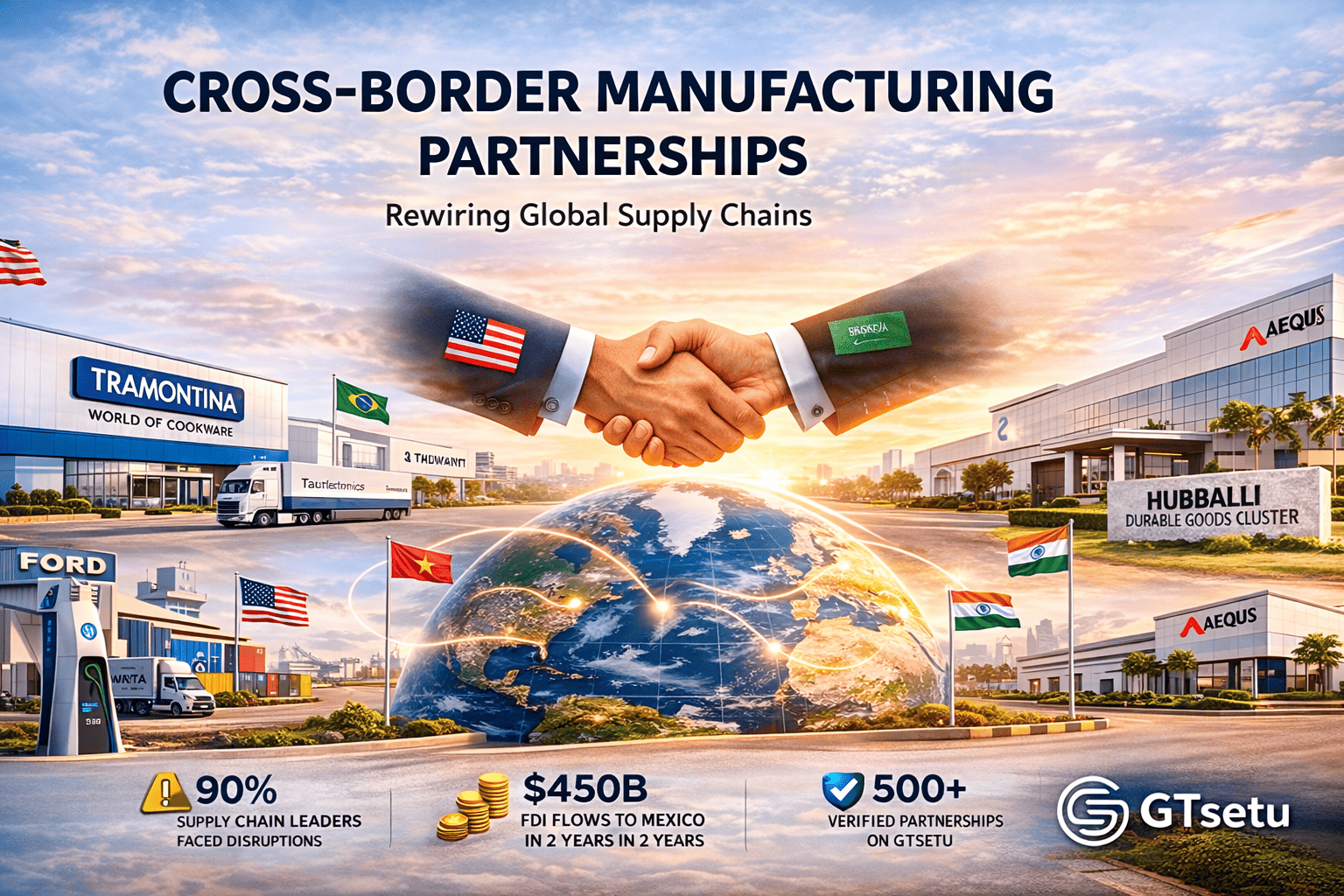
Cross-Border Manufacturing Partnerships Are Reshaping Global Supply Chains | GTsetu
Home ›
Blog ›
Cross-Border Manufacturing Partnerships
💡 Thought Leadership🔗 Global Supply Chain🏭 Manufacturing📊 McKinsey Data
Cross-Border Manufacturing Partnerships Are Reshaping Global Supply Chains
90% of global supply chain leaders faced disruptions in 2024. The ones that didn’t break down had something in common: a verified, strategically-aligned cross-border manufacturing partner. Here is the data, the playbook, and the platform that makes it possible.
🎯 Direct Answer
Cross-border manufacturing partnerships are reshaping global supply chains because single-country production models have proven catastrophically fragile, to tariffs, pandemics, geopolitical tension, and policy shifts. Companies are now forming strategic partnerships with manufacturers, joint venture partners, contract producers, and distributors in new geographies to distribute risk, meet local content requirements, access government procurement channels, and produce closer to where they sell. McKinsey’s 2024 survey found 90% of supply chain executives encountered disruptions, and the companies that recovered fastest were those with diversified, partnership-anchored supply networks. This is not a trend. It is a permanent restructuring of how global manufacturing works.
📅 March 18, 2026⏱ 20 min read✍️ GTsetu Editorial Team📊 Sources: McKinsey, WTO, MIT, Global Trade Magazine
📡 THOUGHT LEADERSHIPMcKinsey: 90% of supply chain executives faced disruptions in 2024, cross-border partnerships are the #1 resilience lever◆WTO warns merchandise trade could contract, companies producing where they sell are shielded◆Foxconn × Alrajhi, Walmart × Vietnam, Apple × India, the partnership playbook is the same at every scale◆Find your right cross-border manufacturing partner on GTsetu, 500+ partners, 100+ countries, zero broker fees◆📡 THOUGHT LEADERSHIPMcKinsey: 90% of supply chain executives faced disruptions in 2024, cross-border partnerships are the #1 resilience lever◆WTO warns merchandise trade could contract, companies producing where they sell are shielded◆Foxconn × Alrajhi, Walmart × Vietnam, Apple × India, the partnership playbook is the same at every scale◆Find your right cross-border manufacturing partner on GTsetu, 500+ partners, 100+ countries, zero broker fees◆
Supply Chain Disruptions
90%
McKinsey: share of executives who faced supply chain challenges in 2024
Tariff Impact
25%+
US tariffs on Chinese goods, forcing urgent supply chain restructuring in 2025
Regionalization Progress
60%
McKinsey: share of companies that have started regionalising their supply chains
AI-Driven Sourcing
65%
B2B sourcing decisions in 2025 influenced by AI-driven partner recommendations
Section 1, The Global Shift
1 The Shift: Why Global Supply Chains Are Breaking Down, And What’s Replacing Them
McKinsey Global Supply Chain Report, 2024 / 2025
Nine in Ten Supply Chain Leaders Faced Disruptions in 2024. The Revolution in Resilience Is Stalling. Cross-Border Partnerships Are the Answer.
For decades, the logic of global manufacturing was simple: produce where it’s cheapest, ship to where you sell. That logic shattered between 2020 and 2025. The COVID-19 pandemic shut factories. Suez Canal attacks cut trade volumes by 50% in early 2024. Panama Canal drought dropped volumes by 32%. US-China tariffs hit 25% on electronics, steel, and semiconductors. The WTO warned that merchandise trade could contract by -0.2%. And McKinsey’s 2024 survey found that 90% of supply chain executives faced disruptions, while simultaneously, the percentage of companies pursuing meaningful resilience strategies has flatlined.
The companies that navigated this terrain aren’t the ones who built more inventory buffers. They are the ones who built better partnerships, cross-border, verified, strategically-aligned manufacturing relationships that let them produce closer to where they sell, absorb tariff shocks through geographic diversification, and access local procurement channels through partners who know the market from the inside. Foxconn partnered with Alrajhi to manufacture EV chargers in Saudi Arabia. Walmart partnered with Vietnamese and Thai manufacturers to reduce Chinese dependency. Apple committed $1 billion to India manufacturing. Ford shifted steel sourcing to Mexico.
This is not a trend. This is the permanent restructuring of global supply chains, from single-hub to multi-partner, from lowest-cost to most-resilient, from import-dependent to locally-anchored.
90%
Supply chain leaders faced disruptions in 2024, McKinsey
-50%
Suez Canal trade volume decline in early 2024 due to attacks
73%
Companies reporting progress on dual-sourcing strategies, McKinsey
$35.3B
FDI inflows to Mexico in 2023, up 11.9%, driven by nearshoring
“The CPO is not only the chief procurement officer anymore, but the chief partnership officer as well, partnerships externally with suppliers and internally with other functions.”
— CPO of a global industrial company, McKinsey Procurement Report 2024
The McKinsey data is unambiguous. 60% of companies have started regionalising their supply chains. 73% report progress on dual-sourcing. The companies that built resilience through partnerships are outperforming those that relied on single-hub efficiency, not by a small margin, but categorically. Supply chain disruptions that used to take weeks to resolve are now resolved in days for companies with the right partner network in place.
💡 The GTsetu Perspective
McKinsey is describing a supply chain transformation that took decades to break and is now being rebuilt through partnerships, not through more inventory, not through AI alone, but through verified, strategically-aligned cross-border manufacturing relationships. That is precisely the problem GTsetu was built to solve: partner discovery with 6-point government tie‑up verification (legal name, registered address, registration number, company status, company type, date of certificate of incorporation), before you need a partner in a crisis, not after. The companies on GTsetu’s platform are building their resilience now, not in the next disruption.
Section 2, Real Partnerships Driving Change
2 Real Cross-Border Partnerships That Prove the Model Works
The partnership-first supply chain model is not theoretical. It is being executed right now by the world’s most sophisticated manufacturers, at every scale, across every industry. These are the landmark examples that define the playbook.
🏭 EV Manufacturing, Dec 2025
Foxconn × Alrajhi Group, Smart Mobility JV, Saudi Arabia
Taiwan’s Foxconn Interconnect Technology (FIT) and Saudi Arabia’s Saleh Suleiman Alrajhi & Sons formed Smart Mobility, a ~$100M joint venture to manufacture EV charging stations at King Salman Energy Park (SPARK), Dammam. Groundbreaking: December 9, 2025. Production: 2026. This is FIT’s first Middle East manufacturing facility. The deal was from Ministry announcement to groundbreaking in 14 months, only possible because Alrajhi brought Saudi regulatory relationships, SPARK brought ready infrastructure, and FIT brought EV IP. The quintessential cross-border partnership model.
Walmart reduced Chinese imports by 10% in 2024, shifting sourcing to Vietnamese and Thai manufacturing partners. The move required rigorous partner vetting and coordination, increasing operational complexity but reducing tariff exposure. A 5% rise in logistics costs was accepted as the price of supply chain resilience and reduced geopolitical concentration risk. Proof that even the world’s largest retailers must partner to survive tariff disruption.
🇺🇸 USA🇻🇳 Vietnam🇹🇭 ThailandDistribution
📱 Tech Manufacturing, 2024–2025
Apple, $1 Billion India Manufacturing Investment
Apple’s $1 billion India manufacturing commitment, executed through local manufacturing partners including Tata Electronics, represents the largest technology company’s acknowledgement that single-geography production is no longer viable. Smaller firms following the same logic but without Apple’s resources are finding verified partner discovery platforms the only viable alternative to capital-intensive greenfield investment. The “produce where you sell” imperative applies at every budget level.
🇺🇸 USA🇮🇳 India📱 ElectronicsCM / JV
🚗 Automotive, 2025
Ford Motor Company, Mexico Nearshoring for Steel & Components
US tariffs on Chinese-origin steel and aluminum added $500–$1,000 per vehicle to Ford’s production cost. Ford’s response: accelerated nearshoring to Mexican suppliers operating under USMCA preferential terms. Cross-border trucking delays rose 15%, but tariff savings and supply chain predictability made the transition commercially justified. Nearshoring is only as fast as your ability to find and verify the right partner on the other side of the border.
🇺🇸 USA🇲🇽 Mexico🚗 AutomotiveCM / Supplier
🌍 Multi-Regional, 2024–2025
Global Manufacturers → Vietnam, Poland, India, Indonesia, Mexico
Companies across electronics, textiles, pharmaceuticals, and automotive are building multi-partner manufacturing networks anchored in Vietnam (CPTPP access), Poland (EU proximity), India (scale + RCEP positioning), Indonesia (growing FDI), and Mexico (USMCA). Vietnam’s exports to CPTPP Latin American members grew 56% between 2018 and 2023. The geography of manufacturing is being rewritten, and every rewrite requires a verified local partner.
🇻🇳 Vietnam🇵🇱 Poland🇮🇳 India🇮🇩 Indonesia🇲🇽 Mexico
🌐 GTsetu Connection
Every one of these partnerships, Foxconn × Alrajhi, Walmart × Vietnam suppliers, Ford × Mexico nearshore partners, required a process that most companies still do manually: finding, verifying, and engaging a strategically-aligned cross-border manufacturing partner before any IP or commercial information is disclosed. GTsetu provides 6-point government tie‑up verification (legal name, registered address, registration number, company status, company type, date of certificate of incorporation), built-in NDA workflows, and zero broker commission, automating and securing the discovery process. Find verified partners →
Section 3, What Is Collaboration
3 What Is a Cross-Border Manufacturing Partnership?
🎯 Definition
A cross-border manufacturing partnership is a formal arrangement between companies from different countries to jointly produce, source, or distribute manufactured goods. It can take the form of a joint venture (shared equity entity), technology licensing (IP transfer for royalties), contract manufacturing (you own the brand, a partner builds), or distribution collaboration (you manufacture, a local partner distributes). The common thread: one party brings what the other cannot quickly acquire alone, local market access, regulatory compliance, manufacturing infrastructure, technology IP, or distribution networks. The Foxconn × Alrajhi model is the textbook example: FIT brought EV technology and global brand; Alrajhi brought Saudi regulatory relationships, SPARK access, and government procurement channels. Neither could replicate the other’s contribution in less than 5 years independently.
The 5 Things Cross-Border Partners Provide That You Cannot Buy Alone Quickly
Local Know-How
Regulatory compliance, government relationships, and market understanding built over years, not months
Infrastructure
Existing factories, industrial park access, and logistics networks that eliminate 3–5 years of greenfield development
Policy Access
Local content certifications, government procurement channels, and trade agreement preferential treatment
Workforce
Trained local labour, compliance with Saudisation / Make in India / Vietnam labour rules without the learning curve
Supply Chain
Established upstream supplier relationships, local component sourcing, and logistics cost structures built over time
Market Trust
A local partner’s reputation and relationships open procurement doors that a foreign brand alone cannot access
Section 4, Why Companies Partner
4 Why Do Companies Form Cross-Border Manufacturing Partnerships?
The motivations behind cross-border manufacturing partnerships have expanded dramatically from pure cost-reduction logic. Today, companies partner for a constellation of strategic reasons, and the most successful partnerships address multiple motivations simultaneously.
Partnership Driver
Urgency in 2025
Example
What a Partner Provides
Without a Partner
Tariff Mitigation
🔴 Critical
Ford → Mexico to avoid 25% China steel tariffs
Local production under preferential trade agreements (USMCA, CPTPP)
$500–$1,000 added cost per vehicle, absorbed or passed to consumer
Local Content Compliance
🔴 Critical
Foxconn → Alrajhi for Saudi LCGPA compliance
Existing certifications, local value-add supply chain, and LCGPA audit history
Disqualified from government procurement; imports receive no preference
Supply Chain Resilience
🔴 Critical
Walmart → Vietnam/Thailand to reduce China concentration
A single disruption (Red Sea, pandemic, tariff) can halt production entirely
Speed to Market
🟡 High
FIT + SPARK → groundbreaking in 14 months vs. 4–6yr greenfield
Ready industrial infrastructure, existing licenses, established workforce
3–6 years of site development, permitting, and workforce training
Policy-Driven Demand
🟡 High
Smart Mobility → Saudi Vision 2030 EV mandates
Government relationships that unlock policy-guaranteed procurement flows
Compete for commercial demand only, lose state-backed procurement entirely
Technology Transfer
🟡 High
Global manufacturers licensing IP to local Asian partners
Local partner builds under license, manufacturer earns royalties without capex
Building a factory in each market; capital-intensive and operationally complex
ESG & Sustainability
🟢 Growing
EU CBAM, carbon border tax on imports
Local production cuts shipping emissions; partners comply with regional ESG rules
EU Carbon Border Adjustment Mechanism (CBAM) adds import costs from 2026
Cost Optimisation
🟢 Stable
Vietnam, Indonesia, Mexico, competitive labour + favourable trade terms
Labour cost differential plus trade agreement benefits
Still valid, but no longer the primary driver, resilience and policy compliance rank above cost
⚠️ The Urgency Signal From McKinsey
McKinsey’s 2025 supply chain risk survey found that tariff mitigation pushed companies to move more inventory into affected regions, but that is a short-term fix, not a structural solution. The structural solution is producing in the region where you sell, through a partner who already has the licenses, the factory, and the regulatory relationships. Cash flow pressures make long-term inventory buffers unsustainable. The only sustainable answer to tariff shock is geographic manufacturing diversification, anchored by a verified local partner.
Section 5, Where to Partner
5 Where to Partner: The Top Manufacturing Regions Attracting Cross-Border Investment Right Now
The geography of global manufacturing is being rewritten. Here are the regions attracting the most cross-border manufacturing partnership investment in 2025–2026, and why.
🇻🇳
Vietnam
CPTPP access, competitive labour, growing tech manufacturing ecosystem, rapid FDI growth from Japan, South Korea, and Taiwan
Production Linked Incentive (PLI) schemes, English-speaking engineering talent, growing electronics ecosystem, Make in India government mandate
PLI Incentives ✓
Moving here: Apple (via Tata/Foxconn), Samsung, global pharma, defence manufacturers
🇵🇱
Poland / Eastern Europe
EU single market access, skilled engineering workforce, growing automotive and electronics cluster, proximity to Western European demand centres
EU Single Market ✓
Moving here: Volkswagen, LG Energy Solution, Stellantis, battery manufacturers
🇸🇦
Saudi Arabia / GCC
Vision 2030 policy-guaranteed demand, LCGPA local content preference, SPARK industrial park, MENA export hub positioning, the Foxconn × Alrajhi model
Vision 2030 ✓
Moving here: Foxconn (Smart Mobility), NEOM suppliers, EV infrastructure, energy tech
Region
Primary Trade Advantage
Local Content Policy
Key Industries
GTsetu Partner Availability
🇻🇳 Vietnam
CPTPP, 14.4% of global GDP in bloc
Medium
Electronics, textiles, seafood
✓ Strong
🇲🇽 Mexico
USMCA, duty-free US/Canada access
Medium
Auto, electronics, aerospace
✓ Strong
🇮🇳 India
PLI schemes, RCEP positioning
High (Make in India)
Electronics, pharma, defence
✓ Extensive
🇵🇱 Poland / E. Europe
EU single market access
EU standards
Auto, EV batteries, machinery
~ Growing
🇸🇦 Saudi Arabia
Vision 2030 demand, LCGPA
Very High (LCGPA)
EV infra, energy tech, advanced mfg
✓ Verified partners
🇮🇩 Indonesia
RCEP, nickel supply for batteries
High (TKDN rules)
Batteries, EV supply chain
~ Growing
Section 6, Types of Collaboration
6 4 Types of Cross-Border Manufacturing Collaboration, Which Fits You?
Not every partnership needs to be a $100M JV. The right model depends on your capital position, IP exposure tolerance, desired market depth, and timeline. Here are the four primary structures, with the trade-offs you need to understand before choosing.
01
Joint Venture (JV)
A new shared legal entity co-owned by both parties. Full profit and risk sharing. Highest commitment, deepest integration. The Smart Mobility model, best when both partners have large complementary assets and a long-term market anchored by policy demand or strategic positioning.
🏭 Smart Mobility / Foxconn model
02
Contract Manufacturing (CM)
You own the product design and brand. A local manufacturer builds to your specification. No equity commitment. Fastest path to cross-border production capacity. Ideal for new market pilots, overflow capacity, or before full JV commitment is warranted by validated demand.
⚡ Low-commitment, fast entry
03
Technology / IP Licensing
You license your manufacturing technology or product IP to a local producer. They manufacture and sell in their market. You earn royalties without capital investment or operational responsibility. Asset-light global expansion, best for IP-rich, capital-constrained manufacturers seeking new geography penetration.
💡 Asset-light expansion
04
Distribution Partnership
You manufacture. A local partner handles sales, warehousing, and final-mile distribution. Eliminates import logistics complexity. Provides local procurement channel access without manufacturing presence. Often the first step before deeper manufacturing collaboration, and the fastest way to test real demand before committing capital.
🌍 Market entry, Step 1
Partnership Model Scorecard, How Each Stacks Up Across Key Criteria
Criteria
Joint Venture
Contract Mfg
IP Licensing
Distribution
Capital required
High ($5M–$100M+)
Minimal
Low (legal costs)
Minimal
IP exposure
High, full access
Medium, specs shared
High, tech transferred
Low, finished goods only
Speed to first production
14–24 months
1–4 months
6–12 months
1–3 months
Local content benefit
✓ Maximum
~ Depends on CM
✓ High via licensee
✗ None
Govt. procurement access
✓ Full
~ Partial
✓ Via licensee
✗ Minimal
Tariff mitigation
✓ Maximum
✓ High
✓ Via licensee
✗ None
Risk sharing
✓ Full
✗ Minimal
~ Partial
✗ Minimal
GTsetu support
✓ JV partner matching
✓ 500+ verified CMs
✓ Licensing partner search
✓ 100+ country distributors
Section 7, How to Collaborate
7 How to Structure a Cross-Border Manufacturing Partnership: The 6-Step Playbook
The Foxconn × Alrajhi deal. The Walmart Vietnam diversification. Apple’s India commitment. These are not improvised, they follow a structured sequence that every manufacturer can replicate at their own scale. Here is the playbook.
1
Define Your Partnership Objective with Precision, Not Vagueness
Before searching for a partner, answer three non-negotiable questions: What do I need that I cannot build in my target market in under 2 years, regulatory relationships, factory infrastructure, local distribution, or manufacturing IP? What do I bring that makes me attractive to a local partner, technology, brand, global customer access, or capital? And what does success look like in 3 years, in measurable terms? Vague objectives produce vague partnerships. Foxconn’s objective was precise: EV charger manufacturing capacity in Saudi Arabia, inside a compliant industrial facility, backed by a partner with Vision 2030 government relationships, commercially operational in 2026. Every word of that sentence drove the partner selection criteria.
2
Identify and Verify Partners Systematically, Not Through Trade Fairs Alone
Trade fair introductions, government matchmaking events, and agent referrals systematically surface the loudest candidates, not the most capable ones. Alrajhi was not discovered at a trade fair. They were identified because of a documented track record: 60+ years of family business operations, established Saudi industrial relationships, and a portfolio spanning construction, steel, and technology, all verifiable before a single conversation. GTsetu provides 6-point government tie‑up verification (legal name, registered address, registration number, company status, company type, date of certificate of incorporation). Import licences, certifications, capacity data, and trade references must be exchanged directly between parties. In the McKinsey framework: identify partners who reduce your supply chain vulnerability, not just partners who respond to your inquiry fastest.
3
Protect Your IP Before Sharing Anything, NDA First, Always
Your manufacturing IP, product designs, process documentation, software, supplier lists, is the core commercial asset you’re bringing to the partnership. In cross-border manufacturing, once that IP is in a partner’s hands without formal protection, reclaiming it across international jurisdictions is expensive and often unsuccessful. NDA execution must precede any technical disclosure. In McKinsey’s framework: collaboration across business functions requires information sharing, but the cross-border version requires legal protection first. GTsetu’s built-in NDA workflow means you share nothing sensitive until a mutual NDA is countersigned with a full audit trail, no external legal firm required for the standard agreement.
4
Run a Controlled Pilot Before Full Capital Commitment
A $100M JV is not where Smart Mobility started, it is where it ended up after the partners validated their complementarity through earlier-stage engagement. Before any partnership scales to full equity or IP transfer, validate the three critical unknowns: Can the partner actually produce to your specification (not their stated capability, your actual product)? Does their supply chain meet real lead time requirements? And do their regulatory certifications hold under proper auditing conditions? A controlled pilot, a limited production run, a trial import consignment, or a scoped technology transfer, surfaces execution gaps before they become legally and commercially binding problems. The MIT supply chain study found nearshoring cut logistics emissions by 10% for companies who properly validated partner capability first, companies who skipped validation absorbed the full complexity without the benefit.
5
Formalise the Structure, JV Agreement, Licensing Contract, CM Agreement, or Distribution Agreement
Every cross-border manufacturing partnership needs a formal written agreement that covers: IP ownership and permitted use; quality standards, audit rights, and non-conformance remedies; local content compliance responsibilities (who owns LCGPA, TKDN, Make in India certification); production volume commitments and capacity guarantees; governance authority, who decides what, and how disputes are resolved; and exit clauses that protect both parties if market conditions or technology standards shift. In tariff-volatile environments, lock-in clauses without revision mechanisms create partnerships that become liabilities. McKinsey’s recommendation to “coordinate response for integrated margin management” applies directly to partnership contract structures, pricing and cost flexibility must be built in from the start.
6
Establish Communication Cadence and Governance From Day One
The McKinsey recommendation to “establish a cross-functional nerve center or control tower to create transparency across internal processes” applies directly to cross-border manufacturing partnerships, and it is consistently underinvested. Time zones, language, regulatory calendar differences, and technology standard evolution create communication gaps that compound into commercial problems. Establish from day one: who makes which decisions without escalation, how quality disputes are documented and resolved, how frequently operational reviews happen, what the escalation path looks like when things go wrong, and how technology and product changes are communicated and implemented. Smart Mobility designated a CEO (Prince Fahad bin Nawaf) from day one, governance clarity that most partnerships fail to achieve until a dispute forces the issue.
Section 8, Dos and Don’ts
8 Dos and Don’ts of Cross-Border Manufacturing Collaboration
✅ Do These
✅ Verify partner capabilities independently, not just their pitch or government endorsement
✅ Choose a partner inside an established industrial cluster over a greenfield promise
✅ Execute NDA before sharing any product specifications, process documentation, or supplier lists
✅ Run a controlled pilot production batch before committing full capital to a JV
✅ Align on local content requirements and compliance strategy from day one
✅ Build exit clauses, tariff environments and technology standards shift fast
✅ Define IP ownership explicitly, especially for software, firmware, and process documentation
✅ Designate governance authority at the start, not when the first dispute occurs
✅ Choose partners with government relationships relevant to your target procurement channels
✅ Start with a distribution partnership to validate demand before committing to manufacturing
✅ Leverage trade agreements (USMCA, CPTPP, RCEP) in your partner geography selection
✅ Document quality standards and audit rights before production begins, not after first failure
❌ Avoid These
❌ Select partners primarily through government matchmaking without independent capability verification
❌ Share manufacturing IP or process documentation before an NDA is signed and countersigned
❌ Skip a pilot and go directly to full-scale JV or CM commitment based on stated capacity
❌ Treat local content compliance as an administrative afterthought, it is a commercial prerequisite
❌ Allow governance ambiguity, 50/50 JV deadlocks in fast-moving supply chains are fatal
❌ Enter cross-border manufacturing agreements without explicit quality audit rights
❌ Ignore technology obsolescence risk, lock-in clauses with no revision mechanism create liabilities
❌ Rely on a single-country partner network, the McKinsey data proves concentration risk is existential
❌ Build greenfield when an established industrial park partner eliminates 3–5 years of construction
❌ Underestimate workforce compliance requirements, Saudisation, Make in India, Vietnam labour rules
❌ Assume a government endorsement of a partner validates their manufacturing capability
❌ Let partnership negotiations run without a defined timeline, urgency asymmetry destroys leverage
Section 9, Misconceptions
9 Misconceptions That Kill Cross-Border Manufacturing Partnerships
❌ Myth
“Cross-border partnerships are only for large multinationals like Foxconn or Apple, we’re too small.”
✅ Reality
The partnership model, technology or brand + local market access + established infrastructure, works at every investment scale. A $2M contract manufacturing agreement in Vietnam follows the exact same strategic logic as a $100M JV in Saudi Arabia. GTsetu’s platform is explicitly built for manufacturers of all sizes to access cross-border partners with 6-point government tie‑up verification, using the same systematic discovery process used by multinationals.
❌ Myth
“We can negotiate IP ownership and quality terms after production starts, let’s just get moving.”
✅ Reality
Starting production before IP and quality terms are documented transfers all leverage to the manufacturer. Once your product is running on their machines across an international border, enforcing undocumented terms is expensive and often impossible. Formal agreements first, production second. This is the single most common failure mode in cross-border manufacturing partnerships, and it is entirely preventable.
❌ Myth
“We need to build more inventory to manage supply chain disruption, partnerships are too complex.”
✅ Reality
McKinsey’s 2025 survey explicitly notes that cash flow pressures make increased inventories unsustainable as a long-term solution. Inventory buffers manage symptoms, geographic manufacturing diversification through partnerships removes the cause. Companies like Walmart, Ford, and Apple are not building more warehouses to manage tariff risk, they are building manufacturing partnerships in new geographies. The complexity of partnership is the short-term cost; the benefit is permanent structural resilience.
❌ Myth
“Government trade missions and matchmaking events are sufficient for finding the right partner.”
✅ Reality
Government matchmaking events surface politically-convenient matches, not strategically-optimal ones. They cannot verify manufacturing capability, financial standing, local content compliance history, or production track record. A partner who impresses at a trade mission and delivers nothing at production scale is a worse outcome than no partner at all. Systematic verification of core credentials (6-point government tie‑up) combined with direct due diligence on capabilities, the approach GTsetu enables, is the only alternative to expensive trial and error.
❌ Myth
“Our market is not ready for local production yet, we’ll form partnerships when demand is more developed.”
✅ Reality
Policy-driven markets like Saudi Vision 2030, India’s PLI, and Vietnam’s CPTPP positioning don’t wait for market maturity, they create it. Companies that establish manufacturing partnerships aligned with policy mandates in 2025–2026 will hold first-mover supply chain positions through the entire market development curve. FIT didn’t wait for Saudi Arabia to have 1 million EVs, they built the factory while the demand was being mandated into existence. Late entrants will find established JVs already holding the government procurement relationships.
Section 10, Model Comparison
10 Full Comparison: JV vs Licensing vs Contract Manufacturing vs Distribution
Factor
Joint Venture
IP Licensing
Contract Mfg
Distribution
Legal entity
New co-owned entity
License agreement only
Manufacturing services agreement
Distribution or reseller agreement
Capital needed
High ($5M–$100M+)
Low (legal + royalties)
Minimal (per-unit cost)
Minimal (inventory terms)
IP exposure
Full, partner has all access
High, tech transferred
Medium, specs shared
Low, finished goods only
Tariff shield
✓ Full, locally produced
✓ Via licensee production
✓ If CM is in target market
✗ None, import duties apply
Local content benefit
✓ Maximum
✓ Via licensee
~ Depends on CM location
✗ None
Speed to first output
14–24 months
6–12 months
1–4 months
1–3 months
Risk sharing
✓ Full
~ Partial
✗ Minimal
✗ None
Best for
Policy-driven markets; long-term strategic anchoring; complementary partner with large market assets
IP-rich, capital-constrained manufacturer; royalty income model; no operational complexity desired
Demand validation; capacity overflow; new product introduction; fastest market test
Initial market entry; demand testing before manufacturing commitment; fastest and lowest risk
GTsetu support
✓ JV partner matching
✓ Licensing partner search
✓ 500+ verified CMs
✓ Verified distributors, 100+ countries
Section 11, GTsetu
11 How GTsetu Helps You Find the Right Cross-Border Manufacturing Partner
The McKinsey data shows that companies pursuing supply chain resilience through diversification are outperforming those that are not, but the percentage pursuing meaningful resilience strategies has flatlined. Why? Because finding, verifying, and engaging the right cross-border manufacturing partner is still broken for most companies. Trade fairs, government events, agent networks, and LinkedIn searches are not systematic. They are random. And in a tariff-volatile, policy-driven manufacturing world, random partner discovery is a strategic liability.
GTsetu is the systematic alternative.
🌐 Platform Spotlight, GTsetu
500+ Partners Across 100+ Countries, 6-Point Government Tie‑Up Verification, Anonymous Discovery, Built-In NDA, Zero Commission
GTsetu is the B2B manufacturing discovery platform where manufacturers, contract manufacturers, distributors, and JV candidates connect. Every partner is verified for six core credentials using government tie‑ups: legal name, registered address, registration number, company status, company type, and date of certificate of incorporation. Import licences, manufacturing certifications, capacity data, and trade references are not verified by GTsetu and must be exchanged directly between parties. You know the baseline identity is real before you commit to a single conversation, and you share nothing sensitive until an NDA is executed.
✅
6-Point Govt Tie‑Up VerificationLegal name, registered address, registration number, company status, company type, date of certificate of incorporation. Verified via official government sources, not self-declared.
🕵️
Anonymous DiscoveryEvaluate verified partner profiles without revealing your identity until mutual interest is confirmed.
📄
Built-In NDA WorkflowShare specifications only after an NDA is executed, full audit trail, no external legal required for standard agreements.
🚫
Zero CommissionNo broker fees on any JV, licensing deal, CM contract, or distribution agreement formed on the platform.
🌍
100+ CountriesJV candidates, CMs, licensing partners, and distributors across every major manufacturing region.
🔐
Encrypted CollaborationShare capacity data, product specs, and roadmap information securely between verified partners only.
QHow are cross-border manufacturing partnerships reshaping global supply chains right now?
In three irreversible ways. First, the single-hub production model has been structurally discredited, 90% of supply chain leaders faced disruptions in 2024 (McKinsey), and those who survived best had distributed, partnership-anchored manufacturing networks. Second, tariffs have made import-dependent production economically unsustainable in multiple key markets, 25% US tariffs on Chinese goods, EU CBAM carbon costs, and local content mandates in Saudi Arabia, India, and Vietnam now make local production a commercial prerequisite, not just an operational option. Third, policy-driven demand (Vision 2030, Make in India, PLI schemes) has created government-guaranteed procurement floors that only locally-manufactured goods can access. The companies forming verified cross-border manufacturing partnerships in 2025–2026 are not just managing risk, they are accessing markets their import-only competitors are structurally excluded from.
QWhat is the first step in forming a cross-border manufacturing partnership?
The first step is defining your objective with precision, not just “enter Vietnam” or “find a Saudi partner,” but specifying exactly what capability gap the partner must fill, what you bring to the partnership that makes you an attractive collaborator, and what success looks like in measurable terms in 36 months. Once that clarity exists, systematic partner identification follows, using GTsetu’s platform to identify candidates whose 6-point government tie‑up verified core credentials match your requirements. The McKinsey framework is clear: supply chain resilience is built through deliberate strategy, not reactive emergency partnerships. Starting with verified discovery on GTsetu means your first partner conversation is with a candidate whose core identity is verified, not a cold introduction you’ll spend months vetting.
QWhat is the biggest risk in a cross-border manufacturing partnership, and how do you mitigate it?
Two risks dominate: unverified partner credentials and IP leakage before formal protection. Unverified credentials are the most common, partners consistently misrepresent legal status, registration, and authority when they want to win business. The mitigation is 6-point government tie‑up verification of core credentials before engagement, followed by direct exchange of licences, certifications, and capabilities. IP leakage is the most commercially damaging, once manufacturing specifications and process documentation are shared across international borders without formal NDA protection, recovery is expensive and often impossible. GTsetu’s 6-point verification and built-in NDA workflow address both risks before the first substantive conversation happens, not after damage has already been done.
QIs a joint venture always better than contract manufacturing for cross-border expansion?
No. A JV is the right structure when both partners bring large complementary assets, both are committed to a long-term market vision, and policy-guaranteed demand justifies the capital commitment. It is not right for demand validation, fast market entry, or situations where one partner lacks the financial standing to co-invest meaningfully. Contract manufacturing is often the correct first step, it validates demand, proves partner capability, and provides the evidence base for a subsequent JV decision. Walmart started with distribution partnerships in Vietnam, validated the supplier network, and deepened engagement from there. The sequence matters more than the structure, and GTsetu supports all four collaboration models with 6-point government tie‑up verified partner profiles for each.
QHow does GTsetu help my company find a cross-border manufacturing partner?
GTsetu’s five-step process: (1) Browse 500+ partner profiles across 100+ countries, with 6-point government tie‑up verification (legal name, registered address, registration number, company status, company type, date of certificate of incorporation). (2) Evaluate anonymously, review profiles without revealing your company identity. (3) Express interest, when you identify a strategic fit, initiate contact through the platform’s secure messaging. (4) Execute NDA automatically, GTsetu’s built-in NDA workflow ensures no sensitive information is shared until a mutual NDA is countersigned with a full audit trail. (5) Exchange capabilities directly, import licences, certifications, capacity data, and trade references must be shared directly between parties. Zero broker commission on any partnership formed. Start your partner search →
QWhich trade agreements should I consider when choosing a partner geography for manufacturing?
Four agreements are most commercially significant right now. (1) USMCA, governs US-Mexico-Canada trade; manufacturing in Mexico gives duty-free US market access, making it the primary nearshoring destination for US-market manufacturers. (2) CPTPP, now covers 14.4% of global GDP; Vietnam and Mexico are members; Vietnam’s exports to CPTPP Latin American members grew 56% between 2018 and 2023. (3) RCEP, Asia-Pacific mega-agreement covering India, Vietnam, Indonesia, Japan, South Korea; strategic for manufacturers targeting Asian markets. (4) EU-India and EU-Mercosur, both advanced significantly in 2025; Poland and Eastern Europe benefit from EU single market access. GTsetu’s partner network explicitly maps to these trade agreement geographies, so when you search for partners in Vietnam, Mexico, or India, you’re accessing manufacturers whose location provides specific trade agreement commercial advantages.
Related Articles on GTsetu
Foxconn × Alrajhi: $100M EV JV Deep Dive
The full story of Smart Mobility, the cross-border partnership playbook in action at King Salman Energy Park.
Joint Venture vs Strategic Alliance
Which structure fits your cross-border expansion, and when to choose which.
Technology Transfer Agreements
License your manufacturing IP to a local partner instead of building a JV, when and how.
What Is Contract Manufacturing?
The fastest, lowest-commitment path to cross-border production, and how to vet your CM partner.
Find International Distributors
Test new market demand with a verified local distributor before committing to manufacturing.
Wheels India × Topy Industries
Another landmark cross-border collaboration, TAA model for alloy wheel manufacturing.
Your Supply Chain Resilience Starts With the Right Cross-Border Partner.
McKinsey says 90% of supply chain leaders faced disruptions in 2024. The ones who didn’t break are the ones with verified manufacturing partners in the right geographies. GTsetu gives you 500+ partners across 100+ countries with 6-point government tie‑up verification, anonymous discovery, built-in NDA workflows, and zero broker fees on any partnership you form.
They represents the product, and research team behind GTsetu, a global B2B collaboration platform built to help companies explore cross-border partnerships with clarity and trust. The team focuses on simplifying early-stage international business discovery by combining structured company profiles, verification-led access, and controlled collaboration workflows.
With a strong emphasis on trust, and disciplined engagement, Team GTsetu shares insights on global trade, partnerships, and cross-border collaboration, helping businesses make informed decisions before entering deeper commercial discussions.