Free for a limited time·Profile verification free·First collaboration free·100+ Companies Onboarded·15+ Collaborations Closed This Month!·No Commission & No Profit Share·Free for a limited time·Profile verification free·First collaboration free·100+ Companies Onboarded·15+ Collaborations Closed This Month!·No Commission & No Profit Share·Free for a limited time·Profile verification free·First collaboration free·100+ Companies Onboarded·15+ Collaborations Closed This Month!·No Commission & No Profit Share·
Renault × Geely Brazil JV: What Manufacturers Must Learn About Global Automotive Collaboration | GTsetu
🔴 Breaking News🤝 Joint Venture🚗 Automotive Manufacturing🇧🇷 Brazil Market Entry
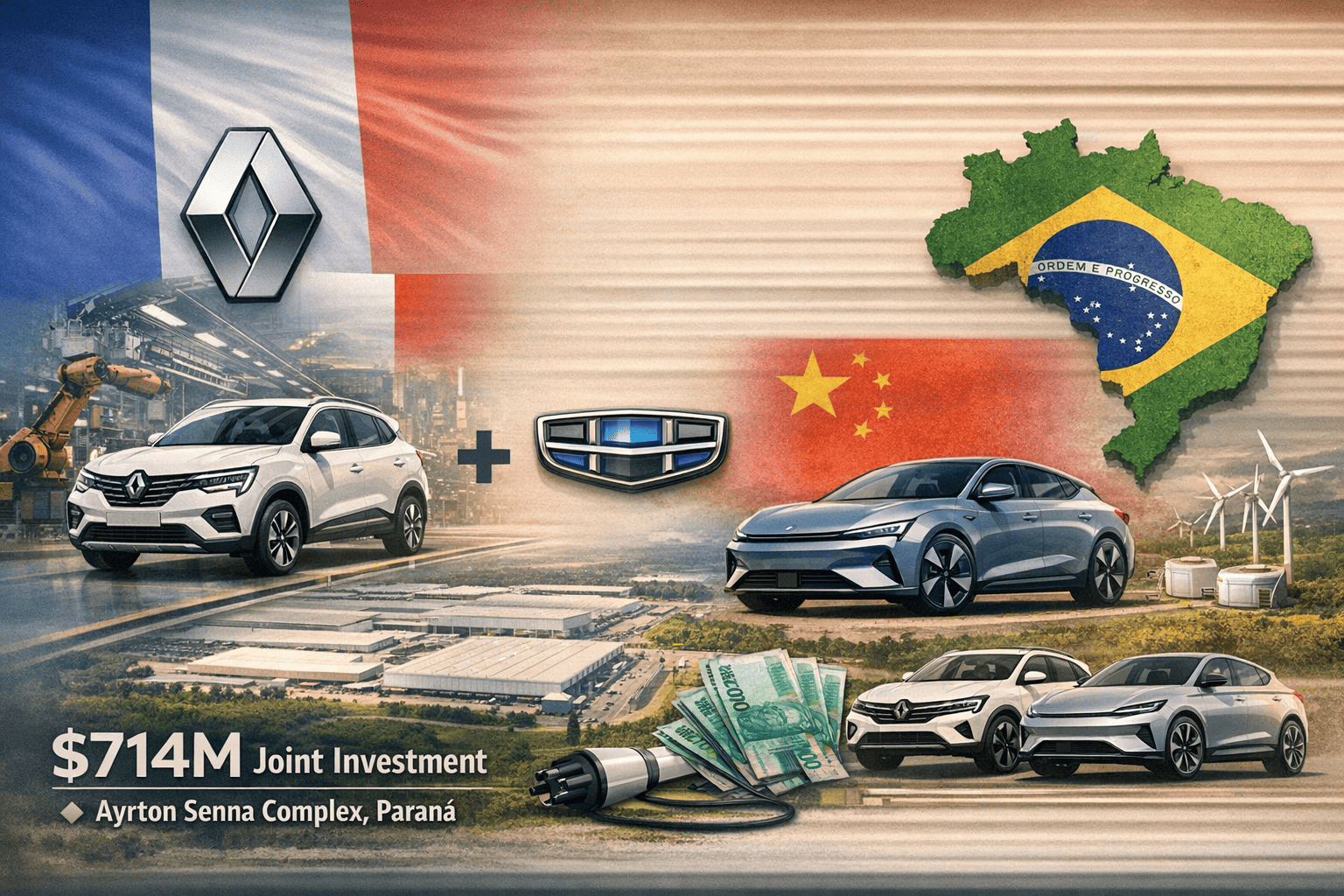
Renault × Geely: France Meets China in a $714M Brazil JV — And What Every Manufacturer Must Learn From It
Geely Holding has acquired a 26.4% stake in Renault do Brasil, committing $714M to jointly manufacture zero and low-emission vehicles at the Ayrton Senna Complex in Paraná. Here’s the full story, why this collaboration works, and the complete playbook for replicating this cross-border manufacturing partnership model.
🚗 Direct Answer
Renault Group and Geely Holding Group have formed a joint venture — Renault Geely do Brasil — in which Geely acquires a 26.4% stake in Renault do Brasil, with Renault remaining the majority shareholder. The partnership was announced via framework agreement on February 17, 2025, and definitive agreements were signed on November 3, 2025. Renault and Geely have jointly committed 3.8 billion Brazilian reais (approximately $714M USD) to develop new vehicles in Brazil, including two new zero and low-emission models built on Geely’s GEA multi-energy platform, scheduled for production at the Ayrton Senna Complex in São José dos Pinhais, Paraná in the second half of 2026. For Geely, the deal provides an established manufacturing base, dealer network, and local expertise without building greenfield — the textbook case for partnership-first market entry in a country where EV imports from China more than doubled to 152,000 units in 2024 alone.
📅 March 17, 2026⏱ 17 min read✍️ GTsetu Editorial Team📰 Automotive Industry News + Analysis
🔴 BREAKINGGeely acquires 26.4% stake in Renault do Brasil — $714M committed for joint EV production in Paraná◆Two new zero/low-emission models on Geely’s GEA platform entering production H2 2026 at Ayrton Senna Complex◆France’s Renault + China’s Geely = Brazil’s most significant automotive cross-border JV of 2025◆Find your global manufacturing partner on GTsetu — verified partners across 100+ countries, zero broker fees◆🔴 BREAKINGGeely acquires 26.4% stake in Renault do Brasil — $714M committed for joint EV production in Paraná◆Two new zero/low-emission models on Geely’s GEA platform entering production H2 2026 at Ayrton Senna Complex◆France’s Renault + China’s Geely = Brazil’s most significant automotive cross-border JV of 2025◆Find your global manufacturing partner on GTsetu — verified partners across 100+ countries, zero broker fees◆
Joint Investment
$714M
3.8B Brazilian reais committed for joint vehicle development
Geely Stake
26.4%
Geely acquires minority share in Renault do Brasil, Nov 3 2025
New EV Models
2 + 2
2 new GEA platform models in H2 2026 + 2 more in 2027
Brazil EV Import Growth
2× in ’24
Chinese EV exports to Brazil doubled to 152,000 units in 2024
Section 1 — The News
1 The Full Story: Renault × Geely — Renault Geely do Brasil
🇫🇷 Renault Group — France
+
🇨🇳 Geely Holding — China
=
🇧🇷 Renault Geely do Brasil — Paraná, Brazil
Live Story — February 2025 → November 2025 → Production 2026
Geely Acquires 26.4% Stake in Renault do Brasil — $714M Committed for Zero-Emission Vehicle Production in Paraná
On February 17, 2025, from Hangzhou, China and Boulogne-Billancourt, France, Renault Group and Geely Holding Group jointly announced a framework agreement to expand their strategic cooperation to Brazil — the largest automotive market in Latin America and China’s fastest-growing market for electric and plug-in hybrid vehicles. Under this framework, Geely would invest in Renault do Brasil to become a minority shareholder, gaining access to Renault’s established manufacturing facilities, dealer network, and local expertise.
On November 3, 2025, definitive agreements were executed. Geely formally acquires a 26.4% stake in Renault do Brasil, with Renault Group remaining the majority shareholder and consolidating the entity in its accounts. Geely now has access to the Ayrton Senna Complex in São José dos Pinhais, Paraná — Renault’s two advanced production facilities, operational since 1998 and employing approximately 2,600 workers.
The combined investment announced in November 2025 is 3.8 billion Brazilian reais (~$714M USD), to be deployed across new model development including two new vehicles on Geely’s GEA multi-energy platform (supporting gasoline, hybrid, and battery-electric propulsion), scheduled for production in the second half of 2026 — plus a renovated Renault model in 2026 and an additional new vehicle in 2027. This is not Renault and Geely’s first collaboration: they already operate an ICE joint venture in South Korea established in 2024, producing the Renault Grand Koleos on Geely’s platform in a Renault-controlled plant in Busan.
For Geely, Brazil is strategically critical — Chinese EV exports to Brazil more than doubled to 152,000 units in 2024, making Brazil China’s fastest-growing EV market. With BYD already constructing its own Brazilian industrial complex in Bahia, Geely’s move through Renault’s infrastructure is a speed-of-execution play: partner-first entry gives Geely manufacturing presence and sales channels years before a greenfield alternative would be ready.
26.4%
Geely’s stake in Renault do Brasil — minority shareholder
$714M
Combined Renault × Geely investment in Brazil vehicle development
H2 2026
First new GEA-platform models enter production at Ayrton Senna Complex
2,600+
Workers at Renault’s Paraná plant — Geely enters a running operation
“Together, we have built trust and an effective working relationship. These are great assets that we want to leverage today with this new cooperation in Brazil.”
— Luca de Meo, CEO, Renault Group
“This is not just a traditional joint venture — it’s a strategic cooperation focused on a high-potential market. By combining our industrial know-how, strong commercial networks, and advanced electrified platforms, we will create a modern and competitive lineup.”
— Fabrice Cambolive, Chief Growth Officer & Renault Brand CEO
💡 GTsetu Perspective
When the CEO of Renault describes a $714M joint investment as built on “trust and an effective working relationship” established through a prior South Korea JV — that’s the collaboration playbook in one sentence. Companies that enter new geographies through verified, trust-tested partners move faster, spend less, and carry less regulatory risk than companies that go alone. Renault and Geely didn’t need a matchmaker in Brazil because they had already built their relationship in Korea. For everyone without that prior partnership history, GTsetu is where verified trust-building starts.
Section 2 — The Timeline
2 Deal Timeline: From Korea Collaboration to Brazil JV
The Renault × Geely Brazil deal moved from framework announcement to definitive agreements in just 8.5 months — extremely fast for a cross-border acquisition with manufacturing integration. This speed was only possible because the two companies had already proven their working relationship in South Korea.
📅 1997 — Renault Enters Brazil
Renault do Brasil Established
Renault establishes its Brazilian subsidiary, building what becomes the Ayrton Senna Complex in São José dos Pinhais, Paraná — the same factory that Geely will enter in 2025. Over 27 years, Renault builds one of Brazil’s largest automotive dealer networks and achieves 5th largest automaker status in the country.
📅 2023 — Horse Powertrain JV
Renault & Geely Form “Horse” — Global Powertrain JV
Before Brazil, Renault and Geely establish Horse Powertrain Limited — a joint venture that Renault CEO Luca de Meo describes as “a world leader in powertrain technology.” Horse lays the trust foundation for everything that follows. Two large companies prove they can operate a shared entity, align on governance, and deliver commercial results together.
📅 2024 — South Korea JV Operational
Renault × Geely ICE JV Launches in Busan, South Korea
A second JV — an internal combustion engine manufacturing joint venture in Busan, South Korea — begins producing the Renault Grand Koleos on Geely’s platform. The Korea JV is the direct precursor to Brazil: same partners, same model (Geely platform + Renault manufacturing infrastructure), now proven at commercial scale.
📅 February 17, 2025 — Framework Agreement
Renault & Geely Announce Brazil Framework — Hangzhou + Paris
Simultaneously announced in Hangzhou, China and Boulogne-Billancourt, France, the framework agreement to expand strategic cooperation to Brazil is made public. Geely will invest to become a minority shareholder in Renault do Brasil, gaining access to manufacturing, sales, and service infrastructure. Subject to definitive agreements and regulatory approval.
📅 June 2025 — JV Structure Announced
Renault Geely do Brasil JV Entity Formally Defined
Geely Auto, Geely Holding and Renault announce the formal JV structure: 73.57% Renault, 21.29% Geely Auto, 5.11% Geely Holding, 0.03% independent third party. The JV will manufacture electric vehicles in Brazil — a strategic upgrade from the Korea ICE-only JV to full zero-emission vehicle production capability.
📅 November 3, 2025 — Definitive Agreements Signed
Geely Formally Acquires 26.4% Stake — $714M Investment Announced
Renault Group and Geely execute definitive agreements. Geely formally acquires its 26.4% stake in Renault do Brasil. Combined investment of 3.8B Brazilian reais (~$714M USD) announced at the Ayrton Senna Complex in São José dos Pinhais. Two new GEA-platform models confirmed for H2 2026 production, plus additional vehicles in 2027.
🚗 Why Prior Partnership History Accelerates Deals
The Renault × Geely Brazil deal closed in 8.5 months from framework to definitive agreements. For a cross-border acquisition with $714M at stake, that is exceptionally fast. The reason: this was not their first collaboration. Horse Powertrain, then the South Korea JV, then Brazil — each successive deal moved faster because trust, governance experience, and legal templates were already established. The lesson for manufacturers: investing in early-stage partnership relationships — even at smaller scale — creates the infrastructure for faster, larger deals later. GTsetu’s NDA-protected collaboration workflow enables this trust-building process at any scale, from a $500K CM trial to a multi-hundred-million JV.
Section 3 — The Anatomy
3 Anatomy of the JV — What Each Partner Brings
The Renault × Geely Brazil JV works because both companies bring irreplaceable assets the other company would take years to replicate independently in Brazil. This is the core logic of every successful manufacturing collaboration: the gap between partners is the source of value, not the overlap.
Collaboration Anatomy — Renault Geely do Brasil — Ayrton Senna Complex, São José dos Pinhais, Paraná
Renault Group
🇫🇷 France — Est. Brazil 1997
What they bring
Infrastructure + Network + Brand
Factory
Ayrton Senna Complex, Paraná
Workforce
~2,600 factory employees
Market standing
5th largest automaker in Brazil
2024 global sales
2.265 million vehicles
What they lack
Low-cost EV platform, China supply chain
+
creates
Geely Holding
🇨🇳 China — Est. 1986
What they bring
GEA EV Platform + Technology IP
Platform
GEA (multi-energy: ICE/hybrid/BEV)
2024 global sales
3.33 million vehicles
Portfolio brands
Volvo, Zeekr, Lynk & Co, Polestar, Lotus
Fortune 500
13 consecutive years listed
What they lack
Brazil factory, dealer network, local expertise
🚗 Renault Geely do Brasil: zero/low-emission vehicles for Latin America
💰 $714M joint investment
🏭 2 new GEA models in production H2 2026
🌍 Brazil as Latin America EV export anchor
Collaboration Dimension
What Renault Provided
What Geely Provided
Why This Balance Works
Manufacturing Infrastructure
Ayrton Senna Complex — 2 production facilities, 27 years operational, 2,600+ employees
Capital (26.4% equity stake + joint $714M investment)
Geely enters a running factory — zero greenfield construction, zero ramp-up time
EV / Low-Emission Technology
Renault’s existing ICE product lineup + Brazilian model knowledge
GEA multi-energy platform supporting gasoline, hybrid, and battery-electric
Geely’s platform is the technological upgrade Renault’s Brazil lineup needs; Renault’s plant is the production base Geely’s platform needs
Market Access
Extensive Brazilian dealer network built over 27 years — Geely vehicles sold through Renault’s retail network
Geely Auto Group’s 3.33M vehicle/year global distribution experience
Geely doesn’t build a dealer network from zero — Renault’s network is immediately available for Geely-branded vehicles
Regulatory Navigation
27 years of Brazilian automotive compliance experience — INMETRO certification, Inovar-Auto, Rota 2030
Experience with Chinese EV regulatory frameworks and international product certifications
Each partner handles regulatory complexity in their domain — no learning curve for either party
Supply Chain
Established Brazilian and South American supplier network for components and raw materials
Access to Geely’s global supply chain, particularly Chinese EV component sourcing
Lowest-cost hybrid supply chain: Chinese EV components where advantageous; local content where Brazilian regulation requires
Prior Relationship
Shared governance experience from Horse Powertrain + South Korea JV
Same — the Korea JV was the proof-of-concept for Brazil
8.5-month close time (Feb → Nov 2025) was only possible because both parties had already resolved the governance and IP-sharing questions in prior JVs
Section 4 — Ownership
4 Ownership Structure — Who Controls What in Renault Geely do Brasil
Renault Geely do Brasil — Ownership Breakdown
Renault 73.57%
Geely Auto 21.29%
GH 5.11%
Renault Group — 73.57% (majority, consolidates entity)
Geely Auto Group (HK listed) — 21.29%
Geely Holding Group — 5.11%
Independent third party — 0.03%
The ownership structure is deliberately designed to give Geely strategic access and influence without triggering a change-of-control that would complicate Brazilian regulatory approval or Renault’s consolidated accounting. Renault retains majority control and continues to consolidate Renault do Brasil in its financial statements — meaning the JV does not create a new accounting entity that requires fresh credit rating or investor disclosure treatment. For Geely, the 26.4% combined stake (21.29% + 5.11%) is large enough to guarantee a board seat and manufacturing access rights, but small enough to avoid the premium valuation and regulatory scrutiny that would accompany a majority acquisition.
💡 Why the 26.4% Stake Structure Is Strategically Elegant
Most cross-border manufacturing deals fail not on technology or commercial terms — they fail on ownership structure design. Geely’s 26.4% stake is a masterclass in minority-but-meaningful equity positioning: large enough to mandate production access and governance rights, small enough to avoid Brazilian CADE antitrust review thresholds for full change-of-control, and structured as a split between Geely Auto (publicly listed HK) and Geely Holding (parent) to optimise each entity’s regulatory and accounting treatment. The structure took 8.5 months to finalise — and every week of that time was worth it. GTsetu’s collaboration templates help manufacturers start with the right structural framework from day one.
Section 5 — Why Brazil
5 Why Brazil? The Automotive Manufacturing Opportunity That Moved Geely
🇧🇷 Brazil Automotive & EV Market Opportunity 2025–2030
Why Global Automakers Are Making Brazil Their Latin America Manufacturing Anchor
Brazil is the largest automotive market in Latin America and — as of 2024 — China’s fastest-growing market for electric and plug-in hybrid vehicles. For global automakers, Brazil combines the scale of an established market with the growth trajectory of an EV transition market. The government’s Rota 2030 automotive policy actively rewards local production. And for Chinese automakers specifically, escalating trade barriers in the US and EU are redirecting investment to markets with open trade relationships and high growth — exactly what Brazil offers in 2025.
#1
Brazil: largest automotive market in Latin America — 2.2M+ vehicles/year
2×
Chinese EV exports to Brazil doubled to 152,000 units in 2024 — fastest-growing market
Rota 2030
Brazil’s automotive industrial policy rewards locally-manufactured vehicles with tax incentives
No tariff barrier
Unlike EU and US, Brazil has no targeted Chinese EV import tariffs — open market for now
27 yrs
Renault’s 27-year presence gives Geely an established dealer + supply chain network immediately
2026
GEA platform EV production starts — positioned ahead of market maturity curve
Brazil’s automotive opportunity has three dimensions that make it uniquely compelling for a partnership-entry strategy like Geely’s. First, scale without tariff barriers — unlike the US (which has 100% EV tariffs on Chinese vehicles) and the EU (which imposed additional duties in 2024), Brazil currently imposes no targeted tariffs on Chinese vehicles. For Geely, manufacturing locally through Renault’s facility locks in Brazilian market access and satisfies local content requirements before that policy window potentially closes. Second, existing infrastructure advantage — Renault’s Ayrton Senna Complex has 27 years of operational history, 2,600+ trained workers, established supplier relationships, and INMETRO certification infrastructure that took Renault decades to build. Geely enters all of that on day one of the JV. Third, EV trajectory — Brazil’s EV market is growing from a small base, exactly the market structure where first-mover manufacturing presence creates durable competitive advantage. Being in production in 2026 is being in production before EV adoption in Brazil reaches mass-market scale.
Section 6 — What Is Collaboration
6 What Is an Automotive Manufacturing Collaboration — And Why Do Companies Do It?
🎯 Definition
An automotive manufacturing collaboration is a formal arrangement between two or more companies — typically across different geographies, technology positions, or market capabilities — to jointly develop, produce, or distribute vehicles or automotive components. The modern automotive supply chain is uniquely suited to collaboration because vehicle development requires the convergence of platform technology, powertrain IP, local manufacturing infrastructure, distribution networks, and regulatory compliance — capabilities that rarely exist in-house for any single company entering a new market. The Renault × Geely playbook is the purest expression of this logic: bring the platform and the brand; let your partner bring the factory, the dealer network, and the 27-year regulatory relationship.
Why Automotive Manufacturers Collaborate — The 6 Strategic Drivers
Speed
Entering a partner’s existing factory + dealer network beats 5–7 years of greenfield automotive plant construction
Platform
EV platform development costs $1B+. Licensing a partner’s GEA or similar platform eliminates that investment for a new-market entry
Trade Risk
Local manufacturing avoids tariff exposure — Geely’s Brazil factory protects Latin America sales if import tariffs emerge
Local Content
Rota 2030 and Brazil’s Inovar-Auto industrial policies favour locally-manufactured vehicles in government fleet procurement
Risk Share
$714M invested across two parties instead of one — each company limits downside while sharing upside in a new market
Trust
Horse + Korea JV proved governance before Brazil. Existing relationships compress deal timelines from years to months
Section 7 — Types of Collaboration
7 4 Types of Automotive Manufacturing Collaboration — Which Fits You?
Not every automotive collaboration needs to be a $714M JV. The right structure depends on how much capital you have, how much market control you need, and how deeply you want to integrate with your partner’s existing infrastructure. Renault and Geely tried three progressively deeper collaboration models — Horse, Korea, then Brazil — each one building the trust infrastructure for the next.
01
Joint Venture (JV)
A shared legal entity co-owned by both parties. Highest commitment and deepest integration. The Renault × Geely Brazil model — best when both partners bring large complementary assets, a long-term market vision, and sufficient prior relationship history to handle shared governance. Renault and Geely built to this level through two prior JVs.
🚗 Renault × Geely Brazil Model
02
Technology / Platform Licensing
You license your automotive platform, powertrain IP, or vehicle design to a local manufacturer who produces and sells in their market. You receive royalties without capital or operational exposure. Geely could have merely licensed its GEA platform to Renault for a royalty — instead they chose JV equity for higher upside and manufacturing presence.
💡 Asset-light expansion
03
Contract Manufacturing (CM)
You own the vehicle brand and design; a local manufacturer builds to your specification. No equity sharing, minimal capital commitment. The fastest path to production in a new geography — and the correct model for a demand validation before JV commitment. Renault effectively offers this model to Geely for its China-made SKD kits sold through Renault dealerships.
🏭 Low-commitment entry
04
Distribution Partnership
You manufacture in your home market; a local distributor handles sales, logistics, and after-sales service in the target market. The lightest collaboration form and often the first step before any manufacturing commitment. Geely’s first Brazil step was selling China-made vehicles through Renault’s dealer network — exactly this model, as a precursor to the full JV.
🌍 Market entry step 1
📊 Automotive Collaboration Model Comparison Matrix
First step: test Brazilian demand before factory commitment
✓ Verified distributors in 100+ countries
Section 8 — How to Collaborate
8 How to Collaborate: A 6-Step Automotive Partnership Playbook
Renault and Geely didn’t wake up one morning and sign a $714M deal. They built through Horse Powertrain, then the Korea JV, then Brazil — each step validating the relationship and compressing the timeline of the next. Here is the full collaboration playbook, derived from this deal pattern and the logic of every successful cross-border automotive manufacturing partnership.
1
Define the Collaboration Objective with Precision
Before searching for a partner, answer three questions clearly: What market capability do I lack that a partner should fill — local manufacturing, dealer network, regulatory relationships, or platform technology? What do I bring that makes me a compelling collaboration partner — IP, brand equity, manufacturing capacity, capital, or established market position? And what does success look like in 3 and 7 years? Geely’s answers were specific: Brazil manufacturing access, Renault’s dealer network, local compliance expertise — in exchange for Geely’s GEA platform technology and capital co-investment. Vague objectives produce vague partner searches and expensive misalignments discovered after capital is committed.
2
Identify and Verify Partners Systematically — Not Through Serendipity
Renault was not a random partner — it was the only major automaker in Brazil with a large, operational plant, an extensive dealer network, a proven track record in Geely’s target vehicle segments, and a prior working relationship with Geely already established through Horse and Korea. Every attribute was verifiable before the deal was discussed. Most companies still rely on trade fair introductions or government matchmaking for cross-border partner discovery. GTsetu’s multi-layer verified partner network allows manufacturers to identify automotive collaboration candidates whose capabilities, market standing, and financial credentials are documented before any conversation — eliminating the 12–18 months of informal due diligence that precedes most major JVs.
3
Protect Your Technology IP Before Sharing Anything
Geely’s GEA multi-energy platform is the core commercial asset in this JV — it is what Renault’s Brazil factory needs to produce competitive next-generation vehicles. Before any platform technical specifications were shared, before any manufacturing integration discussions began, the collaboration had a formal legal framework governing IP ownership and licensing rights. In automotive collaborations, this includes: platform architecture IP, software and firmware for EV/hybrid control systems, manufacturing process documentation, and supply chain sourcing specifications. GTsetu’s built-in NDA workflow enables this protection automatically, with a full audit trail, before any technically sensitive information changes hands.
4
Start Small — Then Scale to Full JV
Renault and Geely did not start with a $714M JV. They started with Horse Powertrain, then proved the model at scale in Korea, then brought it to Brazil. The Brazil JV’s initial phase includes Geely-branded vehicles imported from China and sold through Renault’s dealer network — a distribution step that validates Brazilian consumer demand before the full factory investment is deployed. For manufacturers approaching a new geography, the same logic applies: start with a distribution agreement or CM pilot, validate the market, and let the first phase fund the trust required for the second. GTsetu supports all stages of this progression — verified distributors, CM partners, and JV candidates in 100+ countries.
5
Structure the Collaboration Formally — Before Production, Always
The Renault × Geely Brazil deal took 8.5 months from framework to definitive agreements. A significant portion of that time was spent on ownership structure design (73.57% / 21.29% / 5.11% / 0.03% — a precision allocation that serves specific legal, accounting, and regulatory objectives), IP licensing terms, local content compliance responsibilities under Rota 2030, governance protocols, and exit clause design. For any automotive collaboration, the formal agreement must specify: platform licensing terms and royalty structure, quality standards and audit rights for the manufacturing partner, Rota 2030 / local content compliance responsibilities, governance authority over production volumes and product range decisions, and exit mechanisms if the market or technology landscape changes materially.
6
Build Governance Infrastructure From Day One
A JV with $714M at stake and two operating companies across three continents requires explicit governance infrastructure — not informal alignment. Who approves the product roadmap? Who resolves quality disputes? What happens if one partner wants to introduce a model the other opposes? Who controls the supply chain sourcing decisions for Chinese vs local Brazilian components? These governance questions, if left unresolved at the outset, become costly disputes in fast-moving automotive markets. GTsetu’s encrypted collaboration workspace supports structured, secure partner communication — and the platform’s collaboration frameworks help manufacturers establish governance protocols that scale with the relationship.
Section 9 — Dos and Don’ts
9 Dos and Don’ts of Global Automotive Manufacturing Collaboration
Drawn from the Renault × Geely deal and the patterns of cross-border automotive partnerships that succeeded and failed at scale, here is the definitive guidance on what to do — and what to avoid — in global automotive manufacturing collaboration.
✅ Do These
✅ Build relationship credibility through a smaller prior collaboration before committing to a large JV
✅ Verify your partner’s actual manufacturing credentials independently — not their government endorsements alone
✅ Design an ownership structure that serves specific legal, regulatory, and accounting objectives — not just commercial split
✅ Protect platform and software IP with a formal agreement before any technical disclosure
✅ Start with a distribution or SKD assembly step to validate market demand before full JV capital commitment
✅ Align on local content compliance (Rota 2030 in Brazil) before production decisions are made
✅ Choose a partner whose dealer network is already built — not one who promises to build one
✅ Establish clear product roadmap governance and quality dispute resolution protocols from day one
✅ Build in exit clauses — EV platform technology standards evolve; you need optionality
✅ Time production ramp to precede mass-market EV adoption in the target geography — first-mover manufacturing matters
❌ Avoid These
❌ Enter a $100M+ JV as your first interaction with the partner — prove the relationship at smaller scale first
❌ Share platform specifications or powertrain IP before a countersigned NDA and formal IP agreement
❌ Assume local content compliance is automatic — Rota 2030 requires structured local value-add, not just assembly in Brazil
❌ Choose a partner for their government relationships without independently verifying manufacturing capability
❌ Skip governance documentation and assume alignment will persist as market conditions change
❌ Allow equity structures that create governance ambiguity — the Renault × Geely 73.57% / 26.4% split is precise for a reason
❌ Ignore trade policy risk — Brazil’s open market for Chinese EVs could change; local manufacturing is the hedge
❌ Begin production integration before formal JV or CM agreements are fully executed
❌ Build greenfield when a partner’s established plant eliminates 5+ years of construction and ramp-up
❌ Underestimate the complexity of integrating two distinct automotive supply chains across different continents
Section 10 — Misconceptions
10 Common Misconceptions That Kill Automotive Manufacturing Collaborations
❌ Myth
“We can enter Brazil’s automotive market faster by building our own factory than by finding a JV partner.”
✅ Reality
A greenfield automotive plant in Brazil takes 5–8 years from land acquisition to commercial production. Geely entered Renault’s operational factory and committed to production in H2 2026 — roughly 18 months after the framework agreement. The partner’s 27 years of factory operation, trained workforce, supplier relationships, and dealer network are irreplaceable time advantages. For most manufacturers entering a new geography, partnership-first entry is not just faster — it is the only commercially rational choice.
❌ Myth
“Platform licensing is safer than a JV — the licensee can’t use my IP against me.”
✅ Reality
A poorly drafted licensing agreement is more dangerous than a well-structured JV. In automotive platform licensing, the licensee’s manufacturing engineers inevitably develop deep knowledge of your platform architecture — whether you intended that or not. A JV with explicit IP ownership clauses, audit rights, and reversion terms on JV dissolution often provides better IP protection than a licensing agreement that doesn’t anticipate all the ways manufacturing access creates IP leakage. The structure matters less than the legal precision of the agreement.
❌ Myth
“Brazil has no EV tariffs, so I can just export from China and don’t need a local manufacturing partner.”
✅ Reality
Brazil currently has no targeted Chinese EV tariffs — but this is a policy window, not a permanent commercial structure. The EU imposed duties in late 2024; Brazil’s government is under active domestic industry pressure to follow. Geely’s decision to manufacture locally through Renault is explicitly a hedge against this risk. Companies that rely on export-only strategies are one policy announcement away from a margin collapse. Local manufacturing is the durable long-term strategy; export-only is a short-term revenue play with unhedged political risk.
❌ Myth
“We don’t have Geely’s scale or Renault’s brand history — this JV model doesn’t apply to us.”
✅ Reality
The Renault × Geely model — technology platform + local manufacturing infrastructure partner + established market access — works at every scale. A $5M automotive component licensing deal in Brazil follows the exact same strategic logic as a $714M JV: you bring the product IP or manufacturing capability; your partner brings local market access and regulatory expertise. The playbook is identical regardless of deal size. GTsetu’s verified partner network enables this same systematic partner discovery process for manufacturers at every scale, from component suppliers to full vehicle manufacturers.
❌ Myth
“We need to wait until the partner proves themselves through the market before we commit capital.”
✅ Reality
Waiting for market proof is the logic of second-movers, not first-movers. Geely committed to Brazil’s manufacturing partnership before Brazilian EV adoption reached mass-market scale — precisely because that pre-adoption moment is when manufacturing presence is most affordable and strategically valuable to establish. First-movers in policy-driven markets who establish manufacturing JVs before the demand curve steepens hold procurement relationships and dealer network positions that late entrants find structurally inaccessible. Time your commitment to the market’s growth trajectory, not to its maturity.
Section 11 — Comparison
11 JV vs Licensing vs Contract Manufacturing — Full Automotive Comparison
Factor
Joint Venture (Renault × Geely Model)
Platform / IP Licensing
Contract / SKD Manufacturing
Distribution Partnership
Legal structure
New co-owned entity (Renault Geely do Brasil)
License agreement — no new entity
Manufacturing services agreement
Distribution or reseller agreement
Capital commitment
High — ~$714M in this case
Low — upfront legal + royalties
Minimal — per-unit cost only
Minimal — inventory terms only
Platform IP exposure
High — partner has manufacturing access
High — licensee uses your platform
Medium — partner has specs
Low — partner handles finished units
Rota 2030 / local content benefit
✓ Maximum — fully qualifies
✓ High — local licensee qualifies
~ Depends on local value-add %
✗ None — imported vehicles
Speed to first production
Slowest (8–18 months for JV structure)
Medium (6–12 months)
Fastest (1–4 months for SKD)
Fastest (1–3 months)
Trade tariff protection
✓ Full — Brazilian-made vehicles not subject to import tariffs
✓ High — locally produced
~ Partial — depends on local content %
✗ None — full import tariff exposure
GTsetu support
✓ JV partner matching
✓ Licensing partner search
✓ 500+ verified CMs globally
✓ Verified distributors in 100+ countries
Best when…
Proven prior relationship; established local partner with factory + network; long-term market vision; trade tariff risk to hedge
Strong automotive IP but limited capital; asset-light expansion with royalty income
Demand validation before JV; SKD pilot; overflow capacity in new geography
First-step Brazil market entry; testing before any manufacturing commitment
Section 12 — GTsetu
12 How GTsetu Helps You Find the Right Automotive Collaboration Partner
Geely found Renault through years of progressively deeper collaboration — Horse, Korea, Brazil. The question for your company is: how do you find and build the relationship with the right partner if you haven’t already built one through prior JVs? Most manufacturers still rely on government matchmaking events, trade association introductions, and broker referrals — which surface the most visible companies, not the most strategically aligned ones. GTsetu enables the same systematic, verified partner discovery process that underpins every successful cross-border automotive collaboration — at any scale.
🌐 Platform Spotlight — GTsetu
Find Verified Automotive Manufacturing Partners Across 100+ Countries — Before You Reveal a Single Specification
GTsetu is the verified B2B manufacturing discovery platform where automotive manufacturers, contract manufacturers, component suppliers, and JV candidates connect with transparent capability profiles — zero broker fees on any partnership formed. Every partner is multi-layer verified: business registration, manufacturing certifications, operational capacity data, and trade references. You evaluate who’s real before you commit a single conversation. You share nothing sensitive until an NDA is in place.
✅
Multi-Layer VerificationBusiness registration, IATF certifications, trade references — capability claims are backed, not self-reported.
🕵️
Anonymous DiscoveryEvaluate verified automotive partner profiles without revealing your identity until mutual interest is confirmed.
📄
Built-In NDA WorkflowShare platform specs only after an NDA is executed — full audit trail, no external legal required.
🚫
Zero CommissionNo broker fees. Your JV, licensing deal, or CM contract stays entirely between you and your partner.
🌍
100+ CountriesFind JV candidates, CMs, licensing partners, and distributors across every major automotive manufacturing region.
🔐
Encrypted CollaborationShare capacity data, platform roadmaps, and production specs securely between verified partners.
What Geely Did to Find Renault — What GTsetu Enables for You
What Geely Did to Find Renault
What GTsetu Enables for You
Why This Matters
Identified the only major automaker in Brazil with a verified operational plant, large dealer network, and proven market standing
✓ Browse 500+ verified profiles with documented capabilities, certifications, and market credentials
No capability surprises after you’ve disclosed your platform technology or manufacturing specs
Built trust through two prior collaborations (Horse, Korea) before committing to the $714M Brazil JV
✓ Start with a small pilot collaboration; GTsetu supports every stage from distribution to full JV
First collaboration builds the trust infrastructure that makes the next collaboration faster and larger
Structured formal IP and governance agreements before production integration began
✓ Built-in NDA and collaboration workflow before any IP or platform disclosure
Automotive platform and commercial terms protected from the first conversation
Chose a partner with complementary — not competing — capabilities (Renault has no GEA platform; Geely has no Brazil factory)
✓ Detailed capability profiles identify true strategic complementarity before any engagement
Collaboration value comes from the capability gap between partners — not the overlap
Committed to zero broker intermediation — direct equity stake, direct governance
✓ Zero commission — all partnerships are direct, between you and your partner
Your commercial deal stays between you and your partner, not split with an agent or matchmaker
FAQ
? Frequently Asked Questions
QWhat exactly is the Renault Geely Brazil joint venture?
Renault Geely do Brasil is a joint venture in which Geely Holding Group acquires a 26.4% stake in Renault do Brasil, with Renault Group remaining the majority shareholder at 73.57%. A framework agreement was announced on February 17, 2025 and definitive agreements were signed on November 3, 2025. The combined investment is 3.8 billion Brazilian reais (~$714M USD). The JV gives Geely access to Renault’s Ayrton Senna Complex in São José dos Pinhais, Paraná — two production facilities with approximately 2,600 workers — plus Renault’s established dealer network in Brazil. Two new zero and low-emission vehicle models on Geely’s GEA multi-energy platform are scheduled for production in H2 2026, with additional models in 2027.
QWhy did Geely partner with Renault in Brazil instead of entering alone?
Three structural advantages made Renault the right partner. First, speed — Renault’s 27-year operational factory, 2,600-person workforce, supplier network, and dealer coverage would have taken Geely 5–7 years to replicate greenfield. The JV gets Geely into production in roughly 18 months from framework agreement. Second, market access — Renault’s extensive Brazilian dealer network is immediately available for Geely-branded vehicles, eliminating the cost and time of dealer recruitment. Third, prior trust — Geely and Renault had already operated two prior collaborations (Horse Powertrain, South Korea JV), meaning governance frameworks, IP-sharing protocols, and inter-company working relationships were already proven. The Brazil JV was a scale-up of a proven model, not an experiment with an unknown partner.
QWhat is Geely’s GEA platform and why does it matter for Brazil?
GEA (Global Energy Architecture) is Geely’s multi-energy vehicle platform, designed to support gasoline, hybrid, and battery-electric powertrains on the same underlying architecture. This is strategically important for Brazil because Brazilian consumer demand currently spans all three propulsion types — the GEA platform allows Renault Geely do Brasil to produce gasoline, hybrid, and BEV models from the same production line, adapting to demand mix without retooling. The two new models planned for H2 2026 production will be built on GEA, giving the JV a modern, flexible production foundation that Renault’s existing Brazil platform does not currently have. For Renault, GEA is the technological upgrade their Brazil product line needed; for Geely, it is the platform contribution that justifies their equity stake.
QWhat collaboration model is right for my company — JV, licensing, or contract manufacturing?
The right model depends on three factors: how much capital you have, how much control you need, and whether you have an existing trust relationship with your target partner. A JV (like Renault × Geely Brazil) makes sense when both parties bring large complementary assets, you have an existing relationship with the partner, and a long-term market vision justifies shared governance — typically the right choice after a smaller prior collaboration has proven the relationship. Platform or IP licensing works when you have strong technology but limited capital, or want asset-light geographic expansion. Contract or SKD manufacturing is the fastest path to production without equity exposure — ideal for demand validation before any equity commitment. GTsetu supports all four models — JV partner matching, licensing partner search, 500+ verified CMs globally, and verified distributors across 100+ countries.
QHow can GTsetu help me find an automotive manufacturing partner like Renault?
GTsetu’s process: (1) Define your objective — what capability gap does the partner fill and what do you contribute? (2) Search verified profiles — 500+ multi-layer verified manufacturers, CMs, and industrial partners across 100+ countries, with documented capability profiles rather than self-reported marketing claims. (3) Evaluate anonymously — review partner profiles without revealing your company identity or platform specifications. (4) Execute NDA automatically — GTsetu’s built-in workflow means you disclose nothing sensitive until a mutual NDA is countersigned with a full audit trail. (5) Run a controlled pilot — start with a distribution agreement or CM trial to validate capability before full JV commitment. Zero broker commission on any partnership formed. Start your partner search on GTsetu →
QWhat are the biggest risks in cross-border automotive JVs like Renault × Geely?
The five most significant risks are: (1) Platform IP leakage — automotive platform architecture is the core commercial asset; formal IP ownership clauses must be explicit before any technical collaboration begins. (2) Governance paralysis — when two large corporations co-govern a manufacturing entity, decision-making deadlocks are common without pre-agreed protocols. (3) Local content compliance failure — Rota 2030 requirements are specific; a partner without Brazilian local content compliance experience costs you industrial policy benefits. (4) Supply chain integration complexity — integrating Geely’s Chinese component supply chain with Renault’s established Brazilian supplier base requires explicit sourcing governance. (5) Trade policy changes — Brazil’s current tariff-free treatment of Chinese vehicles could change; the JV manufacturing approach hedges this risk. Starting with a verified, strategically complementary partner from GTsetu’s network reduces all five risks before they arise.
500+ verified manufacturers, contract manufacturers, automotive component suppliers, and industrial partners across 100+ countries. Zero broker fees. Anonymous discovery. Built-in NDA workflows. Your next cross-border automotive collaboration starts with a verified profile — not a trade fair or government matchmaking event.
They represents the product, and research team behind GTsetu, a global B2B collaboration platform built to help companies explore cross-border partnerships with clarity and trust. The team focuses on simplifying early-stage international business discovery by combining structured company profiles, verification-led access, and controlled collaboration workflows.
With a strong emphasis on trust, and disciplined engagement, Team GTsetu shares insights on global trade, partnerships, and cross-border collaboration, helping businesses make informed decisions before entering deeper commercial discussions.