💡 Strategic Analysis🏭 Manufacturing Strategy📊 Deloitte Data🌍 Global Trends
Why Manufacturers Are Choosing International Partnerships Instead of Building New Plants
Deloitte’s 2025/2026 Manufacturing Outlook is unambiguous: manufacturing construction spending declined steadily through 2025, the ISM PMI stayed below 50 for most of the year, and yet 97% of manufacturers reconfigured their supply chains. They did it through partnerships, not poured concrete. Here is the data, the decision framework, and why your next expansion move should start with a government-identity-verified partner (6 points: Name, Address, Registration Number, Company Status, Company Type, Date of Certificate of Incorporation), not a planning permission. Note: GTsetu does NOT verify manufacturing certifications, capacity data, trade references, tax compliance, import/export licences, or financial standing.
🎯 Direct Answer
Manufacturers are choosing international partnerships over building new plants because greenfield construction is too slow, too capital-intensive, and too operationally complex in a tariff-volatile, policy-fragmented world. Deloitte’s 2026 Manufacturing Outlook found that manufacturing construction spending declined steadily through 2025, while companies that prioritised partnerships, diversifying sources, enhancing supplier relationships, pursuing joint ventures and contract manufacturing, consistently outperformed those waiting for new capacity to come online. A greenfield plant in a new market takes 3–6 years and $50M–$500M+ before producing a single unit. A verified contract manufacturing partner can deliver first output in 1–4 months. A JV can reach groundbreaking in 14 months. In a market shaped by 25%+ tariffs, LCGPA local content mandates, and policy-guaranteed demand floors, speed and local relationships are worth more than real estate and concrete. GTsetu helps you find government-identity-verified partners (6 points: Name, Address, Registration Number, Company Status, Company Type, Date of Certificate of Incorporation) across 100+ countries.
📅 March 28, 2026⏱ 19 min read✍️ GTsetu Editorial Team📊 Sources: Deloitte, ISM, NAM, ARC Group
📊 STRATEGIC ANALYSISDeloitte 2026 Outlook: Manufacturing PMI below 50 for most of 2025, construction spending declined while partnerships accelerated◆97% of manufacturers reconfigured supply chains by 2025, the ones winning did it through partnerships, not new plants◆Deloitte: “Build, Buy or Borrow” is the new workforce AND expansion framework, partnerships are the Borrow column◆GTsetu, 500+ government-identity-verified companies across 100+ countries (6 points), find yours before your competitor does◆📊 STRATEGIC ANALYSISDeloitte 2026 Outlook: Manufacturing PMI below 50 for most of 2025, construction spending declined while partnerships accelerated◆97% of manufacturers reconfigured supply chains by 2025, the ones winning did it through partnerships, not new plants◆Deloitte: “Build, Buy or Borrow” is the new workforce AND expansion framework, partnerships are the Borrow column◆GTsetu, 500+ government-identity-verified companies across 100+ countries (6 points), find yours before your competitor does◆
PMI Below 50
Most of 2025
ISM Manufacturing PMI signalled contraction for most of 2025, Deloitte 2026 Outlook
Supply Chain Reconfig
97%
Of manufacturers reconfigured supply chains by 2025, up from 92% in 2022
Smart Mfg Investment
80%
Of 600 executives plan to invest 20%+ of budgets in smart manufacturing, Deloitte 2025
Partnership Speed
14 mo.
Foxconn × Alrajhi: Ministry announcement to factory groundbreaking, vs 4–6yr greenfield
Section 1, Deloitte Data
1 What Deloitte’s 2025/2026 Manufacturing Outlook Actually Says
Deloitte Manufacturing Outlook 2025 / 2026, Strategic Analysis
Manufacturing Construction Spending Declined. PMI Contracted. But Partnerships? They Accelerated. Here Is What 600 Executives Told Deloitte.
Deloitte’s 2026 Manufacturing Industry Outlook opens with a striking diagnosis: throughout 2025, the Institute for Supply Management’s manufacturing PMI languished below 50, signalling sector-wide contraction. Costs rose. Employment fell. And manufacturing construction spending, the classic indicator of investment in new or expanded facilities, declined steadily. Not a plateau. A decline. Companies that were building new plants at a record-breaking pace in June 2024 ($238 billion in construction spending) pulled back sharply as the economic signals turned.
But supply chains were not standing still. 97% of manufacturers reconfigured their supply chains by 2025. The winners were not those who waited for new capacity, they were the ones who diversified sources, enhanced supplier partnerships, and pursued strategic acquisitions and joint ventures to gain market access faster than concrete could dry. Deloitte explicitly identifies “diversifying sources, pursuing mergers and acquisitions, enhancing partnerships, and building internal capabilities” as the techniques that achieved the new strategic goal: balancing optimised cost and resilience simultaneously.
The 2025 Deloitte survey of 600 manufacturing executives found that 80% plan to allocate at least 20% of their improvement budgets to smart manufacturing initiatives, automation hardware, data analytics, sensors, and cloud. These are partner-ecosystem technologies, not standalone-plant technologies. You do not build an agentic AI supply chain control tower in a greenfield factory, you build it across a verified partner network.
Below 50
ISM Manufacturing PMI for most of 2025, contraction territory, Deloitte 2026
↓ Declining
Manufacturing construction spending trend through 2025, Deloitte 2026 Outlook
600
Manufacturing executives surveyed by Deloitte in 2025 smart manufacturing survey
$238B
Peak US manufacturing construction spending (June 2024), now declining
“Techniques such as diversifying sources, pursuing mergers and acquisitions, enhancing partnerships, and building internal capabilities are helping some companies achieve [balanced cost and resilience].”
— Deloitte, 2025 Manufacturing Industry Outlook
The 6 Deloitte Data Points Every Manufacturer Needs to Know in 2026
Deloitte 2026
↓ PMI
ISM Manufacturing PMI below 50 for most of 2025, sector-wide contraction, not just a blip
Industry Research 2025
97%
Of manufacturers reconfigured supply chains by 2025, partnerships were the primary tool
Deloitte Survey 2025
80%
Of 600 executives investing 20%+ of budgets in smart manufacturing, partner-dependent tech
NAM Q3 2024
60%
Of manufacturers cite talent acquisition as their #1 challenge, partnerships transfer workforce risk
Deloitte / Mfg Institute
1.9M
Manufacturing jobs could go unfilled over the next decade, partner for workforce, not just capacity
Deloitte 2026
>75%
Of manufacturers cited trade uncertainty as their primary concern in 2025, partnerships mitigate this
💡 GTsetu Perspective
Deloitte is describing a structural shift in how manufacturers grow, from capital-intensive greenfield construction to partnership-anchored market entry. The Deloitte “Build, Buy or Borrow” workforce framework applies equally to manufacturing capacity: Build (greenfield) is expensive and slow; Buy (M&A) requires significant capital and integration risk; Borrow (partner) delivers speed, local expertise, and shared risk without the balance sheet burden. GTsetu is the platform that makes the “Borrow” option systematic, with government-identity-verified companies (6 points), for any manufacturer at any stage of international expansion. Note: GTsetu does NOT verify manufacturing certifications, capacity data, or trade references.
Section 2, The Greenfield Problem
2 The Problem With Building New Plants Today, Why Greenfield Is the Slowest, Most Expensive Option
🎯 The Core Problem
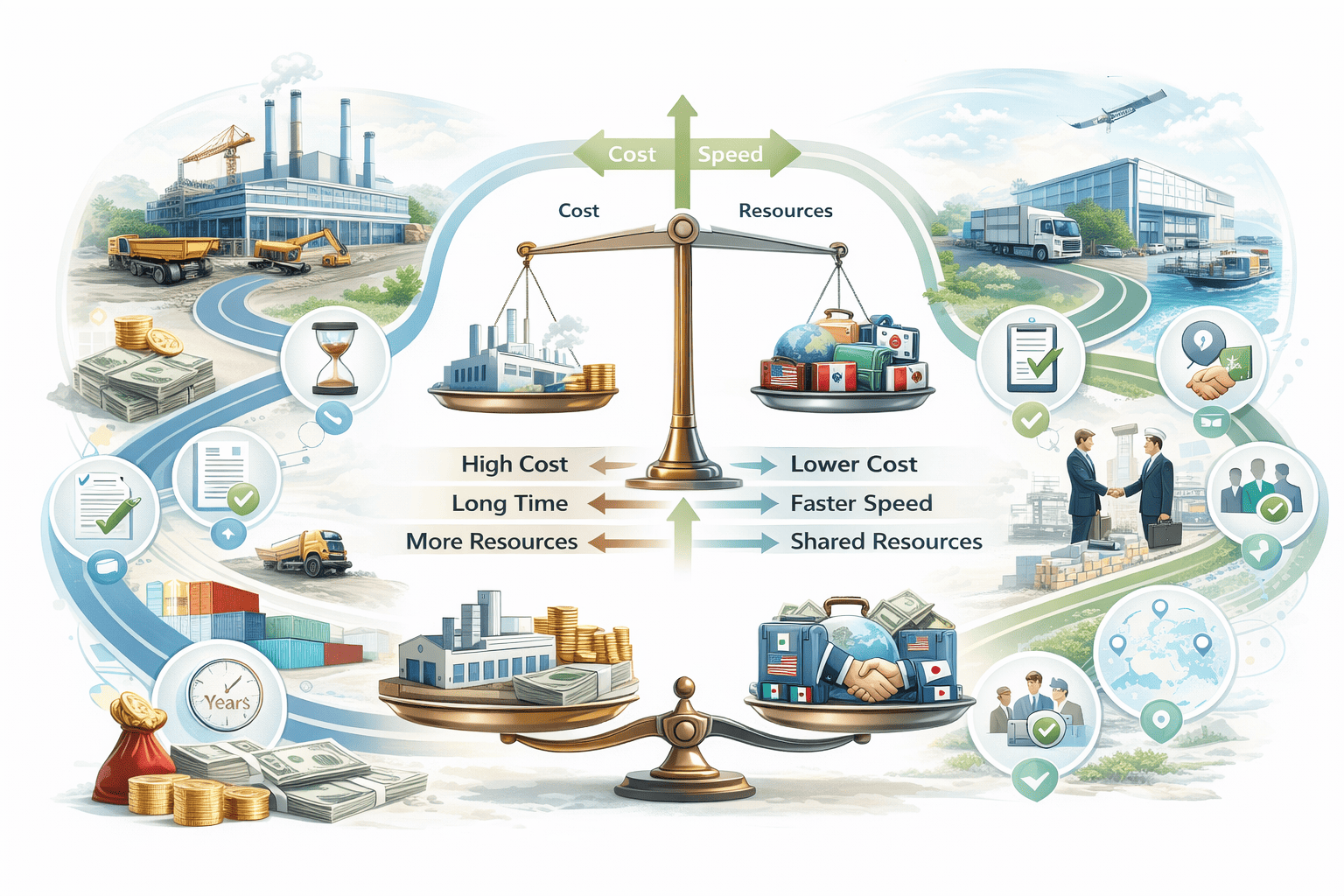
A greenfield manufacturing facility in a new country requires land acquisition, permitting, environmental assessment, infrastructure construction, equipment procurement, workforce hiring and training, regulatory certification, and supply chain establishment, all before a single unit ships. In most markets that are worth entering today (Saudi Arabia, Vietnam, India, Mexico, Poland), this process takes 3–6 years and $50M–$500M+. In that same window, a verified manufacturing partner can be live in 1–4 months at a fraction of the capital. The question is not whether greenfield is ever right, sometimes it is. The question is whether greenfield is right for your expansion goal at this speed and under these capital constraints.
⚠️ Build a New Plant (Greenfield)
Maximum control. Maximum cost. Maximum wait.
Upfront capital
$50M – $500M+
Time to first output
3 – 6 years
Local content compliance
Build from zero
Regulatory navigation
All yours to learn
Workforce
Hire & train from scratch
Govt. procurement access
Years to establish
Risk sharing
100% yours
Tariff shield
Only when operational
✅ International Manufacturing Partnership
Market-ready speed. Shared risk. Instant local roots.
Capital required
Minimal → High (your choice)
Time to first output
1 month → 14 months
Local content compliance
Partner’s existing certs (your responsibility to verify)
Regulatory navigation
Partner’s expertise (your responsibility to verify)
Workforce
Partner’s trained team (your responsibility to verify)
Govt. procurement access
Partner’s relationships (your responsibility to verify)
Risk sharing
Shared or minimal
Tariff shield
From day one of production
The Hidden Costs of Greenfield That Never Appear in the Business Case
Hidden Cost Category
What It Actually Costs
How a Partnership Avoids It
Permitting & Environmental Assessment
6–24 months of delay; $500K–$5M in fees and compliance costs in most regulated markets
Partner’s existing facility has all permits in place (verify independently), zero permitting timeline
Workforce Recruitment & Training
$20K–$40K per skilled worker; 60% of manufacturers cite talent as #1 challenge (NAM / Deloitte)
Partner’s existing trained workforce, you provide technical knowledge transfer, not recruitment; verify partner’s workforce capabilities independently
Local Content Certification (LCGPA, TKDN, PLI)
1–3 year compliance ramp-up; zero benefit during construction phase
Partner with existing certifications (your responsibility to verify) delivers local content benefit from first production run
Government Procurement Relationships
Years of relationship-building; often requires a local legal entity and established track record
A local partner’s existing government relationships (your responsibility to verify) are potentially accessible via the JV or CM entity
Supply Chain Establishment
6–18 months to qualify suppliers; costs rise 15–30% while sourcing locally from scratch
Partner’s existing supply chain is immediately available; your responsibility to verify its reliability and certification
Technology Obsolescence Risk
A factory designed for 2025’s product spec may be wrong by 2028, $50M+ of sunk cost is illiquid
Partnership contracts can be revised; a JV structure with exit clauses preserves strategic optionality
Saudisation / Make in India / Vietnam Labour Rules
Compliance penalties, quotas, and workforce localisation requirements that take years to navigate
Partner brings compliance history (your responsibility to verify); you leverage their record without the learning curve
⚠️ The Deloitte Warning on Construction Spending
Deloitte’s 2026 Outlook explicitly notes that manufacturing construction spending, dollars invested to build new or expand existing facilities, steadily declined through 2025 after peaking at $238 billion in June 2024. The year-over-year pace of growth already slowed from 41.3% in September 2023 to 20.5% in September 2024 before declining further in 2025. Manufacturers who committed to greenfield projects in 2023–2024 based on projected demand are now managing facilities whose original business case assumed conditions that no longer exist. Partnerships, structured with exit clauses and contractual flexibility, do not carry this irreversible capital risk.
Section 3, The Partnership Advantage
3 The Partnership Advantage, By the Numbers
The strategic case for international manufacturing partnerships over greenfield construction is not qualitative, it is supported by quantified time, cost, and market access advantages that compound at every stage of the expansion lifecycle.
14 mo.
Foxconn × Alrajhi JV: Ministry announcement to factory groundbreaking, vs 4–6 yr greenfield in same market
1–4 mo.
Typical time-to-first-output for a contract manufacturing partnership, vs 3–6 years greenfield
~10%
Logistics emissions reduction for companies that properly validated nearshoring partners, MIT supply chain study
56%
Growth in Vietnam’s exports to CPTPP Latin American members 2018–2023, driven by partnership-first market entry
$35.3B
FDI inflows into Mexico in 2023, up 11.9%, overwhelmingly partnership-anchored nearshoring, not pure greenfield
20%+
Partnership improvement budgets as a share of total smart manufacturing spend, Deloitte 2025 survey of 600 executives
Section 4, Real Examples
4 Real Companies That Chose Partnerships Over New Plants, And What It Delivered
🇹🇼🇸🇦
Foxconn (FIT) × Alrajhi, Smart Mobility JV, Saudi Arabia
Instead of building a standalone greenfield EV charger factory in Saudi Arabia, FIT partnered with Alrajhi Group inside King Salman Energy Park. Result: groundbreaking in 14 months; production in 2026; full LCGPA local content compliance from day one; Ministry of Energy endorsement and government procurement channel access through Alrajhi’s existing relationships.
Walmart reduced Chinese import dependency by 10% in 2024 by deepening partnerships with existing Vietnamese and Thai manufacturers, not by building new factories. Speed and verified supplier capability meant the tariff-driven restructuring happened in months, not years. A 5% logistics cost rise was the entire premium paid for structural supply chain resilience.
-10%
China dependency
🇺🇸🇮🇳
Apple, India Manufacturing via Tata & Foxconn Partnerships
Apple’s $1 billion India manufacturing commitment is executed entirely through local manufacturing partners, Tata Electronics and Foxconn, not through Apple-owned greenfield facilities. Apple gets Indian market access, PLI policy benefits, and geopolitical diversification without the capital risk, workforce compliance burden, or 5-year construction timeline of going alone.
$1B
via partners, not plants
🇺🇸🇲🇽
Ford Motor Company, Mexico Nearshoring via Supplier Partnerships
US tariffs on Chinese steel added $500–$1,000 per vehicle to Ford’s cost base. Ford’s response: accelerated partnerships with Mexican suppliers under USMCA preferential terms, not a new plant. Cross-border trucking complexity rose 15%, but tariff savings and supply predictability more than justified the transition. Partner-first, plant-second.
USMCA
tariff shield activated
🇺🇸🇻🇳
P&G, Brownfield Acquisition, Vietnam (2012)
Rather than building a new facility in Vietnam’s Binh Duong province, Procter & Gamble acquired a former Gillette manufacturing facility, getting an existing factory, workforce, supply chain, and regulatory approvals in one transaction. The ARC Group case study is a textbook illustration of partnership/acquisition over greenfield: existing infrastructure, intangible assets (brand, goodwill), and zero permitting delay.
Day 1
operational capacity
🌐 GTsetu Connection
Every company in the examples above found their partner through networks, relationships, and systematic market knowledge, not through trade fair cold introductions. GTsetu makes that systematic, verified discovery available to manufacturers at every scale: 500+ government-identity-verified companies (6 points: Name, Address, Registration Number, Company Status, Company Type, Date of Certificate of Incorporation) across 100+ countries, browsable anonymously, with built-in NDA before any technical disclosure. Note: GTsetu does NOT verify manufacturing certifications, capacity data, trade references, or financial standing. Those remain your responsibility to verify independently. The same discovery process that Foxconn, Apple, and Walmart used at scale, available to you. Find your verified partner →
Section 5, Decision Framework
5 The Build vs Partner Decision Framework, When Does Greenfield Actually Win?
Partnerships are not always the right answer. Greenfield investment still makes strategic sense in specific, well-defined scenarios. The Deloitte “Build, Buy or Borrow” framework, applied to manufacturing expansion, gives you a structured way to decide. The key insight: Build is rarely the default. It is the exception that requires specific justification.
🤝 PARTNER wins when…
Speed is Critical and Capital is Constrained
You need market presence in 6–18 months. You don’t have $50M+ to deploy in construction. A partner with existing infrastructure (whose credentials you verify independently) delivers what you need, without the balance sheet burden or construction timeline.
→ Partnership: JV or CM
🤝 PARTNER wins when…
Local Content or Policy Access Is the Goal
The target market has LCGPA (Saudi Arabia), TKDN (Indonesia), or PLI (India) incentives that require local production, but also require local relationships and certifications that take years to build independently. A partner with existing compliance history (your responsibility to verify) delivers instant policy access.
→ Partnership: JV or Licensing
⚖️ BOTH viable when…
Proven Demand + Long-Term Vision + 5+ Year Horizon
You have validated demand (not just projected demand), a 5+ year strategic commitment, sufficient capital, and a market with strong institutional quality. Start with a partnership to validate, then consider a greenfield for the second facility once market fundamentals are proven.
→ Partner first, build later
🏗️ BUILD may win when…
Full Proprietary Control Is a Strategic Requirement
Your manufacturing process is your core competitive differentiator, process IP that cannot be safely shared with any partner even under NDA. You have the capital, the 5–7 year patience, and a market with no viable partner options that meet your capability standards. Greenfield is the rare exception, not the default.
→ Greenfield: only with full justification
“The Build vs Buy vs Partner decision has expanded. Partnering requires alignment and trust, but when done well, it unlocks innovation and market access without overextending internal teams.”
— Engenia Technologies, Build vs Buy vs Partner 2026 Framework
Section 6, How to Partner
6 How to Structure an International Manufacturing Partnership: The 6-Step Playbook
Whether your partnership takes the form of a JV, a contract manufacturing agreement, a technology license, or a distribution deal, the structural process that makes it work is the same. Here is the six-step playbook, informed by the Deloitte data and the Foxconn × Alrajhi model.
1
Define Precisely What the Partnership Must Deliver, Not Just “Market Entry”
Vague objectives produce vague partnerships. Before searching for a partner, specify: What capability gap must the partner fill, local content compliance, factory infrastructure, government procurement access, or workforce? What do you bring that makes you attractive, technology IP, brand, capital, or global customer access? And what does success look like in 36 months, in measurable commercial terms? The Deloitte framework for supply chain partnerships is clear: companies that balance cost and resilience through partnerships do so deliberately, not reactively. Define the outcome first. Then find the partner.
2
Search for Partners Systematically, Not Through Trade Fairs Alone
Deloitte’s 2025 data shows that 78% of manufacturers have invested or plan to invest in supply chain planning software, because systematic, data-driven supply chain management outperforms intuition-based choices. The same principle applies to partner discovery. GTsetu’s government-identity-verified partner network is the supply chain planning software equivalent for partner search, 500+ government-identity-verified companies across 100+ countries, with documented identity credentials (6 points) before your first conversation. Trade fair introductions are random. Systematic verified discovery is a strategic input. Note: GTsetu does NOT verify manufacturing certifications, capacity data, or trade references.
3
Protect Your IP Before Sharing Anything, NDA First, Always
The Deloitte warning on IP is embedded in its smart manufacturing data: as manufacturers invest in proprietary AI, software-driven processes, and advanced analytics, their manufacturing IP is increasingly the core commercial asset. Sharing process documentation, product specifications, or production system details across international borders without a formal, countersigned NDA and explicit IP ownership clause transfers irreversible leverage to the partner. GTsetu’s built-in NDA workflow means you share nothing sensitive until a mutual NDA is executed with a full audit trail, no external legal firm required for standard agreements.
4
Run a Controlled Pilot, Validate Capability Before Full Commitment
In a 2023 pharmaceutical industry case study, companies that implemented codified quarterly business reviews with manufacturing partners saw 15% improvements in project timelines. The underlying mechanism is the same as piloting: structured validation of actual capability before scaling commitment. In manufacturing partnerships, a pilot production batch, a trial import consignment, or a scoped technology transfer surfaces execution gaps, in quality, lead time, and local content compliance, before they become legally and commercially binding problems at full scale. Deloitte’s survey found that 98% of 800 manufacturers have started digital transformation; what separates outcomes is who validated their partner’s digital capability, not just their stated intent.
5
Formalise the Structure, The Agreement Defines the Partnership’s Resilience
Every manufacturing partnership needs a formal agreement covering: IP ownership and permitted use; quality standards and audit rights; local content compliance responsibilities (LCGPA, TKDN, PLI, who owns certification and what happens if compliance lapses); production volume commitments and capacity guarantees; governance authority with clear decision-making rights; and exit clauses that account for the tariff and technology volatility that Deloitte identifies as the 2025–2026 baseline condition. The Deloitte recommendation to build agility into supply chain strategy applies directly here: lock-in clauses without revision mechanisms create partnerships that become operational liabilities when markets shift.
6
Build Governance and Communication Systems From Day One
Deloitte’s 2026 Outlook recommends that manufacturers establish cross-functional control towers with enhanced visibility across supply chain partners. In an international manufacturing partnership, this is not a technology recommendation, it is a governance imperative. Establish from day one: who has decision-making authority without escalation; how quality issues are documented and resolved; what the operational review cadence looks like; and how technology and product changes are communicated and implemented across geographies and time zones. GTsetu’s encrypted collaboration workspace supports structured, secure partner communication as the relationship deepens from pilot to full production scale.
Section 7, Dos and Don’ts
7 Dos and Don’ts of International Manufacturing Partnerships
✅ Do These
✅ Start with a precise capability gap definition before searching for a partner
✅ Use government-identity-verified company profiles, not trade fair introductions
✅ Execute NDA before sharing product specs, process documentation, or software details
✅ Choose partners inside established industrial clusters over standalone greenfield promises
✅ Run a pilot production batch before committing full JV capital or IP transfer
✅ Align on local content compliance (LCGPA, TKDN, PLI) strategy from day one, and verify partner’s compliance history independently
✅ Define IP ownership and licensing terms explicitly in every agreement
✅ Build exit and revision clauses, Deloitte data confirms tariff volatility is structural, not temporary
✅ Designate governance authority from the start, ambiguity in manufacturing partnerships is expensive
✅ Use quarterly business reviews with KPIs, codified QBRs improve timelines by 15% (pharma study)
✅ Treat partner selection as a supply chain planning input, systematic, data-driven, not intuitive
❌ Avoid These
❌ Select partners primarily through government matchmaking without independent verification
❌ Share manufacturing IP before NDA is countersigned and documented
❌ Skip a pilot and commit full capital based on stated capacity claims alone
❌ Ignore local content compliance requirements until production is already running
❌ Assume a government endorsement validates a partner’s actual manufacturing capability
❌ Lock yourself into rigid volume commitments without revision mechanisms in tariff-volatile markets
❌ Allow governance ambiguity in JVs, 50/50 deadlocks in fast-moving manufacturing markets are fatal
❌ Underestimate Saudisation, Make in India, or Vietnam labour compliance requirements
❌ Start production before agreements are formally executed and countersigned
❌ Treat technology obsolescence as a distant risk, Deloitte warns AI and software are redefining manufacturing product specs rapidly
❌ Rely on a single international partner, 97% of manufacturers multi-sourced by 2025 for good reason
❌ Build greenfield when an established industrial park partner eliminates 3–5 years of construction
Section 8, Misconceptions
8 Misconceptions That Keep Manufacturers Building Greenfield When They Shouldn’t
❌ Myth
“We need full ownership and control, partnerships compromise our quality standards.”
✅ Reality
Quality standards are a contract clause, not a function of ownership structure. Apple manufactures through Foxconn and Tata with quality standards that meet iPhone specifications. The mechanism is contractual quality requirements, audit rights, and KPI-tracked QBRs, not equity ownership. A contract manufacturing agreement with rigorous AQL and OEE targets gives you quality control without the capital burden of owning the facility.
❌ Myth
“Our technology is too proprietary to share with a partner, we must build our own plant.”
✅ Reality
Technology protection is an NDA and IP agreement function, not a greenfield requirement. The manufacturing process can be shared with a partner under a properly structured NDA, technology transfer agreement, and explicit IP ownership clauses, without transferring ownership of the underlying IP. Thousands of manufacturers license proprietary processes to contract manufacturers globally. The legal protection framework exists. GTsetu’s built-in NDA workflow enables it systematically before any disclosure.
❌ Myth
“We invested in the business case for a new plant two years ago, we can’t reverse course now.”
✅ Reality
Deloitte’s 2026 Outlook explicitly documents that manufacturing construction spending declined steadily through 2025, meaning many companies have already made this pivot. Sunk cost fallacy in manufacturing expansion is particularly expensive: a greenfield project started in 2023 based on demand projections that have since been revised by tariff changes, PMI contraction, and policy shifts is not a commitment to honour, it is a risk to reassess. Partner-first entry can run parallel to or ahead of construction commitments.
❌ Myth
“Partnerships are complicated and risky, a greenfield plant is simpler because we control everything.”
✅ Reality
Greenfield projects in foreign markets involve permitting in foreign regulatory systems, workforce hiring in foreign labour markets, supply chain establishment in foreign sourcing environments, and government relationship-building in foreign procurement ecosystems, all of which you manage alone, without a partner’s expertise. Partnership complexity is front-loaded and documented in a contract. Greenfield complexity is distributed across 3–6 years of operational unknowns. The Deloitte data is unambiguous: companies managing complexity through verified partnerships outperform those absorbing it alone through greenfield construction.
❌ Myth
“We can’t find a partner that meets our standards, the verification process is too uncertain.”
✅ Reality
Partner discovery uncertainty is a platform problem, not a market problem. GTsetu’s 500+ government-identity-verified companies across 100+ countries are documented on 6 points: Name, Address, Registration Number, Company Status, Company Type, Date of Certificate of Incorporation. You evaluate who is real before committing. Note: GTsetu does NOT verify manufacturing certifications, capacity data, or trade references. These remain your responsibility to verify independently. The identity verification problem that made greenfield feel safer than partnership is now solved by systematic, government-identity-verified discovery platforms.
Section 9, Full Comparison
9 Full Comparison: Greenfield vs JV vs Contract Manufacturing vs Licensing
Factor
Greenfield Plant
Joint Venture
Contract Manufacturing
IP Licensing
Capital required
$50M – $500M+
$5M – $100M (shared)
Minimal (per-unit)
Low (legal + royalties)
Time to first output
3 – 6 years
14 – 24 months
1 – 4 months
6 – 12 months
Local content benefit
✓ Full, after years of compliance ramp
✓ Maximum, partner’s certs from day 1 (verify independently)
✓ Part of “pursuing M&A and partnerships” strategy
GTsetu support
N/A, GTsetu is for partnership discovery
✓ JV partner matching across 100+ countries (identity-verified)
✓ 500+ identity-verified companies globally
✓ Licensing partner search
Section 10, GTsetu
10 How GTsetu Helps Manufacturers Find Government-Identity-Verified International Partners
The Deloitte data is clear: the manufacturers that are winning in 2025–2026 are those that diversified sources, enhanced partnerships, and built verifiable supplier ecosystems. The ones that are struggling waited for new construction projects to come online in a PMI-contracting, tariff-volatile environment. The strategic case for partnerships over greenfield is settled by the data. The remaining question is execution: how do you find a government-identity-verified, strategically-aligned international manufacturing partner before your competitor does?
🌐 Platform Spotlight, GTsetu
500+ Government-Identity-Verified International Manufacturing Partners, Anonymous Discovery, Built-In NDA, Zero Commission. The Systematic Alternative to Greenfield.
GTsetu is the verified B2B manufacturing discovery platform where manufacturers, contract manufacturers, JV candidates, and distributors connect with government-identity-verified company profiles (6 points: Name, Address, Registration Number, Company Status, Company Type, Date of Certificate of Incorporation), before any IP or commercial information is exchanged. Every company is verified on 6 points using government ties. What GTsetu does NOT verify: manufacturing certifications, capacity data, trade references, tax compliance, import/export licences, industry certifications, financial standing, or authority of representatives. Those remain your responsibility to verify independently. You know who is real before committing to a conversation. And you share nothing sensitive until an NDA is formally executed.
✅
6-Point Government Identity VerificationName, Address, Registration Number, Company Status, Company Type, Date of Certificate of Incorporation, verified using government ties. Note: Certifications, capacity data, and trade references are NOT verified.
🕵️
Anonymous DiscoveryEvaluate 500+ identity-verified company profiles without revealing your company identity until mutual interest is confirmed.
📄
Built-In NDA WorkflowShare product specs only after NDA is countersigned, full audit trail, no external legal firm required.
🚫
Zero CommissionNo broker fees on any JV, licensing deal, CM contract, or distribution agreement formed through the platform.
🌍
100+ CountriesUSMCA, CPTPP, RCEP, LCGPA, PLI, find identity-verified partners aligned to the trade agreement advantages your target market provides.
🔐
Encrypted CollaborationShare capacity data, product roadmaps, and production specs securely between partners only, with full audit trail.
GTsetu verifies six specific data points using government ties: Company Name, Registered Address, Registration Number, Company Status, Company Type, and Date of Certificate of Incorporation. GTsetu does NOT verify manufacturing certifications, capacity data, trade references, tax compliance, import/export licences, industry certifications, financial standing, or authority of representatives. These remain your responsibility to verify independently. GTsetu provides an encrypted workspace where you can request these documents from partners and review them securely, with full audit trail.
GTsetu vs Greenfield vs Traditional Partner Search, What the Deloitte Framework Recommends
Dimension
Greenfield Plant
Trade Fair / Agent Search
GTsetu Verified Discovery
Time to first production
3–6 years
6–18 months (unverified)
✓ 1–14 months with partner (identity-verified)
Capital required
$50M–$500M+
Low (discovery cost)
✓ Minimal (free to search)
Partner identity assurance
N/A, you ARE the plant
None, self-reported claims only
✓ 6-point government identity verification
Manufacturing certifications / capacity
N/A
Self-reported, unverified
Not verified by GTsetu (your responsibility)
IP protection before engagement
N/A
Manual NDA process, no audit trail
✓ Built-in NDA workflow, full audit trail
Local content compliance access
Build from zero over years
Unclear without partner verification
~ Filter partners by location; compliance credentials your responsibility
Deloitte alignment
Declining appetite, construction spend fell through 2025
QWhy are manufacturers choosing international partnerships over building new plants?
Because the data makes partnerships the structurally superior choice in 2025–2026 conditions. Deloitte’s 2026 Manufacturing Outlook documents that manufacturing construction spending declined steadily through 2025 while the ISM PMI stayed below 50, contraction conditions that make $50M–$500M greenfield commitments difficult to justify on new-market business cases. Simultaneously, 97% of manufacturers reconfigured supply chains through partnerships, not construction. A verified international manufacturing partner can deliver local content compliance, government procurement access, a trained workforce, and tariff protection from first production, in 1–14 months. A greenfield plant delivers the same in 3–6 years at 10–100x the capital commitment. In tariff-volatile, policy-fragmented markets, speed and local relationships are worth more than real estate and concrete.
QWhat does Deloitte’s manufacturing outlook say about partnerships specifically?
Deloitte’s 2025 Manufacturing Industry Outlook directly identifies “diversifying sources, pursuing mergers and acquisitions, enhancing partnerships, and building internal capabilities” as the primary techniques companies use to balance optimised cost and resilience, replacing the pandemic-era focus on pure resilience. The 2026 Outlook adds the “Build, Buy or Borrow” workforce framework, which applies equally to manufacturing capacity expansion: Build (greenfield) for core competitive differentiators you cannot share; Buy (M&A) when you need speed and an existing asset base; Borrow (partner) when you need market access, local compliance, or production capacity without the balance sheet burden.
QWhen does building a new plant (greenfield) still make sense?
Greenfield investment still makes sense in four specific conditions: (1) Full proprietary process control is a strategic imperative, your manufacturing process is your core competitive differentiator and cannot be safely shared even under NDA. (2) Validated demand justifies the investment horizon, not projected demand, but proven demand with a 5–7 year strategic commitment and sufficient capital to absorb the full timeline. (3) No viable partner options exist in the target market at the required capability standard, after systematic, verified discovery has been exhausted. (4) Long-term market dominance requires exclusive local presence, where a partner-first approach has already validated the market and the business case for exclusive ownership is now proven. Deloitte’s framework recommends: partner first to validate, then evaluate whether greenfield is justified by the results.
QWhat are the biggest risks in international manufacturing partnerships, and how do you mitigate them?
Three risks dominate: (1) Unverified partner capability, partners consistently overstate manufacturing readiness, certification status, and production capacity. The mitigation is independent verification of certifications, capacity, and references before engagement, followed by a controlled pilot before full commitment. (2) IP leakage before formal agreements, sharing product specifications, process documentation, or software before a countersigned NDA with explicit IP ownership clauses transfers irreversible leverage to the partner. GTsetu’s built-in NDA workflow addresses this at the platform level. (3) Lock-in without flexibility, rigid volume commitments and technology lock-in clauses in a tariff-volatile, rapidly evolving manufacturing technology environment (Deloitte identifies AI and software as key 2025–2026 disruptors) create partnerships that become operational liabilities. The mitigation: exit clauses and revision mechanisms from day one of every agreement.
QHow does GTsetu help manufacturers find verified international manufacturing partners?
GTsetu’s five-step process: (1) Browse 500+ identity-verified profiles across 100+ countries, filtered by geography and sector. GTsetu verifies 6 government identity points only (Name, Address, Registration Number, Company Status, Company Type, Date of Certificate of Incorporation). (2) Evaluate anonymously, review identity-verified company profiles without revealing your company identity. (3) Express interest, initiate contact through the platform’s secure messaging after confirming strategic fit. (4) Execute NDA automatically, GTsetu’s built-in NDA workflow ensures no technical or commercial information is shared until a mutual NDA is countersigned with a full audit trail. (5) Pilot before scaling, GTsetu’s encrypted collaboration workspace supports structured pilot engagement before JV or CM commitment. Note: Manufacturing certifications, capacity data, trade references, tax, licences, and financials are NOT verified by GTsetu and remain your responsibility. Zero broker commission on any partnership formed. Start partner discovery →
QWhat does GTsetu actually verify about potential manufacturing partners?
GTsetu verifies six specific data points using government ties: Company Name, Registered Address, Registration Number, Company Status, Company Type, and Date of Certificate of Incorporation. GTsetu does NOT verify manufacturing certifications, capacity data, trade references, tax compliance, import/export licences, industry certifications, financial standing, or authority of representatives. Those remain your responsibility to verify independently. GTsetu provides an encrypted workspace where you can request these documents from partners and review them securely, with full audit trail.
QWhich manufacturing expansion model, JV, contract manufacturing, or licensing, is best aligned with Deloitte’s 2026 recommendations?
All three are aligned with Deloitte’s explicit recommendations, the choice depends on your capital position and depth of market commitment. JV is best when both parties have large complementary assets and the target market has policy-guaranteed demand (Vision 2030, PLI) that justifies long-term co-investment, Deloitte’s “enhancing partnerships” at maximum depth. Contract manufacturing is the “diversifying sources” strategy, fastest path to production diversification without equity risk, ideal for demand validation and tariff mitigation. IP Licensing is the “build internal capabilities” strategy applied outward, monetising manufacturing IP in new markets without operational complexity. GTsetu supports all three with government-identity-verified partner discovery across 100+ countries.
The Deloitte Data Is Clear. Partnerships Win in 2026. Start Finding Yours.
Manufacturing construction spending declined through 2025. The PMI contracted. But 97% of manufacturers reconfigured supply chains, through partnerships, not poured concrete. GTsetu gives you 500+ government-identity-verified companies across 100+ countries (6 points: Name, Address, Registration Number, Company Status, Company Type, Date of Certificate of Incorporation). Anonymous discovery. Built-in NDA. Zero broker fees. Note: Manufacturing certifications, capacity data, and trade references are NOT verified by GTsetu and remain your responsibility. Start before your competitor does.
They represents the product, and research team behind GTsetu, a global B2B collaboration platform built to help companies explore cross-border partnerships with clarity and trust. The team focuses on simplifying early-stage international business discovery by combining structured company profiles, verification-led access, and controlled collaboration workflows.
With a strong emphasis on trust, and disciplined engagement, Team GTsetu shares insights on global trade, partnerships, and cross-border collaboration, helping businesses make informed decisions before entering deeper commercial discussions.