Free for a limited time·Profile verification free·First collaboration free·100+ Companies Onboarded·15+ Collaborations Closed This Month!·No Commission & No Profit Share·Free for a limited time·Profile verification free·First collaboration free·100+ Companies Onboarded·15+ Collaborations Closed This Month!·No Commission & No Profit Share·Free for a limited time·Profile verification free·First collaboration free·100+ Companies Onboarded·15+ Collaborations Closed This Month!·No Commission & No Profit Share·
Bosch SDS × NxtGen: Sovereign Industrial AI Cloud for India’s Industry 4.0 — What Manufacturers Must Know | GTsetu
🔴 Breaking News🤝 Tech Partnership🤖 Industrial AI Cloud🇮🇳 India Industry 4.0
Bosch SDS × NxtGen:Sovereign Industrial AI Cloud That Changes How Indian Manufacturers Deploy AI
Bosch Software and Digital Solutions has partnered with India’s NxtGen to launch a sovereign industrial AI cloud — combining Bosch’s digital twin and manufacturing AI platforms with NxtGen’s GPU cloud and edge infrastructure. Here’s the full story, why this collaboration works, and the complete cross-border tech-manufacturing partnership playbook.
🤖 Direct Answer
Bosch Software and Digital Solutions (Bosch SDS) has partnered with NxtGen to launch a sovereign industrial AI cloud in India, combining Bosch SDS’s manufacturing AI, IoT, simulation and engineering platforms with NxtGen’s sovereign GPU cloud, edge data centres and GPU-as-a-service capabilities. The initiative hosts all AI workloads entirely within India to meet data residency and regulatory compliance requirements. Together, the companies are jointly developing a Digital Twin – Manufacturing Cloud that supports AI-driven manufacturing intelligence, predictive maintenance and asset optimisation — while enabling industrial data to move between edge environments and centralised cloud. For Indian manufacturers, this means real-time operational AI, from factory floor to cloud, without a single byte of sensitive production data leaving the country. For global technology companies, this partnership is the playbook: bring the domain AI expertise; let your local infrastructure partner bring the sovereign cloud, the data centre footprint, and the regulatory compliance.
📅 March 28, 2026⏱ 17 min read✍️ GTsetu Editorial Team📰 Industrial AI News + Analysis
🔴 BREAKINGBosch SDS × NxtGen launch India’s sovereign industrial AI cloud — digital twins, GPU-as-a-service & edge infrastructure for Industry 4.0◆AI moves from dashboards to real-time factory control — sovereign cloud ensures data never leaves India◆Germany’s Bosch SDS + India’s NxtGen = the cross-border tech-manufacturing collaboration playbook for 2026◆Find your NxtGen on GTsetu — verified tech & manufacturing partners across 100+ countries, zero broker fees◆🔴 BREAKINGBosch SDS × NxtGen launch India’s sovereign industrial AI cloud — digital twins, GPU-as-a-service & edge infrastructure for Industry 4.0◆AI moves from dashboards to real-time factory control — sovereign cloud ensures data never leaves India◆Germany’s Bosch SDS + India’s NxtGen = the cross-border tech-manufacturing collaboration playbook for 2026◆Find your NxtGen on GTsetu — verified tech & manufacturing partners across 100+ countries, zero broker fees◆
Deployment Model
Sovereign
100% India-hosted — data never leaves national jurisdiction
Platform Output
Digital Twin
Joint Digital Twin – Manufacturing Cloud in co-development
AI shifting from analytics to real-time operational decision-making
Section 1 — The News
1 The Full Story: Bosch SDS × NxtGen — Sovereign Industrial AI Cloud
🇩🇪 Bosch SDS — Germany
+
🇮🇳 NxtGen — India
=
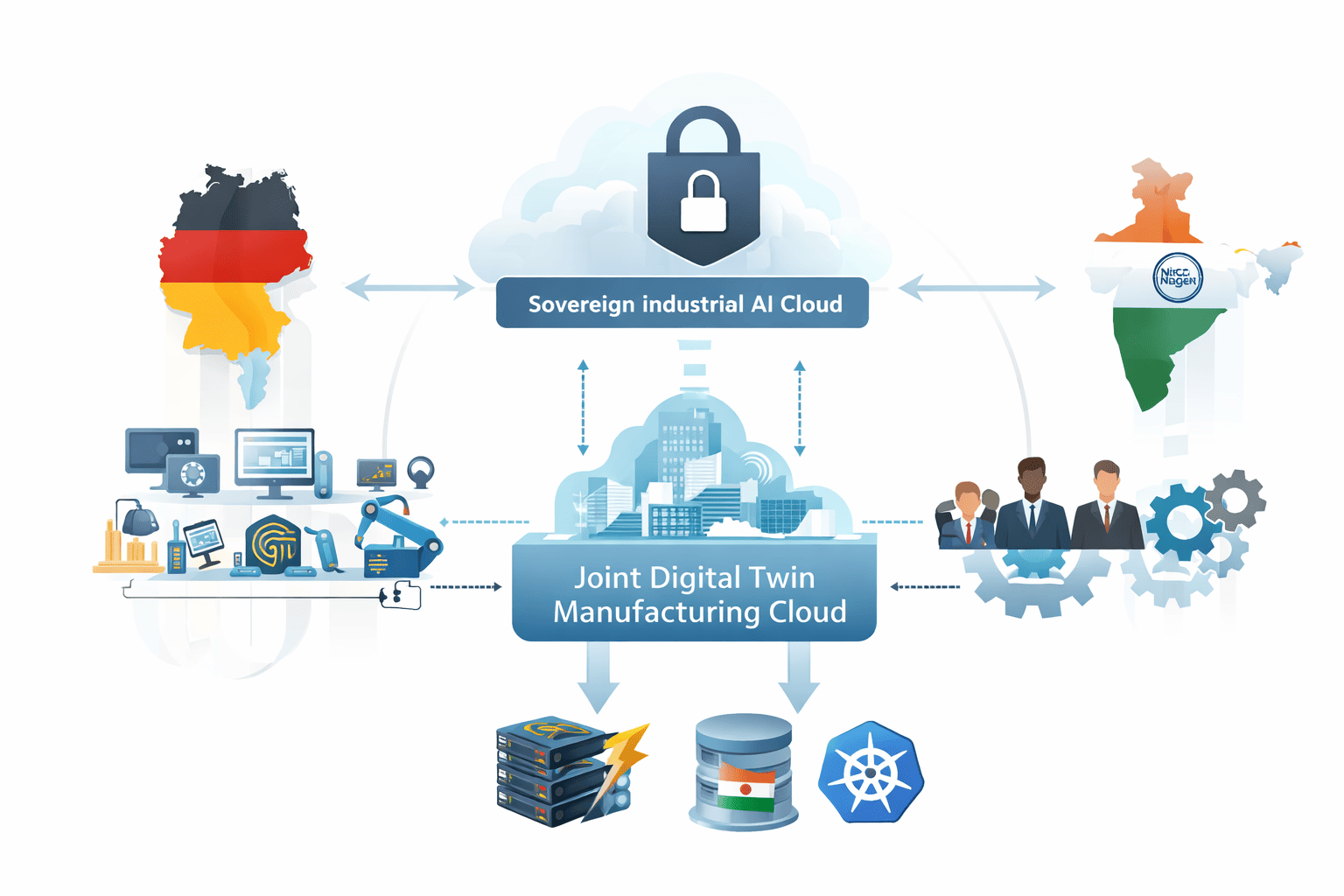
🏭 Sovereign Industrial AI Cloud — India
Breaking — 2026 Industrial AI Partnership
Bosch SDS and NxtGen Launch India’s Sovereign Industrial AI Cloud — Digital Twins, GPU Infrastructure & Real-Time Factory AI in One Platform
Bosch Software and Digital Solutions (Bosch SDS) — the software and digital subsidiary of Germany’s Bosch Group, one of the world’s largest engineering and technology companies — has formally partnered with NxtGen Datacenter & Cloud Technologies, India’s sovereign cloud infrastructure provider, to launch a sovereign industrial AI cloud for Indian enterprises.
The initiative addresses a critical problem for Indian manufacturers deploying AI at scale: where does the data go? Enterprise AI workloads in manufacturing — predictive maintenance models, quality inspection vision AI, digital twin simulations — generate enormous volumes of sensitive operational data. Until now, running these workloads on international cloud platforms meant production data leaving India. The Bosch SDS × NxtGen platform eliminates that risk entirely: all AI workloads are hosted within India, meeting data residency requirements and emerging regulatory mandates around industrial data sovereignty.
The collaboration combines Bosch SDS’s manufacturing AI, IoT, simulation and engineering platforms — built on Bosch’s decades of industrial domain expertise — with NxtGen’s sovereign GPU cloud, edge data centres, and GPU-as-a-service capabilities. Together, the companies are co-developing a Digital Twin – Manufacturing Cloud: a platform that creates virtual replicas of physical factory assets and processes, runs AI simulations and predictive analytics on those replicas, and enables real-time operational decisions — all hosted on sovereign Indian infrastructure.
NxtGen will provide managed GPU infrastructure including provisioning, lifecycle management, 24-hour monitoring, security management, performance optimisation, and Kubernetes-based orchestration for distributed AI workloads. Bosch SDS will deliver domain-specific AI applications, platform engineering, and solution integration across manufacturing and enterprise environments. The architecture supports both edge deployment at factory premises and centralised cloud orchestration — enabling manufacturers to run AI inference at the machine level while maintaining remote monitoring and model management from a central platform.
Sovereign
100% India-hosted — zero data leaves national jurisdiction
Digital Twin
Joint Digital Twin – Manufacturing Cloud in co-development
Edge + Cloud
AI runs at factory edge, orchestrated from central sovereign cloud
GPU-aaS
Managed GPU infrastructure with 24/7 monitoring and Kubernetes orchestration
“The partnership includes flexible deployment models such as edge data centres and cloud-at-customer models, enabling GPU infrastructure to be deployed at customer premises while being centrally managed.”
“In manufacturing and retail, AI is rapidly evolving from dashboards to real-time operational control. That shift requires infrastructure that is local, predictable and production-grade.”
— A S Rajgopal, Managing Director & CEO, NxtGen
💡 GTsetu Perspective
When Bosch — one of the world’s most sophisticated technology companies — decides its India AI strategy requires a local sovereign infrastructure partner rather than building its own data centres, that is the signal every global technology company needs to hear. The fastest way into a regulated market is not to build your own compliance infrastructure. It is to find a verified local partner who already has it — and let them carry the regulatory complexity while you focus on your domain AI expertise. That is exactly what NxtGen provides for Bosch SDS in India. GTsetu is where you find the NxtGen for your market.
Section 2 — The Anatomy
2 Anatomy of the Partnership — What Each Partner Brings
The Bosch SDS × NxtGen partnership is a textbook complementarity deal. Neither company could have built the combined platform at this speed or quality alone. Bosch SDS has the industrial AI domain expertise that took decades to accumulate; NxtGen has the sovereign GPU cloud infrastructure that took years and hundreds of millions to build and certify. The gap between them is exactly the value the partnership creates.
Partnership Anatomy — Bosch SDS × NxtGen — Sovereign Industrial AI Cloud — India
Bosch SDS
🇩🇪 Germany — Bosch Group subsidiary
What they bring
Industrial AI + Domain Expertise
Core capability
Manufacturing AI, IoT, digital twin, simulation platforms
AI applications
Predictive maintenance, asset optimisation, quality AI
Manufacturing AI domain expertise, industrial IoT platforms
Position
India’s sovereign cloud infrastructure leader
🤖 Sovereign Industrial AI Cloud — 100% India-hosted
🏭 Digital Twin – Manufacturing Cloud in joint development
⚡ Edge AI at factory + centralised GPU cloud orchestration
🔒 Zero data leaves India — full regulatory compliance
Collaboration Dimension
What Bosch SDS Provided
What NxtGen Provided
Why This Balance Works
AI Domain Knowledge
Decades of manufacturing AI, IoT sensor integration, simulation and engineering platform expertise across global Bosch factories
Understanding of Indian enterprise IT environments and workload patterns at scale
Bosch SDS knows what manufacturing AI needs to do; NxtGen knows the infrastructure Indian enterprises can actually run it on
Infrastructure
Platform architecture, AI model training pipelines, inference engine design
GPU-as-a-Service, edge data centres, Kubernetes orchestration, 24/7 NOC monitoring
Bosch SDS focuses purely on AI software; NxtGen handles every layer of the hardware and cloud infrastructure stack
Data Sovereignty
Enterprise-grade data processing logic and AI model IP
India-resident cloud infrastructure with certified data residency and regulatory compliance
Bosch SDS’s AI models run in NxtGen’s compliant environment — Indian manufacturers get world-class AI without international data risk
Go-to-Market
Global Bosch brand recognition and enterprise sales relationships in manufacturing
Established Indian enterprise customer base and local sales infrastructure
Bosch SDS opens doors with global brand credibility; NxtGen converts with local market knowledge and existing relationships
Deployment Flexibility
Platform designed for hybrid edge-cloud architectures
Edge data centre infrastructure deployable at customer premises (cloud-at-customer model)
Together they support any deployment topology — from fully centralised cloud to fully on-premise factory edge — that an Indian manufacturer requires
Regulatory Navigation
International AI governance and data handling standards (ISO, IEC)
India PDPB compliance, MEITY cloud policy alignment, CERT-In requirements
Each partner handles regulatory complexity in their own domain — no learning curve for either party in areas outside their expertise
Section 3 — The Technology
3 The Technology Stack — Inside the Digital Twin Manufacturing Cloud
The joint Digital Twin – Manufacturing Cloud is not simply Bosch’s AI software running on NxtGen’s servers. It is an integrated platform architecture in which both partners’ capabilities are combined at the infrastructure, orchestration, and application layers — each layer requiring both companies’ technology to function.
🏗️ Platform Architecture — Bosch SDS × NxtGen Sovereign Industrial AI Cloud
🏭
Factory Edge Layer
AI inference runs at the machine and production line level — zero latency for real-time quality control and predictive maintenance decisions. Edge data centres deployed at customer premises.
NxtGen Edge Infrastructure
🔗
IoT & Sensor Integration
Bosch SDS’s industrial IoT platforms connect factory sensors, SCADA systems, and PLCs — feeding real-time operational data into the digital twin and AI models continuously.
Bosch SDS IoT Platform
🖥️
Digital Twin Engine
Virtual replicas of physical factory assets and processes run in real time — enabling simulation, what-if analysis, and AI-driven optimisation without disrupting live production.
Bosch SDS Simulation Platform
🧠
GPU AI Compute Layer
NxtGen’s managed GPU infrastructure runs model training, inference pipelines, and orchestration workloads at scale. Kubernetes-based orchestration manages distributed AI across edge and cloud.
NxtGen GPU-as-a-Service
🔒
Sovereign Data Residency
All data — operational, production, model weights — remains within India’s borders on NxtGen’s certified infrastructure. Full compliance with Indian data localisation regulations.
NxtGen Sovereign Cloud
📊
Manufacturing Intelligence
Bosch SDS domain AI applications deliver predictive maintenance alerts, asset optimisation recommendations, production yield improvements, and anomaly detection across the factory.
Bosch SDS AI Applications
Capability
Technology Owner
What It Does for Manufacturers
Why It Requires Collaboration
Predictive Maintenance AI
Bosch SDS
Predicts equipment failure before it happens — reducing unplanned downtime by 30–50% in mature deployments
Requires domain-trained AI models from Bosch SDS AND sovereign GPU compute from NxtGen to run at production scale
Digital Twin Simulation
Bosch SDS
Creates virtual replicas of factory assets — enabling design changes to be tested digitally before physical implementation
GPU-intensive simulation workloads require NxtGen’s managed GPU infrastructure to run at enterprise scale cost-effectively
GPU-as-a-Service
NxtGen
Provides on-demand GPU compute for AI training and inference — without capital investment in dedicated hardware
Requires Bosch SDS AI workloads to justify GPU utilisation and enterprise positioning in industrial market
Edge AI Deployment
Both
Runs AI inference at factory premises — sub-millisecond decisions for quality control and safety systems
Requires Bosch SDS’s inference-optimised AI models AND NxtGen’s edge data centre infrastructure deployed at customer sites
Sovereign Data Compliance
NxtGen
Ensures all manufacturing data stays in India — meeting PDPB and sectoral data localisation requirements
Cannot be achieved by Bosch SDS alone — requires NxtGen’s physically India-resident certified cloud infrastructure
AI Workload Orchestration
Both
Kubernetes-based management of AI models across distributed factory-cloud environments — central control, local execution
Requires Bosch SDS’s AI model management logic integrated with NxtGen’s Kubernetes orchestration layer
⚡ The Architecture Insight: Edge + Sovereign Cloud = Manufacturing AI Without Compromise
The most technically elegant aspect of the Bosch SDS × NxtGen architecture is the edge-cloud hybrid model. AI inference — the production-critical decisions — runs at the factory edge with zero latency and no data leaving the premises. AI training, model updates, and centralised monitoring run on NxtGen’s sovereign GPU cloud with full compliance. The result: manufacturers get real-time AI performance AND data sovereignty AND centralised management. Previously, getting all three simultaneously required building your own private cloud — which only companies the size of Toyota or Tata could afford. This partnership makes it accessible to any Indian enterprise manufacturer.
Section 4 — Why India
4 Why India? The Industrial AI Opportunity That Moved Bosch SDS
🇮🇳 India Industrial AI & Manufacturing Technology Opportunity 2025–2030
Why Global Tech Giants Are Making India Their Industry 4.0 Sovereignty Play
India’s manufacturing sector is undergoing the most significant technology transformation in its history — driven by the government’s Production Linked Incentive (PLI) schemes, the Make in India push, and a manufacturing export target of $1 trillion by 2030. This scale of industrial expansion creates massive demand for AI-driven manufacturing intelligence — predictive maintenance, quality control, digital twins, and real-time operational AI. The constraint has been data sovereignty: Indian manufacturers have been reluctant to push sensitive production data to international cloud platforms. The Bosch SDS × NxtGen sovereign cloud removes that constraint entirely.
$1T
India manufacturing export target by 2030 — driving massive Industry 4.0 investment
PLI
Production Linked Incentive schemes across 14 sectors accelerating factory technology adoption
PDPB
India’s Personal Data Protection Bill mandates data localisation — sovereign cloud is compliance, not choice
Edge AI
Factory AI moving from analytics to real-time control — requires local infrastructure, not international cloud
GPU Shortage
Global GPU scarcity makes managed GPU-as-a-service the only viable path for most Indian manufacturers
2026+
Production starts — positioned ahead of mass-market India Industry 4.0 adoption curve
🏭 Why NxtGen’s Infrastructure Was the Right Choice for Bosch SDS
What NxtGen Gives Bosch SDS That No International Cloud Can
Bosch SDS evaluated its India AI deployment options and chose NxtGen for reasons that go beyond simple infrastructure availability. Each of NxtGen’s capabilities solves a specific problem that would have taken Bosch SDS years to replicate independently.
🔒
Sovereign by Design
Built from the ground up for India data residency — not retrofitted international cloud
🧠
GPU-as-a-Service
Managed GPU lifecycle — provisioning to decommission — with 24/7 performance monitoring
🏗️
Edge Data Centres
Deployable at customer premises — enabling cloud-at-customer for maximum data control
⚙️
Kubernetes Orchestration
Production-grade workload management across distributed edge and cloud environments
🏛️
Regulatory Standing
MEITY-aligned, CERT-In compliant — the credentials Indian enterprise IT teams require
📡
Enterprise Customer Base
Existing Indian enterprise relationships give Bosch SDS immediate market access
Section 5 — What Is Collaboration
5 What Is a Tech-Manufacturing Collaboration — And Why Do Companies Do It?
🎯 Definition
A tech-manufacturing collaboration is a formal partnership between a technology platform company and a manufacturing-adjacent infrastructure or services provider — typically from different geographies, regulatory environments, or capability specialisations — to jointly deliver AI, cloud, or industrial technology solutions to enterprise customers. The Industrial AI sector is uniquely suited to collaboration because no single company can simultaneously possess world-class domain AI expertise, sovereign cloud infrastructure, regulatory compliance across every national jurisdiction, and established local enterprise relationships. Bosch SDS has the AI. NxtGen has the sovereign infrastructure. Neither can fully replace the other — and the Indian manufacturer gets both, integrated, from a single platform.
Why Tech Companies Collaborate in Manufacturing AI — The 6 Strategic Drivers
Sovereignty
Data localisation laws make sovereign cloud infrastructure a non-negotiable — international tech companies need a local partner to comply
Speed
Building certified sovereign data centres takes 3–5 years; NxtGen’s existing infrastructure gives Bosch SDS India market entry in months
Domain AI
Manufacturing AI domain expertise — Bosch’s proprietary models trained on decades of industrial data — cannot be acquired or built quickly
GPU Access
Global GPU scarcity means managed GPU-as-a-service is more reliable than direct procurement — NxtGen solves this for Bosch SDS’s customers
Enterprise Trust
Indian CIOs trust NxtGen’s sovereign credentials; global CXOs trust Bosch’s engineering pedigree — together they unlock both boardrooms
GTM Speed
NxtGen’s existing Indian enterprise customer base gives Bosch SDS an immediate sales channel — bypassing years of local market development
Section 6 — Types of Collaboration
6 4 Types of Tech-Manufacturing Collaboration — Which Fits Your Company?
Not every tech collaboration needs to be a full platform co-development like Bosch SDS × NxtGen. The right structure depends on how deeply you need to integrate your technology with your partner’s infrastructure, how much IP you are willing to share, and how quickly you need to generate joint revenue.
01
Strategic Technology Partnership
Full platform co-development: both partners integrate their core technology stacks into a joint solution. The Bosch SDS × NxtGen model — best when both partners bring large, irreplaceable capabilities and a long-term joint GTM vision in a clearly defined market segment. Requires deep technical integration and formal IP governance from day one.
🤖 Bosch SDS × NxtGen Model
02
Technology / IP Licensing
You license your AI platform, algorithms, or industrial software to a local infrastructure or enterprise solutions provider. They deploy and service it under their brand or a co-branded arrangement. You receive royalties without operational integration. Faster and lower-risk than full partnership — but limits joint upside and GTM coordination.
💡 Asset-light expansion
03
White-Label / OEM Platform
Your technology platform is embedded in your partner’s product and sold under their brand. You manufacture (in this case, develop) the underlying platform; your partner handles the customer relationship, compliance, and local support. Maximum market reach with minimum GTM investment — appropriate when your platform is modular and partner can integrate without deep engineering collaboration.
🏷️ Embedded platform model
04
Reseller / Channel Partnership
A local technology distributor or systems integrator resells your AI or industrial software platform to their enterprise customer base. The lightest collaboration form — no product integration, no shared development. The correct first step when you are validating market demand in a new geography before committing to a deeper technology partnership.
🌍 Market entry step 1
📊 Tech-Manufacturing Collaboration Model Comparison Matrix
Model
Integration Depth
IP Exposure
Time to Revenue
Sovereignty Compliance
Joint GTM Strength
Best For
GTsetu Support
Strategic Partnership
Deep — full stack integration
High
6–18 months
✓ Maximum — partner infrastructure is the compliance layer
✓ Strongest
Long-term market anchor; co-development; joint IP creation
✓ Partner matching
IP Licensing
Low — API or SDK only
Medium
3–9 months
✓ High — licensee handles deployment compliance
~ Moderate
Asset-light geographic expansion; royalty income
✓ Licensing partner search
White-Label / OEM
Medium — embedded platform
Medium-High
3–6 months
~ Partner-dependent
~ Partner-led
Scale without sales investment; established partner brand
✓ OEM partner search
Reseller / Channel
Minimal — product only
Low
1–3 months
✗ None — your platform’s deployment compliance is your responsibility
✗ Partner’s existing network only
Market validation; demand testing before deeper investment
✓ Verified resellers in 100+ countries
Section 7 — How to Collaborate
7 How to Collaborate: A 6-Step Tech-Manufacturing Partnership Playbook
The Bosch SDS × NxtGen partnership did not happen through a trade show meeting or a government matchmaking event. It happened because Bosch SDS needed a specific capability — sovereign GPU cloud with India data residency compliance and edge infrastructure — that only a small number of Indian companies actually possess at enterprise grade. Identifying NxtGen as that partner required systematic capability verification, not serendipity. Here is the complete playbook.
1
Define the Capability Gap With Brutal Precision
Before you search for a partner, you need to answer one question with precision: what exact capability do you need that you cannot build faster or more cost-effectively yourself in the target market? Bosch SDS’s answer was specific: India-sovereign GPU cloud infrastructure with certified data residency compliance, edge data centre deployability at customer premises, and an existing Indian enterprise customer base. Vague answers — “we need a local partner in India” — produce vague searches and poor partner matches. The precision of your capability requirement determines the quality of your partner identification. GTsetu’s structured partner discovery framework forces this precision before any search begins.
2
Identify and Verify Partners Systematically — Not Through Networks
NxtGen is India’s sovereign cloud infrastructure leader — but that position is only visible if you look at certified infrastructure credentials, not at marketing claims. Most tech companies entering new markets rely on existing networks, VC introductions, or government matchmaking — which consistently surface the most visible companies, not the most technically capable ones for your specific requirement. GTsetu’s multi-layer verified partner network provides documented capability profiles — infrastructure certifications, MEITY registration, CERT-In compliance status, actual GPU fleet capacity, and customer references — before you invest a single hour in conversation with any candidate partner.
3
Protect Your AI and Platform IP Before Any Technical Disclosure
In tech-manufacturing collaborations, your AI model weights, training data methodology, inference pipeline architecture, and platform API design are the core commercial assets. Unlike physical manufacturing IP, AI IP is extraordinarily easy to inadvertently disclose in early “exploratory” technical discussions. Before any architecture review, model demonstration, or API documentation is shared with a potential partner, a countersigned NDA with explicit AI IP scope must be in place. This includes: model weights and training methodology, inference pipeline design, proprietary industrial data processing logic, and platform integration specifications. GTsetu’s built-in NDA workflow executes this automatically, with a complete audit trail, before any technical disclosure occurs.
4
Run a Controlled Pilot Before Full Platform Integration
A strategic technology partnership of the Bosch SDS × NxtGen depth requires months of technical integration work. Before committing that engineering investment, validate the fundamental compatibility: Can NxtGen’s GPU infrastructure actually run Bosch SDS’s AI inference workloads at the latency and throughput specifications the platform requires? Does the data sovereignty compliance hold under real enterprise audit conditions? Are the Kubernetes orchestration capabilities compatible with Bosch SDS’s workload management requirements? A controlled pilot — a single use case, a single customer site, a defined 90-day window — answers all of these questions at a fraction of the cost of discovering incompatibility after full integration.
5
Structure the Partnership Agreement in Writing — Every Commercial Term
A strategic technology partnership must be governed by a formal agreement that covers: IP ownership for jointly developed technology (the Digital Twin – Manufacturing Cloud platform components developed by both teams); data handling and sovereignty responsibilities (who is accountable if a data residency breach occurs); SLA commitments and consequences for GPU infrastructure downtime; joint go-to-market terms including territory, lead ownership, co-marketing responsibilities, and revenue share; and exit clauses that protect both parties if the technical integration fails to achieve commercial targets or if regulatory requirements change. In AI partnerships specifically, the IP ownership of models fine-tuned on customer data must be addressed explicitly — this is consistently the most contentious issue in post-deployment disputes.
6
Establish Joint GTM Governance and Customer Engagement Protocols
Technology partnerships fail most commonly not in technical integration but in go-to-market execution — when two companies try to jointly sell to the same customer without clear protocols. Bosch SDS and NxtGen will jointly pursue enterprise opportunities, which requires explicit agreement on: who owns the customer relationship for each opportunity, how joint proposals are structured and priced, how technical demonstrations are coordinated, and how post-sale support responsibilities are divided between Bosch SDS’s AI application layer and NxtGen’s infrastructure layer. Every ambiguity in GTM governance becomes a customer-visible problem within 6 months of the partnership going live. GTsetu’s collaboration workspace provides structured frameworks for documenting these protocols before the first joint customer engagement.
Section 8 — Dos and Don’ts
8 Dos and Don’ts of Cross-Border Tech-Manufacturing Collaboration
✅ Do These
✅ Verify your partner’s actual sovereign cloud certifications independently — not their marketing collateral alone
✅ Define AI IP ownership for jointly developed models before any co-development begins
✅ Execute a countersigned NDA covering model weights, inference pipelines, and platform APIs before any technical disclosure
✅ Run a 90-day pilot on a single use case before committing to full platform integration
✅ Align on data sovereignty and regulatory compliance responsibilities in writing, not verbally
✅ Choose a partner whose infrastructure certifications are genuinely compliant with your target customers’ requirements
✅ Define joint GTM protocols — lead ownership, pricing, proposal structure, post-sale support — before the first customer engagement
✅ Build SLA commitments for GPU infrastructure availability into the partnership agreement — downtime affects your AI platform’s reputation
✅ Establish clear exit clauses covering IP reversion, customer data handling, and infrastructure transition
✅ Start with an Indian enterprise customer segment where your partner already has relationships and credibility
❌ Avoid These
❌ Share AI model architecture or platform APIs before a countersigned NDA with explicit AI IP scope
❌ Assume data sovereignty compliance without independently verifying infrastructure certifications
❌ Skip the pilot and go straight to full platform integration based on partner technical claims alone
❌ Leave AI IP ownership of jointly developed models ambiguous — this is the most common cause of tech partnership disputes
❌ Choose a partner for market access without verifying their technical infrastructure can actually run your AI workloads
❌ Allow your AI models to be fine-tuned on customer data without explicit IP ownership clauses covering those fine-tuned variants
❌ Build your India sovereign cloud from scratch when a certified partner eliminates 3–5 years of infrastructure development
❌ Underestimate the complexity of integrating AI inference pipelines across edge and cloud environments — this is a multi-month engineering programme
❌ Enter a deep strategic partnership as a first interaction — validate with a pilot, licensing deal, or reseller relationship first
Section 9 — Misconceptions
9 Common Misconceptions That Kill Tech-Manufacturing Collaborations
❌ Myth
“We can just deploy our AI platform on AWS or Azure India region — that satisfies data sovereignty.”
✅ Reality
AWS and Azure India regions store data within India geographically, but the parent companies are subject to US law, including the CLOUD Act, which can compel data disclosure to US authorities. For Indian manufacturers in defence, critical infrastructure, or regulated industries, this creates a genuine sovereignty gap. NxtGen’s infrastructure is operated by an Indian entity, subject only to Indian law — a material compliance difference that a sovereign cloud partnership like Bosch SDS × NxtGen uniquely addresses.
❌ Myth
“Our AI platform is containerised — any cloud infrastructure partner can run it without integration work.”
✅ Reality
Containerisation handles application deployment, not performance optimisation or security integration. Running Bosch SDS’s manufacturing AI on NxtGen’s GPU infrastructure required specific GPU driver configuration, CUDA version alignment, Kubernetes operator customisation, model serving framework integration, and edge-cloud network architecture design. None of this is automatic from containerisation alone. The assumption that any cloud can run any AI platform is the most common cause of AI partnership technical failures — discovered only after the partnership agreement is signed.
❌ Myth
“A reseller agreement is enough — we don’t need a deep technology partnership to sell AI in India.”
✅ Reality
A reseller agreement is the correct first step — but it cannot deliver the sovereign compliance, edge deployment, and GPU-as-a-service that Indian manufacturing enterprises are now requiring as standard. Indian CIOs are increasingly disqualifying AI platforms that cannot demonstrate sovereign infrastructure compliance. A reseller selling your platform on non-sovereign infrastructure is a market access strategy, not a market capture strategy. The Bosch SDS × NxtGen model wins enterprise mandates that a pure reseller channel cannot — because the platform itself is compliant, not just the reseller’s promises.
❌ Myth
“Manufacturing AI is too complex for a partner to deliver — we need to own the full stack ourselves.”
✅ Reality
Full-stack ownership is commercially rational only if you can build every layer faster, better, and cheaper than a specialist partner. Bosch SDS could theoretically build its own India data centres — Bosch Group has the capital. But it would take 3–5 years, hundreds of millions in capex, and regulatory certification processes that NxtGen has already completed. The collaboration model is not about capability limitation — it is about opportunity cost. Every month Bosch SDS spends building sovereign cloud infrastructure is a month it is not building industrial AI models. Partnerships let each company focus entirely on where they create the most value.
❌ Myth
“India’s Industry 4.0 market is still too early — we should wait until the market matures before partnering.”
✅ Reality
The Indian manufacturing AI market is growing fastest precisely now — before mass-market platform standardisation, when early partnerships define the platform choices that enterprises will live with for 5–10 years. Companies that establish sovereign industrial AI platforms in 2026 will hold the enterprise procurement relationships and technical integrations that competitors entering in 2028 will find structurally inaccessible. Bosch SDS is entering India’s industrial AI market at the moment of maximum strategic leverage — not waiting for proof of demand.
Section 10 — Comparison
10 Strategic Partnership vs Licensing vs White-Label — Full Tech Collaboration Comparison
Factor
Strategic Partnership (Bosch × NxtGen Model)
IP / Platform Licensing
White-Label / OEM
Reseller / Channel
Legal structure
Partnership agreement + joint development agreement + revenue share
License agreement — no operational integration
OEM or white-label manufacturing / embedding agreement
Reseller or distribution agreement
Engineering commitment
High — full stack integration over 6–18 months
Low — API/SDK documentation only
Medium — platform embedding and brand customisation
Minimal — product training only
AI IP exposure
High — partner has deep platform access
Medium — licensee uses your API or SDK
High — partner embeds your full platform
Low — partner sells finished product
Sovereignty compliance
✓ Maximum — partner IS the compliance infrastructure
✓ High — licensee handles deployment compliance
~ Partner-dependent
✗ Your platform’s compliance — your responsibility
Time to first revenue
Slowest (6–18 months integration + certification)
Medium (3–9 months)
Medium (3–6 months)
Fastest (1–3 months)
Joint GTM strength
✓ Maximum — fully integrated joint offering
~ Moderate — licensee-led
~ Partner-led, limited co-brand visibility
✗ Minimal — partner’s existing pitch only
GTsetu support
✓ Strategic partner matching
✓ Licensing partner search
✓ OEM partner search globally
✓ Verified resellers in 100+ countries
Best when…
Both partners have large irreplaceable capabilities; long-term market anchor; data sovereignty is a hard customer requirement
Strong AI IP but limited desire for operational integration; royalty income model
Platform is modular and partner has strong brand in target market
First-step market validation; testing demand before deeper investment
Section 11 — GTsetu
11 How GTsetu Helps You Find the Right Tech-Manufacturing Partner
Bosch SDS found NxtGen. For your company, the question is: how do you find the verified sovereign infrastructure, manufacturing technology, or industrial AI partner you need — in a market you don’t yet operate in? Most technology companies still rely on existing networks, VC introductions, and government trade missions. These consistently produce the most visible candidates — not the most capable ones for your specific technical requirement. GTsetu enables the same systematic, verified partner discovery that underpins every successful cross-border tech-manufacturing collaboration — at any scale.
🌐 Platform Spotlight — GTsetu
Find Verified Tech-Manufacturing Partners Across 100+ Countries — Before You Share a Single Line of Code or Platform Architecture
GTsetu is the verified B2B manufacturing and technology partner discovery platform where industrial AI companies, cloud infrastructure providers, sovereign tech operators, contract manufacturers, and distribution partners connect with transparent, documented capability profiles — zero broker fees on any partnership formed. Every partner is multi-layer verified. You evaluate who’s real and capable before you commit a single conversation. You share nothing technically sensitive until an NDA is in place.
✅
Multi-Layer VerificationInfrastructure certifications, regulatory compliance status, GPU fleet capacity, customer references — capability claims are documented, not self-reported.
🕵️
Anonymous DiscoveryEvaluate verified partner profiles without revealing your company identity or platform architecture until mutual interest is confirmed.
📄
Built-In NDA WorkflowShare platform specs and AI architecture only after an NDA is countersigned — full audit trail, no external legal required.
🚫
Zero CommissionNo broker fees. Your strategic partnership, licensing deal, or reseller agreement stays entirely between you and your partner.
🌍
100+ CountriesFind strategic tech partners, OEM partners, licensing targets, and verified distributors across every major manufacturing and technology market.
🔐
Encrypted CollaborationShare AI platform roadmaps, infrastructure requirements, and integration specifications securely between verified partners.
What Bosch SDS Did to Find NxtGen — What GTsetu Enables for You
What Bosch SDS Did to Find NxtGen
What GTsetu Enables for You
Why This Matters
Identified the Indian sovereign cloud provider with verified GPU infrastructure, MEITY compliance, and enterprise customer base
✓ Browse verified profiles with documented infrastructure certifications, compliance status, and customer references
No technical or compliance surprises after you’ve disclosed your AI platform architecture
Validated NxtGen’s GPU infrastructure could actually run Bosch SDS AI workloads before full integration commitment
✓ Request pilot engagements through GTsetu’s structured collaboration framework before full partnership
Incompatibility discovered in a pilot costs weeks; discovered after integration costs months and reputational damage
Structured formal partnership documentation covering IP, GTM, and data sovereignty before joint customer engagement
✓ Built-in NDA and collaboration workflow — AI IP and commercial terms protected from the first technical conversation
Tech partnerships that start without formal IP governance end with disputes over jointly developed model ownership
Chose a partner with genuinely complementary capabilities — NxtGen has no AI; Bosch SDS has no sovereign cloud
✓ Detailed capability profiles identify true strategic complementarity before any engagement
Partnership value comes from the capability gap between partners — not the overlap. GTsetu’s profiles make this gap visible before engagement
Committed to zero broker intermediation — direct partnership, direct revenue share, direct customer relationships
✓ Zero commission — all partnerships are direct, between you and your partner, not split with a matchmaker
Broker commissions on recurring technology partnerships compound into millions — GTsetu eliminates this permanently
FAQ
? Frequently Asked Questions
QWhat exactly is the Bosch SDS and NxtGen sovereign industrial AI cloud?
Bosch Software and Digital Solutions (Bosch SDS) has partnered with NxtGen to launch a sovereign industrial AI cloud in India — a platform that combines Bosch SDS’s manufacturing AI, IoT, simulation and engineering platforms with NxtGen’s sovereign GPU cloud, edge data centres, and GPU-as-a-service infrastructure. All AI workloads are hosted entirely within India to meet data residency and regulatory compliance requirements. The companies are jointly developing a Digital Twin – Manufacturing Cloud that supports AI-driven manufacturing intelligence, predictive maintenance, and asset optimisation, while enabling industrial data to move between factory edge environments and a centralised sovereign cloud — without leaving India’s borders.
QWhat is a sovereign industrial AI cloud and why does it matter for Indian manufacturers?
A sovereign industrial AI cloud is cloud computing infrastructure hosted entirely within a country’s national borders, operated by an entity subject to that country’s laws — ensuring that sensitive operational and production data never leaves national jurisdiction. For Indian manufacturers, this matters because production data (machine sensor readings, quality inspection results, supply chain data) is commercially sensitive and increasingly subject to India’s data localisation regulations. Deploying industrial AI on international cloud platforms creates compliance risk and potential for foreign legal data access. The Bosch SDS × NxtGen sovereign cloud eliminates both risks — enterprise-grade AI runs on infrastructure that is physically, legally, and operationally within India.
QWhy did Bosch SDS partner with NxtGen instead of using AWS India or Azure India regions?
AWS and Azure India regions store data geographically within India, but the parent companies (Amazon and Microsoft) are US entities subject to the US CLOUD Act, which can compel data disclosure to US law enforcement. For Indian manufacturers in regulated sectors — defence, critical infrastructure, BFSI — this creates a genuine sovereignty gap. NxtGen is an Indian entity, subject only to Indian law, with infrastructure that satisfies true data sovereignty requirements. Additionally, NxtGen provides GPU-as-a-Service and edge data centre capabilities deployable at customer premises (cloud-at-customer), which international hyperscalers do not offer at the same compliance level or local infrastructure depth.
QWhat collaboration model is right for my technology company entering a new market?
The right model depends on three factors: how deeply your platform needs to integrate with local infrastructure, how much AI IP you are willing to expose, and whether you have an existing relationship with the target partner. A strategic technology partnership (like Bosch × NxtGen) is right when both partners bring large irreplaceable capabilities and data sovereignty is a hard customer requirement. IP licensing is right when you have strong AI IP but want asset-light expansion. White-label / OEM embedding works when your platform is modular and a partner’s brand is stronger in the target market. A reseller agreement is the correct first step when you are validating market demand before any deeper commitment. GTsetu supports all four models — strategic partner matching, licensing partner search, OEM partner search, and verified resellers across 100+ countries.
QHow can GTsetu help me find an industrial AI or sovereign cloud partner like NxtGen?
GTsetu’s five-step process: (1) Define your objective precisely — what specific infrastructure capability, compliance certification, or market access does the partner need to provide? (2) Search verified profiles — GTsetu lists multi-layer verified technology and manufacturing partners across 100+ countries with documented capabilities, certifications, and customer references. (3) Evaluate anonymously first — review partner profiles without revealing your company identity or platform architecture. (4) Execute NDA automatically — GTsetu’s built-in workflow means you disclose nothing technically sensitive until a mutual NDA is countersigned with a full audit trail. (5) Run a controlled pilot — validate infrastructure compatibility and commercial alignment under real conditions before full partnership commitment. Zero broker commission on any partnership formed. Start your partner search on GTsetu →
QWhat are the biggest risks in cross-border industrial AI partnerships like Bosch SDS × NxtGen?
The five most significant risks are: (1) AI IP leakage — model weights, inference pipeline design, and training methodology are core commercial assets; formal IP ownership documentation is essential before any technical disclosure. (2) Sovereignty compliance gap — marketing claims about data residency must be independently verified against actual infrastructure certifications before any customer commitments. (3) Technical incompatibility discovered post-commitment — AI workload performance requirements must be validated on partner infrastructure in a pilot, not assumed from technical specifications. (4) GTM governance failure — joint selling without explicit lead ownership and revenue share protocols creates customer-visible conflict within months. (5) Jointly developed IP disputes — when both partners contribute to a new platform feature or model, ownership must be contractually defined before development begins. Starting with a verified, technically documented partner from GTsetu’s network reduces all five risks before they surface.
500+ verified manufacturers, technology partners, sovereign infrastructure providers, and industrial AI enablers across 100+ countries. Zero broker fees. Anonymous discovery. Built-in NDA workflows. Your next cross-border tech-manufacturing collaboration starts with a verified profile — not a trade mission or VC introduction.
They represents the product, and research team behind GTsetu, a global B2B collaboration platform built to help companies explore cross-border partnerships with clarity and trust. The team focuses on simplifying early-stage international business discovery by combining structured company profiles, verification-led access, and controlled collaboration workflows.
With a strong emphasis on trust, and disciplined engagement, Team GTsetu shares insights on global trade, partnerships, and cross-border collaboration, helping businesses make informed decisions before entering deeper commercial discussions.