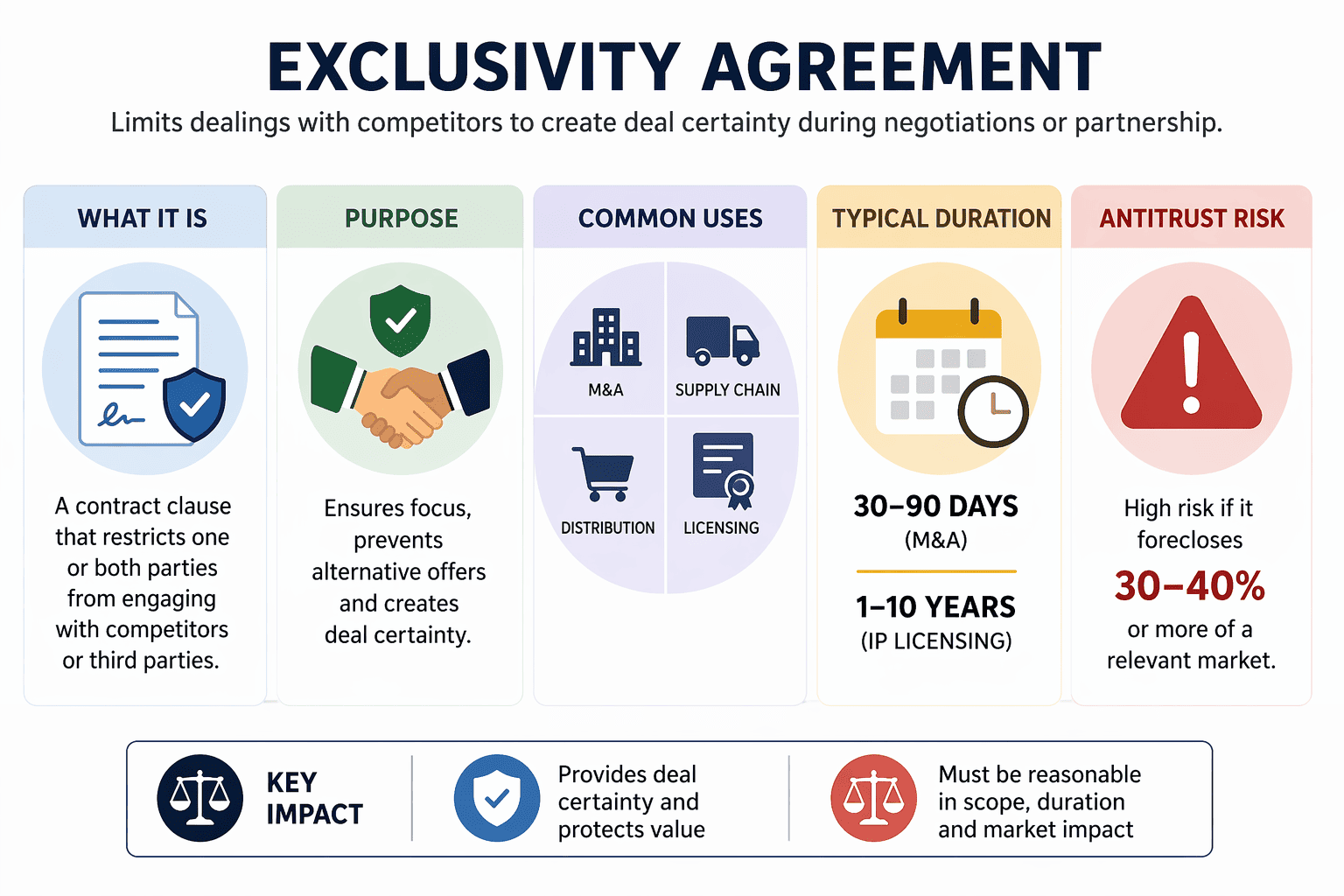
How an Exclusivity Agreement Works
In cross-border negotiations, whether for a manufacturing partnership, a distribution agreement, a joint venture, or an M&A transaction, the party that initiates the process often invests substantial resources in due diligence, legal fees, and management time before any binding transaction agreement is signed. Without exclusivity protection, the counterparty may continue negotiating with competitors, using the first party’s investment to drive up the price or to extract better terms elsewhere. An exclusivity clause addresses this risk.
Once an exclusivity provision is agreed, typically within an LOI, Term Sheet, or standalone Exclusivity Agreement, the restricted party is legally prohibited from initiating, soliciting, or entertaining discussions with any third party regarding a competing transaction for a defined period (usually 30 to 90 days, sometimes longer in complex M&A). The exclusivity period gives the other party a protected window to complete due diligence, negotiate definitive documentation, and secure financing without the risk of being outbid or circumvented.
Exclusivity obligations are binding in most commercial jurisdictions when properly drafted. However, courts in England, Singapore, and the United States will not enforce an exclusivity clause of indefinite duration or unreasonably broad scope. The duration must be proportionate to the complexity of the transaction, and the scope must be clearly defined. In India, exclusivity is enforceable subject to reasonableness under Section 27 of the Indian Contract Act, 1872, which prohibits general restraints on trade but allows reasonable exclusivity in commercial contracts.
⚡ Critical Distinction
An exclusivity clause is not the same as a non-compete clause. Exclusivity operates during a defined negotiation period and prevents the counterparty from engaging with third parties on a specific transaction. A non-compete operates after the termination of a relationship and restricts a party from engaging in competing business activities altogether. Exclusivity is temporary and transaction-specific; a non-compete is longer-term and broader. Both can appear in the same agreement but serve fundamentally different purposes.
Types of Exclusivity Arrangements
Types of Exclusivity in Commercial Agreements
Exclusivity provisions take several forms depending on the transaction context and the degree of protection required. The most common in international trade and partnership negotiations are no-shop clauses, no-talk clauses, no‑hire restrictions, and territorial exclusivity in distribution agreements.
🚫 No-Shop / No-Talk / No‑Due‑Diligence
Classic Exclusivity in M&A and LOIs
The restricted party agrees not to solicit, initiate, or encourage any competing proposal, not to engage in discussions with third parties about a competing transaction, and not to provide due diligence information to any third party regarding a competing proposal.
- No-shop: prohibits soliciting competing bids
- No-talk: prohibits discussing competing proposals
- No‑due‑diligence: prohibits sharing information with competing bidders
- Fiduciary-out: exception allowing board to consider superior proposals under defined conditions
- Match-right: gives the exclusive party the right to match any superior proposal
🌍 Territorial & Distribution Exclusivity
Exclusive Supply, Distribution, or Licensing
In long-term commercial agreements, exclusivity defines geographic or channel-specific rights, the supplier agrees not to appoint other distributors in a defined territory, or the distributor agrees not to carry competing product lines.
- Exclusive distribution territory (e.g., exclusive rights for India or Southeast Asia)
- Exclusive supply arrangement (buyer commits to source exclusively from supplier)
- Exclusive license (licensee has sole right to exploit IP in a defined field)
- Exclusive manufacturing or OEM relationship
- Minimum purchase or revenue commitment often paired with exclusivity
✨ GTsetu Guidance
In cross-border negotiations, GTsetu recommends that parties document exclusivity in a binding standalone clause within an LOI or Term Sheet, rather than relying on oral understandings. The clause should include: (i) a clear definition of the restricted transaction; (ii) a finite exclusivity period (30–90 days for typical commercial negotiations; longer for complex M&A); (iii) a binding obligation to negotiate in good faith during the exclusivity period (see Good Faith Negotiation); (iv) any fiduciary-out or matching-right exceptions; and (v) consequences of breach, including injunctive relief and damages. Without these elements, enforcement is uncertain and the exclusivity provides only psychological, not legal, protection.
Real-World Example
Exclusivity in Practice: The DraftKings–Fanduel Merger Litigation
The consequences of breaching an exclusivity clause, and the importance of precise drafting, are well illustrated by contested M&A litigation. While the parties ultimately abandoned the merger, the case provides a template for how exclusivity obligations are enforced.
📌 Case Study, M&A Exclusivity Dispute
In 2019, DraftKings and FanDuel entered merger discussions. Their LOI contained a typical exclusivity (no-shop) provision prohibiting FanDuel from soliciting or engaging with other potential acquirers for a defined period. During the exclusivity period, FanDuel’s management engaged in discussions with a private equity firm regarding an alternative transaction without terminating the exclusivity agreement or providing notice to DraftKings.
When DraftKings discovered the parallel negotiations, it sued for breach of the exclusivity clause, seeking damages and injunctive relief. The case settled, but the litigation illustrates a key principle: exclusivity clauses are enforceable, and parties that breach them face liability, including the risk of an injunction preventing the alternative transaction from closing. The outcome also underscores the importance of including a clear “fiduciary-out” or “superior proposal” exception if the board needs flexibility to consider better offers.
For cross-border manufacturing and distribution partnerships, the same principle applies. A supplier that signs an exclusivity letter with a buyer and then secretly negotiates with a competitor risks being sued for breach, ordered to cease discussions, and held liable for the buyer’s wasted due diligence costs and lost opportunity.
Key Clauses & Drafting
What Every Exclusivity Clause Must Address
A well-drafted exclusivity clause is precise about what is restricted, for how long, and what exceptions apply. Vague or open-ended exclusivity obligations are either unenforceable or produce disputes about scope. The following elements are essential for enforceability across major jurisdictions.
✓
Defined Transaction / Scope
The clause must specify exactly what transaction or activity is subject to exclusivity, e.g., “the proposed acquisition of Company X” or “the distribution of Product Y in Territory Z.” General language prohibiting “any transaction” is too vague.
✓
Finite Exclusivity Period
Courts will not enforce an exclusivity clause of indefinite duration. The period must be reasonable given the complexity of the transaction, typically 30–90 days for commercial negotiations, up to 180 days for complex regulatory approvals.
✓
Clear Restricted Activities
Specify what the restricted party cannot do: solicit competing proposals, enter discussions, share due diligence information, or execute a definitive agreement with a third party. Each prohibition should be separately stated.
✓
Fiduciary-Out / Superior Proposal Exception
In M&A contexts, the target’s board has fiduciary duties to shareholders. An exclusivity clause without a fiduciary-out may be unenforceable against the board if a superior proposal emerges. Include a clear exception allowing the board to consider superior proposals after providing notice and a matching right.
✓
Matching Right (Go-Shop / Match)
Gives the exclusive party the right to match any superior third-party proposal within a defined period (typically 3–5 business days). Protects the exclusive party’s investment while allowing the board to fulfil fiduciary duties.
✓
Consequences of Breach
The clause should state that breach entitles the non-breaching party to seek injunctive relief (specific performance) and damages. A liquidated damages provision (break-up fee) payable by the breaching party is common in M&A exclusivity clauses.
✓
Good Faith Negotiation Obligation
Expressly obligate both parties to negotiate in good faith during the exclusivity period. This is particularly important in civil law jurisdictions where good faith is implied, but valuable in common law jurisdictions where it is not automatically implied.
✓
Governing Law & Dispute Resolution
Exclusivity clauses are governed by the governing law of the LOI or Term Sheet. In cross-border transactions, choose a governing law with clear enforceability of exclusivity clauses, New York, England & Wales, or Singapore are common choices. Specify arbitration or court jurisdiction.
Exclusivity by Jurisdiction
Enforceability of Exclusivity Clauses Across Key Jurisdictions
Exclusivity clauses are generally enforceable across major commercial jurisdictions, but courts impose important limits: the duration must be reasonable, the scope must be clearly defined, and the clause must not operate as an unreasonable restraint on trade. The table below summarises the enforceability landscape.
| Jurisdiction | Enforceability of Exclusivity Clauses | Key Limitations / Requirements |
|---|
| England & Wales | Generally Enforceable | Duration must be reasonable; indefinite exclusivity is void. Courts apply reasonableness test. Exclusivity in LOIs is binding if clearly stated. |
| United States | Generally Enforceable | Varies by state. New York and Delaware courts routinely enforce exclusivity clauses in LOIs and Term Sheets. Duration must be reasonable (typically 30–90 days). |
| India | Enforceable (with limits) | Section 27 of the Indian Contract Act, 1872 prohibits restraints on trade. Exclusivity in commercial contracts (distribution, supply) is generally upheld if reasonable in scope and duration. Exclusivity in employment contexts is more restricted. |
| Singapore | Generally Enforceable | Follows English common law. Exclusivity clauses in LOIs and Term Sheets are enforceable if the duration is reasonable and the clause is clearly drafted. |
| Germany | Enforceable | Exclusivity clauses are generally enforceable under German law, subject to good faith obligations (§242 BGB). The duration must be reasonable for the transaction type. |
| China | Enforceable | Exclusivity in commercial contracts is enforceable under the PRC Civil Code. Courts will assess reasonableness of duration and scope. Good faith obligations apply during negotiation. |
| UAE | Generally Enforceable | Exclusivity clauses in commercial agency and distribution agreements are governed by specific laws. In M&A LOIs, exclusivity is enforceable if the duration is reasonable and clearly defined. |
✨ GTsetu Cross-Border Note
When drafting an exclusivity clause for a cross-border negotiation, for example, between an Indian manufacturer and a German distributor, consider that the German party may assume good faith obligations apply during the exclusivity period (as they do under German law), while the Indian party may not have the same expectation. To avoid misalignment, include an express good faith negotiation clause in the LOI or Term Sheet, and select a governing law that both parties understand. GTsetu’s verified partner network helps reduce cross-cultural negotiation risk by establishing clear communication protocols and documented commitments from the outset.
Exclusivity vs Related Terms
Exclusivity vs Non-Compete vs Right of First Refusal
Exclusivity is often confused with other restrictive clauses, non-compete provisions, rights of first refusal, and non-solicitation clauses. Understanding the differences is essential for drafting and enforcement.
| Clause Type | Primary Restriction | When It Operates | Typical Duration |
|---|
| Exclusivity / No-Shop | :Prohibits negotiating or contracting with third parties for a specific transactionDuring a defined negotiation period (before definitive agreement) | 30–180 days |
| Non-Compete Clause | Prohibits engaging in competing business activities | After termination of employment, partnership, or business sale | 6 months – 5 years |
| Right of First Refusal (ROFR) | Requires a party to offer the other party the opportunity to purchase before selling to a third party | When the restricted party receives a third-party offer | Perpetual or defined term |
| Non-Solicitation | Prohibits soliciting employees, customers, or counterparties | After termination of relationship | 12–24 months |
| Standstill | Prohibits a party from acquiring additional shares or launching a takeover | During a defined period (common in M&A) | 6–24 months |
Where Exclusivity Is Used
Common Applications in International Business
📄Letters of Intent (LOI) & Term Sheets
Exclusivity is most commonly found in LOIs and Term Sheets, protecting the buyer’s due diligence investment by preventing the seller from shopping the deal to competitors during the exclusivity period.
🏭Exclusive Distribution & Supply
Manufacturers grant exclusive distribution rights for a territory or channel in exchange for minimum purchase commitments or marketing investment. Distributors agree to carry only the manufacturer’s products in the defined category.
🤝Joint Venture Negotiations
Before forming a JV, parties often agree to exclusivity during the negotiation and due diligence phase, preventing either party from pursuing alternative partners while the JV agreement is being drafted.
⚖️M&A & Investment Transactions
Exclusivity (no-shop) clauses are standard in M&A LOIs and merger agreements. They protect the acquirer’s due diligence investment and prevent auction dynamics once a preferred buyer is selected.
💡Technology Licensing
An IP licensor may grant an exclusive licence for a defined field or territory, prohibiting the licensor from licensing the same IP to competitors within that scope. Often paired with minimum royalty commitments.
🌍Cross-Border Manufacturing Partnerships
An OEM may agree to source exclusively from a contract manufacturer for a product line in exchange for capacity reservation, quality investment, or pricing concessions. The manufacturer agrees not to produce competing products for other brands.
Risks & Pitfalls
Common Risks and Drafting Pitfalls in Exclusivity Clauses
🚩
Indefinite or Unreasonable Duration
An exclusivity clause with no fixed end date, or a duration that is unreasonably long given the transaction, is unenforceable in most jurisdictions. Courts will strike down open‑ended exclusivity. Always include a specific end date (e.g., “90 days from the date of this LOI”).
🚩
Vague Scope, “Any Transaction”
Exclusivity that prohibits the restricted party from entering “any transaction” with any third party is too broad and may be struck down as an unreasonable restraint of trade. Define the scope precisely: the specific proposed acquisition, the specific product category, the specific territory.
🚩
No Fiduciary-Out in M&A
In an M&A LOI, a target company’s board has fiduciary duties to shareholders. An exclusivity clause without a fiduciary-out (allowing the board to consider a superior proposal) may be unenforceable against the board. Always include a clear exception with notice and matching right provisions.
🚩
Misunderstanding Exclusivity vs Non-Binding LOI
Parties sometimes assume that because an LOI is non-binding on commercial terms, the exclusivity clause is also non-binding. This is incorrect: exclusivity provisions are explicitly drafted to be binding even when the LOI is otherwise non-binding. Always state in the LOI that the exclusivity clause is intended to be legally binding.
🚩
No Consequences of Breach Specified
An exclusivity clause that does not specify the consequences of breach, injunctive relief, damages, break-up fee, leaves the non-breaching party with uncertain remedies. Include an express provision that the non-breaching party is entitled to seek specific performance (injunctive relief) and damages, and consider a liquidated damages amount for breach.
🚩
Exclusivity Without Good Faith Obligation
In common law jurisdictions (England, US, Singapore), there is no general implied duty to negotiate in good faith. An exclusivity clause without an express good faith obligation may allow the restricted party to frustrate the negotiation without technically breaching exclusivity. Add an express obligation to negotiate in good faith during the exclusivity period.
Exclusivity Lifecycle
The Exclusivity Lifecycle: From LOI to Definitive Agreement
01
Commercial Alignment & LOI Drafting
The parties agree on principal commercial terms and the need for exclusivity to protect due diligence. The exclusivity clause is drafted into the LOI or Term Sheet, specifying duration, scope, and any fiduciary-out exceptions.
02
Execution of Binding Exclusivity
Both parties execute the LOI or standalone Exclusivity Agreement. The exclusivity period begins. The restricted party is now legally prohibited from soliciting or engaging with third parties on competing transactions.
03
Due Diligence & Definitive Agreement Negotiation
The protected party conducts due diligence and negotiates the definitive agreement (SPA, JV Agreement, Distribution Agreement) within the exclusivity window. Both parties are obligated to negotiate in good faith if the clause so provides.
04
Extension, Expiration, or Termination
If the parties are close to agreement, they may extend the exclusivity period in writing. If no agreement is reached by the end of the exclusivity period, the restriction lapses, and the restricted party may freely engage with third parties.
05
Definitive Agreement Execution
Once the definitive agreement is signed, the exclusivity clause in the LOI is typically superseded. The final agreement may contain its own exclusivity provisions (e.g., exclusive distribution, exclusive supply) that operate for the term of the agreement.
Exclusivity in the Document Sequence
Where Exclusivity Fits in the International Transaction Lifecycle
| Document | Binding Nature | Exclusivity Provision? | Typical Stage |
|---|
| Expression of Interest (EoI) | :Non-binding commerciallyRare, exclusivity not typically included at this stage | Earliest stage; market sounding |
| Memorandum of Understanding (MoU) | Generally non-binding commercially | Possible, but must be explicitly stated as binding | Early-to-mid; framework and intent |
| Letter of Intent (LOI) / Term Sheet | Commercially non-binding; binding provisions (confidentiality, exclusivity, governing law) are enforceable | Most common location for exclusivity clauses in M&A and commercial transactions | Mid-stage; after principal terms agreed, before due diligence |
| Heads of Agreement (HoA) | Often non-binding commercially; can be structured as binding | May include exclusivity as a binding term | Mid-to-late; pre-formal drafting |
| Conditional Agreement / Definitive Agreement | Fully binding from execution | May contain exclusive distribution, exclusive supply, or exclusivity in the context of a joint venture | Post-negotiation; binding commitment |
FAQ
Frequently Asked Questions
QIs an exclusivity clause in a Letter of Intent legally binding?
Yes, when properly drafted and clearly identified as binding. While the commercial terms of an LOI are typically non-binding, the exclusivity (no-shop) clause, confidentiality provision, and governing law clause are almost always drafted as binding obligations. To ensure enforceability, the LOI must state explicitly that the exclusivity clause is intended to be legally binding, define the exclusivity period, specify the scope of restricted activities, and be signed by authorised representatives of both parties.
QWhat is the difference between exclusivity and a non-compete clause?
Exclusivity operates during a defined negotiation period and prohibits the restricted party from engaging with third parties on a specific transaction. It is temporary and transaction-specific. A
non-compete clause operates after the termination of a relationship (employment, partnership, business sale) and prohibits a party from engaging in competing business activities altogether. Non-competes are typically broader in scope and longer in duration. Both restrict commercial freedom, but they are enforced under different legal standards and serve different commercial purposes.
QWhat happens if a party breaches an exclusivity clause?
The non-breaching party may seek injunctive relief (a court order preventing the breaching party from continuing discussions with a third party or closing a competing transaction) and damages (compensation for wasted due diligence costs, legal fees, and lost opportunity). Many exclusivity clauses also include a liquidated damages provision (break-up fee) specifying a fixed amount payable on breach. In cross-border transactions, the availability of injunctive relief depends on the governing law and the jurisdiction where the breaching party’s assets or operations are located.
QCan exclusivity be extended beyond the initial period?
Yes, the parties can agree in writing to extend the exclusivity period. Any extension must be documented in writing, signed by authorised representatives of both parties, and should specify the new end date. Oral extensions are not recommended; courts may find them unenforceable, and they create uncertainty about when the exclusivity period actually ends. In complex transactions requiring regulatory approvals, parties often include an automatic extension provision tied to the regulatory review timeline.
QIs exclusivity enforceable in India under the Indian Contract Act?
Yes, with important qualifications. Section 27 of the Indian Contract Act, 1872, declares that agreements in restraint of trade are void. However, Indian courts have consistently held that reasonable exclusivity clauses in commercial contracts, such as exclusive distribution agreements, exclusive supply arrangements, and exclusivity in LOIs for M&A, are not violative of Section 27 because they do not operate as a general restraint on trade. The exclusivity must be limited in duration, reasonable in scope, and ancillary to a legitimate commercial transaction. Post-employment non-competes are generally void; transaction-specific exclusivity is enforceable. For cross-border deals involving Indian parties, it is essential to have the exclusivity clause reviewed by India-qualified counsel.