Free for a limited time·Profile verification free·First collaboration free·100+ Companies Onboarded·15+ Collaborations Closed This Month!·No Commission & No Profit Share·Free for a limited time·Profile verification free·First collaboration free·100+ Companies Onboarded·15+ Collaborations Closed This Month!·No Commission & No Profit Share·Free for a limited time·Profile verification free·First collaboration free·100+ Companies Onboarded·15+ Collaborations Closed This Month!·No Commission & No Profit Share·
India–EU FTA: The “Mother of All Deals” — Every Manufacturer and Exporter Must Know
🔴 Breaking News📋 Free Trade Agreement🇮🇳 India Manufacturing🇪🇺 EU Market Access
India–EU FTA: The “Mother of All Deals” — Every Manufacturer, Exporter and Importer Must Know
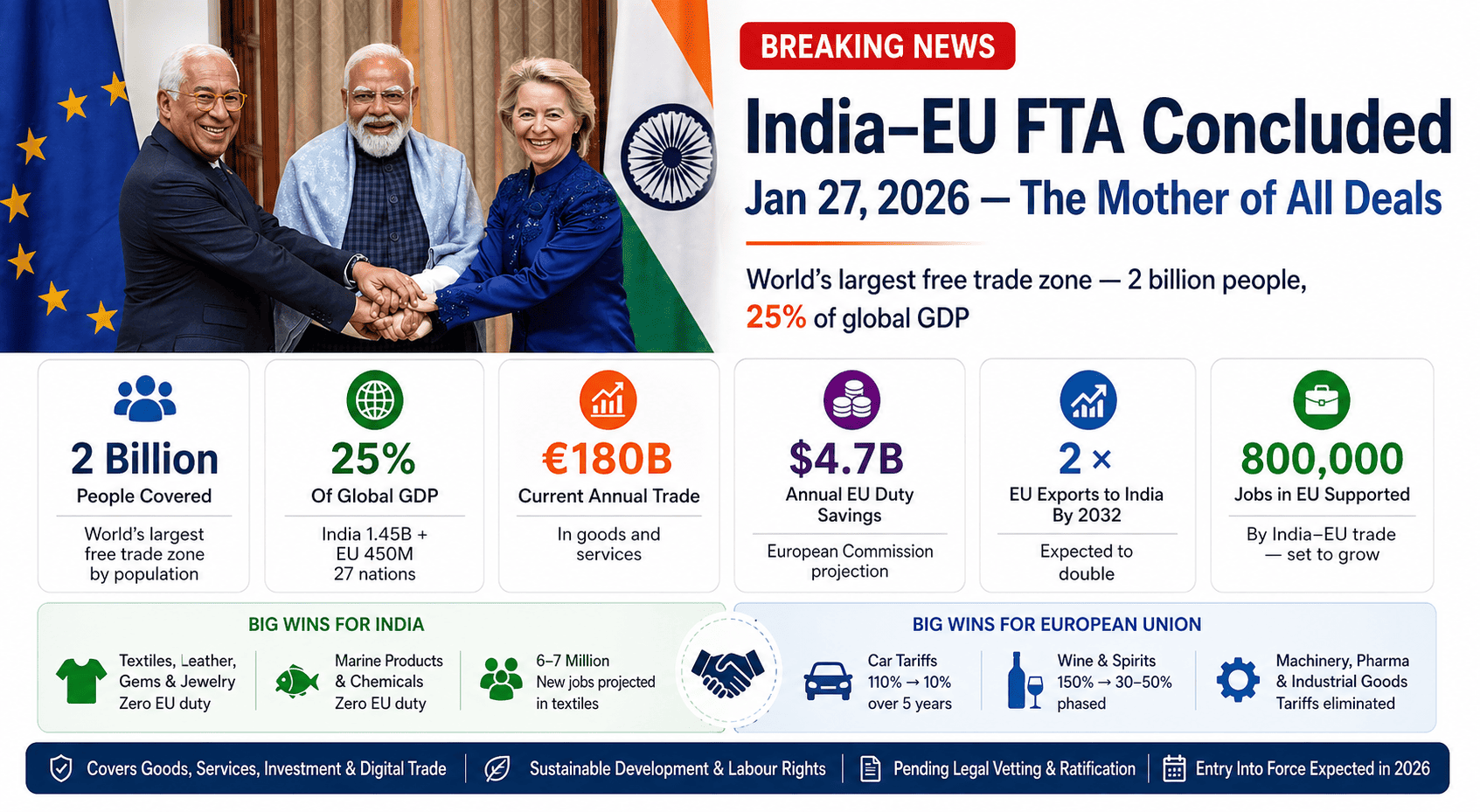
India and the European Union concluded the world’s largest free trade agreement on January 27, 2026 — creating a free trade zone of 2 billion people and 25% of global GDP. Car tariffs slashed from 110% to 10%. Zero duty for Indian textiles. $4.7 billion in annual EU duty savings. Here is your complete guide to every opportunity, every risk, and every action to take today.
📋 Direct Answer
India and the European Union concluded a landmark Free Trade Agreement on January 27, 2026 at a summit at Hyderabad House, New Delhi — the largest trade deal ever concluded by either side. The agreement creates the world’s largest free trade zone by population: 2 billion people representing 25% of global GDP. India will eliminate or reduce tariffs on 96.6% of EU exports by value; the EU will do the same for 99.5% of Indian goods. Key headline terms: India slashes EU car tariffs from up to 110% to 10% over five years (with annual quota of 250,000 EU vehicles); Indian textiles, leather, gems, and jewelry face zero EU duty, unlocking a $33B export sector; wine tariffs drop from up to 150% to 30%; the European Commission projects $4.7 billion in annual EU duty savings and expects EU exports to India to double by 2032. European Commission President Ursula von der Leyen called it the “mother of all deals.” The agreement still requires legal vetting, formal signing, and ratification by the European Parliament and EU Council before entry into force.
📅 April 1, 2026⏱ 19 min read✍️ GTsetu Editorial Team📰 Trade Policy + Manufacturing Opportunity Analysis
🔴 BREAKINGIndia–EU FTA concluded Jan 27, 2026 — 2 billion people, 25% of global GDP — “Mother of All Deals” now the world’s largest free trade zone◆India slashes EU car tariffs from 110% → 10% over 5 years · 250,000 quota vehicles annually · €4B in annual EU duty savings◆Indian textiles, leather, gems & jewelry: zero EU duty — $33B sector unlocked · 6–7 million new jobs projected in textiles alone◆Find your India or EU manufacturing & distribution partner on GTsetu — verified, zero broker fees, 100+ countries◆🔴 BREAKINGIndia–EU FTA concluded Jan 27, 2026 — 2 billion people, 25% of global GDP — “Mother of All Deals” now the world’s largest free trade zone◆India slashes EU car tariffs from 110% → 10% over 5 years · 250,000 quota vehicles annually · €4B in annual EU duty savings◆Indian textiles, leather, gems & jewelry: zero EU duty — $33B sector unlocked · 6–7 million new jobs projected in textiles alone◆Find your India or EU manufacturing & distribution partner on GTsetu — verified, zero broker fees, 100+ countries◆
Population Covered
2 Billion
World’s largest free trade zone by population — India 1.45B + EU 450M
Annual EU Duty Savings
$4.7B
European Commission projection on annual duty savings for EU exporters
Indian Textile Sector
$33B + 0%
Zero EU duty on textiles, leather, gems — unlocking $33B in Indian exports
EU Car Tariff
110% → 10%
India slashes EU auto tariffs over 5 years — 250,000 quota vehicles/year
Section 1 — The Deal
1 The Full Story: India–EU FTA — The “Mother of All Deals”
🇮🇳 Republic of India — 1.45B people, 4th largest economy
+
🇪🇺 European Union — 27 nations, 450M people, 2nd largest economy
=
🌍 World’s Largest Free Trade Zone — 2B people, 25% of global GDP
Concluded — January 27, 2026 — Hyderabad House, New Delhi
India and the EU Create the World’s Largest Free Trade Zone — Covering 2 Billion People and Nearly 25% of Global GDP
On January 27, 2026, at a summit at Hyderabad House in New Delhi, Indian Prime Minister Narendra Modi, European Commission President Ursula von der Leyen, and European Council President António Costa announced the conclusion of negotiations for the India–EU Free Trade Agreement — the largest trade deal ever concluded by either party. Von der Leyen and Costa had attended India’s Republic Day celebrations as chief guests the previous day, underscoring the geopolitical weight of the moment.
The agreement connects the world’s fourth-largest economy (India) and the world’s second-largest economic bloc (EU) in the most comprehensive trade liberalisation framework either side has ever agreed to. Together, they represent approximately 25% of the world’s GDP and — for the first time in history — form a single free trade zone covering 2 billion people. The EU and India already trade over €180 billion worth of goods and services per year, supporting close to 800,000 jobs in the EU alone. The FTA is expected to double EU exports to India by 2032.
The deal covers trade in goods, services, investment protection, digital trade, intellectual property rights, sustainable development, and labour rights. On tariffs alone: India will eliminate or reduce tariffs on 96.6% of EU exports by value; the EU will do the same for 99.5% of Indian goods. The European Commission projects $4.7 billion in annual EU duty savings. India’s Commerce Minister Piyush Goyal projected the deal could create 6–7 million jobs in the Indian textile sector alone.
Notably, the agreement still requires legal vetting, formal signing, and ratification by the European Parliament and EU Council of Ministers before entering into force. India’s Commerce Minister indicated he expected entry into force in 2026.
25%
Of global GDP covered — the world’s most economically significant FTA
€180B
Existing annual India–EU trade in goods and services — the FTA’s launching base
2×
EU exports to India expected to double by 2032 post-implementation
800,000
EU jobs currently supported by India–EU trade — set to grow significantly
“We have delivered the mother of all deals. This is a tale of two giants — the world’s second- and fourth-largest economies. Two giants who choose partnership in a true win-win fashion.”
— Ursula von der Leyen, President, European Commission
“This agreement will deepen economic ties, create new opportunities for our people, and strengthen the partnership between India and Europe for a future characterized by prosperity.”
— Narendra Modi, Prime Minister of India
💡 GTsetu Perspective
This FTA is not just a trade policy event — it is a structural shift in the India–EU manufacturing and supply chain relationship that will play out over a decade. The companies that identify their India or EU manufacturing and distribution partners in 2026 — while tariff schedules are being implemented and supply chains are being reoriented — will hold preferred supplier positions and established distribution networks that competitors entering in 2028 will find costly to replicate. GTsetu is where verified India and EU partner discovery happens systematically, not through trade missions or broker introductions.
Section 2 — The Journey
2 The 19-Year Journey: From First Talks in 2007 to Conclusion in January 2026
📅 2007 — First Attempt
EU–India FTA Negotiations Begin
The EU and India begin FTA negotiations in 2007, motivated by strong bilateral trade growth and the strategic value of connecting two large democratic economies. Early rounds show promise, but fundamental disagreements emerge quickly.
📅 2013 — Talks Collapse
Negotiations Suspended Over Patent Protection, Data Security & Mobility
After six years of talks, negotiations stall over three intractable disputes: India’s resistance to EU demands on pharmaceutical patent protection (which threatened India’s generic drug sector), disagreements on data security standards, and India’s insistence on the right of Indian professionals to work freely across Europe. The talks are formally suspended in 2013.
On June 17, 2022, the EU relaunches FTA negotiations with India, alongside separate negotiations for an Investment Protection Agreement and a Geographical Indications Agreement. The geopolitical context has fundamentally shifted: both the EU (seeking to reduce dependency on China) and India (seeking to diversify from US supply chains) now have urgent strategic reasons to conclude a deal.
📅 February 2025 — Target Set
Modi–von der Leyen Set Year-End 2025 Deadline
Indian Prime Minister Modi and European Commission President von der Leyen set a target to conclude negotiations by the end of 2025. This political deadline proves critical — it focuses ministerial attention and compresses the remaining negotiation timeline.
📅 September 2025 — Final Push
EU VP Kallas Voices Support as US Tariff Pressure Accelerates India’s Motivation
EU Commission Vice-President Kaja Kallas voices strong support for closer EU–India trade and security relations. Meanwhile, US imposition of 50% tariffs on Indian goods accelerates India’s motivation to diversify export markets — the EU becomes even more strategically valuable as a destination for Indian exporters facing US trade barriers.
📅 January 27, 2026 — CONCLUDED
Negotiations Concluded — “Mother of All Deals” Announced at Hyderabad House
After 19 years of on-and-off negotiations, the EU and India conclude the FTA at a summit in New Delhi attended by PM Modi, Commission President von der Leyen, and Council President Costa — who had attended India’s Republic Day as chief guests the previous day. Von der Leyen declares it the “mother of all deals.” India’s Commerce Minister projects entry into force in 2026 following legal vetting, formal signing, and EU Parliamentary ratification.
Section 3 — Tariff Changes
3 Tariff Changes — The Complete Breakdown
This is where the FTA becomes real for manufacturers and traders. Here is every major tariff change, with before and after numbers, staging timelines, and what it means for your supply chain.
📊 Key Tariff Changes — India–EU FTA 2026 — Before → After
🇪🇺 EU Exports to India
Passenger Cars (ICE & EV)
110%
→
10%
Phased over 5 years. Annual quota of 250,000 EU vehicles. Game-changing for VW, BMW, Mercedes, Stellantis.
🇮🇳 India Exports to EU
Textiles, Apparel & Footwear
4–26%
→
0%
Zero duty at entry into force. Unlocks $33B in Indian exports. 6–7M new jobs projected in textiles alone.
🇪🇺 EU Exports to India
Wine & Spirits
150%
→
30–50%
Wine reduced to ~30%, spirits to 40%, beer to 50%. Phased reduction. A dedicated wines & spirits working group established.
🇮🇳 India Exports to EU
Gems, Jewelry & Leather
4–26%
→
0%
Part of the $33B zero-duty Indian export package. Key sector for Surat, Jaipur, and Tamil Nadu manufacturers.
🇪🇺 EU Exports to India
Machinery & Industrial Equipment
7.5–15%
→
0%
Machinery tariffs eliminated — making EU industrial equipment and manufacturing tooling significantly price-competitive in India.
🇮🇳 India Exports to EU
Marine Products & Fisheries
6–20%
→
0%
Zero duty for Indian seafood — major win for coastal states. EU marine tariffs on Indian shrimp, fish, and processed seafood eliminated.
🇪🇺 EU Exports to India
Pharmaceuticals & Medical Devices
10–15%
→
0%
Zero tariff for EU pharma and medtech — improving EU competitiveness in India’s fast-growing healthcare market.
🇮🇳 India Exports to EU
Chemicals & Plastics
4–6.5%
→
0%
Chemical and plastics exports zero-rated — significant for Indian petrochemical and specialty chemical manufacturers.
Tariff Liberalisation Coverage — The Numbers
Metric
EU Commitment
India Commitment
What This Means
Tariff lines eliminated/reduced
Over 90% of tariff lines (91% by value)
86% of tariff lines (93% by value)
Near-total liberalisation for mainstream trade flows
Total trade liberalisation coverage
99.3% of trade value
96.6% of trade value
Both parties approaching near-complete free trade on goods
Annual duty savings
~€4 billion (~$4.7B) for EU exporters
Significant — specific figure pending full text
Immediate cost advantage for EU companies competing in India
Implementation timeline
Phased — some immediate, some over 5–10 years
Phased — car tariffs over 5 years
Supply chain planning needs to account for staging periods
Sensitive sectors excluded (India)
N/A
Beef, sugar, rice, chicken, milk powder, honey, wheat, garlic, ethanol — maintained at current tariffs
Food sovereignty protected; EU agri-food wins limited to non-sensitive products
Carbon Border Adjustment
CBAM stays — no exemption for India
India objects but no exemption granted
Indian steel & aluminium exporters face new CBAM costs from 2026; EU provides €500M decarbonisation support
⚠️ Critical: CBAM Applies to India Despite FTA
The EU’s Carbon Border Adjustment Mechanism (CBAM) — effective January 1, 2026 — applies to Indian steel, aluminium, cement, fertilisers, electricity, and hydrogen exports to the EU regardless of the FTA. There are no CBAM exemptions for India. Indian exporters in these sectors must now document and report embodied carbon in their products, with financial obligations scaling from 2026 onward. The EU has pledged €500 million to support India’s industrial decarbonisation — but CBAM compliance is the exporter’s responsibility. Any Indian manufacturer targeting EU markets in CBAM-covered sectors must audit their carbon footprint immediately.
Section 4 — Sector Winners
4 Sector Winners and Losers — Who Gains Most from the India–EU FTA?
🇮🇳 India’s Biggest Winners
👕
India → EU
Textiles & Apparel
Zero EU duty. $33B export sector. 6–7M new jobs projected. Surat, Tiruppur, Ludhiana manufacturers benefit immediately.
💎
India → EU
Gems & Jewelry
Zero EU duty. Major win for Surat diamond cutters and Jaipur gem industry facing US tariff headwinds.
🐟
India → EU
Marine & Fisheries
Zero EU duty. Large opportunity for coastal state processors — shrimp, fish, and processed seafood all zero-rated.
👟
India → EU
Leather & Footwear
Zero EU duty. India’s leather industry — second only to China — gains immediate price advantage over non-FTA competitors.
⚗️
India → EU
Chemicals & Pharma
Zero EU duty for chemicals. Indian generic pharma gains improved EU market access with simplified regulatory cooperation.
🏗️
India → EU
Services & IT
Mobility framework simplifies Indian IT professional access to EU. A long-standing demand now partially resolved.
🇪🇺 EU’s Biggest Winners
🚗
EU → India
Automotive (Cars)
110% → 10% over 5 years. 250,000 quota vehicles/year. VW, BMW, Mercedes, Stellantis all immediately advantaged.
🍷
EU → India
Wine & Spirits
150% → 30% for wine. French, Italian, Spanish wine producers gain first meaningful India market access in history.
⚙️
EU → India
Machinery & Equipment
Tariffs eliminated. German, Italian, and Czech machinery manufacturers gain major price advantage in India’s $3T industrial market.
💊
EU → India
Pharma & Medtech
Zero tariff. EU MedTech and pharmaceutical companies gain privileged access to one of the world’s fastest-growing healthcare markets.
✈️
EU → India
Avionics & Aerospace
Tariff reductions on avionics and aerospace components — supporting Airbus and European defence supply chains in India.
5 Why Did Both Sides Finally Cross the Finish Line?
🎯 The Three Forces That Closed the Deal
Three converging geopolitical forces made 2026 the year both India and the EU finally concluded an FTA that had been attempted since 2007. First, US tariff pressure on India — the US imposed 50% tariffs on Indian goods in 2025, making the EU a critical alternative export market for Indian manufacturers in textiles, chemicals, gems, and seafood. Second, EU’s China diversification imperative — the EU is actively seeking to reduce trade dependence on China across manufacturing, technology, and raw materials; India is the only market large enough and democratic enough to serve as a genuine alternative anchor. Third, geopolitical alignment — both India and the EU are democracies facing pressure from authoritarian state capitalism; an FTA sends a signal, as von der Leyen put it, “that rules-based cooperation still delivers great outcomes.”
50%
US tariffs on Indian goods in 2025 — making EU market access a survival imperative for Indian exporters
China Risk
EU’s strategic priority to reduce trade dependency on China — India is the only viable alternative at scale
19 Years
From first talks in 2007 to conclusion in 2026 — geopolitical urgency finally overcame structural disagreements
Democracy Signal
The world’s two largest democracies choosing trade partnership signals a rules-based alternative to US-China bipolarity
€500M
EU pledge to support India’s industrial decarbonisation — softening CBAM impact and cementing the partnership’s investment dimension
6,000
European companies already operating in India — the FTA accelerates their competitive position and creates space for new entrants
Section 6 — Manufacturing Opportunity
6 The Manufacturing Opportunity: What the India–EU FTA Creates for Cross-Border Manufacturers
The Structural Manufacturing Shifts the India–EU FTA Will Drive Over the Next Decade
The India–EU FTA is not just a trade policy event — it is a trigger for the largest reorientation of India–Europe supply chains since India’s 1991 economic liberalisation. For manufacturers on both sides, this creates specific, time-sensitive opportunities that are most valuable to act on in 2026–2027, before supply chain positions are established and preferred supplier relationships are locked in.
India Mfg Hub
EU machinery tariffs eliminated — India becomes even more attractive as a low-cost manufacturing base for EU supply chains
EU JVs in India
With 0% machinery tariffs, EU companies setting up India JVs save millions on tooling and equipment import costs
Textile Supply Chain
EU fashion brands and retailers should establish India manufacturing partnerships now — before zero-duty quota positions fill up
Auto Components
As EU OEMs increase India car sales, Indian auto component suppliers gain a direct supply pathway to EU assembly plants
Pharma & Biotech
EU pharma companies can now import Indian APIs and intermediates at zero duty — fundamentally changing cost structures for generic drugs in Europe
CBAM Risk
Indian manufacturers in steel, aluminium, and cement must decarbonise or face material cost disadvantage despite FTA tariff savings
Strategic Action
For Indian Manufacturers
For EU Manufacturers
Time Sensitivity
Find a distribution partner
Find EU distributors for textiles, gems, leather, chemicals — zero duty means immediate price competitiveness
Find India distributors for cars, wine, machinery, agri-food — India’s middle class is the fastest-growing consumer market in the world
NOW — before preferred distributor positions are taken
Establish a manufacturing JV
Partner with EU companies to manufacture in India for zero-duty EU export — capture the “manufactured in India, sold in EU” opportunity
Establish India manufacturing JVs with zero machinery import duty — dramatically reduces JV capex and operating costs
2026–27 — while JV partner selection is most open
Audit supply chain for rules of origin
Verify that your products meet EU rules of origin thresholds — only products significantly processed in India qualify for zero duty
Ensure EU origin compliance — self-certification required, uploaded to portal for customs verification
IMMEDIATELY — before first preferential shipments
CBAM compliance (India exporters)
If you export steel, aluminium, cement, fertiliser, or hydrogen to EU — begin carbon footprint audit and CBAM compliance programme immediately
If sourcing from India in CBAM sectors — understand your supplier’s carbon reporting obligations
URGENT — CBAM financial obligations from 2026
Review pricing and contracts
Review long-term EU distribution contracts — tariff reduction creates margin to either improve price competitiveness or improve margin
Review India distribution agreements — staged car tariff reductions need to be reflected in multi-year pricing frameworks
Before FTA entry into force — rewrite old contracts
Section 7 — How to Capitalise
7 How to Capitalise: The 6-Step India–EU FTA Action Playbook
1
Map Your Tariff Position Within 30 Days
Before you can act on the FTA, you need to know exactly how it affects your specific products. Identify your HS codes, look up your current India or EU tariff rate, and map what the FTA staging schedule means for your cost structure. For Indian textile, leather, and gem exporters, this is straightforward — zero duty at entry into force. For EU car exporters, the staging is more complex — tariffs fall over five years within a 250,000-vehicle annual quota. For manufacturers in CBAM-covered sectors, the FTA tariff benefit may be partially or fully offset by CBAM costs that must be quantified simultaneously. GTsetu’s partner discovery process starts with this product-level trade map — you need to know your competitive position before you can brief a partner on what you need them to do.
2
Identify Your Priority Market and Distribution Gap
The FTA eliminates the tariff barrier — but the distribution barrier remains. An Indian textile manufacturer with zero EU duty still needs EU distributors, EU retail relationships, EU logistics, and EU quality certifications to convert the tariff advantage into revenue. An EU car manufacturer with a 250,000-vehicle quota needs India dealerships, after-sales service networks, and financing partners to fill that quota. Define your distribution gap precisely: do you need a distributor, an agent, a contract manufacturer, a JV partner, or a technology licensing target? GTsetu’s verified network provides documented partner profiles for every one of these needs across India and across all 27 EU member states.
3
Verify Partners Before Disclosing Commercial Information
The FTA will generate an enormous volume of inbound partnership enquiries — Indian manufacturers approaching EU distributors, EU companies approaching Indian manufacturers. Not all of these will be credible. In the FTA opportunity rush, the risk of disclosing pricing strategies, product cost structures, and supply chain designs to unverified counterparties is acute. Verify your partner’s business registration, sector credentials, financial standing, and relevant trade references before any substantive commercial conversation. GTsetu’s multi-layer verification process documents all of these credentials before you invest a single hour — and the built-in NDA workflow ensures your commercial terms are protected before any disclosure.
4
Audit Your Rules of Origin Compliance
Preferential tariff rates under the India–EU FTA only apply to products that meet specific rules of origin thresholds — only goods genuinely processed in India or the EU qualify. The proof of origin is in the form of a self-certified statement that exporters upload to a portal, verified by customs authorities. For Indian manufacturers with significant imported component content — particularly in electronics, pharma, or automotive — understanding whether your product meets the origin threshold is not optional; it determines whether you actually benefit from the FTA’s zero-duty provisions. EU companies setting up India manufacturing operations must structure their supply chains to qualify for “Made in India” origin from day one.
5
Structure Your Partnership Agreement Before the Market Moves
Every distribution agreement, manufacturing JV, and licensing deal associated with the India–EU FTA opportunity needs to explicitly address the FTA’s phased tariff schedule. If you sign a five-year exclusive distribution agreement today for EU car sales in India, the pricing and volume terms need to account for car tariffs falling from 110% to 10% over that exact period. If you sign an India manufacturing JV agreement, the machinery import cost projections need to reflect zero tariff from FTA entry into force. Contracts that were written before the FTA was concluded need to be reviewed and amended. GTsetu’s collaboration workspace supports structured, documented commercial negotiation and agreement management — protecting both parties as tariff environments change.
6
Move in 2026 — The First-Mover Advantage Is Real and Time-Limited
The India–EU FTA opportunity is largest for the companies that establish distribution relationships, manufacturing partnerships, and supply chain positions in 2026 and 2027 — before the market matures and preferred positions are occupied. For Indian textile exporters, EU distribution partnerships formed in 2026 will have two years of zero-duty market building before competitors who wait for implementation confirmation enter. For EU car manufacturers, dealership network agreements and service partnerships formed in 2026 position them ahead of the 2027–2028 full quota ramp-up. The companies that wait for the FTA to enter into full force before acting will find that the early movers have already established the relationships that generate the compound advantage. GTsetu’s verified partner network enables rapid identification and engagement with the right counterparty without the 6–12 months of conference circuit and ministerial introduction that characterises traditional market entry.
Section 8 — Dos and Don’ts
8 Dos and Don’ts for Manufacturers and Exporters Under the India–EU FTA
✅ Do These
✅ Map your HS code tariff position under the FTA immediately — understand your specific staging schedule
✅ Audit rules of origin compliance for all products you intend to export under preferential tariff rates
✅ For Indian CBAM-sector exporters: begin carbon footprint documentation now — CBAM financial obligations apply from 2026
✅ Find and verify EU distribution or manufacturing partners in 2026 — first-mover positions are the most valuable
✅ Review and update all existing India–EU distribution and supply agreements to reflect the FTA’s staged tariff schedule
✅ For EU car manufacturers: begin India dealership network and after-sales service partnerships now, ahead of full quota activation
✅ Execute NDAs before sharing pricing, product cost structures, or supply chain designs with prospective India–EU partners
✅ For Indian textile/leather/gem exporters: establish EU distribution partnerships before the zero-duty rush creates a crowded channel market
✅ Consider India as a manufacturing base for EU-destined exports — zero machinery import duty dramatically reduces JV capex
✅ Leverage the FTA’s mobility framework for deploying Indian IT professionals and EU technical experts cross-border
❌ Avoid These
❌ Assume the FTA is already in force — it requires EU Parliamentary ratification and legal vetting before tariff reductions apply
❌ Assume zero EU duty applies to your product without verifying rules of origin compliance — products not meeting origin thresholds get standard tariffs
❌ Ignore CBAM if you export steel, aluminium, cement, or fertilisers — the FTA provides zero CBAM exemption
❌ Wait until the FTA formally enters into force to identify distribution or manufacturing partners — the best positions will be taken
❌ Sign multi-year distribution or pricing contracts without explicitly accounting for the FTA’s phased tariff reduction schedule
❌ Assume the FTA means Indian professionals can work freely anywhere in the EU — mobility provisions are improved but structured with frameworks, not blanket rights
❌ Attempt to route non-Indian or non-EU origin goods through India or the EU to claim FTA tariff benefits — customs authorities will audit origin statements
❌ Assume pharmaceutical exports face no regulatory changes — the FTA includes regulatory cooperation provisions that affect market access timelines
❌ Miss the Geographical Indications gap — the FTA concluded without a GI agreement; products like Champagne and Parma Ham have no automatic protection in India yet
❌ Share pricing or commercial intelligence with unverified Indian or EU partner prospects without a formal NDA in place
Section 9 — Misconceptions
9 Common Misconceptions About the India–EU FTA
❌ Myth
“The FTA is in force now — I can ship under zero duty immediately.”
✅ Reality
The FTA was concluded on January 27, 2026 — meaning negotiations are complete — but it is not yet in force. Before preferential tariff rates apply, the agreement requires legal vetting and translation, formal signing by both parties, approval by the EU Council of Ministers, consent of the European Parliament, and ratification in India. India’s Commerce Minister projected entry into force in 2026, but businesses should not ship under preferential rates until formally confirmed. Use this window to prepare — not to ship.
❌ Myth
“All Indian goods now face zero EU tariff — my product is included.”
✅ Reality
The FTA covers 99.5% of Indian goods by value — but not 100%. And even for included products, zero duty only applies if the product meets the rules of origin threshold. Products assembled in India from predominantly imported components may not qualify as “Indian origin” under the FTA’s rules. Additionally, tariff reductions for many products are phased over 5–10 years, not immediate. Verify your specific HS code position before making commercial commitments.
❌ Myth
“The FTA eliminates India’s car tariffs completely — any EU car can now be sold in India at low cost.”
✅ Reality
India’s car tariff falls from 110% to 10% — which is dramatic, but not zero, and subject to a 250,000-vehicle annual quota. Cars above the quota continue to face standard tariff rates. The staging period is five years. EU carmakers must plan dealership network capacity, financing solutions, and after-sales infrastructure to actually absorb the quota — the tariff reduction is worthless without the distribution infrastructure to deploy it. Additionally, 10% tariff plus GST plus registration fees still results in European cars being more expensive than locally assembled vehicles in India.
❌ Myth
“The FTA means Indian IT professionals can now work freely across all EU countries.”
✅ Reality
The FTA includes a “Comprehensive Framework for Cooperation on Mobility” that aims to simplify visa procedures — but this is a framework for cooperation, not a blanket right of free movement. Indian professionals still require national visas and work permits in each EU member state. The FTA improves the process — particularly for intra-corporate transferees, business visitors, and contractual service suppliers — but the EU’s national immigration sovereignty remains intact. The original 2013 breakdown was partly over this issue; the 2026 resolution is an improvement, not a full solution.
❌ Myth
“The FTA protects European food brands like Champagne and Parmesan in India.”
✅ Reality
A Geographical Indications (GI) agreement was not concluded as part of the FTA due to time constraints. Products like “Champagne,” “Parmigiano-Reggiano,” and “Prosciutto di Parma” currently have no automatic GI protection in India under this deal. A separate GI agreement is being negotiated in parallel, but until it enters into force, European food and beverage brands cannot rely on the FTA to protect their appellation rights in the Indian market.
Section 10 — GTsetu
10 How GTsetu Helps You Find the Right India–EU Manufacturing or Distribution Partner
The India–EU FTA eliminates the tariff barrier. It does not find you a verified Indian textile manufacturer to white-label your EU brand. It does not find you a European distributor with the cold-chain infrastructure to handle your Indian seafood exports. It does not vet the EU machinery company claiming to offer the best JV terms for your India factory. Finding the right partner — verified, capable, and strategically aligned — is the step that turns the FTA opportunity into actual revenue. That is exactly what GTsetu enables, systematically.
🌐 Platform Spotlight — GTsetu
Find Verified India–EU Manufacturing, Distribution, and JV Partners — Before the FTA Window Closes
GTsetu is the verified B2B manufacturing and trading partner discovery platform connecting Indian manufacturers, European companies, distributors, and JV candidates with documented capability profiles — zero broker fees on any partnership formed. The FTA creates the opportunity. GTsetu puts the right partner in front of you before your competitors get there first.
✅
Multi-Layer VerificationBusiness registration, export certifications, trade references, sector credentials — every partner profile is documented, not self-reported.
🕵️
Anonymous DiscoveryEvaluate verified Indian and EU partner profiles without revealing your company identity or pricing until mutual interest is confirmed.
📄
Built-In NDA WorkflowProtect your product costs, margin structure, and supply chain designs — NDA countersigned with full audit trail before any commercial disclosure.
🚫
Zero CommissionNo broker fees. Your distribution agreement, JV, or supply contract stays entirely between you and your partner.
🌍
India + 100+ CountriesFind manufacturing partners, distributors, and JV candidates across India, all 27 EU member states, and 100+ countries globally.
⚡
Move in 2026First-mover partnership positions are most valuable right now — before preferred distributor slots are filled and JV partner selection windows close.
No — the FTA has been concluded but is not yet in force. Negotiations were completed on January 27, 2026, but the agreement still requires legal vetting and translation, formal signing by both parties, approval by the EU Council of Ministers, and consent of the European Parliament before preferential tariff rates apply. India’s Commerce Minister Piyush Goyal stated he expects the deal to enter into force in 2026, but no specific date has been confirmed as of the publication of this article. Manufacturers should prepare their supply chains, partner identification, and rules of origin compliance during this window — but should not ship under preferential rates until the entry-into-force date is officially announced.
QWhich Indian exports benefit most from the FTA?
The biggest Indian export winners are textiles, apparel, marine products, leather, footwear, chemicals, plastics, sports goods, toys, gems, and jewelry — all of which face zero EU duty once the FTA enters into force. These sectors collectively account for approximately $33 billion in Indian exports and were previously subject to EU tariffs of 4% to 26%. India’s Commerce Minister projected that the textile sector alone could create 6–7 million new jobs following the FTA. Additionally, Indian pharmaceutical and chemical exports gain improved market access, and the Indian IT services sector benefits from the mobility framework that simplifies professional movement to the EU.
QWhat happens to EU car tariffs in India?
India agreed to slash car tariffs from as much as 110% to 10% over five years, with an annual quota of 250,000 EU vehicles. This is one of the most significant single tariff concessions in the agreement and represents a major commercial win for European automakers including Volkswagen, BMW, Mercedes-Benz, Stellantis, and Volvo. In the immediate aftermath of the FTA announcement, shares of Indian carmakers Tata Motors and Mahindra & Mahindra fell 1.3% and 4.2% respectively, while Hyundai Motor India — a Korean company with India manufacturing — fell 3.6%. The quota and staging period mean the impact will be gradual, but EU car brands are already establishing dealership and service infrastructure in India to be ready.
QDoes the India–EU FTA affect CBAM obligations for Indian exporters?
No — the EU’s Carbon Border Adjustment Mechanism (CBAM) applies to India with no FTA exemptions. The EU remained firm on this point despite Indian objections. CBAM has been active since January 1, 2026 and covers steel, aluminium, cement, fertilisers, electricity, and hydrogen. Indian manufacturers exporting these products to the EU must document and report embedded carbon — and will face increasing financial obligations as CBAM’s full implementation phase progresses. To offset the impact, the EU pledged €500 million to support India’s industrial decarbonisation. Indian manufacturers in CBAM-covered sectors should treat carbon footprint auditing as urgent — the FTA tariff savings can be partially or fully offset by CBAM costs if carbon intensity is not addressed.
QHow can GTsetu help me capitalise on the India–EU FTA?
GTsetu is the verified partner discovery platform that connects Indian and EU manufacturers, distributors, and JV candidates with documented capability profiles — without broker fees. For Indian exporters entering EU markets: find verified European distributors for textiles, leather, gems, seafood, and chemicals across all 27 EU member states. For EU companies targeting India: find verified Indian manufacturers, distributors, and JV partners with documented production capabilities, export track records, and sector certifications. The process: (1) browse verified profiles anonymously, (2) execute an NDA before any commercial disclosure, (3) run a pilot or trial order to validate capabilities, (4) formalise the partnership with a documented agreement. Zero commission on any deal. Start your India–EU partner search on GTsetu →
The India–EU FTA Window Is Open. Find Your Partner on GTsetu.
The tariff barrier is coming down. The distribution, manufacturing, and JV partner positions are being established right now. 500+ verified manufacturers, distributors, and industrial partners across India, all 27 EU member states, and 100+ countries. Zero broker fees. Anonymous discovery. Built-in NDA workflows. Move in 2026 — before the best positions are taken.
They represents the product, and research team behind GTsetu, a global B2B collaboration platform built to help companies explore cross-border partnerships with clarity and trust. The team focuses on simplifying early-stage international business discovery by combining structured company profiles, verification-led access, and controlled collaboration workflows.
With a strong emphasis on trust, and disciplined engagement, Team GTsetu shares insights on global trade, partnerships, and cross-border collaboration, helping businesses make informed decisions before entering deeper commercial discussions.