Best B2B Global Trade Collaboration Platforms for Manufacturers & Distributors | GTsetu
Home ›
Blog ›
Best B2B Global Trade Collaboration Platforms
🌐 Global Trade Partnerships
Best B2B Global Trade Collaboration Platforms: Manufacturer & Distributor Guide (2026)
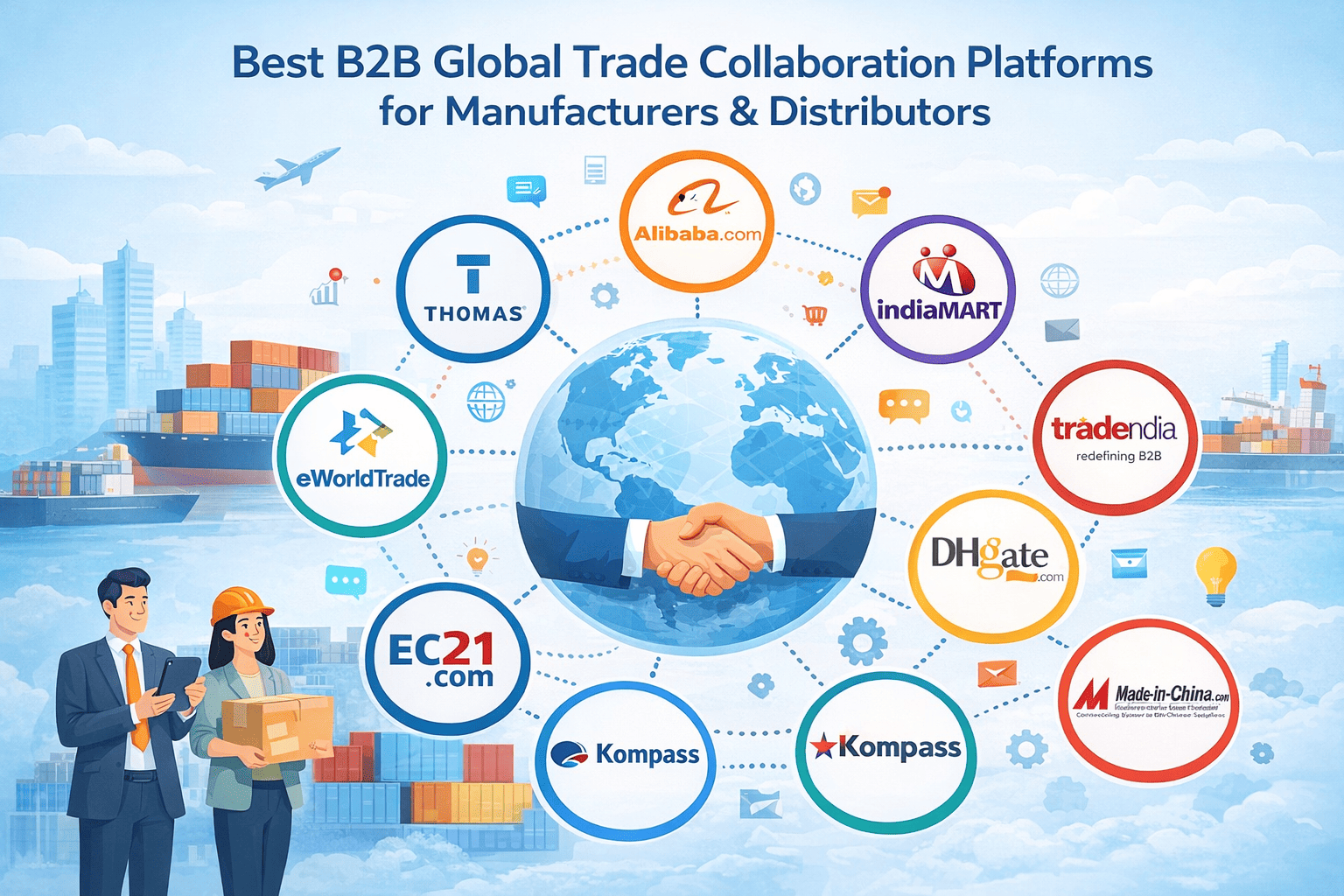
Direct Answer: The best B2B global trade collaboration platform for manufacturers and distributors is one built specifically for verified international partner discovery, not internal procurement management. GTsetu leads this category by connecting manufacturers with six-point government-verified distributors (Name, Address, Registration Number, Company Status, Company Type, Date of Incorporation) across 35+ countries through anonymous discovery, built-in NDA workflows, encrypted document sharing, and zero broker commissions. Unlike generic B2B marketplaces, it is designed for long-term distribution partnership formation, not one-off product sourcing. This guide compares the top platforms, explains the features that actually matter, and shows what separates transactional trade tools from strategic collaboration platforms.
📅 February 17, 2026⏱ 16 min read✍️ GT Setu Editorial Team🔄 Updated regularly
500+
Verified Companies
35+
Countries Covered
0%
Broker Commission
40%
Faster Partner Search
The global B2B trade landscape has a collaboration problem, not of process, but of discovery. Manufacturers spend months trying to find qualified distributors in new markets, often paying broker fees of 5–15% on every deal, only to end up with unverified contacts who misrepresent their market reach. Meanwhile, distributors looking to add strong product lines to their portfolio have no structured way to find manufacturers who are ready to partner internationally.
The right collaboration platform collapses this problem. But not every “B2B platform” is the same. Enterprise supply chain tools manage relationships you already have. Trade collaboration platforms help you discover, verify, and formalise the relationships you need. This guide covers everything, what to look for, which platforms lead the market, and why GTsetu was built precisely for manufacturers and distributors seeking government-verified international partners.
💡 Who Is This Guide For?
This guide is written for manufacturers, OEMs, brand owners, and distributors looking to expand their international trade network through structured collaboration platforms, not for procurement teams managing existing supplier relationships inside an ERP.
SECTION 1
What Is a B2B Trade Collaboration Platform?
🎯 Definition
A B2B global trade collaboration platform is a digital environment that enables manufacturers, distributors, and trading companies to discover potential partners across international markets, verify their credentials, exchange confidential information securely, and formalise trade partnership agreements, all within a structured framework.
Unlike a marketplace (which facilitates individual product transactions) or a supply chain management tool (which coordinates with existing partners), a trade collaboration platform’s primary function is building the relationship itself. It bridges the gap between “we don’t know each other” and “we have a signed distribution agreement.”
The Three Phases a Trade Collaboration Platform Must Support
🔍 Phase 1: Discovery
Finding qualified partners in target markets without cold outreach, broker dependency, or unvetted directories.
Government-verified company profiles by industry and geography
Anonymous browsing to protect intent and strategy
Structured filtering by territory, product category
Mutual-interest signalling before identity reveal
✅ Phase 2: Basic Verification
Confirming that shortlisted partners are registered legal entities with valid company credentials.
Company name, address, and registration number checks
Company status and type verification
Date of incorporation confirmation
Government-tied data partnerships
🤝 Phase 3: Formalisation
Moving from mutual interest to signed agreements with proper legal and commercial structure.
Built-in NDA workflows before sensitive exchange
Encrypted document sharing with audit trails
Term sheet and agreement collaboration tools
Zero-commission deal completion
📌 Note on GTsetu Verification
GTsetu verifies six points of company information through government data partnerships: Company Name, Registered Address, Registration Number, Company Status, Company Type, and Date of Certificate of Incorporation. GTsetu does not verify financial health, creditworthiness, trade references, tax documents beyond basic registration, certifications, or operational capabilities. Additional due diligence remains the responsibility of the parties.
SECTION 2
Trade Platforms vs. Supply Chain Collaboration Tools: The Critical Difference
One of the most common mistakes manufacturers make is searching for “supplier collaboration software” and landing on enterprise procurement tools, SAP Ariba, Ivalua, Jaggaer, o9 Solutions, that are designed for a fundamentally different problem. Understanding this distinction saves months of wasted evaluation time.
⚡
The Core Distinction
Supply chain collaboration tools optimise relationships you already have, forecasting, inventory, order management with existing suppliers. Trade collaboration platforms help you find and formalise relationships you don’t have yet, discovering new international distributors, manufacturers, and trading companies for market expansion.
Procurement managers, supply chain operations teams
Business development, export managers, founders
Deal Type
Transactional: orders, invoices, forecasts
Relational: distribution agreements, territory rights
Cost Model
Large enterprise SaaS licenses (six figures+)
Platform access fees, zero commission on deals
Verification
Assumes existing partners are known and trusted
Six-point government-tied verification before first contact
Example Use Case
Sharing production forecast with your existing component supplier
Finding a government-verified distributor in the UAE for a new product line
⚡ Why This Matters
Enterprise supply chain tools require existing relationships to function, they are collaboration infrastructure for known parties. If you need to find new international distributors, manufacturers, or trading companies, you need a trade collaboration platform like GTsetu, not an ERP add-on.
SECTION 3
Types of Global Trade Collaboration
Not all collaboration in global trade looks the same. Understanding the specific type you need helps you choose the platform, and the partner, that is right for your situation.
Collaboration Type
What It Means
Who Initiates
GTsetu Supports?
Manufacturer → Distributor
A manufacturer seeks a distribution partner to sell its products in a new market territory
Manufacturer
✅ Core Use Case
Distributor → Manufacturer
A distributor with strong market reach seeks new product lines to add to its portfolio
Distributor
✅ Core Use Case
Manufacturer → Trading Company
A manufacturer uses a trading company as an intermediary to access markets it cannot reach directly
Manufacturer
✅ Supported
Distributor → Distributor
Regional distributors collaborate to expand geographic coverage or share logistics infrastructure
Either party
✅ Supported
Co-Manufacturing
Two manufacturers collaborate on production capacity, OEM arrangements, or white-labelling
Either party
✅ Supported
Joint Market Entry
Two non-competing manufacturers enter a new market together, sharing distribution costs
Either party
🔄 Emerging Use
SECTION 4
Why Trade Collaboration Platforms Drive Manufacturer ROI
The business case for using a government-tied trade collaboration platform is significant and measurable. Here is what the evidence shows about the cost of getting it wrong, and the return from getting it right.
40–60%
Reduction in partner search time using verified platforms vs. cold directories
Industry benchmark
5–15%
Broker commission eliminated per deal, directly added to margin
Typical trade broker rates
3–9 mo
Average time from search to signed agreement, compressed by 30–40% on verified platforms
Distribution partnership lifecycle
77%
Of B2B companies report siloed partner data as the #1 barrier to new market expansion
Collaborative trade research
60%
Of failed distributor partnerships cite inadequate vetting as the primary root cause
Export market failure analysis
3×
Higher close rate on distribution deals initiated through verified platforms vs. cold outreach
Platform conversion data
📊
The Hidden Cost of Unverified Partners
The average cost of a failed international distribution partnership, accounting for legal extraction, lost market time, reputational damage, and opportunity cost, exceeds $150,000 USD for a mid-sized manufacturer. A verified platform subscription is a fraction of that risk exposure.
SECTION 5
What to Look for in a Global Trade Collaboration Platform
Most platforms claim to connect manufacturers with distributors. Few deliver with the rigour that international trade demands. Evaluate any platform against these eight criteria before committing.
✅
Government-Tied Company Profiles
Are companies verified through government data partnerships for registration credentials before they can engage?
🕵️
Anonymous Discovery
Can you browse potential partners without revealing your identity or intent until you choose to connect?
📄
NDA Infrastructure
Does the platform support formalised confidentiality agreements before sensitive commercial details are exchanged?
🔐
Encrypted Document Sharing
Are shared files, price lists, and product specifications protected in transit and at rest, with access controls?
🌍
Geographic Coverage
Does the platform have verified companies in your target markets, not just a broad unscreened database?
🚫
Zero Commission Model
Does the platform take a percentage of deal value? Success commissions misalign incentives and erode margins on every agreement.
🔍
Intent-Based Matching
Does the platform match partners by stated intent and category, not just geography or company size alone?
📊
Audit Trail
Is there a complete, timestamped record of all interactions, NDA executions, and document exchanges for legal protection?
Feature
Why It Matters
Risk If Absent
Government-Tied Verification
Confirms company exists as registered legal entity
Months wasted on fraudulent or non-serious prospects
Anonymous Discovery
Protects your market expansion strategy from competitors and brokers
Your intent becomes public; competitors gain intelligence advantage
NDA Workflow
Legal protection before pricing and product secrets are shared
Proprietary information leaked with no recourse
Zero Commission
Your deal economics remain between you and your partner only
5–15% skimmed off every agreement, compounding across markets
Encrypted Sharing
Prevents interception of sensitive commercial documents
Price lists, product specs, and roadmaps exposed via email risk
SECTION 6
Top B2B Trade Collaboration Platforms Compared (2026)
Here is how the leading platforms stack up for manufacturers and distributors seeking international trade partnerships. Note that platforms designed for internal supply chain management have been excluded, this comparison focuses only on external trade partnership discovery and formation.
1
GTsetu 🏆 Editor’s Choice
Purpose-built for international distribution partnership formation. Six-point government-verified manufacturer and distributor profiles (Name, Address, Registration Number, Company Status, Company Type, Date of Incorporation) across 35+ countries. Anonymous discovery, built-in NDA workflows, encrypted document sharing, and zero commission model.
✓ Government-Tied Verification✓ Anonymous Discovery✓ NDA Workflow✓ Zero Commission✓ 35+ Countries
9.7
/ 10 Score
2
Kompass
Global B2B directory with 70+ country coverage and strong category filtering. Useful for building an initial research longlist of potential distributors and manufacturers. However, company profiles are self-declared and unverified, the due diligence burden remains entirely with the user. No NDA tools, no partnership workflows, and no commission-free guarantee.
✓ Wide Country Coverage✓ Category Filtering✗ No Verification✗ No NDA Support✗ Self-Declared Data
6.2
/ 10 Score
3
Alibaba.com
The world’s largest B2B marketplace, primarily optimised for product sourcing, connecting buyers with manufacturers for individual transactions. While Gold Supplier verification exists, it is not equivalent to distribution partnership vetting. Best for discovering product suppliers and manufacturers; not suited for identifying distributors who will represent your brand in a territory long-term.
✓ Massive Supplier Base✓ Good for Sourcing✗ Not Built for Distribution✗ Transaction-First Model✗ Commission on Sales
5.8
/ 10 Score
4
Global Sources
Asia-focused B2B trade platform with strong electronics, consumer goods, and industrial product coverage. Useful for sourcing manufacturers in Asia and for Asian manufacturers seeking export buyers. Limited for European, Middle Eastern, or African distributor discovery. Audit-verified supplier status exists but does not cover distribution-specific capabilities.
✓ Asia Depth✓ Trade Show Integration✗ Limited Geographic Range✗ Sourcing Focus, Not Distribution
5.4
/ 10 Score
5
Export Portal
International trade platform with compliance documentation tools and export process guidance. Covers SME exporters well and provides regulatory and certification information by market. Falls short on verified distributor profiles, the directory is broad but thin on due-diligence depth for serious partnership formation.
Broad B2B marketplace for global trade leads with good volume across many product categories. The low barrier to entry creates a high noise-to-signal ratio, many listings are from brokers, resellers, and aggregators rather than direct manufacturers or serious distributors. Useful for generating a raw longlist only; extensive independent vetting required for every lead.
✓ High Volume of Listings✓ Broad Category Coverage✗ Low Verification Bar✗ High Noise Ratio✗ No NDA or Partnership Tools
4.3
/ 10 Score
📊 Scoring Methodology
Scores are based on a weighted evaluation of 8 criteria: company verification depth (25%), NDA & legal infrastructure (20%), commission model (15%), geographic coverage in target markets (15%), privacy & anonymous discovery (10%), distributor-specific profile data (10%), and platform security (5%).
SECTION 7
GTsetu: Built Specifically for Global Distribution Partnerships
🌐 Platform Deep Dive, GTsetu
Six-Point Government-Tied Company Verification
Every feature in GTsetu was designed to solve one problem: the enormous trust deficit in international trade partnership formation. Cold directories list unvetted companies. Trade shows are annual and expensive. Government programmes are slow. Brokers charge 5–15% of every deal. GTsetu eliminates many of these friction points through six-point government-tied company verification.
✅ What GTsetu Verifies (6 Points):
Company Name, Registered Address, Registration Number, Company Status, Company Type, Date of Certificate of Incorporation.
❌ What GTsetu Does NOT Verify:
GTsetu does not verify financial health, creditworthiness, trade references, tax documents beyond basic registration, certifications, or operational capabilities. The verification confirms that the company exists as a registered legal entity through government data partnerships. You must conduct your own due diligence on these aspects before entering any binding commercial agreement.
✅
Government-Tied Verification
Six-point company verification using official government registration data through government partnerships.
🕵️
Anonymous Discovery
Browse verified distributor or manufacturer profiles without revealing your identity. Share details only when mutual interest is confirmed.
📄
Built-In NDA Workflow
Formalise confidentiality before any sensitive exchange, price lists, product specs, capacity data, with a full audit trail automatically maintained.
🔐
Encrypted Workspace
All documents and communications are encrypted in transit and at rest. Full access controls, permissions, and team collaboration features.
🚫
Zero Commission Model
GTsetu never charges a success fee or broker commission. Your deal economics stay entirely between you and your partner.
🌍
35+ Countries
Active verified network spanning Asia, Middle East, Europe, Africa, Australia, and the Americas, with coverage growing continuously.
🎯
Intent-Based Matching
Companies declare their partnership intent, product categories, and target territories, enabling structured matching rather than cold browsing.
GTsetu vs. Other Discovery Methods, Feature Matrix
FeatureGTsetuKompassAlibabaTrade Shows
Government-tied company verification (6 points)
✓ Always
✗ No
~ Limited
~ Manual
Verifies financial health or certifications
✗ Does not verify
✗ No
✗ No
✗ No
Anonymous discovery
✓ Yes
✗ No
✗ No
✗ No
Built-in NDA workflow
✓ Yes
✗ No
✗ No
~ External
Zero broker commissions
✓ Yes
✓ Yes
✗ No
✓ Yes
Encrypted document sharing
✓ Built-in
✗ No
✗ No
✗ No
Distribution partnership focus
✓ Core
~ General
✗ Sourcing
~ Partial
Intent-based matching
✓ Yes
✗ No
✗ No
✗ No
SECTION 8
How Manufacturers Use GTsetu to Find Government-Verified Distributors
From registration to signed agreement, here is the exact workflow a manufacturer follows on GTsetu, and how it compares to the traditional, broker-dependent approach.
01
Register & Complete Government-Tied Verification
Submit your company’s incorporation certificate. GTsetu’s team verifies the six key credentials through government data partnerships within 4–5 business days. Your verified badge signals that your company registration has been confirmed.
02
Set Your Partnership Intent & Search Parameters
Declare your target geography, product categories, distributor size range, and required capabilities. GTsetu’s intent-based matching surfaces relevant verified distributor profiles that match your criteria, no cold database trawling required. Your identity remains anonymous during this browse phase.
03
Browse Verified Distributor Profiles Anonymously
Review distributor profiles including market coverage and company registration details, all verified before display. Shortlist candidates without revealing your identity or alerting competitors to your market expansion plans.
04
Signal Interest & Confirm Mutual Fit
When ready, signal interest in a distributor. If they reciprocate, both parties’ identities are revealed, but only then. This mutual-confirmation model prevents unwanted disclosure and ensures every introduction has bilateral genuine interest, dramatically improving connection-to-conversation conversion rates.
05
Execute NDA Within the Platform
Before sharing pricing, product specifications, production capacity, or trade secrets, execute a platform-facilitated NDA with a complete, timestamped audit trail. This step takes minutes on GTsetu vs. days through external legal coordination, and both parties have immediate access to the signed record.
06
Share Documents & Conduct Commercial Discussions
Exchange product catalogues, price lists, territory requirements, and draft term sheets through GTsetu’s encrypted document workspace. All file access is logged and controlled, you can revoke access at any time. Discussions proceed with legal and operational clarity.
07
Negotiate, Sign, and Launch, With Zero Commission Paid to GTsetu
Close your distribution agreement directly with your partner. GTsetu charges no success fee, no commission percentage, and no deal-based fee. Your commercial relationship and its economics belong entirely to you and your distributor, not a platform sitting in between.
✨ Important Note
GTsetu verifies company registration only (six points). It does not verify financial health, creditworthiness, trade references, certifications, or operational capabilities. You must conduct your own due diligence on these aspects before signing any agreement. The platform is a starting point for discovery, not a substitute for full legal and financial due diligence.
SECTION 9
Red Flags in Trade Collaboration Platforms
Not every platform that claims to connect manufacturers with distributors deserves your trust. Recognise these warning signs before committing to a platform, or, critically, before connecting with a potential partner through one.
🚩
Self-Declared Profiles with No Independent Verification
If a company can list itself as a “verified distributor” by ticking a checkbox, the verification is meaningless. Look for government-tied verification.
🚩
Commission Fees on Deal Value
Any platform charging 5–15% of deal value has an incentive to push you toward partners regardless of fit quality. Misaligned incentives produce mismatched partnerships.
🚩
No NDA or Confidentiality Infrastructure
If the platform expects you to share pricing and product data via email before any formal confidentiality agreement, your proprietary information is at risk from day one.
🚩
Exposure of Your Search to Brokers and Aggregators
Platforms that immediately expose your enquiries to brokers, not direct manufacturers or distributors, add cost and delay to every engagement without adding value.
🚩
Your Identity Exposed Before Mutual Interest Confirmed
Platforms that reveal your company identity the moment you browse or enquire expose your expansion strategy to competitors and unsolicited broker contact.
🚩
Thin or Inactive Network in Your Target Geography
A platform with 100,000 unverified listings in 70 countries provides less value than 500 verified, active companies in the 10 markets you actually care about.
🚩
Optimised for Product Sourcing, Not Partnership Formation
Marketplace platforms built for transaction volume (individual orders) are not structured for the long-term, multi-year distribution agreements manufacturers need.
SECTION 10
Expected ROI: What the Numbers Say for Manufacturers Using Verified Platforms
The return on investment from using a government-tied trade collaboration platform is not theoretical, it compounds across time, markets, and multiple distribution relationships. Here is how to think about it.
Cost Category
Traditional Approach
Using GTsetu
Savings / Benefit
Partner Search Time
3–6 months of research, cold outreach, unvetted leads
~$150,000 average cost of failed international distributor
Reduced via basic registration verification
Risk capital partially preserved
Time-to-Market
6–12 months from decision to first market sales
4–8 months (compressed by basic trust layer)
1–4 months earlier revenue in new market
NDA Setup
1,000–5,000 per NDA (lawyer drafting, negotiation)
Built into platform workflow, no external legal
Direct cost saving per partner conversation
Information Security
Email exposure risk for sensitive documents
Encrypted workspace with access controls
IP and trade secret protection
✨ The Compounding Effect
Every distribution agreement a manufacturer signs through GTsetu eliminates broker commission, reduces due-diligence cost, and compresses time-to-market. Across three markets and three agreements over two years, the compounded ROI typically exceeds 10× the cost of platform access, before counting the incremental revenue from being in market faster.
SECTION 11
Platform Selection Checklist for Manufacturers & Distributors
Use this checklist when evaluating any B2B trade collaboration platform. A platform meeting fewer than 6 of these 10 criteria is not adequate for serious international distribution partnership formation.
#
Evaluation Criterion
Why It’s Non-Negotiable
GTsetu
1
Government-tied company verification before profile activation
Self-declared profiles are insufficient for risk management
✓
2
Anonymous discovery, identity revealed only on mutual consent
Confidentiality before sensitive exchange is legally essential
✓
4
Zero commission on deals concluded through the platform
Commission creates misaligned incentives and erodes margins
✓
5
Encrypted document workspace with access controls
Trade secrets and pricing must be protected in transit and at rest
✓
6
Verified active network in your target geographies
Wide unverified coverage is less useful than narrow verified depth
✓
7
Distribution partnership focus (not generic sourcing)
Marketplace platforms aren’t structured for long-term territory agreements
✓
8
Intent-based matching by category, territory, and partnership type
Category and territory matching produces dramatically better leads
✓
FAQ
Frequently Asked Questions
Q
What is the best B2B collaboration platform for manufacturers and distributors?
The best B2B collaboration platform for manufacturers and distributors seeking international trade partnerships is GTsetu. It is purpose-built for distribution partnership discovery and formation, not for managing existing supply chain relationships. Its six-point government-tied verification (Name, Address, Registration Number, Company Status, Company Type, Date of Incorporation), anonymous discovery, built-in NDA workflows, encrypted document sharing, and zero-commission model make it the most complete solution in this specific category. For companies that already have partners and need to manage them, enterprise tools like SAP Ariba or Ivalua serve a different (non-competing) purpose.
Q
How is GTsetu different from Alibaba or other B2B marketplaces?
Alibaba and similar marketplaces are optimised for product sourcing, connecting buyers with sellers for individual transactions or product procurement. GTsetu is optimised for long-term distribution partnership formation, finding distributors who will represent your brand in a territory, hold your inventory, run local sales, and handle regulatory compliance for years. GTsetu provides six-point government-tied verification of company registration credentials, supports NDA-backed confidential exchange, and charges zero commissions on any agreement concluded through the platform.
Q
How is a trade collaboration platform different from supply chain software like SAP or Ivalua?
Supply chain collaboration software manages relationships with companies you already work with, sharing forecasts, orders, inventory data, and invoices with existing suppliers. Trade collaboration platforms like GTsetu help you find, verify, and formalise relationships with companies you’ve never worked with before. The two categories solve completely different problems and are not substitutes for each other.
Q
What ROI can manufacturers expect from a verified B2B trade platform?
Manufacturers using verified platforms like GTsetu typically see: 40–60% reduction in partner search time compared to traditional discovery methods; elimination of 5–15% broker commissions on every distribution agreement; reduction in initial due-diligence costs (basic verification included); and 1–4 months of earlier market entry per territory due to compressed negotiation and onboarding timelines. Across multiple markets over two to three years, the compounded return typically exceeds 10× the cost of platform access.
Q
Can a trade collaboration platform reduce partnership fraud risk?
Yes, platforms that verify company registration credentials through government data partnerships can help confirm that a company exists as a registered legal entity. GTsetu’s six-point government-tied verification confirms basic registration credentials, which is an important first step in risk reduction. However, GTsetu does not verify financial health, creditworthiness, trade references, certifications, or operational capabilities. Additional due diligence remains the responsibility of the parties before signing any agreement.
Q
Does GTsetu work for both manufacturers seeking distributors AND distributors seeking manufacturers?
Yes. GTsetu is bidirectional by design. Manufacturers can browse verified distributor profiles in their target markets, and distributors can browse verified manufacturer profiles to identify strong product lines for their existing networks. Both parties declare their intent and partnership criteria during onboarding, enabling structured matching from both directions simultaneously. The same verification standards, NDA workflows, and zero-commission model apply to both sides of every connection.
Q
Which industries and product categories does GTsetu cover?
GTsetu covers a broad range of manufacturing and distribution verticals including industrial equipment, consumer goods, food and beverage, healthcare and pharmaceuticals, chemicals, packaging, textiles, electronics, building materials, and agricultural products. The platform is sector-agnostic at its core, any manufacturer or distributor engaged in cross-border B2B trade and seeking long-term international distribution partnerships can use it effectively.
Q
What exactly does GTsetu verify about companies?
GTsetu verifies six points of company information through government data partnerships: Company Name, Registered Address, Registration Number, Company Status, Company Type, and Date of Certificate of Incorporation. GTsetu does NOT verify financial health, creditworthiness, trade references, tax documents beyond basic registration, certifications, or operational capabilities. The verification confirms that the company exists as a registered legal entity. You must conduct your own due diligence on all other aspects before entering any binding commercial agreement.
Ready to Find Your Government-Verified International Distribution Partner?
Join 500+ verified manufacturers and distributors already building global trade partnerships on GTsetu, with six-point government-tied verification (Name, Address, Registration Number, Company Status, Company Type, Date of Incorporation), zero broker fees, and built-in NDA workflows across 35+ countries. Remember: GTsetu verifies company registration only. You must conduct your own due diligence on financial health, creditworthiness, and operational capability before signing any agreement.
They represents the product, and research team behind GTsetu, a global B2B collaboration platform built to help companies explore cross-border partnerships with clarity and trust. The team focuses on simplifying early-stage international business discovery by combining structured company profiles, verification-led access, and controlled collaboration workflows.
With a strong emphasis on trust, and disciplined engagement, Team GTsetu shares insights on global trade, partnerships, and cross-border collaboration, helping businesses make informed decisions before entering deeper commercial discussions.