How to Find International Distributors: Complete B2B Guide for Manufacturers | GTsetu
Home ›
Blog ›
How to Find International Distributors
🌐 Global Trade Partnerships
How to Find International Distributors: Complete B2B Guide for Manufacturers
Direct Answer: To find international distributors, manufacturers should (1) define a clear distributor profile matching their target market, (2) use verified B2B platforms, trade directories, and government export programmes to identify candidates, (3) rigorously vet each shortlisted partner for business registration, market coverage, and financial health, (4) sign an NDA before sharing proprietary details, and (5) formalise the relationship via a distribution agreement covering territory, exclusivity, pricing, and KPIs. Platforms like GTsetu accelerate this process by providing verified manufacturer and distributor profiles across 100+ countries — with verification on six government-sourced points (Name, Address, Registration Number, Company Status, Company Type, Date of Certificate of Incorporation) — plus built-in NDA workflows and zero broker fees.
📅 February 17, 2026⏱ 18 min read✍️ GT Setu Editorial Team🔄 Updated regularly
500+
Verified Companies
100+
Countries
1,200+
Connections Made
0%
Broker Commission
Finding the right international distributor is one of the highest-leverage decisions a manufacturer can make — and one of the hardest to get right. Partner with the wrong distributor and you risk stalled growth, damaged brand reputation, and years of contractual headache. Get it right and a single distribution agreement can unlock an entire region.
This guide covers every stage of the process: defining what you need, where to look, how to vet candidates, what to negotiate, and how platforms like GTsetu are transforming the way manufacturers connect with verified distribution partners globally.
💡 Who Is This Guide For?
This article is written for manufacturers, OEMs, and brand owners looking to enter new international markets through third-party distributors. It is equally useful for established distributors looking to understand how manufacturers evaluate potential partners.
SECTION 1
1 What Is an International Distributor?
🎯 Definition
An international distributor is a company or individual that purchases products from a manufacturer, takes legal ownership of the goods, and resells them for profit in a foreign market — handling import logistics, customs clearance, local marketing, inventory, and after-sales support.
Unlike a sales agent who earns commissions on your behalf, a distributor buys your products outright. This means faster cash flow for you and full market risk transferred to the distributor. They leverage their existing local network — relationships with retailers, wholesalers, and end buyers — to get your product into market faster than you could independently.
A distributor’s performance directly shapes your brand’s perception in that market. They are often the only face your overseas customers ever see. Choosing carefully is not optional — it is strategic.
What Distributors Typically Handle
Function
Distributor Responsibility
Your Responsibility
Import & Customs
Handles clearance, duties, compliance
Export documentation, certifications
Local Inventory
Warehousing and stock management
Replenishment lead times, MOQs
Sales & Marketing
Local campaigns, retail placement
Brand guidelines, product training
After-Sales
Returns, warranty, technical support
Technical documentation, spare parts
Pricing
Sets local retail/wholesale prices
Sets transfer price (ex-factory)
Regulatory
Local product registrations, labelling
Certifications (CE, BIS, FDA, etc.)
Market Intelligence
Provides consumer and competitor feedback
Product development decisions
SECTION 2
2 Distributor vs. Agent: Which Do You Need?
Before searching, clarify which model suits your go-to-market strategy. The choice has significant implications for pricing control, cash flow, and brand ownership in the target market.
FactorInternational DistributorSales Agent
Takes ownership of goods
✓ Yes
✗ No
You control end pricing
✗ Limited
✓ Yes
Upfront cash flow for manufacturer
✓ Better
~ Slower
Market risk bearer
✓ Distributor
✗ You
Brand proximity to end customer
~ Indirect
✓ Direct
Handles local logistics
✓ Yes
✗ No
Speed of market entry
✓ Faster
~ Slower
Best for
Scale, new markets, volume
High-value, niche, brand control
⚡ Quick Decision Rule
Choose a distributor if speed of market access and cash flow matter most. Choose an agent if brand control and direct customer relationships are the priority. Many manufacturers begin with an agent to test a market, then transition to a distributor once volume justifies it.
SECTION 3
3 Step 1 — Define Your Ideal Distributor Profile
The most common mistake manufacturers make is beginning their distributor search before defining who they are actually looking for. Signing with the first willing company is a recipe for underperformance. Build your profile first.
🌍
Target Geography
Which specific country, region, or territory do you want covered? National, regional, or city-level?
🏭
Industry Vertical
Does the distributor need experience in your specific sector — industrial, FMCG, pharma, machinery?
Can they fund minimum order quantities and hold adequate inventory without cash flow risk?
🤝
Existing Relationships
Do they already serve your target retail or wholesale channels? What brands do they carry?
⚖️
Regulatory Knowledge
Familiarity with local import regulations, product certifications, and labelling requirements.
🚫
Competing Products
Are they currently distributing a direct competitor? Decide your position on exclusivity early.
📊
Sales Force Size
How many dedicated sales representatives can they commit to your product category?
✨ Profile Template Tip
Write your ideal distributor profile as a one-page brief before starting outreach. Include: geography, preferred company size (turnover range), product portfolio compatibility, required certifications, and deal-breakers. This becomes your benchmark for shortlisting — and it prevents emotional decisions.
SECTION 4
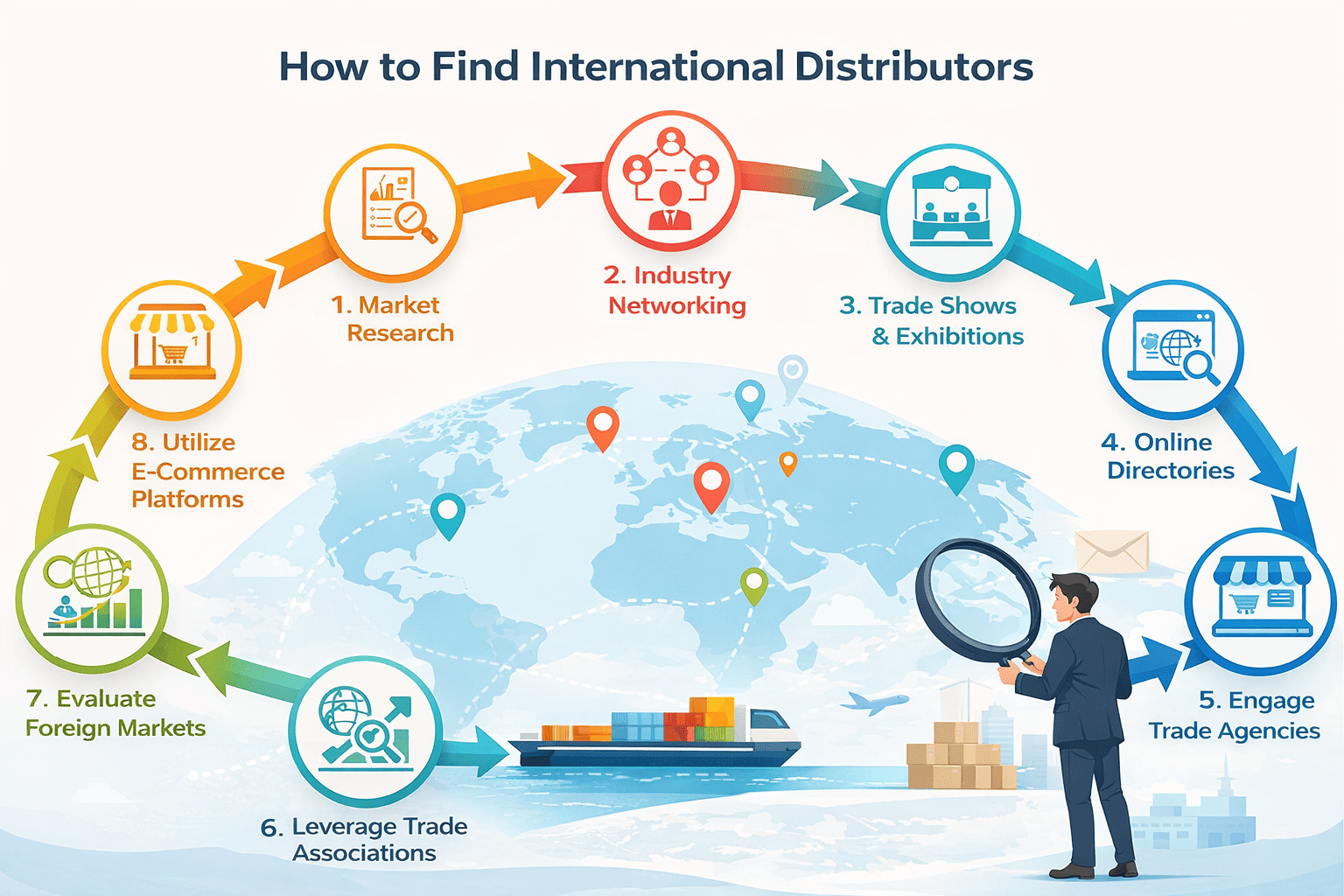
4 Step 2 — Where to Find International Distributors
There are several reliable channels for finding international distribution partners. The most effective strategies combine digital discovery with in-person industry engagement.
01
Verified B2B Collaboration Platforms
Purpose-built platforms like GTsetu list verified manufacturers and distributors by industry, geography, and intent. All companies on GTsetu are verified on six government-sourced points: Name, Address, Registration Number, Company Status, Company Type, and Date of Certificate of Incorporation — using government tie-ups, not self-reported data. Anonymous browsing protects both parties until mutual interest is confirmed, and built-in NDA workflows enable secure collaboration before any sensitive information is exchanged.
02
International Trade Shows & Exhibitions
Industry-specific trade shows remain one of the best places to identify credible distributors face-to-face. Events like Hannover Messe, Dubai Expo-linked sector shows, Canton Fair, and sector-specific expos attract qualified distributors actively looking for new product lines. Research attendees in advance and schedule meetings before arrival.
03
Government Export Promotion Agencies
Most countries operate export promotion bodies that offer distributor-finding services — often at low or no cost. In the US, the Commerce Department’s International Partner Search service provides vetted distributor lists. In India, bodies like FIEO and the Indian Trade Portal offer similar programmes. These are frequently underutilised by SME manufacturers.
04
Industry & Trade Associations
Sector associations maintain member directories that include distributors in specific verticals. Because membership implies a degree of legitimacy, these leads tend to be higher quality than cold directory searches. Reach out to associations in your target market, not just your home country.
05
Competitor Reverse-Engineering
Study how your direct competitors distribute in your target market. Their current distributors may carry non-competing complementary products you could partner with — or a competing distributor’s dissatisfied partner may be open to switching. Trade press announcements and LinkedIn company pages often reveal distribution relationships.
06
Your Existing Network & Referrals
Referrals from trusted business contacts, existing customers, or financial institutions operating in your target market remain among the highest-quality leads. A warm introduction compresses the trust-building phase considerably. Don’t underestimate this channel before investing in more costly discovery methods.
07
B2B Trade Directories & Databases
Directories like Kompass, Dun & Bradstreet, and regional databases provide searchable databases of companies by industry and geography. Note that these list companies without verification — additional due diligence is essential for any lead sourced from a directory.
Channel
Lead Quality
Cost
Speed
Best For
Verified B2B Platform (GTsetu)
⭐⭐⭐⭐⭐
Low–Medium
Fast
Systematic, scalable global search
Trade Shows
⭐⭐⭐⭐
High
Slow (annual)
Face-to-face relationship building
Government Agencies
⭐⭐⭐⭐
Very Low
Medium
SME manufacturers, first-time exporters
Industry Associations
⭐⭐⭐⭐
Low
Medium
Sector-specific niche markets
Personal Referrals
⭐⭐⭐⭐⭐
None
Unpredictable
Trust-critical markets
B2B Directories
⭐⭐
Low
Fast (but unvetted)
Initial research only
Cold Digital Outreach (LinkedIn)
⭐⭐
Low
Slow (low response)
Supplementary prospecting
SECTION 5
5 Step 3 — How to Vet and Shortlist Candidates
Discovery is only the beginning. The vetting stage is where most manufacturers fail — either rushing through it or skipping it entirely because they’re excited about a promising lead. A thorough vetting process protects you from costly mistakes.
Vetting Stage
What to Check
How to Check It
Legal Standing
Valid business registration, not blacklisted
Company registry, local authority checks
Financial Health
Solvency, turnover range, payment history
Credit bureau report, D&B rating, bank reference
Track Record
Years in business, clients, products distributed
Website, LinkedIn, trade references (call them)
Infrastructure
Warehouse capacity, vehicles, tech systems
Site visit (virtual or physical), photos, ERP confirmation
Regulatory Compliance
Import licences, industry certifications
Document request, regulatory body confirmation
Portfolio Compatibility
Do they carry competing brands?
Direct questioning, market observation
Authority of Representative
Is the person you’re dealing with authorised?
Request authority letter with company seal
SECTION 6
6 Step 4 — Evaluation Criteria: Scoring Your Shortlist
Use a weighted scorecard to compare shortlisted distributors objectively. The weights below are illustrative — adjust them to match your own strategic priorities.
Criterion
Weight
How to Score (1–5)
Why It Matters
Market Coverage
20%
5 = full national coverage
Determines your potential reach in market
Financial Capacity
18%
5 = strong balance sheet, credit rated
Prevents stock-out and payment risk
Industry Expertise
17%
5 = deep vertical specialisation
Reduces product education cost
Sales Force Strength
15%
5 = large dedicated team
Drives sell-through to end customers
Logistics Infrastructure
12%
5 = modern warehouse, own fleet
Ensures product reaches market on time
Brand Alignment
10%
5 = premium portfolio, no conflicts
Protects brand perception
Regulatory Knowledge
8%
5 = certified, fully compliant
Avoids import stoppages
📋 Scorecard Usage
Multiply each score by its weight percentage and sum across all criteria. A distributor scoring above 80% is a strong candidate. Below 60% indicates a poor fit regardless of how enthusiastic the first meeting felt.
SECTION 7
7 Step 5 — Exclusive vs. Non-Exclusive Distribution
One of the most consequential decisions in structuring an international distribution relationship is whether to grant exclusivity. Both models have legitimate use cases — the right choice depends on your market entry strategy and the distributor’s commitment.
Exclusive Distributor
Non-Exclusive Distributor
Definition
Only authorised seller of your product in the territory
One of several distributors in the territory
Distributor motivation
High — full market upside is theirs
Lower — competing with other distributors
Your risk
High if distributor underperforms — you are locked in
Low — you can appoint additional partners
Best when
Distributor commits to investment in your brand
Testing a market or distributor, or large territory
Contract safeguard
Include minimum performance targets or exclusivity lapses
Define territories clearly to avoid conflict
Transition strategy
Start exclusive; review at year 1 and year 3
Offer exclusivity as earned incentive for top performer
SECTION 8
8 Red Flags: Warning Signs in a Prospective Distributor
Recognising bad partnership signals early saves months of painful extraction later. These warning signs should trigger either deeper due diligence or disqualification.
🚩
Cannot Verify Business Registration
Legitimate distributors can provide verifiable incorporation documents. Refusal or delay is a disqualifier.
🚩
Demands Exclusivity Before Any Commitment
Requesting exclusivity without agreeing to minimum purchase volumes or investment is a one-sided demand.
🚩
Carries Too Many Competing Brands
A distributor representing 8+ direct competitors will deprioritise your products when push comes to shove.
🚩
Requests Large Upfront Payment from You
Legitimate distributors buy product; they do not charge manufacturers for the privilege of distribution rights.
🚩
Unclear About Current Clients
Reluctance to name existing principals or provide trade references suggests fabricated credentials.
🚩
No Physical Warehouse or Infrastructure
A distributor without logistics infrastructure is effectively a paper company. Verify with a site visit or photos.
🚩
Unresponsive to NDA Request
Genuine business partners understand NDAs. Resistance to standard confidentiality protocols signals poor intent.
🚩
Vague About Market Coverage Claims
“We cover the whole region” without specific accounts, routes, or retail relationships is empty positioning.
SECTION 9
9 Regional Playbook: Key Distribution Markets
Distribution dynamics vary significantly by region. Here is a concise orientation for the markets where GTsetu operates:
🇮🇳
South Asia
Multi-tier distribution is common. Relationships and trust are paramount before contracts.
🇦🇪
Middle East
UAE acts as a regional hub. Exclusivity arrangements are common and expected by serious distributors.
🇩🇪
Europe
Highly regulated. CE marking and REACH compliance are non-negotiable before distributor conversations.
🇳🇬
Africa
High-growth markets with significant informal sectors. Formal verification and escrow arrangements are advisable.
🇸🇬
Southeast Asia
Singapore is a gateway hub. Country-by-country fragmentation means local distributor knowledge is essential.
🇦🇺
Australia
Transparent, contract-driven market. Longer lead times but reliable payment and lower default risk.
Region
Average Distribution Chain Length
Key Certifications to Prepare
Relationship or Contract First?
South Asia
3–4 tiers (importer → regional → local)
BIS, FSSAI (India), PSQCA (Pakistan)
Relationship first
Middle East
1–2 tiers (exclusive importer → retail)
GSO, ESMA, Halal where applicable
Contract strongly preferred
Europe
1–2 tiers (importer → retail/wholesale)
CE Marking, REACH, EN standards
Contract first
Africa
2–3 tiers (vary by country)
SON, KEBS, SABS depending on market
Relationship first
Southeast Asia
2–3 tiers (country-specific)
BPOM (Indonesia), HSA (Singapore)
Balanced
Americas
1–2 tiers
FCC, FDA, UL depending on product
Contract first
SECTION 10
10 NDA & Distribution Agreement Essentials
Once you’ve identified a strong candidate, the legal framework protects both parties. Never share proprietary product information, pricing, or trade secrets before an NDA is in place.
NDA — What to Cover Before Sharing Details
NDA Clause
Why It Matters
Scope of confidential information
Clearly define what constitutes protected information (pricing, formulas, production processes)
Permitted use restriction
Information shared for evaluation only — cannot be used to develop competing products
Duration
Typically 2–5 years; survivable if no agreement is reached
Governing law
Specify which country’s law governs the NDA — critical for cross-border enforceability
Return / destruction clause
If negotiations fail, all shared materials must be returned or destroyed
Distribution Agreement — Key Commercial Terms
Term
Recommended Approach
Territory definition
Map exact geography — country, states, or named cities. Leave no ambiguity.
Exclusivity and termination trigger
Tie exclusivity to annual minimum purchase volumes. Failure = automatic non-exclusive conversion.
Pricing & discounts
Define transfer price, discount tiers, and currency. Include price review clause annually.
Minimum purchase commitments
Year 1 target (lower), Year 2+ target (ratchet up). Include consequence of shortfall.
IP ownership
All intellectual property remains with manufacturer. Distributor may not alter branding or packaging.
Performance KPIs
Revenue targets, distribution points, marketing spend, reporting frequency.
Termination
30–90 day notice, immediate termination for breach. Include stock buyback obligations.
Dispute resolution
Specify arbitration body and jurisdiction. ICC arbitration is internationally respected.
✅ GTsetu NDA Workflow
GTsetu facilitates NDA workflows directly within the platform — so manufacturers and distributors can formalise confidentiality before any sensitive exchange, with a complete audit trail maintained for both parties.
SECTION 11
11 How to Manage & Work with International Distributors
Finding the right distributor is only half the battle — the real work begins after the contract is signed. Successful manufacturers treat distributor management as an ongoing strategic partnership, not a transactional vendor relationship. Poor management leads to underperformance, conflict, and eventual separation.
The Four Pillars of Effective Distributor Management
01
Clear Communication & Expectations
Establish communication protocols from day one: who are the primary contacts on each side, what is the cadence of check-ins (weekly? monthly?), which channels are used for urgent vs. routine matters, and what response time is expected. Ambiguity in communication causes 80% of distributor relationship breakdowns. Create a shared communication charter in the first 30 days.
02
Joint Business Planning
The best distributor relationships operate with a shared annual business plan — not just your plan for them. Schedule a formal planning session at the start of each fiscal year covering: sales targets by quarter, marketing campaign calendar, new product launches, inventory stocking levels, and investment commitments from both parties. Update quarterly and treat the plan as a living document.
03
Performance Tracking & KPIs
Define measurable KPIs upfront and track them religiously: sales volume by SKU, inventory turnover, number of active retail points, customer complaints, on-time delivery rate, and market share growth. Share a dashboard monthly. KPIs should be transparent to both parties — surprises during an annual review mean the monitoring cadence was insufficient.
04
Continuous Support & Enablement
A distributor is only as good as the tools you give them. Provide: comprehensive product training (initial and ongoing), sales collateral in local language, technical support hotline, co-marketing fund contributions, and periodic market visits from your team. Treat them as an extension of your sales force, not an outsourced problem to forget about.
Operational Best Practices for Working with Distributors
Activity
Frequency
Who Owns It
Expected Outcome
Business Review Call
Monthly
Joint (both parties present)
Review prior month performance, resolve blockers
Quarterly Business Review (QBR)
Quarterly
Joint (senior leadership)
Strategic alignment, plan updates, investment decisions
Sales Data Submission
Weekly/Bi-weekly
Distributor
Visibility into sell-through, inventory levels
Product Training Sessions
Quarterly or per new launch
Manufacturer
Keep sales team updated on features, positioning
Market Visit
2–4 times per year
Manufacturer
Ground truth on retail placement, competitive landscape
Marketing Plan Review
Quarterly
Joint
Align campaigns, approve co-marketing spend
Contract Performance Review
Annually
Joint (legal & commercial)
Assess compliance with agreement terms, renew or renegotiate
Customer Complaint Escalation
As needed
Distributor initiates, manufacturer resolves
Protect brand reputation, maintain quality
Managing Underperformance
When a distributor consistently misses targets, address it immediately through a structured performance improvement plan (PIP). The PIP should include: specific gaps identified (e.g., 30% below sales target for 2 consecutive quarters), root cause analysis (lack of marketing support? inventory stockouts? competitive pressure?), agreed corrective actions with deadlines, and consequences if improvement does not occur (e.g., transition to non-exclusive status, or contract termination).
⚠️ Common Management Mistakes
The three most common management failures are: (1) Over-communicating in the first month then disappearing for six months, (2) Setting targets without providing the resources or support to hit them, and (3) Treating all distributors identically regardless of market maturity or performance tier. Tailor your management intensity to each distributor’s needs and results.
SECTION 12
12 Strategies for Building Strong Distributor Relationships
The most successful international partnerships are built on mutual trust, transparency, and aligned incentives — not just contractual obligations. Here are proven strategies for transforming a transactional arrangement into a genuine strategic partnership.
🤝
Treat Them as Partners, Not Vendors
Involve distributors in product development feedback, pricing strategy discussions, and market expansion planning. When they feel like strategic partners, they invest more.
📊
Share Market Intelligence Both Ways
Don’t just demand sales data — reciprocate by sharing competitive intelligence, industry trends, and upcoming product roadmaps early. Information symmetry builds trust.
💰
Align Financial Incentives
Structure pricing and rebate programs so that distributor profitability grows when they hit your strategic objectives — not just volume. Reward market share gains, not just sales.
🎯
Co-Invest in Market Development
Offer co-marketing funds, trade show subsidies, or training investments. When both parties have skin in the game, commitment levels rise dramatically.
👥
Build Personal Relationships
Business is still done person-to-person. Regular in-person visits, joint attendance at industry events, and even informal dinners build rapport that contracts alone cannot.
🎓
Invest in Their Team’s Growth
Offer training not just on your products but on sales methodologies, digital marketing, or supply chain management. Distributors value partners who help them improve overall.
🔄
Be Responsive to Their Needs
When a distributor requests product modifications, faster lead times, or flexible payment terms, evaluate seriously. Rigidity damages relationships; flexibility builds loyalty.
🏆
Recognise and Reward Performance
Create distributor awards programs, publish success stories, or offer exclusive access to new products for top performers. Public recognition drives motivation.
The Relationship Maturity Model
Not all distributor relationships operate at the same level of partnership. Understanding where you are — and where you want to be — helps set appropriate expectations.
StageCharacteristicsCommunication StyleHow to Progress
Stage 1: TransactionalOrder-based relationship, minimal information sharing, price-focusedReactive, order fulfillment onlyBegin sharing sales data and market insights
Stage 2: CooperativeRegular communication, some joint planning, occasional market visitsScheduled calls, basic reportingIntroduce joint business planning and co-marketing
Stage 3: CollaborativeShared business plans, co-investment, mutual problem-solvingProactive, strategic discussionsInvolve in product development, long-term exclusivity
Stage 4: Strategic PartnershipJoint product development, integrated systems, multi-year commitmentsExecutive engagement, shared roadmapsFormalise as preferred partner, explore equity arrangements
💡 Relationship-Building Timeline
Most distributor relationships begin at Stage 1 (transactional) and take 12–18 months to reach Stage 3 (collaborative) if both parties invest in the relationship. Forcing partnership behaviors too early feels inauthentic; waiting too long to evolve keeps you locked in a transactional, price-driven dynamic. Reassess the relationship maturity every six months.
SECTION 13
13 How to Become an International Distributor
This guide has focused primarily on manufacturers seeking distributors — but the reverse inquiry is equally common. If you operate a distribution business and want to represent international manufacturers, here is the framework for positioning yourself as an attractive partner.
What Manufacturers Look for in a Distributor
When evaluating potential distributors, manufacturers assess five core dimensions. If you can demonstrate strength across all five, you become a highly attractive partner.
Document your distribution network with specifics: number of retailers served, cities covered, market share in key accounts
Financial Stability
Ability to fund inventory, creditworthiness
Provide audited financials, bank references, and credit bureau rating. Proactively share this during first contact.
Operational Capability
Warehouse infrastructure, logistics capacity, IT systems
Create a “Distributor Profile” document with warehouse photos, square footage, inventory management system, fleet size, etc.
Product Portfolio Fit
Complementary products, no direct conflicts, channel alignment
Present your current portfolio honestly. Position gaps as opportunities for the manufacturer to fill.
Growth Orientation
Willingness to invest in brand-building, not just take orders
Show examples of past brand launches you’ve successfully scaled. Share your approach to new product introductions.
Steps to Become an International Distributor
01
Build Your Business Foundations
Ensure you have: valid business registration and import/export licences, adequate warehouse or storage facilities, working capital to fund 60–90 days of inventory, existing customer relationships in your target segment, and industry-specific certifications if required (ISO, GDP, Halal, etc.). Manufacturers will verify all of these.
02
Identify Your Niche & Target Manufacturers
Generalist distributors struggle to compete against specialists. Choose a clear vertical (industrial supplies, FMCG, medical devices, etc.) and geography, then build a shortlist of international manufacturers whose products complement — but do not compete with — your existing portfolio. Research them thoroughly before reaching out.
03
Create a Professional Distributor Profile
Manufacturers receive dozens of distribution inquiries. Stand out with a concise, professional profile covering: your company background, years in business, territory and market coverage, existing product lines (with brand names), key retail/wholesale accounts, warehouse capacity, sales team size, and your value proposition (why you, specifically?).
04
Join Verified B2B Platforms
Rather than cold-calling manufacturers, list your company on verified platforms like GTsetu where manufacturers actively search for distributors. GTsetu verifies companies on six government-sourced points: Name, Address, Registration Number, Company Status, Company Type, and Date of Certificate of Incorporation — using government tie-ups, not self-reported data. Anonymous browsing works both ways — you can also discover manufacturers looking for partners in your region.
05
Attend Trade Shows as a Buyer
International trade shows are not just for manufacturers — they are where distributors scout new products. Register as a trade visitor, research exhibitors in advance, and schedule meetings on-site. Bring your distributor profile as a leave-behind.
06
Demonstrate Market Knowledge
When approaching a manufacturer, lead with insight — not just interest. Show that you understand their product, their competitors in your market, pricing dynamics, and regulatory requirements. Manufacturers want partners who can hit the ground running, not ones they need to educate.
07
Propose a Win-Win Business Plan
Don’t just ask to distribute their product — propose how you will do it. Outline your go-to-market approach: which accounts you will target, your launch timeline, expected first-year volume, marketing support you will provide, and what you need from them (pricing, exclusivity, co-marketing funds, etc.).
🎯 Distributor Success Tip
The best distributors approach manufacturers with a market entry plan — not a generic “we want to distribute your products” email. Manufacturers are more likely to engage when they see you have done the homework and understand how to win in your market. Specificity signals seriousness.
Getting Listed on GTsetu as a Distributor
GTsetu enables distributors to create verified profiles that manufacturers can discover during their partner search. The verification process uses government tie-ups to confirm:
📄
Government-Sourced Data
Name, Address, Registration Number, Company Status, Company Type, Date of Certificate of Incorporation — verified against official government records.
✅
Active Status Confirmation
Business is confirmed as legally active and currently operating on the date of verification, no dormant, dissolved, or suspended entities.
🔒
Authority Verification
You must submit an authority letter with company seal confirming your role and authority to represent the company.
🏅
Verified Badge
Once approved, your profile receives a verification badge, increasing manufacturer trust and inquiry rates.
Anonymous discovery works for distributors too: You can browse manufacturer profiles without revealing your identity, express interest selectively, and only share full details after mutual interest is confirmed. This protects your existing supplier relationships while exploring new opportunities.
SECTION 14
14 Realistic Timeline for Finding an International Distributor
The full process from initial search to active sales typically takes 3 to 9 months. Rushing any phase increases risk significantly. Here is a realistic phased timeline:
Initial outreach, mutual interest confirmation, shortlist to 5–8
Phase 3
Weeks 8–14
Deep due diligence, reference calls, site visits, NDA execution
Phase 4
Weeks 14–20
Commercial negotiations, term sheet, legal review, agreement signing
Phase 5
Weeks 20–30
Onboarding, product training, first shipment, market launch
⚡ Accelerating the Timeline
Using a pre-verified platform like GTsetu compresses Phases 1–2 from 8 weeks to as little as 2–3 weeks, because basic verification is already complete before you make first contact. The saved time and reduced uncertainty more than justify the platform investment.
SECTION 15
15 How GTsetu Solves the Distributor Search Problem
🌐 Platform Spotlight — GTsetu
The B2B Platform Built for Verified Global Partnerships
Finding an international distributor through traditional channels is slow, expensive, and risky. Cold directories list unvetted companies. Trade shows are annual. Government programmes are bureaucratic. GTsetu was built to solve exactly this problem — providing a government-sourced verification environment where manufacturers and distributors connect with built-in trust infrastructure.
✅
6-Point Government-Sourced VerificationName, Address, Registration Number, Company Status, Company Type, and Date of Certificate of Incorporation — verified using government tie-ups, not self-reported data.
🕵️
Anonymous DiscoveryBrowse verified distributor profiles without revealing your identity. Share details only when ready to connect.
📄
NDA Workflow Built-InFormalise confidentiality before any sensitive exchange, with a full audit trail maintained automatically.
🚫
Zero Commission ModelGTsetu never charges a success fee or broker commission. Your deal economics stay between you and your partner.
🔐
Encrypted WorkspaceAll documents and communications are encrypted in transit and at rest. Full access controls for your team.
🌍
100+ CountriesActive network spanning Asia, Middle East, Europe, Africa, Australia, and the Americas.
QHow do manufacturers find international distributors?
Manufacturers find international distributors through verified B2B platforms like GTsetu, international trade shows, government export promotion agencies (such as the US Commercial Service or FIEO in India), industry trade associations, and trade directory databases. The most reliable approach combines digital discovery on verified platforms with in-person industry engagement to build the relationship. Referrals from trusted business contacts remain the highest-conversion source.
QWhat is the difference between a distributor and a sales agent?
An international distributor buys your products outright, takes legal ownership of inventory, and resells independently — handling import, warehousing, marketing, and after-sales. A sales agent represents your company abroad and earns a commission on sales they facilitate, without ever owning the goods. Distributors offer faster market access and better cash flow; agents offer more control over pricing and the final customer relationship.
QWhat should I look for when choosing an international distributor?
The key criteria are: verified business registration and legal standing; financial capacity to hold adequate inventory; existing market coverage and channel relationships in your target territory; compatible product portfolio with no direct conflicts; logistics and warehouse infrastructure; local regulatory and certification knowledge; and willingness to commit to performance targets. Use a weighted scorecard to compare candidates objectively rather than relying on impressions from initial meetings.
QShould I grant exclusivity to my international distributor?
Exclusivity is a valuable incentive — but only when it comes with clear minimum performance obligations. A common best practice is to start with a non-exclusive arrangement or a 12-month trial exclusivity, then convert to full exclusivity once the distributor has demonstrated market traction and hit agreed sales targets. Always include a termination-of-exclusivity clause triggered by failure to meet purchase volume commitments.
QHow long does it take to find and onboard an international distributor?
The typical process takes 3 to 9 months: roughly 4–8 weeks for research and shortlisting, 4–6 weeks for due diligence and initial meetings, 4–8 weeks for NDA execution and commercial negotiation, and 4–12 weeks for onboarding and first shipment. Using a pre-verified B2B platform significantly compresses the early research and vetting stages.
QHow does GTsetu help manufacturers find distributors?
GTsetu is a verified B2B platform connecting manufacturers and distributors across 100+ countries. All companies are verified on six government-sourced points: Name, Address, Registration Number, Company Status, Company Type, and Date of Certificate of Incorporation — using government tie-ups. The platform supports anonymous browsing, structured discovery, built-in NDA workflows, encrypted document sharing, and audit trails — with zero broker commissions on any deal concluded.
QHow do I manage international distributors effectively?
Effective distributor management requires four pillars: (1) Clear communication protocols with defined cadence and escalation paths, (2) Joint business planning with shared annual targets and quarterly reviews, (3) Transparent KPI tracking including sales volume, inventory turnover, and market coverage, and (4) Continuous enablement through product training, marketing support, and regular market visits. The best manufacturers treat distributors as strategic partners with two-way information sharing rather than transactional vendors.
QWhat are the best strategies for building relationships with international distributors?
Strong distributor relationships are built through: treating them as partners rather than vendors, sharing market intelligence bidirectionally, aligning financial incentives with strategic objectives, co-investing in market development, building personal relationships through regular visits, investing in their team’s training and growth, being responsive to their operational needs, and publicly recognising top performance. Most successful relationships evolve from transactional to collaborative over 12–18 months of consistent engagement.
QHow can I become an international distributor for manufacturers?
To become an international distributor: (1) Build business foundations including valid registration, import licences, warehouse facilities, and working capital; (2) Identify your niche industry vertical and target geography; (3) Create a professional distributor profile documenting your market coverage, existing accounts, and infrastructure; (4) Join verified B2B platforms like GTsetu where manufacturers actively search for distribution partners; (5) Attend trade shows as a buyer; (6) Approach manufacturers with market-specific insights demonstrating you understand their product and local competitive landscape; (7) Propose a concrete go-to-market plan rather than generic interest.
QWhere can companies looking for international distributors find verified partners?
Companies looking for international distributors can find verified partners through: specialised B2B collaboration platforms like GTsetu (which verify companies using government tie-ups on six core data points), international trade shows and exhibitions, government export promotion agencies (US Commercial Service, FIEO, etc.), industry trade associations, and referrals from trusted business networks. The most efficient approach uses a verified platform for initial discovery combined with in-person relationship building at industry events. Avoid general directories that list companies without verification.
QWhat is an international partner search and how does it work?
An international partner search is the systematic process of identifying, vetting, and connecting with qualified business partners (distributors, agents, OEMs, or trading companies) in foreign markets. The process involves: defining your ideal partner profile, researching candidates through multiple channels, conducting due diligence on shortlisted companies, verifying credentials and business standing, negotiating commercial terms, and formalising the relationship through legal agreements. Modern partner search increasingly uses verified B2B platforms that compress the discovery and vetting phases from months to weeks through pre-completed verification using government-sourced data.
QHow do manufacturers looking for distributors worldwide conduct their search efficiently?
Manufacturers looking for distributors worldwide should: (1) Start with a clear written profile of ideal distributor characteristics by market, (2) Use verified B2B platforms for systematic discovery across multiple geographies simultaneously, (3) Leverage government export promotion services for free or low-cost vetted leads, (4) Attend key international trade shows with pre-scheduled meetings, (5) Tap industry associations in target markets for member directories, (6) Implement a structured vetting scorecard to compare candidates objectively, and (7) Use phased rollout — begin with 2-3 priority markets rather than 20+ simultaneously to maintain management bandwidth.
QDo I need an NDA before talking to a potential distributor?
Initial discovery conversations can proceed without an NDA — you can discuss product categories, market opportunities, and general capabilities openly. However, before sharing pricing structures, product formulations, production capacity, or proprietary business information, an NDA is essential. GTsetu facilitates NDA workflows within the platform, making this step fast and auditable.
Ready to Find Your Verified International Distributor?
Join 500+ verified companies already building global trade partnerships on GTsetu — with government-sourced verification, zero broker fees, and built-in NDA workflows.
They represents the product, and research team behind GTsetu, a global B2B collaboration platform built to help companies explore cross-border partnerships with clarity and trust. The team focuses on simplifying early-stage international business discovery by combining structured company profiles, verification-led access, and controlled collaboration workflows.
With a strong emphasis on trust, and disciplined engagement, Team GTsetu shares insights on global trade, partnerships, and cross-border collaboration, helping businesses make informed decisions before entering deeper commercial discussions.