OEM vs ODM vs JDM vs OBM vs EMS vs CEM vs CMO: Full Comparison | GTsetu
Home ›
Blogs ›
OEM vs ODM vs JDM vs OBM vs EMS vs CEM vs CMO
🏭 Manufacturing Models
OEM vs ODM vs JDM vs OBM vs EMS vs CEM vs CMO: Full Comparison
Direct Answer: OEM (Original Equipment Manufacturer) is a brand owner that designs products and sells them under its own brand, often outsourcing production. ODM (Original Design Manufacturer) designs AND manufactures products that other companies rebrand and sell. EMS (Electronics Manufacturing Services) provides comprehensive manufacturing services to OEMs, including PCB assembly, testing, supply chain, and logistics. CEM (Contract Electronics Manufacturer) is a subset of EMS focused on electronics assembly. CMO (Contract Manufacturing Organisation) is the cross-industry equivalent used in pharma, food, and FMCG. OBM (Original Brand Manufacturer) designs, makes, and sells entirely under its own brand, while JDM (Joint Design Manufacturer) is a hybrid where the brand owner and manufacturer co-design the product. For manufacturers seeking government-verified global partners across all these models, GTsetu connects you with six-point government-verified companies (Name, Address, Registration Number, Company Status, Company Type, Date of Incorporation) across 100+ countries, with zero broker fees.
📅 Published February 17, 2026🔄 Updated September 22, 2026⏱ 20 min read✍️ GTsetu Editorial Team
7
Key Acronyms Decoded
100+
Countries on GTsetu
500+
Verified Companies
0%
Broker Commission
Walk into any B2B manufacturing conversation and you’ll be hit with a barrage of acronyms, OEM, ODM, EMS, CEM, CMO, OBM, JDM. Each one describes a different type of company, a different business model, and a different relationship in the manufacturing value chain. Understanding these distinctions is not just academic; it directly determines which partners you pursue, how you structure contracts, how you protect your IP, and how you scale internationally.
This guide decodes every term, compares the models side-by-side, and, crucially, explains how each model fits into a global manufacturing and distribution strategy. Whether you are a brand owner evaluating OEM procurement options, a contract manufacturer or EMS provider seeking new clients, or a distributor trying to understand your supply chain, this is the guide you need.
💡 Who This Guide Is For
Brand owners evaluating outsourcing models, contract manufacturers and EMS providers seeking to understand how clients categorise them, distributors trying to navigate the supply chain, and anyone who has been confused by these acronyms in a trade conversation.
SECTION 1
1 The Seven Key Manufacturing Acronyms at a Glance
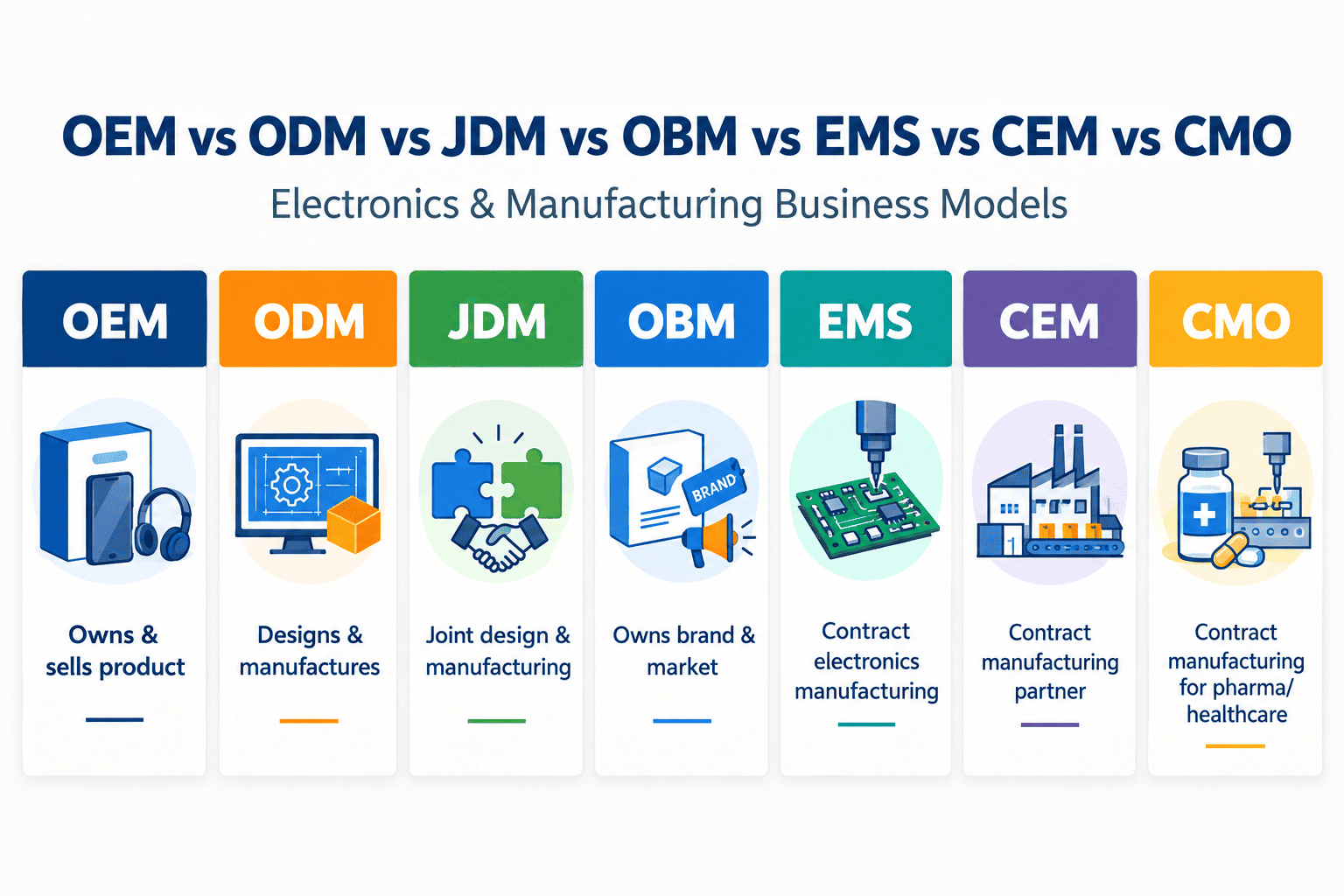
Before diving into detailed explanations, here is a quick-reference visual overview of all seven acronyms. Each represents a distinct role in the manufacturing value chain, though in practice, companies often overlap between categories.
OEM
Original Equipment Manufacturer
Brand owner that designs and sells products under its own name. Often outsources production.
🏷️ Brand Owns IP
ODM
Original Design Manufacturer
Designs AND manufactures products. Sells to multiple brand owners who apply their own labels.
Subset of EMS. Specialises in assembly of electronic products to client-provided designs.
🔧 Assembly Specialist
CMO
Contract Manufacturing Organisation
Cross-industry equivalent of contract manufacturing. Widely used in pharma, food, and FMCG.
🌐 Multi-Sector
OBM
Original Brand Manufacturer
Designs, manufactures, and sells under its own brand end-to-end. No third-party label involved.
🏆 Full Value Chain
JDM
Joint Design Manufacturer
Hybrid model, brand owner and manufacturer co-design the product and often share IP.
🤝 Shared Design
📌 Why These Terms Get Confused
The boundaries between OEM, ODM, EMS, and CEM are not always clear-cut. The same company can act as an EMS provider for one client and an ODM for another. And confusingly, “OEM” is sometimes used colloquially to mean the contract manufacturer rather than the brand owner. Two more terms, OBM and JDM, sit at either end of the design-ownership spectrum, OBM being full self-ownership, JDM being shared co-design, and are covered in their own sections below. This guide uses the precise, industry-standard definitions throughout.
SECTION 2
2 What Is an OEM (Original Equipment Manufacturer)?
🎯 Definition
An OEM (Original Equipment Manufacturer) is a company that designs a product and sells it under its own brand. The OEM’s logo appears on the final product. The OEM retains full ownership of the intellectual property, the design, the formula, the technology. However, the OEM typically outsources actual production to contract manufacturers (EMS, CEM, or ODM providers), keeping its focus on product innovation, branding, marketing, and sales.
Think of Apple: the iPhone has an Apple logo. Apple designed it. Apple sells it. Apple owns the IP. But Apple does not manufacture it, Foxconn, Pegatron, and Luxshare do. Apple is the OEM. Foxconn is the EMS/CEM provider.
What Does an OEM Actually Do?
01
Product Design & Engineering
The OEM owns the design process, creating specifications, engineering drawings, bills of materials, and quality standards that define exactly what the product must be.
📍 Apple’s Jony Ive team designing iPhone hardware
02
IP Ownership & Protection
All patents, trade secrets, design rights, and trademarks belong to the OEM. The contract manufacturer is explicitly prohibited from using this IP for other clients.
📍 Nike’s shoe designs are Nike IP, not the factory’s
03
Brand, Marketing & Sales
The OEM controls the customer relationship, brand identity, pricing strategy, and distribution channels. End customers often don’t know (or care) who manufactured the product.
📍 Samsung sells products globally; factories are invisible
04
Quality Standards & Auditing
The OEM sets quality requirements and audits the contract manufacturer to ensure compliance, through third-party inspections, factory visits, or resident quality engineers.
📍 Pharma OEMs sending QA teams to CMO facilities
OEM Parts: A Clarification
In some industries (particularly automotive and electronics repair), “OEM parts” refers to parts that are authentic, manufactured to the original equipment manufacturer’s exact specifications. This is contrasted with “aftermarket parts” made by third parties. This usage of “OEM” describes the parts themselves, not a business model, a nuance worth noting when purchasing or specifying components.
~80%
of major consumer electronics brands outsource manufacturing to EMS/CEM providers
Higher
margins for OEMs vs. their contract manufacturers, OEMs carry market risk, CMs carry operational risk
Full
IP control means OEMs can switch manufacturers without losing their product differentiation
Global
OEMs use GTsetu to find government-verified contract manufacturers in Asia, Europe, and the Americas
SECTION 3
3 What Is an ODM (Original Design Manufacturer)?
🎯 Definition
An ODM (Original Design Manufacturer) is a company that handles both product design and manufacturing. The ODM owns the intellectual property of the design. It then sells the product to multiple brand owners who apply their own branding and sell it as their product. The ODM’s name rarely appears on the final product. In essence: the ODM does the hard work of product development; the brand owner supplies the marketing and distribution reach.
ODM is particularly prevalent in consumer electronics, accessories, food and beverage (store brands), and apparel. When you buy a “private label” or “white-label” product, it is almost always ODM-manufactured. The same physical product may be sold under ten different brand names simultaneously, all sourced from the same ODM factory.
How ODM Differs from Simple Private Labelling
Dimension
ODM
Private Label / White Label
Who designs the product?
The ODM company itself
The ODM or a third party, often a generic design
IP ownership
ODM owns the design IP
Typically ambiguous or shared
Customisation
Limited, brand owner chooses from ODM’s catalogue
Minimal, brand is applied to existing product
Exclusivity
Rarely exclusive unless negotiated
Never exclusive
Brand owner’s investment
Low, no product development cost
Very low, no development, minimal customisation
Differentiation
Limited, competitor may sell same product
Minimal, entirely brand-dependent
✨ GTsetu Insight
Many manufacturers on GTsetu offer both ODM capabilities (sell their existing designs under your brand) AND contract manufacturing capabilities (produce to your unique specifications). When searching for partners, it’s important to clarify which model you need, the commercial terms, IP clauses, and pricing structures differ significantly between the two.
SECTION 4
4 What Is an EMS Provider (Electronics Manufacturing Services)?
🎯 Definition
An EMS (Electronics Manufacturing Services) provider is a company that offers comprehensive, end-to-end manufacturing services specifically for electronic products, on behalf of OEM clients. EMS providers go far beyond simple assembly. They handle design-for-manufacturability (DFM) support, PCB and PCBA production, component sourcing and supply chain management, testing and quality assurance, logistics and distribution, and even after-sales repair and return management. The OEM retains IP and brand ownership throughout.
What Services Does an EMS Provider Typically Offer?
🖥️
PCB & PCBA Manufacturing
Printed circuit board fabrication, Surface Mount Technology (SMT) assembly, and through-hole soldering for electronic assemblies.
🔬
Design for Manufacturability (DFM)
Engineering support to review the OEM’s design and optimise it for efficient, cost-effective high-volume production.
🏗️
New Product Introduction (NPI)
Managing the transition from prototype to full-scale production, including tooling, process development, and pilot builds.
📦
Supply Chain & Procurement
Component sourcing, BOM analysis, supplier management, and inventory optimisation across the full materials supply chain.
✅
Test & Quality Assurance
Functional testing, in-circuit testing (ICT), X-ray inspection, and quality control to ensure every unit meets specification.
🚢
Logistics & Direct Fulfillment
Warehousing, order fulfillment, customs management, and direct-to-retailer or direct-to-consumer shipping services.
Complete product assembly incorporating PCBAs, cables, mechanical enclosures, and firmware programming into finished units.
The largest EMS providers in the world, Foxconn (Hon Hai), Flex Ltd, Jabil, Celestica, and Pegatron, operate at a scale that supports global OEM clients with operations across dozens of countries. But EMS is not exclusively for large corporations; mid-market and regional EMS providers serve smaller OEMs with dedicated attention and competitive pricing.
SECTION 5
5 What Is a CEM (Contract Electronics Manufacturer)?
🎯 Definition
A CEM (Contract Electronics Manufacturer) is a company that specialises in the assembly and production of electronic products to specifications provided by its OEM clients. CEMs are a subset of EMS, they offer similar core assembly capabilities but typically with a narrower service scope, focused on the production side rather than the full lifecycle services offered by larger EMS providers. CEMs are highly certified, often specialising in precision electronics like PCB assemblies, cable assemblies, and electromechanical sub-systems.
CEM vs EMS: The Practical Distinction
Capability
CEM
EMS
PCB assembly
✅ Core competency
✅ Core competency
Cable & electromechanical assembly
✅ Yes
✅ Yes
Design support (DFM)
⚠️ Limited
✅ Extensive
Supply chain management
⚠️ Partial
✅ End-to-end
Logistics & fulfillment
⚠️ Limited
✅ Full service
After-sales repair & RMA
⚠️ Rarely
✅ Standard offering
Typical client size
SMB to mid-market OEMs
Mid-market to global OEMs
Regulatory certifications
✅ Typically highly certified
✅ Highly certified
📌 Terminology Note
In modern B2B usage, EMS and CEM are often used interchangeably, especially by smaller providers who offer the core assembly services of a CEM but market themselves as EMS providers. When evaluating a potential partner, focus on their actual capability list rather than which acronym they use to describe themselves.
SECTION 6
6 What Is a CMO (Contract Manufacturing Organisation)?
🎯 Definition
A CMO (Contract Manufacturing Organisation) is the cross-industry equivalent of a contract manufacturer, a company hired to produce goods on behalf of a brand owner across sectors that don’t primarily use the EMS/CEM terminology. CMO is the preferred term in pharmaceuticals (where CDMOs, Contract Development and Manufacturing Organisations, are also common), food and beverage, nutraceuticals, cosmetics, and FMCG. The CMO manufactures to the client’s specifications and formula; the client retains IP and brand ownership.
An OBM (Original Brand Manufacturer) is a company that controls the entire value chain, design, manufacturing, branding, marketing, and sales, under its own name, with no third-party label involved anywhere in the process. OBM is best understood as the evolution point many OEMs and ODMs move toward: a factory that started out producing for other brands eventually builds its own brand, retail presence, and customer relationships, becoming an OBM in its own right.
The clearest way to see the progression is OEM → ODM → OBM. A factory begins as a pure OEM contract producer (making someone else’s design), grows into an ODM (designing products that others rebrand), and eventually launches its own branded line, at which point it is operating as an OBM. Several well-known consumer electronics and appliance brands followed exactly this path, moving from supplying other companies to selling directly under their own name.
OBM vs OEM vs ODM: Who Owns What?
Dimension
OEM
ODM
OBM
Owns the brand
Yes (brand owner)
No, client owns the brand
Yes, fully
Owns the design
Yes, typically
Yes, the ODM owns it
Yes, fully
Manufactures in-house
Often outsourced
Yes, in-house
Yes, often in-house
Sells under whose name?
Its own brand
Client’s brand (rebranded)
Its own brand, no rebranding
Market relationship
Direct to consumer/retail
B2B, sells to brand owners
Direct to consumer/retail
✨ GTsetu Insight
On GTsetu, you’ll find companies across the full OEM-to-OBM spectrum: pure contract manufacturers looking for OEM clients, ODMs with ready-made catalogues for private-label buyers, and OBMs seeking distribution partners for their own branded product lines in new markets.
SECTION 8
8 What Is JDM (Joint Design Manufacturer)?
🎯 Definition
A JDM (Joint Design Manufacturer) arrangement sits between OEM and ODM: the brand owner and the manufacturer co-design the product together, rather than one side handing a finished design to the other. The brand owner typically contributes market insight, user experience direction, and target specifications; the manufacturer contributes production engineering, component knowledge, and manufacturability expertise. IP is usually shared or split by negotiated agreement rather than owned outright by either party.
JDM is common when a brand owner has strong knowledge of its customers but limited in-house hardware engineering, and wants more design influence than a standard ODM catalogue purchase allows, without the full cost and lead time of building a product from a blank page as a pure OEM contract manufacturing project.
OEM vs ODM vs JDM: Where Design Responsibility Sits
Dimension
OEM (Contract Mfg)
ODM
JDM
Who designs the product?
Brand owner, fully
Manufacturer, fully
Both, jointly
Design IP ownership
Brand owner
Manufacturer
Shared, per contract
Brand owner’s input
Complete specification
Selects from catalogue
Requirements & UX direction
Time & cost to launch
Highest
Lowest
Moderate
Typical use case
Highly differentiated products
Commodity or white-label goods
Semi-custom electronics, wearables, smart devices
📌 Terminology Note
Some companies also use “CM” (Contract Manufacturer) as a generic umbrella term covering EMS, CEM, and CMO providers interchangeably, particularly outside electronics-specific contexts. If you see a partner described simply as a “CM,” check their capability list; it usually means the same thing as EMS or CEM in that industry.
SECTION 9
9 OEM vs ODM vs JDM vs OBM vs EMS vs CEM vs CMO: The Full Comparison
This is the definitive side-by-side comparison, the table that all ranking articles attempt but few execute comprehensively, now covering all seven models. Use it as your go-to reference when evaluating a manufacturing partnership model.
Factor
OEM
ODM
JDM
OBM
EMS
CEM
CMO
Full name
Original Equipment Manufacturer
Original Design Manufacturer
Joint Design Manufacturer
Original Brand Manufacturer
Electronics Manufacturing Services
Contract Electronics Manufacturer
Contract Manufacturing Organisation
Primary role
Brand owner; designs & sells product
Designs & manufactures; sells to brand owners
Co-designs product with brand owner
Full-stack brand; designs, makes & sells own products
The OEM vs ODM distinction is the one most commonly misunderstood, and the most commercially consequential. Getting it wrong costs brand owners significant money in either IP exposure or missed differentiation.
✅ Choose OEM Route (Contract Manufacturing) When…
✅ Your product design is your competitive advantage
✅ You need full IP ownership and exclusivity
✅ Product specifications are highly technical or regulated
✅ You want the freedom to switch manufacturers
✅ You have budget for design and NPI investment
✅ Long-term brand differentiation is the strategy
⚡ Choose ODM Route When…
⚡ Speed to market is your #1 priority
⚡ You lack in-house design or engineering capability
⚡ Budget for product development is limited
⚡ Product category is commodity, brand matters more than design
⚡ You want to test a market before investing in custom design
⚡ You are comfortable that competitors may sell similar products
The IP Ownership Matrix: OEM vs ODM
IP Type
OEM Contract Manufacturing
ODM Arrangement
Product design / drawings
OEM (brand owner) owns fully
ODM owns, brand owner licenses it
Tooling and moulds
Typically brand owner’s property
ODM’s property (unless purchased separately)
Manufacturing process
CM’s proprietary process
ODM’s proprietary process
Brand and trademark
OEM (brand owner) owns fully
Brand owner owns fully
Formula / composition
OEM owns (if provided)
ODM owns (unless licensed)
Right to switch manufacturers
Yes, OEM takes designs to new CM
Complicated, design goes with ODM
SECTION 11
11 EMS vs CEM: What’s the Real Difference?
If OEM vs ODM is the most misunderstood distinction in strategy, EMS vs CEM is the most misunderstood distinction in operations. In practical terms, the lines are increasingly blurred, but understanding the theoretical distinction helps you scope your partner requirements accurately.
💡 Clearest Way to Think About It
EMS is the broader category; CEM is a subset. All CEMs are EMS providers, but not all EMS providers are CEMs. EMS is the preferred term for larger, full-service electronics outsourcing companies offering design, manufacturing, supply chain, and lifecycle services. CEM tends to be used for companies that focus specifically on electronics assembly and production, without the broader full-service wrapper.
SECTION 12
12 Which Manufacturing Model Is Right for Your Business?
The right model depends on your strategic position, product type, IP maturity, capital availability, and time-to-market requirements. Use this decision framework to orient your thinking.
🧭 Manufacturing Model Decision Guide
If you have a unique product design and need IP control…
→ Use Contract Manufacturing (OEM Model)
OEM → CM
Find a CEM, EMS, or CMO to manufacture to your specifications. GTsetu lists government-verified CMs globally.
If you want fastest route to market with minimal upfront investment…
→ Use ODM (Buy & Rebrand)
Brand Owner → ODM
Source a ready-made design from an ODM. Accept shared design; focus investment on brand and distribution.
If you need full-lifecycle electronics manufacturing support…
→ Engage an EMS Provider
OEM → EMS
EMS handles design, assembly, testing, supply chain, logistics, and after-market for your product.
If you need electronics assembly only, with lower volume requirements…
→ Engage a CEM
OEM → CEM
CEM provides focused PCB assembly and electronics production without the full EMS overhead.
If your product is in pharma, food, or FMCG…
→ Engage a CMO
Brand → CMO
CMO manufactures to your formula/spec under GMP or food safety standards. IP and brand remain yours.
If you already manufacture for others and want to launch your own branded line…
→ Transition Toward OBM
Factory → OBM
Build your own brand, retail presence, and direct distribution instead of remaining purely OEM/ODM-dependent.
If you want design input without taking on full engineering ownership…
→ Use a JDM Arrangement
Brand + Manufacturer
Co-design with your manufacturer, sharing UX direction and engineering effort, and negotiate the IP split upfront.
Once you’ve chosen a model, you need distribution…
→ Find Government-Verified Distributors
GTsetu Platform
GTsetu connects manufacturers with six-point government-verified international distributors across 100+ countries, the missing link.
SECTION 13
13 Industries Using Each Manufacturing Model
Industry
Dominant Model
Why This Model?
Key Examples
Consumer Electronics
OEM → EMS, with ODM for accessories
High IP value; scale requires EMS; accessories use ODM for speed
Apple/Foxconn; generic phone cases from ODMs
Pharmaceuticals
OEM → CMO / CDMO
GMP compliance critical; formulation IP must be protected
Pfizer, AstraZeneca using Lonza, Patheon
Food & Beverage
Brand Owner → CMO (co-manufacturing)
HACCP compliance; perishability requires regional production
Reckitt/Dettol using Godrej; supermarket own-brands
Automotive
OEM → Tier 1/Tier 2 CM
Safety-critical parts need strict spec adherence; IP is core asset
Safety and regulatory certification are critical; a chassis OEM is paired with a specialised medical-fitout manufacturer
Ambulance, mobile clinic, and emergency-vehicle upfitters working with chassis OEMs
PPE & Medical Apparel
OEM (spec-driven) or ODM (catalogue)
Certification-heavy category; buyers compare custom-spec OEM production against ready-stock ODM options
N95/surgical mask, gown, and glove manufacturers serving both OEM and ODM buyers
Apparel & Footwear
OEM → Contract Factory
Brand differentiation entirely design-driven; low capital in production
Nike, Adidas, Zara using Asian contract factories
Industrial Equipment
OEM → CEM / CM
Specialised components; moderate volume; IP protection critical
Siemens, Honeywell using contract sub-assemblers
Cosmetics & Personal Care
Brand → CMO (co-formulation)
Formula is competitive advantage; contract filling widely available
L’Oréal, Unilever using regional CMOs
SECTION 14
14 Real-World Examples Across All Seven Models
Brand / Company
Model Used
Manufacturing Partner Type
What the Partner Does
Apple (iPhone)
OEM → EMS
Foxconn, Pegatron (EMS)
Complete assembly; supply chain; testing, Apple retains all design IP
Nike
OEM → Contract Factory
400+ factories (Asia)
Full garment/shoe production; Nike controls design, brand, distribution
Dell
OEM → EMS
Flex, Foxconn
Server and PC assembly; supply chain and direct fulfillment
Supermarket “Own Brand”
Retailer → ODM
ODM food/FMCG producers
ODM produces & packages existing formulation; retailer applies own label
Pfizer (Vaccines)
OEM → CMO / CDMO
Lonza, Patheon
API synthesis, formulation, fill-finish, Pfizer retains formula IP
Reckitt (Dettol soap)
OEM → CMO
Godrej Consumer Products
Full soap manufacturing to Reckitt’s formula; Godrej uses idle capacity
Cisco Systems
OEM → EMS
Celestica, Foxconn
Network hardware assembly, testing, and supply chain management
Generic Bluetooth speaker brand
Brand Owner → ODM
Chinese ODM factories
ODM designs & manufactures; brand applies logo, same product sold under many names
Factory-turned-consumer-brand
OBM
In-house + partner factories
Full control of design, brand, and direct-to-consumer sales after growing out of OEM/ODM supplier roots
Smartwatch / IoT brand
Brand + Manufacturer (JDM)
Joint design team
Brand supplies UX and market requirements; manufacturer co-engineers hardware, IP is shared per contract
SECTION 15
15 How These Models Fit the Global Supply Chain
Understanding these acronyms in isolation is only half the picture. What matters commercially is how these models chain together in a global supply network, and where GTsetu fits in to help manufacturers and brand owners connect the dots.
The Global Manufacturing Value Chain
1
Product Conception & Design (OEM / Brand Owner)
The brand owner (OEM) develops the product concept, engineering specifications, and target cost structure. This is where IP is created and the manufacturing model choice is made, OEM contract manufacturing for custom products, ODM for speed and lower investment, or JDM when the brand wants to co-design rather than choose one extreme or the other.
The EMS/CEM or CMO sources raw materials, components, and sub-assemblies from Tier 2 and Tier 3 suppliers. This supply chain management function is one of the most valuable services an EMS provider offers, the OEM benefits without managing hundreds of supplier relationships directly.
3
Manufacturing & Assembly (EMS / CEM / CMO / ODM)
The contracted manufacturer produces the product, whether it’s PCB assembly in an electronics CEM, tablet manufacturing in a pharmaceutical CMO, or full garment production in an apparel contract factory. This is the physical production stage.
4
Quality Assurance & Testing
Either the EMS/CMO’s internal QA team or a third-party inspection service verifies compliance with the OEM’s specifications before goods are released. For regulated industries (pharma, medical devices), regulatory compliance is embedded in this step.
5
Export & Logistics
Finished goods are shipped to the OEM’s distribution network or directly to markets. Larger EMS providers handle direct fulfillment; smaller CMs typically ship to the OEM’s warehouse for onward distribution management.
6
International Distribution (Verified Distributors)
This is the gap most manufacturing-focused guides miss. Production without market-ready distribution is just expensive inventory. In each target market, the OEM needs a government-verified local distributor to handle import, warehousing, sales, and after-sales. GTsetu connects manufacturers directly with six-point government-verified distributors across 100+ countries, completing the value chain.
SECTION 16
16 How GTsetu Helps You Find Government-Verified Manufacturing & Distribution Partners
🌐 Platform Spotlight, GTsetu
Six-Point Government-Tied Company Verification
Whether you are an OEM searching for a verified EMS, CEM, CMO, ODM, JDM, or OBM manufacturing partner, or a contract manufacturer looking for brand owners and distributors to work with, the traditional discovery process is slow, risky, and costly. Cold directories list unverified companies. Trade shows are annual and geographically limited. Brokers charge commission on every deal. GTsetu is a global sourcing partner for OEMs and a government-verified distribution channel, built to solve the first step of OEM procurement: six-point government-tied company verification.
✅ What GTsetu Verifies (6 Points):
Company Name, Registered Address, Registration Number, Company Status, Company Type, Date of Certificate of Incorporation.
❌ What GTsetu Does NOT Verify:
GTsetu does not verify financial health, creditworthiness, trade references, tax documents beyond basic registration, certifications, or operational capabilities. The verification confirms that the company exists as a registered legal entity through government data partnerships. You must conduct your own due diligence on manufacturing capability, quality certifications, and financial standing before signing any contract.
✅
Government-Tied Verification
Six-point company verification using official government registration data, not self-declared information.
🕵️
Anonymous Discovery
Browse government-verified OEM, ODM, EMS, CEM, CMO, OBM, and JDM-ready profiles without revealing your identity until mutual interest is confirmed.
📄
Built-In NDA Workflow
Formalise confidentiality before sharing any design, formula, or pricing information, with a full digital audit trail from day one.
🚫
Zero Commission
No broker fees, ever. Your commercial deal stays entirely between you and your partner.
🔐
Encrypted Collaboration
Documents and communications are encrypted in transit and at rest with full access controls.
🌍
100+ Countries
Active government-verified network across Asia (including Vietnam, the Philippines, and South Korea), the Middle East, Europe, Africa, Australia, and the Americas.
An OEM (Original Equipment Manufacturer) is a brand owner that designs its own products and typically outsources production to a contract manufacturer, retaining full IP ownership. An ODM (Original Design Manufacturer) designs AND manufactures the product itself, then sells it to multiple brand owners who apply their own labels. The critical difference: in OEM arrangements the brand owner owns the design; in ODM arrangements the manufacturer owns the design. OEM gives more differentiation and IP control; ODM gives faster, cheaper market entry.
QWhat does OEM mean in manufacturing?
In manufacturing, OEM (Original Equipment Manufacturer) refers to the brand owner, the company whose logo appears on the final product. The OEM designs the product, owns its intellectual property, and sells it under its brand, but typically outsources the physical manufacturing to contract manufacturers (EMS, CEM, CMO, or ODM providers). Apple, Nike, and Samsung are classic examples of OEMs that outsource production while retaining full brand and IP control.
QWhat is the difference between EMS and CEM?
EMS (Electronics Manufacturing Services) is the broader category, covering companies that provide end-to-end services including design support, PCB assembly, testing, supply chain management, logistics, and after-sales repair. CEM (Contract Electronics Manufacturer) is a subset of EMS focused primarily on electronics assembly and production. All CEMs are essentially EMS providers, but large EMS companies like Foxconn and Flex offer far more comprehensive services than a typical CEM. In practice, smaller companies often use both terms interchangeably.
QWhat does CMO stand for in manufacturing?
In manufacturing, CMO stands for Contract Manufacturing Organisation, a company hired to manufacture products on behalf of a brand owner across non-electronics sectors. CMO is the preferred term in pharmaceuticals, food and beverage, cosmetics, nutraceuticals, and FMCG. A closely related term is CDMO (Contract Development and Manufacturing Organisation), used in pharma when the manufacturer is also involved in product development. The CMO model is commercially identical to EMS/CEM in electronics, the client retains IP and brand; the CMO provides manufacturing capacity and expertise.
QWhat is OBM in manufacturing, and how is it different from OEM?
OBM (Original Brand Manufacturer) is a company that designs, manufactures, and sells products entirely under its own brand, with no other company’s label involved at any stage. This differs from OEM, where the brand owner typically outsources production to a contract manufacturer while still owning the brand. Many OBMs started out as OEM or ODM suppliers for other brands and later launched their own product lines, moving up the value chain from making other people’s products to selling their own.
QCan the same company be both an OEM and an ODM?
Yes, and this is common, particularly in electronics. A company like Foxconn acts as an EMS/CEM provider for Apple (where Apple is the OEM with full IP control), but may simultaneously operate as an ODM for smaller brands that want to rebrand its own existing product designs. Similarly, a large manufacturer might design and sell products under its own brand (making it an OEM, and eventually an OBM) while also offering contract manufacturing services to other OEMs. Context determines which role applies in each specific client relationship.
QWhich model gives the best IP protection?
OEM contract manufacturing (where you provide designs to an EMS/CEM/CMO) provides the best IP protection, assuming a robust NDA and IP ownership clause is in the manufacturing agreement. ODM arrangements provide the least IP protection for brand owners, since the ODM retains design IP and can supply the same product to competitors. JDM sits in between, with IP split by negotiated agreement, and OBM carries the least third-party IP risk since the same company owns design, production, and brand. In all models, a well-drafted contract, segmented IP disclosure, and regular audits are essential safeguards. GTsetu facilitates NDA workflows before any sensitive information is exchanged between parties.
QWhat is JDM (Joint Design Manufacturer)?
JDM (Joint Design Manufacturer) is a hybrid model between OEM and ODM. In a JDM arrangement, the brand owner and the manufacturer co-design the product together, sharing design responsibility and often sharing IP. This model is common when the brand owner has strong market and user experience knowledge but lacks deep manufacturing engineering expertise, and the manufacturer has strong production engineering capability. JDM results in shared IP that must be carefully negotiated in the contract.
QAre there verified OEM, ODM, and EMS partners in the Philippines, Vietnam, and South Korea?
Yes. Southeast Asia and East Asia, including the Philippines, Vietnam, and South Korea, are established electronics and contract manufacturing hubs, and GTsetu’s government-verified network covers companies in all three markets alongside its broader 100+ country footprint. Search by country and company type to shortlist OEM, ODM, EMS, CEM, or CMO partners in a specific region before starting NDA and commercial discussions.
QHow do I find government-verified OEM, ODM, EMS, or CMO partners internationally?
The most efficient and secure approach is through a B2B platform like GTsetu. GTsetu provides six-point government-verified company profiles (Name, Address, Registration Number, Company Status, Company Type, Date of Incorporation) across 100+ countries, covering OEM brand owners, ODMs, EMS providers, CEMs, CMOs, OBMs, and international distributors, all in one platform. Built-in NDA workflows protect your IP from first contact, and the zero-commission model means your deal economics stay between you and your partner. Remember: GTsetu verifies company registration only. You must conduct your own due diligence on manufacturing capability, quality certifications, and financial standing before signing any agreement. You can also use trade shows, government export promotion agencies, and industry associations, but always verify independently before sharing any proprietary information.
Ready to Find Government-Verified OEM, EMS, ODM, CMO, OBM, or JDM Partners Globally?
Join 500+ verified companies on GTsetu. Six-point government-tied verification (Name, Address, Registration Number, Status, Type, Date of Incorporation) across 100+ countries. Built-in NDA workflows, encrypted collaboration, and zero broker fees. Remember: GTsetu verifies company registration only. You must conduct your own due diligence on manufacturing capability, quality certifications, and financial standing before signing any agreement.
They represents the product, and research team behind GTsetu, a global B2B collaboration platform built to help companies explore cross-border partnerships with clarity and trust. The team focuses on simplifying early-stage international business discovery by combining structured company profiles, verification-led access, and controlled collaboration workflows.
With a strong emphasis on trust, and disciplined engagement, Team GTsetu shares insights on global trade, partnerships, and cross-border collaboration, helping businesses make informed decisions before entering deeper commercial discussions.