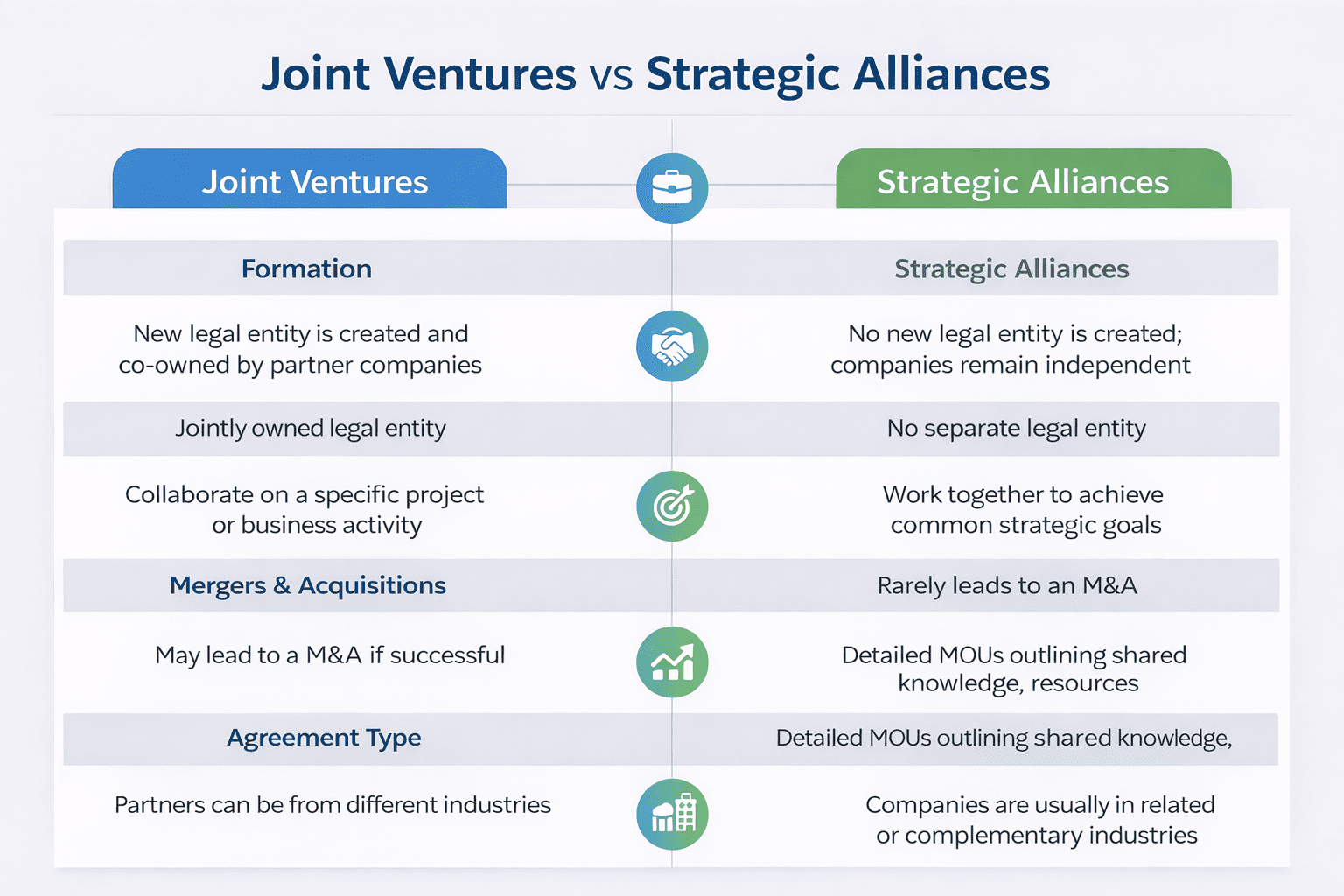
Joint Venture vs Strategic Alliance: Complete B2B Guide
Direct Answer: A Joint Venture (JV) is a formal business arrangement where two or more companies create a new, separate legal entity, sharing capital, governance, profits, and liabilities. A Strategic Alliance is a broader cooperative arrangement where companies work together toward shared objectives while remaining fully independent legal entities, no new company is formed. Every joint venture is a form of strategic alliance, but most strategic alliances are not joint ventures. The right choice depends on your commitment level, capital appetite, IP position, regulatory environment, and strategic goals. For businesses seeking verified international partners for either structure, GTsetu connects you with government-identity-verified (6 points: Name, Address, Registration Number, Company Status, Company Type, Date of Certificate of Incorporation) companies across 100+ countries, with built-in NDA workflows and zero broker fees. Note: GTsetu does NOT verify tax compliance, certifications, financial standing, or trading history; these remain your responsibility.
📅 Published August 10, 2026⏱ 18 min read✍️ GTsetu Editorial Team🔄 Updated September 22, 2026
6
Alliance Types Decoded
100+
Countries on GTsetu
500+
Government-Identity-Verified Companies
0%
Broker Commission
Two of the most consequential strategic decisions any business can make involve how deeply to partner with another company, and through what legal and operational structure. The terms “joint venture” and “strategic alliance” are used constantly in B2B conversations, boardroom presentations, and trade press, but they are frequently conflated, misunderstood, or applied incorrectly.
Getting this distinction right is not an academic exercise. The structure you choose directly determines how you share risk and reward, who controls decision-making, how your IP is protected, what regulatory hurdles you face, and how cleanly you can exit if the relationship does not work out. For businesses expanding into new geographies, launching new products, or accessing new distribution channels, the choice between a JV and an alliance can be the difference between a highly profitable partnership and an expensive, protracted legal dispute.
This guide explains both models comprehensively, from definitions and legal structures to real-world examples, pros and cons, and a decision framework, with particular focus on the role of verified partner discovery in making any partnership structure succeed.
💡 Who This Guide Is For
Business owners and executives evaluating cross-border partnerships, legal and strategy teams structuring collaboration agreements, manufacturers and distributors exploring co-operative market entry, and anyone who has been confused by the JV vs strategic alliance distinction in a trade or M&A conversation.
SECTION 1
1 B2B Partnership Models at a Glance
The B2B partnership landscape spans a spectrum from informal cooperation to full merger. Joint ventures and strategic alliances sit in the middle of this spectrum, deeper than a simple supplier-buyer relationship, lighter than a full acquisition. Here is a visual orientation across the key models:
JV
Joint Venture
Two or more companies form a separate, jointly-owned legal entity. Shared capital, governance, profit, and liability.
🏢 New Legal Entity
SA
Strategic Alliance
Companies collaborate on specific objectives while remaining independent. No new legal entity created.
🤝 No New Entity
EA
Equity Alliance
One partner acquires a minority equity stake in the other, deeper than a contract alliance but no new entity.
📈 Minority Stake
DA
Distribution Alliance
One partner distributes the other’s products in a defined market. Common in international expansion strategies.
🌍 Market Access
TL
Technology Licensing Alliance
IP or technology is shared under a formal licence agreement. Licensor retains ownership; licensee gains access.
🔐 IP Licensing
CM
Co-Manufacturing Alliance
Partners jointly produce goods, sharing capacity, capability, or cost. Related to contract manufacturing.
🏭 Shared Production
📌 The Spectrum from Cooperation to Control
Business partnerships exist on a continuum: at the lightest end is a simple supplier agreement; at the deepest end is a full merger or acquisition. Joint ventures and strategic alliances occupy different points on this spectrum, JVs being more formalised and asset-intensive, non-equity alliances being more agile and low-commitment. Understanding where your situation sits on this spectrum is the first step to choosing the right structure.
SECTION 2
2 What Is a Joint Venture?
🎯 Definition
A Joint Venture (JV) is a formal business arrangement in which two or more companies contribute capital, assets, expertise, or technology to establish a new, separate legal entity, commonly called a “NewCo” or “JV Company.” Each partner holds an equity stake in the new entity, proportional to their contribution. Profits, losses, management responsibilities, and strategic decisions are shared according to the terms of a Joint Venture Agreement. Both partners retain their independent existence, the JV is a distinct company they collectively own, not a merger of the parent companies.
Joint ventures are particularly common in capital-intensive industries, highly regulated sectors, and situations where one partner has market access and the other has technology or product expertise. They are also widely used as a market entry mechanism in countries that restrict foreign ownership, many markets in Asia, the Middle East, and Africa require foreign companies to partner with a local entity through a JV structure.
What Partners Typically Contribute to a JV
💰
Capital Investment
Each partner contributes financial capital to fund the JV’s operations, assets, and working capital. The equity split typically reflects the capital ratio.
🛠️
Technology & IP
One or both partners may contribute patents, proprietary processes, software, or trade secrets, often under licence to the JV entity. Critical to protect via robust agreements.
🌍
Market Access & Relationships
A local partner contributes established customer relationships, regulatory familiarity, distribution networks, and local brand recognition.
👥
Human Capital & Management
Partners second key personnel to the JV, or contribute management expertise through board representation and strategic guidance.
🏭
Production Capacity
Physical assets, factories, equipment, distribution infrastructure, may be contributed to or shared with the JV. Closely related to contract manufacturing arrangements.
📜
Regulatory Licences
In regulated markets, a local partner’s existing licences, permits, or operating approvals are often the primary reason for forming a JV rather than a standalone operation.
50/50
The most common equity split in JVs, though imbalanced splits (51/49, 60/40) are used to clarify control
Higher
Governance complexity vs alliances, JVs require board structures, shareholder agreements, and annual accounts
Harder
To exit, dissolving a JV entity is more complex and costly than ending a non-equity strategic alliance
Often
A JV is a precursor to full acquisition, when one partner eventually buys the other’s stake
🏛️ Non-Equity Joint Ventures: The Exception to Watch For
Most JVs are equity-based, meaning a new company is incorporated and both partners hold shares. But some “contractual” or “non-equity joint ventures” exist, especially in construction, energy exploration, and consortium bidding, where partners cooperate on a specific project under a joint venture agreement without incorporating a separate company. These sit closer to a strategic alliance in legal form but are still called “joint ventures” in industry usage because of the depth of shared risk and joint output. If you see the term used this way, check whether a NewCo was actually incorporated, that is the real dividing line, not the label.
SECTION 3
3 What Is a Strategic Alliance?
🎯 Definition
A Strategic Alliance is a cooperative arrangement between two or more independent companies that agree to pursue shared strategic objectives, such as entering a new market, developing a new product, sharing distribution infrastructure, or co-marketing complementary offerings, while each company continues to operate as a fully independent legal entity. No new company is formed. No equity is exchanged (unless it is an equity alliance). The relationship is governed by a collaboration or partnership agreement, which defines the scope, obligations, exclusivity terms, IP arrangements, and exit provisions.
Strategic alliances are the most common form of formal inter-company cooperation in global business. They offer speed, flexibility, and lower commitment than a joint venture, making them a preferred structure for testing new markets, co-developing products, sharing distribution channels, or accessing technology. The partner companies remain separate, their finances, staff, and governance structures remain distinct, but their activities in the defined scope of the alliance are coordinated and mutually beneficial.
A well-structured B2B collaboration through a strategic alliance requires clear contractual definition, verified partner credentials, and secure information exchange, all areas where having a trusted partner discovery and collaboration platform like GTsetu is critical from day one.
✨ GTsetu Insight
Many international distribution partnerships on GTsetu begin as straightforward strategic alliances, a manufacturer and a distributor agreeing to collaborate in a specific geography. Over time, these can evolve into deeper equity arrangements or joint ventures if both parties see sustained value. Starting with a government-identity-verified partner via GTsetu’s international distributor discovery network gives you a low-commitment way to test partnership compatibility before escalating commitment.
Strategic Alliance vs Ordinary Business Partnership
A common point of confusion, and a frequently searched question, is how a “strategic alliance” differs from a plain business “partnership.” The two terms overlap but are not identical. A partnership, in the legal sense, is often a specific business structure (e.g., a general or limited partnership) in which two or more parties co-own and operate a single business, frequently with shared, unlimited liability for general partners. A strategic alliance is a broader, more flexible commercial arrangement between otherwise separate, independently operating companies, it is not a legal ownership structure at all, but a contractual collaboration. In everyday usage, “strategic partnership” and “strategic alliance” are typically used interchangeably to describe the same non-equity collaboration, while “partnership” alone more often implies a formal co-ownership structure with its own liability rules. When in doubt, the operative question is the same one that separates a JV from an alliance: has a new shared entity or liability structure been created, or are the parties simply agreeing to cooperate under contract?
SECTION 4
4 Types of Strategic Alliance: A Taxonomy
Strategic alliances are not a single, monolithic structure, they span a wide range of arrangements, from highly informal to nearly as structured as a joint venture. Understanding the different types helps you identify which structure fits your specific strategic need.
01
Joint Venture (Equity Alliance)
The most formalised type of alliance, creates a new shared legal entity. Both partners hold equity and share governance, profits, and liabilities.
📍 Sony Ericsson (Sony + Ericsson mobile JV)
02
Minority Equity Alliance
One partner acquires a minority stake in the other, providing strategic alignment and profit participation without forming a new company or creating a 50/50 governance structure.
📍 Renault’s minority stake in Nissan
03
Non-Equity / Contractual Alliance
A formal partnership agreement for co-operation, covering joint development, shared services, or coordinated activity, without any equity exchange. The most common and flexible form.
📍 Airline codeshare agreements (e.g., Star Alliance)
04
Distribution Alliance
A manufacturer or brand owner grants an independent distributor rights to sell its products in a defined territory. The distributor partnership is contractual, not equity-based.
📍 An Indian FMCG brand using a UAE distributor via GTsetu
05
Technology Licensing Alliance
One company licenses its technology, software, patents, or know-how to another under a formal licence agreement. IP ownership stays with the licensor; the licensee pays royalties for access.
📍 ARM licensing chip architecture to Qualcomm and Apple
06
Co-Manufacturing / Supply Alliance
Two companies collaborate on production, sharing manufacturing capacity, supply chain infrastructure, or procurement leverage. Closely related to OEM/ODM/EMS models.
📍 Two pharma brands sharing CMO capacity in off-peak periods
SECTION 5
5 Joint Venture vs Strategic Alliance: The Core Differences
The fundamental distinction between a joint venture and a strategic alliance is deceptively simple: a JV creates a new legal entity; a strategic alliance does not. But this single difference cascades into a wide range of consequential distinctions across governance, capital, liability, IP, and exit.
💡 The One Sentence Distinction
A Joint Venture says: “Let’s build a new company together.” A Strategic Alliance says: “Let’s work together, but we stay separate companies.”
Seven Key Dimensions of Difference
1
Legal Structure
A JV creates a new, independent legal entity registered with relevant authorities, a company in its own right, with its own directors, bank accounts, regulatory obligations, and tax identity. A strategic alliance involves no new legal entity; the cooperation is governed by a contract between the existing parent companies.
2
Commitment Level & Capital
JVs require capital contributions and formal asset transfers, they are long-term, capital-intensive structures. Strategic alliances can be established with minimal capital contribution, making them far faster to initiate and far lower risk if the partnership fails to deliver value.
3
Governance & Control
JVs require a formal governance structure, a board, shareholder agreements, voting mechanisms, and management appointments. Alliances are governed by a partnership or collaboration agreement, typically more flexible and with less formal day-to-day governance machinery.
4
Profit & Loss Sharing
JV profits and losses flow through the equity structure, distributed according to shareholding percentages. Alliance partners retain their separate P&L accounts; value exchange is governed by contractual terms such as fees, royalties, commissions, or revenue sharing.
5
Liability
In a JV, each partner is typically liable only to the extent of their equity stake in the JV entity (depending on structure and jurisdiction). In an alliance, each party remains separately liable for its own obligations, contractual terms define indemnification and liability caps between the parties.
6
IP Ownership & Protection
IP contributed to a JV is typically licensed to the JV entity, and new IP created by the JV may be jointly owned, creating complex ownership issues on exit. In an alliance, IP remains with its original owner and is governed by a licence or access agreement, making IP ownership cleaner and exit simpler. For detailed guidance on secure B2B collaboration, see GTsetu’s resource.
7
Exit & Dissolution
Exiting a JV is costly and legally complex, requiring valuation of the JV entity, negotiation of buy-out terms, asset division, and potential tax implications. Exiting a non-equity strategic alliance is typically much simpler, governed by the notice and termination provisions in the partnership agreement.
Sony Ericsson, Hulu (Disney+NBC+Fox), Tatasteel-ThyssenKrupp
Star Alliance, Starbucks-Spotify, Apple Pay partnerships
Renault-Nissan, Alibaba-Paytm
Where Do Mergers, Acquisitions & Consortiums Fit In?
JVs and strategic alliances are frequently confused with two other collaboration structures. Knowing where each sits relative to a JV and an alliance helps clarify the full spectrum:
Structure
New Entity?
Ownership Change?
Commitment
How It Relates to JV / Alliance
Strategic Alliance
No
No
Low–Medium
The lightest formal structure; the baseline both JVs and equity alliances build on.
Joint Venture
Yes (NewCo)
Partial (in NewCo only)
High
A deep, equity-based form of strategic alliance; parent companies stay independent.
Consortium
Sometimes (for bidding/project vehicles)
No
Medium, project-bound
A group-based, often temporary alliance of three or more parties formed to bid on or deliver a single large project (e.g., infrastructure tenders); narrower in scope than an ongoing strategic alliance and usually dissolved once the project ends.
Merger
Yes (combined entity)
Full, both companies combine
Permanent
The deepest structure; unlike a JV, the original parent companies typically cease to exist as separate entities.
Acquisition
No (target is absorbed)
Full, acquirer takes control
Permanent
Often the endpoint of a successful JV, when one partner buys out the other’s stake entirely.
In short: a strategic alliance is the lightest touch; a consortium is a temporary, project-specific grouping (commonly seen in construction and infrastructure tenders); a joint venture is a deeper, equity-based commitment between otherwise independent companies; and a merger or acquisition is a permanent combination where independence is given up entirely. Businesses often move through this spectrum in stages, starting with an alliance, deepening into a JV, and, in some cases, ending in a full acquisition once the partnership has proven its value.
SECTION 7
7 Pros & Cons of Each Model
Joint Venture: Advantages & Disadvantages
✅ Advantages of a Joint Venture
✅ Clear governance structure with formal profit and loss sharing
✅ Enables entry into markets that restrict foreign ownership
✅ Shared capital base enables larger-scale investments
✅ Partners are deeply committed, reducing free-rider risk
✅ Creates a credible local presence and brand entity
✅ Can evolve into a full acquisition if performance validates
⚠️ Disadvantages of a Joint Venture
⚠️ Slow and expensive to establish, legal, regulatory, and financial complexity
⚠️ Governance conflicts between partners can paralyse decision-making
⚠️ IP contributed to the JV may become jointly owned, creating exit complications
⚠️ Difficult and costly to exit if the relationship sours
⚠️ Cultural and operational clashes between organisations are common
⚠️ Requires significant management bandwidth from both partner organisations
Strategic Alliance: Advantages & Disadvantages
✅ Advantages of a Strategic Alliance
✅ Fast to establish, often just a signed agreement
✅ Lower financial commitment, minimal capital required
✅ Both partners retain full operational independence
✅ IP ownership remains clearly with original owner
✅ Flexible, scope and terms can be adjusted as the relationship develops
✅ Easy to exit, termination governed by notice provisions
⚠️ Disadvantages of a Strategic Alliance
⚠️ Lower commitment can mean partners deprioritise the alliance under pressure
⚠️ No shared equity stake limits profit participation upside
⚠️ Harder to enforce obligations without financial “skin in the game”
⚠️ May not satisfy regulatory requirements for local market entry
⚠️ Value creation can be harder to measure and attribute
⚠️ Weaker signal of long-term commitment to customers and stakeholders
SECTION 8
8 Which Model Is Right for Your Business?
The right structure depends on your strategic goals, risk appetite, capital position, regulatory environment, and the maturity of your relationship with the potential partner. Use this decision framework to orient your thinking:
🧭 JV vs Strategic Alliance Decision Guide
If the target market requires a local legal entity or restricts foreign ownership…
→ Form a Joint Venture
JV Required
Many markets in Asia, the Middle East, and Africa mandate local partnership via a JV structure for regulatory compliance.
If you want to test market compatibility before deep commitment…
→ Start with a Strategic Alliance
Alliance First
A distribution or collaboration agreement lets you assess partner performance before escalating to equity or JV structures.
If large capital investment is required to operate in the target market…
→ Share via a Joint Venture
Capital Sharing
A JV pools capital, distributes financial risk, and creates a shared balance sheet for large-scale infrastructure or production investment.
If speed to market is the primary driver…
→ Use a Strategic Alliance
Agile Entry
Strategic alliances can be established in weeks; JVs take months and significant legal/regulatory overhead to formalise.
If IP protection is your primary concern…
→ Prefer a Strategic Alliance with strong NDA
IP Protection
Non-equity alliances keep IP clearly with the original owner. GTsetu’s secure collaboration workflows protect IP from first contact.
If you need to find a local, verified partner to identify or license into a market…
→ Start with GTsetu
GTsetu Platform
Local-partner identification for JVs and alliances alike, verify identity (6 points via government ties), sign NDAs, and explore collaboration opportunities across 100+ countries, before committing to any legal structure. GTsetu does NOT verify tax, certifications, or financial standing.
SECTION 9
9 The Partnership Lifecycle: From Alliance to JV to Acquisition
In practice, B2B partnerships rarely start as fully-formed joint ventures. The most durable partnerships typically evolve through a natural progression, beginning as a light collaboration, deepening as trust and value are proven, and eventually graduating to more formal structures.
1
Discovery, Local Partner Identification & Verification
Companies identify potential partners, including local partners required for regulated-market JVs, through trade shows, referrals, or platforms like supplier collaboration platforms such as GTsetu. At this stage, business identity verification is critical, confirming that the counterparty’s legal registration and status are legitimate before sharing any proprietary information. GTsetu provides 6-point government identity verification; tax, certifications, and financial standing remain your responsibility.
2
NDA & Preliminary Discussions
A mutual NDA is signed, protecting confidential information before detailed discussions begin. GTsetu’s built-in NDA workflow enables this formally from first contact, with a complete audit trail, protecting both parties from the outset of any partnership exploration.
3
Non-Equity Strategic Alliance
A formal collaboration agreement is signed, defining the scope of cooperation, IP arrangements, exclusivity, revenue sharing or fee structures, performance metrics, and exit provisions. This is the most common starting point. For distribution-focused alliances, see GTsetu’s guidance on finding international distributors.
4
Equity Alliance or Minority Stake
If the alliance proves commercially successful, one or both partners may invest equity, acquiring a minority stake in the other. This deepens commitment, aligns financial incentives more directly, and often brings board representation and strategic influence without forming a wholly new entity.
5
Joint Venture Formation
When the scope of collaboration is sufficiently large, long-term, and capital-intensive, or when regulatory requirements mandate it, the partners form a new JV entity. The JV Agreement, Shareholders Agreement, and related governance documents formalise the deeper relationship.
6
Full Acquisition or Dissolution
JVs often conclude in one of two ways: one partner acquires the other’s stake (leading to full ownership), or the JV is wound down. Non-equity alliances conclude more cleanly, governed entirely by contractual termination provisions. Having a clean exit clause in any partnership agreement, from the very beginning, is non-negotiable.
SECTION 10
10 Industries, Use Cases & Real-World Examples
Industry
Dominant Structure
Why?
Real Example
Automotive
Joint Venture
Massive capital requirements; local manufacturing mandates in markets like China
BMW-Brilliance Automotive JV in China
Consumer Electronics
Strategic Alliance (Distribution)
Fast market access; distributors add local market knowledge without equity complexity
Regulatory market entry; R&D cost sharing; IP licensing for regional manufacturing rights
AstraZeneca-Moderna vaccine collaboration
Airlines & Travel
Non-Equity Strategic Alliance
Code-sharing, lounge access, and frequent flyer programmes, without capital entanglement
Star Alliance (United, Lufthansa, Singapore Airlines)
Retail & FMCG
Distribution Alliance / Co-manufacturing
Regional distribution partners bring local compliance, warehousing, and last-mile reach
Indian FMCG brand expanding to GCC via GTsetu distributor
Technology & Software
Technology Licensing / API Alliance
Fast scaling of ecosystem without the overhead of JV governance
Apple Pay, banking partnerships across 40+ countries
Energy & Infrastructure
Joint Venture / Consortium
Capital intensity; regulatory requirements; long operational timelines justify formal structure; large tenders often bid via consortium
BP-Eni JV for deepwater exploration in Egypt
Manufacturing
JV and/or Co-Manufacturing Alliance
Shared production infrastructure; market entry; OEM/EMS relationships often evolve into deeper structures
Tata Motors-Fiat JV for India manufacturing
SECTION 11
11 Key Risks & How to Mitigate Them
Both joint ventures and strategic alliances carry inherent risks. Awareness of these risks, and proactive structural mitigation, is what separates successful long-term partnerships from expensive failures.
🔍
Unverified Partner Identity
Entering a JV or alliance with a counterparty whose legal registration, name, address, or company status has not been independently verified. GTsetu’s 6-point government identity verification (Name, Address, Registration Number, Company Status, Company Type, Incorporation Date) mitigates this from day one. Tax compliance, certifications, and financial standing remain your responsibility.
🔐
IP Leakage Without NDAs
Sharing product designs, formulas, customer data, or trade secrets before a formal NDA is in place. Use GTsetu’s built-in NDA workflow to formalise confidentiality before any sensitive exchange.
⚖️
Governance Deadlock in JVs
50/50 JVs with no deadlock resolution mechanism can become paralysed when partners disagree. Always include a clear dispute resolution and deadlock mechanism in the Shareholders Agreement.
🚪
No Clear Exit Provisions
Entering any partnership without clear termination rights, buyout mechanisms, or asset division provisions. Legal drafting must address exit scenarios from the outset, not after problems arise.
🌍
Cultural & Operational Misalignment
Mismatched management styles, decision-making speeds, and business cultures, particularly in cross-border JVs, are among the most cited reasons for partnership failure.
📉
Performance Without Accountability
Alliance partners deprioritising shared commitments when under pressure from their own P&L. Clear KPIs, reporting obligations, and consequences for underperformance must be contractually embedded.
✨ GTsetu Mitigation
GTsetu directly addresses the first two risks, unverified partner identity (via 6-point government ties) and IP exposure before NDAs, which are the most common early-stage failure points in both JV and alliance formation. Every company on the platform is government-identity-verified on 6 points before listing. Every partner interaction begins with a formal NDA workflow. The entire discovery process is anonymous until mutual interest is confirmed. Note: GTsetu does NOT verify tax compliance, certifications, financial standing, or trading history. See how GTsetu’s secure B2B collaboration infrastructure works.
SECTION 12
12 How GTsetu Helps You Find Government-Identity-Verified Partners for JVs & Strategic Alliances
🌐 Platform Spotlight, GTsetu
The Missing Step in Every JV & Alliance Journey: Finding a Government-Identity-Verified Partner First
The most sophisticated joint venture agreement or strategic alliance contract is worthless if the counterparty is not who they claim to be. The most common failure point in B2B partnerships, whether a distribution alliance, a co-manufacturing arrangement, or a full JV, is not the legal structure. It is choosing a partner whose legal identity has not been independently verified. GTsetu was built to solve this foundational problem: a government-identity-verified B2B discovery environment where manufacturers, distributors, brand owners, and potential JV partners connect with built-in trust infrastructure, across 100+ countries, with zero broker commission.
What GTsetu verifies (6 points via government ties): Company Name, Registered Address, Registration Number, Company Status, Company Type, Date of Certificate of Incorporation.
What GTsetu does NOT verify (your responsibility): Tax compliance, import/export licences, industry certifications, financial standing, trading history, or authority of representatives. GTsetu provides an encrypted workspace to request and review these documents securely.
✅
6-Point Government Identity Verification
Name, Address, Registration Number, Company Status, Company Type, and Incorporation Date verified via government ties before any company is listed.
🕵️
Anonymous Discovery
Explore verified potential JV partners and alliance candidates without revealing your identity until mutual interest is confirmed.
📄
Built-In NDA Workflow
Formalise confidentiality before sharing any business-sensitive information, with a full digital audit trail from first contact.
🚫
Zero Commission
No broker fees. Your commercial deal, whether a distribution alliance, co-manufacturing agreement, or JV, stays entirely between you and your verified partner.
🔐
Encrypted Collaboration
Documents and communications encrypted in transit and at rest. Request tax certificates, licences, and financial documents from partners securely within the workspace.
🌍
100+ Countries
Active government-identity-verified network across Asia, Middle East, Europe, Africa, Australia, and the Americas, for both international distribution and manufacturing partnerships.
GTsetu verifies six specific data points using government ties: Company Name, Registered Address, Registration Number, Company Status, Company Type, and Date of Certificate of Incorporation. GTsetu does NOT verify tax compliance, import/export licences, industry certifications, financial standing, trading history, or authority of representatives. These remain your responsibility to verify independently. GTsetu provides an encrypted workspace where you can request these documents from partners and review them securely, with full audit trail.
Not verified by GTsetu; your responsibility via encrypted workspace
✗ Self-reported, unverified
Anonymous initial discovery
✓ Yes
✗ No
Built-in NDA before discussions
✓ Yes
~ External legal needed
Zero broker commissions
✓ Always
✗ Often 5–15%
Manufacturing + distribution on one platform
✓ Single platform
✗ Separate sources
Encrypted document sharing
✓ Built-in
✗ Email risk
100+ country coverage
✓ Yes
~ Geography-limited
FAQ
? Frequently Asked Questions
QWhat is the difference between a joint venture and a strategic alliance?
A joint venture creates a new, separate legal entity jointly owned by two or more companies, with shared capital, formal governance, profit distribution via equity dividends, and joint liability. A strategic alliance is a cooperative arrangement where companies pursue shared objectives through a contractual agreement while remaining fully independent legal entities, no new company is formed, no equity is exchanged (in a non-equity alliance), and each partner retains its own P&L, governance, and identity. Every joint venture is a form of strategic alliance, but most strategic alliances are not joint ventures.
QIs a joint venture a type of strategic alliance?
Yes, a joint venture is one of the most formalised and committed forms of strategic alliance. Strategic alliances exist on a spectrum from informal collaboration through contractual partnerships to equity alliances and, at the deepest end, joint ventures. So while all JVs are strategic alliances, the reverse is not true: most strategic alliances are non-equity arrangements that fall well short of forming a new shared legal entity.
QWhen should I choose a joint venture over a strategic alliance?
Choose a joint venture when: the target market requires a local legal entity or restricts foreign ownership (very common in Asia, the Middle East, and Africa); the venture requires significant shared capital investment; you need formal joint governance and profit-sharing structures; or you want the partnership to be a credible long-term commitment visible to customers, regulators, and investors. Choose a strategic alliance when: speed is critical; capital commitment must be limited; you want to test compatibility before deeper investment; or the collaboration is project-specific or time-limited.
QWhat are the main types of strategic alliance?
The principal types of strategic alliance include: (1) Joint Ventures, new shared legal entity with equity stakes; (2) Minority Equity Alliances, one partner acquires a stake in the other without forming a new company; (3) Non-Equity Contractual Alliances, formal cooperation governed purely by contract; (4) Distribution Alliances, one partner distributes the other’s products in a defined territory (the most common form in international B2B trade); (5) Technology Licensing Alliances, IP or technology access under a formal licence; and (6) Co-Manufacturing Alliances, shared production capacity and supply chain infrastructure.
QHow is an equity alliance different from a joint venture?
In an equity alliance, one company simply buys a minority stake in another, existing, independent company, no new entity is created, and the target company continues operating as it did before, just with an outside investor now on the cap table. In a joint venture, two or more companies jointly incorporate a brand-new company that neither of them fully owns, and that new entity carries out the shared activity. The practical difference is what’s being invested in: an equity alliance invests in an existing business; a joint venture creates and invests in a new one.
QIs a strategic alliance the same as a partnership?
Not quite. “Partnership” is often a specific legal business structure (general or limited partnership) with defined ownership and liability rules for the partners. “Strategic alliance” describes a broader, more flexible commercial collaboration between companies that stay legally separate, it is not itself a legal entity type. In casual business usage, “strategic partnership” and “strategic alliance” are usually treated as synonyms for a non-equity collaboration agreement, so context matters: check whether the arrangement creates a formal co-ownership/liability structure (a true partnership or JV) or is simply a contractual collaboration (an alliance).
QJoint venture vs strategic alliance vs merger, what’s the difference?
A strategic alliance is the lightest structure, companies cooperate under contract and remain fully separate. A joint venture is deeper, the partners create and co-own a new legal entity, but each parent company continues to exist independently outside the JV. A merger is the deepest and most permanent, two companies combine into one, and typically at least one of the original companies ceases to exist as a separate legal entity. In short: alliance = cooperate; JV = co-own a new company; merger = become one company.
QWhat is the main risk of a joint venture compared to a strategic alliance?
The main risks of a joint venture relative to a strategic alliance include: governance deadlock (particularly in 50/50 JVs where no partner has a casting vote); costly and complex exits if the relationship deteriorates; complex IP ownership of jointly-developed innovations; higher upfront capital commitment; significant management bandwidth drain; and cultural or operational clashes between partner organisations. Strategic alliances carry lower commitment-related risks but risk partners deprioritising shared obligations under their own performance pressures. In both structures, choosing an unverified or misrepresented partner (identity, not credentials) is the most common early-stage failure, which is why platforms like GTsetu focus on government identity verification before any partnership discussions begin.
QCan a strategic alliance evolve into a joint venture?
Yes, and this is one of the most common evolutionary paths in B2B partnerships. Companies frequently begin with a lightweight distribution or collaboration alliance to test market and partner fit, then deepen the relationship through an equity stake, and eventually formalise the collaboration as a fully incorporated joint venture when the commercial opportunity justifies the governance overhead. Having a well-structured initial alliance agreement that anticipates this possible evolution, with options for equity acquisition and JV formation, is best practice in sophisticated partnership structuring.
QHow do I find joint venture or strategic alliance partners internationally?
The most efficient and secure approach is through a government-identity-verified B2B discovery platform like GTsetu. GTsetu provides 6-point verified company profiles across 100+ countries, covering manufacturers, distributors, brand owners, and potential JV partners, with built-in NDA workflows, anonymous discovery, and zero broker commission. GTsetu verifies Name, Address, Registration Number, Company Status, Company Type, and Date of Certificate of Incorporation via government ties. It does NOT verify tax compliance, certifications, financial standing, or trading history; these remain your responsibility. You can also use trade associations, government export promotion agencies, and trade shows, but independent identity verification of any counterparty is essential before sharing commercially sensitive information in any structure.
QWhat does GTsetu actually verify?
GTsetu verifies six specific data points using government ties: Company Name, Registered Address, Registration Number, Company Status (Active/Dissolved), Company Type (Ltd, Pvt Ltd, etc.), and Date of Certificate of Incorporation. GTsetu does NOT verify tax compliance, import/export licences, industry certifications, financial standing, trading history, or authority of representatives. Those remain your responsibility to verify independently. GTsetu provides an encrypted workspace where you can request these documents from partners and review them securely, with full audit trail.
Ready to Find Government-Identity-Verified Partners for Your JV or Strategic Alliance?
Join 500+ verified manufacturers, distributors, and brand owners already building cross-border partnerships on GTsetu, with 6-point government identity verification, built-in NDA workflows, and zero broker fees across 100+ countries. Note: GTsetu verifies 6 identity points; tax compliance, certifications, financial standing, and trading history remain your responsibility.
They represents the product, and research team behind GTsetu, a global B2B collaboration platform built to help companies explore cross-border partnerships with clarity and trust. The team focuses on simplifying early-stage international business discovery by combining structured company profiles, verification-led access, and controlled collaboration workflows.
With a strong emphasis on trust, and disciplined engagement, Team GTsetu shares insights on global trade, partnerships, and cross-border collaboration, helping businesses make informed decisions before entering deeper commercial discussions.