Licensing vs Distribution Agreements: Complete B2B Guide (2026) | GTsetu
Home ›
Blog ›
Licensing vs Distribution Agreements
📜 B2B Agreement Structures
Licensing vs Distribution Agreements: Complete B2B Guide
Direct Answer: A Licensing Agreement grants a licensee the right to use the licensor’s intellectual property, such as a trademark, patent, technology, or manufacturing formula, typically in exchange for royalties or a licence fee, while the licensor retains IP ownership. A Distribution Agreement grants a distributor the right to purchase, market, and resell the supplier’s products within a defined territory, the distributor buys at wholesale and resells at a margin. The key distinction: licensing concerns IP rights and often authorises the licensee to manufacture or use the IP; distribution concerns physical or digital product resale. Both differ from an agent agreement (agent sells on the principal’s behalf for commission, never takes title) and a franchise agreement (a combined trademark licence plus a full operating system). In many international arrangements, licensing and distribution work together, a distribution agreement is typically accompanied by a limited trademark licence. For businesses seeking verified international distributors or licensing partners, GTsetu connects you with government‑tie‑up verified companies (6 points: legal name, registered address, registration number, company status, company type, incorporation date) across 100+ countries, with built-in NDA workflows and zero broker fees.
📅 Published February 23, 2026🔄 Updated September 22, 2026⏱ 19 min read✍️ GTsetu Editorial Team
8
Agreement Structures Decoded
100+
Countries on GTsetu
500+
Verified Companies
0%
Broker Commission
Two of the most widely used, and most frequently confused, commercial agreements in international B2B trade are the licensing agreement and the distribution agreement. Both allow a company to extend its commercial reach beyond its own direct operations. Both involve a formal contractual relationship with an independent business partner. And both require careful drafting to protect intellectual property, revenue streams, and the brand’s market position.
But they are fundamentally different in purpose, structure, and commercial consequence. A licensing agreement is primarily an IP instrument: it grants rights to use, manufacture, or commercialise intellectual property. A distribution agreement is primarily a commercial instrument: it governs how a third party buys and resells physical or digital products. Businesses evaluating market-entry structures often also weigh these two against an agent agreement, a franchise agreement, and a representative office, each carrying a different balance of risk, control, and cost, which we compare directly further down this guide. Understanding which structure, or which combination of structures, applies to your situation is one of the most commercially significant decisions a brand owner or manufacturer makes when entering a new market or scaling an existing one.
This guide explains both agreements comprehensively, compares them rigorously against related structures, walks through the essential clauses each must contain, and explains how finding verified partners through platforms like GTsetu’s international distributor network is the critical first step in making any licensing or distribution arrangement succeed.
💡 Who This Guide Is For
Brand owners and IP holders evaluating how to monetise or distribute their products internationally, manufacturers seeking distribution partners in new geographies, distributors and agents wanting to understand what they are agreeing to, and legal and commercial teams drafting or reviewing any of these agreement types.
⚖️ Legal Disclaimer
This guide provides commercial and strategic context for understanding licensing, distribution, agency, and franchise agreements. It is not legal advice. Always engage qualified legal counsel in the relevant jurisdiction before drafting, signing, or relying on any commercial agreement.
SECTION 1
1 Agreement Types at a Glance
Before diving into detailed explanations, here is a visual orientation across the principal agreement types you will encounter in B2B commercial partnerships, from pure IP licensing to physical product distribution:
LA
Licensing Agreement
Grants the licensee rights to use the licensor’s IP, trademark, patent, technology, or formula. Licensor retains IP ownership and earns royalties.
🔐 IP Rights Granted
DA
Distribution Agreement
Grants a distributor rights to buy and resell the supplier’s products in a defined territory. Distributor buys at wholesale and earns a margin on resale.
🚚 Product Resale Rights
EDA
Exclusive Distribution
Sole distributor rights in a territory. No other distributor, or the supplier itself, may sell those products there. Requires higher minimum commitments.
🏆 Territorial Exclusivity
ELA
Exclusive Licence
Sole right to use specified IP within a defined scope. Even the licensor is excluded. More valuable and higher royalty than a non-exclusive licence.
⭐ Exclusive IP Access
AA
Agent Agreement
Agent sells on behalf of the principal for commission, never taking title to goods. Lowest control and lowest commitment of all these structures.
🤝 Commission Sales
FA
Franchise Agreement
Combines a trademark licence with a full operating system, marketing plan, and ongoing support, in exchange for franchise fees and royalties.
🏬 Full Business System
📌 Why These Agreements Get Confused
In practice, distribution agreements frequently include embedded trademark licences, giving distributors the right to use the supplier’s brand in local marketing, and a franchise agreement is itself a licence plus a distribution-style relationship plus an operating manual. This overlap causes confusion: is it a licence, a distribution agreement, or a franchise? Section 7 below walks through exactly how these structures differ so you can identify which one you are actually negotiating.
SECTION 2
2 What Is a Licensing Agreement?
🎯 Definition
A Licensing Agreement is a legal contract in which the owner of intellectual property (the licensor) grants another party (the licensee) the right to use, manufacture, sell, or otherwise exploit that IP, within defined parameters of scope, territory, duration, and exclusivity, typically in exchange for royalty payments or a fixed licence fee. The licensor retains full ownership of the IP throughout. The licensee gains access and use rights but does not acquire ownership. If the licence terminates, the licensee’s rights to use the IP terminate with it.
Licensing is one of the most powerful tools for IP monetisation and market expansion. Rather than investing directly in foreign market infrastructure, a brand owner or technology developer can license their IP to a local company with existing market presence, manufacturing capability, and regulatory compliance, earning royalty income with minimal operational investment in the new market. This approach is particularly prevalent in pharmaceuticals, technology, consumer goods, media, fashion, and manufacturing, where an established brand licenses its name or formula to a regional manufacturer rather than manufacturing it directly.
For manufacturers operating under OEM or ODM models, licensing is often the IP mechanism that governs the relationship, the brand owner licences its design or trademark to the contract manufacturer or distributor as part of the commercial arrangement. This is also the structure behind most “manufacturing licence” deals reported in the fashion and consumer goods press, where a brand licenses a third-party manufacturer to produce and sometimes distribute goods carrying its name, while the brand itself retains ownership of the trademark.
What Does a Licensor Actually Grant?
™️
Trademark Licence
The right to use the licensor’s brand name, logo, and trademarks in the defined territory and scope. Always subject to quality control provisions to protect brand integrity.
🔬
Patent Licence
The right to manufacture, use, or sell products protected by the licensor’s patents. Particularly common in pharmaceuticals, engineering, and technology hardware.
💾
Technology / Software Licence
The right to use proprietary software, platforms, algorithms, or technical processes. Common in SaaS, manufacturing technology, and enterprise software, and typically paired with a separate reseller or software distribution contract, see Section 13.
🧪
Formula / Know-How Licence
The right to manufacture products using the licensor’s proprietary formulas, recipes, or trade secrets. Common in food and beverage, cosmetics, and pharmaceuticals.
📖
Copyright Licence
The right to reproduce, distribute, or adapt the licensor’s creative works, books, music, software code, imagery, or other protected content.
🏭
Manufacturing Licence
The right to manufacture products to the licensor’s specifications and sell them, often under the licensor’s brand. Related to contract manufacturing arrangements.
Royalties
Primary revenue model for licensors, typically 2–15% of net sales depending on IP type and exclusivity
Full IP
Ownership always remains with licensor, licensee gains access, not title, to the IP
Quality
Control provisions are critical, licensor must specify standards to protect brand and IP integrity
Auditing
Royalty audit rights allow licensor to verify sales figures and ensure correct royalty payments
SECTION 3
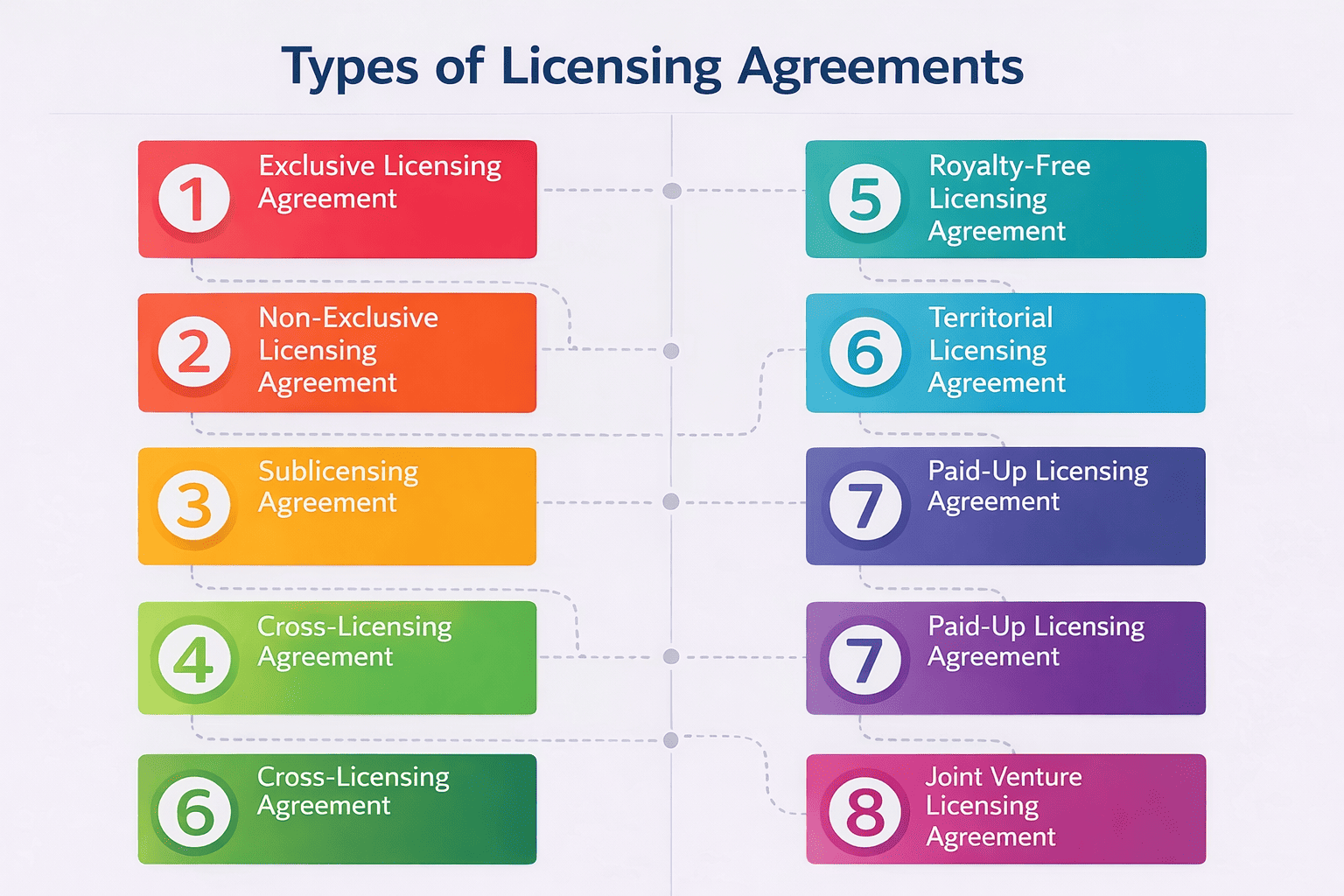
3 Types of Licensing Agreements
01
Exclusive Licence
Grants the licensee the sole right to use the IP within the defined scope, even the licensor cannot exercise those rights in that territory or field. Commands the highest royalties and typically demands minimum performance commitments from the licensee.
📍 A pharmaceutical company giving one regional partner exclusive rights to manufacture its drug formula
02
Non-Exclusive Licence
The licensor can grant the same rights to multiple licensees simultaneously. Lower royalty rates reflect lower exclusivity value. Common for technology platforms and content licensing where broad adoption is the goal.
📍 A software company licensing its platform to multiple regional SaaS resellers simultaneously
03
Sole Licence
Only one licensee is appointed in a territory, but the licensor retains the right to also use the IP in that scope. A middle ground between exclusive and non-exclusive, only one external party has access, but the licensor is not excluded.
📍 A food brand appointing one licensee in a region but continuing to sell directly through its own channels
04
Cross-Licence
Both parties licence IP to each other simultaneously. Common between technology companies with overlapping patents, enabling both to use each other’s innovations without infringement risk or ongoing payment complexity.
📍 Two consumer electronics manufacturers cross-licensing their respective display and battery patents
05
Sub-Licence
The licensee is authorised to grant a portion of the licensed rights to a third party (sub-licensee). Requires explicit permission from the licensor and careful structural drafting to avoid uncontrolled IP proliferation.
📍 A master licensee in the GCC sub-licensing rights to local country partners in the UAE, Saudi Arabia, and Kuwait
06
Compulsory Licence
Granted by government authority without the IP owner’s consent, typically in pharmaceutical or public interest contexts. Allows generic manufacturing of patented products in defined circumstances.
📍 Government-issued compulsory licences for vaccine manufacturing in developing markets
SECTION 4
4 What Is a Distribution Agreement?
🎯 Definition
A Distribution Agreement is a commercial contract in which a supplier (manufacturer, brand owner, or wholesaler) grants a distributor the right to purchase the supplier’s products and resell them to end customers, retailers, or downstream trade partners within a defined territory and for a defined period. The distributor buys the products outright, taking title and bearing inventory risk, and earns its return through the margin between the price it pays the supplier and the price at which it resells. The distributor is not the supplier’s agent; it is an independent business buying and reselling on its own account, which is the key legal distinction from an agent agreement (see Section 7). The supplier’s brand appears on the product throughout, which is why distribution agreements almost always include a trademark licence component.
Distribution agreements are the backbone of international market entry for manufacturers and brand owners. Rather than establishing their own sales force, warehousing, and regulatory compliance in each target market, suppliers partner with established local distributors who bring market relationships, logistics infrastructure, local regulatory knowledge, and capital to carry inventory. For a detailed guide on identifying and approaching international distributors, see GTsetu’s resource on finding verified international distributors.
What Does a Distributor Actually Do?
📦
Buys & Holds Inventory
The distributor purchases stock from the supplier, takes title and responsibility for the inventory, and manages warehousing in the territory, including associated capital and storage costs.
🏪
Sells to Local Trade
Distributor sells to retailers, wholesalers, and end customers in the assigned territory, using its own existing trade relationships and sales force that the supplier does not have locally.
🚛
Logistics & Last Mile
Handles import clearance, customs duties, local transportation, and last-mile delivery, removing the supplier from the operational complexity of in-country logistics.
📋
Regulatory Compliance
Manages local product registration, labelling compliance, and import licensing, critical in regulated categories like food, pharma, and electronics.
📣
Marketing & Promotion
Executes brand-approved marketing activities in the territory, trade promotions, retailer placements, and local advertising, typically under a co-marketing or MDF (marketing development funds) framework.
🔧
After-Sales & Service
Manages customer service, warranty claims, and product returns in the territory, protecting the supplier’s brand reputation without the supplier needing local service infrastructure.
✨ GTsetu Insight
Finding a qualified, credible distributor is the single most consequential decision in international market entry. GTsetu’s international distributor discovery network provides distributor profiles across 100+ countries with government‑tie‑up verification of six core credentials, with built-in NDA workflows so you can begin commercial discussions on a confidentiality-protected basis before sharing pricing, product specifications, or margin structures.
SECTION 5
5 Types of Distribution Agreements
01
Exclusive Distribution
One distributor holds sole rights in a defined territory. Neither the supplier nor any other distributor may sell to that territory’s customers directly. Highest commitment from both sides, distributor invests more; supplier gives up direct channel flexibility.
📍 A German medical device brand appointing one exclusive distributor for the entire GCC region
02
Non-Exclusive Distribution
The supplier can appoint multiple distributors in the same territory simultaneously and may also sell directly. Less commitment required from either party; more competition between channels. Common for commodity or FMCG products.
📍 A FMCG brand using multiple regional distributors across India simultaneously
03
Selective Distribution
The supplier appoints only distributors meeting defined qualitative criteria, technical capability, showroom standards, customer service levels, or minimum stock holdings. Balances coverage with brand quality control.
📍 A luxury consumer electronics brand allowing only certified, premium retail distributors to carry its products
04
Sole Distribution
Similar to exclusive, but the supplier retains the right to sell directly in the territory. Only one distributor is appointed, but the supplier does not fully exclude itself from the market, creating a slightly different competitive dynamic.
📍 A manufacturer appointing a sole regional distributor while maintaining a direct key account relationship with one large retailer
05
Sub-Distribution
A master or regional distributor is given rights to appoint sub-distributors in its territory, creating a tiered distribution structure. Common in large or geographically complex markets requiring localised penetration.
📍 A master distributor for Southeast Asia appointing country-level sub-distributors in Thailand, Vietnam, and Indonesia
06
Digital / E-Commerce Distribution
Governs a distributor’s right to sell the supplier’s products through online marketplaces, e-commerce platforms, and direct-to-consumer digital channels. Increasingly important as a separate agreement tier from physical distribution rights.
📍 A supplier appointing an exclusive e-commerce distributor for Amazon, Flipkart, and Noon across South Asia and the GCC
SECTION 6
6 Licensing vs Distribution: The Core Differences
The fundamental distinction between a licensing agreement and a distribution agreement is what is being transferred: in licensing, it is the right to use IP; in distribution, it is the right to buy and resell products. This single distinction cascades into very different commercial, legal, and operational structures.
💡 The One Sentence Distinction
A Licensing Agreement says: “You may use my IP, here is what you can do with it and what you owe me.” A Distribution Agreement says: “Buy my products at this price, then sell them in your territory and keep your margin.”
1
What Is Being Transferred?
A licence transfers IP usage rights, the right to use, manufacture, or commercialise intellectual property while the licensor retains ownership. A distribution agreement transfers product resale rights, the distributor buys physical products and resells them. No IP ownership or even usage rights are typically transferred; only product title passes when the distributor buys inventory.
2
How Does the Partner Earn Revenue?
Licensees earn revenue from the commercial exploitation of the licensed IP, selling products manufactured under the licence, using the licensed software, or operating under the licensed brand. Their fee to the licensor is a royalty on those revenues. Distributors earn revenue from the margin between the wholesale price they pay the supplier and the price at which they resell, their income is not paid to the supplier; it is retained from the difference.
3
Who Bears Inventory Risk?
In a distribution agreement, the distributor buys the inventory and bears full inventory risk, if products do not sell, the distributor absorbs the loss (subject to any return provisions in the agreement). In a licensing agreement where the licensee manufactures, the licensee bears production cost risk. Where a licensee is only granted sales rights under a licence (rarer), the IP royalty may still be owed even if sales underperform.
4
Who Controls Pricing?
In a licensing agreement, the licensee typically sets its own resale prices, the licensor controls royalty rates but not downstream pricing (with exceptions for quality positioning). In a distribution agreement, suppliers can provide recommended retail prices and may set minimum pricing floors to protect brand positioning, but cannot legally fix resale prices in most jurisdictions (resale price maintenance is often a competition law violation).
5
IP Protection Requirements
Licensing agreements require extensive IP protection provisions, scope of permitted use, quality control obligations (critical for trademark licences to maintain validity), and clear restrictions on sub-licensing or modification. Distribution agreements require more limited IP provisions, primarily a trademark licence for marketing use and brand guidelines. For guidance on secure B2B collaboration from first contact, see GTsetu’s resource.
6
Termination Complexity
Terminating a licensing agreement requires the licensee to immediately cease all use of the licensed IP, including destroying or returning licensed materials, ceasing manufacturing, and removing branded products from the market. Terminating a distribution agreement primarily requires clearing existing inventory (sell-through provisions are common), ceasing to use the trademark in marketing, and returning unsold stock (if agreed). Neither is simple, but IP cessation makes licence termination structurally more complex.
SECTION 7
7 Agent vs Distributor vs Licensing vs Franchise vs Representative Office
Licensing and distribution are only two of five common structures businesses use to enter or expand in a market without setting up a wholly-owned local entity. The other three, an agent agreement, a franchise agreement, and a representative office, are frequently confused with licensing and distribution because they share the same underlying goal: extending commercial reach through an independent local partner. The structures sit on a rising scale of risk, control, and cost for the principal, from lowest to highest.
🎯 The Risk Scale, Lowest to Highest
Representative Office (no sales, liaison only, lowest risk) → Agent Agreement (sells on commission, no title to goods) → Distribution Agreement (buys and resells, bears inventory risk) → Licensing Agreement (grants IP use rights, quality control and IP-leakage risk) → Franchise Agreement (a licence plus a full operating system, the highest commitment and highest liability exposure of the five).
Structure
What the Local Party Does
Takes Title to Goods?
Uses Principal’s IP/Brand?
Typical Risk Level
Representative Office
Market research, liaison, and promotion only; cannot conclude sales contracts or invoice customers
No
Limited, for liaison purposes only
Lowest
Agent Agreement
Sells or negotiates sales on behalf of the principal in exchange for commission
No, title passes directly from principal to customer
Limited, to represent the principal
Low
Distribution Agreement
Buys products from the supplier and resells them for its own account and profit
Yes, distributor takes title on purchase
Often, via an embedded trademark licence for marketing
Moderate
Licensing Agreement
Uses, manufactures, or commercialises the licensor’s IP under defined terms
N/A, licensed IP, not goods, is transferred (title in any goods depends on the deal)
Yes, that is the core of the agreement
Moderate to high, for the IP owner
Franchise Agreement
Operates a full business under the franchisor’s brand, system, and marketing plan
Yes, typically buys inventory or supplies as part of the system
Yes, extensively, brand, systems, and operating manuals
Highest, for both parties
How Each Structure Differs in Practice
🏢
Representative Office
Used for market research, sourcing, and relationship-building before committing to a market. Cannot generate local revenue or sign binding sales contracts, it is a pre-entry, not a commercial, structure.
🤝
Agent Agreement
The agent introduces buyers and negotiates on the principal’s behalf but never owns the goods. The principal invoices the customer directly and pays the agent commission. Lower cost, lower control than a distributor.
🚚
Distribution Agreement
The distributor is an independent buyer-reseller, covered in full in Sections 4-5 above. It bears inventory risk that an agent never takes on, and in return keeps its resale margin rather than a commission.
🔐
Licensing Agreement
Covered in full in Sections 2-3 above. Distinguished from the other four by transferring IP usage rights rather than product resale or representation rights.
🏬
Franchise Agreement
A franchise is best understood as a trademark licence plus a distribution-style commercial relationship plus a prescriptive operating manual covering everything from store layout to staff training. Franchising is separately, and often heavily, regulated in most jurisdictions (pre-sale disclosure requirements, registration, cooling-off periods), unlike most standalone licence or distribution agreements.
✨ Practical Takeaway
If your local partner will never own the goods and is paid commission, you are drafting an agent agreement. If they buy and resell for their own account, it’s distribution. If they are gaining rights to your IP itself, it’s a licence. If they are adopting your entire branded business system, it’s a franchise, and it will trigger franchise-specific disclosure and registration laws that none of the other four structures do. Confirming which structure you actually need, before drafting begins, avoids the single most common and most expensive redrafting exercise in international commercial contracting.
SECTION 8
8 Licensor vs Licensee: Quick Reference
Within any licensing agreement, two roles govern the entire relationship: the licensor and the licensee. Confusing which party is which is a common source of early-stage negotiation errors, so here is a direct comparison.
Dimension
Licensor
Licensee
Who they are
The IP owner, the trademark, patent, technology, or formula belongs to them
The party receiving permission to use that IP
What they grant/receive
Grants a defined right to use the IP, within scope, territory, and term
Receives the right to use, and often manufacture or sell under, the IP
Revenue direction
Receives royalties or licence fees from the licensee
Pays royalties or licence fees to the licensor
IP ownership after signing
Retains full ownership throughout the agreement and after it ends
Never acquires ownership, only a time-bound right of use
Primary obligation
Maintain and defend the IP; provide quality standards and support where agreed
Use the IP only within the permitted scope; meet quality and reporting standards
What happens on termination
Recovers full, unencumbered control of the IP
Must immediately cease all use of the licensed IP
💡 Memory Aid
The licensor is the source, the one who originally owns and offers the IP. The licensee is the one who sees a use for it and pays to access it. Whenever you are unsure which party you are, ask who owned the intellectual property before the agreement was signed, that party is always the licensor.
SECTION 9
9 Full Side-by-Side Comparison Table
Dimension
Licensing Agreement
Distribution Agreement
Primary purpose
Grant rights to use, manufacture, or commercialise IP
Grant rights to buy and resell products in a territory
What is transferred?
IP usage rights (not ownership)
Product resale rights + product title on purchase
IP ownership
Licensor always retains ownership
Supplier retains; distributor gets limited trademark use only
Revenue model for rights holder
Royalties (% of sales) or fixed licence fees
Wholesale product margin (price sold to distributor)
Revenue model for partner
Revenue from exploiting licensed IP, minus royalties
Often yes, trademark licence for marketing embedded within
SECTION 10
10 Essential Clauses in Each Agreement
The value of any commercial agreement lies entirely in its drafting. Licensing, distribution, agent, and franchise agreements can look similar at a superficial level, but the clauses that protect each party’s core interests are distinct, and omitting any of these essential provisions creates commercial and legal exposure.
Essential Clauses in a Licensing Agreement
Clause 01
Grant of Licence
Precisely defines what IP is licensed, what the licensee may do with it (use, manufacture, sell, sub-licence), the territory, the field of use, and whether the licence is exclusive, sole, or non-exclusive.
Clause 02
Royalty Structure & Payment
Sets the royalty rate (percentage of net sales, gross sales, or per unit), minimum royalty guarantees, payment frequency, currency, and late payment consequences.
Clause 03
Quality Control & Standards
Critical for trademark licences, the licensor must maintain control over product quality to preserve trademark validity. Specifies standards, approval processes, and right of inspection.
Clause 04
Royalty Reporting & Audit Rights
Licensee must provide periodic royalty statements; licensor has the right to audit the licensee’s books to verify accuracy of royalty payments. Audit costs typically borne by licensor unless discrepancy exceeds threshold.
Clause 05
IP Ownership & New IP
Confirms the licensor’s ownership of licensed IP. Critically, specifies who owns improvements or modifications made by the licensee, a common source of serious disputes if not addressed upfront.
Clause 06
Sub-Licensing Restrictions
Specifies whether and how the licensee may grant sub-licences. Uncontrolled sub-licensing is a significant IP dilution and quality control risk, must be explicitly permitted or prohibited.
Clause 07
Representations & Warranties
Licensor warrants that it owns the IP and has the right to grant the licence. Licensee warrants it will use the IP only as permitted. Both parties represent their authority to enter the agreement.
Clause 08
Termination & Post-Termination
Grounds for termination (breach, insolvency, change of control), notice periods, and critically, what happens after termination: licensee must cease all IP use, destroy or return licensed materials, and provide final royalty accounting.
Essential Clauses in a Distribution Agreement
Clause 01
Appointment & Territory
Precisely defines the distributor’s territory, the products covered, and whether the appointment is exclusive, sole, or non-exclusive, and what “territory” means (country, region, channel, or customer segment).
Clause 02
Minimum Purchase Commitments
Annual or periodic minimum order volumes the distributor must achieve to retain its appointment, particularly critical for exclusive agreements where the supplier forgoes other distribution channels in the territory.
Clause 03
Pricing & Payment Terms
Wholesale pricing, currency, payment terms (net 30/60/90), credit limits, and procedures for price changes. Many suppliers include a price change notification requirement of 30–90 days.
Clause 04
Trademark Licence for Marketing
Grants the distributor a limited, non-exclusive, revocable licence to use the supplier’s brand, trademarks, and marketing materials in the territory, subject to brand guidelines and approval requirements.
Clause 05
Reporting & Market Intelligence
Distributor’s obligation to provide sell-through data, inventory levels, market intelligence, and competitive information, critical for the supplier to manage the territory and plan production and marketing.
Clause 06
Non-Compete & Non-Solicitation
Restricts the distributor from selling directly competing products during the term (and sometimes for a defined period after termination). Scope must be carefully calibrated to avoid competition law issues in the relevant jurisdiction.
Clause 07
Term & Renewal
Initial term, renewal conditions (automatic or by election), performance review triggers for non-renewal, and notice requirements. Many jurisdictions have specific rules on minimum notice periods for distribution agreement termination.
Clause 08
Termination & Stock Clearance
Grounds for early termination, notice periods, sell-through period for existing inventory (typically 60–180 days post-termination), right of repurchase of unsold stock, and immediate cessation of trademark use.
SECTION 11
11 Pros & Cons of Each Model
Licensing Agreement: Advantages & Disadvantages
✅ Advantages of Licensing
✅ Enables rapid market entry without direct capital investment in manufacturing or operations
✅ Generates royalty income from IP that might otherwise be underutilised in certain markets
✅ Licensee’s local expertise, market knowledge, and relationships accelerate adoption
✅ Scalable across multiple territories simultaneously through multiple licensees
✅ Licensor retains full IP ownership throughout, it can be relicensed or recaptured
✅ Enables market presence where direct investment would be restricted or impractical
⚠️ Disadvantages of Licensing
⚠️ Quality control risk, licensee’s poor execution can damage the brand or invalidate trademarks
⚠️ Royalty verification depends entirely on the licensee’s honest reporting, audit rights are essential but rarely exercised proactively
⚠️ IP leakage risk, licensees may, intentionally or not, expose trade secrets to third parties
⚠️ Licensee may become a future competitor if they develop expertise using your IP
⚠️ Complex to terminate if licensee has integrated the IP into their operations
⚠️ Lower per-unit return than manufacturing and selling directly in the market
Distribution Agreement: Advantages & Disadvantages
✅ Advantages of Distribution
✅ Fast market entry using the distributor’s existing trade relationships and logistics infrastructure
✅ Distributor bears inventory risk and working capital, supplier receives cash on sale to distributor
✅ Supplier retains full product design, manufacturing, and quality control, just sells into the channel
✅ Distributor’s local regulatory knowledge handles import compliance, product registration, and labelling
✅ Relatively easy to switch distributors if performance is poor, no IP entanglement
✅ Minimum purchase commitments provide demand visibility for production planning
⚠️ Disadvantages of Distribution
⚠️ Supplier has limited visibility into end-customer relationship and pricing in the market
⚠️ Exclusive distribution gives a single party significant leverage, if they underperform, the supplier is locked out of the market
⚠️ Distributor may carry competing products that take priority over your brand
⚠️ Supplier cannot directly control the price at which its products reach end customers (resale price maintenance laws)
⚠️ Brand reputation can be damaged by poor distributor service, improper storage, or grey market activity
⚠️ Many jurisdictions have strong distributor protection laws that make termination costly
SECTION 12
12 Which Agreement Structure Is Right for Your Business?
The right structure depends on what you are commercialising (IP, manufactured products, or both), your level of control over quality and brand, your capital position, and the nature of the market you are entering. Use this decision framework:
🧭 Licensing vs Distribution Decision Guide
If you want to monetise a patent, formula, technology, or brand without manufacturing locally…
→ Use a Licensing Agreement
Licensing
Grant the local partner rights to manufacture or commercialise your IP under licence. You earn royalties; they manage local operations.
If you already manufacture and want to expand market reach without building a local sales force…
→ Use a Distribution Agreement
Distribution
Appoint a verified local distributor to buy and resell your products. Find verified partners via GTsetu’s international distributor network.
If you just need someone to introduce buyers without them ever owning your goods…
→ Use an Agent Agreement
Agency
Lower cost, lower control than distribution. The agent negotiates sales for commission; you retain the direct customer relationship and title to goods until sale.
If you want the distributor to also promote and use your brand in local marketing…
→ Embed a Trademark Licence in the Distribution Agreement
Combined
Include a limited, non-exclusive trademark licence within the distribution agreement, standard practice in international B2B distribution.
If you want a partner to replicate your entire branded business model, not just sell a product…
→ Use a Franchise Agreement
Franchise
The highest-commitment structure of the five; triggers franchise-specific disclosure and registration laws in most jurisdictions, take specialist legal advice before offering one.
If you need the partner to have maximum commitment and invest in market development…
→ Use Exclusive Arrangements
Exclusive
Exclusive licences and exclusive distribution both demand higher partner commitment, supported by minimum performance obligations in the agreement.
If protecting your IP from leakage and misuse is your primary concern…
→ Start with an NDA, then a Tightly Drafted Licence
IP-First
Use GTsetu’s built-in secure B2B collaboration workflows before any sensitive disclosure. Then structure a tightly scoped licence with quality control and audit rights.
Not sure which structure fits and need to find verified international partners?
→ Start on GTsetu
GTsetu
Discover verified manufacturers, distributors, and licensing partners across 100+ countries, anonymously and with built-in NDA infrastructure from day one. Government‑tie‑up verification of 6 core credentials.
SECTION 13
13 When Licensing and Distribution Work Together
💡 The Most Common Real-World Structure
In the vast majority of international B2B trade partnerships, licensing and distribution are not alternatives, they operate simultaneously within the same commercial relationship. A distribution agreement almost always contains an embedded licence (typically for trademark use), and a manufacturing licence often operates alongside a distribution arrangement that governs how the licensed product reaches market.
Understanding how these two structures layer on top of each other is essential for anyone building an international commercial partnership. Here are the most common combined structures you will encounter:
01
Distribution Agreement + Embedded Trademark Licence
The most common structure in international B2B distribution. The distribution agreement governs product purchase and resale; an embedded licence clause permits the distributor to use the supplier’s trademarks and brand assets for local marketing. The trademark licence terminates automatically when the distribution agreement ends.
📍 Standard structure for consumer goods, electronics, and FMCG international distribution
02
Manufacturing Licence + Distribution Rights
The licensor grants both a manufacturing licence (to produce the product locally) and distribution rights (to sell in a defined territory). Common in markets where import costs or regulatory requirements make local manufacturing advantageous, and related to OEM and contract manufacturing models.
📍 A food brand licensing its formula to a local manufacturer who also has exclusive distribution rights for that market
03
Technology Licence + Reseller / Software Distribution Contract
Common in software and technology. A technology licence governs the right to deploy the technology; a reseller or software distribution contract governs how the technology partner sells and supports it for end clients, including margin, support levels, and version or update rights. The two documents work in parallel with cross-references to each other.
📍 An enterprise software company appointing regional resellers who each receive a non-exclusive technology licence plus a software distribution contract
04
Brand Licence + White-Label Distribution
The licensor allows the licensee to use its brand on products manufactured by the licensee (own-manufacture or via a third-party CM) and sell them under the licensed brand. Closely related to ODM manufacturing models where the brand is the primary asset being licensed, this is also the typical structure behind a fashion or consumer brand’s “manufacturing licence” being sold to a regional operator.
📍 A consumer brand licensing its trademark to a regional manufacturer who produces and distributes the products locally
✨ GTsetu Insight
When building any of these combined structures internationally, the quality of the partner you choose is more consequential than the quality of the agreement you draft. A well-drafted agreement with a poorly-vetted partner creates expensive legal disputes; a relationship with a verified, credible partner rarely needs to invoke dispute provisions. GTsetu’s business verification infrastructure (government tie‑up verification of 6 points) ensures every partner you discover on the platform has been independently verified before any commercial discussion begins.
SECTION 14
14 Industries, Use Cases & Real-World Examples
Industry
Dominant Structure
Why This Structure?
Typical Real-World Example
Pharmaceuticals
Manufacturing Licence + Distribution Agreement
Local manufacturing mandated or tax-advantaged; IP protection of formula is paramount
Originator pharma brand licences formula to regional CMO; distribution agreement governs market access
Consumer Electronics
Distribution Agreement + Trademark Licence
Supplier manufactures centrally; distributor handles local import, sales, and after-sales
European electronics brand appointing exclusive GCC distributor via GTsetu with embedded trademark licence
Food & Beverage
Manufacturing Licence (for branded production) or Distribution Agreement (for imports)
Perishability requires local production in many markets; import model used where logistics allow
An international FMCG brand licensing its recipe to a local manufacturer in India; OR using an importer-distributor in the UAE
Technology / SaaS
Technology Licence + Reseller Agreement / Software Distribution Contract
Software is IP, licensing is the natural structure; the reseller or software distribution contract governs channel economics
Enterprise software platform licensing to regional value-added resellers (VARs) across Southeast Asia
Fashion & Apparel
Brand/Manufacturing Licence + Distribution or Retail Agreement
Brand is the core asset; manufacturing often already outsourced to contract manufacturers. This is the structure behind most reported “manufacturing licence sold to a fashion brand” deals, the trademark and design IP stay with the brand while a manufacturing licence governs production and often bundles regional distribution rights
International fashion brand licensing its trademark and manufacturing rights to a regional operator for a defined territory’s production, retail, and wholesale
Industrial Equipment
Exclusive Distribution + Trademark Licence + Service Agreement
After-sales service critical; exclusive distributor commits to holding parts stock and service capability
German industrial manufacturer appointing exclusive distributors per country with service obligations in each territory
Cosmetics & Personal Care
Manufacturing Licence (for local production) or Distribution Agreement (for imports)
Formula protection critical; local manufacturing reduces import costs in large markets
International cosmetics brand licensing formula to a local GMP-certified CMO for the ASEAN market
Media & Entertainment
Copyright Licence (territory-specific)
IP (content) is the entire product; territorial licensing governs where content can be distributed and how
Film studio licensing territorial broadcast rights to streaming platforms on a country-by-country basis
SECTION 15
15 Key Risks & How to Mitigate Them
🔍
Unverified Partner Credentials
The most common early-stage failure: engaging with a licensee, distributor, agent, or franchisee who misrepresents their financial standing, market reach, or compliance credentials. GTsetu’s government‑tie‑up verification of 6 core credentials (business verification) addresses this before any commercial discussion begins.
🔐
IP Disclosure Before NDA
Sharing proprietary formulas, product specifications, pricing structures, or trade secrets before a formal NDA is executed. GTsetu’s secure collaboration workflows enable NDA execution before any sensitive exchange takes place.
💸
Royalty Underreporting
Licensees reporting lower sales figures to reduce royalty obligations. Mitigate with robust audit rights, minimum guaranteed royalties, and periodic royalty statements, with clear consequences for material underreporting.
📉
Distributor Underperformance in Exclusive Arrangements
An exclusive distributor fails to hit targets, but the supplier is locked out of the territory. Mitigate with minimum purchase commitments, right-to-cure provisions, and performance review triggers for exclusivity conversion to non-exclusive.
⚖️
Distributor and Agent Termination Protection Laws
Many jurisdictions (particularly in the EU, Middle East, and Latin America) provide strong statutory protections for distributors and commercial agents on termination, including mandatory compensation regardless of contract terms. Always take local legal advice before signing in any new jurisdiction.
🏷️
Trademark Invalidity Through Uncontrolled Licensing
In many jurisdictions, a trademark can be invalidated if the owner grants a licence without maintaining quality control over the licensed products (a “naked licence”). Every trademark licence must include quality control standards and the licensor’s right of inspection.
🌐
Grey Market and Parallel Imports
Products sold legitimately in one market appearing in another at lower prices, undermining the exclusive distributor and the supplier’s pricing strategy. Addressed through careful territorial definition, anti-diversion clauses, and product traceability measures.
🚪
Difficult Exit Without Clear Termination Provisions
Attempting to exit a licensing, distribution, agency, or franchise relationship without clear contractual termination rights creates significant legal and commercial exposure. Exit provisions, notice periods, stock return, IP cessation, and non-compete obligations, must be drafted before the relationship begins, not after problems arise.
SECTION 16
16 How GTsetu Helps You Find Verified Licensing & Distribution Partners
🌐 Platform Spotlight, GTsetu
The Verified Starting Point for Every Licensing & Distribution Partnership
No licensing agreement protects against an untrustworthy licensee. No distribution contract compensates for a distributor who misrepresented their market reach. The most frequently cited cause of international licensing and distribution failure is not poor contract drafting, it is choosing the wrong partner. GTsetu was built to solve this foundational problem: a government‑tie‑up verified B2B discovery environment where brand owners, IP holders, manufacturers, agents, and international distributors find and connect with verified partners, across 100+ countries, with built-in NDA infrastructure from first contact and zero broker commission on any deal. Every company on GTsetu is verified using direct government tie‑ups across six essential credentials: legal name, registered address, registration number, company status, company type, and date of certificate of incorporation. GTsetu does not verify import licences, industry certifications, financial standing, or production capabilities; those must be exchanged and validated directly between partners.
✅
Government Tie‑Up Verification
6‑point verification: legal name, registered address, registration number, company status, company type, incorporation date.
📜
Licences & Certifications
GTsetu does not verify these. They must be exchanged directly between partners during due diligence.
🕵️
Anonymous Discovery
Explore verified licensing and distribution partner profiles without revealing your identity until mutual interest is confirmed.
📄
Built-In NDA Workflow
Formalise confidentiality before sharing any formula, product specification, pricing structure, or proprietary information, with a full digital audit trail.
🚫
Zero Commission
No broker fees on any deal, whether a licensing arrangement, exclusive distribution agreement, or co-manufacturing partnership.
🔐
Encrypted Collaboration
All documents and communications encrypted in transit and at rest. Secure B2B collaboration from first contact.
🌍
100+ Countries
Active verified network for international distributors, licensing partners, and manufacturing collaborators across Asia, the Middle East, Europe, Africa, and the Americas.
QWhat is the difference between a licensing agreement and a distribution agreement?
A licensing agreement grants a licensee the right to use the licensor’s intellectual property, such as a trademark, patent, technology, or formula, typically in exchange for royalties, while the licensor retains IP ownership. A distribution agreement grants a distributor the right to purchase and resell the supplier’s products within a defined territory, the distributor buys at wholesale and earns a margin on resale. The key distinction: licensing deals with IP rights and often authorises the licensee to manufacture or use the IP; distribution deals with physical or digital products that the distributor buys from the supplier and resells. In many international arrangements, both structures work together, a distribution agreement typically includes an embedded trademark licence permitting the distributor to use the supplier’s brand in local marketing.
QWhat is the difference between an agent, a distributor, a licensee, and a franchisee?
An agent sells on behalf of the principal, never takes title to goods, and earns commission, this is the lowest-risk, lowest-control structure for the principal. A distributor buys products outright and resells them for its own account and profit. A licensee is granted rights to use the licensor’s intellectual property, often to manufacture under it, in exchange for royalties. A franchisee operates under a full business system, combining a trademark licence with an operating method, in exchange for franchise fees and ongoing royalties. A representative office, used mainly for market research and liaison, cannot transact sales at all. Risk and control generally increase from agent, to distributor, to licensee, to franchisee, see Section 7 for a full side-by-side table.
QWhat is the difference between a licensor and a licensee?
The licensor is the party that owns the intellectual property, such as a trademark, patent, formula, or technology, and grants another party permission to use it. The licensee is the party that receives that permission and pays royalties or fees in exchange. The licensor retains ownership throughout; the licensee only gains a right of use for the term and scope defined in the agreement. See Section 8 for a full quick-reference table.
QWhat is an exclusive distribution agreement?
An exclusive distribution agreement grants a single distributor the sole right to sell a supplier’s products within a defined territory. During the term of the agreement, neither the supplier nor any other distributor may sell those products to customers in that territory. Exclusive appointments typically require higher minimum purchase commitments from the distributor in return for territorial protection. They are the dominant structure in international market entry where the supplier wants a committed, investing partner rather than a passive reseller.
QCan a distribution agreement include a licence?
Yes, and in practice, this is the norm rather than the exception. A distribution agreement almost always includes a limited trademark licence permitting the distributor to use the supplier’s brand name, logo, and marketing materials in the assigned territory. This trademark licence is typically restricted to use in connection with the authorised products, non-exclusive, non-transferable, and automatically terminates when the distribution agreement ends. In some cases, particularly where the distributor is also manufacturing (such as in a licensed manufacturing plus distribution arrangement), additional IP licence provisions will be included.
QWhat is a software distribution contract?
A software distribution contract is a distribution or reseller agreement scoped to software or digital products rather than physical goods. It typically sits alongside a technology or end-user licence, the licence governs how the software may be used, while the distribution or reseller agreement governs how the reseller markets, sells, and supports it within a defined territory or customer segment, including margin, support obligations, and update or version rights.
QWhat are the essential clauses in a distribution agreement?
The essential clauses in a distribution agreement include: (1) Grant of distribution rights, scope, territory, and exclusivity level; (2) Minimum purchase commitments or minimum sales targets with consequences for shortfall; (3) Pricing, payment terms, and credit conditions; (4) Trademark licence for marketing use in the territory; (5) Product quality, storage, and compliance obligations; (6) Reporting requirements, sell-through data, forecasting, and market intelligence; (7) Term and renewal conditions; (8) Termination rights, notice periods, and sell-through provisions for existing inventory; (9) Non-compete obligations during and after the term; and (10) Governing law and dispute resolution mechanism, particularly important in cross-border arrangements.
QWhat is a naked licence and why is it dangerous?
A naked licence occurs when a trademark owner grants a licence to use their trademark without maintaining adequate quality control over the licensee’s use of that mark. In many jurisdictions, including the United States and several European countries, a naked licence can result in the trademark being invalidated, as the owner is deemed to have abandoned control over the mark’s use. This is a critical risk for any business that grants trademark licences without including and enforcing quality control provisions. Every trademark licence must specify the quality standards the licensee must meet, the licensor’s right of inspection and approval, and remedies for breach of those standards.
QWhat is the difference between an exclusive licence and an exclusive distribution agreement?
Both are exclusive in their respective domains. An exclusive licence grants the licensee the sole right to use specified IP in a defined scope, even the licensor is excluded from exercising those rights in that scope. An exclusive distribution agreement grants one distributor the sole right to sell the supplier’s products in a defined territory, no other distributor may sell there, and (in a truly exclusive structure) neither may the supplier. The commercial consequence is similar, one party has sole access to a market or IP for a period, but the legal instrument, the rights transferred, and the obligations attached are fundamentally different. Exclusive licences are governed by IP law; exclusive distribution agreements are governed by contract law (and in some jurisdictions, commercial agency and distributor protection laws).
QHow do I find verified international distributors or licensing partners?
The most efficient and secure approach is through a B2B discovery platform like GTsetu. GTsetu provides distributor and licensing partner profiles across 100+ countries with government‑tie‑up verification of six core credentials (legal name, registered address, registration number, company status, company type, incorporation date), built-in NDA workflows that protect your IP from the very first interaction. Unlike cold databases or trade shows, every company on GTsetu has been verified via government tie‑ups before listing. GTsetu does not verify import licences, industry certifications, financial standing, or production capabilities; those must be exchanged and validated directly between partners. And because the platform operates on a zero-commission model, your deal economics stay entirely between you and your verified partner. See GTsetu’s dedicated resource on finding international distributors for detailed guidance.
Ready to Find Verified Licensing & Distribution Partners Globally?
Join 500+ verified manufacturers, brand owners, and distributors already building cross-border licensing and distribution partnerships on GTsetu, with government‑tie‑up verification of six core credentials, built-in NDA workflows, and zero broker fees across 100+ countries.
They represents the product, and research team behind GTsetu, a global B2B collaboration platform built to help companies explore cross-border partnerships with clarity and trust. The team focuses on simplifying early-stage international business discovery by combining structured company profiles, verification-led access, and controlled collaboration workflows.
With a strong emphasis on trust, and disciplined engagement, Team GTsetu shares insights on global trade, partnerships, and cross-border collaboration, helping businesses make informed decisions before entering deeper commercial discussions.