Franchise Models in International Trade: Complete B2B Guide (2026) | GTsetu
Home ›
Blog ›
Franchise Models in International Trade
🏪 International Franchise Structures
Franchise Models in International Trade: Complete B2B Guide
Direct Answer: A Franchise Model in international trade is a contractual arrangement in which a franchisor grants a franchisee in a foreign country the right to operate under its brand, business systems, trademarks, and operational processes, typically in exchange for an initial franchise fee and ongoing royalties. Unlike pure licensing (which grants IP rights) or distribution (which grants product resale rights), franchising grants an entire proven business model: brand identity, operational processes, training, quality standards, and ongoing support. The primary international franchise structures are Unit Franchise, Master Franchise (including single-country master franchises), Area Development, Sub-Franchise, Conversion Franchise, and Social/Micro Franchise. Each model distributes risk, capital investment, and control differently, and choosing correctly between them, then verifying the counterparty, is one of the most commercially significant decisions a franchisor makes when entering a new market. For businesses seeking government-verified international franchise partners across 100+ countries, GTsetu provides six-point government-verified company profiles (Name, Address, Registration Number, Status, Type, Date of Incorporation), with built-in NDA workflows and zero broker fees.
📅 Published February 24, 2026🔄 Updated September 22, 2026⏱ 20 min read✍️ GTsetu Editorial Team
7
Franchise Models Decoded
100+
Countries on GTsetu
6-Point
Govt. Sourced Verification
0%
Broker Commission
Franchising is one of the world’s most powerful mechanisms for scaling a proven business model across borders without the capital burden of direct ownership. It sits at the intersection of intellectual property licensing, commercial distribution, and operational replication, drawing from all three disciplines while being reducible to none of them. When a brand like McDonald’s enters a new country, or when a business services company expands across Southeast Asia, or when a healthcare concept grows from one market into twenty, franchising is frequently the structural vehicle that makes it possible.
Yet “franchising” is not a single model. It encompasses a spectrum of structures, from the single-location unit franchise to the country master franchise arrangement that effectively turns a local operator into a mini-franchisor in their own right, up to a full international master franchise covering a multi-country region. Understanding which structure applies to your situation, and what each model demands in terms of capital, control, legal compliance, and operational support, is foundational to any serious international expansion strategy in 2026.
This guide breaks down every major franchise model used in international trade, compares them rigorously, walks through the essential clauses of a franchise agreement (including transfer pricing considerations for cross-border royalty flows), and explains how finding verified international franchise partners through platforms like GTsetu’s global partner discovery network is the critical first step before any commercial relationship begins.
💡 Who This Guide Is For
Brand owners and franchisors planning international expansion, entrepreneurs and investors evaluating country master franchise opportunities in their region, businesses comparing franchising with licensing and distribution as expansion strategies, and legal and commercial teams drafting or reviewing international franchise agreements.
⚖️ Legal Disclaimer
This guide provides commercial and strategic context for understanding franchise models in international trade. It is not legal, tax, or transfer pricing advice. Franchise law varies significantly across jurisdictions, always engage qualified legal and tax counsel in both the franchisor’s home jurisdiction and the franchisee’s target market before drafting, signing, or relying on any franchise agreement.
SECTION 1
1 Franchise Model Types at a Glance
Before exploring each model in depth, here is a visual orientation across the principal franchise structures used in international trade, from the foundational single-unit model to country master franchise and regional master franchise arrangements and beyond:
UF
Unit Franchise
One franchisee receives the right to open and operate a single franchise location in a defined territory. The simplest and most common entry point for international franchising.
📍 Single Location
MF
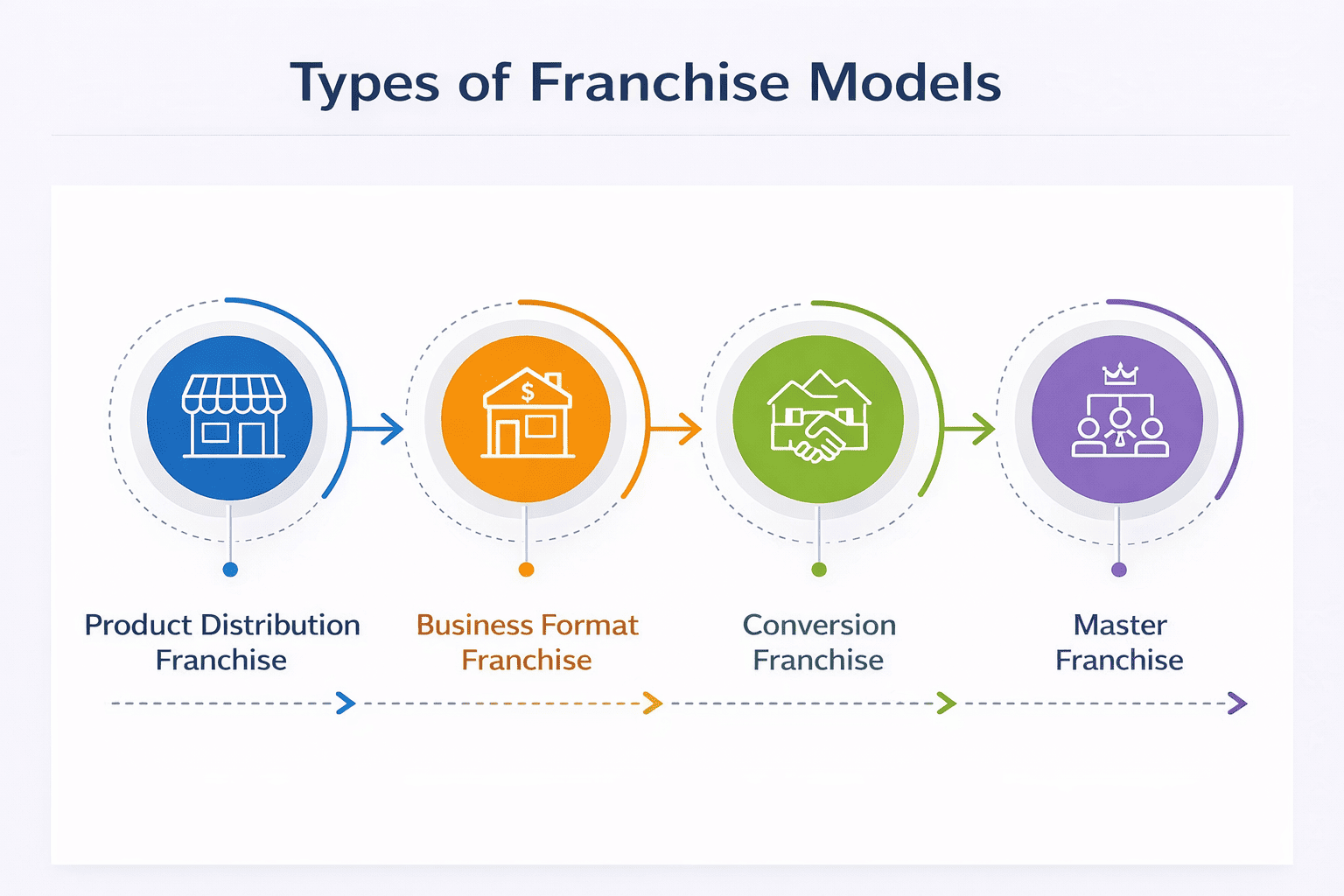
Master Franchise
A master franchisee receives the right to sub-franchise the entire concept across a single country (a country master franchise) or a wider multi-country region, acting as the franchisor’s local representative and earning a share of sub-franchisee fees.
🌍 Country/Region Rights
AD
Area Development
One franchisee commits to opening multiple units across a territory according to a development schedule, but operates all units themselves rather than sub-franchising.
🗺️ Multi-Unit Commitment
SBF
Sub-Franchise
A master franchisee grants sub-franchise rights to local unit operators. Creates a three-tier structure: franchisor → master franchisee → unit sub-franchisee.
🔗 Tiered Structure
CF
Conversion Franchise
An existing independent business converts to operate under the franchisor’s brand and systems. Accelerates network growth by recruiting established operators rather than new entrants.
🔄 Business Conversion
SOC
Social / Micro Franchise
Franchising structures adapted for social enterprise, development organisations, or micro-entrepreneurs. Prioritises impact alongside commercial sustainability. Growing in emerging markets.
🌱 Impact-Focused
📌 Why International Franchise Structures Vary So Much
Each franchise model distributes three critical variables differently: capital (who invests in market development), control (how closely the franchisor can manage standards and brand), and speed (how rapidly the brand can scale in a new market). Understanding which variable matters most for your situation is the key to selecting the right structure, whether that is a single country master franchise or a broader regional model, and the right verified partner to operate it.
SECTION 2
2 What Is International Franchising?
🎯 Definition
International Franchising is a market-entry and expansion strategy in which a franchisor (the brand and system owner) grants a franchisee in a foreign country the contractual right to operate a business under its brand, using its proven systems, trademarks, operational processes, and ongoing support infrastructure, in exchange for an initial franchise fee and ongoing royalty payments. The franchisor retains ownership of the brand and intellectual property throughout. The franchisee invests their own capital to establish and operate the business locally, following the franchisor’s standards and benefiting from an established brand with a proven track record.
International franchising is fundamentally distinct from simply opening company-owned branches abroad. When a franchisor opens its own location in a foreign market, it bears 100% of the capital requirement, operational risk, and management burden. When it franchises, it leverages the franchisee’s local capital, local market knowledge, local relationships, and local operational commitment, dramatically reducing the franchisor’s direct investment while accelerating brand presence. The franchisor’s return comes through fees and royalties rather than operating profit.
The franchise relationship involves three core legal instruments that work together: a Franchise Agreement (governing the relationship), a Trademark Licence (permitting brand use), and an Operations Manual (specifying operating standards). In international contexts, these documents must be carefully adapted for local legal requirements, franchise disclosure laws, consumer protection regulations, IP registration requirements, and repatriation rules vary significantly across jurisdictions. Some sources and industry commentators use the phrase “trade franchise” or “franchise trade” loosely to describe this broader cross-border franchising activity, but there is no separate legal category by that name, it refers to the same international franchising relationship described throughout this guide.
What Does a Franchisor Actually Provide?
™️
Brand & Trademark Rights
The right to operate under and market using the franchisor’s established brand identity, trademarks, logos, and brand guidelines, the single most valuable asset in the franchise relationship.
📋
Proven Business System
Documented operational processes, standard operating procedures, customer service standards, and the accumulated commercial know-how that distinguishes a replicable franchise from a one-off business.
🎓
Training Programme
Initial training (often at the franchisor’s headquarters or flagship location) covering operations, brand standards, product knowledge, and management, plus ongoing training as the system evolves.
📣
Marketing Support
National or international marketing campaigns, brand assets, marketing templates, and sometimes co-operative advertising fund contributions that build brand awareness in the franchisee’s market.
🔧
Ongoing Operational Support
Field support visits, helpdesk access, product or service updates, technology platform updates, and regular performance reviews, the ongoing relationship that distinguishes franchising from a one-time licence grant.
🏭
Supply Chain & Approved Suppliers
Access to the franchisor’s approved supplier network, proprietary products or ingredients, and supply chain infrastructure, ensuring product consistency across all franchise locations. Often linked to contract manufacturing arrangements.
Royalties
Typically 4–12% of gross sales, the franchisor’s primary ongoing revenue from international operations
Franchise Fee
One-time initial fee paid at signing, covers rights grant, training, and setup support from the franchisor
Marketing Fund
Typically 1–4% of gross sales contributed to a co-operative marketing fund managed by the franchisor
IP Ownership
Always remains with the franchisor, the franchisee gains operational rights, not title to the brand or systems
SECTION 3
3 Franchising vs Licensing vs Distribution
These three commercial structures are frequently confused, particularly in international B2B contexts where elements of all three may operate simultaneously in the same commercial relationship. They are also the three primary “alternative channel” programs businesses weigh against franchising when planning market entry. Understanding the precise distinctions determines which legal instruments you need and what obligations each party carries.
💡 The Three-Sentence Distinction
A Licence says: “You may use my IP, here is what you can do with it and what you owe me.” A Distribution Agreement says: “Buy my products at this wholesale price, then sell them in your territory and keep your margin.” A Franchise Agreement says: “You will operate a business exactly as I specify, using my brand, my systems, and my support, and you will pay me for the right to do so.”
Dimension
Licensing Agreement
Distribution Agreement
Franchise Agreement
What is granted?
IP usage rights
Product resale rights
Complete business system rights
Business system
Not included
Not included
Core of the arrangement
Training & support
Rare / limited
Product knowledge only
Comprehensive & ongoing
Operational control
Quality standards only
Brand guidelines only
Extensive, operations manual enforced
Revenue for rights holder
Royalties on IP use
Wholesale product margin
Franchise fee + royalties + marketing fund
Franchisee/licensee manufactures?
Often yes
Never
Sometimes (product franchises)
Trademark licence included?
It IS the licence
Usually embedded
Always embedded within franchise agreement
Level of brand control
Moderate
Limited
Highest, every touchpoint standardised
Capital borne by partner
Moderate
Inventory cost only
High, full location setup investment
Termination complexity
High, IP cessation
Moderate, stock clearance
Very high, business cessation or rebrand
Common sectors
Pharma, tech, FMCG, media
Consumer goods, electronics, food
Food & beverage, retail, services, healthcare
✨ GTsetu Insight
In practice, the lines between franchising, licensing, and distribution often blur, particularly in international arrangements. A sophisticated international distribution agreement may include so many operational requirements that it resembles a franchise in all but name. Understanding which elements of each structure apply to your commercial relationship, and drafting accordingly, is why engaging both specialist legal counsel and a trusted supplier collaboration platform from the outset matters so much.
SECTION 4
4 Unit Franchise Model
🎯 Definition
A Unit Franchise is the foundational building block of every franchise system. It grants a single franchisee the right to open and operate one franchise location within a defined territory, under the franchisor’s brand and systems, for a defined period. The franchisee pays an initial franchise fee at signing and ongoing royalties on gross sales throughout the term. The franchisee bears full capital and operational responsibility for their single location; the franchisor provides training, support, and system access. For international expansion, unit franchises are typically the proving ground for a new market before the franchisor commits to a master or area development structure.
The unit franchise model is the most granular level of franchising, and the most direct. The franchisor maintains the closest relationship with the franchisee, since there is no intermediary master franchisee layer. This means greater control over brand standards and operational consistency, but also a significantly higher operational burden for the franchisor: managing individual franchisees across dozens of countries is resource-intensive, which is why most mature international franchise systems migrate toward country master franchise or area development structures for large markets.
When Unit Franchise Works Best Internationally
🧪
Market Testing Phase
When entering a new country for the first time, a single pilot unit franchise allows the franchisor to test market reception, localise the model, and establish proof of concept before committing to larger structural arrangements.
🏙️
Small or Niche Markets
In markets where overall demand supports only a handful of locations, such as small island nations or niche B2B service categories, unit franchise arrangements are sufficient without the complexity of a master structure.
🎯
Premium / Limited Locations
For premium concepts where scarcity is part of the brand proposition, luxury retail, fine dining, specialist healthcare, unit franchises allow precise control over location selection and brand presentation.
👤
High-Trust Individual Partners
When the franchisor identifies exceptional individual operators in a foreign market who are not positioned to take on a multi-unit commitment but are ideal brand ambassadors for their city or region.
SECTION 5
5 Master Franchise Model & Country Master Franchise Agreements
🎯 Definition
A Master Franchise Agreement grants a master franchisee the right to develop and sub-franchise the franchisor’s concept across an entire country or large region. When the scope is limited to one nation, this is commonly called a country master franchise, the most widely used form of international master franchise, since it gives the franchisor one accountable local partner per country rather than one partner spanning several countries. The master franchisee effectively becomes the franchisor’s representative in that territory, recruiting and signing sub-franchisees, delivering training and support, enforcing brand standards, and collecting sub-franchisee fees on the franchisor’s behalf. In return, the master franchisee retains a defined percentage of the sub-franchise fees and royalties collected, with the remainder remitted to the franchisor. The master franchisee pays a substantial upfront master franchise fee for these regional or country rights.
The master franchise model is the dominant structure for rapid international expansion because it transfers the enormous operational burden of building a franchise network in a new country to a local entity with the capital, relationships, market knowledge, and entrepreneurial drive to execute it. The franchisor gains brand presence across an entire country or region with a single contractual relationship, rather than managing hundreds of individual unit franchise agreements across time zones, languages, and regulatory environments.
A country master franchise and a broader international master franchise (spanning several countries, such as a GCC-wide or ASEAN-wide agreement) work on the same underlying mechanics, only the territorial scope and the master franchisee’s operational complexity differ. A single-country master franchisee only ever has to navigate one regulatory, tax, and consumer environment; a multi-country international master franchisee must coordinate sub-franchisee networks and compliance across several jurisdictions simultaneously, which typically demands a larger, better-capitalised organisation.
This structural efficiency comes with a significant trade-off: the franchisor’s direct control over day-to-day brand standards is mediated through the master franchisee layer. If the master franchisee executes poorly, or makes commercial decisions that compromise brand integrity, the consequences affect the entire regional or country network, not just one location. This is why the selection and verification of a master franchisee, whether for a single country master franchise or a multi-country international master franchise, is arguably the most consequential decision a franchisor makes in international expansion. GTsetu’s six-point government-tied company verification provides the first step in this process by confirming the company exists as a registered legal entity before any commercial discussion begins.
Master Franchise vs Unit Franchise: Key Structural Differences
One country (country master franchise) or a multi-country region
Single location or small defined area
Can sub-franchise?
✓ Yes, core purpose
✗ No
Capital requirement
Very high, master fee + infrastructure
Moderate, single location setup
Revenue model
Share of sub-franchisee fees + own ops
Own location operating profit
Franchisor’s operational burden
Low, managed through MF layer
High, direct management
Franchisor’s brand control
Mediated through master franchisee
Direct and immediate
Speed of market penetration
Fast, MF drives local growth
Slow, one location at a time
Risk of wrong partner selection
Very high, affects entire country/region
Contained, single location
SECTION 6
6 Area Development Franchise Model
🎯 Definition
An Area Development Agreement grants a single franchisee the exclusive right to open and operate multiple franchise locations within a defined territory, according to a mandatory development schedule agreed at the time of signing. Unlike a master franchise, the area developer does not sub-franchise. All locations are opened and operated by the area developer themselves. In exchange for this multi-unit commitment, the area developer typically receives territorial exclusivity and sometimes a reduced per-unit franchise fee. If the development schedule is not met, the franchisor may terminate the exclusivity or the agreement entirely.
Area development is the intermediate model between a single unit franchise and a full country master franchise. It suits franchisors who want significant market penetration in a territory without delegating the sub-franchising function, and franchisees who have the capital and operational capacity to build multiple locations but are not positioned (or licensed) to recruit and manage third-party franchisees. Many large-scale international franchise networks use area development as their primary expansion vehicle in markets where the franchisor wants to maintain tighter quality control than a master structure allows.
For franchisors evaluating whether to appoint a master franchisee or an area developer, the key question is: does the local partner have the capital and operational capacity to build multiple locations themselves, or do they need to recruit and manage sub-franchisees to achieve the required coverage? The answer to this question, which requires deep due diligence on the prospective partner, is one of the primary reasons that partner verification through platforms like GTsetu’s supplier collaboration platform is so valuable at the outset of any international expansion process.
SECTION 7
7 Sub-Franchise, Conversion & Social Franchise Models
01
Sub-Franchise
Created when a master franchisee grants franchise rights to individual unit operators (sub-franchisees) within their territory. Creates a three-tier structure: franchisor → master franchisee → sub-franchisee. The franchisor’s agreement is with the master franchisee; the master franchisee’s agreement is with the sub-franchisee. The franchisor must ensure their master franchise agreement contains robust provisions governing the standards of sub-franchise agreements, including approval rights over sub-franchise terms and termination rights if sub-standards are breached.
📍 A US food brand’s GCC master franchisee granting individual restaurant sub-franchises in UAE, Saudi Arabia, Kuwait, and Bahrain
02
Conversion Franchise
An existing independent business, already operating in the same category, converts to operate under the franchisor’s brand and systems. The operator retains their existing location, staff, and customer base but adopts the franchisor’s brand identity, products, and operational standards. Conversion franchising accelerates network growth because the franchisor is recruiting established operators with proven track records rather than first-time franchisees building from scratch. Common in real estate, hospitality, and professional services.
📍 An independent regional hotel group converting to an international hospitality brand’s franchise system to benefit from global booking platforms and brand recognition
03
Social Franchise
A franchising model adapted for social enterprises, non-governmental organisations, or development programmes where the primary objective is social impact, health outcomes, economic inclusion, or community services, alongside or instead of commercial profit. The franchisor (often an NGO or international development organisation) replicates proven service delivery models through local franchise operators. Social franchising is growing significantly in emerging markets across South Asia, sub-Saharan Africa, and Southeast Asia, particularly in healthcare and agricultural services.
📍 An international health organisation franchising its maternal health clinic model to local NGO operators across rural markets in South and Southeast Asia
04
Micro-Franchise
A scaled-down franchising model specifically designed for micro-entrepreneurs with very limited capital, typically in developing or emerging markets. The franchisor provides a highly standardised, low-capital business kit (products, branding, training, and a simple operating system) to micro-franchisees who sell or distribute products in their local community. Micro-franchising bridges the gap between informal distribution and structured commercial replication, creating economic opportunity at scale.
📍 A consumer goods company enabling micro-entrepreneurs in rural India or sub-Saharan Africa to operate as branded distribution agents with a standardised product kit
05
Product / Trade Name Franchise
The simplest form of franchising, primarily a trademark licence combined with a product supply agreement. The franchisee is authorised to use the franchisor’s brand and sell its products, but receives minimal business system or operational support. Common in automotive dealerships, petroleum retailing, and beverage distribution. Structurally closest to a distribution agreement with an embedded trademark licence, which is why it is sometimes classified as distribution rather than franchising in legal practice.
📍 An international petroleum brand appointing franchised petrol station operators who use the brand and purchase fuel exclusively from the franchisor
06
Business Format Franchise
The most comprehensive and most common form of modern franchising, encompassing not just brand use and product supply, but the entire business system: operations manual, training programme, marketing support, technology platform, customer service standards, and ongoing field support. Fast food, retail, business services, and healthcare franchises are almost universally business format franchises. This is the model most people mean when they refer to “franchising.”
📍 A global quick-service restaurant brand providing its franchisees with the complete system: recipes, equipment specifications, store design, POS technology, training curriculum, and ongoing support infrastructure
SECTION 8
8 Full Franchise Model Comparison Table
Dimension
Unit Franchise
Master Franchise
Area Development
Conversion Franchise
Territory scope
Single location
Country / large region
Defined multi-unit territory
Existing business location
Can sub-franchise?
No
Yes, core purpose
No, operates units directly
No
Number of locations
One
Many (via sub-franchisees)
Multiple (self-operated)
One (existing)
Franchisee capital req.
Moderate
Very high
High
Low to moderate (no fit-out)
Franchisor control
High, direct
Low, mediated via MF
High, direct
High, post-conversion
Speed of expansion
Slow
Very fast
Moderate to fast
Fast (recruits existing ops)
Development schedule?
No
Yes (for network build)
Yes, mandatory
No
Franchisor’s op. burden
High per franchisee
Low, MF handles locally
Moderate
High (retraining required)
Royalty flow
Direct to franchisor
Split: MF retains share
Direct to franchisor
Direct to franchisor
Best for markets that are…
Small / pilot / niche
Large / complex / distant
Medium, growth ready
Already have operators
Partner vetting criticality
High
Extremely high
Very high
Very high
SECTION 9
9 Essential Clauses in an International Franchise Agreement
The international franchise agreement is arguably the most complex commercial contract in international trade, it must simultaneously govern IP rights, operational standards, financial obligations, training commitments, territory definitions, tax treatment, and exit mechanics. Omitting or poorly drafting any of the following essential provisions creates serious legal and commercial exposure.
Core Rights & Commercial Terms
Clause 01
Grant of Franchise Rights
Precisely defines what is being granted: the right to operate under the brand and system, in what territory, for how many locations, and whether the appointment is exclusive. For country master franchise agreements, also specifies the right to sub-franchise and the geographic scope of that right.
Clause 02
Trademark & IP Licence
Grants the franchisee a limited, non-exclusive, non-transferable licence to use the franchisor’s trademarks, brand assets, and trade dress in the territory, subject to strict brand guidelines and quality control obligations. The licensor must maintain quality control to preserve trademark validity.
Clause 03
Franchise Fee & Royalty Structure
Sets the initial franchise fee (payable at signing), ongoing royalty rate (typically a percentage of gross sales), marketing fund contribution, and any technology fees. Also specifies payment frequency, currency, and applicable withholding tax treatment for cross-border royalty flows. Where the franchisor and franchisee are related entities within the same corporate group, this clause should also reference the group’s transfer pricing policy, since related-party royalty rates are subject to arm’s length scrutiny by tax authorities in both jurisdictions.
Clause 04
Development Schedule
For area development and master franchise agreements, mandatory timelines for opening specified numbers of locations. Includes milestone dates, consequences for missing targets (loss of exclusivity, right to cure, or agreement termination), and procedures for seeking extensions.
Clause 05
Training & Support Obligations
The franchisor’s binding obligations: initial training programme (location, duration, content), on-site opening support, access to the operations manual, helpdesk access, field visits, and ongoing training as the system updates. This clause creates the franchisor’s most operationally significant obligations.
Clause 06
Operations Manual & Quality Standards
Incorporates the operations manual by reference and establishes it as binding on the franchisee. Specifies the franchisor’s right to amend the manual, the franchisee’s obligation to comply with updates within defined timeframes, and the consequences of non-compliance with operational standards.
Clause 07
Reporting & Audit Rights
Franchisee’s obligation to provide periodic sales reports, financial statements, and operational compliance reports. Franchisor’s right to audit financial records and inspect locations to verify royalty reporting accuracy and operational standard compliance.
Clause 08
Approved Products & Suppliers
Defines which products the franchisee must use or sell, approved supplier lists, and the procedure for seeking approval for alternative suppliers. Also governs mandatory product purchases directly from the franchisor where applicable. Often linked to OEM or contract manufacturing arrangements.
Clause 09
Marketing Obligations
The franchisee’s minimum local marketing spend requirements, obligations to use only franchisor-approved marketing materials, contributions to the cooperative marketing fund, and the franchisor’s approval rights over local marketing campaigns before execution.
Clause 10
Non-Compete & Non-Solicitation
Restrictions on the franchisee operating competing businesses during the franchise term, and often for a defined period after termination. Post-term non-solicitation provisions restrict poaching of co-franchisees and franchisor staff. Scope must comply with competition law in the relevant jurisdiction.
Clause 11
Term, Renewal & Transfer
Initial franchise term, renewal rights and conditions (including performance requirements for renewal), the franchisee’s right to transfer the franchise to a third party (subject to franchisor approval), and the franchisor’s right of first refusal to repurchase on transfer.
Clause 12
Termination & Post-Termination
Grounds for termination (breach, insolvency, failure to meet development targets, change of control), notice and cure periods, and critically, post-termination obligations: immediate cessation of brand use, return or destruction of confidential materials, and de-identification of premises.
Transfer Pricing & Cross-Border Tax Considerations
A question that surfaces frequently once a franchisor moves from a single unit franchise to a country master franchise or a wholly owned regional subsidiary structure is how franchise agreement transfer pricing works. Where the franchisor licenses its brand and systems to a related-party regional entity, which in turn signs country master franchise agreements with local partners, tax authorities in each jurisdiction will examine whether the royalty rate, marketing fund allocation, and any management or service fees charged between the related entities reflect an arm’s length price, broadly, what an unrelated third party would have paid for the same rights in the same market.
💰 Practical Transfer Pricing Checkpoints
Franchisors operating through related-party regional or country structures should typically: (1) document a formal transfer pricing policy covering royalty rates, marketing contributions, and any intercompany service fees; (2) benchmark royalty rates against comparable unrelated-party franchise agreements in the same industry; (3) maintain contemporaneous transfer pricing documentation as required by local law; and (4) engage qualified tax counsel in both the franchisor’s and the master franchisee’s jurisdictions, particularly where withholding tax treaties, permanent establishment risk, or advance pricing agreements may apply. This guide provides general commercial context only and is not tax advice.
🌐 International Franchise Law Complexity
Unlike domestic franchise agreements, international arrangements must navigate two jurisdictions simultaneously. Pre-sale disclosure laws (required in the US, EU, Australia, Canada, and many other markets), mandatory minimum franchise terms, distributor protection legislation that may apply to franchisees, IP registration requirements in the franchisee’s country, currency control and royalty repatriation rules, and local employment law for any staff the franchise requires, all must be addressed before a single franchise agreement is signed. Always engage local legal counsel in the franchisee’s jurisdiction alongside the franchisor’s home-country counsel.
SECTION 10
10 Pros & Cons of Each Franchise Model
From the Franchisor’s Perspective
✅ Advantages of International Franchising
✅ Rapid market penetration without proportionate capital investment, franchisee funds the local build-out
✅ Franchisee’s local market knowledge, regulatory familiarity, and trade relationships accelerate real-world performance
✅ Steady royalty income stream provides revenue visibility and predictability across markets
✅ Brand presence and customer relationships are built across multiple markets simultaneously
✅ Geographic diversification reduces dependence on any single market’s economic cycle
✅ Franchisee’s entrepreneurial motivation typically exceeds that of a salaried employee running a company-owned unit
⚠️ Disadvantages of International Franchising
⚠️ Brand reputation across an entire country depends on the franchisee’s operational standards, poor execution damages the global brand
⚠️ Royalty income is lower than the operating profit the franchisor would earn from company-owned operations in the same market
⚠️ International franchise agreements are legally complex and expensive to draft, register, and enforce across jurisdictions
⚠️ Training and ongoing support for international franchisees is resource-intensive, particularly across language barriers and time zones
⚠️ Terminating a poorly performing franchisee, especially under master franchise structures, can be commercially damaging and legally complex
⚠️ Some jurisdictions impose significant legal protections on franchisees that make termination of underperforming relationships difficult regardless of contract terms
Master Franchise Model: Pros & Cons
✅ Advantages of Master Franchise
✅ Single contractual relationship manages an entire country or region, dramatic reduction in franchisor’s administrative burden
✅ Master franchisee’s local expertise handles all in-country sub-franchisee recruitment, training, and support
✅ Large upfront master franchise fee provides immediate capital to the franchisor without requiring direct investment
✅ Fastest path to multi-location brand presence in complex or distant markets
✅ Master franchisee’s financial stake in the network’s success creates powerful commercial alignment
⚠️ Disadvantages of Master Franchise
⚠️ Franchisor’s control over brand standards and day-to-day operations is mediated through the master franchisee layer, creating quality control risk
⚠️ Franchisor receives only a portion of total royalties, the master franchisee retains a significant share as compensation for their local infrastructure role
⚠️ A poorly performing master franchisee can undermine an entire regional network and be very difficult to replace mid-term
⚠️ Sub-franchisees may feel disconnected from the franchisor, creating network cohesion challenges over time
⚠️ If the master franchisee fails or terminates, the franchisor must suddenly take on direct management of all sub-franchisees, a significant operational shock
SECTION 11
11 Which Franchise Model Is Right for Your Business?
🧭 International Franchise Model Decision Guide
If you want to test market reception before committing to full-scale expansion…
→ Start with a Unit Franchise Pilot
Unit Franchise
Appoint one carefully selected pilot unit franchisee in the target market. Use learnings to localise your model before committing to a country master franchise or area development structure.
If you want rapid, capital-light expansion across a single country or an entire region…
→ Appoint a Master Franchisee
Master / Country Master Franchise
Find a verified, well-capitalised local partner to develop and manage the country or regional network. Verify before engaging, one wrong master franchisee affects your entire country network. See GTsetu’s six-point government-tied company verification for the first step in partner assessment.
If you want to build multi-unit presence but maintain direct brand control in a market…
→ Use Area Development
Area Development
Commit one well-capitalised partner to a mandatory multi-unit development schedule while retaining direct franchisor oversight of every location, no sub-franchise layer required.
If there are already established independent operators in the market in your category…
→ Explore Conversion Franchising
Conversion Franchise
Recruit experienced existing operators to convert to your brand. Speed of network establishment is faster than building from scratch, and you recruit operators with proven track records rather than first-timers.
If your market involves social impact outcomes in emerging or developing markets…
→ Consider Social or Micro-Franchise Structures
Social / Micro
Adapt the franchise model for impact-first outcomes, healthcare access, economic inclusion, agricultural distribution. Micro-franchise structures enable very-low-capital operators to participate in a replicable business system.
Need to find government-verified master franchisees, country master franchisees, or area developers across 100+ countries?
→ Start on GTsetu
GTsetu
Discover six-point government-verified company profiles with built-in NDA infrastructure from first contact and zero commission on any deal. Secure B2B collaboration from day one.
SECTION 12
12 Franchise as a Market Entry Strategy
Franchising is one of a suite of market entry strategies available to businesses expanding internationally, alongside direct export, licensing, joint ventures, distribution partnerships, and wholly-owned direct investment. These are often described collectively as “alternative channel programs” against which franchising is benchmarked. Each strategy makes different trade-offs between capital commitment, control, speed, and local adaptability. Understanding where franchising sits in this spectrum is essential to choosing the right vehicle for each target market.
1
Export / Distribution (Lowest Control, Lowest Investment)
The simplest entry: sell products to a local international distributor who resells in the target market. Zero in-country operational presence required. Brand presence is limited to the product itself; the brand has no control over the customer experience beyond the product. Appropriate for manufactured goods where the customer relationship is through the product, not through a service experience.
2
Licensing (IP Rights Transfer, Limited Control)
Grant a local partner rights to use your IP, trademarks, patents, formulas, technology, in exchange for royalties. More presence than export but less operational control than franchising. The licensee decides how to commercialise the IP within the licence scope. Appropriate when the IP itself is the valuable asset and the brand does not require a consistent service experience to deliver its value.
3
Franchising (System Transfer, High Control, Low Investment)
Grant a local partner the complete business system, brand, operations, training, support, and impose detailed operational standards through the franchise agreement and operations manual. Far greater brand control than licensing or distribution; far lower capital requirement than direct investment. The optimal structure when consistent customer experience across all locations is fundamental to the brand proposition. The critical decision point: which franchise model (unit, country master franchise, area development) to use in each specific market.
4
Joint Venture (Shared Investment, Shared Control)
Establish a new legal entity jointly with a local partner, sharing capital investment, operational responsibility, and profits. Greater control than franchising but requires significant capital commitment and the complexity of ongoing co-management. Appropriate in markets where foreign direct investment restrictions require local equity participation, or where the strategic value of a specific local partner justifies the complexity.
5
Wholly Owned Direct Investment (Full Control, Full Investment)
Establish a wholly owned subsidiary, open company-operated locations, hire staff directly, and manage all operations from the centre. Maximum brand control, maximum capital requirement. Appropriate only when the market size and strategic importance justify the investment, and when the franchisor has the management bandwidth to operate directly in multiple international markets simultaneously.
✨ GTsetu Insight
Many businesses that begin with distribution or licensing arrangements in a new market eventually graduate to franchising as the brand’s operational requirements in that market mature. GTsetu’s supplier collaboration platform is designed to support this evolution, connecting businesses with government-verified partners who can grow with them from an initial distribution relationship into more comprehensive franchise or licensing structures over time.
SECTION 13
13 Industries, Use Cases & Real-World Examples
Industry
Dominant Franchise Model
Why This Model?
Typical Example
Quick Service Restaurants (QSR)
Master Franchise + Sub-Franchise
Rapid multi-location build-out required; local food regulations and supply chains are highly country-specific; master franchisee manages in-country complexity
International QSR brand appointing a single master franchisee for the GCC region, who then sub-franchises individual restaurant locations across UAE, Saudi Arabia, and Kuwait
Retail & Fashion
Master Franchise or Area Development
Retail real estate, mall relationships, and consumer fashion preferences are intensely local; a master franchisee’s market relationships are essential to securing premium locations
An international fashion brand appointing a master franchisee for South Asia who handles mall leasing, localised visual merchandising, and staff training across India, Pakistan, and Sri Lanka
Business Services & Professional Services
Unit Franchise or Area Development
Service quality depends on individual practitioners; tighter per-location control is required; area development suits established business services operators expanding geographically
A business consulting or accounting services franchise appointing area developers in major cities who commit to opening multiple service locations under a common brand standard
Healthcare & Wellness
Unit Franchise or Conversion Franchise
Regulatory compliance and clinical standards require direct franchisor oversight per location; conversion franchising leverages existing licensed healthcare facilities
An international dental clinic brand converting established independent dental practices to operate under its brand, retaining existing clinical teams while standardising patient experience and brand
Education & Training
Master Franchise or Area Development
Curriculum localisation, teacher training, and regulatory approval for educational programmes are country-specific; country master franchisees manage these in-country requirements
An international supplementary education brand appointing area developers for major cities who open and operate tutoring centres serving the local curriculum alongside the franchisor’s core programme
Hospitality & Hotels
Conversion Franchise or Area Development
Existing hotel properties can convert without new construction; hospitality franchising leverages established operators with property assets and staff already in place
An international hotel brand converting independently owned properties in a region to operate under its brand, gaining immediate network scale without new property investment
Emerging Market Healthcare (Social Franchise)
Social / Micro-Franchise
Last-mile healthcare delivery requires local operators with community trust; low-capital entry model enables micro-entrepreneurs to participate; impact metrics alongside financial returns
A maternal health organisation franchising its standardised antenatal care model to local community health workers across rural South Asia and sub-Saharan Africa
Petroleum Retail
Product / Trade Name Franchise
Structurally closest to a distribution arrangement, franchisees use the brand and purchase fuel exclusively from the franchisor-linked supplier; minimal business format elements required
An international petroleum brand appointing individual petrol station operators as franchisees who use the brand identity and purchase fuel products through the franchisor’s supply chain
📌 Localization Is Non-Negotiable
Every successful international franchise, from McDonald’s menu adaptations in India to KFC’s flavour integration in China, has required deliberate, structured localisation of some elements of the business model. The franchisor’s challenge is to determine which elements are non-negotiable (brand identity, core quality standards, customer experience fundamentals) and which elements must adapt to local consumer preferences, regulations, and cultural expectations. Getting this balance wrong in either direction, over-standardising or over-localising, is one of the primary causes of international franchise failure.
SECTION 14
14 Key Risks & How to Mitigate Them
🔍
Unverified Franchisee Credentials
The most preventable and most common cause of international franchise failure: appointing a master franchisee or area developer who misrepresented their financial capacity, market reach, or operational expertise. GTsetu’s six-point government-tied company verification addresses the first step of this process by confirming company registration and legal existence before any commercial discussion begins. You must conduct your own due diligence on financial capacity and operational capability.
🔐
IP Disclosure Before NDA
Sharing proprietary systems, operations manuals, financial performance representations, or trade secrets before a formal NDA is in place. GTsetu’s secure B2B collaboration workflows enable NDA execution before any sensitive exchange, with a full digital audit trail.
⚖️
Franchise Disclosure Law Non-Compliance
Many jurisdictions (US, EU, Australia, Canada, and others) mandate pre-sale franchise disclosure documents with specific content and timing requirements. Failure to comply invalidates the franchise agreement and can expose the franchisor to criminal liability. Always engage local legal counsel before marketing franchises in any new jurisdiction.
🏷️
Trademark Not Registered in the Franchisee’s Country
In many jurisdictions, trademark rights are territorial, a trademark registered in the franchisor’s home country provides no protection in the franchisee’s country. Always register key trademarks in the target market before signing any franchise agreement. A franchisor that cannot prove trademark ownership in the target country has fundamentally limited franchise agreement enforceability.
📉
Master Franchisee Underperformance
A master franchisee who fails to meet development targets locks the franchisor out of an entire country or region. Mitigate through robust development schedule provisions, milestone-based exclusivity (exclusivity only confirmed as targets are achieved), right-to-cure provisions, and clear conversion-to-non-exclusive triggers for failure to perform.
🌐
Brand Damage Through Inconsistent Standards
In a master franchise structure, the franchisor’s ability to directly inspect every location is limited. Brand damage from poor standards in one sub-franchisee’s location can spread quickly, particularly in the age of social media. Regular audit requirements, mystery shopping programmes, and clear termination provisions for repeated standards failures are essential contractual protections.
💸
Royalty Repatriation & Transfer Pricing Restrictions
Several countries impose restrictions on the repatriation of royalty payments to foreign franchisors, including withholding taxes, central bank approval requirements, currency controls, and transfer pricing adjustments for related-party structures. These restrictions must be identified and addressed in the agreement before signing, including provisions for what happens if royalty repatriation becomes legally restricted during the term.
🚪
Franchisee Protection Laws on Termination
Many jurisdictions provide statutory protections to franchisees on termination, including mandatory notice periods, compensation rights, and restrictions on non-renewal, that override contractual termination provisions. Terminating a non-performing franchisee, particularly a master franchisee with an established regional network, can be extraordinarily expensive and legally complex. Exit provisions must be carefully drafted and local law thoroughly researched before any agreement is signed.
SECTION 15
15 How GTsetu Helps You Find Government-Verified International Franchise Partners
🌐 Platform Spotlight, GTsetu
Six-Point Government-Tied Company Verification
No franchise agreement, however expertly drafted, protects against the wrong franchisee. A country master franchise agreement with an under-capitalised partner, a misrepresented area developer, or an unverified sub-franchisee is not a commercial arrangement, it is a litigation waiting to happen. The most frequently cited cause of international franchise failure is not structural or legal complexity; it is partner selection. GTsetu was built to solve the first step of this problem by providing six-point government-tied company verification using official government registration data.
✅ What GTsetu Verifies (6 Points, Using Government Tie-Ups):
• Company Name
• Registered Address
• Registration Number
• Company Status (Active/Dormant/Dissolved)
• Company Type (Private Limited, LLC, Sole Proprietorship, etc.)
• Date of Certificate of Incorporation
❌ What GTsetu Does NOT Verify:
GTsetu does not verify financial health, creditworthiness, trade references, tax compliance status, certifications, operational capabilities, or manufacturing capacity. The verification confirms that the company exists as a registered legal entity through government data partnerships. You must conduct your own due diligence on financial capacity, market reputation, and operational capability before signing any franchise agreement.
✅
Government-Tied Verification
Six-point company verification using official government registration data, not self-declared information.
🕵️
Anonymous Discovery
Explore verified master franchisee, area developer, and unit franchisee candidate profiles without revealing your brand or identity until mutual interest is confirmed.
📄
Built-In NDA Workflow
Formalise confidentiality before sharing any operations manual excerpt, financial performance data, or proprietary system information, with a full digital audit trail from day one.
🚫
Zero Commission
No broker fees on any franchise deal, whether a country master franchise arrangement, area development agreement, or unit franchise appointment.
🔐
Encrypted Collaboration
All documents and communications encrypted in transit and at rest. Secure B2B collaboration from first contact to signed agreement.
🌍
100+ Countries
Active verified network covering franchisors, master franchisees, area developers, distributors, and international partners across Asia, the Middle East, Europe, Africa, and the Americas.
✓ Always (Name, Address, Registration Number, Status, Type, Date of Incorporation)
✗ Rarely verified at all
Verifies financial health or creditworthiness
✗ Does not verify (buyer must conduct due diligence)
✗ Requires separate due diligence
Anonymous discovery before commitment
✓ Yes
✗ No
NDA before sensitive disclosure
✓ Built-in workflow
~ External legal needed
Zero broker commissions
✓ Always
✗ Often 5–15%
Franchisors + Franchisees on one platform
✓ Single platform
✗ Separate sources
Encrypted document sharing
✓ Built-in
✗ Email risk
100+ country coverage
✓ Yes
~ Geography-limited
FAQ
? Frequently Asked Questions
QWhat is a franchise model in international trade?
A franchise model in international trade is a contractual arrangement in which a franchisor grants a franchisee in a foreign country the right to operate under its brand, using its proven business systems, trademarks, and operational processes, typically in exchange for an initial franchise fee and ongoing royalties on gross sales. Unlike pure licensing (which grants IP rights) or distribution (which grants product resale rights), franchising grants an entire proven business model: brand identity, operational processes, training, quality standards, and ongoing support infrastructure. The franchisor retains IP ownership throughout; the franchisee invests their own capital to establish and operate the business in their market.
QWhat is the difference between a master franchise and a unit franchise?
A unit franchise grants one franchisee the right to open and operate a single franchise location in a defined territory. A master franchise grants a master franchisee the right to sub-franchise the concept to multiple unit franchisees across an entire country or large region, effectively acting as the franchisor’s local representative. The master franchisee recruits, trains, and supports sub-franchisees, retaining a share of the sub-franchise fees and royalties collected. The master franchisee typically pays a substantially larger upfront fee for these regional rights and takes on significant obligations for network development. The key distinction: a unit franchisee is an operator; a master franchisee is both an operator and a local franchisor.
QWhat is a country master franchise agreement?
A country master franchise agreement is a master franchise scoped to a single country rather than a multi-country region. The franchisor grants one local partner, the country master franchisee, exclusive rights to develop, sub-franchise, and support the brand throughout that country, including recruiting sub-franchisees, delivering training, and enforcing brand standards. It is the most common form of international master franchise because it gives the franchisor a single accountable partner per country and gives the master franchisee a manageable, single-jurisdiction regulatory and tax environment, as opposed to a broader multi-country international master franchise covering several markets under one agreement.
QWhat is an area development franchise agreement?
An area development franchise agreement grants a single franchisee the exclusive right to open multiple franchise units across a defined territory according to a mandatory development schedule agreed at signing. Unlike a master franchise, the area developer operates all units themselves, there is no sub-franchising. The area developer commits to opening a specified minimum number of locations within defined timeframes in exchange for territorial exclusivity. Failure to meet the development schedule typically results in loss of exclusivity or termination of the agreement. Area development suits franchisees with the capital and operational capacity to run multiple locations directly, without requiring the additional revenue share that a master franchise structure creates.
QHow does franchising differ from licensing and distribution in international trade?
These three commercial structures are closely related but fundamentally different. A licensing agreement grants the licensee the right to use specified intellectual property, a trademark, patent, or formula, but does not prescribe how the business using that IP should be operated. A distribution agreement grants a distributor the right to purchase and resell the supplier’s products in a territory, but does not transfer business systems or impose operational standards beyond product compliance. Franchising grants an entire business system: the brand, the operational processes, the training programme, the ongoing support infrastructure, and the comprehensive quality standards that define the customer experience. Franchising imposes far more extensive operational obligations on the franchisee than either a licence or distribution agreement, and in return, provides a far more structured support relationship from the franchisor. These structures, together with joint ventures and direct investment, form the full set of alternative market entry channels a business weighs before choosing franchising.
QWhat are the essential clauses in an international franchise agreement?
The essential clauses in an international franchise agreement include: (1) Grant of franchise rights, territory, exclusivity, and scope; (2) Trademark and IP licence, scope of permitted brand use and quality control obligations; (3) Initial franchise fee and ongoing royalty structure, including marketing fund contributions and transfer pricing treatment for related-party structures; (4) Development schedule, for area development or master franchise arrangements; (5) Training and support obligations of the franchisor; (6) Operations manual incorporation and franchisee compliance obligations; (7) Approved products and supplier requirements; (8) Reporting, audit, and inspection rights; (9) Marketing obligations and brand guidelines; (10) Non-compete and non-solicitation provisions; (11) Term, renewal conditions, and right of first refusal; (12) Termination rights and post-termination obligations including brand cessation; and (13) Governing law, dispute resolution, and jurisdiction, particularly critical in cross-border arrangements.
QDoes transfer pricing apply to international franchise agreements?
Yes, where the franchisor and franchisee are related parties, for example, a franchisor licensing its brand to a wholly owned regional entity, which then signs country master franchise agreements with local partners, cross-border royalty and franchise fee payments between the related entities generally must be set on an arm’s length basis to satisfy transfer pricing rules in both jurisdictions. Tax authorities frequently scrutinise franchise royalty rates, marketing fund allocations, and intercompany management fees. Franchisors operating through related-party regional or country structures should document a formal transfer pricing policy, benchmark royalty rates against comparable unrelated-party agreements, and engage qualified tax counsel in each relevant jurisdiction. This is general commercial context, not tax advice.
QWhat is a social franchise and how does it differ from a commercial franchise?
A social franchise applies the structural mechanics of commercial franchising, brand replication, standardised operating systems, training, and quality control, to social enterprise or development programme objectives, where the primary goal is social impact rather than (or alongside) commercial profit. Social franchisors are typically NGOs, international development organisations, or hybrid social enterprises. Their franchisees are often local community operators, health workers, or micro-entrepreneurs. The key structural differences from commercial franchising are: the fee model may be subsidised or absent; the “royalties” may take the form of impact reporting obligations rather than financial payments; and success metrics include health outcomes, community access, or economic inclusion alongside financial performance. Social franchising is growing significantly in healthcare, agricultural services, and financial inclusion programmes across South Asia, sub-Saharan Africa, and Southeast Asia.
QHow do I find government-verified international master franchisees or area developers?
The most efficient and secure approach is through a government-tied B2B discovery platform like GTsetu. GTsetu provides six-point government-verified company profiles across 100+ countries (Company Name, Registered Address, Registration Number, Company Status, Company Type, Date of Incorporation), with built-in NDA workflows that protect your brand systems and financial performance data from the very first interaction. Unlike franchise brokers who charge commissions, or trade show introductions where credential verification is limited, every company on GTsetu has completed government-tied verification of their registration credentials before listing. The platform operates on a zero-commission model, ensuring your deal economics stay entirely between you and your partner. Remember: GTsetu verifies company registration only, not financial health or creditworthiness. You must conduct your own due diligence on these aspects before signing. See GTsetu’s resources on finding international partners and secure B2B collaboration for detailed guidance.
Ready to Find Government-Verified International Franchise Partners Globally?
Join verified companies on GTsetu. Six-point government-tied verification (Name, Address, Registration Number, Status, Type, Date of Incorporation) across 100+ countries. Built-in NDA workflows, encrypted collaboration, and zero broker fees. Remember: GTsetu verifies company registration only, not financial health or operational capability. You must conduct your own due diligence before signing any franchise agreement.
They represents the product, and research team behind GTsetu, a global B2B collaboration platform built to help companies explore cross-border partnerships with clarity and trust. The team focuses on simplifying early-stage international business discovery by combining structured company profiles, verification-led access, and controlled collaboration workflows.
With a strong emphasis on trust, and disciplined engagement, Team GTsetu shares insights on global trade, partnerships, and cross-border collaboration, helping businesses make informed decisions before entering deeper commercial discussions.