Toll Manufacturing Explained: What It Is, How It Works & When to Use It (2026 Guide)
Direct Answer: Toll manufacturing (also called toll processing) is an arrangement where a company supplies its own raw materials or semi-finished products to a third-party manufacturer, the toll manufacturer, which processes them into finished goods according to the client’s specifications, in exchange for a flat service fee called a toll. Unlike contract manufacturing, the client retains ownership of materials throughout and maintains greater control over formulations, IP, and quality standards. This guide covers the full toll manufacturing process, how it compares to contract manufacturing, which industries rely on it, what a toll manufacturing agreement must include, and how to find verified toll processing partners globally through GTsetu‘s government‑tie‑up verification platform (6 points: legal name, registered address, registration number, company status, company type, incorporation date).
📅 February 24, 2026⏱ 17 min read✍️ GTsetu Editorial Team🔄 Updated regularly
$52.6B
Chemical Toll Market by 2025
6.5%
CAGR, Toll Processing Sector
0%
Broker Commission on GTsetu
35+
Countries, Verified Network
For many manufacturers, the biggest barrier to growth is not demand, it is the capital cost and technical complexity of adding production capacity. Building a dedicated facility for a new product line, acquiring specialised blending or milling equipment, or hiring certified process chemists are all investments that can stall a promising product launch for years.
Toll manufacturing solves this. By outsourcing specific processing steps to a partner who already has the infrastructure, companies can move from formulation to market without committing to fixed capital expenditure, while retaining full ownership of their materials, their formulations, and their intellectual property.
This guide explains everything you need to know: the definition, the step-by-step process, the critical distinction from contract manufacturing, the industries that use it most, and how to find verified toll manufacturing partners through GTsetu’s verified B2B collaboration network.
💡 Who Is This Guide For?
This guide is for manufacturing directors, business development leads, product managers, and founders who are evaluating whether toll manufacturing is the right model for their production needs, and how to find qualified, verified toll processing partners globally.
SECTION 1
What Is Toll Manufacturing?
🎯 Definition
Toll manufacturing (also called toll processing or tolling) is a production arrangement in which a company, the client, supplies its own raw materials, proprietary formulations, or semi-finished goods to a third-party manufacturer. That manufacturer, known as the toll manufacturer, processes the materials into finished or intermediate products according to the client’s specifications, using its own equipment, facilities, and workforce. In exchange, the client pays a flat service fee, the “toll”, rather than purchasing the finished goods outright.
The term “toll” has historical roots in milling, where farmers would bring their own grain to a miller who would grind it into flour and retain a portion, the toll, as payment. The modern industrial version works on exactly the same principle: you bring the materials, the specialist does the processing, and you pay a fee for the service.
Crucially, in toll manufacturing, the client retains ownership of the raw materials throughout the entire production process. The finished goods, and the intellectual property embedded in the formulation or process, belong to the client, not the toll manufacturer. This ownership structure is the defining characteristic that separates tolling from other outsourcing models.
🏭
The Core Principle
Toll manufacturing gives companies access to specialised production capabilities, expensive equipment, certified facilities, expert process technicians, without the capital investment of owning them. You pay for the transformation of your materials, not for the infrastructure that performs it.
SECTION 2
How the Toll Manufacturing Process Works
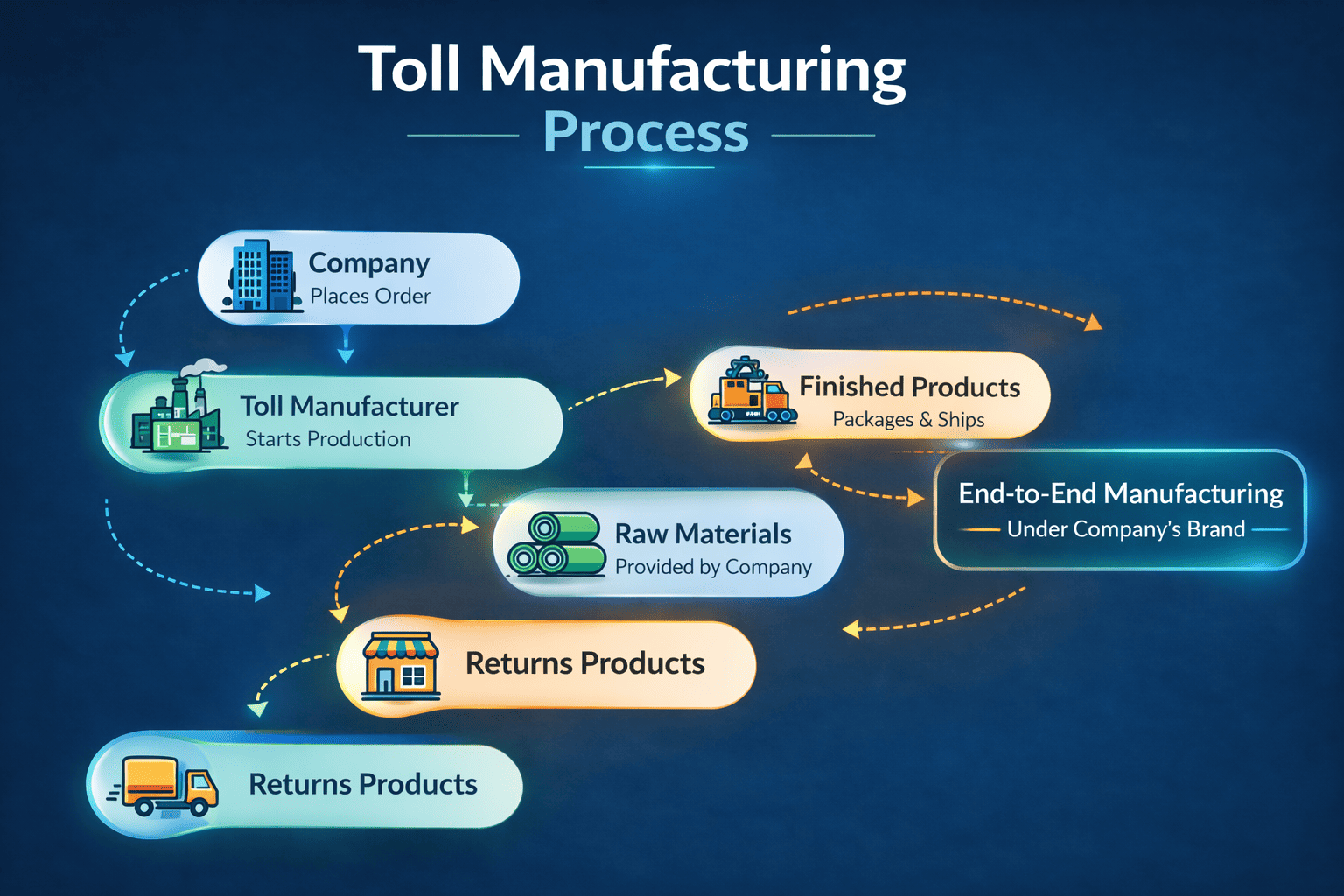
The toll manufacturing workflow is structured and contractual. Every engagement begins with a formal agreement and proceeds through clearly defined stages. Here is the complete process from initial contact to final delivery.
01
Define Scope & Execute the Toll Manufacturing Agreement
Before any materials move, both parties agree on and document: the exact scope of processing required, production timelines and batch sizes, quality specifications and testing standards, confidentiality obligations and IP protections, fee structure (flat toll per batch, unit, or weight), liability and insurance terms, and dispute resolution mechanisms. This agreement is the legal foundation of the entire relationship.
02
Supply Raw Materials to the Toll Manufacturer
The client sources, purchases, and ships the raw materials, proprietary formulations, or semi-finished goods to the toll manufacturer’s facility. The client may also supply specific packaging materials, additives, or proprietary components. Logistics coordination, including customs, labelling, and insurance for materials in transit, is typically the client’s responsibility unless otherwise agreed.
03
Processing & Manufacturing
The toll manufacturer carries out the agreed processing activities using their specialised equipment, certified facilities, and trained workforce. This could include mixing, blending, granulation, milling, coating, drying, packaging, sterilisation, or any other transformation step specified in the agreement. The manufacturer follows the client’s formulation and process specifications exactly.
04
Quality Control & Compliance Testing
The toll manufacturer conducts rigorous quality assurance checks throughout processing, including in-process sampling, finished-product testing, and specification verification. In regulated industries (pharmaceuticals, food, chemicals), this step also involves regulatory compliance checks against GMP, HACCP, ISO, or other relevant standards agreed in the contract.
05
Documentation & Reporting
The toll manufacturer provides the client with batch records, quality certificates, test reports, and compliance documentation. This paper trail is essential for the client’s own quality management, regulatory filings, and customer requirements. Transparency in documentation is a hallmark of reputable toll manufacturers.
06
Delivery, Warehousing, or Direct Dispatch
Finished goods are returned to the client, shipped directly to the client’s customers, or stored in the toll manufacturer’s warehouse, according to the terms of the agreement. Some full-service toll manufacturers also offer logistics and inventory management as supplementary services, giving clients end-to-end outsourcing of the production-to-delivery chain.
⚡ Important Distinction
The toll manufacturer is responsible for the quality of the processing, how well they transform your materials. The client remains responsible for the quality and suitability of the raw materials supplied. This split responsibility is central to how toll agreements are structured and why material sourcing standards matter enormously.
SECTION 3
Toll Manufacturing vs. Contract Manufacturing
Toll manufacturing and contract manufacturing are frequently confused, even used interchangeably, but they represent fundamentally different relationships with different implications for control, ownership, cost, and risk. Understanding the distinction is essential before choosing which model fits your situation.
⚡
The Single Most Important Difference
In toll manufacturing, you own the raw materials and supply them to the processor. In contract manufacturing, the manufacturer owns and sources the materials itself. Everything else, IP control, cost structure, quality responsibility, and formulation confidentiality, flows from this one distinction.
Aspect
Toll Manufacturing
Contract Manufacturing
Raw Material Ownership
Client owns and supplies all materials throughout the process
Manufacturer typically sources and owns raw materials
Control Over Process
Client specifies every detail of the formulation and process
Manufacturer often determines or optimises the production method
IP Protection
Stronger, formulation and process remain with the client
Higher risk, manufacturer may have broader access to proprietary data
Cost Structure
Client pays flat toll (service fee) per batch or unit
Client pays for materials + labour + production overhead bundled
Flexibility
Very high, ideal for proprietary or custom formulations
Lower client-side flexibility; manufacturer controls more variables
Neither model is universally superior. The right choice depends on your product category, the sensitivity of your IP, your raw material sourcing capabilities, and how much production control you need to retain. Many companies use both models simultaneously, toll manufacturing for their proprietary formulations and contract manufacturing for standardised product lines.
SECTION 4
Key Benefits of Toll Manufacturing
For manufacturers, brand owners, and formulation companies that want to scale production without scaling capital expenditure, toll manufacturing offers a compelling set of strategic and economic advantages.
💰
Capital Cost Elimination
Avoid the hundreds of thousands, or millions, required to purchase, install, validate, and maintain specialised processing equipment. Pay only for the processing you need, when you need it.
🔬
Access to Specialised Expertise
Toll manufacturers invest in becoming category experts. Their process engineers, quality chemists, and equipment operators bring depth of experience that would take years and significant cost to build in-house.
📈
Scalability on Demand
Ramp production volumes up or down in response to market demand without being constrained by fixed in-house capacity. Ideal for products with seasonal demand, new product launches, or rapid market growth phases.
🚀
Faster Speed to Market
Leveraging an existing toll manufacturing facility can compress your time from formulation to first commercial batch by months compared to building or commissioning your own production line.
🛡️
Reduced Operational Risk
Equipment failures, labour shortages, regulatory compliance breaches, and environmental incidents at a toll facility are managed by the toll manufacturer, not by you. Business continuity is preserved for your core operations.
🎯
Focus on Core Competencies
When production complexity is managed externally, your internal resources can focus on innovation, formulation, sales, and customer relationships, the activities that actually differentiate your brand.
🔒
IP Ownership Retained
Because you supply your own materials and define the process, your formulation and process IP remains firmly under your control, protected by the toll agreement and NDAs rather than transferred to the manufacturer.
🌍
Global Market Access
Toll manufacturers in target markets can process your materials locally, reducing import duties, shortening delivery lead times, and ensuring regulatory compliance with local standards.
30–50%
Lower production launch cost vs. building in-house capacity
Manufacturing cost benchmark
3–9 mo
Faster time-to-first-batch vs. in-house facility setup
Facility commissioning comparison
0
Capex required for specialised processing equipment
Core tolling benefit
100%
IP and formulation ownership retained by client
Structural advantage of toll model
SECTION 5
Challenges & Risks to Manage in Toll Manufacturing
The benefits of toll manufacturing are real and significant, but so are the risks if you enter the arrangement without proper due diligence, contractual protections, and ongoing oversight. Here are the challenges every company should plan for before signing a toll agreement.
⚠️ Quality Consistency Across Batches
Maintaining identical quality across dozens or hundreds of production batches at a third-party facility requires rigorous process documentation and active oversight.
Define acceptance criteria for every batch in the agreement
Require batch records and certificates of analysis for every run
Schedule periodic facility audits by your own quality team
Establish clear procedures for batch rejection and remediation
🔐 Intellectual Property Exposure
Sharing proprietary formulations and process parameters with an external manufacturer carries inherent IP risk if the relationship or legal protections break down.
Require a robust NDA before any technical data is shared
Limit the scope of information shared to what is strictly necessary
Include non-compete clauses for specific product categories
Register IP in relevant jurisdictions before disclosure
🚚 Logistics Complexity
Coordinating the supply of raw materials from multiple vendors to a toll facility, and the return of finished goods, adds supply chain layers that must be actively managed.
Map the full logistics chain before the first production run
Build safety stock buffers for critical raw materials
Clarify insurance responsibilities for materials in transit
Establish clear escalation procedures for supply disruptions
⛓️ Third-Party Dependency Risk
Your production schedule becomes partially dependent on the toll manufacturer’s capacity, operational reliability, and financial stability, factors outside your direct control.
Verify financial health before signing long-term agreements
Include capacity reservation and priority scheduling clauses
Qualify backup toll manufacturers for critical product lines
Require advance notice of any capacity, ownership, or facility changes
✨ Mitigation Principle
Most toll manufacturing risks are manageable with the right contractual framework and partner verification process. The two most important protections are: (1) a comprehensive toll manufacturing agreement with clear quality, IP, and liability terms; and (2) thorough pre-engagement verification of the toll manufacturer’s credentials, certifications, and financial standing, exactly what verified B2B platforms like GTsetu provide.
SECTION 6
Industries That Rely on Toll Processing
Toll manufacturing is not limited to any single sector. It thrives wherever specialised equipment, regulatory compliance environments, or process expertise create natural barriers to in-house production. The following industries are the largest users of toll processing globally.
🧪
Chemicals
Blending, reaction, distillation, largest toll sector globally
💊
Pharmaceuticals
API processing, tablet coating, sterile filling, GMP-critical
The toll manufacturing agreement is not an administrative formality, it is the legal and operational backbone of the entire relationship. A poorly drafted agreement is the single most common cause of toll manufacturing disputes, IP breaches, and quality failures. Here is what every robust toll agreement must contain.
1
Scope of Work
A precise, unambiguous description of the processing activities to be performed, including the specific inputs, transformation steps, outputs, batch sizes, and any ancillary services (packaging, warehousing, dispatch). Vagueness in scope is the most common source of post-agreement disputes.
2
Raw Material Ownership & Responsibility
Explicit confirmation that the client owns all raw materials, semi-finished goods, and finished products throughout the process. Define what happens to material losses, waste, and by-products, including how they are measured, reported, and disposed of.
3
Quality Standards & Acceptance Criteria
Detailed technical specifications for finished goods, including analytical test methods, acceptable ranges, and the consequences of out-of-specification batches. Specify who performs testing, at whose cost, and what the remediation or rejection process is.
4
Confidentiality & NDA Provisions
Robust non-disclosure obligations covering all proprietary formulations, process parameters, trade secrets, and business information shared during the engagement. Define duration, permitted disclosures, and the consequences of breach. For international partnerships, using a platform with built-in secure collaboration infrastructure like GTsetu reinforces these protections with an auditable trail.
5
IP Non-Compete Clauses
Prohibit the toll manufacturer from using your formulations, processes, or technical knowledge to develop competing products, either for themselves or for third parties. Define the restricted scope by product category, geography, and duration.
6
Fee Structure & Payment Terms
The toll, the flat fee for processing services, should be clearly defined by unit (per batch, per tonne, per 1,000 units, etc.), with payment timelines, currency, invoicing procedures, and adjustment mechanisms for raw material waste or rework.
7
Production Timelines & Capacity Commitments
Agreed production schedules, lead times, minimum and maximum batch frequencies, and priority allocation rules during capacity-constrained periods. Include force majeure provisions and the obligations of each party during unforeseeable disruptions.
8
Liability, Insurance & Indemnification
Define which party bears liability for material losses, processing errors, regulatory non-compliance, and third-party claims. Specify the minimum insurance coverage each party must maintain and the process for filing and resolving claims.
9
Audit Rights & Facility Access
The client should retain the right to audit the toll manufacturer’s facility, quality systems, and batch records on reasonable notice. This is non-negotiable for regulated industries and highly recommended for all others.
10
Termination, Transition, & Exit Provisions
Define the conditions and notice periods for termination by either party, procedures for orderly transition of materials and documentation, and any post-termination obligations (continued confidentiality, return of proprietary equipment, etc.).
⚡ Legal Note
For cross-border toll manufacturing agreements, also address: governing law and jurisdiction, dispute resolution mechanism (arbitration is typically preferred over litigation in international contexts), export control compliance, and any country-specific regulatory requirements for the product category. Always have the agreement reviewed by legal counsel in both jurisdictions.
SECTION 8
How to Choose the Right Toll Manufacturing Partner
Selecting a toll manufacturer is one of the most consequential decisions in your production strategy. The wrong partner compounds risk across quality, IP, and supply continuity. The right partner becomes a strategic production asset for years. Evaluate every candidate against these criteria before committing.
🏆
Industry-Specific Experience
Choose a toll manufacturer with documented experience in your product category, not a generalist. Sector-specific knowledge reduces errors, accelerates scale-up, and ensures compliance with category-specific regulations.
⚙️
Equipment & Facility Fit
Verify that the toll manufacturer’s existing equipment is appropriate for your process, capacity, precision, contamination management, and material compatibility all matter. Do not assume; inspect or request detailed facility specifications.
📋
Certifications & Regulatory Compliance
Confirm all relevant certifications are current: ISO 9001 (quality), GMP (pharma/food), REACH/EPA (chemicals), HACCP (food), and any sector-specific standards your customers or regulators require.
📍
Location & Logistics Fit
A toll manufacturer close to your raw material suppliers or target markets reduces transport costs, lead times, and supply chain complexity. For international operations, consider customs, import/export regulations, and local regulatory alignment.
💼
Financial Stability
A financially unstable toll manufacturer is a single-point-of-failure for your production. Verify financial health through audited accounts, credit ratings, or third-party financial checks before signing long-term agreements.
🤝
Communication & Transparency Culture
Assess how the toll manufacturer communicates during the evaluation phase. Prompt, clear, and transparent communication before the agreement is a strong predictor of how they will behave when production problems arise.
📈
Scalability & Capacity Headroom
Confirm the toll manufacturer has capacity to grow with you. A partner running at 95% utilisation with no expansion plans cannot support your growth ambitions without significant risk of delays.
🔍
Reference Checks & Track Record
Request references from current or former clients in similar product categories. A reputable toll manufacturer should be able to provide verifiable references without hesitation.
SECTION 9
How GTsetu Helps You Find Verified Toll Manufacturing Partners Globally
🌐 Platform Spotlight, GTsetu
The Verified B2B Network for International Manufacturing Partnerships, Including Toll Processing
Finding a qualified toll manufacturer in a new geography is hard. Cold directories list unverified companies. Trade shows are annual and expensive. Broker intermediaries add 5–15% to every deal. And sharing your formulation with an unvetted processor is an IP risk that no NDA alone can fully address when you have no way to verify who you’re actually talking to.
GTsetu solves the discovery and trust problem. Every company on the platform, including toll manufacturers and processing partners, is verified using direct government tie‑ups across six essential credentials: legal name, registered address, registration number, company status, company type, and date of certificate of incorporation. This verification is mandatory before any company can appear in the network. GTsetu does not verify import licences, industry certifications, financial standing, or production capabilities; those must be exchanged and validated directly between partners. You can browse, evaluate, and connect with verified toll processing partners across 35+ countries through anonymous discovery, then formalise the relationship through built-in NDA workflows and encrypted document sharing, all without paying broker commissions.
✅
Government Tie‑Up Verification
6‑point verification: legal name, registered address, registration number, company status, company type, incorporation date.
📜
Licences & Certifications
GTsetu does not verify these. They must be exchanged directly between partners during due diligence.
🕵️
Anonymous Discovery
Browse toll manufacturer profiles without revealing your identity or formulation intent until you choose to connect.
📄
Built-In NDA Workflow
Execute confidentiality agreements within the platform, with a complete, timestamped audit trail, before sharing any sensitive technical data.
🔐
Encrypted Document Sharing
Share formulations, process specs, and quality documents through an encrypted workspace with full access controls and revocation rights.
🚫
Zero Commission
GTsetu charges no success fee or commission on any toll manufacturing agreement concluded through the platform.
🌍
35+ Country Coverage
Active verified network across Asia, Middle East, Europe, Africa, and the Americas, with continuous network growth.
How Manufacturers Use GTsetu to Source Toll Processing Partners
The workflow from registration to verified toll manufacturing engagement on GTsetu follows a structured, trust-first sequence that protects your formulation IP from first contact.
Stage
What Happens on GTsetu
IP Protection Level
1. Registration
Your company submits verification documents; GTsetu reviews and activates your profile
Full anonymity maintained
2. Browse Toll Partners
Anonymously review verified toll manufacturer profiles filtered by country, category, certifications, and capacity
Your identity is not revealed
3. Signal Interest
Express interest in shortlisted toll manufacturers; identity revealed only on mutual confirmation
Mutual consent before any disclosure
4. Execute NDA
Formalise confidentiality within the platform before any formulation or process data is shared
Legal protection in place
5. Share Specifications
Exchange process specs, quality standards, and capacity requirements via encrypted document workspace
Encrypted, access-controlled, auditable
6. Negotiate & Sign
Draft and finalise the toll manufacturing agreement with full commercial clarity, no broker sitting in between
Zero commission; deal economics entirely yours
SECTION 10
Red Flags When Evaluating Toll Manufacturers
Not every company that describes itself as a toll manufacturer can deliver on what your product demands. Recognise these warning signs during the evaluation process, and treat them as disqualifying unless there is a clear and verifiable explanation.
🚩
No Relevant Industry Certifications
A toll manufacturer without current, third-party-verified certifications relevant to your product category (GMP, HACCP, ISO, etc.) presents unacceptable regulatory and quality risk.
🚩
Reluctance to Allow Facility Audits
Any toll manufacturer that refuses or obstructs client audits of their facility and quality systems should be disqualified immediately, this is a non-negotiable transparency requirement.
🚩
Vague or Incomplete Batch Records
If a toll manufacturer cannot produce detailed, accurate batch records from previous production runs for reference clients, they cannot provide the traceability your production and regulatory compliance requires.
🚩
Resistance to Robust NDA Terms
Reluctance to sign a comprehensive NDA with IP non-compete clauses before receiving your formulation is a serious warning sign, regardless of how it is rationalised.
🚩
No References from Similar-Category Clients
A toll manufacturer that cannot provide verifiable references from clients with similar products or regulatory requirements has an unproven track record in your category.
🚩
Operating at or Near Full Capacity
A toll manufacturer with no capacity headroom cannot absorb your growth or protect your production schedule from disruption when their other clients’ demand spikes.
🚩
Unverified Company Credentials
If you cannot independently verify the toll manufacturer’s business registration, ownership, and financial standing, or if they resist providing documentation, do not proceed. This is exactly the risk that GTsetu’s verification layer eliminates.
🚩
Pressure to Share Formulation Before NDA
Any request to share proprietary formulations or process parameters before a formal NDA is executed is a serious breach of professional norms, and potentially the beginning of an IP theft scenario.
SECTION 11
Related Manufacturing Partnership Models to Consider
Toll manufacturing sits within a broader ecosystem of manufacturing partnership models. Depending on your product, market, and strategic objectives, one of these adjacent models, or a combination, may be more appropriate.
Model
Key Characteristic
Best For
GTsetu Resource
Toll Manufacturing
Client supplies materials; processor provides transformation services only
Many manufacturers use toll manufacturing for their proprietary formulations while simultaneously using contract manufacturing for standardised product lines and distribution agreements for market access. The models are complementary, not mutually exclusive. GTsetu’s verified network supports all of these partnership types, explore the full supplier collaboration platform here.
FAQ
Frequently Asked Questions
Q
What is toll manufacturing, and how does it differ from contract manufacturing?
Toll manufacturing is an arrangement where the client supplies their own raw materials to a third-party processor (the toll manufacturer), who transforms them into finished goods using their own equipment and expertise in exchange for a flat service fee. The client retains ownership of materials throughout the entire process. Contract manufacturing, by contrast, involves the manufacturer sourcing and owning the raw materials themselves, producing finished goods to the client’s specification. The key difference is material ownership and the degree of control the client retains over inputs and formulation IP.
Q
What is a tolling agreement, and what should it include?
A tolling agreement (also called a toll manufacturing agreement) is the legally binding contract that governs the relationship between a client and a toll manufacturer. It must include: a precise scope of work, raw material ownership clauses, quality specifications and acceptance criteria, confidentiality and NDA provisions, IP non-compete clauses, the fee structure and payment terms, production timelines and capacity commitments, liability and insurance terms, client audit rights, and exit and termination provisions. For cross-border agreements, add governing law, dispute resolution mechanism, and export compliance clauses.
Q
Which industries use toll manufacturing most extensively?
The largest users of toll manufacturing are the chemical sector (blending, synthesis, distillation), pharmaceuticals (API processing, tablet coating, sterile filling), food and beverage (co-packing, ingredient blending), cosmetics and personal care (emulsification, filling), paints and coatings (pigment dispersion), agrochemicals (formulation and granulation), industrial minerals (grinding and milling), and plastics and polymers (compounding and colour masterbatch production). Any industry where specialised equipment or regulatory-certified facilities create a barrier to in-house production is a natural fit for tolling.
Q
How is my intellectual property protected in a toll manufacturing arrangement?
IP protection in toll manufacturing rests on three pillars: (1) the toll manufacturing agreement itself, which must include comprehensive confidentiality obligations and IP non-compete clauses; (2) the client’s control over material supply, since you supply your own formulated inputs, the toll manufacturer never needs full visibility into your upstream formulation; and (3) choosing a verified, reputable toll manufacturer whose credentials, compliance, and track record can be independently confirmed. Platforms like GTsetu add a further layer of protection through government‑tie‑up verification of six core credentials, built-in NDA workflows, and encrypted document sharing, ensuring no sensitive technical data is exchanged without a formal, auditable confidentiality agreement in place.
Q
What does the “toll” in toll manufacturing actually mean?
The “toll” refers to the flat service fee paid to the toll manufacturer for performing the processing work. Unlike a price per finished unit that incorporates material costs, the toll is purely a fee for the labour, equipment usage, and expertise involved in the transformation process. The client separately bears the cost of raw materials. This fee structure is advantageous because it remains fixed regardless of how valuable the finished product turns out to be, the toll manufacturer does not benefit from increases in your product’s market value.
Q
How do I find a verified toll manufacturing partner internationally?
Finding a verified toll manufacturing partner internationally requires a platform that goes beyond an unverified directory. GTsetu connects manufacturers with toll processing partners across 35+ countries. Every company on GTsetu is verified using direct government tie‑ups across six essential credentials: legal name, registered address, registration number, company status, company type, and date of certificate of incorporation. The platform supports anonymous discovery (so you can evaluate partners without revealing your formulation intent), built-in NDA workflows (so confidentiality is formalised before any technical exchange), and zero broker commissions. GTsetu does not verify import licences, industry certifications, financial standing, or production capabilities; those must be exchanged and validated directly between partners. Start by exploring GTsetu’s verified manufacturing network.
Q
Can I use toll manufacturing for a single production step rather than the entire process?
Absolutely. One of the key strengths of toll manufacturing is its modularity. You can engage a toll manufacturer for a single step in your production chain, such as milling or spray drying, while retaining other steps in-house. Many manufacturers use multiple toll partners simultaneously, each handling a specialised step in their overall production process. The toll agreement simply needs to define the specific step or steps the toll manufacturer is responsible for, and the specification of the input and output at each handoff point.
Ready to Find Verified Toll Manufacturing Partners Globally?
Join GTsetu’s verified network of manufacturers and processors across 35+ countries. Browse verified toll manufacturing partners anonymously (government‑tie‑up verification of 6 core credentials), formalise with built-in NDAs, and close agreements with zero broker commissions.
They represents the product, and research team behind GTsetu, a global B2B collaboration platform built to help companies explore cross-border partnerships with clarity and trust. The team focuses on simplifying early-stage international business discovery by combining structured company profiles, verification-led access, and controlled collaboration workflows.
With a strong emphasis on trust, and disciplined engagement, Team GTsetu shares insights on global trade, partnerships, and cross-border collaboration, helping businesses make informed decisions before entering deeper commercial discussions.