Co-Development Partnerships Explained: What They Are, How They Work & When to Use Them | GTsetu
Home ›
Blog ›
Co-Development Partnerships Explained
🔬 Innovation & R&D Partnerships
Co-Development Partnerships Explained: What They Are, How They Work & When to Use Them (2026 Guide)
Direct Answer: A co-development partnership is a structured collaboration where two or more companies jointly develop a new product, technology, or service, each contributing specialised knowledge, capabilities, and resources, while sharing costs, risks, and rights to the resulting innovation. Unlike contract manufacturing (where one party simply produces to another’s specification) or a licensing deal (where IP is transferred), co-development creates something new through equal strategic collaboration. This guide explains all co-development models, the IP governance frameworks that protect each party, the industries that rely on it most, what a co-development agreement must include, and how GTsetu connects companies with government-identity-verified (6 points: Name, Address, Registration Number, Company Status, Company Type, Date of Certificate of Incorporation) co-development partners globally, without broker fees and with built-in IP protections from the first conversation. GTsetu does NOT verify tax compliance, certifications, technical capabilities, or financial standing; these remain your responsibility to verify independently.
📅 February 24, 2026⏱ 18 min read✍️ GTsetu Editorial Team🔄 Updated regularly
20–30%
Faster Development via Parallel Workflows
2×
Higher Success Rate vs. Solo R&D
0%
Broker Commission on GTsetu
35+
Countries, Government-Identity-Verified Network
In a market where innovation cycles are shortening and R&D costs are escalating, going it alone is increasingly difficult. The time and capital required to develop a new product from concept to commercialisation, particularly in regulated sectors like pharmaceuticals, chemicals, or automotive, often exceeds what any single company can justify. The solution, for a growing number of manufacturers and innovators, is co-development: sharing the investment, the expertise, and the risk with a carefully chosen strategic partner.
But co-development is also one of the most relationship-intensive and legally complex partnership models in B2B trade. The intimacy of the collaboration, sharing technical knowledge, R&D data, and formulation IP, demands a higher level of trust, verification, and contractual rigour than most other partnership types. Done well, it accelerates innovation and creates durable competitive advantages. Done poorly, it exposes proprietary knowledge to an adversary and generates costly disputes over who owns what.
This guide covers every dimension of co-development partnerships, what they are, how they are structured, which models apply in which contexts, how IP is governed, and how to find the right government-identity-verified partner through GTsetu’s B2B collaboration network.
💡 Who Is This Guide For?
This guide is for business development leads, R&D directors, manufacturing partnerships managers, and founders who are considering co-development as a strategy for accelerating innovation, entering new markets, or sharing the cost of complex product development with a strategic partner.
SECTION 1
What Is a Co-Development Partnership?
🎯 Definition
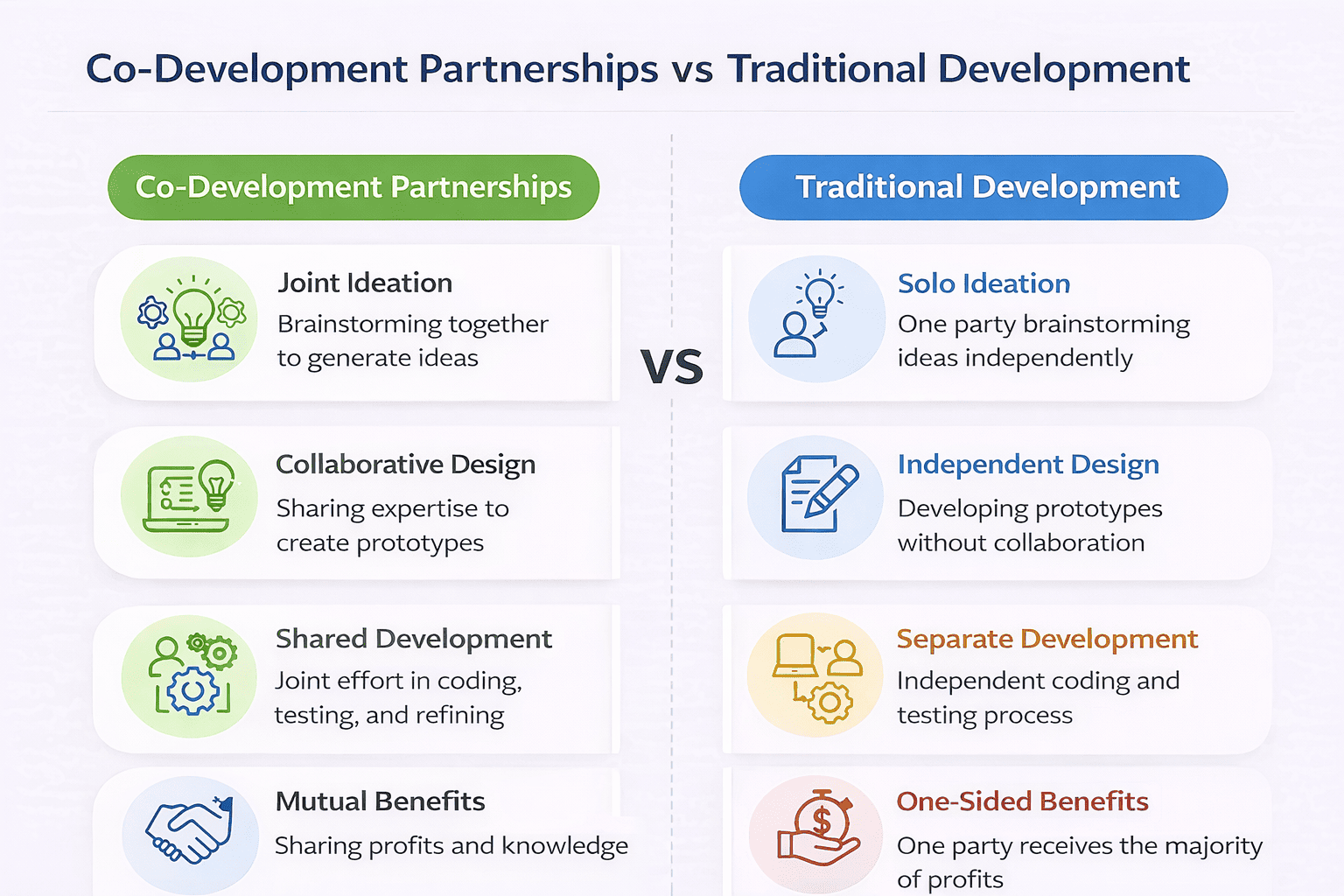
A co-development partnership is a strategic collaboration in which two or more organisations jointly develop a new product, technology, process, or service. Each party contributes specialised knowledge, capabilities, and resources, whether that is formulation expertise, clinical infrastructure, manufacturing technology, regulatory knowledge, or market access, and both parties share the costs, risks, and benefits of the development programme. The resulting innovation, and the rights to it, are governed by a formal co-development agreement that defines IP ownership, usage rights, and commercialisation terms.
The term “co-development” is used across industries from pharmaceuticals and chemicals to automotive components and software platforms. In each context, the core principle is the same: two parties who bring complementary strengths join forces to build something that neither could create as efficiently or effectively alone.
What distinguishes co-development from simpler outsourcing models is the equality of strategic contribution. Both parties have skin in the game, financially, technically, and operationally. This is not a client hiring a vendor. It is two specialists combining forces to create a joint outcome.
🤝
The Core Principle
Co-development works because specialisation is rarely symmetrical. A pharmaceutical company may have deep regulatory and clinical expertise but limited manufacturing scale. A CDMO may have cutting-edge processing technology but no access to novel drug candidates. Co-development brings these complementary strengths together under a shared objective, turning individual limitations into joint competitive advantage.
The Three Pillars of Any Co-Development Relationship
🔬
Shared Knowledge
Both parties contribute technical know-how, R&D data, and domain expertise that the other party either does not possess or would take years to develop independently.
💰
Shared Investment
Development costs, R&D, clinical trials, regulatory filings, prototyping, testing, are shared according to agreed terms, reducing the individual financial burden on each partner.
🏆
Shared Outcome
Both parties have defined rights to the resulting innovation, whether through joint IP ownership, licensing rights, market territory division, or revenue-sharing arrangements.
SECTION 2
Co-Development vs. Contract Manufacturing vs. Licensing
Co-development is frequently confused with other B2B partnership models, particularly contract manufacturing and technology licensing. The differences are fundamental and determine which model is appropriate for a given strategic objective.
⚡
The Key Distinction
Contract manufacturing produces something that already exists to a defined spec. Licensing transfers rights to something that already exists. Co-development creates something that does not yet exist, through the combined effort and expertise of both partners. It is the only model where both parties are genuinely building together.
Dimension
Co-Development
Contract Manufacturing
Technology Licensing
Starting Point
Neither party has the final product
Client has the product spec; manufacturer executes
Licensor already has the IP/technology
Nature of Collaboration
Joint creation and problem-solving
Transactional service delivery
IP transfer or usage rights grant
IP Ownership
Jointly created; governed by co-dev agreement
Client retains IP; manufacturer executes only
Licensor retains IP; licensee pays for usage rights
Risk Sharing
Both parties share development risk
Client bears most risk; manufacturer delivers to spec
Licensee bears commercialisation risk
Resource Contribution
Both parties contribute expertise, capital, and facilities
Manufacturer contributes production; client pays fee
Licensor provides IP; licensee provides capital and market access
Relationship Depth
Deep, long-term, interdependent
Transactional; can be arm’s-length
Contractual; degree of closeness varies
Best For
New product innovation, complex development programmes, market entry with shared expertise
Co-development is not a single arrangement, it encompasses a spectrum of collaboration models, each with different resource contributions, IP structures, and risk profiles. Choosing the right model depends on what each partner brings, what each seeks, and how the resulting innovation will be commercialised.
🔬 Full Joint Development
Both parties contribute equivalent R&D resources, co-own all resulting IP, and share commercialisation rights equally. The most symmetrical and interdependent model.
Equal investment and equal IP ownership
Requires highest alignment on goals and governance
Common in pharma biologics and advanced materials
Joint steering committee oversight is essential
🏭 Development + Supply Agreement
One partner leads development; the other commits to supplying the resulting product at commercial scale. Development cost is offset by a guaranteed supply relationship.
IP typically owned by the development-leading party
Supply partner receives preferred supplier status
Common in food ingredients and specialty chemicals
Reduces financial risk for the innovating party
🌍 Territory-Split Co-Development
Both parties co-develop a product, but commercialise it in different geographic territories, each taking exclusive rights to their respective markets.
Each party funds development costs proportionate to territory value
Eliminates internal competition between partners
Common in pharmaceuticals, agrochemicals, and medical devices
Requires clear territorial definitions and exclusivity terms
💊 CDMO Co-Development
A contract development and manufacturing organisation co-develops a product with an innovator company, typically in exchange for preferred manufacturing rights at commercialisation.
CDMO invests development resources; innovator provides IP seed
Innovator retains product IP; CDMO retains process IP
Dominant model in pharmaceutical and biologic sectors
A supplier proactively co-develops a new ingredient, component, or material with a customer, investing R&D resources in exchange for preferred supplier status and long-term supply agreements.
Supplier contributes formulation or material expertise
Customer contributes application knowledge and market pull
Common in food ingredients, chemicals, and automotive components
Early supplier integration improves product performance
🤖 Platform Co-Development
Two technology or software companies jointly develop a shared platform, with each party building proprietary applications or services on top of it for their respective markets.
Platform IP jointly owned; application IP separately owned
Each party commercialises independently to their customer base
Reduces duplicated infrastructure investment
Common in digital manufacturing, SaaS, and industrial IoT
SECTION 4
The Co-Development Process: Step by Step
Successful co-development does not happen organically, it follows a structured sequence from initial concept alignment through to commercial launch. Each stage requires specific governance mechanisms, legal protections, and milestone criteria.
01
Define the Innovation Objective & Technology Roadmap Alignment
Before any partner conversations begin, define exactly what you are trying to develop, target product specifications, performance requirements, intended market, regulatory pathway, and timeline. This innovation brief is the lens through which you will evaluate every potential partner. Technology roadmap alignment between partners is a prerequisite, not an afterthought.
02
Identify, Evaluate & Verify Potential Partners
Assess candidates for technical complementarity (do they have what you lack?), R&D capacity and infrastructure, regulatory expertise, cultural and strategic fit, and financial stability. This is where most co-development programmes stumble, using unverified directories or broker introductions exposes your innovation intent to unqualified or unverified counterparties. GTsetu’s government-identity-verified network solves this by ensuring every potential co-development partner has passed 6-point identity verification (Name, Address, Registration Number, Company Status, Company Type, Incorporation Date) before first contact. Note: GTsetu does NOT verify tax compliance, certifications, technical capabilities, or financial standing; these remain your responsibility.
03
Execute NDA & Declare Background IP
Before any technical information is shared, execute a robust non-disclosure agreement covering all information exchanged during the evaluation and development phases. Simultaneously, each party should formally declare their “background IP”, the pre-existing knowledge and IP they are bringing into the project, to prevent future disputes about what was jointly developed versus what was individually owned before the partnership began. Using a platform with built-in secure document exchange ensures this exchange is encrypted, auditable, and legally protected.
04
Negotiate & Execute the Co-Development Agreement
Define and formalise: the scope and objectives of the development programme, each party’s resource contributions (funding, personnel, equipment, facilities), milestone schedule and decision gates, cost-sharing mechanism, foreground IP ownership and usage rights, commercialisation rights and territory allocation, confidentiality obligations, governance structure (joint steering committee, working groups), and termination provisions. This agreement is the legal backbone of the entire partnership.
05
Execute the Development Programme with Active Governance
Run the joint development programme with regular joint steering committee reviews, clear milestone reporting, shared documentation repositories, and defined escalation procedures for technical disagreements. The governance infrastructure is not bureaucracy, it is what prevents small misalignments from becoming partnership-ending disputes. Parallel workstreams typically compress development timelines by 20–30% compared to sequential solo development.
06
Conduct Joint Regulatory & Quality Validation
For regulated industries (pharma, food, chemicals, medical devices), the co-development programme must include joint management of regulatory submissions, quality validation, and compliance documentation. Define clearly which party is the regulatory lead in which jurisdiction, and how regulatory costs and obligations are shared. This phase is where CDMOs and regulatory specialists in the partnership create the most value.
07
Transition to Commercialisation
Move the jointly developed product from development to market launch according to agreed commercialisation rights. This may involve separate market launches in different territories, a shared licensing arrangement, a manufacturing supply agreement, or a co-marketing approach depending on the model chosen. The transition point is when the value of the co-development investment begins to compound into commercial returns for both parties.
SECTION 5
Key Benefits of Co-Development Partnerships
The strategic rationale for co-development is compelling across a wide range of industries and company sizes. Here is why companies choose to co-develop rather than develop alone.
⚡
Faster Time to Market
Parallel development workstreams, where each partner works simultaneously on their area of expertise, compress development timelines by 20–30% compared to sequential solo programmes.
💰
Shared R&D Cost Burden
Splitting development investment allows each partner to pursue innovations that would be cost-prohibitive alone. Joint R&D funding can unlock development programmes with a value:cost ratio that would not be viable for either party independently.
🔬
Access to Complementary Expertise
Co-development brings in specialised technical knowledge, regulatory experience, or manufacturing technology that would take years and significant investment to build in-house, immediately and at a fraction of the cost.
🛡️
Distributed Risk
R&D risk, technical failure, regulatory rejection, market timing, is shared between partners. A failed development programme is painful; it is significantly less painful when the cost is split and learnings are shared.
🌍
Market Access Expansion
A co-development partner with established market presence in a target geography can provide immediate commercial access for the jointly developed product, collapsing the time and cost of market entry.
📈
Higher Innovation Quality
Products developed by two domain specialists outperform products developed by a generalist alone. Early supplier or partner integration consistently improves technical performance, manufacturing efficiency, and regulatory compliance of the final output.
🔗
Strategic Relationship Depth
Successful co-development creates a depth of relationship, shared investment, joint IP, mutual dependency, that is difficult to replicate through transactional partnerships and creates long-term competitive moats for both parties.
🧩
Portfolio Diversification
Co-development allows companies to build a broader innovation pipeline than would be possible with solo development, by running multiple co-development programmes with different partners simultaneously across different product categories.
20–30%
Faster development via parallel workstreams vs. sequential solo development
Co-development benchmark
40–60%
Reduction in individual R&D cost burden through shared investment
R&D partnership analysis
2×
Higher innovation success rate when early partner expertise is integrated
Joint product development research
77%
Of B2B companies cite accessing external specialist knowledge as the primary co-dev driver
Strategic partnership survey
SECTION 6
Challenges & Risks to Manage in Co-Development
Co-development’s intimacy, the shared technical knowledge, joint decision-making, and mutual IP exposure, also generates unique risks that purely transactional partnerships do not face. Understanding and mitigating these risks before the partnership begins is critical.
⚠️ IP Boundary Disputes
Without precise upfront definition of background IP (each party’s pre-existing knowledge) and foreground IP (jointly created), disputes about ownership of the resulting innovation are nearly inevitable.
Conduct formal background IP declaration before development begins
Define foreground IP ownership rules explicitly in the co-dev agreement
Use auditable document sharing to create a timestamped record of contributions
Register relevant IP in all target jurisdictions before disclosure
🎯 Goal and Priority Misalignment
Partners often enter co-development with different timelines, risk appetites, and commercialisation priorities. Undisclosed misalignment surfaces at the worst possible moment, mid-development, when exit costs are highest.
Conduct a strategic fit assessment before signing any agreement
Define joint KPIs and success criteria upfront
Establish a joint steering committee with decision-making authority
Include “go/no-go” decision gates at key milestones
🔐 Confidentiality Leakage
Sharing R&D data, formulations, and proprietary processes with a partner exposes sensitive technical information that, if leaked or misappropriated, can permanently damage competitive position.
Execute a robust NDA before any technical exchange begins
Limit information shared to what is strictly necessary per stage
Use encrypted document sharing with access controls and audit trails
Include post-termination confidentiality obligations
⚖️ Unequal Resource Contribution
In practice, one partner often ends up contributing more time, expertise, or capital than originally agreed. Without clear contribution tracking and rebalancing mechanisms, resentment accumulates and partnerships fracture.
Define each party’s resource commitments quantitatively in the agreement
Establish a joint project management office with shared visibility
Include contribution review checkpoints at each milestone
Define remediation procedures if commitments fall short
⚡ The Trust Foundation
Most co-development risks are dramatically reduced when you start with a government-identity-verified partner rather than an unverified introduction. A company whose legal registration, name, address, registration number, status, type, and incorporation date have been independently confirmed via government ties before first contact is a fundamentally safer starting point for co-development than one discovered through a cold directory or broker referral. GTsetu provides this 6-point government identity verification. However, GTsetu does NOT verify tax compliance, certifications, financial standing, or technical capabilities; these remain your responsibility to verify independently.
SECTION 7
IP Governance: The Critical Framework for Co-Development
Intellectual property governance is the single most important legal dimension of any co-development partnership. The intimacy of technical collaboration creates IP ambiguity that, without a carefully constructed framework, generates disputes that have destroyed otherwise successful partnerships. Here is how IP is correctly structured in a co-development context.
Background IP
Pre-Existing Knowledge
Each party’s IP that existed before the co-development partnership began. Background IP is owned solely by the party that created it and is contributed to, but not transferred into, the joint programme. Usage rights must be explicitly granted in the agreement.
Foreground IP
Jointly Created IP
New IP generated during the co-development programme, formulations, processes, data, discoveries. Ownership of foreground IP is the most contentious negotiation point: joint ownership, single-party ownership with cross-licensing, or division by application domain are all possible structures.
Sideground IP
Independently Created During the Programme
IP created by one party independently during the co-development period but not as part of the joint programme. Must be explicitly carved out of the foreground IP provisions to avoid unintended claims by the other party.
Usage Rights
Cross-Licensing Provisions
Even where IP is owned by one party, the other may require a licence to use it, to continue commercialising the jointly developed product, to service their customers, or to continue their own development programmes. Licence scope, exclusivity, territory, and duration must all be defined.
IP Governance Model
How It Works
Best Applied When
Risk
Joint Ownership (50/50)
Both parties co-own all foreground IP with equal rights to exploit independently
Equal contributions, similar commercialisation goals
Either party can licence to third parties without consent (in some jurisdictions)
Lead Party Ownership + Cross-Licence
One party owns the IP; grants the other a defined licence to use it
Asymmetric contributions; one party drives commercialisation
Licensor may restrict usage if relationship deteriorates
Domain-Split Ownership
Each party owns IP relevant to their domain (e.g., formulation vs. process)
Distinct technical contributions with clear domain boundaries
Boundary disputes when innovations overlap domains
Territory-Split Ownership
Each party owns and exploits the IP exclusively in their territory
Non-competing market geographies
Complexity if products cross territorial lines via third parties
Revenue-Sharing on Jointly Owned IP
Both parties own IP jointly but share revenues from commercialisation proportionally
Neither party can independently commercialise effectively
Requires ongoing financial governance and audit rights
✨ IP Protection in Practice
Before sharing any R&D data with a co-development candidate, execute your NDA and background IP declaration through a platform with an auditable, encrypted document trail. GTsetu’s built-in NDA workflow and encrypted document workspace ensures that every technical exchange is formally protected, timestamped, and access-controlled from the very first conversation, not retroactively after a breach has already occurred.
SECTION 8
Industries That Use Co-Development Most Extensively
Co-development partnerships are most common in industries where product innovation is technically complex, regulatory barriers are high, development costs are substantial, or time-to-market pressure is intense enough to make sharing development resources strategically rational.
Regulatory registrations tied to territory ownership
SECTION 9
What a Co-Development Agreement Must Include
The co-development agreement is the legal and operational document that determines whether a co-development partnership succeeds or becomes a costly dispute. A poorly drafted agreement is the single most common cause of co-development failure. Here is what every robust co-development agreement must cover.
1
Scope and Objectives of the Development Programme
A precise definition of what is being developed, the target product specifications, success criteria, regulatory pathway, and intended markets. Vague scope definitions are the root cause of most co-development misalignments, every ambiguity in scope becomes a dispute at the point where it matters most.
2
Background IP Declaration and Protection
Each party’s pre-existing IP that is being contributed to the programme must be formally declared, listed in an appendix, and explicitly protected from becoming part of the foreground IP pool. Failure to do this is the most common cause of IP ownership disputes in co-development.
3
Foreground IP Ownership and Usage Rights
Define precisely who will own IP created during the programme, including formulas, data, processes, and discoveries, and what usage rights each party will have. Specify whether joint ownership is granted, who can licence to third parties, and on what terms.
4
Resource Contributions and Cost-Sharing Mechanism
Quantify each party’s committed contributions, funding amounts, FTE allocations, facility access, equipment time, third-party service budgets, and define the cost-sharing mechanism (50/50 split, proportionate to revenue rights, milestone-linked tranches, etc.).
5
Development Milestone Schedule and Decision Gates
Define the project timeline with clear milestones, deliverables at each stage, and go/no-go decision gates where either party can reassess continuation based on objective technical or commercial criteria. Decision gates protect both parties from over-investing in a programme that has lost strategic rationale.
6
Governance Structure and Joint Steering Committee
Establish the governance framework: a joint steering committee with defined composition and authority, working group structures for each technical domain, decision-making procedures (consensus vs. designated lead), and escalation pathways for disputes that cannot be resolved at the working level.
7
Confidentiality and Non-Compete Obligations
Comprehensive NDA terms covering all technical information, R&D data, business strategies, and commercial plans exchanged during the programme. Include post-termination confidentiality duration, permitted disclosures, and non-compete clauses defining what each party cannot develop independently or with third parties using knowledge gained from the co-development relationship.
8
Commercialisation Rights and Revenue Sharing
Define how the resulting product will be commercialised: which party has rights in which territories or market segments, whether exclusive or non-exclusive, at what royalty or revenue-sharing rates, and for what duration. This section must anticipate scenarios where one party wishes to out-license, sell their rights, or change commercialisation strategy.
9
Termination and IP Reversion Provisions
Define termination triggers (unilateral, mutual, for cause, for convenience), notice periods, obligations on termination (return or destruction of data, cessation of use of shared IP), and IP reversion rules, who retains what rights to jointly developed IP if the partnership ends at different stages of the programme.
10
Governing Law, Jurisdiction, and Dispute Resolution
For international co-development partnerships, specify governing law, chosen jurisdiction, and dispute resolution mechanism. International arbitration (ICC, LCIA, SIAC) is strongly preferred over litigation for cross-border partnerships, it is faster, confidential, and more reliably enforceable across jurisdictions. Always have the agreement reviewed by legal counsel in both parties’ jurisdictions.
SECTION 10
How GTsetu Connects You with Government-Identity-Verified Co-Development Partners Globally
🌐 Platform Spotlight, GTsetu
The Verified B2B Network for International Co-Development & Manufacturing Partnerships
Finding the right co-development partner is harder than finding a supplier or distributor. The stakes are higher, you are sharing proprietary R&D knowledge, not just placing a purchase order. Unverified directories, broker introductions, and trade show encounters expose your innovation intent and technical secrets to parties you cannot independently verify.
GTsetu is built precisely for this level of partnership. Every company on the platform, including co-development partners, CDMOs, R&D service providers, and ingredient specialists, has passed 6-point government identity verification (Name, Address, Registration Number, Company Status, Company Type, Date of Certificate of Incorporation) before their profile is active. You can identify, evaluate, and connect with government-identity-verified co-development candidates across 35+ countries through anonymous discovery, then formalise the relationship through built-in NDA workflows and encrypted document exchange, without a broker sitting between you and your future innovation partner.
What GTsetu verifies (6 points via government ties): Company Name, Registered Address, Registration Number, Company Status, Company Type, Date of Certificate of Incorporation.
What GTsetu does NOT verify (your responsibility): Tax compliance, import/export licences, industry certifications, financial standing, technical capabilities, R&D infrastructure, or authority of representatives. GTsetu provides an encrypted workspace to request and review these documents securely.
✅
6-Point Government Identity Verification
Every co-development candidate verified on Name, Address, Registration Number, Company Status, Company Type, and Incorporation Date via government ties before being listed.
🕵️
Anonymous Discovery
Browse co-development partner profiles and evaluate technical capabilities without revealing your innovation intent until mutual interest is confirmed.
📄
Built-In NDA Workflow
Execute confidentiality agreements with a complete, timestamped audit trail before sharing any R&D data, formulations, or technical specifications.
🔐
Encrypted Document Sharing
Exchange technical briefs, R&D data, and development specifications through an encrypted workspace with full access controls and revocation rights. Request tax certificates, licences, and certifications from partners securely.
🚫
Zero Commission
GTsetu charges no success fee or commission on any co-development agreement concluded through the platform. Your deal economics belong entirely to you.
🌍
35+ Countries
Government-identity-verified partners across multiple regions, enabling co-development with verified counterparties worldwide.
GTsetu verifies six specific data points using government ties: Company Name, Registered Address, Registration Number, Company Status, Company Type, and Date of Certificate of Incorporation. GTsetu does NOT verify tax compliance, import/export licences, industry certifications, financial standing, technical capabilities, R&D infrastructure, or authority of representatives. These remain your responsibility to verify independently. GTsetu provides an encrypted workspace where you can request these documents from partners and review them securely, with full audit trail.
How the Co-Development Discovery Workflow Works on GTsetu
Stage
What Happens on GTsetu
IP Protection
1. Register & Verify
Submit business documents; GTsetu reviews 6-point identity via government ties and activates your profile, same standard applied to every partner you will later browse
Full anonymity during registration
2. Define Partnership Intent
Specify your co-development objective, technical domain, target geography, partner capability requirements, and partnership model preference
Intent remains anonymous at this stage
3. Browse Verified Partners
Anonymously review co-development partner profiles including self-reported capabilities and prior programme experience (note: technical capabilities are self-reported and not verified by GTsetu)
Your identity is not revealed
4. Signal Interest
Express interest; identity revealed only when the other party confirms mutual interest
Mutual consent before any disclosure
5. Execute NDA & Background IP Declaration
Formalise confidentiality and background IP boundaries within the platform before any R&D data is shared
Legal protections formally in place
6. Share Technical Brief & Evaluate Fit
Exchange development objectives, technical requirements, and collaboration terms through the encrypted workspace
Encrypted, access-controlled, auditable
7. Negotiate & Sign Co-Dev Agreement
Finalise the co-development agreement directly with your partner, zero commission, zero broker involvement. You remain responsible for verifying tax compliance, certifications, and financial standing independently
Full deal economics between partners only
SECTION 11
Red Flags When Evaluating Co-Development Partners
The depth of knowledge shared in a co-development partnership makes partner evaluation more consequential than in almost any other B2B relationship type. Recognise these warning signs before committing, and treat them as disqualifying unless there is a clear and verifiable explanation.
🚩
Pressure to Share Technical Data Before NDA
Any candidate who requests formulation details, R&D data, or process parameters before a formal NDA is executed should be immediately disqualified. This is the clearest signal of either naivety or predatory intent.
🚩
Reluctance to Declare Background IP
A co-development candidate that resists formal background IP declaration before the programme begins is setting up a future dispute about what was jointly created versus what they independently owned. This cannot be left to trust.
🚩
Unverified or Vague Technical Credentials
A candidate that cannot provide verifiable evidence of the specific technical capabilities they claim to bring to the partnership, equipment, certifications, prior programme results, is misrepresenting their contribution value. GTsetu does NOT verify technical capabilities; this is your responsibility.
🚩
No Clear Commercialisation Strategy
A co-development partner who has not thought through how the jointly developed product will reach market, and who benefits from what in the commercialisation phase, will create conflict at the most valuable moment of the partnership.
🚩
Financial Instability
A financially unstable co-development partner cannot sustain their resource commitments through a multi-year development programme. Their exit mid-programme may leave you holding the full cost with incomplete IP and no commercialisation path. GTsetu does NOT verify financial standing; this is your responsibility.
🚩
Active Conflicts of Interest
A co-development candidate with existing programmes for your direct competitors, particularly in the same product category, creates an unavoidable conflict of interest. Confidentiality obligations are very difficult to enforce in practice when a team is simultaneously working on competing programmes.
🚩
Misaligned Strategic Timelines
If your co-development candidate has a fundamentally different urgency or timeline for the programme, needing results in 6 months where you need 18, or vice versa, the partnership will experience constant friction at every milestone and decision gate.
🚩
No Governance Experience in Joint R&D
A candidate with no prior co-development programme experience may underestimate the governance demands, steering committees, shared documentation, milestone reviews, leading to chaos in project management and resentment about accountability.
SECTION 12
Related Partnership Models to Consider Alongside Co-Development
Co-development often coexists with or transitions into other partnership models as a product moves from R&D through to commercial scale-up and market distribution. Understanding the full ecosystem of options helps you structure the right partnership architecture for each stage.
Model
Key Characteristic
Relationship to Co-Development
GTsetu Resource
Co-Development
Joint creation of new products or technologies
This guide
This guide
Contract Manufacturing
Manufacturer produces to client’s specification using own materials
Typically follows co-development once the product spec is finalised
The most effective global manufacturers build a pipeline: co-development creates the innovation → contract manufacturing scales the production → distribution agreements deliver the product to new markets. GTsetu’s government-identity-verified network supports all three stages, explore the full supplier and partner collaboration platform here.
FAQ
Frequently Asked Questions
Q
What is a co-development partnership, and how does it differ from contract manufacturing?
A co-development partnership is a collaboration where two parties jointly create a new product, technology, or service that neither possesses at the outset. Both parties contribute specialised knowledge and resources, share development costs and risks, and jointly hold or divide rights to the resulting innovation. Contract manufacturing, by contrast, is a transactional arrangement where one party already has a finished product specification and commissions another to produce it. The manufacturer has no stake in the product’s innovation and receives a fee for production services only. Co-development creates something new; contract manufacturing replicates something that already exists.
Q
Who owns the IP in a co-development partnership?
IP ownership in a co-development partnership is entirely determined by the co-development agreement, there is no default rule that applies universally. Common structures include joint ownership of all foreground IP (newly created during the programme), lead-party ownership with a cross-licence granted to the contributing party, domain-split ownership (each party owns IP in their area of contribution), or territory-split ownership (each party owns and commercialises the IP in their respective markets). Background IP, each party’s pre-existing knowledge brought into the programme, must be formally declared and protected before the programme begins, as it remains individually owned regardless of subsequent developments.
Q
Which industries use co-development partnerships most?
Co-development is most prevalent in pharmaceuticals and biologics (where CDMO co-development with manufacturing rights is the dominant model), specialty chemicals and food ingredients (where supplier-led co-development for custom formulations is common), automotive components (OEM + Tier 1 supplier joint development), electronics and semiconductors (platform and chip-software co-development), agrochemicals (territory-split joint formulation development), and industrial machinery (systems integration co-development). The common thread is that specialised knowledge, high development costs, or regulatory complexity make joint development more efficient than solo R&D.
Q
What should a co-development agreement include?
A robust co-development agreement must include: a precise definition of the development scope and objectives, formal background IP declarations by each party, foreground IP ownership and cross-licensing provisions, quantified resource contribution commitments and cost-sharing mechanism, a milestone schedule with go/no-go decision gates, governance structure including a joint steering committee, comprehensive confidentiality and non-compete obligations, commercialisation rights and revenue-sharing terms, termination triggers and IP reversion provisions, and governing law with a defined dispute resolution mechanism. For cross-border agreements, also address export control compliance and jurisdiction-specific regulatory requirements.
Q
How do I protect my IP when entering a co-development partnership?
Protecting your IP in co-development requires a layered approach. First, formally declare your background IP (pre-existing knowledge) before the programme begins and ensure it is explicitly protected in the co-development agreement. Second, execute a comprehensive NDA before sharing any technical data with any candidate, using a platform with built-in, auditable NDA infrastructure like GTsetu ensures this protection is formalised and timestamped from the first conversation. Third, share R&D information through an encrypted document workspace with access controls so that you retain visibility and revocation rights over sensitive technical disclosures. Fourth, register relevant IP in your target jurisdictions before the co-development programme begins, registration before disclosure is significantly stronger protection than registration after.
Q
How is a co-development partnership different from a joint venture?
A joint venture involves two parties creating a new, jointly owned legal entity that develops, manufactures, or commercialises products independently of either parent. Co-development typically does not involve creating a new legal entity, the parties collaborate under a contractual framework while remaining separate organisations. Joint ventures involve deeper commitment, more complex governance, and more permanent capital deployment. Co-development is more flexible and reversible, making it appropriate for specific product programmes rather than broad, long-term market operations. Co-development sometimes evolves into a joint venture when the partnership’s scope and investment level justify creating a dedicated joint entity. See also: Joint Venture vs. Strategic Alliance.
Q
How do I find a co-development partner internationally?
Finding a co-development partner requires a platform that goes well beyond an unverified company directory. GTsetu connects innovators and manufacturers with government-identity-verified (6 points) co-development partners across 35+ countries, with verification of Name, Address, Registration Number, Company Status, Company Type, and Date of Certificate of Incorporation via government ties. The platform supports anonymous discovery (so you can evaluate co-development candidates without revealing your innovation intent), built-in NDA workflows (so confidentiality is formally in place before any R&D data is shared), and zero broker commissions on any agreement concluded. Note: GTsetu does NOT verify tax compliance, certifications, technical capabilities, or financial standing; these remain your responsibility to verify independently. Start by exploring GTsetu’s verified international partner network.
Q
What does GTsetu actually verify?
GTsetu verifies six specific data points using government ties: Company Name, Registered Address, Registration Number, Company Status (Active/Dissolved), Company Type (Ltd, Pvt Ltd, etc.), and Date of Certificate of Incorporation. GTsetu does NOT verify tax compliance, import/export licences, industry certifications, financial standing, technical capabilities, R&D infrastructure, or authority of representatives. Those remain your responsibility to verify independently. GTsetu provides an encrypted workspace where you can request these documents from partners and review them securely, with full audit trail.
Ready to Find Government-Identity-Verified Co-Development Partners Globally?
Join GTsetu’s verified network of manufacturers, innovators, and R&D specialists across 35+ countries. Browse government-identity-verified co-development partners anonymously, formalise with built-in NDAs, share technical data securely, and close agreements with zero broker commissions. Note: GTsetu verifies 6 identity points; tax compliance, certifications, technical capabilities, and financial standing remain your responsibility.
They represents the product, and research team behind GTsetu, a global B2B collaboration platform built to help companies explore cross-border partnerships with clarity and trust. The team focuses on simplifying early-stage international business discovery by combining structured company profiles, verification-led access, and controlled collaboration workflows.
With a strong emphasis on trust, and disciplined engagement, Team GTsetu shares insights on global trade, partnerships, and cross-border collaboration, helping businesses make informed decisions before entering deeper commercial discussions.