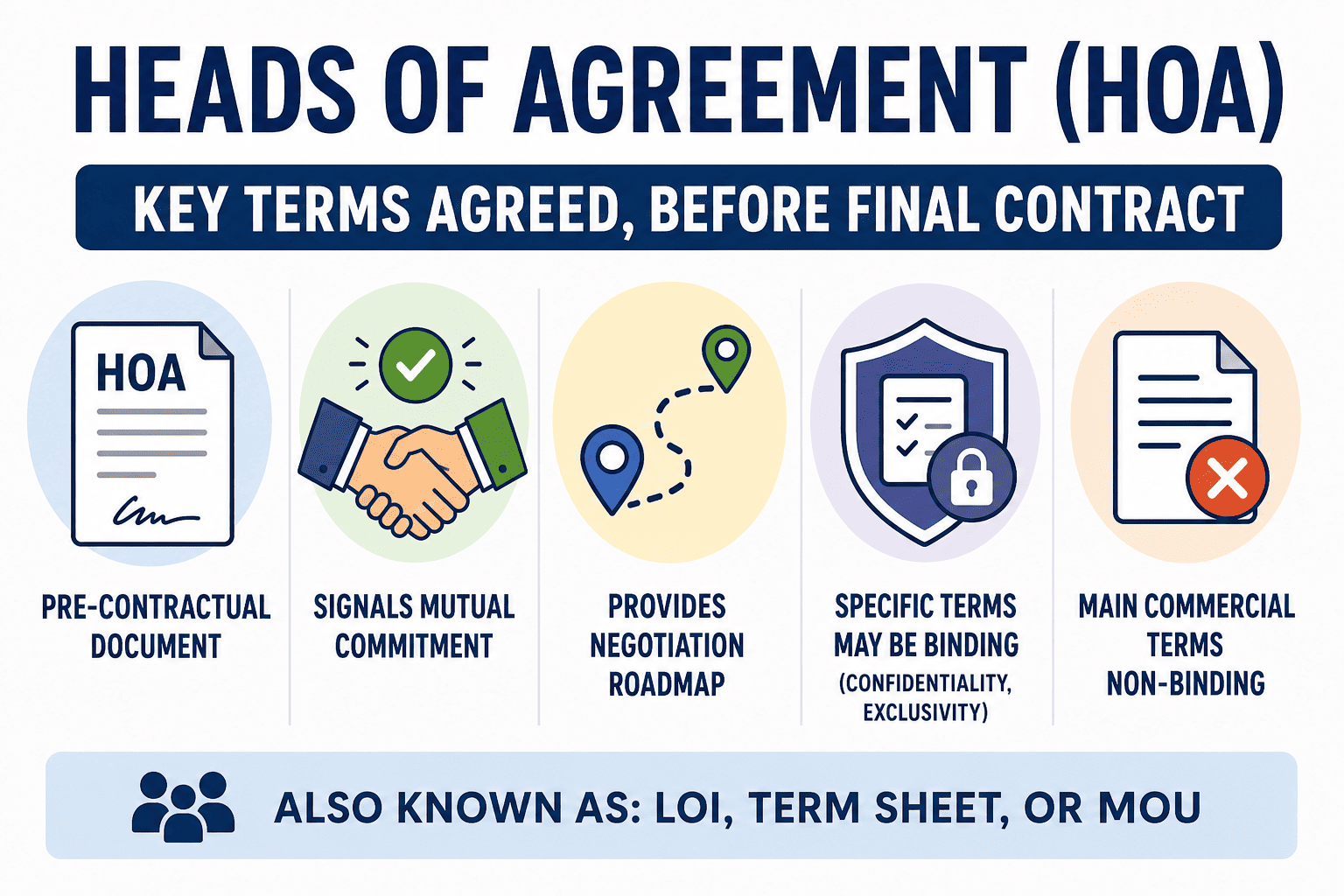
Why Use Heads of Agreement in Commercial Deals?
In any substantial transaction – whether a business sale, joint venture, or complex supply agreement – the parties face a dilemma: they need to invest time and money in due diligence and legal drafting, but they first want confidence that the other side is genuinely aligned on the core commercial points. A Heads of Agreement solves this by creating a provisional blueprint.
It forces both sides to focus on the key economic and structural terms before getting lost in legal detail. It also allows sellers to lock in favourable terms before due diligence reveals issues, while buyers gain a protected window (via binding exclusivity) to investigate without fear of being used as a stalking horse. Regulatory bodies, lenders, or shareholders can also be shown the HOA to demonstrate progress and seek clearances early.
⚡ Strategic Function
An HOA is not a mere ‘agreement to agree’. It is a tool to manage risk, allocate negotiation leverage, and signal seriousness. The binding parts protect your position; the non‑binding parts preserve flexibility. Clarity on which is which is everything.
Pros & Cons
Advantages and Disadvantages of Using an HOA
✅ Pros / Advantages
- Alignment early: Both parties, advisers and stakeholders understand the framework before major costs are incurred.
- Focuses negotiations: Keeps discussions on key commercial points, avoiding distraction by minor details.
- Secures commitment: Binding confidentiality and exclusivity clauses protect sensitive information and negotiation investment.
- Regulatory facilitation: Can be shown to competition authorities, ASX, FIRB, or lenders to seek clearances or approvals.
- Seller’s tactical edge: Key terms can be agreed before due diligence might reveal points the buyer would otherwise use to chip price.
- Speed and goodwill: A signed HOA generates momentum and demonstrates mutual intent.
⚠️ Cons / Disadvantages
- Time & cost: Drafting an HOA adds an extra layer of work and legal fees if the transaction is simple.
- False certainty: Parties may mistakenly treat the HOA as the final deal and stop negotiating commercially.
- Limited flexibility: If too much is binding, you lose the ability to adapt as due diligence reveals new facts.
- Buyer’s risk: Agreeing price before full due diligence can lock a buyer into an overvalued deal (seller’s advantage).
- Competition law risk: Certain pre‑agreements may breach antitrust rules without proper clearance.
- Unintended binding effect: Poorly drafted HOAs can be held enforceable by courts, even if labelled ‘non‑binding’.
Binding vs Non-Binding
Binding vs Non-Binding: What an HOA Actually Commits You To
An HOA is a flexible instrument. It can be entirely non‑binding, entirely binding, or (most commonly) a hybrid. The critical rule: the document must clearly state which clauses are intended to be legally enforceable. Silence creates ambiguity, and courts may look at the parties’ conduct to infer intent.
✅ Typically Binding Clauses
- Confidentiality / NDA – protects information exchanged during negotiations.
- Exclusivity / no‑shop clause – prevents seller from negotiating with others for a defined period.
- No‑poaching of employees – critical when employee information is shared early.
- Break fees / cost liability – if one party pulls out in bad faith.
- Governing law and jurisdiction – specifies which courts and law apply to binding parts.
- Intellectual property ownership – if collaboration or pre‑disclosure is involved.
⚠️ Typically Non-Binding Clauses
- Price and payment method – indicative, subject to due diligence and final contract.
- Commercial terms – volume, delivery, specifications, warranties (level of detail).
- Conditions precedent (e.g. regulatory approvals) – usually expressed as targets, not binding promises.
- Timeline and milestones – aspirational, unless explicitly made binding.
- “Best efforts” / “good faith” negotiation clauses – often too vague to enforce, but can create obligations if detailed.
- Structure of the deal – subject to change during drafting.
✨ Practical Guidance
Always include an “entire agreement” clause in the final contract that expressly supersedes the HOA. This avoids the risk that terms from the HOA (even non‑binding ones) are later argued to be collateral contracts. For the HOA itself, use clear headings like “Binding provisions” and “Non‑binding provisions”.
Key Content & Negotiation
What to Include and How to Negotiate an HOA
The content will vary by transaction type, but a robust HOA typically answers these core questions:
- Transaction description: What exactly is being bought, sold, or partnered on?
- Price and payment: Amount, form (cash, shares, earn‑out), and any price adjustment mechanism.
- Conditions precedent: Shareholder approvals, regulatory clearances (ACCC, FIRB, ASX), third-party consents.
- Timeline: Target dates for due diligence, signing of final agreement, and closing.
- Key warranties/indemnities: Not the full list, but the level of protection (e.g., “full business warranties”).
- Binding provisions: Expressly list confidentiality, exclusivity, costs, governing law.
- Further negotiation obligation: Often a “best efforts” or “good faith” clause – but be specific (timetable, negotiators) if you want it enforceable.
- Expiry date: Prevents indefinite limbo.
Negotiation Tips – From the Sources
💼
Be commercial, not just legal
Focus on business-critical terms (price, timeline, exclusivity). Save the boilerplate for the main contract. The HOA is a commercial alignment tool, not a final legal document.
🔒
Protect yourself before disclosing
Ensure the confidentiality clause is binding before sharing sensitive data – pricing, customer lists, or proprietary processes.
⚖️
Decide binding intent early
If you want flexibility, make commercial terms non‑binding but keep exclusivity/confidentiality binding. If you need certainty (e.g., for a lender), consider a fully binding HOA with clear conditions.
📅
Include a “sunset” clause
Without a deadline, the other party can delay negotiations indefinitely while you remain locked out of other opportunities.
📝
Use clear language and examples
Avoid vague statements. If a term is complex, add a brief example to illustrate intent – this helps avoid future disputes.
HOA vs MoU vs Term Sheet
Heads of Agreement vs MoU vs Term Sheet
While often used interchangeably, these documents have subtle differences in tone and typical application. The table below summarises the distinctions drawn from legal practice.
| Dimension |
Heads of Agreement (HOA) |
Memorandum of Understanding (MoU) |
Term Sheet |
| Primary Use |
Commercial transactions: business/asset sales, joint ventures, complex supply deals |
Institutional/government partnerships, international MOUs, early research collaboration |
Investment / financing: venture capital, private equity, loan terms |
| Tone & Detail |
Deal‑oriented, specific about commercial terms |
Relationship‑oriented, broader principles |
Highly structured, finance‑focused (valuation, liquidation preferences, governance) |
| Binding Status |
Hybrid: commercial terms non‑binding; confidentiality/exclusivity binding |
Usually non‑binding, but can have binding parts (e.g., dispute resolution) |
Typically non‑binding on economics; binding on confidentiality and exclusivity |
| Typical Length |
2–5 pages |
3–8 pages |
4–15 pages (detailed term sheets) |
| Leads To |
Share/asset purchase agreement, joint venture agreement |
Partnership deed, formal collaboration agreement |
Investment agreement, shareholders’ agreement |
Frequently Asked Questions
Frequently Asked Questions
Q
Is a Heads of Agreement legally binding?
It depends on the drafting and the parties’ intention. Most HOAs are intentionally partly binding: commercial terms (price, structure) are non‑binding, while protective provisions (confidentiality, exclusivity, governing law) are binding. If the document is silent, a court may infer intent from conduct. Always specify binding/non‑binding status clause‑by‑clause.
Q
When should we use a Heads of Agreement?
Use an HOA after initial discussions show alignment, but before committing significant legal/due diligence resources. It is ideal for medium to high‑value transactions where both sides want to test key terms and secure a protected negotiation window. For very simple deals, an HOA may be unnecessary overhead.
Q
Can a Heads of Agreement create tax or regulatory issues?
Yes. If binding provisions trigger a transfer of assets or rights, it could create stamp duty or capital gains tax liabilities prematurely. Also, competition law (e.g., ACCC in Australia) may require clearance for certain pre‑agreements. Always take tax and antitrust advice before signing.
Q
What happens after the HOA is signed?
The parties conduct due diligence (if not already done), negotiate the detailed final contract based on the HOA framework, and work towards satisfying any conditions precedent (regulatory approvals, etc.). The HOA’s binding clauses (like exclusivity) continue until replaced by the final agreement or expiry.
Q
Is a “best efforts” clause in an HOA enforceable?
Possibly, if it is specific enough. A vague “negotiate in good faith” is often unenforceable as an “agreement to agree”. However, if it includes concrete obligations – e.g., a timetable, named negotiators, specific actions – a court may enforce it. Best to treat it as a signal of intent rather than a guarantee.