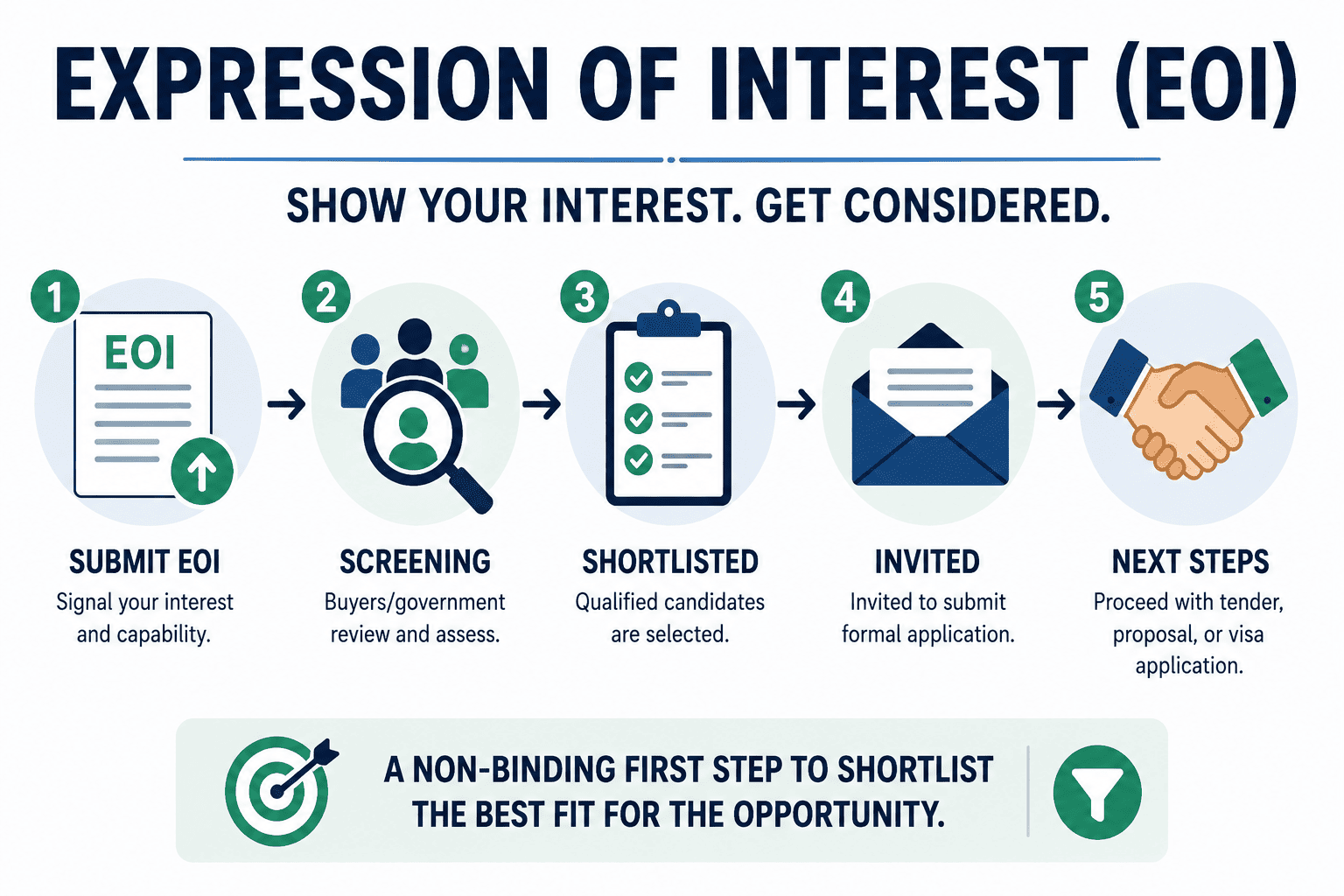
Why Is an EOI Used in Business and Immigration?
An EOI appears at the earliest formal stage of a selection process. Whether in public procurement, skilled migration, or partnership sourcing, its core purpose is efficient filtering. For a government buyer, an EOI reveals how many suppliers are capable and interested, informing whether to proceed with a full tender. For an immigration authority (like Australia’s SkillSelect), it ranks candidates by points to issue invitations only to the highest-scoring applicants.
For businesses, an EOI is a low-cost way to test the waters. It avoids the expense of a full proposal until you know the buyer is serious and you have a realistic chance. It also forces you to concisely present your core qualifications. In migration systems, submitting an EOI is mandatory to enter the pool from which invitations are drawn, it is not the visa application itself, but the essential first step.
⚡ Key Principle
An EOI is not a bid, an offer, or a contract. It is a statement of interest backed by evidence of capability. Its success depends on how well you align your profile with the selector’s criteria, whether that’s a points test or a tender evaluation matrix.
Two Faces of EOI
EOI in Procurement vs. Skilled Migration
The term “EOI” is used in two very different contexts. Understanding which one you are dealing with is essential.
📦 PROCUREMENT / TENDER EOI
- Purpose: Shortlist suppliers before a full RFP.
- Format: Company profile, relevant experience, capacity, certifications.
- Outcome: Invitation to submit a full tender or proposal.
- Binding? No – but may require a separate NDA for confidential data.
- Example: “Click to express interest” on a government portal, or a 5-page capability statement.
🌏 IMMIGRATION (SKILLSELECT) EOI
- Purpose: Enter a pool of candidates for skilled visas.
- Format: Online form with personal details, occupation, work history, points claimed.
- Outcome: Invitation to apply for a visa (if ranked high enough).
- Binding? No – but providing false information can lead to a ban.
- Example: Australia Subclass 189, 190; Canada’s Express Entry (profile).
✨ Practical Tip
If you are responding to a procurement EOI, treat it as a mini-proposal: be concise, evidence-based, and strictly follow the requested format. If you are submitting an immigration EOI, double-check your points score, an invitation is not guaranteed even if you meet the minimum.
EOI vs RFP vs Tender
EOI vs RFP vs Invitation to Tender
These terms describe different stages of a sourcing process. An EOI is always the earliest stage.
| Dimension |
Expression of Interest (EOI) |
Request for Proposal (RFP) |
Invitation to Tender (ITT) |
| Stage |
Preliminary / market sounding |
Detailed solution stage (shortlisted suppliers) |
Final pricing and formal offer |
| Content |
Capability, experience, interest |
Methodology, approach, team, draft pricing |
Fixed price, detailed commercial terms, binding offer |
| Binding Nature |
Non-binding (indicates interest) |
Usually non-binding commercially |
Typically binding if accepted |
| Audience |
Open to all interested parties |
Shortlisted suppliers only |
Shortlisted bidders (often 3–5) |
| Outcome |
Shortlist for RFP/ITT |
Down-selection to preferred bidder |
Contract award |
Critical Steps
How to Prepare a Compelling EOI
Whether you are bidding for a contract or submitting a migration EOI, these steps increase your chances of progressing.
1️⃣
Analyse the Selection Criteria
For procurement: address each criterion explicitly. For migration: ensure your points claim is accurate and verifiable. Use keywords from the original request.
2️⃣
Provide Evidence, Not Just Claims
Include brief case studies, certifications, and financial statements if requested. In migration, have your skills assessment and English test results ready.
3️⃣
Respect Formatting & Deadlines
Follow page limits, file type instructions, and submit before the deadline. Late EOIs are usually rejected without review.
4️⃣
Be Concise but Impactful
Use bullet points, tables, and clear headings. Highlight your unique differentiators – what makes you the ideal candidate.
5️⃣
Plan for the Next Stage
An EOI that leads to an RFP or visa invitation is just the beginning. Start preparing your full proposal or application documents early.
EOI Workflow
Typical EOI Process Flow
01
Opportunity Announcement
A buyer (or immigration authority) publishes an EOI call with scope, criteria, and deadlines. In procurement, this may be on a portal like Find a Tender.
02
EOI Submission
Interested parties submit their response by the deadline. This may be a simple registration click or a structured document.
03
Evaluation & Shortlisting
The buyer assesses EOIs against published criteria to create a shortlist of qualified suppliers. In migration, this is an automatic points-based ranking.
04
Invitation to Next Stage
Shortlisted suppliers receive an RFP or ITT. Migration candidates receive an invitation to apply for the visa (valid for 60 days in Australia).
05
Full Application / Bid
Detailed proposal, pricing, and supporting documents are submitted. For migration, this is the point where you pay fees and provide all evidence.
FAQ
Frequently Asked Questions
Q
Is an Expression of Interest legally binding?
In the vast majority of cases—whether in procurement, migration, or partnerships—an EOI is non-binding. Its purpose is to indicate interest and demonstrate capability, not to create a contractual obligation. However, any confidential information shared during the EOI stage should be covered by a separate binding Non-Disclosure Agreement (NDA).
Q
What is the difference between an EOI and an RFP?
An EOI is an early, high-level document used to gauge interest and shortlist qualified suppliers or candidates. A Request for Proposal (RFP) is a detailed follow-up document that asks shortlisted parties for a comprehensive solution, including methodology, pricing, and formal terms. An EOI asks “Who are you and can you do this?”; an RFP asks “Exactly how will you do it and at what cost?”.
Q
When should an EOI be submitted?
An EOI should be submitted strictly by the deadline specified in the invitation. For procurement, this is often a hard cut-off. For immigration systems like Australia’s SkillSelect, an EOI can be submitted at any time, but its “points score” determines if and when you receive an invitation to apply formally.