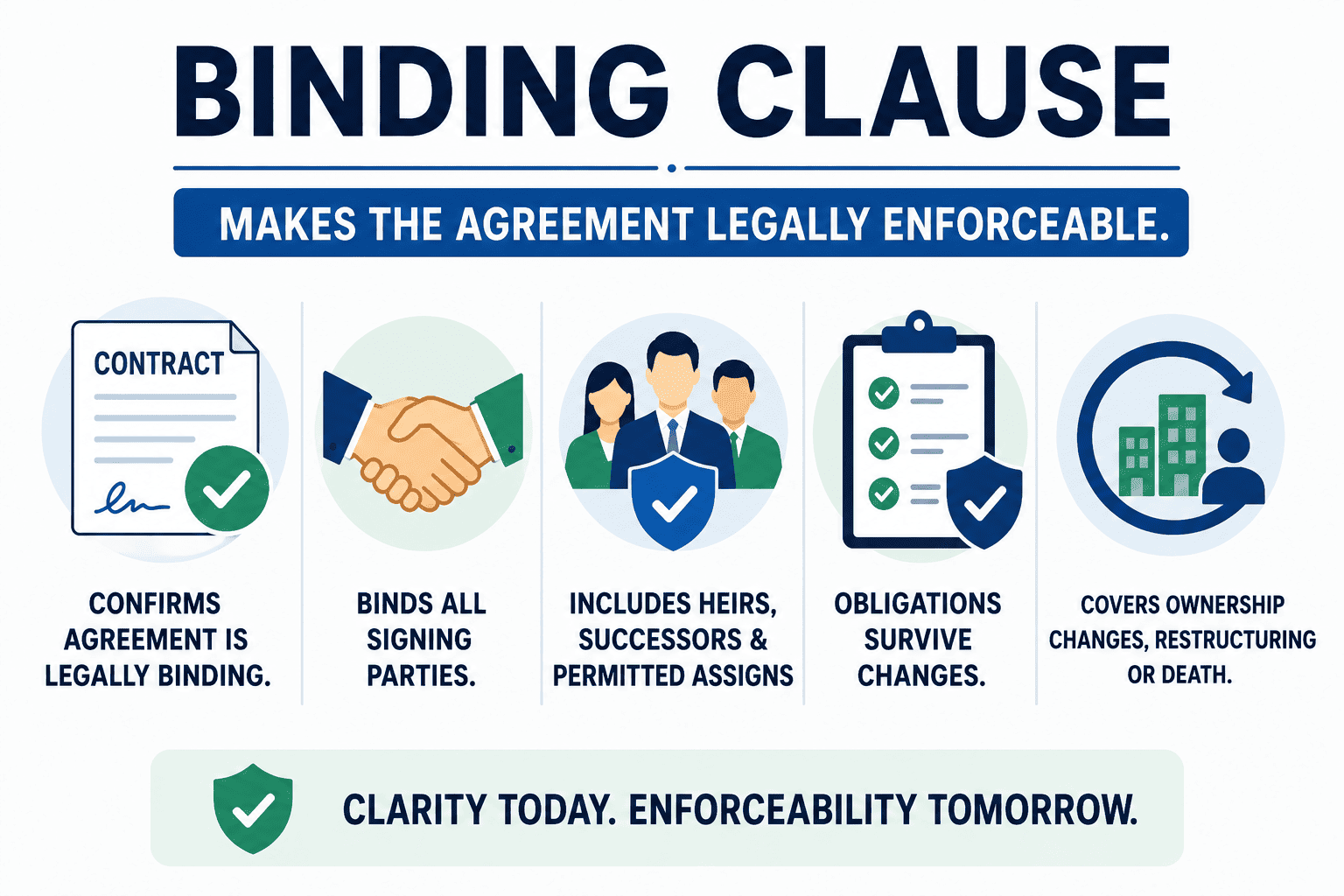
A Binding Clause (or Binding Effect Clause) is a contractual provision that confirms the agreement is legally enforceable. It typically states that the contract is binding not only on the signing parties but also on their heirs, successors, and permitted assigns. This clause eliminates ambiguity about whether the obligations survive a change in ownership, corporate restructuring, or death.
In cross-border trade, parties change: companies are acquired, restructured, or dissolve; key individuals retire or pass away. Without an explicit binding clause, a successor might argue they are not obligated by a contract signed by their predecessor. The binding clause preempts that argument. It ensures the agreement runs with the business and binds anyone who lawfully steps into the shoes of a party.
The clause is particularly critical in long-term supply agreements, distribution partnerships, manufacturing joint ventures, and any contract where performance extends over years. It also appears in preliminary documents: a binding clause in a Letter of Intent (LOI) can make confidentiality and exclusivity provisions enforceable even if the commercial terms are non-binding.
While many legal systems (like the U.S. and UK) imply that contracts bind successors unless stated otherwise, civil law jurisdictions may require explicit language. Always include a binding clause when contracting across different legal traditions.
A binding clause is not a magic wand — it only makes the contract enforceable as written. Its effect depends on the rest of the agreement and the surrounding circumstances.
Based on the reference sources (Law Insider, fynk, CoBrief, UpCounsel), here are ready-to-use templates for various scenarios.
| Scenario / Focus | Sample Wording |
|---|---|
| Standard / All-Purpose | “This Agreement shall be binding upon and inure to the benefit of the parties hereto and their respective heirs, legal representatives, successors, and permitted assigns.” |
| With Governing Law | “This Agreement is a legally binding contract governed by the laws of [Singapore]. The parties submit to the exclusive jurisdiction of its courts.” |
| Irrevocability | “Upon execution, this Agreement is binding and irrevocable. No party may cancel or amend it except by a written instrument signed by all parties.” |
| Mutual Consent Required for Amendment | “This binding Agreement may only be modified by mutual written consent of the parties, and any such modification shall be binding on their successors.” |
| Confidentiality Binding on Successors | “The confidentiality obligations in Section [X] shall be binding on the parties and their successors, assigns, and any acquiring entity in a merger.” |
| No Waiver | “No waiver of any term shall be binding unless in writing and signed by the waiving party, and shall not affect the binding nature of the rest of the Agreement.” |
| Assignment Prohibition + Binding | “Neither party may assign this Agreement without consent, but if consent is given, this Agreement shall be binding on the assignee.” |
| Third-Party Beneficiaries | “This Agreement is binding on the parties and their successors, and is enforceable by the third-party beneficiaries identified in Schedule A.” |
| Binding Arbitration Clause | “Any dispute arising under this binding Agreement shall be resolved by binding arbitration in [Geneva] under the ICC Rules.” |
| Binding Effect After Termination | “Termination of this Agreement shall not relieve the parties of obligations that expressly or by their nature survive, and this clause shall remain binding.” |
| Binding on Heirs (Individual/Partnership) | “This Agreement shall be binding upon the parties and their respective heirs, executors, administrators, and successors in interest.” |
| Binding Preliminary Agreement (LOI) | “The parties intend to be legally bound by the confidentiality, exclusivity, and governing law provisions of this Letter of Intent.” |
| Binding Effect with Merger Clause | “This Agreement constitutes the entire binding agreement and supersedes all prior negotiations. It shall be binding on the parties and their successors.” |
| Binding on Affiliates | “This Agreement shall be binding on the parties and their respective affiliates, subsidiaries, and related entities to the extent they perform obligations.” |
| Binding in Counterparts | “This Agreement may be executed in counterparts, each of which shall be deemed an original and all of which together shall be one binding instrument.” |
| Binding with Conditions Precedent | “This Agreement shall become binding only upon satisfaction of the conditions precedent listed in Exhibit A, after which it binds the parties and their successors.” |
| Binding Effect in a Binding Advice Clause | “All disputes shall be finally resolved by binding advice in accordance with the [NAI] Binding Advice Rules, and such advice shall be binding on the parties.” |
| Binding Indemnification | “The indemnification obligations in Section [Y] shall be binding on the parties and shall survive any transfer of assets or change of control.” |
| Binding with Specific Performance | “The parties agree that this Agreement is binding and that a breach may be remedied by specific performance, in addition to other remedies.” |
| Binding on Receivers and Trustees | “This Agreement shall be binding on any receiver, trustee, or administrator appointed over the assets of a party.” |
| Binding Non-Circumvention | “The non-circumvention obligations are binding and extend to the parties’ related parties, agents, and successors.” |
| Binding with Joint and Several Liability | “If more than one party is named, their obligations are joint and several, and this Agreement binds them and their successors jointly and severally.” |
Don’t bury the binding clause. Place it early (often Section 1 or 2) and use precise terms: “heirs, successors, and permitted assigns” is the gold standard. If you need it to bind affiliates, say so explicitly.
While many courts imply binding on successors, some jurisdictions require explicit language. In cross-border deals, never rely on implication — include the clause.
If you omit “assigns,” a court might find that an assignee (who didn’t sign) is not bound. Always include “successors and permitted assigns.”
A binding clause that says “binds assigns” but an assignment clause that prohibits assignment creates confusion. Align them.
Preliminary documents without a clear binding clause risk that confidentiality or exclusivity will be unenforceable. Reference the LOI page.
If a party is an individual or partnership, add “heirs, executors, administrators” to cover death or incapacity.
| Clause Type | Function | Typical Location |
|---|---|---|
| Binding Clause | Identifies who is obligated (parties + successors/assigns). | Early in the contract (Section 1 or 2). |
| Assignment Clause | Controls whether rights can be transferred to a third party. | Usually mid-to-late (Boilerplate). |
| Entire Agreement (Merger) Clause | Confirms the written contract is the complete and final agreement. | Boilerplate (often near the end). |
| Governing Law / Jurisdiction | Specifies which law applies and where disputes are resolved. | Boilerplate. |
| Binding Advice Clause (Arbitration-like) | Commits parties to accept a third party’s decision as final. | Dispute resolution section. |

Team GTsetu represents the product, compliance, and research team behind GTsetu, a global B2B collaboration platform built to help companies explore cross-border partnerships with clarity and trust. The team focuses on simplifying early-stage international business discovery by combining structured company profiles, verification-led access, and controlled collaboration workflows.
With a strong emphasis on trust, compliance, and disciplined engagement, Team GTsetu shares insights on global trade, partnerships, and cross-border collaboration, helping businesses make informed decisions before entering deeper commercial discussions.