Technology Transfer Agreements: The Complete Guide for Manufacturers & Global Trade Partners
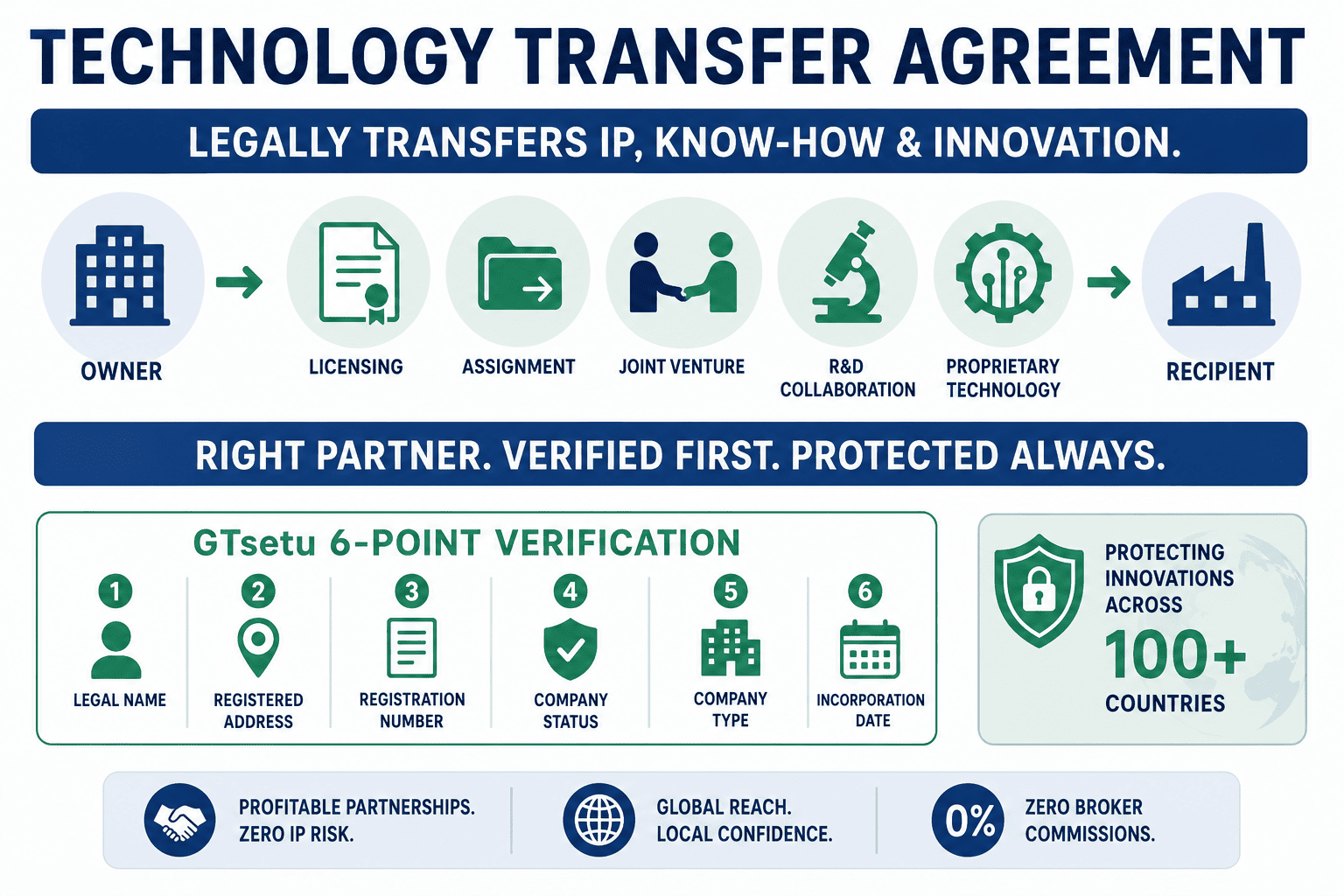
Direct Answer: A technology transfer agreement is a legal contract that governs the transfer of intellectual property rights, technical know-how, proprietary processes, or patented innovations from one party to another, whether through licensing, assignment, joint venture, or R&D collaboration. For manufacturers and international trade partners, structuring technology transfer correctly is the difference between a profitable partnership and an IP catastrophe. GTsetu‘s government‑tie‑up verification platform (6 points: legal name, registered address, registration number, company status, company type, incorporation date) ensures every manufacturing and distribution partner has been verified before any technology discussion begins, protecting your innovations across 100+ countries with zero broker commissions.
📅 March 1, 2026⏱ 22 min read✍️ GTsetu Editorial Team🔄 Updated regularly
7
Agreement Types Covered
100+
Countries Covered
500+
Verified Trade Partners
0%
Broker Commission
Technology is the defining competitive asset of modern manufacturing. Whether you have developed a proprietary formulation, a precision manufacturing process, a software system, or a patented product design, the way you transfer that technology to partners, and the legal framework you use to protect it, determines whether you build a profitable global business or inadvertently hand your competitive advantage to a competitor.
This guide covers everything manufacturers, distributors, and trade partners need to know about technology transfer agreements, from the seven core agreement types and their critical clauses, to IP protection strategies, cross-border considerations, red flags, and how GTsetu‘s verified B2B platform creates the trust foundation that technology transfer partnerships require.
💡 Who Is This Guide For?
Written for manufacturers seeking to commercialise their technology through licensing, contract manufacturing, or joint ventures; for distributors evaluating manufacturing partnerships that involve technical knowledge sharing; and for any B2B trade partner navigating agreements where intellectual property is a central concern. Related reading: Licensing vs. Distribution Agreements and What Is Contract Manufacturing.
SECTION 1
1 What Is a Technology Transfer Agreement?
🎯 Definition
A technology transfer agreement is a legal contract that governs the transfer of intellectual property rights, technical knowledge, proprietary processes, or patented innovations from one party (the transferor or licensor) to another (the transferee or licensee). It defines exactly what technology is being transferred, the scope of rights granted (exclusivity, territory, field of use), payment structure (fees, royalties, milestones), IP ownership and improvement rights, confidentiality obligations, and dispute resolution mechanisms. In international manufacturing and trade, technology transfer agreements are the legal backbone of contract manufacturing, OEM/ODM arrangements, co-development partnerships, and technology licensing deals.
The term “technology transfer” encompasses a wide spectrum of transactions, from a multinational corporation licensing patented pharmaceutical processes to a contract manufacturer in India, to a startup sharing its proprietary manufacturing algorithm with an OEM partner in Vietnam. What they share in common is the need for a carefully structured legal agreement that protects the IP owner while enabling the recipient to effectively use the transferred technology.
Formal vs. Informal Technology Transfer
Transfer Mode
Description
Legal Protection
Common Context
Formal (Contractual)
Technology transferred under a written agreement with defined rights, obligations, and IP protections
Technology disseminated through researcher mobility, publications, conferences, or reverse engineering
Weak, no contractual protections
Academic settings, public domain technologies
⚡ The Manufacturing Imperative
In B2B manufacturing contexts, every technology disclosure, even preliminary technical discussions, should be preceded by a signed NDA and, where substantive know-how will be shared, a full technology transfer agreement. Informal technology disclosure without contractual protection is one of the most common causes of IP loss in international manufacturing partnerships.
SECTION 2
2 Types of Technology Transfer Agreements
Technology transfer can be structured in multiple ways depending on the nature of the technology, the relationship between the parties, the commercial objectives, and the level of control the technology owner wishes to retain. The seven core agreement types below cover the full spectrum of technology transfer structures encountered in international manufacturing and trade.
Most Common
Patent Licensing Agreement
Grants the licensee the right to use, make, sell, or import a patented invention without transferring ownership of the patent. Can be exclusive (only one licensee), non-exclusive (multiple licensees), or sole (one licensee but licensor retains rights). Royalty payments are typically tied to net sales or units produced. Fundamental to technology commercialisation in pharmaceuticals, electronics, and advanced manufacturing.
Most Common
Know-How / Trade Secret Agreement
Transfers proprietary technical knowledge, processes, formulations, or methodologies that are not formally patented. Because know-how cannot be registered, protection relies entirely on the contractual confidentiality framework. Particularly important in food & beverage manufacturing, chemical processes, and specialist materials where the competitive advantage lies in process knowledge rather than patentable innovations.
IP Transfer
Technology Assignment Agreement
Transfers full ownership of the intellectual property to the recipient, the assignor permanently gives up all rights. Unlike licensing, assignment is irrevocable unless the agreement provides otherwise. Used in M&A transactions, spin-offs, and situations where the technology owner no longer requires the IP but wants to monetise it. Requires careful consideration of post-assignment obligations and warranties regarding IP validity.
Collaborative
Joint Venture Agreement (Technology Component)
Two or more parties create a new entity or collaboration framework that includes the contribution of technology by one or more parties. IP ownership of contributed technology, jointly developed improvements, and independently developed IP must all be clearly defined. See our guide on joint venture vs. strategic alliance for a detailed comparison. The technology provisions are often the most complex and contentious part of JVA negotiations.
Collaborative
R&D Collaboration Agreement
Governs joint research and development between two parties, with defined provisions on ownership of IP arising from the collaboration (foreground IP), each party’s pre-existing IP (background IP), access rights, publication rights, and commercialisation arrangements. Relevant in co-development partnerships between manufacturers and technology companies or research institutions. Foreground IP ownership is typically the most negotiated element.
Systems Transfer
Franchise Agreement
Transfers a complete operational system including brand, technology, processes, training, and ongoing support. While primarily associated with retail and food service, franchise models in international trade are also used in manufacturing and distribution to enable rapid market expansion while maintaining quality control over the transferred operational technology and systems.
Support Only
Technical Assistance Agreement
Provides training, consulting, and operational support related to a technology without fully transferring IP rights. The recipient gains the capability to operate the technology but does not own it and may have limited rights to adapt it. Often used as a precursor to or complement of a full licensing agreement, particularly in capital equipment and industrial plant transfers.
💡 Combining Agreement Types
Most sophisticated technology transfer deals involve a combination of agreement types, for example, a patent licence combined with a know-how agreement and a technical assistance arrangement. Separating these into distinct contractual provisions (even within a single agreement) is critical, because the legal treatment, tax implications, and termination consequences of each type can differ significantly. Read our comparison of licensing vs. distribution agreements for additional context.
SECTION 3
3 Why Technology Transfer Matters in Manufacturing
Technology is not just a product feature, it is a manufacturing asset. The way you structure its transfer determines your competitive position, revenue streams, and market control for years or decades. Getting it wrong is expensive and often irreversible.
🏭
Manufacturing Scale
Technology transfer enables manufacturers to scale into new geographies and production volumes without capital-intensive replication. Proper agreements ensure quality consistency across all licensed manufacturing sites.
💰
Revenue Generation
Licensing technology generates royalty income from assets the IP owner has already invested in developing. A well-structured agreement creates a revenue stream that scales with the licensee’s success.
🌍
Market Access
Technology licensing is frequently the fastest route into markets where FDI is restricted, where a local partner’s regulatory relationships are essential, or where full market entry investment is not yet justified.
🔬
Innovation Acceleration
R&D collaboration agreements combine the technology bases and complementary capabilities of multiple organisations, accelerating product development beyond what any single party could achieve independently.
🛡️
IP Protection
A properly structured technology transfer agreement is the primary legal defence against IP misappropriation, unauthorised sublicensing, and use of your technology beyond the agreed scope or territory.
📊
Competitive Control
Technology licensing terms, particularly exclusivity conditions, performance requirements, and field-of-use restrictions, allow the IP owner to shape the competitive landscape in each target market.
Technology Transfer in the Manufacturing Value Chain
The strength of a technology transfer agreement is determined by the precision and completeness of its clauses. Missing or ambiguous provisions are where disputes arise, and in international trade contexts, disputes are expensive and outcomes are uncertain. These are the essential clauses every technology transfer agreement must contain.
SECTION 12
12 How GTsetu Supports Technology Transfer Partnerships
⚙️ Platform Spotlight, GTsetu
The Trust Infrastructure That Technology Transfer Requires
Technology transfer is the highest-stakes category of B2B partnership, disclosing proprietary processes, formulations, or innovations to an unverified partner can result in permanent IP loss with no legal remedy. GTsetu was built to create the verified foundation that technology-intensive partnerships require: every company on the platform is verified using direct government tie‑ups across six essential credentials: legal name, registered address, registration number, company status, company type, and date of certificate of incorporation. This verification is mandatory before any company can appear in the network. GTsetu does not verify import licences, industry certifications, financial standing, or production capabilities; those must be exchanged and validated directly between partners.
🔐
Government Tie‑Up Verification
6‑point verification: legal name, registered address, registration number, company status, company type, incorporation date.
📝
Built-In NDA Workflow
Platform-native NDA execution before any technical information exchange, the first legal layer in any technology transfer relationship.
🔒
Encrypted Document Workspace
Secure, access-controlled document sharing for sensitive technical specifications, process documents, and IP materials.
🏭
Verified Manufacturing Partners
Identify verified contract manufacturers, OEM/ODM partners, and co-development candidates with confirmed operational credentials.
🌐
100+ Country Coverage
Technology licensing and transfer partnerships facilitated across major manufacturing hubs, Asia, Europe, Middle East, Americas, and Africa.
🚫
Zero Commission Model
No broker fees on partnerships formed through the platform, your technology licensing economics are not diluted by intermediary costs.
🔄
Ongoing Compliance Monitoring
Continuous monitoring of partner verification status, not a one-time check. Alerts when partner status changes.
👤
Authority Verified Representatives
Every representative confirmed to have legal authority to bind their company, ensuring agreements you sign are enforceable.
Use this checklist before executing any technology transfer agreement. For high-value or complex agreements, all items should be addressed, for simpler agreements, focus at minimum on the items marked as essential.
Checklist Item
Priority
Notes
Technology precisely defined and documented
Essential
Patent numbers, know-how categories, software versions all specified
Partner business identity verified
Essential
Government tie‑up verification (6 points) via GTsetu or independent registry check
NDA executed before any technical disclosure
Essential
Governed by law enforceable in receiving party’s jurisdiction
IP ownership confirmed (including any encumbrances)
Essential
Patents clear of third-party licences or pledges; know-how not in public domain
Grant of rights precisely scoped
Essential
Territory, field of use, exclusivity, permitted activities all defined
Payment structure and royalty base defined
Essential
Net sales definition, royalty rates, payment timing, minimum royalties
Improvement ownership and grants-back addressed
Essential
Licensee improvements, who owns, who gets access, under what terms
Sublicensing restrictions and controls
Essential
Prohibited or requiring licensor written consent
Term, termination, and post-termination provisions
Essential
Including technology return/destruction obligations
Governing law and dispute resolution mechanism
Essential
Preferably international arbitration for cross-border deals
Export control compliance reviewed
High Priority
EAR/ITAR (US), Dual-Use Regulation (EU), local equivalents
Withholding tax on royalties analysed
High Priority
Impact of double tax treaties on net royalty economics
FAQ
? Frequently Asked Questions
Q
What is a technology transfer agreement?
A technology transfer agreement is a legal contract that governs the transfer of intellectual property rights, technical knowledge, proprietary processes, or patented innovations from one party (the transferor or licensor) to another (the transferee or licensee). It defines exactly what technology is being transferred, the scope of rights granted (exclusivity, territory, field of use), payment structure (fees, royalties, milestones), IP ownership and improvement rights, confidentiality obligations, quality control standards, and dispute resolution mechanisms. In international manufacturing and trade, technology transfer agreements are the legal backbone of contract manufacturing, OEM/ODM arrangements, co-development partnerships, and technology licensing deals across borders.
Q
What are the main types of technology transfer agreements?
The seven main types are: (1) Patent Licensing Agreements, granting rights to use a patented invention; (2) Know-How / Trade Secret Agreements, transferring proprietary technical knowledge; (3) Technology Assignment Agreements, outright transfer of IP ownership; (4) Joint Venture Agreements with technology components; (5) R&D Collaboration Agreements, joint research with defined IP ownership of outputs; (6) Franchise Agreements, including technology, branding, and operational systems; and (7) Technical Assistance Agreements, training and support without full IP transfer. Most international manufacturing deals involve a combination of these types, for example, a patent licence combined with a know-how agreement and a technical assistance arrangement.
Q
What is the difference between a technology license and a technology assignment?
In a technology license, the transferor retains ownership of the intellectual property and grants the licensee the right to use it under defined conditions, which may be exclusive, non-exclusive, or sole, and may be limited by territory, field of use, or time period. Licensing generates ongoing royalty income and allows the licensor to maintain market control. In a technology assignment, full ownership of the intellectual property is permanently transferred to the assignee, the transferor gives up all rights in exchange for typically a one-time payment. For most manufacturing technology transfer contexts, licensing with strong protective clauses is preferred because it is reversible, generates ongoing royalties, and allows the licensor to enforce quality standards.
Q
What are the key clauses in a technology transfer agreement?
Essential clauses include: (1) Precise definition and documentation of the transferred technology; (2) Grant of rights, exclusivity, territory, and field of use; (3) IP ownership and improvement/grants-back provisions; (4) Payment structure, upfront fees, royalties, milestones; (5) Confidentiality and non-disclosure obligations; (6) Sublicensing rights and restrictions; (7) Quality control and audit rights; (8) Term and termination provisions including post-termination obligations; (9) Export control compliance; (10) Governing law and dispute resolution, preferably international arbitration for cross-border deals; and (11) Change of control provisions preventing automatic transfer to an acquirer without consent.
Q
What is know-how and how is it protected in technology transfer?
Know-how refers to the accumulated practical technical knowledge, skills, processes, and experience required to successfully implement a technology, knowledge that cannot be fully captured in a patent specification. It is transferred through technical documentation, on-site training, secondment of personnel, and ongoing technical assistance. Because know-how cannot be formally registered, its protection relies entirely on contractual confidentiality. Best practices include: executing a standalone NDA before any disclosure, limiting access to identified named individuals with personal undertakings, using secure document exchange platforms (see our B2B secure collaboration guide), and including strong post-termination return and destruction obligations with survival of confidentiality for the maximum period permitted by applicable law.
Q
What are the risks of technology transfer in international manufacturing?
Key risks include: IP theft or misappropriation by the receiving party; technology being used outside the agreed scope, territory, or field of use; unauthorised sublicensing to third parties including competitors; inadequate contractual protection in jurisdictions with weak IP enforcement; export control violations particularly for dual-use technologies; failure to register the agreement in markets where registration is required for royalty remittance (China, Brazil, India); disputes over ownership of improvements made by the licensee; and the receiving party reverse-engineering the technology and then competing directly. These risks are significantly reduced by thorough partner verification (using platforms like GTsetu), robust agreements drafted by experienced IP counsel, and careful structuring of the information disclosure process.
Q
How do technology transfer agreements relate to contract manufacturing and OEM partnerships?
Technology transfer agreements are the legal backbone of contract manufacturing and OEM/ODM arrangements. When a brand owner engages a contract manufacturer, they share proprietary formulations, process specifications, quality protocols, and design files, all of which constitute technology transfer and require appropriate legal protection. A well-structured manufacturing agreement should include: a know-how agreement (or technology licence if patents are involved), confidentiality provisions, clear ownership of all tooling and moulds, restrictions on manufacturing identical products for competitors, and post-termination obligations. Without these provisions, the contract manufacturer may use your process knowledge to supply your competitors or launch competing products under their own brand.
Q
How does GTsetu support technology transfer partnerships?
GTsetu supports technology transfer partnerships by providing government‑tie‑up verification of six core company credentials (legal name, registered address, registration number, company status, company type, incorporation date). This verification is mandatory before any company appears on the platform. GTsetu does not verify import licences, industry certifications, financial standing, or production capabilities; those must be exchanged and validated directly between partners. The platform’s built-in NDA workflow enables confidentiality protection before technical discussions begin, and the encrypted document workspace supports secure exchange of sensitive technical materials. Whether you are a technology licensor seeking verified contract manufacturers, OEM partners, or international distribution partners for your licensed products, or a manufacturer seeking technology partnerships, GTsetu’s network of 500+ verified companies across 100+ countries provides the starting point, with zero broker commissions on partnerships formed.
Q
What is the difference between a technology transfer agreement and a distribution agreement?
A distribution agreement governs the sale and resale of finished products in a defined territory, the distributor does not need access to the technology that produced the product. A technology transfer agreement governs the sharing of the underlying IP and technical knowledge required to produce or implement the technology itself. Many international market expansion strategies involve both: a technology licence to a local manufacturing partner (to produce locally) combined with a distribution agreement with a sales partner (to distribute the products). The legal structures, commercial economics, and IP risk profiles of these two agreement types are fundamentally different.
Every company on GTsetu has completed government‑tie‑up verification of six core credentials (legal name, address, registration number, status, type, incorporation date), so your technology transfer discussions begin from a foundation of verified identity. 500+ verified companies across 100+ countries. Zero broker commissions.
They represents the product, and research team behind GTsetu, a global B2B collaboration platform built to help companies explore cross-border partnerships with clarity and trust. The team focuses on simplifying early-stage international business discovery by combining structured company profiles, verification-led access, and controlled collaboration workflows.
With a strong emphasis on trust, and disciplined engagement, Team GTsetu shares insights on global trade, partnerships, and cross-border collaboration, helping businesses make informed decisions before entering deeper commercial discussions.