Incoterms Explained: All 11 Terms, Risk Transfer & How to Choose, Complete B2B Guide
Direct Answer: Incoterms (International Commercial Terms) are 11 standardised trade terms published by the International Chamber of Commerce (ICC) that define who, the buyer or seller, bears costs, risks, and logistics responsibilities at each stage of an international shipment. The 11 terms are: EXW, FCA, CPT, CIP, DAP, DPU, DDP (any transport mode) and FAS, FOB, CFR, CIF (sea and inland waterway only). EXW places maximum obligation on the buyer; DDP places maximum obligation on the seller. The most widely used terms in B2B global trade are FOB and CIF for ocean freight, and FCA and DAP for multimodal shipments. For manufacturers and distributors building cross-border partnerships, choosing the right Incoterm is critical. GTsetu connects you with government-identity-verified trade partners across 100+ countries (verifying Name, Address, Registration Number, Company Status, Company Type, and Date of Certificate of Incorporation) who operate under clearly agreed Incoterms frameworks. Note: GTsetu does NOT verify tax compliance, licences, certifications, financial standing, or trading history; these remain your responsibility.
📅 Published May 25, 2026📅 Updated September 22, 2026⏱ 22 min read✍️ GTsetu Editorial Team🔄 Incoterms 2020 Edition, current version
11
Incoterms Decoded
1936
First Published by ICC
100+
Countries on GTsetu
0%
Broker Commission
Every time goods cross a border, someone is responsible for freight, insurance, customs clearance, and the risk of loss or damage. Without a shared framework, buyer and seller disputes are inevitable, and costly. Incoterms exist to eliminate that ambiguity. They are the universal language of international trade logistics, used in contracts across every industry from electronics manufacturing to pharmaceuticals to consumer goods.
This guide decodes all 11 Incoterms in plain English, with detailed definitions, buyer vs seller responsibilities, comparison tables, and a practical decision framework. Whether you are a manufacturer looking to export your products, a distributor evaluating import terms, or a brand owner working with contract manufacturers, getting Incoterms right is non-negotiable.
💡 Who This Guide Is For
Manufacturers, exporters, importers, brand owners, distributors, freight forwarders, and procurement professionals who need a definitive plain-English reference for all Incoterms, including which to use, which to avoid, and how they interact with your trade partnerships and supplier agreements.
SECTION 1
1 What Are Incoterms?
🎯 Definition
Incoterms (International Commercial Terms) are a globally recognised set of 11 standardised trade terms published and maintained by the International Chamber of Commerce (ICC). They define the division of costs, risks, and responsibilities between buyer and seller in international, and often domestic, sales contracts. Specifically, Incoterms clarify: who pays for freight and insurance at each stage, when risk transfers from seller to buyer, and who handles customs clearance at origin and destination.
First introduced in 1936, Incoterms have been revised nine times to reflect the evolving realities of global trade, the latest edition being Incoterms 2020, which came into effect on 1 January 2020. The word “Incoterms” is a registered trademark of the ICC; it is not a generic term for trade terms but specifically refers to ICC’s published rules. There is currently no Incoterms 2021, 2022, 2024, or 2025 edition, contracts should always cite “Incoterms 2020” (or, where an older contract applies, “Incoterms 2010”) explicitly, see Section 13 for the full version history.
What Incoterms Cover, and What They Don’t
✅ What Incoterms DO Define
✅ Who pays for freight, loading, unloading at each stage
✅ Exactly where and when risk transfers from seller to buyer
✅ Who arranges and pays for export customs clearance
✅ Who arranges and pays for import customs clearance and duties
✅ Who arranges and pays for cargo insurance
✅ Who provides shipping documents (bill of lading, etc.)
❌ What Incoterms Do NOT Cover
❌ Transfer of ownership / title to goods (see title transfer FAQ)
❌ Payment terms (when or how buyer pays seller)
❌ Contract of sale (product specs, warranties)
❌ Dispute resolution or applicable law
❌ Consequences of breach of contract
❌ Taxation or VAT obligations
📌 Critical Distinction
Incoterms define delivery and risk transfer, not payment or ownership. A shipment on DDP terms does not mean the buyer has paid; it means the seller has delivered and cleared goods to the buyer’s door. Payment terms (T/T, L/C, etc.) are agreed separately in the sales contract, and title transfer is a separate legal question entirely, see our FAQ on Incoterms and title transfer below.
11
Standard Incoterms in the current 2020 edition
9×
Revised since 1936 to keep pace with global trade evolution
ICC
International Chamber of Commerce, the body that publishes and owns Incoterms
Global
Used in trade contracts across every industry and 200+ countries worldwide
SECTION 2
2 All 11 Incoterms at a Glance
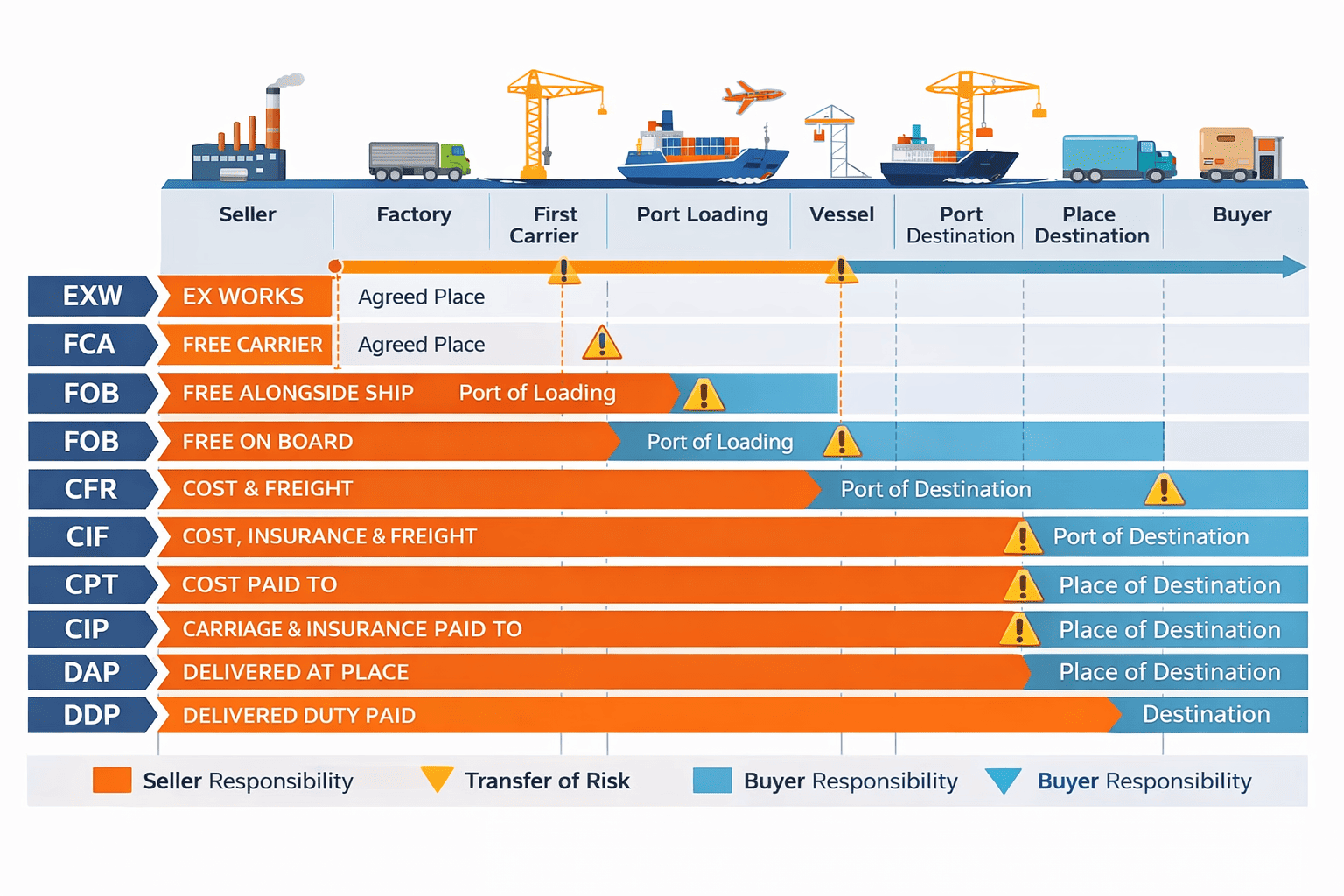
Here is a quick-reference overview of all 11 Incoterms 2020 terms. They are divided into two groups: 7 terms applicable to any mode of transport (including multimodal, air, road, and rail), and 4 terms applicable only to sea and inland waterway transport.
📋 Quick List: All 11 Incoterm Codes
Any mode of transport (7): EXW, FCA, CPT, CIP, DAP, DPU, DDP | Sea & inland waterway only (4): FAS, FOB, CFR, CIF. These are the only 11 valid ICC Incoterms codes, jump to the full comparison table for a side-by-side view of all of them.
EXW
Ex Works
Seller makes goods available at their premises. Buyer bears all risks and costs from that point.
🔴 Max Buyer Risk
FCA
Free Carrier
Seller delivers to named carrier or place nominated by buyer. Risk transfers at that named point.
📦 Any Mode
CPT
Carriage Paid To
Seller pays freight to named destination. Risk transfers to buyer when handed to first carrier.
📦 Any Mode
CIP
Carriage & Insurance Paid To
Like CPT + seller provides Clause A insurance to named destination. Popular for high-value cargo.
🛡️ Includes Insurance
DAP
Delivered at Place
Seller delivers to named destination, ready to unload. Buyer handles import clearance and duties.
🏭 Door Delivery
DPU
Delivered at Place Unloaded
Seller delivers AND unloads at named destination. Only term requiring seller to unload. New in 2020.
🆕 New in 2020
DDP
Delivered Duty Paid
Seller’s maximum obligation. Seller delivers cleared for import, all duties paid, to buyer’s door.
🔵 Max Seller Risk
FAS
Free Alongside Ship
Seller delivers goods alongside the vessel at named port of shipment. Sea/waterway only.
⚓ Sea Only
FOB
Free On Board
Seller loads goods on vessel at named port. Risk transfers once goods are on board. Most popular.
⚓ Most Used
CFR
Cost and Freight
Seller pays freight to destination port. Risk transfers when goods loaded on vessel at origin.
⚓ Sea Only
CIF
Cost Insurance & Freight
Like CFR + seller provides minimum Clause C insurance to destination port. Widely used in commodities.
⚓ Sea Favourite
SECTION 3
3 The Seller–Buyer Obligation Spectrum
The single most useful mental model for Incoterms: imagine a spectrum from maximum buyer obligation (EXW) to maximum seller obligation (DDP). As you move along the spectrum, more responsibility shifts from buyer to seller. This is also reflected in the price, a DDP price includes everything the seller must do; an EXW price is just the goods at factory gate.
Responsibility Spectrum: Buyer ←→ Seller
EXW
FCA FAS
FOB CFR
CPT CIF
CIP
DAP DPU
DDP
🔴 Max Buyer Responsibility🔵 Max Seller Responsibility
The single fact that answers most Incoterms questions: the seller handles export customs clearance under every Incoterm except EXW, and the buyer handles import customs clearance under every Incoterm except DDP. Everything else, freight, insurance, unloading, is a matter of degree between those two fixed points.
SECTION 4
4 The 7 Incoterms for Any Mode of Transport
These seven terms can be used regardless of how goods are transported, by sea, air, road, rail, or a combination. They are particularly relevant for manufacturers and distributors using multimodal transport, air freight, or road/rail connections where sea-specific terms would be inappropriate.
EXW
Ex Works
📦 Any Mode⚠️ Not Recommended for Cross-Border
Seller’s obligation is minimal: make goods available at their premises (factory, warehouse, etc.). From this point, the buyer bears all costs and risks, including loading, export clearance, freight, insurance, import clearance, and final delivery.
EXW is the most advantageous Incoterm for the seller and the most burdensome for the buyer. While it seems simple, it is actually problematic for international trade because the buyer, who is in the destination country, must arrange and pay for export clearance in the origin country, where they have no legal presence. In practice, EXW works best for domestic trade or where the buyer has a freight forwarder or agent in the seller’s country.
📘 Seller Responsible For
Packing goods
Making goods available at named premises
Providing commercial invoice and packing list
📗 Buyer Responsible For
Loading at seller’s premises
Export customs clearance & duties
All freight (origin to destination)
Insurance
Import clearance & all duties
FCA
Free Carrier
📦 Any Mode⭐ Recommended for Air & Multimodal
Seller delivers goods to a named carrier or place nominated by the buyer, typically a carrier’s depot, the port, or a named address. The seller handles export clearance. Risk transfers at the named delivery point.
FCA is the recommended alternative to FOB for containerised and air freight shipments. A key change in Incoterms 2020 allows the buyer to instruct the carrier to issue a shipped-on-board bill of lading, addressing the requirement of documentary credit banks. FCA is flexible: the delivery point can be the seller’s premises (seller loads) or another place (buyer arranges collection).
📘 Seller Responsible For
Export packaging & documentation
Export customs clearance
Delivery to named carrier/place
Loading if delivery at seller’s premises
📗 Buyer Responsible For
Main carriage (freight from named point)
Insurance
Destination charges
Import customs clearance & duties
CPT
Carriage Paid To
📦 Any ModeSeller Pays Freight
Seller contracts and pays for carriage to the named destination. However, risk transfers to the buyer when goods are handed to the first carrier at origin, not at the destination. This cost/risk split is crucial.
CPT is the multimodal equivalent of CFR. The split between where cost transfers (destination) and where risk transfers (first carrier at origin) means buyers carry the risk of transit damage even though the seller paid for the freight. Buyers should ensure they have adequate insurance under CPT arrangements.
📘 Seller Responsible For
Export clearance
Main carriage cost to named destination
Contracting with carriers
📗 Buyer Responsible For
Risk from handover to first carrier
Insurance (buyer must arrange)
Destination charges
Import clearance & duties
CIP
Carriage and Insurance Paid To
📦 Any ModeClause A Insurance⭐ Best for High-Value Goods
Same as CPT but seller also provides insurance. Under Incoterms 2020, CIP requires Clause A (all-risk) insurance, the highest level, whereas CIF only requires Clause C. This upgrade from 2010 makes CIP significantly more protective for buyers.
CIP is strongly recommended for high-value goods, pharmaceuticals, electronics, and cargo that is difficult to replace. The seller’s Clause A insurance requirement ensures the buyer is covered for almost all risks during transit. The risk-transfer point is still origin (first carrier), same as CPT.
📘 Seller Responsible For
Export clearance
Main carriage cost to named destination
Clause A (all-risk) insurance
📗 Buyer Responsible For
Risk from handover to first carrier
Destination charges
Import clearance & duties
DAP
Delivered at Place
📦 Any Mode⭐ Popular for B2B Distribution
Seller delivers goods to the named destination, ready for unloading by the buyer. Seller handles all transport, export clearance, and transit risks. Buyer handles unloading, import clearance, and duties.
DAP is widely used in B2B distribution where the seller (often a manufacturer or exporter) wants to handle the full door-to-door logistics but the buyer prefers to manage their own import procedures. It is often described informally as “door delivery” or “door to door minus import clearance,” since the goods travel all the way to the buyer’s premises but the buyer still clears customs. It is particularly common in international distribution agreements where the manufacturer supplies to local distributors on a delivered basis.
📘 Seller Responsible For
All freight & insurance to named destination
Export clearance
All transit risks until named place
📗 Buyer Responsible For
Unloading at destination
Import customs clearance
Import duties & taxes
DPU
Delivered at Place Unloaded
📦 Any Mode🆕 Replaced DAT in 2020
Seller delivers and unloads goods at the named destination. DPU is the only Incoterm where the seller is responsible for unloading. It replaced DAT (Delivered at Terminal) in Incoterms 2020, extending delivery beyond terminals to any named place.
DPU is useful when the seller has or can arrange unloading facilities at the destination, or when the delivery point does not have its own unloading equipment. Compared to DAP, the seller under DPU bears the cost and risk of unloading, an important distinction when negotiating with distributors or warehouses.
📘 Seller Responsible For
All freight to named destination
Export clearance
Unloading at destination
📗 Buyer Responsible For
Import customs clearance
Import duties & taxes
Onward delivery from unloaded point
DDP
Delivered Duty Paid
📦 Any Mode🔵 Maximum Seller Obligation⚠️ Avoid if Seller Can’t Import Locally
The seller’s maximum obligation. Seller is responsible for delivering goods to the buyer’s named address, cleared for import, with all import duties and taxes paid. The buyer only needs to unload the goods.
DDP is the mirror image of EXW, and the true “door to door” Incoterm: the seller manages the full journey from factory door to buyer’s door, including import clearance. The buyer pays the DDP price and receives goods at their door with all costs included. However, DDP requires the seller to have the ability to pay import duties in the destination country, which may not be legally straightforward without a local entity. DDP is widely used in B2C e-commerce and cross-border retail. In B2B, it is used where the manufacturer supplies to retail chains or when distributors require a fully landed cost.
📘 Seller Responsible For
All freight, insurance & handling
Export & import customs clearance
All import duties, VAT & taxes
Delivery to buyer’s named address
📗 Buyer Responsible For
Unloading (unless agreed otherwise)
Nothing else, buyer pays one all-in price
SECTION 5
5 The 4 Incoterms for Sea & Inland Waterway Only
These four terms, FAS, FOB, CFR, and CIF, are exclusively for ocean and inland waterway transport. Using them for air, road, or containerised multimodal shipments creates legal ambiguity and risk, because the risk transfer point (alongside ship / on board) may not map to how containerised cargo is actually handled. For containers, FCA should be used instead of FOB.
FAS
Free Alongside Ship
⚓ Sea & Inland Waterway Only
Seller delivers goods alongside the named vessel at the port of shipment. Risk transfers once goods are placed alongside the ship on the quay or in lighters. Seller handles export clearance.
FAS is primarily used for bulk cargo, heavy machinery, or goods loaded directly by crane at the vessel. It is less common for containerised trade. The buyer then arranges and pays for loading, ocean freight, and all subsequent costs.
📘 Seller Responsible For
Export clearance
Delivery alongside vessel at named port
📗 Buyer Responsible For
Loading on board vessel
Ocean freight
Insurance
Import clearance & duties
FOB
Free On Board
⚓ Sea & Inland Waterway Only⭐ Most Used in Global Trade
Seller delivers goods on board the vessel at the named port of shipment and clears goods for export. Risk transfers once goods are loaded on board. Buyer contracts and pays for ocean freight, insurance, and all subsequent costs.
FOB is the single most widely used Incoterm in global trade, particularly for manufacturing exports from Asia. It gives buyers control over the main ocean freight leg, allowing them to negotiate their own shipping rates and select preferred carriers. For large-volume buyers, this can result in significant freight savings compared to CIF, where the seller controls freight selection. However, for containerised cargo, ICC actually recommends using FCA instead of FOB to better reflect where risk transfers in container logistics. Note: the French-language abbreviation for this term is sometimes seen as “FAB” (Franco A Bord), the ICC’s official English code remains FOB.
📘 Seller Responsible For
Export packing & documentation
Export customs clearance & duties
Delivery on board vessel at named port
Loading charges at origin port
📗 Buyer Responsible For
Ocean freight from origin port
Cargo insurance
Destination port charges
Import customs clearance & duties
CFR
Cost and Freight
⚓ Sea & Inland Waterway Only⚠️ Risk/Cost Split at Origin
Seller pays freight to the named destination port. However, critically, risk transfers when goods are loaded on board the vessel at origin, not at destination. Seller does not provide insurance.
CFR creates the same risk/cost split as CPT: the seller pays freight to destination, but risk has already transferred to the buyer at origin loading. Buyers under CFR must remember to arrange their own insurance for the ocean voyage, even though the seller paid for it. CFR is commonly used in commodity trade (grain, metals, bulk goods).
📘 Seller Responsible For
Export clearance
Loading on board at origin
Ocean freight to destination port
📗 Buyer Responsible For
Risk from loading at origin
Cargo insurance (must self-arrange)
Destination port charges & unloading
Import clearance & duties
CIF
Cost, Insurance and Freight
⚓ Sea & Inland Waterway Only⭐ Popular with Smaller Buyers
Seller pays freight and provides minimum Clause C insurance to the named destination port. Risk still transfers when goods are loaded at origin. The seller’s insurance (Clause C) is minimum cover, buyers should consider supplementing with their own policy.
CIF is extremely popular in global trade because it offers buyers convenience, a single price to their destination port that includes freight and basic insurance. It is often the natural next step for a buyer moving away from EXW, since the seller absorbs export clearance, freight, and minimum insurance in one quoted price. However, buyers should be aware that: (1) risk still transfers at origin loading; (2) Clause C insurance only covers major perils, not all losses; and (3) buyers lose control over freight selection, meaning sellers may use cheaper, less reliable carriers. Large importers with significant buying power often prefer FOB to control their freight costs. Smaller importers often prefer CIF for simplicity. Note: CIF is sometimes mistyped as “CFI”, which is not a valid Incoterm. For more details on structuring trade relationships, see our guide on licensing vs distribution agreements.
📘 Seller Responsible For
Export clearance
Loading on board at origin
Ocean freight to destination port
Minimum Clause C insurance
📗 Buyer Responsible For
Risk from loading at origin
Destination port charges & unloading
Import clearance & duties
Top-up insurance if needed
SECTION 6
6 Full Comparison: All 11 Incoterms Side-by-Side
The definitive reference table, all 11 terms compared across seven key dimensions. Use this as your incoterms cheat sheet and chart.
Incoterm
Mode
Risk Transfers When…
Seller Pays Freight
Seller Arranges Insurance
Seller Handles Export
Seller Handles Import
Best For
EXW
Any
Goods available at seller’s premises
❌ No
❌ No
❌ No
❌ No
Domestic trade; buyer has local agent
FCA
Any
Goods delivered to named carrier/place
❌ No
❌ No
✅ Yes
❌ No
Containerised, air & multimodal
CPT
Any
Goods handed to first carrier at origin
✅ Yes
❌ No
✅ Yes
❌ No
Multimodal; buyer arranges own insurance
CIP
Any
Goods handed to first carrier at origin
✅ Yes
✅ Clause A
✅ Yes
❌ No
High-value, pharma, electronics
DAP
Any
Goods ready to unload at destination
✅ Yes
✅ Yes
✅ Yes
❌ No
B2B distribution; seller handles logistics
DPU
Any
Goods unloaded at destination
✅ Yes
✅ Yes
✅ Yes
❌ No
Terminal/warehouse delivery; seller unloads
DDP
Any
Goods delivered to buyer’s door
✅ Yes
✅ Yes
✅ Yes
✅ Yes
E-commerce; buyer wants all-in price
FAS
Sea only
Goods alongside vessel at origin port
❌ No
❌ No
✅ Yes
❌ No
Bulk cargo, heavy machinery
FOB
Sea only
Goods loaded on board at origin
❌ No
❌ No
✅ Yes
❌ No
Break-bulk, bulk; most popular overall
CFR
Sea only
Goods loaded on board at origin
✅ Yes
❌ No
✅ Yes
❌ No
Commodities; buyer arranges insurance
CIF
Sea only
Goods loaded on board at origin
✅ Yes
✅ Clause C (min)
✅ Yes
❌ No
Smaller importers; convenience pricing
📌 Insurance Note: CIF vs CIP
CIF (sea only) provides minimum Clause C insurance, covering named perils like fire, sinking, collision. CIP (any mode) provides Clause A (all-risk) insurance, covering almost all physical loss or damage. For manufactured goods, pharmaceuticals, or electronics, CIP’s all-risk cover is significantly more valuable. The insurance under both terms is for the buyer’s benefit, but arranged and paid for by the seller.
SECTION 7
7 FOB vs CIF: The Most Debated Trade-Off
FOB vs CIF is the most common trade-term debate in global manufacturing and distribution, particularly for ocean freight sourcing from Asia. The choice has real financial implications.
When establishing trade terms with an international distributor found through GTsetu, most B2B partnerships use FOB or DAP. FOB is preferred when the distributor has established freight relationships in their home country. DAP is preferred when the manufacturer wants to offer a delivered price to simplify the distributor’s cost modelling. Discuss Incoterms explicitly during the secure collaboration phase of your partnership, before any commercial terms are locked. GTsetu provides government-identity-verified (6 points) company profiles, but does NOT verify tax compliance, licences, certifications, or financial standing.
SECTION 8
8 EXW vs FOB (and EXW vs CIF): Why EXW Is Often a Mistake for Exporters
Many sellers instinctively prefer EXW because it appears to minimise their obligations. In reality, EXW can create significant problems for international trade, and many experienced exporters recommend avoiding it in favour of FOB, FCA, or CIF.
Issue
EXW
FOB / FCA (Recommended)
Export clearance
Buyer must arrange in seller’s country, where buyer has no legal presence or agent
Seller handles in their own country, legally straightforward
Loading at seller’s premises
Buyer’s risk, even if seller’s staff physically load the goods
Seller’s risk until goods on board vessel (FOB) or at named point (FCA)
Risk of export refusal
Goods may be stranded if buyer’s agent fails to arrange export docs
Seller ensures all export requirements are met
Compliance exposure
Seller may still be implicated if buyer misuses goods post-export
Seller controls export process and can verify end-use
Practical reality
Seller often ends up helping with export anyway, informally, with all the risk
Responsibilities are clearly defined and legally allocated
EXW vs CIF: Opposite Ends of the Spectrum
Buyers researching EXW often end up comparing it directly to CIF, since the two terms sit almost opposite each other on the responsibility spectrum. Under EXW, the buyer arranges and pays for loading, export clearance, main freight, insurance, and import clearance, essentially everything. Under CIF, the seller clears the goods for export, loads them on board the vessel, pays ocean freight, and provides minimum insurance to the destination port, leaving the buyer to handle only destination charges, import clearance, and duties. For a first-time buyer sourcing internationally, CIF is almost always the easier and lower-risk starting point compared to EXW.
SECTION 9
9 DDP vs DAP: Maximum Seller Obligation Terms & “Door to Door” Delivery
🚪 What Does “Door to Door” Mean in Incoterms?
“Door to door” is a logistics industry phrase, not an official ICC Incoterm. It describes a shipment that the seller manages from their own premises all the way to the buyer’s premises. DDP is the closest official match, seller-cleared, duty-paid delivery straight to the buyer’s door. DAP is “door delivery, buyer clears,” the goods reach the buyer’s door but the buyer still handles import clearance and duties.
Factor
DDP
DAP
Import customs clearance
Seller handles and pays
Buyer handles and pays
Import duties & VAT
Seller pays all duties and taxes
Buyer pays all duties and taxes
Seller needs local entity?
Often yes, to pay duties and VAT in destination country
Seller may not be able to reclaim import VAT in destination country
Buyer reclaims VAT as normal
⚠️ DDP Caution for Manufacturers
DDP can trap sellers if import duty rates change unexpectedly (e.g., tariff hikes, anti-dumping measures) after the contract is signed. On DAP, the buyer bears this risk. Many experienced manufacturers and distribution partners prefer DAP for exactly this reason, it gives the distributor (who is in the destination country and better understands the import regime) control over their own customs process.
SECTION 10
10 Which Incoterm Should You Use?
The right Incoterm depends on your role in the transaction, your logistics capability, the mode of transport, the product type, and your relationship with the counterparty. Use this decision framework to guide your choice.
🧭 Incoterms Decision Guide for B2B Trade
Buyer wants maximum control over freight & shipping costs (ocean)
→ Use FOB
FOB
Buyer books their own ocean freight at market rates. Best for high-volume importers with freight forwarder relationships.
CIF for ocean to destination port; DAP for door delivery. Good for smaller importers or first-time partnerships.
Multimodal, air, or containerised shipment (not bulk sea)
→ Use FCA instead of FOB
FCA
FCA correctly reflects risk transfer for containers. ICC officially recommends FCA over FOB for containerised cargo.
Buyer wants all-in price; seller to handle everything including import duties
→ Use DDP
DDP
Seller assumes all costs. Common in e-commerce and retail supply. Seller must be able to legally pay import duties.
Seller delivers to buyer’s door but buyer manages their own import
→ Use DAP
DAP
Seller delivers to named address; buyer handles import clearance and duties. Clean split used in many B2B distribution contracts.
High-value goods; seller should provide comprehensive insurance
→ Use CIP (any mode)
CIP
CIP requires Clause A all-risk insurance paid by seller. Ideal for electronics, pharma, and luxury goods in multimodal or air shipments.
Incoterm Selector by Trade Role
Your Role
Your Priority
Recommended Incoterm
Avoid
Manufacturer / Exporter
Minimise logistics obligations
FOB or FCA
DDP (unless you have local presence)
Manufacturer / Exporter
Offer competitive delivered pricing
DAP or CIF
EXW (creates export complications)
Importer / Distributor
Control freight costs & carrier selection
FOB or FCA
CIF (loses freight control)
Importer / Distributor
Simplicity; single landed price
CIF or DAP
EXW (too many moving parts)
B2B Brand Owner (OEM)
Supplier delivers to factory/warehouse
DAP or DDP
EXW when supplier is overseas
E-commerce / Direct-to-Consumer
Customer pays one all-in price
DDP
DAP (customer must handle import)
🎯 Best Incoterm for the Buyer / Importer, Quick Answer
There is no single “best” Incoterm for every buyer, it is a trade-off between control and convenience. If you want to control freight cost and carrier choice, choose FOB (sea) or FCA (any mode). If you want the seller to handle freight and basic insurance for a simpler, single landed price, choose CIF (sea) or DAP/DDP (any mode). Large-volume importers with freight forwarder relationships typically save money on FOB/FCA; smaller or first-time importers usually find CIF, DAP, or DDP easier to manage.
SECTION 11
11 Common Incoterms Mistakes & Terms Often Confused With Incoterms
🚫
Using FOB for Containerised Cargo
FOB risk transfers when goods are loaded on board the vessel, but containerised cargo is handed to the carrier (CFS/CY) well before vessel loading. FCA is the ICC-recommended alternative that correctly reflects this reality.
🚫
Choosing EXW for International Trade
EXW places the burden of export clearance on the buyer, who is in the destination country. This is legally problematic and practically difficult. FOB or FCA are almost always better for international shipments.
🚫
Confusing “Risk Transfer” with “Cost Transfer”
Under CPT, CFR, and CIF, the seller pays freight to destination, but risk transfers at origin. Many buyers assume they are fully protected because the seller paid for freight. Wrong, they must arrange their own insurance.
🚫
Not Specifying a Named Place
Every Incoterm must be followed by a precise named place or port (e.g., “FOB Shanghai” not just “FOB”). Without a named location, the term is legally ambiguous and disputes about the delivery point become impossible to resolve.
🚫
Assuming Incoterms Cover Everything
Incoterms do not cover payment, title transfer, warranties, product specifications, or dispute resolution. These must be addressed separately in your sales contract or distribution agreement.
🚫
Using Obsolete Terms (DAT) or Wrong Years
DAT was replaced by DPU in Incoterms 2020. There is also no “Incoterms 2021, 2022, 2018, or 2025” edition, only Incoterms 2020 and 2010 are valid published editions. Always specify the version: “CIF Incoterms 2020.”
🚫
Selling DDP Without Local Legal Presence
A seller using DDP must pay import duties and VAT in the destination country, which often requires a local entity or fiscal representative. Without this, the seller may breach local tax law or be unable to clear the goods.
🚫
Accepting CIF When Shipping High-Value Goods
CIF provides minimum Clause C insurance only. For electronics, pharmaceuticals, or luxury goods, the limited cover may not be sufficient. Negotiate CIP (Clause A) or arrange supplemental insurance independently under FOB.
Codes and Abbreviations Often Confused With Incoterms
A few codes that show up in shipping conversations are not, in fact, valid Incoterms. Knowing the difference avoids costly contract drafting errors:
CFI, not a real Incoterm; almost always a typo for CIF (Cost, Insurance and Freight).
CFS (Container Freight Station), a physical facility where cargo is consolidated or deconsolidated, not a trade term describing risk or cost allocation.
FAB, the French-language abbreviation “Franco A Bord,” equivalent to the English FOB, but not itself an ICC code.
DDU (Delivered Duty Unpaid), used under Incoterms 2000 but discontinued since Incoterms 2010; its closest modern equivalent is DAP.
DAT (Delivered at Terminal), used under Incoterms 2010 but replaced by DPU in the 2020 edition.
SECTION 12
12 Incoterms by Industry: What Each Sector Typically Uses
Industry
Dominant Incoterms
Why
GTsetu Relevance
Consumer Electronics
FOB (origin), DAP (delivery)
High-volume buyers control own freight; DAP for distributor supply
Manufacturers & distributors connect on GTsetu for cross-border supply
Pharmaceuticals
CIP or DDP
Cold chain; high-value cargo needs Clause A insurance; DDP for retail
CMO/CDMO partnerships on GTsetu (verify compliance independently)
Food & Beverage
CIF, FOB, DAP
Bulk commodity trade uses CIF; finished product distribution uses DAP
CMO partnerships for regional manufacturing; distributor sourcing globally
Industrial Equipment
CIP, DAP
High-value heavy equipment needs insurance; DAP for project deliveries
OEM manufacturers finding certified service distributors on GTsetu
Apparel & Footwear
FOB
Brands buy FOB from Asian factories; control own freight consolidation
Contract manufacturers finding OEM brand owner clients on GTsetu
Automotive Parts
DAP or FCA
Just-in-time delivery requires seller to manage logistics to factory
Tier 1/2 supplier partnerships across manufacturing hubs
Commodities (Grain, Metals)
CIF, CFR, FOB
Classic bulk trade terms; documentary credit banks require these terms
Less directly relevant, GTsetu focuses on manufactured goods trade
Cosmetics & FMCG
DAP, DDP
Brand owners supply distributors DAP; DDP for e-commerce channels
13 Incoterms 2010 vs Incoterms 2020: Key Changes (There Is No 2021, 2022 or 2025 Edition)
Incoterms 2020 came into effect on 1 January 2020 and remains the current, most recent edition as of 2026. Both the 2010 and 2020 versions remain in use, contracts can specify either, and both are legally valid as long as the version is clearly named. Here are the key differences.
📌 No “Incoterms 2021 / 2022 / 2024 / 2025” Exists
A large number of people search for “Incoterms 2021,” “2022,” or “2025” expecting a newer edition. There isn’t one. The ICC publishes a new Incoterms edition roughly once every ten years, 1936, 1953, 1967, 1976, 1980, 1990, 2000, 2010, and 2020. Incoterms 2020 is still the rulebook in force today; the next revision is not expected before the end of this decade. If a document, course, or supplier references “Incoterms 2021” or similar, they almost always mean Incoterms 2020.
Change Area
Incoterms 2010
Incoterms 2020
DAT → DPU
DAT (Delivered at Terminal), limited to terminal delivery
DPU (Delivered at Place Unloaded), extends delivery to any named place, not just terminals
FCA + Bill of Lading
No provision for on-board bill of lading under FCA
Buyer can instruct carrier to issue shipped-on-board B/L to seller, enabling documentary credit use
CIP Insurance Level
CIP required minimum Clause C insurance (same as CIF)
CIP now requires Clause A (all-risk) insurance, significantly higher cover
Own Transport (FCA, DAP, DPU, DDP)
Not explicitly addressed
Parties can use own means of transport, not just 3rd party carriers, under these terms
Security obligations
Minimal reference
Explicit security-related obligations and cost allocation included for all terms
Cost listing format
Costs listed across multiple articles
All costs consolidated in single A9/B9 article per term, easier reference
Explanatory notes
Limited guidance notes
Detailed explanatory notes for each rule included in the official publication
✅ Best Practice: Always Specify the Version
When using Incoterms in a contract, always specify the edition, for example: “FOB Shanghai, Incoterms 2020”. This eliminates ambiguity if there is any dispute about which version applies. Contracts that only say “FOB” without a year may default to the most recent version, but specifying the year is always safer. For the official rulebook text, refer to the ICC’s official Incoterms 2020 page.
SECTION 14
14 GTsetu: Finding Government-Identity-Verified Trade Partners Who Speak Your Terms
🌐 Platform Spotlight, GTsetu
Understanding Incoterms Is Step One. Finding the Right Partner Is Step Two.
Knowing your Incoterms is essential, but it only matters in the context of a real trade relationship. The hardest part for most manufacturers, exporters, and distributors is finding verified counterparties who operate under clearly defined commercial terms, understand Incoterms in their trade context, and can be trusted to execute. GTsetu solves this: a government-identity-verified B2B discovery platform connecting manufacturers, brand owners, and international distributors across 100+ countries, with built-in NDA workflows, zero broker commission, and structured onboarding that ensures both parties are clear on commercial terms from day one.
What GTsetu verifies (6 points via government ties): Company Name, Registered Address, Registration Number, Company Status, Company Type, Date of Certificate of Incorporation.
What GTsetu does NOT verify (your responsibility): Tax compliance, import/export licences, industry certifications, financial standing, trading history, authority of representatives. GTsetu provides an encrypted workspace to request and review these documents securely.
✅
6-Point Government Identity Verification
Company Name, Address, Registration Number, Status, Type, and Incorporation Date verified via government ties before any company goes live.
🕵️
Anonymous Discovery
Browse verified manufacturer and distributor profiles without revealing your identity until mutual interest is confirmed.
📄
Built-In NDA Workflow
Formalise confidentiality before sharing pricing, product specs, or Incoterm preferences, with complete audit trail.
🔐
Encrypted Workspace
Share price lists, shipping terms, product specs, and request tax certificates / licences from partners, with encryption and full access controls.
🚫
Zero Commission
No broker fees, ever. Your commercial deal, including the Incoterms agreed, stays between you and your partner.
🌍
100+ Countries
Active government-identity-verified network spanning Asia, Middle East, Europe, Africa, Australia, and the Americas.
GTsetu verifies six specific data points using government ties: Company Name, Registered Address, Registration Number, Company Status, Company Type, and Date of Certificate of Incorporation. GTsetu does NOT verify tax compliance, import/export licences, industry certifications, financial standing, trading history, or authority of representatives. These remain your responsibility to verify independently. GTsetu provides an encrypted workspace where you can request these documents from partners and review them securely, with full audit trail.
How Incoterms Feature in GTsetu Partnerships
01
Manufacturer → Distributor Supply Agreements
When a manufacturer found through GTsetu supplies an international distributor, the Incoterm in the supply agreement defines who handles cross-border logistics. DAP and FOB are the most common terms used in these distribution agreements.
📍 Typical: FOB origin or DAP distributor’s warehouse
02
OEM → Contract Manufacturer Supply
In contract manufacturing relationships, the OEM typically buys on FOB or FCA terms from their CM, then manages global distribution from there. The CM is responsible up to vessel loading; the OEM takes over.
📍 Typical: FOB factory port to OEM’s logistics hub
03
Co-Development & Joint Venture Trade
In co-development partnerships and joint ventures, components or finished goods may cross borders between partners. FCA and CIP are commonly used to handle intercompany transfers with clear risk and insurance allocation.
📍 Typical: FCA or CIP for intercompany component transfers
04
White Label & Private Label Supply
For white label and private label arrangements, the brand owner often wants goods delivered to their warehouse, making DAP or DDP the natural Incoterm choice so the brand owner can receive finished goods without logistics complexity.
📍 Typical: DAP brand owner’s distribution centre
FAQ
? Frequently Asked Questions
QWhat are Incoterms and why do they matter?
Incoterms (International Commercial Terms) are 11 standardised trade terms published by the International Chamber of Commerce (ICC) that define who, buyer or seller, is responsible for freight, insurance, customs clearance, and risk at each stage of a shipment. They matter because without agreed Incoterms, every international transaction is ambiguous: who pays if the goods are damaged at sea? Who handles the import paperwork? Incoterms answer these questions clearly, reducing disputes and providing a common language for trade across 200+ countries.
QIs there an Incoterms 2021, 2022, 2018, or 2025 edition?
No. The current and most recent edition is Incoterms 2020, effective from 1 January 2020. There is no Incoterms 2018, 2021, 2022, 2024, or 2025 edition, the ICC has historically revised the rules roughly once a decade (1936, 1953, 1967, 1976, 1980, 1990, 2000, 2010, 2020), so the next update is not expected before the late 2020s. Contracts can still validly reference the older Incoterms 2010 edition, or any earlier one, as long as the version is clearly named, for example “FOB Shanghai, Incoterms 2010.” If you see “Incoterms 2021” referenced anywhere, it almost always means Incoterms 2020.
QWhat is the most commonly used Incoterm in global trade?
FOB (Free On Board) is the most widely used Incoterm globally, particularly for ocean freight sourcing from Asia. It strikes a practical balance: the seller handles export clearance and gets goods on board the vessel; the buyer controls the ocean freight booking and manages import from that point. CIF (Cost, Insurance and Freight) is the second most popular, commonly used by smaller importers who prefer the seller to arrange freight and basic insurance to their destination port.
QWhat is the difference between FOB and CIF?
Both FOB and CIF apply to sea transport only, and in both terms, risk transfers when goods are loaded on board the vessel at the origin port. The difference is who pays for the main ocean freight and insurance: under FOB, the buyer arranges and pays for ocean freight and insurance; under CIF, the seller pays for both. FOB gives buyers freight control and transparency; CIF gives buyers convenience at the cost of losing freight selection control. Risk transfer is at the same point, origin loading, for both.
QWhat is the difference between EXW and CIF?
EXW and CIF sit at almost opposite ends of the Incoterms responsibility spectrum. Under EXW, the buyer arranges and pays for loading, export clearance, main freight, insurance, and import clearance, essentially the entire journey. Under CIF, the seller handles export clearance, loads the goods on board the vessel, pays ocean freight, and arranges minimum Clause C insurance to the destination port, leaving the buyer to handle only destination charges, import clearance, and duties. For most international buyers, CIF is significantly lower-effort and lower-risk than EXW.
QWhich Incoterm is best for the buyer or importer?
There is no single “best” Incoterm for buyers, it depends on whether you prioritise control or convenience. Importers who want to control freight cost, choose their own carrier, and negotiate shipping rates typically prefer FOB (sea) or FCA (any mode). Importers who want simplicity, a single landed price with no logistics management, typically prefer CIF, DAP, or DDP. Large-volume importers with established freight forwarder relationships usually save money on FOB; first-time or smaller importers often find CIF or DAP easier to manage.
QWhat does “door to door” mean in Incoterms?
“Door to door” is not an official ICC Incoterm, it is shipping industry shorthand for a term where the seller manages the entire journey from their own premises to the buyer’s premises. DAP (Delivered at Place) and DDP (Delivered Duty Paid) are the closest official Incoterms to door-to-door delivery. Under DAP the goods reach the buyer’s door but the buyer still clears import and pays duties; under DDP the seller clears import and pays duties too, making it the true door-to-door equivalent, fully delivered and duty-paid to the buyer’s address.
QWhat changed between Incoterms 2010 and Incoterms 2020?
The four key changes in Incoterms 2020 are: (1) DAT was replaced by DPU (Delivered at Place Unloaded), extending delivery beyond terminals to any named place; (2) FCA now allows the buyer to request a shipped-on-board bill of lading from the carrier, enabling letter of credit use; (3) CIP’s insurance requirement was upgraded from Clause C to Clause A (all-risk), making it significantly more protective; and (4) parties using FCA, DAP, DPU, and DDP can now use their own means of transport, not just third-party carriers. Both 2010 and 2020 editions remain legally valid when specified in a contract.
QWhy should I avoid EXW for international trade?
EXW places the responsibility for export customs clearance on the buyer, who is in the destination country and has no legal presence or established relationships in the seller’s country. This makes export clearance practically difficult and can create legal complications. Additionally, under EXW, if the seller’s staff help load goods onto the buyer’s truck and damage occurs during loading, the liability is still technically the buyer’s, even though the seller’s employees caused it. FOB, FCA, or CIF are almost always better alternatives for international shipments.
QDo Incoterms determine title transfer or who owns the goods during transit?
No. Incoterms do not govern title transfer or the transfer of ownership of goods, they only address delivery, cost, and risk. A separate clause in your sales contract must address when title passes. It is common for title to pass at the same point as risk (e.g., at FOB loading), but this must be explicitly stated in the contract, it is not automatic. In some trade finance arrangements, the seller may retain title until payment is received, regardless of the Incoterm used.
QIs CFI a valid Incoterm?
No. CFI is not one of the 11 official Incoterms, it is a common typo or mix-up of CIF (Cost, Insurance and Freight). A few other codes are occasionally confused with Incoterms too: CFS (Container Freight Station) is a physical facility, not a trade term; FAB is the French abbreviation for FOB; and DDU and DAT were valid under older editions but have since been replaced by DAP and DPU respectively. The 11 current, valid ICC codes are EXW, FCA, CPT, CIP, DAP, DPU, DDP, FAS, FOB, CFR, and CIF.
QCan I use Incoterms for domestic trade?
Yes, Incoterms can technically be used for domestic trade, and EXW is particularly common domestically because there are no export/import formalities involved. However, Incoterms were designed primarily for international trade and do not address domestic-specific considerations like local transport regulations, VAT handling within a single jurisdiction, or local customs practices. Many countries have their own domestic trade terms that may be more appropriate for internal shipments.
QHow do I agree Incoterms with an international manufacturing or distribution partner found through GTsetu?
The GTsetu platform includes a built-in NDA workflow that enables secure information exchange before commercial terms are formally agreed. Once initial interest is established between a manufacturer and distributor, trade terms, including Incoterms, are typically discussed during the commercial negotiation phase. Most manufacturers on GTsetu can supply on FOB, CIF, or DAP terms; most distributors have a preference based on their freight capabilities. The platform facilitates secure document sharing for initial pricing and trade term discussions, after which parties proceed to bilateral contract finalisation. See our guide on B2B secure collaboration for more on protecting your commercial information during negotiations. Note: GTsetu verifies 6 identity points only; tax, licences, certifications, and financial standing remain your responsibility to verify independently.
QWhat does GTsetu actually verify?
GTsetu verifies six specific data points using government ties: Company Name, Registered Address, Registration Number, Company Status (Active/Dissolved), Company Type (Ltd, Pvt Ltd, etc.), and Date of Certificate of Incorporation. GTsetu does NOT verify tax compliance, import/export licences, industry certifications, financial standing, trading history, or authority of representatives. Those remain your responsibility to verify independently. GTsetu provides an encrypted workspace where you can request these documents from partners and review them securely, with full audit trail.
Join 500+ verified manufacturers, exporters, and distributors already building cross-border trade partnerships on GTsetu, with government-identity-verified (6 points) company profiles, zero broker fees, and built-in NDA workflows across 100+ countries. Note: GTsetu verifies 6 identity points; tax, licences, certifications, and financial standing remain your responsibility.
They represents the product, and research team behind GTsetu, a global B2B collaboration platform built to help companies explore cross-border partnerships with clarity and trust. The team focuses on simplifying early-stage international business discovery by combining structured company profiles, verification-led access, and controlled collaboration workflows.
With a strong emphasis on trust, and disciplined engagement, Team GTsetu shares insights on global trade, partnerships, and cross-border collaboration, helping businesses make informed decisions before entering deeper commercial discussions.