Free for a limited time·Profile verification free·First collaboration free·No Commission·No Profit Share·Free for a limited time·Profile verification free·First collaboration free·No Commission·No Profit Share·Free for a limited time·Profile verification free·First collaboration free·No Commission·No Profit Share·
White Label vs Private Label Manufacturing: Complete Guide for Brands & Distributors | GTsetu
Home ›
Blog ›
White Label vs Private Label Manufacturing
🏷️ Manufacturing Models
White Label vs Private Label Manufacturing: The Complete Guide for Brands & Distributors (2026)
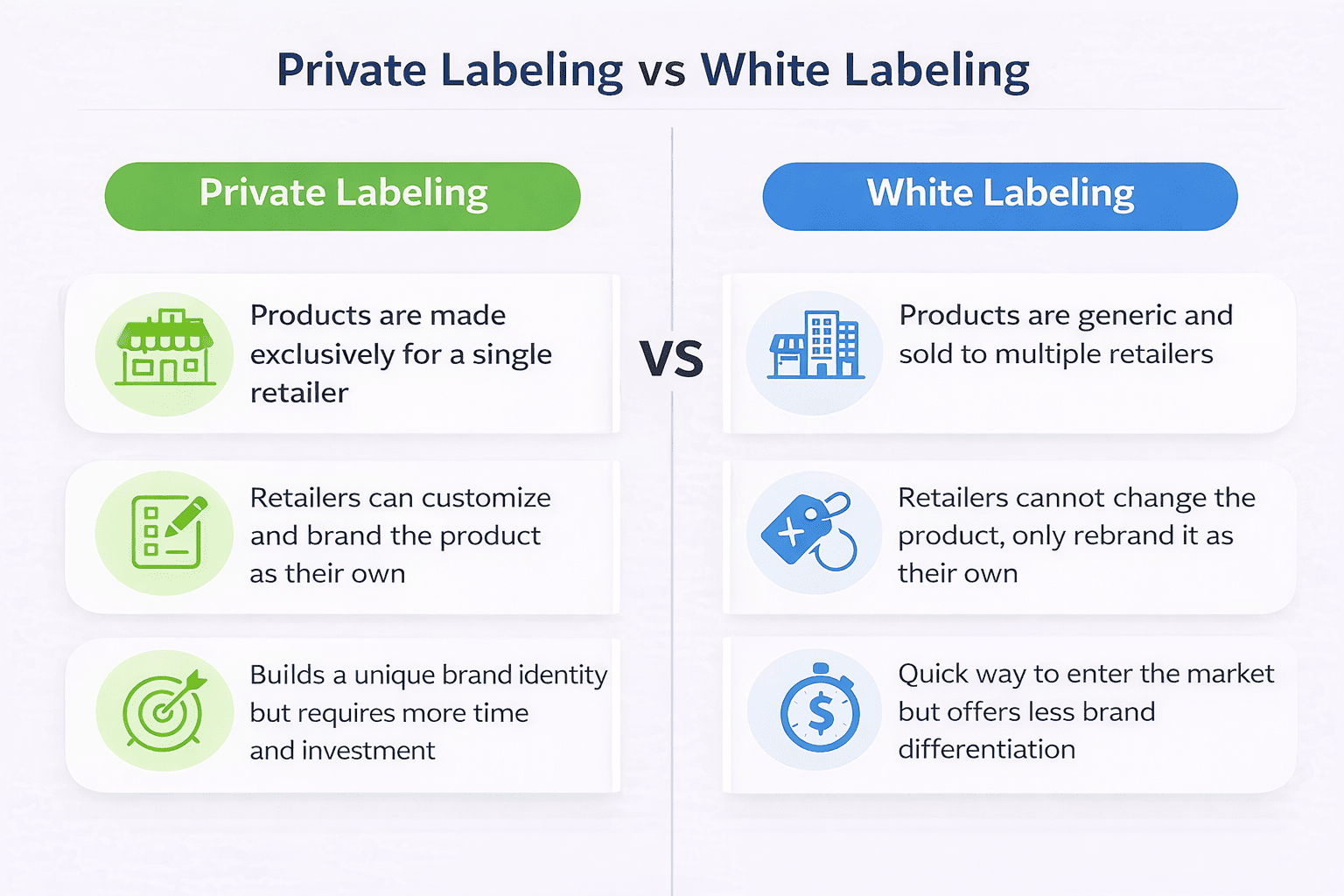
Direct Answer: White label manufacturing means purchasing a generic, pre-made product from a manufacturer and selling it under your own brand — with little or no customization. Private label manufacturing means commissioning a product made exclusively for your brand, with custom formulations, specifications, or packaging that competitors cannot replicate. The key difference is exclusivity and customization: white label is fast and low-cost; private label builds differentiated brand equity. This guide covers both models in depth — including pros, cons, industry examples, cost structures, and how to find verified manufacturers for either path through GTsetu.
📅 February 24, 2026⏱ 18 min read✍️ GTsetu Editorial Team🔄 Updated regularly
$5.5T
Global Private Label Market
35+
Countries on GTsetu
0%
Broker Commission
500+
Verified Manufacturers
Walk into any supermarket, open any e-commerce store, or browse a B2B product catalogue — and you are almost certainly looking at a mix of white label and private label products, often without knowing which is which. Major global brands including IKEA, Zara, Aldi, Amazon, and Costco have built entire product strategies around one or both of these manufacturing models.
Yet for most brand owners, founders, and distributors entering international manufacturing for the first time, the distinction between white label and private label remains genuinely confusing — because the terms are used interchangeably in many markets, even though they describe fundamentally different commercial relationships with manufacturers.
Getting this wrong is expensive. Choosing white label when you need product exclusivity means competitors immediately undercut you with identical goods. Choosing private label when you needed speed to market adds months to your launch and costs you can’t yet justify. This guide makes the distinction unambiguous — and shows you how to find the right manufacturing partner for whichever path you choose.
💡 Who This Guide Is For
This guide is written for brand founders, product managers, distributors, and export managers evaluating manufacturing models for a new product or market entry. It covers both models from a practical commercial and sourcing perspective — not just a definition exercise.
SECTION 1
What Is White Label Manufacturing?
🎯 Definition
White label manufacturing is a model in which a manufacturer produces a generic product and makes it available for multiple businesses to purchase, rebrand, and sell under their own brand names. The product itself is identical — or nearly identical — across all buyers. The only thing that changes is the logo, packaging, and pricing applied by each reseller.
The term comes from the image of a product with a blank white label — ready to be printed with whoever buys it. In white labelling, the manufacturer handles all product design, formulation, and production decisions. The purchasing company simply applies their branding and takes it to market.
This model is extremely common in fast-moving consumer goods, supplements, cosmetics, electronics accessories, office supplies, and software — anywhere the underlying product is largely commoditised and the value-add sits primarily in marketing, distribution, and brand recognition.
How White Label Works in Practice
01
Manufacturer Develops a Generic Product
The manufacturer invests in R&D, formulation, tooling, and production to create a standardised product that works for a broad market — a shampoo, a supplement capsule, a Bluetooth speaker, a software dashboard.
02
Multiple Brands Purchase and Rebrand the Product
Several different companies — including direct competitors — purchase the same product from the same factory. Each applies their own logo, packaging, and brand story. The product inside may be chemically or technically identical.
03
Each Brand Markets and Distributes Independently
The white label buyer’s value-add is entirely in go-to-market: pricing strategy, distribution channel, marketing positioning, and customer relationships. The manufacturer retains no obligation of exclusivity.
04
Buyer Pays Per Unit — No Tooling or R&D Investment
Because the product already exists, white label buyers typically face lower minimum order quantities and no upfront development costs. The speed from decision to launch can be as short as a few weeks.
⚡ White Label Reality Check
Because a white label product can be sold simultaneously by multiple resellers — including your direct competitors in the same geography — your competitive differentiation cannot come from the product itself. It must come entirely from your brand, pricing, distribution, and customer experience. If you cannot win on those dimensions alone, white label creates a race to the bottom.
SECTION 2
What Is Private Label Manufacturing?
🎯 Definition
Private label manufacturing is a model in which a brand commissions a manufacturer to produce a product that is exclusively designed, formulated, or specified for that brand — and cannot be sold to any other company. The brand controls product specifications, materials, formulation, packaging, and often has a formal exclusivity clause in the manufacturing agreement.
Private label products are not simply rebranded generic goods — they are purpose-built for a specific brand’s market position, customer profile, and product strategy. The brand owner bears more of the development cost and risk, but gains genuine product differentiation, pricing power, and a defensible market position that competitors cannot replicate by purchasing the same product from the same factory.
Retail own-brands are the most visible example of private label: the supermarket’s own-brand pasta sauce, the pharmacy chain’s own-brand vitamins, the fashion retailer’s own-label clothing range. But private label extends well into industrial products, B2B equipment, specialty chemicals, and technology hardware.
How Private Label Works in Practice
01
Brand Develops Product Brief and Specifications
The brand defines what they need — ingredients, materials, dimensions, functional performance standards, packaging requirements, regulatory certifications. This brief forms the basis of the manufacturing agreement.
02
Manufacturer Produces to Specification Under Exclusivity
The manufacturer produces the product exclusively for the commissioning brand. Exclusivity clauses in the contract prevent the manufacturer from selling the same formulation, design, or specification to any other company — typically within a defined territory and for a defined period.
03
Brand Bears Development Costs and MOQ Commitments
Because the manufacturer invests in tooling, formulation R&D, or custom components for a single brand, private label contracts typically require higher minimum order quantities and may include an upfront development or tooling fee. These costs are the price of exclusivity.
04
Brand Owns the Product Specification — Often the IP
In well-structured private label agreements, the brand retains ownership of the product specification, formulation, or design IP — meaning they can switch manufacturers without losing their product. This is a critical negotiating point that many brands miss on their first private label contract.
SECTION 3
White Label vs Private Label: Key Differences Side by Side
The confusion between these models often persists because both involve a third-party manufacturer producing something a brand then sells under its own name. But the commercial, legal, and strategic implications diverge significantly across every key dimension.
Everything else flows from one fact: white label manufacturers sell the same product to anyone who pays; private label manufacturers are contractually committed to make that product only for you. That single commercial difference changes IP ownership, pricing power, brand defensibility, development cost, and time to market simultaneously.
SECTION 4
Pros & Cons of White Label Manufacturing
White label is not a lesser model — it is the right model for specific strategic situations. Understanding where it excels and where it fails is what separates brands that use it well from those that get trapped by its limitations.
✅ Pros of White Label
Fastest possible time to market — weeks, not months
No upfront development or tooling costs
Low minimum order quantities to test demand
No product development expertise required
Proven, tested product — no quality unknown
Easy to expand range quickly across multiple SKUs
Manufacturer handles regulatory compliance and certifications
Low risk for new brands validating a market concept
Ideal for distribution-led business models where volume is the moat
⚠️ Cons of White Label
Competitors can sell identical products under different branding
No product-level differentiation — margin wars are inevitable
Cannot protect against a competitor sourcing the same product
Difficult to build genuine long-term brand equity
Manufacturer can discontinue or alter the product at any time
No IP ownership — specification stays with manufacturer
Premium pricing is difficult to sustain without other moats
Scaling requires moving to private label or losing margin
Brand story becomes thin if there is nothing unique about the product
✨ Best White Label Strategy
The brands that succeed with white label long-term are those who compete on superior distribution, deeper retailer relationships, stronger marketing, or faster service — not on the product itself. If you cannot build a durable advantage in these dimensions, white label becomes a temporary position, not a permanent strategy.
SECTION 5
Pros & Cons of Private Label Manufacturing
Private label is the dominant model for brands that want to own their market position rather than rent it. But it comes with real costs and risks that white label avoids. Knowing the trade-offs helps you plan the transition at the right moment.
✅ Pros of Private Label
Exclusive product — competitors cannot copy by sourcing from the same factory
Brand equity is built on product differentiation, not just marketing
Supports premium pricing and protects margin
Customer loyalty tied to unique product attributes
IP ownership gives leverage to switch manufacturers
Ability to improve product based on customer feedback
Stronger position in retailer negotiations (exclusive SKU)
Foundation for long-term brand leadership in a category
Manufacturer is contractually committed to your success
⚠️ Cons of Private Label
Higher upfront investment in tooling, sampling, and development
Longer time to market — typically 3–9 months from brief to launch
Higher minimum order quantities increase inventory risk
Requires clear product brief and quality specifications upfront
Product development risk — first run may require multiple iterations
IP clause negotiation requires legal expertise
Finding the right verified manufacturer takes time and due diligence
Switching manufacturers is more complex if IP is poorly documented
Less flexibility to pivot product quickly in response to market changes
SECTION 6
Industry Examples: Who Uses Which Model?
Both models appear across virtually every product category. Understanding which industries lean toward each model — and why — helps you identify what your own category norms are before you approach manufacturers.
Industries Where White Label Dominates
💊
Nutraceuticals & Supplements
Most supplement brands launch on white label — same formulations, different bottles. Differentiation is driven by marketing, certifications, and trust signals.
💻
Software & SaaS
White label SaaS platforms are resold by thousands of agencies under their own brand — the same codebase, different logos and sub-domains.
📦
Office & Janitorial Supplies
Most B2B supply companies source white label products — rebranded pens, paper, cleaning products — where functional equivalence is the only purchase criterion.
🔌
Electronics Accessories
Charging cables, phone cases, and accessories are predominantly white label — the same Shenzhen-manufactured component sold under hundreds of brand names simultaneously.
Industries Where Private Label Dominates
🛒
Grocery & FMCG Retail
Supermarket own-brand products are the textbook private label example — Aldi, Costco, Tesco all manufacture exclusive formulations unavailable under competitor brands.
👗
Fashion & Apparel
Zara, H&M, and virtually every fast fashion brand operate on private label — proprietary design, exclusive fabrics, and seasonal collections manufactured to spec.
💄
Beauty & Skincare
Premium beauty brands invest heavily in proprietary formulations — custom actives, concentrations, and delivery systems that define brand identity and justify price premiums.
🔩
Industrial Equipment
Equipment brands develop exclusive mechanical specifications, safety standards, and performance characteristics — private label agreements with component manufacturers are standard.
Category
Dominant Model
Why
Notable Examples
Supplements / Nutraceuticals
White Label (often)
Commoditised formulas; differentiation through branding and certifications
Thousands of brands, same contract manufacturers
Grocery Own-Brand
Private Label
Retailer needs unique recipes unavailable at competitors
Aldi, Costco Kirkland, Whole Foods 365
Fashion & Apparel
Private Label
Design and material exclusivity is the entire product proposition
Zara, H&M, Uniqlo, ASOS
SaaS / Software
White Label
Same platform code resold by agencies under their brand
CRM resellers, LMS platforms, email tools
Premium Skincare
Private Label
Proprietary actives and concentrations define brand identity
The Ordinary, La Mer, Estée Lauder
Industrial B2B Equipment
Private Label / OEM
Safety specs and performance standards are brand-owned
Caterpillar components, Siemens modules
Electronics Accessories
White Label
Commodity products; brand is packaging and channel trust
Cables, cases, adapters across Amazon brands
Food Service Equipment
Often Private Label
Restaurant chains need exclusive specs for consistency
McDonald’s custom fryer specs, Starbucks cups
SECTION 7
How OEM, ODM & Contract Manufacturing Fit In
White label and private label describe the buyer’s perspective — what you get and whether it’s exclusive. But on the manufacturer’s side, the terms that govern these arrangements are OEM (Original Equipment Manufacturer), ODM (Original Design Manufacturer), and contract manufacturing. Understanding this vocabulary is essential when approaching factories directly.
Term
What It Means
Buyer’s Control
Closest To
OEM (Original Equipment Manufacturer)
Manufacturer produces to the buyer’s specification and design. Buyer provides the blueprint; factory executes. Buyer typically owns the IP.
High — buyer controls design, spec, materials
Private Label
ODM (Original Design Manufacturer)
Manufacturer designs and produces a product, which buyers can rebrand. May allow minor modifications. Manufacturer typically owns the base design IP.
Medium — buyer selects from existing designs, may modify
Between White and Private Label
White Label Manufacturing
Manufacturer produces a standardised product available to any buyer. Multiple brands sell the identical product. Manufacturer owns all IP.
Low — branding and packaging only
White Label (exact match)
Contract Manufacturing
Brand outsources production of its own-designed product to a third-party factory. The brand owns the design; the factory provides production capacity.
Very High — brand controls all aspects of product
Private Label / OEM
🔗
The Practical Overlap
Most international manufacturing conversations will mix these terms. An ODM factory can produce white label goods (standardised, non-exclusive) or private label goods (customised, exclusive) depending on the agreement. What matters is not the label applied to the relationship but the specific contractual terms: Are you getting exclusivity? Who owns the IP? Can the manufacturer sell to your competitors? Read more in our OEM vs ODM vs EMS guide and our deep-dive on what contract manufacturing means for brand owners.
SECTION 8
Cost Structure & MOQ Comparison
The financial profile of white label versus private label manufacturing is fundamentally different. Understanding the cost structure helps you model the right approach for your launch budget, working capital, and growth trajectory.
50–500
Typical white label MOQ (units) — varies significantly by category and manufacturer
500–5K+
Typical private label MOQ — higher to offset tooling and development investment
$0
White label upfront tooling cost — none; product already exists
$2K–$50K
Private label tooling and development cost — varies by category complexity
2–6 wks
White label time to first shipment — once supplier is confirmed
3–9 mo
Private label development timeline — formulation, sampling, approval, production
Cost Element
White Label
Private Label
Notes
Tooling / Mold Development
$0 (product exists)
$2,000–$50,000+
Physical products with custom geometry; software exempt
Formulation / R&D
$0
$1,000–$20,000+
Highest in beauty, food, pharma, specialty chemicals
Sample Development
Often free or low cost
$200–$2,000 per iteration
Multiple rounds typical for complex products
Minimum Order Quantity
50–500 units (typical)
500–5,000+ units
Varies widely by category; negotiate carefully
Per-Unit Cost
Higher per unit at low volumes
Lower per unit at scale
Private label economics improve significantly with volume
Packaging Development
Low — standard packaging with custom label
Medium to High — custom packaging design and tooling
Critical for food, health, electronics, industrial products
Total Launch Investment (estimate)
$1,000–$20,000 for first batch
$10,000–$150,000+ including development
Wide range depending on category, volume, and market
💡 The True Cost Comparison
White label appears cheaper upfront — but the long-term cost of failing to differentiate (margin erosion, price wars, brand commoditisation) can far exceed the initial savings. Private label costs more to start — but a successful exclusive product delivers higher margins, stronger brand loyalty, and better distribution negotiating power for every year after launch.
SECTION 9
Which Model Is Right for You? A Decision Framework
Neither model is universally superior. The right choice depends on your stage of business, available capital, product category, competitive landscape, and strategic goals. Use these criteria to make the decision clearly.
Choose White Label When…
🚀 Speed Is Critical
You need to be in market in weeks, not months — to capture a trend, test a concept, or meet an urgent distribution opportunity.
💰 Capital Is Limited
You cannot absorb tooling costs, development fees, or high MOQ inventory commitments at this stage of your business.
🧪 Market Validation First
You want to test whether there is genuine demand for a product category before investing in custom manufacturing.
📣 Your Moat Is Distribution
You have exclusive retail relationships, a dominant channel presence, or a customer acquisition engine that can compete regardless of product uniqueness.
📦 Category Is Commoditised
Your product category has no meaningful product differentiation — utility is the primary purchase driver, not brand or uniqueness.
🔄 Product Range Expansion
You are an established brand adding complementary SKUs in adjacent categories where you don’t want to invest in full product development.
Choose Private Label When…
🏆 Brand Differentiation Is the Strategy
Your long-term brand equity depends on owning something unique that competitors genuinely cannot replicate by ordering from the same factory.
💎 Premium Pricing Is Required
Your price point, retailer positioning, or consumer perception requires a product that is demonstrably different — not just differently packaged.
📈 Volume Justifies Development Cost
Your projected volumes — or those of a distribution partner — are sufficient to amortise tooling and development costs across the first year’s production.
🔒 Market Exclusivity Is Necessary
You are signing a territory distribution agreement that requires an exclusive product — your distributor cannot accept a product their competitors can also sell.
🌍 International Expansion
You are entering markets where local competitors will immediately find your white label source and undercut you — private label exclusivity is your protection.
🤝 Retailer Relationships Require Exclusivity
Major retailers or distributors require exclusive SKUs as a condition of listing — a white label product available from multiple brands won’t qualify.
✨ The Migration Path
Many successful brands follow a deliberate migration: launch with white label to validate demand rapidly and cheaply → invest in private label once you have proven sell-through and customer insights → use private label exclusivity to win larger retail and distribution agreements that justify scale. This is not settling — it is intelligent capital allocation across the lifecycle of a brand. If you are at the private label stage, finding the right international distributors becomes the next critical step after locking down your manufacturer.
SECTION 10
How to Find Verified Manufacturers for White Label or Private Label
Whether you choose white label or private label, finding the right manufacturing partner is the most operationally consequential decision in the process. The risks of getting it wrong are asymmetric and expensive: unverified manufacturers can deliver substandard quality, fail regulatory compliance, breach exclusivity, or disappear after deposit payment.
The Traditional Manufacturing Search — And Its Problems
🚩
Unverified B2B Directories
Sites that list factories without independent verification allow phantom manufacturers, brokers posing as factories, and companies with lapsed certifications to appear alongside legitimate manufacturers.
🚩
Trade Show Discovery Without Due Diligence
Meeting a manufacturer at a trade show does not verify their financial stability, compliance status, actual production capacity, or authority of the representative to commit on behalf of the company.
🚩
Broker-Introduced Manufacturers
Brokers who introduce manufacturers typically charge 5–15% commission on every order and have a financial incentive to introduce you to whoever pays them the highest referral fee — not whoever is best for your product.
🚩
Cold Email to Factory Directories
Direct cold outreach to factory lists yields extremely low response rates from qualified manufacturers and exposes your product concept, specifications, and commercial intent to parties with no confidentiality obligation.
🚩
Sharing Specifications Without NDA
Sending product specs, formulations, or pricing expectations to a manufacturer before signing an NDA is how proprietary information leaks to competitors — a risk that grows with every unverified contact you engage.
🚩
Point-in-Time Verification Only
Verifying a manufacturer once — at the time of first contact — does not protect you from a factory whose certification lapses, ownership changes, or financial situation deteriorates after the initial check.
What a Verified Manufacturer Search Looks Like
A rigorous manufacturer evaluation — whether for white label or private label — should include independent checks on business registration and legal standing, tax compliance status, relevant industry certifications (ISO, GMP, FDA, CE, etc.), production capacity and current utilisation, financial stability indicators, and authority confirmation for the representative signing agreements. This is precisely the verification layer that robust business ID verification in B2B manufacturing requires — and it is what GTsetu enforces for every company on its platform before they can engage with any partner.
SECTION 11
How GTsetu Connects Brands with Verified Manufacturers
🌐 Platform Deep Dive — GTsetu
Find White Label or Private Label Manufacturers with Pre-Verified Credentials Across 35+ Countries
GTsetu was built to solve the exact problem that makes international manufacturing partnerships so costly to get wrong: the trust deficit between brands and manufacturers who don’t know each other. Whether you are sourcing a white label product or commissioning exclusive private label manufacturing, every manufacturer on GTsetu has passed a multi-layer compliance verification before they appear in search results. No phantom factories. No brokers posing as manufacturers. No outdated certificates. And zero commission on any agreement you conclude through the platform.
✅
Pre-Verified Manufacturers
Business registration, tax compliance, certifications, and authority-of-representative — all reviewed before a manufacturer can be listed or engage with buyers.
🕵️
Anonymous Discovery
Browse verified manufacturer profiles without revealing your product concept or brand identity until mutual interest is confirmed — protecting your specifications and strategy.
📄
Built-In NDA Workflow
Execute confidentiality agreements within the platform before sharing any product brief, formulation, or specification. Full audit trail maintained automatically.
🔐
Encrypted Document Sharing
Share product specs, CAD files, formulation briefs, and price targets through a secure, encrypted workspace with full access controls.
🚫
Zero Commission on Deals
GTsetu charges no success fee or commission on manufacturing agreements concluded through the platform. Your cost of goods stays exactly what you negotiate.
🔄
Continuous Monitoring
Manufacturer compliance status is monitored on an ongoing basis — not just at onboarding. If a certification lapses, you know before it becomes your problem.
🌍
35+ Countries
Active verified manufacturer and distributor network spanning Asia, Middle East, Europe, Africa, Australia, and the Americas.
🎯
Category & Capability Filtering
Filter manufacturers by product category, production capabilities, certifications held, territory, and partnership intent — not just location.
Q
What is the difference between white label and private label?
The core difference is exclusivity and customization. White label products are generic, pre-manufactured goods that a factory makes available to multiple buyers simultaneously — you apply your branding, but so can your competitors. Private label products are manufactured exclusively for your brand to your specifications — competitors cannot purchase the same product from the same factory. White label is fast and low-cost; private label builds defensible brand differentiation at higher upfront investment.
Q
Which is better: white label or private label manufacturing?
Neither is universally better — the right choice depends on your strategic position, capital availability, and competitive landscape. White label is better for fast launches, market validation, low upfront investment, and distribution-led brands. Private label is better for building differentiated brand equity, commanding premium pricing, and locking out competitors at the product level. Many brands start with white label to validate demand, then transition to private label as volume grows to justify the development investment.
Q
Can I switch from white label to private label as my brand grows?
Yes — and this is an extremely common and strategically sound growth path. The typical sequence is: launch with white label to validate market demand quickly and cheaply, build sales volume and gather customer feedback, then commission private label manufacturing once you have the volume to justify development costs and the customer insights to inform a superior product brief. GTsetu supports both transitions by connecting brands with verified manufacturers who offer both standard white label supply and full custom private label production capabilities.
Q
What are the typical minimum order quantities for each model?
White label products typically carry lower MOQs — often 50 to 500 units — because the manufacturer uses the same production run for multiple clients and bears no exclusivity cost. Private label manufacturing typically requires higher MOQs, commonly 500 to 5,000+ units, to offset the tooling, formulation development, and exclusivity commitment the manufacturer is accepting on your behalf. MOQs vary widely by product category, material complexity, and individual manufacturer — always negotiate, as initial quoted MOQs are rarely final.
Q
Who owns the IP in white label vs private label manufacturing?
In white label manufacturing, the manufacturer retains all IP — the product design, formulation, and tooling belong to the factory, which is why they can sell the same product to your competitors. In private label manufacturing, IP ownership depends entirely on the contract. Well-negotiated private label agreements give the brand ownership of the specification, formulation, and any custom tooling — meaning the brand can switch manufacturers without losing its product. Poorly structured private label contracts can leave IP with the factory, so legal review of exclusivity and IP clauses is non-negotiable before signing.
Q
How do I find verified white label or private label manufacturers?
The most reliable path is through a verified B2B trade platform like GTsetu, which independently screens manufacturers for business registration, tax compliance, industry certifications, production capabilities, and authority-of-representative before listing them. This eliminates the risk of engaging fraudulent manufacturers, brokers posing as factories, or companies with lapsed certifications. GTsetu also provides built-in NDA workflows so you can share product specifications securely — without exposing your IP before confidentiality is formally in place — and charges zero commission on any manufacturing agreement you conclude.
Q
What is the difference between white label and OEM/ODM manufacturing?
These terms describe the same supply chain dynamic from different perspectives. White label is the buyer’s term for a non-exclusive, pre-made product they rebrand. ODM (Original Design Manufacturer) is the factory’s term for producing a design it owns which buyers can rebrand, sometimes with modifications. OEM (Original Equipment Manufacturer) is when a factory produces to the buyer’s design and specification — closer to private label. The practical implication is that an ODM factory can supply both white label (unmodified, to multiple buyers) and private label (customised, exclusively) depending on the agreement terms. Read our OEM vs ODM vs EMS guide for a full breakdown.
Ready to Source Your White Label or Private Label Manufacturer?
Join 500+ verified manufacturers, brands, and distributors already building international trade partnerships on GTsetu — with compliance-backed verification, zero broker fees, built-in NDA workflows, and encrypted document sharing across 35+ countries.
Team GTsetu represents the product, compliance, and research team behind GTsetu, a global B2B collaboration platform built to help companies explore cross-border partnerships with clarity and trust. The team focuses on simplifying early-stage international business discovery by combining structured company profiles, verification-led access, and controlled collaboration workflows.
With a strong emphasis on trust, compliance, and disciplined engagement, Team GTsetu shares insights on global trade, partnerships, and cross-border collaboration, helping businesses make informed decisions before entering deeper commercial discussions.