Free for a limited time·Profile verification free·First collaboration free·100+ Companies Onboarded·15+ Collaborations Closed This Month!·No Commission & No Profit Share·Free for a limited time·Profile verification free·First collaboration free·100+ Companies Onboarded·15+ Collaborations Closed This Month!·No Commission & No Profit Share·Free for a limited time·Profile verification free·First collaboration free·100+ Companies Onboarded·15+ Collaborations Closed This Month!·No Commission & No Profit Share·
India–New Zealand FTA Signed: 100% Zero Duty on Indian Exports — What Every B2B Manufacturer Must Do Now | GT Setu
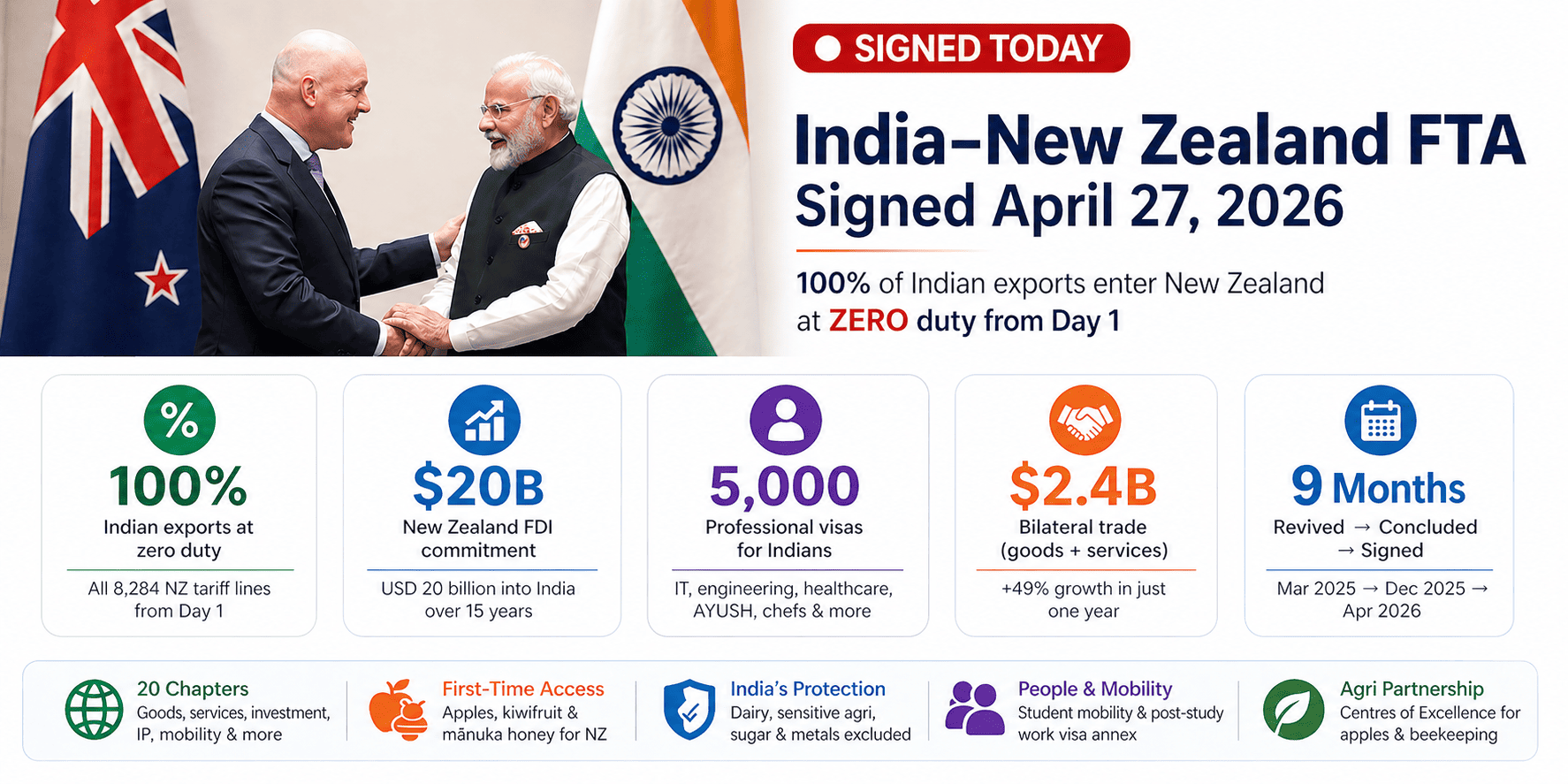
🔴 Signed Today🤝 Free Trade Agreement🇮🇳 India Exports🇳🇿 New Zealand
India–New Zealand FTA Signed: 100% Zero Duty on Indian Exports
Signed April 27, 2026 — India and New Zealand have concluded a “once-in-a-generation” trade deal. Every Indian export enters New Zealand at zero duty from Day 1. USD 20B in FDI committed. 5,000 professional visas opened. Here is every detail you need — and exactly how to convert this into real B2B business.
⚡ Direct Answer
India and New Zealand signed their Free Trade Agreement on April 27, 2026, eliminating duties on 100% of Indian exports to New Zealand from Day 1 of Entry into Force. New Zealand has committed USD 20 billion in FDI into India over 15 years, opened 5,000 professional visa pathways for skilled Indians, and for the first time signed a Student Mobility and Post Study Work Visa Annex with any country. Negotiations concluded in December 2025 — just 9 months after being revived in March 2025 — making it one of India’s fastest-ever concluded FTAs. The deal covers 20 chapters across goods, services, investment, SPS, TBT, customs, IP, and mobility. India has protected its sensitive sectors: dairy, most animal products, sugar, and several metals remain in the exclusion list covering 29.97% of tariff lines.
📅 April 27, 2026⏱ 16 min read✍️ GT Setu Editorial Team📰 Trade Policy + B2B Playbook📌 Sources: NZ MFAT · PIB India
🔴 SIGNED TODAYIndia–New Zealand FTA signed April 27, 2026 — 100% of Indian exports enter New Zealand at ZERO duty from Day 1◆USD 20 billion NZ investment commitment to India over 15 years — biggest FDI pledge in any India FTA◆5,000 professional visas for Indians in IT, engineering, healthcare, AYUSH, chefs & more◆NZ PM Christopher Luxon: “Once-in-a-generation trade pact” — concluded in just 9 months◆Find verified NZ & Oceania B2B partners on GT Setu — turn zero-duty access into real orders◆🔴 SIGNED TODAYIndia–New Zealand FTA signed April 27, 2026 — 100% of Indian exports enter New Zealand at ZERO duty from Day 1◆USD 20 billion NZ investment commitment to India over 15 years — biggest FDI pledge in any India FTA◆5,000 professional visas for Indians in IT, engineering, healthcare, AYUSH, chefs & more◆NZ PM Christopher Luxon: “Once-in-a-generation trade pact” — concluded in just 9 months◆Find verified NZ & Oceania B2B partners on GT Setu — turn zero-duty access into real orders◆
Indian Exports at Zero Duty
100%
All 8,284 NZ tariff lines — zero duty from Day 1 of Entry into Force
NZ FDI Commitment
$20B
USD 20 billion into India over 15 years — plus NZ Investment Desk for NZ investors
Professional Visas
5,000
TEE visas for skilled Indians in IT, engineering, healthcare, AYUSH & more
Bilateral Trade 2024-25
$1.3B
Merchandise trade; +49% growth in just one year; total goods+services ~$2.4B
Concluded In
9 Months
March 2025 revived → Dec 2025 concluded → Apr 2026 signed — record pace
Section 1 — The News
1 The Full Story: India–New Zealand FTA — Signed April 27, 2026
Signed Today — New Delhi, April 27, 2026
India and New Zealand Seal a “Once-in-a-Generation” Trade Deal — 100% Zero Duty, $20B Investment, 5,000 Visas
India and New Zealand signed their landmark Free Trade Agreement in New Delhi on April 27, 2026, in the presence of Commerce Minister Piyush Goyal, New Zealand’s Trade and Investment Minister Todd McClay, and New Zealand Prime Minister Christopher Luxon, who called it a “once-in-a-generation trade pact.” The signing ceremony was the culmination of a negotiation story stretching back to 2010 — and of an extraordinary final sprint: negotiations were revived in March 2025 and concluded in just nine months in December 2025.
The agreement delivers 100% zero-duty access for Indian exports to New Zealand from Day 1 of Entry into Force — all 8,284 New Zealand tariff lines fall to zero for Indian goods. India’s average applied tariff of 2.2% becomes zero immediately for all Indian suppliers. For labour-intensive sectors — textiles, leather, engineering goods, pharmaceuticals, plastics — which faced NZ peak tariffs of up to 10%, this is a structural, permanent competitive advantage over non-FTA exporters.
On the investment side, New Zealand has committed to facilitate USD 20 billion in FDI into India over 15 years — the largest investment commitment in any India bilateral FTA. India will establish a dedicated NZ Investment Desk to support NZ investors. The deal also opens 5,000 professional visa pathways for skilled Indians and creates India-first annexes on AYUSH traditional medicine and student mobility.
100%
Indian exports enter NZ at zero duty — all 8,284 tariff lines, from Day 1
$20B USD
New Zealand FDI commitment into India over 15 years
20 Chapters
Goods, services, investment, SPS, TBT, IP, mobility, customs and more
9 Months
Mar 2025 revived → Dec 2025 concluded — India’s fastest-ever FTA pace
5,000
Professional TEE visas for skilled Indians in IT, engineering, AYUSH, healthcare
“Today, this Free Trade Agreement is about building trade around people and launching opportunities for our farmers, for our entrepreneurs, for our students, for our women and for our innovators.”
— Piyush Goyal, Union Commerce and Industry Minister, India
“India today works with the rest of the world from a position of strength, full of confidence to engage, expand the relationship.”
— Piyush Goyal, at the FTA signing ceremony
💡 GT Setu Perspective
Zero-duty access is a structural advantage — but it is not automatic revenue. Every Indian manufacturer who now competes at zero duty in New Zealand still needs to find the right buyer, distributor, or joint venture partner in that market. The FTA opens the door; verified business partnerships are what walk through it. New Zealand’s Indian diaspora of 300,000 is a commercial bridge that understands both markets — and GT Setu’s verified network is where these connections are built systematically, not by chance.
Section 2 — Timeline
2 Negotiation Timeline: 15 Years to Reach This Day
🗓 India–New Zealand FTA — Full Negotiation Journey
2010
First Launch — Trade Negotiations Begin
India and New Zealand launch FTA negotiations. India’s bilateral trade with NZ at the time was well under $1 billion. Optimism on both sides about the potential of the relationship.
2010–2015
Nine Rounds Completed — Talks Stall
After nine rounds of negotiations, talks hit an impasse — primarily over dairy market access. New Zealand’s dairy sector sought access to India’s heavily protected market; India’s farm lobby held firm. Talks suspended in 2015.
India and New Zealand restart negotiations with a fresh mandate, new political will on both sides, and a significantly changed global trade environment. India’s global FTA momentum (UK, UAE, Australia, EFTA, Oman already concluded) provides a framework and confidence.
Dec 2025
Conclusion — Negotiations Wrapped in 9 Months (December 22, 2025)
India and New Zealand announce conclusion of FTA negotiations — just 9 months after revival. Commerce Minister Piyush Goyal confirms the agreement includes 100% NZ tariff elimination for Indian goods, USD 20B FDI commitment, and unprecedented mobility provisions. Called one of India’s fastest-concluded FTAs.
Apr 2026
Signing — April 27, 2026 (Today)
Formal signing in New Delhi by Piyush Goyal and Todd McClay, in the presence of NZ PM Christopher Luxon. Industry outreach event in Agra on April 26 preceded the signing, focusing on leather, pharma, AYUSH, medical devices, and engineering. Agreement awaits ratification and Entry into Force expected in 2026-27.
Section 3 — India’s Gains
3 What India Gets — Sector-by-Sector Analysis
The core gain for India is simple and unambiguous: every Indian export to New Zealand enters at zero duty from Day 1. New Zealand’s pre-FTA average applied tariff was 2.2%, with peaks of up to 10% on textiles, leather, engineering goods, and ceramics. All of those go to zero. Here is where Indian exporters will feel the biggest impact.
New Zealand imports approximately USD 11 billion in engineering goods annually from the world. India’s current share — USD 68.26M — is less than 1%. With peak tariffs of up to 10% now eliminated, Indian engineering manufacturers are now fully price-competitive with NZ’s existing suppliers from FTA partners like Australia, China (ChAFTA), and ASEAN (ASFTA). The addressable market expansion for quality, certified Indian engineering goods in NZ is measured in hundreds of millions over the next 5 years.
Section 4 — NZ Gains
4 What New Zealand Gets — And Why This Is Balanced
🇳🇿 New Zealand Key Gains from the India FTA
New Zealand Gets a Door Into the World’s Fastest-Growing Large Economy — With Carefully Managed Access
For New Zealand, this deal provides preferential access to a 1.4-billion-person economy projected to become the world’s third-largest by the early 2030s — and growing middle class consuming more premium goods and services. Critically, New Zealand is the first country ever to secure preferential access for apples and mānuka honey in any Indian FTA — two of NZ’s most iconic export products.
95%
NZ current exports to India get preferential access; 50%+ immediately on Day 1
Kiwifruit
First country to secure tariff-free kiwifruit access plus 50% reduction outside quota
Apples
First country to secure preferential apple access in any Indian FTA — via TRQ
Honey
Mānuka honey tariff cut 75% over 5 years — first honey access in any India FTA
Wine
India wine tariffs reduced 66-83% over 10 years; MFN clause locks in future improvements
Dairy
Fast-track mechanism for NZ dairy ingredients into India for further manufacturing & export; future review committed
Section 5 — The Anatomy
5 The Deal Anatomy — What Both Sides Bring to the Table
FTA Anatomy — India 🇮🇳 × New Zealand 🇳🇿 — Signed April 27, 2026
🥝 NZ: First-ever apple, kiwifruit & honey access in any India FTA
📈 Bilateral trade target: $2.4B → multiples over 15 years
Section 6 — Services & Mobility
6 Services, Visas & Mobility — India’s Hidden Wins
118
Services sectors where NZ made commitments; MFN treatment in 139 sectors
5,000
TEE professional visas per year for Indians — IT, engineering, healthcare, AYUSH, chefs, music teachers
1,000
Working Holiday Visas per year for young Indians — multiple entry, 12 months
AYUSH
First-ever Health and Traditional Medicine Annex NZ has signed — AYUSH, yoga, Ayurveda, homeopathy
3-4 yrs
Post-study work visas for Indian students: 3 yrs (STEM bachelor), up to 4 yrs (PhD)
MFN
Most Favoured Nation clause — India automatically benefits from any better services access NZ grants future FTA partners
🌏 Why the AYUSH Annex Matters for B2B
New Zealand has never before signed a dedicated Health and Traditional Medicine Services annex with any country. The India-first AYUSH annex recognises Ayurveda, Yoga & Naturopathy, Unani, Sowa-Rigpa, Siddha, and Homeopathy practitioners’ credentials for the NZ market. This creates structured B2B opportunities for Indian AYUSH product manufacturers, wellness tourism operators, and Ayurvedic ingredient exporters — not just practitioners. The $50 billion leather export ambition highlighted at the Agra pre-signing event is matched by quieter but significant opportunities in AYUSH product exports to NZ’s wellness-conscious consumer base.
Section 7 — Exclusions
7 India’s Protected Sectors — What’s Excluded and Why
India has kept 29.97% of tariff lines in its exclusion list — protecting the sectors where domestic political and economic sensitivity is highest. Understanding what is excluded is as important for B2B planning as knowing what is included.
Strategic metals; protect domestic smelting industry
No preferential access
Gems & Jewellery
Rough and polished gems, jewellery
Protect India’s world-leading gems and jewellery sector from reverse imports
No access
Arms & Ammunition
All arms and ammunition products
National security — standard exclusion in all Indian FTAs
Standard
Section 8 — Bilateral Trade Context
8 Bilateral Trade Context — Why This Deal’s Timing Is Perfect
📊 The Trade Momentum Story
India–NZ bilateral merchandise trade grew from USD 855 million (2015-16) to USD 1.3 billion (2024-25) — a 49% surge in just one year. India’s exports to NZ increased 130% over the decade while NZ imports into India grew only 7.21% — India consistently maintains a positive trade balance. Total trade including services reached approximately USD 2.4 billion in 2024. With 300,000 Indian-origin persons in New Zealand (5% of its population), the diaspora bridge is already proven and commercial. The FTA’s zero-duty access arrives precisely when bilateral trade momentum has hit its highest point — the multiplier effect will be significant.
Trade Metric
2015-16
2023-24
2024-25
Change (10yr)
Total Merchandise Trade
USD 855M
USD 873M
USD 1.3B
+52%
India Exports to NZ
~USD 309M
USD 537M
USD 711M
+130%
NZ Exports to India
~USD 546M
USD 336M
USD 587M
+7.21%
India Services Exports to NZ
—
USD 561M
USD 634M
+13% YoY
Total Goods + Services
—
—
~USD 2.4B
—
Section 9 — How to Leverage
9 How to Leverage the India–NZ FTA: The 5-Step B2B Playbook
Zero-duty market access is a necessary condition for export success — not a sufficient one. The Indian manufacturers who will actually grow their NZ business are the ones who convert the tariff advantage into verified buyer relationships, signed distribution agreements, and recurring purchase orders. Here is how.
1
Verify Your Product’s FTA Eligibility and Rules of Origin Compliance
Not every Indian product automatically benefits from zero-duty access. Your product must meet the India–NZ FTA’s Rules of Origin (ROO) requirements, which are aligned with India’s existing FTAs. Self-declaration is available for approved exporters from Day 1. If your product uses imported materials, calculate whether the value-addition in India meets the ROO threshold. This is the foundational step before any commercial conversation — do not promise zero-duty pricing to NZ buyers before confirming ROO compliance.
2
Build a Verified Capability Profile Before Approaching NZ Distributors
New Zealand is a high-income, rules-based market. NZ buyers and distributors are sophisticated and require documented supplier capability — certifications, factory audits, quality management systems, financial references, and export track records. A brochure is not sufficient. Use GT Setu’s 6-point verification process to create an independently verified company profile before reaching out to any NZ distribution partner. This verification is the first commercial signal you send — make it credible.
3
Choose the Right Market Entry Model — Distributor First, Then JV
New Zealand is a small market (5 million people) but a high-value one ($49,380 GDP per capita). For most Indian manufacturers, the right entry model is a verified local distributor who already has established buyer relationships, warehouse infrastructure, and regulatory knowledge. The FTA’s MSME cooperation chapter provides institutional linkages for small businesses. Evaluate a JV only after distributor volumes justify the deeper capital commitment. The NZ Investment Desk created by the FTA will assist NZ investors in India — the reverse channel is distributor-first for most Indian exporters heading to NZ.
4
Protect Your IP and Products Before Any Market Disclosure
The FTA includes an IP chapter with NZ committing to amend its laws within 18 months to provide EU-level protection for Indian Geographical Indications (GIs). However, at the business level, GI protection is not the same as commercial IP protection. Before sharing product formulations, manufacturing specifications, proprietary packaging, or brand assets with any potential NZ distributor, execute a mutual NDA. GT Setu’s built-in NDA workflow handles this automatically — mutual NDA countersigned before any sensitive commercial information is shared, with a full digital audit trail.
The FTA includes concrete trade facilitation commitments: goods released by customs within 48 hours of arrival (24 hours for perishables), advance rulings on origin and classification, electronic documentation, and paperless trade systems. For Indian food and agriculture exporters specifically, the Agricultural Productivity Partnership creates structured cooperation including Centres of Excellence for premium apple cultivation and sustainable beekeeping — which means supply chain collaboration, not just trade. Use the 48-hour clearance commitment as a sales argument with NZ buyers who currently face longer clearance times from competing suppliers.
Section 10 — Dos & Don’ts
10 Dos and Don’ts for Indian Exporters and Manufacturers
✅ Do These
✅ Confirm your product’s Rules of Origin compliance before marketing zero-duty prices to NZ buyers
✅ Register as an approved exporter to benefit from self-declaration of origin from Day 1
✅ Focus first on sectors with highest NZ import volumes — engineering ($11B/yr), textiles ($1.9B/yr), pharma ($1.4B/yr)
✅ Build an independently verified supplier profile before approaching NZ distributors or buyers
✅ Sign NDA before sharing product formulations, specifications, or proprietary commercial information
✅ Leverage the Indian diaspora in NZ (300,000 people; 5% of population) as commercial intelligence and network entry
✅ Use NZ as a gateway to wider Oceania and Pacific Island markets where India has no other FTA
✅ For agri-food exporters, explore the Agricultural Productivity Partnership and Centres of Excellence for supply chain collaboration
✅ Use the FTA’s 48-hour customs clearance commitment as a competitive sales argument to NZ buyers
✅ For AYUSH products and services, the India-first Health and Traditional Medicine Annex creates a structured first-mover advantage — act now
❌ Avoid These
❌ Assume zero duty means automatic orders — market access ≠ market share; you still need the right buyer
❌ Promise FTA-preferential pricing to NZ buyers before confirming Rules of Origin compliance
❌ Treat NZ as a homogenous market — Māori cultural sensitivities, Food Standards NZ regulations, and NZFSA requirements are distinct from Indian market standards
❌ Ignore NZ’s strict biosecurity, labelling, and food safety requirements — failure here will void the commercial advantage of zero duty
❌ Share product samples, specifications, or brand assets before NDA is signed
❌ Expect the NZ market to absorb Indian volumes without a verified local distribution network in place
❌ Neglect NZ’s NZBN (New Zealand Business Number) requirement for entities doing business in NZ
❌ Misread the dairy exclusion — NZ dairy ingredients can enter India via the fast-track manufacturing mechanism; this is not total exclusion
❌ Wait for the FTA to enter into force before building distributor relationships — by then, competitors will already have signed exclusives
❌ Assume the FTA’s professional visa provisions are easy — the 5,000 TEE visa quota is sector-specific and requires formal applications
Section 11 — Misconceptions
11 Common Misconceptions About FTA Benefits
❌ Myth
“Zero duty means NZ buyers will automatically seek out Indian suppliers.”
✅ Reality
Zero duty removes a cost barrier — it does not create demand. NZ buyers need verified supplier capability, quality certification, competitive pricing, reliable supply, and regulatory compliance before they switch from existing suppliers. The FTA gives Indian exporters a level playing field; verified B2B relationships are what win the order. India’s current share of NZ’s $11B engineering import market is less than 1% — the gap is not tariffs alone.
❌ Myth
“The FTA covers all Indian exports — my product automatically qualifies.”
✅ Reality
Zero-duty access is conditional on meeting Rules of Origin (ROO) requirements. Products using imported inputs must demonstrate sufficient value-addition in India to qualify as “Indian origin” under the FTA. Self-certification is available from Day 1 for approved exporters, but the ROO verification process must be completed first. Products that fail ROO will pay standard NZ MFN tariffs even after the FTA enters into force.
❌ Myth
“The NZ market is too small — India’s manufacturing scale makes this deal irrelevant.”
✅ Reality
New Zealand’s small population (5M) belies its commercial value: $49,380 GDP per capita, $47B annual imports, and a gateway to Oceania and Pacific Island markets where India has no other FTA. India’s services exports to NZ grew 13% in one year to USD 634M. The leather and footwear industry sees NZ as a stepping stone to a $50B export ambition regionally. NZ is not the end market — it is the hub market for the wider Pacific rim.
❌ Myth
“India gave up too much — NZ dairy will flood the Indian market.”
✅ Reality
India has protected its entire dairy sector in the exclusion list. Milk, cream, whey, yoghurt, butter, and cheese products all remain excluded. New Zealand received only a fast-track mechanism for dairy ingredients entering India for further manufacturing and export — not retail market access. This is actually a sophisticated supply chain collaboration provision, not a market opening. India’s 75 million dairy farming households are not commercially impacted.
❌ Myth
“The USD 20B FDI commitment is just a number — NZ is too small to invest that much.”
✅ Reality
New Zealand’s total overseas investment stands at USD 422.6 billion as of March 2025 — the country invests nearly 8% of its GDP annually overseas. The USD 20B commitment over 15 years equals roughly USD 1.3B per year, which is less than 0.3% of NZ’s existing overseas investment base. It is ambitious but not implausible. The dedicated NZ Investment Desk India will create will help channel NZ institutional and private sector capital into India’s rapidly growing economy.
Section 12 — GT Setu
12 How GT Setu Converts Zero-Duty Access Into Real Orders
The India–NZ FTA has done its job: it has made Indian exports price-competitive in the New Zealand market by eliminating every tariff line. Now the work begins. Market access is the structure; verified business relationships are the mechanism. GT Setu is the platform that builds those verified relationships — systematically, securely, and at no broker commission.
🌐 Platform Spotlight — GT Setu
Find Verified NZ Distributors, Buyers, and B2B Partners — Turn the India–NZ FTA Into Real Revenue
GT Setu is the verification-first B2B manufacturing and trade discovery platform connecting Indian manufacturers, exporters, and service providers with verified partners across New Zealand, Australia, Oceania, and 100+ countries — with multi-layer verified profiles, built-in NDA workflows, and zero broker commission on any partnership formed. Zero-duty access means your price is competitive. A verified GT Setu profile means your capability is credible. Together, they are how the FTA converts into a purchase order.
✅
6-Point VerificationBusiness registration, certifications, export references — your capability is documented before you approach any NZ partner.
🕵️
Anonymous DiscoveryBrowse verified NZ distributor and buyer profiles before revealing your identity — no cold calls.
📄
Built-In NDA WorkflowMutual NDA executed automatically before any product spec, pricing, or commercial data is shared.
🚫
Zero CommissionNo broker fees. Your distribution agreement, JV, or supply contract is directly between you and your partner.
🌏
Oceania + PacificNZ as a Pacific hub — verified partners in NZ, Australia, and island markets that connect to India’s zero-duty FTA access.
🔐
Secure WorkspaceShare samples, product data, and pricing securely with verified partners only — full audit trail.
How the FTA Creates Opportunity — How GT Setu Converts It Into Business
FTA Provision
What It Creates
How GT Setu Helps You Act On It
Zero duty on 100% of Indian exports
Price competitiveness vs non-FTA suppliers in NZ market
✓ Verified NZ distributor profiles with sector coverage — find who’s importing your category already
USD 20B NZ FDI commitment
NZ investors actively seeking Indian manufacturing partners
✓ Anonymous discovery — evaluate NZ investor profiles before revealing your company identity
AYUSH and traditional medicine annex
Structured market access for AYUSH products and wellness services in NZ
✓ Verified NZ wellness, pharma, and healthcare distributor matching
IP protections and NDA framework
Legal framework for sharing product data across borders
✓ Built-in NDA workflow — mutual NDA before any product specification is shared
MSME cooperation chapter
Institutional linkages for small businesses to access trade information
✓ GT Setu serves manufacturers at every scale — no minimum revenue requirement for verified profiles
Agricultural Productivity Partnership
Supply chain collaboration between Indian and NZ agri-businesses
✓ Agri-food sector verified partner discovery — from ingredients to distribution
FAQ
? Frequently Asked Questions
QWhat is the India–New Zealand FTA and when was it signed?
The India–New Zealand Free Trade Agreement was signed on April 27, 2026, in New Delhi by Commerce Minister Piyush Goyal and NZ Trade Minister Todd McClay. Negotiations were revived in March 2025 after stalling since 2015, and concluded in just 9 months in December 2025 — one of India’s fastest-concluded FTAs. The deal eliminates duties on 100% of Indian exports to New Zealand from Day 1 of Entry into Force, commits New Zealand to USD 20 billion in FDI into India over 15 years, and opens 5,000 professional visa pathways for skilled Indians. It covers 20 chapters including goods, services, investment, SPS, TBT, customs, IP, and mobility.
QWhich Indian sectors benefit most from zero-duty access to New Zealand?
The sectors with the most significant immediate benefit are those that faced peak NZ tariffs of up to 10% and now enter at zero: textiles and clothing (1,057 tariff lines; NZ market imports $1.9B/year globally), engineering goods (1,396 tariff lines; NZ market imports $11B/year — the biggest opportunity), leather and footwear (181 tariff lines; peak 10% eliminated), and pharmaceuticals (90 tariff lines). Plastics and rubber (397 lines), marine products (363 lines), and agriculture including spices, fruits, cereals, and processed foods all benefit from full tariff elimination. Services sectors — IT, engineering, healthcare, education, AYUSH — also benefit from NZ committing across 118 sectors.
QDoes New Zealand get dairy access into India?
No — dairy products (milk, cream, whey, yoghurt, cheese, butter) are in India’s exclusion list and remain fully protected. However, a dedicated fast-track mechanism has been agreed for NZ dairy ingredients entering India for further manufacturing and export — meaning NZ dairy can enter India as an industrial input for processed foods that are then exported, not as retail dairy products. New Zealand also receives a commitment that India will consult with NZ if it offers dairy access to comparable countries in the future, alongside a one-year post-entry review commitment. India’s 75 million dairy farming households are not commercially impacted.
QWhat visa benefits does the India–NZ FTA create for Indian professionals?
The FTA creates three visa pathways for Indians: (1) 5,000 Temporary Employment Entry (TEE) visas for skilled professionals for stays of up to 3 years — covering IT, engineering, healthcare, education, construction, plus iconic Indian occupations (AYUSH practitioners, yoga instructors, chefs, music teachers). (2) 1,000 Working Holiday Visas per year for young Indians — multiple entry, 12 months. (3) Student mobility — Indian students can work 20 hours per week while studying in NZ, with post-study work visas of 3 years for STEM bachelor graduates, up to 3 years for master’s, and up to 4 years for PhD. This is the first Student Mobility and Post Study Work Visa Annex NZ has signed with any country.
QWhen does the India–NZ FTA enter into force?
The agreement was signed on April 27, 2026. It will formally enter into force after ratification by both countries’ parliaments or domestic processes. Entry into force is expected in 2026-27. The zero-duty access for Indian exports, the USD 20B FDI commitment, and the visa provisions all take effect from the date of Entry into Force — not from the signing date. Indian exporters should use this window (between signing and Entry into Force) to complete their Rules of Origin compliance verification, build NZ distributor relationships through platforms like GT Setu, and apply for approved exporter status for self-declaration of origin.
QHow can I find New Zealand distributors or buyers for my Indian products using the FTA?
The FTA creates the commercial framework — finding the right NZ partner requires a systematic, verified approach. (1) Build a verified capability profile — GT Setu’s 6-point verification creates an independently documented supplier profile before you approach any NZ buyer. (2) Discover anonymously — browse verified NZ distributor and importer profiles by sector without revealing your identity. (3) Protect IP with built-in NDA — mutual NDA executed automatically before any product specification, pricing, or commercial data is shared. (4) No broker commission — all partnership terms are directly between you and your NZ partner. Start your NZ partner search on GT Setu →
The FTA Has Opened the Door. GT Setu Walks You Through It.
Zero-duty access is India’s structural advantage in New Zealand from Day 1. Verified NZ distributors, buyers, and B2B partners are what convert that advantage into purchase orders. 500+ verified manufacturers, distributors, and B2B partners across New Zealand, Australia, Oceania, and 100+ countries. Zero broker fees. Built-in NDA workflows. Start before Entry into Force — before your competitors do.
They represents the product, and research team behind GTsetu, a global B2B collaboration platform built to help companies explore cross-border partnerships with clarity and trust. The team focuses on simplifying early-stage international business discovery by combining structured company profiles, verification-led access, and controlled collaboration workflows.
With a strong emphasis on trust, and disciplined engagement, Team GTsetu shares insights on global trade, partnerships, and cross-border collaboration, helping businesses make informed decisions before entering deeper commercial discussions.