Free for a limited time·Profile verification free·First collaboration free·100+ Companies Onboarded·15+ Collaborations Closed This Month!·No Commission & No Profit Share·Free for a limited time·Profile verification free·First collaboration free·100+ Companies Onboarded·15+ Collaborations Closed This Month!·No Commission & No Profit Share·Free for a limited time·Profile verification free·First collaboration free·100+ Companies Onboarded·15+ Collaborations Closed This Month!·No Commission & No Profit Share·
US–UK Free Trade Agreement (FTA) 2026: Signed, Tariffs Cut, Digital Gold Standard | GTsetu
🇺🇸 US–UK Trade Deal🏗️ Post-Brexit Policy💻 Digital Trade🌐 Special Relationship
US–UK Free Trade Agreement: Gold Standard Digital Chapter & Tariffs Eliminated in 2026 Landmark Deal
When the world’s largest economy signs a comprehensive free trade agreement with its closest strategic partner, the signal transcends tariff schedules: this is a structural rewiring of the transatlantic trade architecture — tackling post-Brexit frictions, eliminating steel and agricultural barriers, and setting a precedent for financial data sovereignty with a dedicated digital trade chapter that observers are calling the “Gold Standard” for modern FTAs.
🎯 Direct Answer
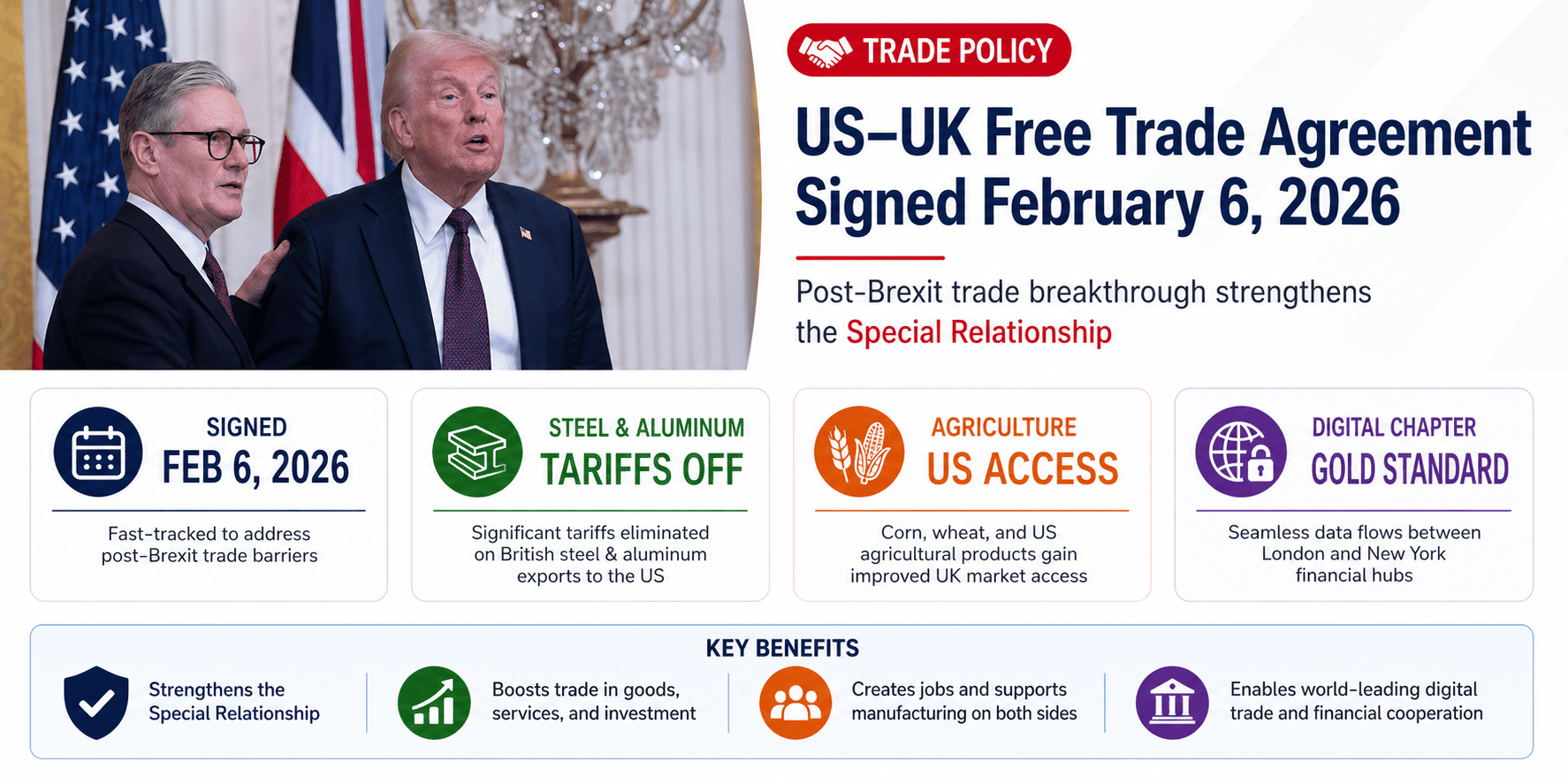
The US–UK Free Trade Agreement was signed on February 6, 2026, fast-tracked to resolve post-Brexit trade barriers and deepen the Special Relationship. The deal delivers on three fronts: it removes significant tariffs on British steel and aluminum entering the US market; it lifts tariffs on US agricultural exports including corn and wheat heading to the UK; and it includes a landmark “Gold Standard” digital trade chapter enabling seamless cross-border data flows between the London and New York financial centres. For manufacturers, exporters, and financial services firms, the FTA opens material new pathways — and introduces a compliance and opportunity landscape that rewards those already positioned with verified transatlantic partners.
📅 February 10, 2026⏱ 11 min read✍️ GTsetu Editorial Team📊 Signed: February 6, 2026
🤝 TRADE POLICYUS–UK FTA signed February 6, 2026 — post-Brexit trade breakthrough strengthens the Special Relationship◆British steel & aluminum tariffs eliminated — US corn and wheat tariffs lifted under the deal◆Gold Standard digital trade chapter — seamless data flows between London and New York financial hubs◆GTsetu — verified cross-border manufacturing and trade partners across 100+ countries◆🤝 TRADE POLICYUS–UK FTA signed February 6, 2026 — post-Brexit trade breakthrough strengthens the Special Relationship◆British steel & aluminum tariffs eliminated — US corn and wheat tariffs lifted under the deal◆Gold Standard digital trade chapter — seamless data flows between London and New York financial hubs◆GTsetu — verified cross-border manufacturing and trade partners across 100+ countries◆
Signed
Feb 6, 2026
Fast-tracked to address post-Brexit trade hurdles between the US and UK
Steel & Aluminum
Tariffs Cut
Significant tariff removal on British steel and aluminum exports to the US
Agriculture
US Access
Corn, wheat, and US agricultural products gain improved UK market access
Digital Chapter
Gold Standard
Seamless data flows between London and New York financial hubs enshrined in treaty
Section 1 — Context
1 The Deal in Context: Why February 2026
US–UK FTA — Signed February 6, 2026
The Most Consequential Bilateral Trade Deal of the Post-Brexit Era — Seven Years in the Making.
The UK formally left the EU’s single market on January 1, 2021. For five-plus years, a comprehensive US–UK FTA remained elusive — stalled by disagreements over agricultural standards, pharmaceutical pricing, NHS procurement, and the Northern Ireland Protocol. The February 6, 2026 signing resolves the central impasse: it is a fast-tracked, comprehensive deal that addresses the most commercially significant post-Brexit trade barriers between the world’s largest economy and its closest anglophone partner.
The political framing is explicit: “strengthening the Special Relationship” — a phrase that signals the FTA is as much diplomatic architecture as trade mechanics. For manufacturers, logistics operators, and financial services firms operating across the Atlantic, the practical impact is material tariff reduction, regulatory convergence pathways, and an unprecedented digital trade framework.
Feb 6, 2026
Signing date — fast-tracked after post-Brexit impasse resolved
Comprehensive
Covers goods, agriculture, services, digital trade, and investment
Post-Brexit
Addresses trade barriers in place since UK left EU single market in 2021
Special Relationship
Framed as strategic as well as commercial — US–UK geopolitical alignment deepened
Duration of negotiations
5+ yrs
Negotiations began post-Brexit vote; formal FTA rounds stretched across multiple governments
UK–US trade value
~$300B
Annual bilateral goods and services trade — one of the world’s largest bilateral relationships
Steel & aluminum
Tariffs Off
Significant UK steel and aluminum tariffs removed for US market entry under the deal
Agriculture
Corn + Wheat
US agricultural exports gain preferential UK access — corn and wheat named specifically
Digital chapter
Gold Standard
Financial data flows between London and New York — first of its kind treaty-level framework
Financial hubs
LON + NYC
Both cities’ financial sector data sovereignty enshrined — seamless cross-border flows enabled
Section 2 — Steel & Aluminum
2 Steel, Aluminum, and Manufacturing Tariffs
The most immediate relief for British manufacturers arrives in the metals sector. The Section 232 tariffs — 25% on steel and 10% on aluminum — that the US imposed in 2018 and maintained through successive administrations remained a persistent drag on UK industrial exports. The FTA removes these tariffs for UK-origin product, subject to rules-of-origin and melted-and-poured criteria that prevent third-country circumvention.
The removal of steel and aluminum tariffs is not a symbolic gesture — it restores UK producers to competitive parity with Canada and Mexico under USMCA, reshaping the transatlantic metals trade map overnight.
— GTsetu editorial synthesis of FTA tariff schedule analysis
Sector
Previous tariff position
Post-FTA position
Impact
British steel
25% Section 232 tariff (US)
Eliminated
UK producers regain cost parity with USMCA partners in US market
British aluminum
10% Section 232 tariff (US)
Eliminated
Aerospace-grade and packaging aluminum export economics substantially improved
US corn
UK MFN / WTO tariff applicable post-Brexit
Preferential rate
US agricultural exporters gain over EU corn for UK feed and processing supply chains
US wheat
UK MFN tariff applicable
Preferential rate
US wheat gains milling and export share in UK — volume uplift expected within 12–24 months
UK manufactured goods
Mixed; some MFN, some subject to quotas
Phased reduction
Tariff schedules phase down over 5–10 year tracks for sensitive categories
The tariff elimination on steel and aluminum applies to UK-origin product under melted-and-poured criteria. Manufacturers sourcing slab or billet from third countries for finishing in the UK should review their origin qualification before assuming preferential access. GTsetu-verified UK partners with certified domestic melting capacity are best-positioned to capture day-one tariff savings.
Section 3 — Agriculture
3 Agriculture: US Corn, Wheat, and UK Market Access
The agricultural chapter was among the most contentious in negotiations — UK consumer groups and farming unions pushed back on US hormone-treated beef and chlorinated chicken standards. The final text navigates this by granting preferential tariff access to specific US commodity crops (corn and wheat prominently cited) while retaining UK food safety standards for processed and fresh products. This represents a phased opening rather than wholesale alignment to US agricultural norms.
🌽
US corn: feed and ethanol supply chains
US corn exporters gain preferential rates into the UK, displacing some EU and Black Sea volume in UK animal feed and bioethanol processing. AHDB and USDA forecasts suggest volume uplift of 15–25% within two harvest cycles as contracts reprice to new tariff economics.
+15–25%
Estimated volume uplift (US corn to UK)
🌾
US wheat: milling and baking industry impact
Hard red winter wheat — a US specialty — gains meaningful access for the UK milling sector. UK bakers and flour millers operating on blended grist strategies will benefit from greater competition and potentially lower input costs versus current EU and Canadian supply.
Preferential
Rate — day-one access
🥩
Beef and poultry: standards retained, quotas expanded
UK food safety standards on hormone treatment and chlorine washing are preserved in the FTA text. However, tariff-rate quotas for US beef are expanded — allowing more conventionally-raised US beef (which can be produced to UK-equivalent standards) into the market under managed volume limits.
TRQ+
Expanded quota access
Section 4 — Digital Chapter
4 The Gold Standard Digital Trade Chapter
The most globally significant and structurally novel element of the US–UK FTA is its digital trade chapter — described by both governments and independent trade lawyers as a “Gold Standard” framework. It goes substantially further than the digital provisions in CPTPP, USMCA, or even the UK–Singapore Digital Economy Agreement.
Digital Trade Chapter — Gold Standard
Seamless Data Flows Between London and New York: A Treaty-Level Framework for the World’s Two Largest Financial Centres.
The chapter prohibits unjustified data localisation requirements — meaning neither government can mandate that financial data generated in one jurisdiction must be stored or processed domestically. This directly addresses a long-standing regulatory friction for banks, asset managers, and fintech firms operating dual London–New York infrastructure.
Beyond data flows, the chapter establishes regulatory cooperation mechanisms between the FCA and SEC, a mutual recognition framework for digital identity and e-signatures, and prohibitions on customs duties on electronic transmissions — locking in a duty-free digital trade floor that neither party can unilaterally reverse without treaty renegotiation.
No localisation
Data storage mandates prohibited — London and NYC infrastructure interoperable
FCA ↔ SEC
Regulatory cooperation framework for financial services data governance
Zero duties
Customs duties on electronic transmissions permanently prohibited under treaty
e-ID mutual recognition
Digital identity and e-signature frameworks recognised across both jurisdictions
Fintech
London and NY fintech firms gain treaty-level cross-border data portability — no retroactive localisation risk
Banking
Global banks running unified UK–US data lakes can consolidate infrastructure without regulatory bifurcation costs
AI / cloud
Cloud-first financial services platforms benefit as treaty bars forced local compute mandates in either market
💡 What “Gold Standard” means in practice
Unlike GDPR-era data transfer mechanisms (SCCs, adequacy decisions) which are subject to legal challenge, the digital trade chapter creates treaty-level obligations that override domestic regulatory change. For compliance teams, this means UK–US data flows are shielded from the recurring Schrems-style risk that has disrupted EU–US data infrastructure. The framework is widely viewed as a model for future digital trade agreements globally.
Section 5 — Timeline
5 Post-Brexit Road to the FTA: Timeline
January 2021
UK leaves EU single market and customs union
Post-Brexit trade arrangement with the EU finalised; UK begins independent trade policy. US–UK FTA negotiations on hold pending US administration review.
Multiple rounds break down over US demands for UK alignment on agricultural standards. Northern Ireland Protocol complicates UK’s treaty-making capacity for goods. BeefChlorinated chickenNHS procurement
2024
Digital trade framework breaks the logjam
Both governments agree to lead with a digital chapter rather than resolve every goods dispute first. FCA–SEC regulatory cooperation MOU signed as precursor to treaty-level provisions. Digital firstFCA–SEC MOU
Late 2025
Fast-track: steel, aluminum, and agriculture package finalised
Section 232 tariff removal for UK metals agreed in exchange for expanded US agricultural TRQs. Parliamentary and Congressional fast-track authority invoked to accelerate ratification.
February 6, 2026
US–UK FTA signed — Special Relationship formalised in trade law
Comprehensive agreement signed. Steel and aluminum tariffs effective on entry into force date. Digital chapter provisions enter into force within 90 days of ratification by both legislatures. SignedGold Standard digital chapterTariff removal
Section 6 — GTsetu
6 What This Means for Cross-Border Manufacturers and Exporters
The US–UK FTA is a structural market-access event, not a marginal policy change. For manufacturers, the winners are those already positioned with verified UK and US supply chain partners who can certify rules-of-origin compliance, manage tariff classification under the new schedule, and qualify product through both FDA and UK conformity frameworks where mutual recognition pathways now apply.
UK steel and fabrication firms — review melted-and-poured origin documentation and certify US export product under FTA provisions immediately to capture day-one tariff savings.
US agricultural exporters — engage UK buyers now as long-term contracts reprice to preferential tariff economics; build distributor relationships before EU-linked competitors respond.
Fintech and financial services — leverage the digital chapter’s data flow provisions to rationalise UK–US infrastructure, reduce compliance overhead, and scale cross-border products without localisation risk.
Pharmaceutical and medtech firms — engage the FDA–MHRA mutual recognition pathway to compress dual-market approval timelines and reduce duplicative testing costs.
🌐 GTsetu
Find Verified Partners on Both Sides of the Atlantic — From Day One of the FTA.
Whether you’re a UK manufacturer qualifying for US tariff-free access, a US agricultural exporter building UK distribution, or a financial services firm seeking compliant cross-border partners under the new digital chapter, GTsetu connects you to verified manufacturers and trade partners — NDA-protected from first contact.
✓
500+ verified partners Across US, UK, and 100+ countries — filter by capability, certs, and region.
🔒
NDA-first workflow Protect drawings and commercial strategy before deep technical reviews.
🧭
FTA-ready network Partners pre-screened for rules-of-origin compliance, regulatory certs, and export readiness.
Tariff elimination is not automatic on signing — it takes effect on the entry into force date following ratification by both legislatures. Exporters should not adjust pricing or contractual commitments until formal EIF proclamation. Rules-of-origin documentation requirements apply from EIF, not from signing. Consult your customs broker and trade counsel before adjusting classification or invoicing.
FAQ
? Frequently Asked Questions
QWhen was the US–UK Free Trade Agreement signed?
The US–UK FTA was signed on February 6, 2026. It was fast-tracked to address post-Brexit trade barriers and strengthen the Special Relationship between the United States and the United Kingdom.
QWhat tariffs does the US–UK FTA eliminate?
The deal removes significant tariffs on British steel and aluminum entering the US market (previously 25% and 10% respectively under Section 232). On the other side, it removes or reduces UK tariffs on US agricultural products including corn and wheat, granting preferential rates for US commodity exports.
QWhat is the Gold Standard digital trade chapter?
The Gold Standard digital trade chapter is a treaty-level framework that enables the seamless flow of data between the London and New York financial hubs. It prohibits unjustified data localisation requirements, establishes FCA–SEC regulatory cooperation, bans customs duties on electronic transmissions, and provides mutual recognition of digital identity and e-signatures. It is widely regarded as the most comprehensive digital trade chapter in any bilateral FTA to date.
QDoes the FTA change UK food safety standards?
No. The FTA preserves UK food safety standards on hormone-treated beef and chlorinated poultry — these were not harmonised to US norms. However, tariff-rate quotas for US beef and agricultural commodity crops are expanded, giving US producers preferential but managed access rather than unrestricted import rights.
QWhen do the tariff cuts take effect?
Tariff eliminations take effect on the entry into force (EIF) date — which follows ratification by both the US Congress and UK Parliament. The agreement was signed February 6, 2026; exporters and importers should monitor official EIF proclamations before adjusting pricing, classification, or commercial contracts.
Capture the US–UK FTA Opportunity With the Right Partners.
The deal is signed. The tariff savings are real. GTsetu helps UK and US manufacturers, exporters, and financial services firms find verified cross-border partners — NDA-protected from first technical touch — so you move before competitors do.
They represents the product, and research team behind GTsetu, a global B2B collaboration platform built to help companies explore cross-border partnerships with clarity and trust. The team focuses on simplifying early-stage international business discovery by combining structured company profiles, verification-led access, and controlled collaboration workflows.
With a strong emphasis on trust, and disciplined engagement, Team GTsetu shares insights on global trade, partnerships, and cross-border collaboration, helping businesses make informed decisions before entering deeper commercial discussions.