Why a Framework Supply Agreement Matters in Global Trade
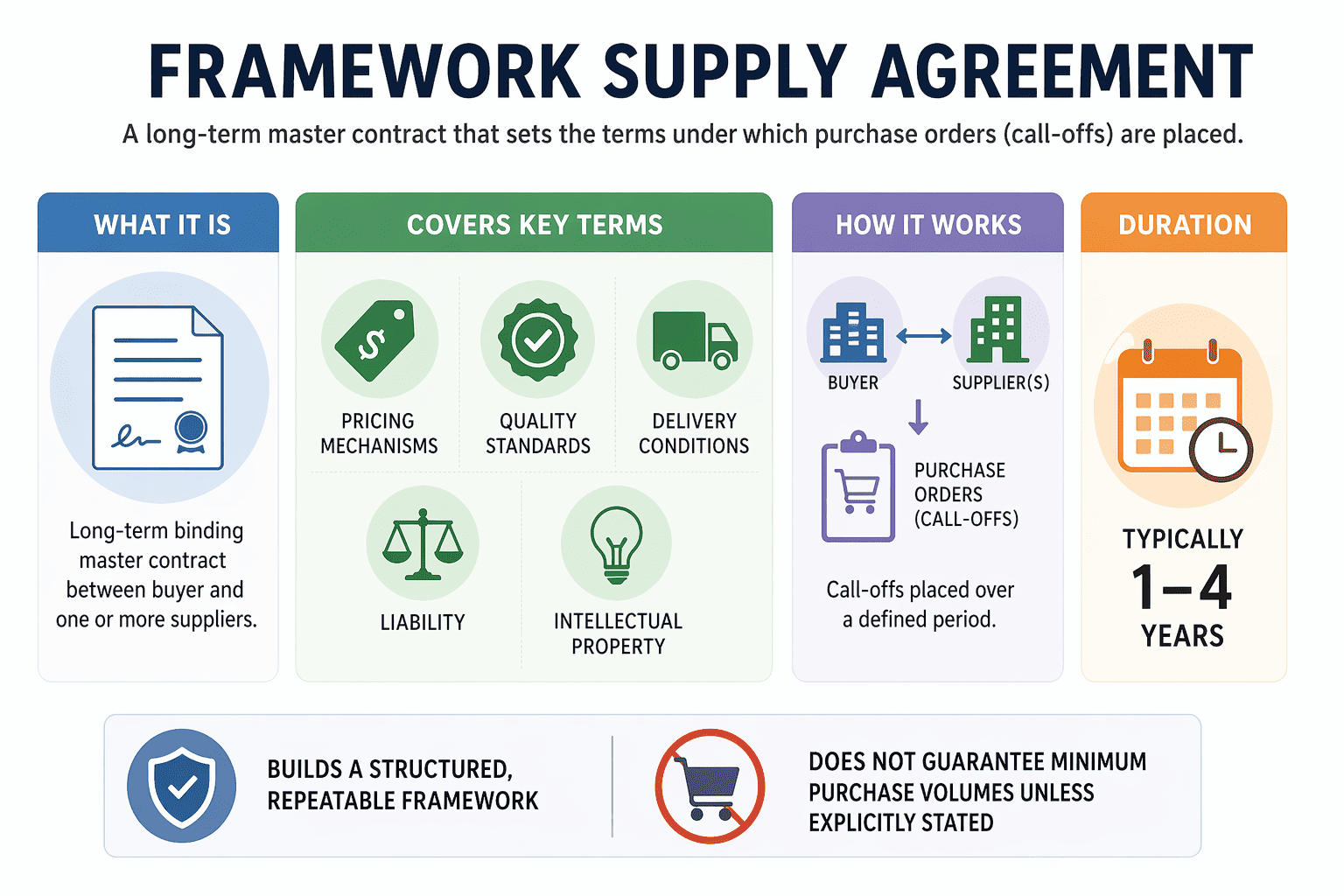
In cross-border manufacturing and distribution, negotiating a full contract for every transaction is inefficient and impractical. A Framework Supply Agreement solves this by locking in the agreed commercial rules, pricing, quality specifications, delivery terms, and legal protections, once, after which individual purchase orders execute under that umbrella. This structure is widely used in public procurement, automotive supply chains, electronics manufacturing, and consumer goods distribution. It provides buyers with pricing certainty and streamlined ordering, while suppliers gain a stable, multi-year relationship horizon. However, a framework does not guarantee volume; suppliers must carefully assess minimum commitment provisions before signing.
✨ GTsetu Insight
On the GTsetu platform, a Framework Supply Agreement is the natural next step after two verified companies complete initial discovery. The platform’s structured company profiles and 6-point government tie‑up verification (legal name, registered address, registration number, company status, company type, date of certificate of incorporation) help manufacturers and distributors establish the trust baseline needed to move from Letter of Intent (LOI) to a binding framework.
How a Framework Supply Agreement Works
Once executed, the framework governs all future transactions. The buyer places call-off orders (individual purchase orders) referencing the framework. Each call-off triggers the supplier’s obligation to deliver and the buyer’s obligation to pay under the pre-agreed terms. If the framework includes multiple suppliers, the buyer may run mini-competitions or directly award orders based on ranking. The agreement typically lasts 1–4 years and may include renewal options. Without minimum volume guarantees, the buyer is not obliged to place any orders, the framework provides opportunity, not revenue certainty.
Types of Framework Supply Agreements
🏭 Single‑Supplier Framework
One supplier is appointed as the exclusive provider for the defined scope. All call-off orders during the term are placed with that supplier. Best suited for specialised components, proprietary technology, or highly integrated supply relationships.
🔄 Multi‑Supplier Framework
Several pre-qualified suppliers are included. Orders are awarded through mini-competitions or direct selection based on pre-agreed criteria (price, delivery, quality). Maintains competition and reduces concentration risk, common in public procurement and high-volume commercial buying.
Anatomy of a Framework Supply Agreement: Core vs. Protective Clauses
⚙️
Pricing & adjustment mechanism
Fixed, index-linked, or subject to periodic review.
📦
Call-off procedure
How orders are placed, acknowledged, and confirmed.
📏
Quality standards & specifications
Technical requirements, tolerances, certification.
⏱️
Lead times & Incoterms
Delivery windows, shipping obligations.
🔒
Confidentiality & NDAProtection of pricing and technical information, see
NDA resource.
⚖️
IP ownership
Tooling, designs, formulations, critical in manufacturing frameworks.
🛡️
Limitation of liability
Caps on exposure, exclusions for consequential loss.
🌍
Governing law & dispute resolution
Essential for cross-border enforceability.
Framework vs. MSA vs. MoU
| Document | Binding Status | Primary Use | Implemented By |
|---|
| Framework Supply Agreement | Fully binding\n | Recurring supply of goods\n | Call-off orders / purchase orders\n |
\n| Master Services Agreement (MSA)\n | Fully binding\n | Services, IT, consulting, outsourcing\n | Statements of Work (SOWs)\n |
\n| Memorandum of Understanding (MoU)\n | Generally non-binding commercially\n | Early-stage intent & framework\n | Formal binding agreement\n |
\n| Conditional Agreement\n | Fully binding, performance deferred\n | Transactions subject to regulatory/financing conditions\n | Unconditional closing\n |
Real-World Use Cases in Cross-Border Manufacturing
🚗Automotive OEM Supply
Tier-1 suppliers operate under multi-year frameworks covering just-in-time delivery, quality holdbacks, and annual price reductions.
📱Electronics Manufacturing (EMS)
Brands sign framework agreements with contract manufacturers for component pricing, MOQs, and IP protection across multiple product generations.
🏛️Public Procurement
Government agencies use frameworks for medical supplies, construction materials, and IT hardware, suppliers compete for a place, then bid for call-offs.
⚠️ Critical Supplier Risk
A framework without minimum volume commitments or take-or-pay provisions creates no guaranteed revenue. Suppliers investing in dedicated tooling, capacity, or compliance should negotiate a minimum annual purchase commitment or a capacity reservation fee. GTsetu’s partner network provides 6-point government tie‑up verification (name, address, registration number, company status, type, incorporation date) to help suppliers assess buyer credibility before committing to framework negotiations. Import licences, certifications, and financial standing must be validated directly between parties. See good faith negotiation principles in cross-border deals.
Key Stages to Structure a Framework Supply Agreement
01
Commercial alignment & Heads of Agreement
Define scope, exclusivity, pricing logic, and term. Document in a Heads of Agreement or Term Sheet before legal drafting.
02
Due diligence & verification
Confirm supplier certifications, capacity, financial health. GTsetu’s business verification ID streamlines this phase.
03
Draft framework & quality annexures
Attach technical specifications, quality protocols, and inspection rights as numbered schedules.
04
Negotiate liability, IP & termination
Allocate risk through liability caps, indemnities, and IP ownership clauses. Consider a non-compete clause if exclusivity is granted.
05
Execute & operationalise
Sign with authorised signatories and embed call-off procedures in procurement and logistics teams.
Common Risks & Drafting Pitfalls
🚩
No minimum volume commitment
Suppliers invest in capacity but receive zero orders. Always negotiate minimum annual purchase guarantees or take-or-pay provisions.
🚩
Ambiguous quality specifications
“Industry standard” invites disputes. Attach signed technical schedules and inspection protocols.
🚩
Unclear pricing review mechanism
Multi-year fixed prices become untenable with input cost inflation. Include index-linking or defined annual review with fair adjustment.
🚩
IP ownership not addressed
Tooling, moulds, and custom designs may remain with the supplier unless explicitly assigned. Draft clear IP clauses.
Frequently Asked Questions
QIs a Framework Supply Agreement the same as a Conditional Agreement?
No. A Framework Supply Agreement is fully binding from execution and does not typically contain conditions precedent. A
Conditional Agreement defers performance until a specified event (e.g., regulatory approval). A framework may become conditional if it includes a clause making its effectiveness subject to board approval or financing, but that is not standard.
QWhat is a mini-competition in a multi-supplier framework?
A mini-competition is a streamlined bidding process among the pre-qualified suppliers on the framework. The buyer issues a specific requirement (quantity, delivery date), and suppliers submit bids based on the framework’s terms. The buyer awards the call-off to the best bid. Mini-competitions maintain price competition while keeping legal terms pre-agreed.
QCan a framework be exclusive to one supplier?
Yes, a single-supplier framework grants exclusivity for the defined scope. The buyer agrees to source exclusively from that supplier during the term. In return, the supplier often commits to capacity reservation, volume discounts, or dedicated support. Exclusivity should be balanced with service-level agreements and termination rights for non-performance.