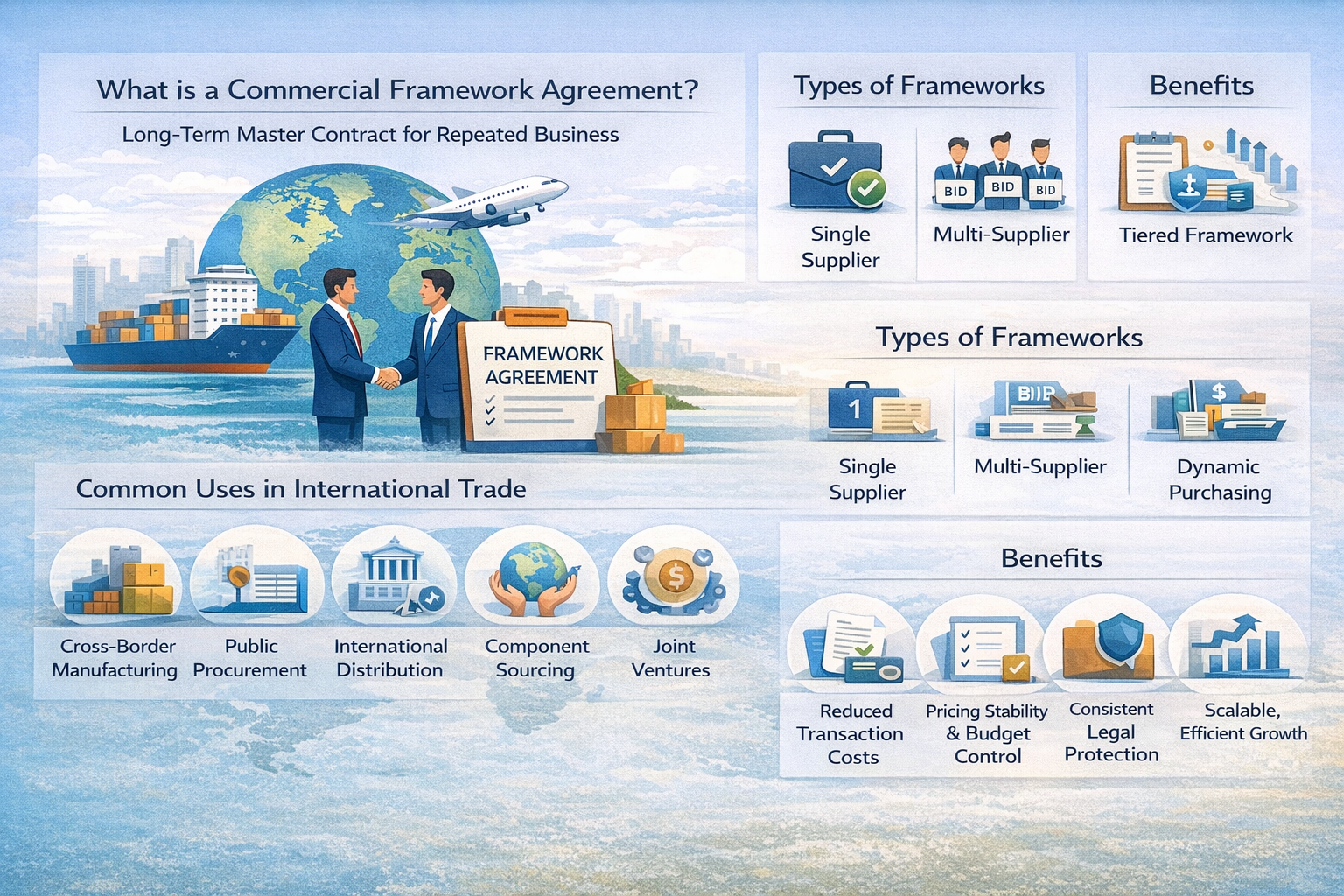
Why Is a Commercial Framework Agreement Used?
In cross-border trade and long-term supply partnerships, negotiating a full contract for every individual transaction is neither efficient nor scalable. A Commercial Framework Agreement solves this: it locks in the agreed commercial rules of the relationship once — pricing methodology, quality specifications, delivery standards, liability allocation, and dispute resolution — and then allows individual transactions to be initiated with a simple purchase order or call-off, without restarting the legal negotiation from scratch each time.
The framework is particularly powerful in relationships where the parties anticipate a recurring pattern of transactions over an extended period — typically one to four years — but cannot predict with certainty the precise volume, product mix, or timing of each future order at the outset. It gives buyers the confidence of a committed supply relationship with pre-agreed pricing and standards; it gives suppliers the commercial visibility of a structured engagement without the administrative cost of repetitive contract negotiation.
Unlike a Memorandum of Understanding — which records intent without creating enforceable commercial obligations — or a Letter of Intent — which outlines proposed terms but typically remains non-binding — a Commercial Framework Agreement is a fully binding instrument. It is the foundation on which all subsequent individual transactions are built. Its relationship to each call-off order is structurally analogous to the relationship between a Master Services Agreement (MSA) and an individual Statement of Work — the framework governs all; the call-off defines the specific transaction.
⚡ Key Principle
A Commercial Framework Agreement is not a guarantee of volume. Unless the agreement contains explicit minimum purchase commitments, take-or-pay provisions, or guaranteed revenue floors, the buyer is under no obligation to place any specific number of orders during the term. The value of the framework lies in what it enables — fast, efficient, legally protected transactions — not in what it mandates. Suppliers must evaluate this carefully before accepting framework terms without minimum commitment protections.
Where It’s Used
Common Applications in International Trade & Supply
Commercial Framework Agreements are one of the most widely deployed contractual structures in cross-border supply chains, public procurement, and long-term manufacturing partnerships. The following represent the most typical contexts in which they are used.
🏭
Cross-Border Manufacturing & Supply Chains
A brand or OEM establishes a framework with an overseas manufacturer setting agreed unit pricing, quality specifications, MOQs, and inspection protocols for all future production runs. Individual purchase orders are placed under the framework as demand arises.
🏛️
Public Sector & Government Procurement
Public bodies use framework agreements to pre-qualify suppliers and establish agreed pricing for recurring goods or services — from construction materials to IT equipment — without running a full tender process for every individual purchase.
🌍
International Distribution Arrangements
A manufacturer establishes a framework with a regional distributor covering pricing tiers, territory, exclusivity parameters, and return conditions. Each shipment is governed by a call-off referencing the framework, rather than a standalone distribution contract.
🔩
Component & Raw Material Sourcing
Industrial buyers — automotive OEMs, electronics manufacturers, food processors — use framework agreements with component or ingredient suppliers to lock in pricing and quality standards for the procurement year, then place monthly or weekly call-off orders as production schedules dictate.
🤝
Joint Venture Supply Obligations
Where a joint venture or manufacturing partnership involves one party supplying inputs to the other — as seen in automotive and electronics JVs — a Commercial Framework Agreement governs the inter-party supply relationship with the precision and enforceability of an arm’s-length commercial contract.
🔬
Technology Licensing & IP Supply
Technology companies supplying licensed components, software, or proprietary systems to manufacturing partners use framework agreements to govern the terms of each deployment — royalty rates, usage rights, update obligations, and liability boundaries — without renegotiating for each use case.
Types of Framework Agreements
The Four Principal Types of Commercial Framework Agreement
Not all framework agreements are structured identically. The appropriate type depends on the number of suppliers involved, the competitive dynamics the buyer wishes to maintain, and the procurement environment — private sector, public sector, or regulated industry. The four principal structures each address different commercial objectives.
Type 01
Single-Supplier Framework
All call-off orders during the term are awarded to one pre-agreed supplier. The parties negotiate the full framework commercially and the supplier is the exclusive provider for the defined scope.
- Simplified administration and single point of contact
- Stronger commercial relationship and greater predictability
- Higher dependency risk if supplier performance deteriorates
- Best suited for specialised or niche supply relationships
Type 02
Multi-Supplier Framework
Multiple pre-qualified suppliers are included in the framework. Individual call-off orders are awarded through mini-competitions or direct selection based on pre-agreed ranking criteria.
- Maintains ongoing pricing competition among suppliers
- Reduces supply concentration risk
- More complex administration and supplier management
- Common in public sector and high-volume commercial procurement
Type 03
Tiered or Cascaded Framework
Suppliers are ranked within the framework. Call-offs are offered to the top-ranked supplier first; if they cannot fulfil, the order cascades to the next-ranked supplier in sequence.
- Preserves preference for primary supplier relationship
- Provides supply continuity assurance through backup tiers
- Ranking criteria must be objectively defined in the framework
- Common in infrastructure, construction, and logistics sectors
Type 04
Dynamic Purchasing System (DPS)
A continuously open electronic framework with no application closing date — new suppliers can join at any time during the term, as long as they meet the qualifying criteria.
- Promotes competition and market access across the term
- Allows entry of innovative or emerging suppliers mid-term
- Requires robust digital procurement infrastructure
- More common in public sector and technology procurement
Anatomy of the Agreement
Anatomy of a Commercial Framework Agreement: Core vs. Protective Clauses
A well-structured Commercial Framework Agreement addresses two distinct layers of the relationship: the commercial mechanics that govern day-to-day transactions, and the legal protections that allocate risk, define liability, and ensure enforceability. Both layers must be addressed explicitly — frameworks that neglect either create significant operational and legal exposure.
⚙️ Core Commercial Clauses
- Pricing & price adjustment mechanism — fixed, index-linked, or subject to periodic review
- Call-off & ordering procedures — how individual orders are placed, accepted, and confirmed
- Minimum order quantities (MOQs) — if applicable to any product category
- Quality standards & specifications — technical requirements, tolerances, and certification obligations
- Lead times & delivery terms — Incoterms, delivery windows, and priority handling
- Payment terms — net payment periods, invoicing procedures, and late payment provisions
- Term & renewal — duration, automatic renewal provisions, and notice requirements for non-renewal
- Capacity reservation — whether the supplier is obligated to reserve any minimum production capacity
🛡️ Legal Protection & Risk Clauses
- Confidentiality & NDA — protection of pricing, technical, and commercial information — see also our NDA resource
- Intellectual property ownership — who owns designs, tooling, formulations, and adaptations
- Limitation of liability — caps on financial exposure, exclusions for consequential loss
- Indemnification — product liability, third-party claims, and regulatory infringement
- Termination rights — for cause, for convenience, and change of control provisions
- Force majeure — definition and consequence of events outside either party’s control
- Non-compete & exclusivity — see our non-compete clause resource
- Governing law & dispute resolution — the jurisdiction and mechanism for resolving disputes — essential in cross-border frameworks
✨ Practical Guidance: The Call-Off Hierarchy
Every Commercial Framework Agreement should specify what happens when a call-off order contains terms that conflict with the master framework. Standard practice in international commercial contracts is that the framework governs all such conflicts — the call-off is subordinate to the master agreement. This must be stated explicitly; absent this hierarchy clause, disputes about which document controls will arise at precisely the moment when speed and certainty are most needed.
Benefits
Strategic Benefits of a Commercial Framework Agreement
Beyond legal protection, a well-negotiated Commercial Framework Agreement delivers operational and commercial advantages that compound over the life of the relationship. The following benefits represent the principal reasons both buyers and suppliers choose the framework structure over transaction-by-transaction contracting.
⏱️
Dramatically Reduced Transaction Costs
Once the framework is in place, individual call-off orders require minimal legal review. The commercial infrastructure is already built — each transaction executes in days, not months.
💰
Pricing Certainty & Budget Predictability
Pre-agreed pricing — whether fixed for the term, index-linked to commodity benchmarks, or subject to defined annual reviews — gives both parties the commercial visibility needed for effective financial planning and margin management.
📦
Supply Chain Reliability
Suppliers within a framework have visibility of the buyer’s anticipated demand profile and can plan production capacity, raw material sourcing, and logistics accordingly — reducing lead times and the risk of supply disruption.
⚖️
Consistent Legal Protection
Every call-off placed under the framework carries the same legal protections — liability caps, IP ownership, confidentiality, and dispute resolution — regardless of size or frequency. Small orders benefit from the same rigour as large ones.
🤝
Stronger Partnership Dynamics
Framework agreements create a formal long-term commitment structure that incentivises both parties to invest in the relationship — supplier investment in quality and capacity; buyer investment in demand sharing and forecast transparency.
📈
Scalability Without Renegotiation
As business volumes grow, new products or service lines can be added to the framework through a simple amendment — without reopening the entire commercial negotiation. The master framework scales with the relationship.
Real-World Partnership Examples
Commercial Framework Agreements in Cross-Border Partnerships
Commercial Framework Agreements are the contractual backbone of many of the cross-border manufacturing and supply partnerships that GTsetu tracks and facilitates. The following examples illustrate how framework structures operate in practice across different industries and geographies.
🏭 Manufacturing Partnership
CalCom Vision & Goldmedal: LED Manufacturing Framework
A cross-border manufacturing arrangement where a framework agreement governs production specifications, quality standards, and supply terms for LED components across the relationship’s duration.
Read the case →
🌍 Supply Chain Strategy
Cross-Border Manufacturing Partnerships & Global Supply Chains
An analysis of how framework agreements underpin the supply chain structures that enable manufacturers to scale across borders without re-negotiating foundational terms for every production run.
Read the analysis →
🚗 Automotive JV
Renault & Geely: Brazil Automotive Joint Venture
Large-scale automotive joint ventures depend on Commercial Framework Agreements to govern inter-party component supply, technology licensing, and production capacity commitments across the JV lifecycle.
Read the case →
⚡ EV Manufacturing
Foxconn & Al-Rajhi: EV Manufacturing JV in Saudi Arabia
Technology and manufacturing JVs in the EV sector require framework agreements that address component supply obligations, IP licensing boundaries, quality compliance, and evolving regulatory requirements.
Read the case →
🇮🇳 India Manufacturing
Tramontina & Aequs: India Joint Venture Collaboration
A cross-border manufacturing partnership in India illustrating how framework agreements define production obligations, quality specifications, and export supply terms between global and local partners.
Read the case →
🔩 Component Supply
Wheels India & Topy Industries: Long-Term Supply Collaboration
A long-term component supply collaboration where a commercial framework governs pricing, delivery, and quality standards for automotive wheel supply across multiple production cycles.
Read the case →
How to Structure One
How to Structure a Commercial Framework Agreement: Key Stages
A Commercial Framework Agreement that is negotiated under time pressure or without adequate preparation tends to contain ambiguities that generate disputes precisely when the relationship is under commercial stress. The following stages represent best practice for parties entering a cross-border framework.
01
Define the Commercial Scope & Relationship Structure
Before drafting begins, both parties must agree on the scope of the framework — what products or services it covers, the geographic territory, the anticipated duration, and whether the arrangement is exclusive or non-exclusive. This commercial alignment is best documented in a Heads of Agreement or Term Sheet before legal drafting commences.
02
Negotiate Pricing Structure & Review Mechanisms
Agree on how pricing will work across the framework’s term — fixed pricing, tiered volume pricing, annual review provisions, currency clauses, or commodity index linkage. This is the most commercially sensitive element of the framework and requires the most careful drafting to avoid disputes at renewal or during market volatility.
03
Define Quality Standards, Specifications & Inspection Rights
The framework must attach — or incorporate by reference — the complete technical specifications, quality standards, testing protocols, and inspection rights that will apply to every call-off. These are the contractual basis on which the buyer can reject non-conforming goods or require rework. Vague quality provisions are one of the most common sources of framework agreement disputes in cross-border supply.
04
Draft the Call-Off & Order Management Procedure
The framework should contain a clear, operationally workable procedure for placing, acknowledging, varying, and cancelling call-off orders — including lead times, order acknowledgement periods, cancellation rights and associated costs, and the consequence of the supplier failing to fulfil a confirmed call-off. This section is used on a day-to-day operational basis and must be practical as well as legally precise.
05
Negotiate Legal & Risk Allocation Provisions
Liability caps, indemnification, IP ownership, confidentiality, termination rights, and governing law must all be negotiated and drafted with care. In cross-border frameworks, the choice of governing law — and whether disputes will be resolved through arbitration or national courts — has significant practical implications. Engage qualified legal counsel in both parties’ jurisdictions at this stage.
06
Execute with Authority & Implement Operationally
Both parties must execute the framework through properly authorised signatories — confirmed by board resolution or equivalent authority documentation where required. Once executed, the framework must be operationally embedded: procurement teams, logistics functions, quality departments, and finance teams must all understand the call-off procedure, pricing structure, and their respective obligations under the agreement.
Risks & Common Pitfalls
Common Risks and Drafting Pitfalls
🚩
No Minimum Volume Commitment — Supplier Receives Nothing
The most significant commercial risk for suppliers in a framework agreement is signing a framework without any minimum purchase commitment or guaranteed revenue floor — and then receiving no call-off orders. A framework without volume protections gives the supplier all the obligations of an exclusive or preferred supplier with none of the commercial certainty. Always negotiate a minimum annual purchase commitment, a take-or-pay provision, or a capacity reservation fee if exclusivity or significant set-up investment is required.
🚩
Ambiguous Quality Specifications Leading to Rejection Disputes
A framework that incorporates quality specifications by vague reference — “to industry standard” or “in accordance with buyer requirements” — rather than by precise, agreed, and attached technical documentation creates disputes about whether any given delivery meets the required standard. Quality specifications must be attached as numbered annexures, signed by both parties, and incorporated by explicit reference into both the framework and every call-off order.
🚩
Undefined Pricing Review Mechanism
A framework with a fixed price and a multi-year term — but no mechanism for price review in the event of significant input cost changes — can become commercially untenable for the supplier as raw material, energy, or labour costs shift. Equally, a buyer facing aggressive price increases at the annual review with no cap or benchmark has no contractual protection. Both parties need a clearly defined, fair, and workable pricing review clause.
🚩
IP Ownership Not Addressed for Customised Tooling or Designs
Where the buyer commissions bespoke tooling, moulds, designs, or formulations for production under the framework, the ownership of that IP — and what happens to tooling at the end of the framework — must be explicitly addressed. Absent clear IP provisions, suppliers in many jurisdictions may retain rights over tooling or process IP that the buyer assumed they were paying for. This is one of the most frequently disputed elements in cross-border manufacturing frameworks.
🚩
No Good Faith Obligation During the Term
In jurisdictions without an implied duty of good faith in commercial contracts — most notably England and Wales — a party to a framework agreement may be entirely within their legal rights to behave in a way that frustrates the other party’s commercial expectations, provided they do not technically breach a specific provision. For long-term cross-border frameworks, parties from civil law traditions should note that the framework’s governing law may not automatically import the good faith obligations they expect from their home jurisdiction.
🚩
Termination Provisions That Favour One Party
Framework agreements often contain termination for convenience clauses that allow the buyer to exit the framework on relatively short notice — leaving the supplier with uncommitted production capacity, purchased raw materials, and a lost commercial relationship. Suppliers should negotiate a notice period proportional to the investment required under the framework, and should ensure that any committed orders, tooling investments, or reserved capacity are protected by specific survival provisions or compensation clauses triggered on termination for convenience.
Framework vs Other Documents
Commercial Framework Agreement vs Related Documents
The Commercial Framework Agreement occupies a specific position in the commercial contract hierarchy. Understanding what distinguishes it from the documents that precede and accompany it — and from other long-term master contracts — is essential for structuring any cross-border partnership correctly.
| Dimension |
Commercial Framework Agreement |
MSA |
MoU |
Heads of Agreement |
Conditional Agreement |
| Binding Status |
Fully binding from execution |
Fully binding from execution |
Generally non-binding on commercial terms |
Often non-binding commercially; varies |
Fully binding; performance deferred to condition satisfaction |
| Primary Focus |
Supply of goods or goods + services over multiple transactions |
Delivery of services across multiple projects |
Framework of intent and relationship principles |
Agreed commercial terms before formal drafting |
Committing to a transaction subject to defined prerequisites |
| Implemented By |
Call-off orders / purchase orders |
Statements of Work (SOWs) |
Formal binding agreement |
Formal binding agreement |
Becomes unconditional on condition satisfaction |
| Volume Commitment |
Not guaranteed unless explicitly specified |
Not guaranteed unless specified in SOW |
Not applicable |
Not applicable |
Performance obligation arises on condition satisfaction |
| Typical Term |
1–4 years, often renewable |
Ongoing, until terminated |
Until formal agreement or expiry |
Until formal agreement or expiry |
Until condition period expires or agreement becomes unconditional |
| Best Suited For |
Recurring supply, manufacturing, distribution, public procurement |
IT, consulting, outsourcing, managed services |
Early-stage partnerships, institutional cooperation |
Pre-contract alignment before formal drafting |
M&A, regulated transactions, real estate, project finance |
| Conflict Resolution Hierarchy |
Framework governs; call-off subordinate |
MSA governs; SOW subordinate |
N/A (non-binding) |
HoA subordinate to formal agreement |
Full agreement provisions apply once unconditional |
✨ Note on Commercial Framework vs MSA
The distinction between a Commercial Framework Agreement and a Master Services Agreement is primarily one of context rather than structure. Both are binding master templates implemented through subordinate transaction documents. The key difference: an MSA is optimised for service delivery and uses Statements of Work (SOWs) as its subordinate documents; a Commercial Framework Agreement is optimised for the supply of goods (or goods + services) and uses purchase orders or call-off contracts. In practice, many cross-border supply relationships — particularly in manufacturing and technology — use hybrid structures that draw from both frameworks. The label matters less than the content and internal consistency of the document.
FAQ
Frequently Asked Questions
Q
Is a Commercial Framework Agreement legally binding?
Yes. A Commercial Framework Agreement is fully legally binding from the moment it is executed by both parties. This distinguishes it fundamentally from non-binding pre-contractual instruments such as a
Memorandum of Understanding or a
Letter of Intent. The binding nature applies immediately to all the terms and conditions set out in the framework — confidentiality, governing law, quality standards, pricing, and termination provisions. What is not immediately binding is the obligation to place or fulfil specific purchase volumes — those obligations arise only when individual call-off orders are placed and accepted. Always have the framework reviewed by qualified legal counsel in both parties’ relevant jurisdictions before execution.
Q
What is the difference between a Commercial Framework Agreement and a Master Services Agreement?
Both a
Master Services Agreement and a Commercial Framework Agreement are long-term binding master contracts that govern multiple future transactions under a single legal umbrella. The core difference is context: an MSA is designed for service delivery relationships — IT services, consulting, outsourcing — and its individual transactions are defined through Statements of Work (SOWs). A Commercial Framework Agreement is designed for the supply of goods, or goods combined with services, and its individual transactions are defined through call-off orders or purchase orders. Both share the same master-and-subordinate structure, and both carry the same risk: ambiguous scope or missing provisions create disputes at the transaction level that the master agreement was supposed to prevent.
Q
What happens if no call-off orders are placed under the framework?
In the absence of explicit minimum purchase commitments, take-or-pay provisions, or guaranteed revenue floors, neither party is obligated to place or fulfil any specific volume of orders under a Commercial Framework Agreement. If no call-off orders are placed during the term, the framework simply expires at the end of its term — with neither party incurring liability for the absence of orders. This is one of the most significant commercial risks for suppliers: they may have invested in capacity, tooling, or compliance specifically for the framework relationship, without any contractual guarantee of return. Suppliers should always negotiate minimum commitments, capacity reservation fees, or take-or-pay structures when the framework requires up-front investment.
Q
How does a call-off order work under a Commercial Framework Agreement?
A call-off order is an individual purchase order placed by the buyer under the Commercial Framework Agreement, specifying the product, quantity, delivery date, and any order-specific delivery instructions. Once the supplier acknowledges and confirms the call-off, both parties are bound to perform that specific transaction — the buyer to pay, the supplier to deliver — on the terms set out in the call-off and governed by the overarching framework. The framework determines all the legal conditions: pricing, quality standards, liability, and dispute resolution. The call-off determines only the order-specific operational details. In the event of any conflict between the call-off and the framework, the framework terms typically prevail — but this hierarchy must be explicitly stated in the framework agreement itself.
Q
Do I need a separate NDA if a Commercial Framework Agreement includes a confidentiality clause?
If the Commercial Framework Agreement contains a comprehensive confidentiality clause that covers the full scope of information likely to be shared — including pre-framework commercial discussions, technical specifications, pricing, and business strategy — a separate standalone
NDA may not be necessary once the framework is executed. However, if sensitive information is shared during the negotiation of the framework itself — before execution — a standalone NDA should be in place to protect that pre-execution disclosure. Additionally, for particularly sensitive categories of information (such as proprietary formulations, source code, or manufacturing processes), a dedicated confidentiality annex with specific provisions may be preferable to a general clause embedded in the framework.