Free for a limited time·Profile verification free·First collaboration free·100+ Companies Onboarded·15+ Collaborations Closed This Month!·No Commission & No Profit Share·Free for a limited time·Profile verification free·First collaboration free·100+ Companies Onboarded·15+ Collaborations Closed This Month!·No Commission & No Profit Share·Free for a limited time·Profile verification free·First collaboration free·100+ Companies Onboarded·15+ Collaborations Closed This Month!·No Commission & No Profit Share·
Tramontina × Aequs India JV: What Smart Manufacturers Can Learn About Global Collaboration | GTsetu
🔴 Breaking News🤝 Joint Venture🇮🇳 India Manufacturing
Tramontina × Aequs: Brazil Meets India in a ₹80 Crore JV — And What Every Manufacturer Must Learn From It
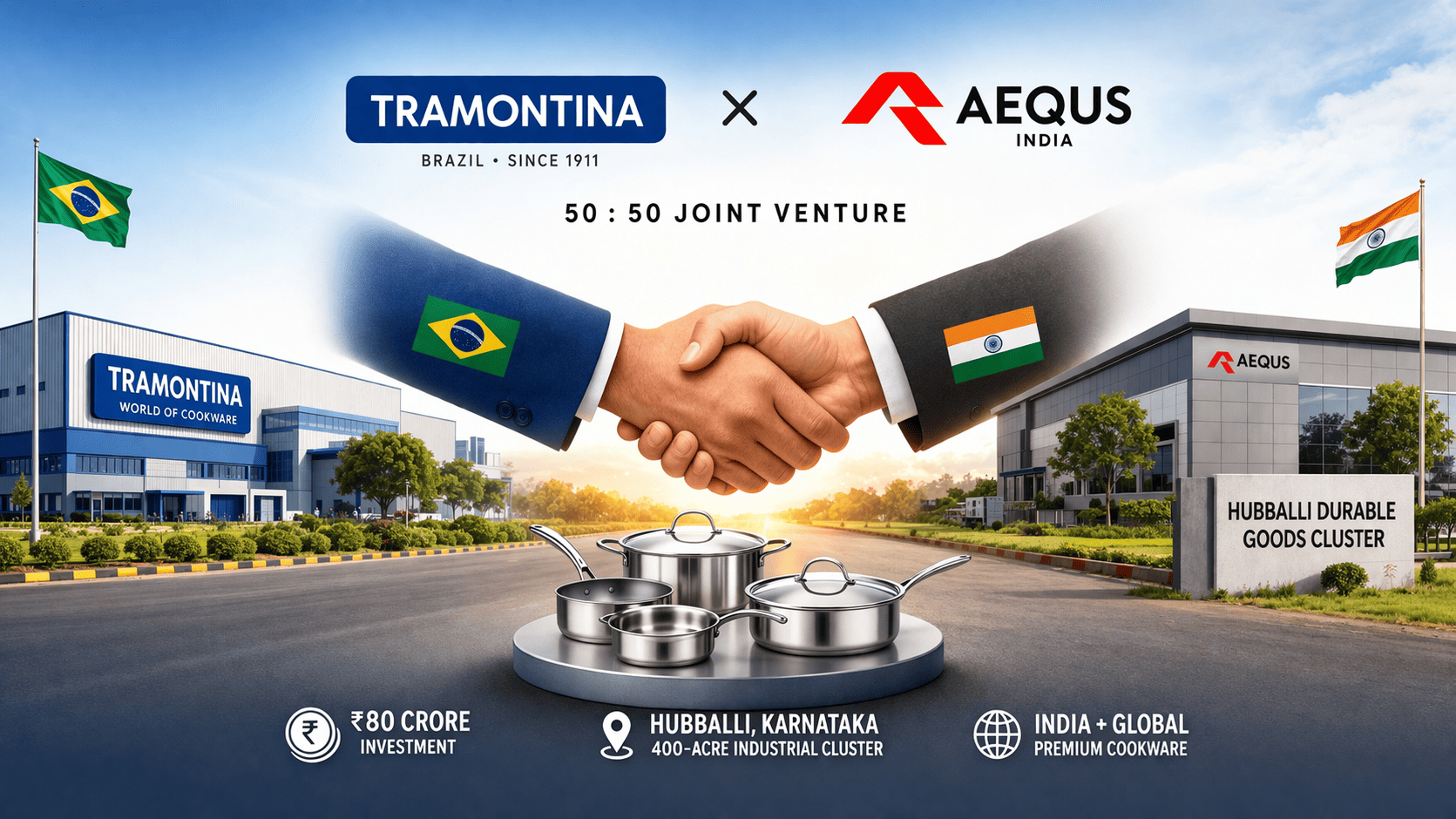
Brazil’s 113-year-old kitchenware giant just opened its first factory outside the Americas — in Hubballi, India — through a 50:50 joint venture with precision manufacturer Aequs. Here’s the full story, why it works, and how your company can replicate the same model.
🎯 Direct Answer
Tramontina (Brazil) and Aequs (India) have formed a 50:50 joint venture — Aequs Cookware Pvt. Ltd. (ACPL) — with an investment of up to ₹80 crore, manufacturing premium cookware at the 400-acre Hubballi Durable Goods Cluster in Karnataka. This marks Tramontina’s first manufacturing facility outside the Americas, combining Tramontina’s 113 years of cookware expertise with Aequs’s precision engineering and established industrial ecosystem. The JV is designed to serve both India’s domestic premium market and global distribution — and it is a textbook example of how global manufacturers should approach cross-border collaboration in 2025: find a verified local partner with complementary strengths, leverage an existing industrial cluster, and structure a joint entity rather than building from scratch.
📅 March 13, 2026⏱ 18 min read✍️ GTsetu Editorial Team📰 News + Analysis
🔴 BREAKINGTramontina × Aequs form 50:50 JV — Tramontina’s first factory outside the Americas opens in Hubballi, Karnataka◆₹80 Crore investment in Aequs Cookware Pvt. Ltd. to produce premium cookware for India and global markets◆113-year-old Brazilian giant + India’s precision manufacturing powerhouse = the global collaboration playbook for 2025◆Find your own Aequs on GTsetu — verified manufacturing partners across 100+ countries, zero broker fees◆🔴 BREAKINGTramontina × Aequs form 50:50 JV — Tramontina’s first factory outside the Americas opens in Hubballi, Karnataka◆₹80 Crore investment in Aequs Cookware Pvt. Ltd. to produce premium cookware for India and global markets◆113-year-old Brazilian giant + India’s precision manufacturing powerhouse = the global collaboration playbook for 2025◆Find your own Aequs on GTsetu — verified manufacturing partners across 100+ countries, zero broker fees◆
Investment
₹80 Cr
Total JV investment in Hubballi facility
JV Structure
50:50
Equal partnership — Tramontina + Aequs
Tramontina Age
113 yrs
Founded 1911 in Brazil, products in 120+ countries
HDC Cluster
400 ac
Hubballi Durable Goods Cluster — purpose-built for consumer goods
Section 1 — The News
1 The Full Story: Tramontina × Aequs
Live Story — February 2025
Tramontina Opens First Factory Outside the Americas — Inside India’s Hubballi Durable Goods Cluster
In February 2025, Tramontina — a Brazilian kitchenware and housewares conglomerate founded in 1911 with 22,000 products available in 120 countries — announced a landmark 50:50 joint venture with Aequs Private Ltd., a Belagavi-based diversified manufacturer with precision engineering operations across three continents.
The new entity, Aequs Cookware Pvt. Ltd. (ACPL), will operate from the Hubballi Durable Goods Cluster (HDC) in Karnataka — a 400-acre industrial hub purpose-built to support the consumer goods sector. With a total investment of up to ₹80 crore (approximately $9.6M USD), ACPL will manufacture premium cookware and consumer goods for both the Indian domestic market and international distribution.
Most significantly: this is Tramontina’s first and only manufacturing facility outside the Americas in its 113-year history — a decision that took over a century to make, and chose India as its global expansion anchor.
1st
Tramontina facility outside the Americas in 113 years
22,000
Tramontina products across kitchenware, cutlery & housewares
120+
Countries where Tramontina products are currently sold
Karnataka
State chosen — home to 3 Aequs industrial clusters in North Karnataka
“By combining Aequs’ integrated manufacturing ecosystem with Tramontina’s global strength, we will drive innovation, efficiency, and scale to deliver world-class products.”
— Aravind Melligeri, Chairman & CEO, Aequs
“The Hubballi unit will allow us to serve the global market with high-quality products under highly competitive conditions while also meeting local demand.”
— Eduardo Scomazzon, Chairman of the Board, Tramontina Brazil
💡 GTsetu Perspective
When a company that has manufactured exclusively in the Americas for 113 years decides its first overseas factory should be in India — that’s not a casual decision. It’s a signal. India’s combination of manufacturing cost competitiveness, engineering talent, growing domestic demand, and export positioning is now compelling enough to move 113-year-old incumbents. If Tramontina found its Aequs, what’s stopping you from finding yours?
Section 2 — The Anatomy
2 Anatomy of the JV — What Each Partner Brings
The Tramontina × Aequs partnership works precisely because neither partner could have achieved this alone. Each brings exactly what the other lacks. This is the first principle of any successful manufacturing collaboration.
Tramontina knows what to make; Aequs knows how to make it in India
Infrastructure
Capital investment, quality standards
400-acre cluster, machines, labor, utilities
Zero greenfield risk — Aequs provides a plug-and-play factory environment
Regulatory Navigation
Export compliance & global standards
Indian regulatory & Make in India expertise
Both partners handle their home-market regulatory complexity
Supply Chain
Raw material sourcing relationships
Vertically integrated India supply chain
India-local supply chain reduces material lead time and import dependency
Risk
50% equity — skin in the game
50% equity — full commitment, not just a contract
Equal ownership aligns incentives completely — both succeed or fail together
Section 3 — Why India
3 Why India? The Manufacturing Opportunity That Moved a 113-Year-Old Company
🇮🇳 India Manufacturing Opportunity 2025
Why Global Manufacturers Are Choosing India as Their First Overseas Factory
India is no longer just an outsourcing destination — it is a strategic global manufacturing hub combining cost competitiveness, engineering talent, domestic consumption growth, and the Make in India government initiative. This is precisely why Tramontina’s first non-Americas factory landed in Hubballi.
~$250B
India’s consumer goods market by 2030
~300M+
India’s growing middle class — the target premium cookware buyer
15–30%
Typical cost advantage vs manufacturing in developed markets
120+
Countries accessible as export markets from India, leveraging FTAs
400 ac
HDC Cluster — purpose-built infrastructure; no greenfield risk
3
Aequs industrial clusters in North Karnataka — proven ecosystem
India’s strategic appeal for manufacturing collaboration has three dimensions that the Tramontina-Aequs deal captures perfectly. First, cost and talent — India offers engineering talent at globally competitive costs with strong technical education infrastructure. Second, domestic demand — India’s growing middle class creates immediate local market opportunity that doesn’t require export logistics. Third, global export positioning — products manufactured in India can reach the Middle East, Southeast Asia, East Africa, and Europe with logistics economics that Brazilian factories cannot match.
🌐 GTsetu for India Market Entry
GTsetu’s verified partner network includes manufacturers, contract manufacturers, distributors, and suppliers across India’s major industrial clusters — including Karnataka, Maharashtra, Gujarat, Tamil Nadu, and more. If you’re a global manufacturer looking to replicate the Tramontina model, GTsetu is where you start your partner search. Find verified India manufacturing partners →
Section 4 — What Is Collaboration
4 What Is a Manufacturing Collaboration — And Why Do Companies Do It?
🎯 Definition
A manufacturing collaboration is a formal arrangement between two or more companies — typically from different geographies, industries, or capability sets — to jointly pursue a manufacturing or market objective that neither could achieve as efficiently alone. Collaborations range from lightweight (a contract manufacturing relationship) to deep and permanent (a 50:50 joint venture like Tramontina × Aequs). What makes collaboration different from simply outsourcing production is the presence of mutual investment, shared risk, aligned incentives, and complementary capabilities — each party contributes something the other cannot easily replicate.
Why Companies Collaborate — The 6 Strategic Drivers
Market
Access local demand without building from scratch — Tramontina’s play in India
Cost
Leverage a partner’s infrastructure, labor, and supply chain to slash unit costs
Speed
A partner’s existing factory beats 3–5 years of greenfield construction time
Capability
Access precision engineering, certifications, or processes you don’t have in-house
Risk
Share capital exposure and operational risk — 50:50 structures spread the downside equally
Regulation
A local partner navigates domestic regulations, import duties, and compliance requirements
Section 5 — Types of Collaboration
5 4 Types of Manufacturing Collaboration — Which Fits You?
Not every collaboration needs to be a 50:50 JV. The right structure depends on how much control you want, how much capital you can invest, and how deeply you want to integrate with your partner. Here are the four primary models.
01
Joint Venture (JV)
A new shared legal entity co-owned by both parties. Highest commitment, deepest integration, full profit and risk sharing. The Tramontina × Aequs model — best when both partners have complementary assets and long-term market ambitions.
⚖️ Tramontina × Aequs Model
02
Contract Manufacturing (CM)
You own the design and brand; a partner manufactures to your specification. Lower commitment, no equity sharing. Ideal when you need production capacity or cost reduction without a permanent partner. Scalable and reversible.
🏭 Low-commitment entry
03
Technology / IP Licensing
You license your manufacturing IP, brand, or process to a local partner who produces and sells in their market. You receive royalties without capital investment. Tramontina could have done this — instead they chose deeper equity participation.
💡 Asset-light expansion
04
Distribution Partnership
You manufacture; a local distributor sells and services in their market. The lightest form of collaboration. Eliminates shipping lead time for end customers. Often the first step before deeper manufacturing collaboration in a new geography.
🌍 Market entry step 1
📊 Collaboration Model Comparison Matrix
Model
Capital Required
Control
Risk Shared?
Speed to Market
Typical Lead Time Reduction
Best For
GTsetu Support
Joint Venture
High
Shared 50:50
✓ Full
Slow (12–24 months setup)
Maximum — eliminates shipping + material LT
Long-term market anchor; large capital available
✓ JV partner matching
Licensing / IP
Low
Low (licensee controls)
~ Partial
Medium (6–12 months)
High — local production eliminates most LT
IP-rich companies wanting asset-light expansion
✓ Licensing partner search
Contract Mfg
Minimal
High (you own design)
✗ Minimal
Fast (1–4 months)
Moderate — reduces production LT
Overflow capacity; new product introduction
✓ 500+ verified CMs
Distribution
Minimal
Full (you own product)
✗ Minimal
Fast (1–3 months)
Eliminates shipping LT for end customer
New market entry; testing demand
✓ Verified distributors globally
Section 6 — How to Collaborate
6 How to Collaborate: A 6-Step Playbook (Inspired by Tramontina × Aequs)
The Tramontina × Aequs deal didn’t happen by accident — it followed a deliberate sequence that every manufacturer seeking a global collaboration partner should replicate. Here is the playbook distilled from this deal and hundreds of successful B2B manufacturing partnerships.
1
Define the Collaboration Objective with Precision
Before searching for a partner, answer three questions: What capability do I lack that a partner should provide? What do I bring that makes me an attractive collaboration partner? What does success look like in 3 years? Tramontina’s answers were clear — they needed India manufacturing infrastructure and local market access, and they offered 113 years of global brand equity and cookware IP. Vague objectives produce vague partner searches and failed deals.
2
Identify and Verify Potential Partners Systematically
Never rely on cold introductions or trade fair chance meetings for strategic collaborations. Aequs was chosen because it had demonstrated precision manufacturing at scale, operated an established industrial cluster, and had credible aerospace-grade quality systems — all verifiable facts, not marketing claims. Use GTsetu’s verified partner network to identify candidates whose capabilities are documented and multi-layer verified before you invest time in conversations.
3
Protect Your IP Before Sharing Anything
A collaboration that requires sharing your product designs, manufacturing processes, quality standards, or trade secrets must begin with an NDA — executed and countersigned before any technical disclosure. This is non-negotiable. GTsetu’s built-in NDA workflow enables this automatically: you share nothing sensitive until mutual interest is confirmed and the NDA is in place, with a full audit trail.
4
Run a Structured Pilot Before Full Commitment
A 50:50 JV with ₹80 crore of investment is not where Tramontina and Aequs started their relationship. Before any partnership scales to full commitment, commission a controlled pilot: a small production run, a trial distribution agreement, or a scoped technology transfer test. The pilot validates capability claims under real operating conditions and surfaces execution gaps before they become legal or financial problems.
5
Structure the Collaboration Formally — In Writing, In Detail
A JV requires a joint venture agreement. A CM relationship requires a manufacturing services agreement. A licensing deal requires a technology license agreement. Every collaboration needs formal documentation covering: equity or revenue split, IP ownership and licensing terms, quality standards and audit rights, production volume commitments, governance and decision-making authority, and crucially — exit clauses that protect both parties if the collaboration fails. Never begin production at scale on verbal or informal terms.
6
Establish Communication Cadence and Governance From Day One
The most technically sound JV can fail from communication breakdown. Establish from the start: who makes which decisions, how disputes are resolved, how often operational reviews happen, who the key contacts are at each company, and what the escalation path looks like. Cross-continental collaborations amplify every communication gap — proactive structure is the only fix. GTsetu’s encrypted collaboration workspace enables secure, structured partner communication as your relationship deepens.
Section 7 — Dos and Don’ts
7 Dos and Don’ts of Global Manufacturing Collaboration
Drawing from the Tramontina × Aequs model and the patterns of hundreds of B2B manufacturing partnerships, here is the definitive list of collaboration dos and don’ts.
✅ Do These
✅ Verify your partner’s capabilities through documented evidence, not marketing materials
✅ Align on quality standards in writing before production begins
✅ Sign NDA before sharing any product specifications or process documentation
✅ Run a pilot production batch before committing to full-scale investment
✅ Choose a partner with complementary capabilities — not a mirror of your own
✅ Define IP ownership and licensing terms explicitly at the outset
✅ Build in exit clauses that protect both parties equitably
✅ Establish governance structure and communication cadence on Day 1
✅ Leverage an industrial cluster (like HDC) rather than building greenfield
✅ Structure equity to align incentives — equal stakes mean equal commitment
❌ Avoid These
❌ Partner with an unverified company based on a trade show introduction alone
❌ Share your product designs or manufacturing IP before an NDA is signed
❌ Assume cultural or operational alignment — explicitly test and document it
❌ Skip a pilot and go straight to full production commitment
❌ Negotiate on verbal or email terms without formal agreements
❌ Partner with someone who replicates your strengths — the gap is where value comes from
❌ Ignore lead time and capacity reality — verify against actual operational data
❌ Allow equity imbalances that create decision-making paralysis or resentment
❌ Begin a JV without agreed exit mechanisms for both sides
❌ Underestimate the time and cost of cross-cultural communication management
Section 8 — Common Misconceptions
8 Common Misconceptions That Kill Manufacturing Collaborations
Most collaboration failures are not caused by bad intentions — they are caused by wrong assumptions held by one or both parties going in. These are the most damaging.
❌ Myth
“The lowest-cost manufacturer is the best collaboration partner.”
✅ Reality
The best partner is the one with verified complementary capabilities — price is one factor among many. A cheap partner who can’t hold tolerances, deliver on time, or protect your IP will cost you far more than a premium-priced verified partner. Aequs was not chosen because they were cheap — they were chosen because of their precision engineering pedigree and established infrastructure.
❌ Myth
“A contract is enough protection — we don’t need to verify their capabilities upfront.”
✅ Reality
Contracts enforce consequences after failure — they don’t prevent failure. Pre-verified capabilities prevent the failure in the first place. By the time you’re enforcing a contract cross-internationally, you’ve already lost months, money, and potentially your IP. Verification before engagement is the only reliable protection.
❌ Myth
“We can start producing and sort out the formal agreement once the relationship is established.”
✅ Reality
Starting production before formal agreements are in place transfers all leverage to the manufacturer. Your product is in their hands, their machines are running, and you have no documented terms. This is the single most common source of IP theft, quality disputes, and unenforceable pricing in cross-border manufacturing. Formal agreements first, production second — always.
❌ Myth
“The production partner’s quoted capacity is their real capacity.”
✅ Reality
Self-reported capacity and real available capacity are consistently different. A factory might have 100-unit/day nominal capacity but if cycle time already exceeds takt time for their existing orders, your order joins a queue. Always request current utilisation rates, takt vs cycle time data, and lead time from existing customers before accepting quoted capacity as available capacity. GTsetu’s verified profiles include operational capacity data, not just nominal figures.
❌ Myth
“A licensing deal is inferior to a JV — JV always means more value.”
✅ Reality
JVs are appropriate when both parties have large, complementary assets and a long-term shared vision. Licensing works better when you want low-capital, reversible market expansion without operational control responsibilities. Tramontina could have licensed their brand to an Indian manufacturer — they chose a JV because they wanted deeper operational control and a larger share of the India opportunity. The right structure depends on your objectives, not on a hierarchy of commitment levels.
Section 9 — Comparison
9 JV vs Licensing vs Contract Manufacturing — Full Comparison
Factor
Joint Venture (like Tramontina × Aequs)
Technology / IP Licensing
Contract Manufacturing
Distribution Partnership
Legal structure
New co-owned entity (ACPL)
License agreement — no new entity
Manufacturing services agreement
Distribution or reseller agreement
Capital commitment
High — ₹80 crore in this case
Low — upfront legal + ongoing royalties
Minimal — per-unit cost only
Minimal — inventory terms only
IP exposure risk
High — partner has full access
High — licensee gets your IP
Medium — partner gets specs
Low — partner handles existing products
Upside sharing
✓ Full profit sharing
Royalty % only
None — you keep margin
Margin split only
Speed to first production
Slowest (12–24 months)
Medium (6–12 months)
Fastest (1–4 months)
Fastest (1–3 months)
Market entry permanence
Permanent — own entity in market
Dependent on licensee’s performance
Reversible — switch CMs anytime
Reversible — change distributors
Decision-making control
Shared — 50:50 = consensus required
Low — licensee runs operations
High — you spec everything
Moderate — you set product; they sell
GTsetu support
✓ JV partner matching
✓ Licensing partner search
✓ 500+ verified CMs globally
✓ Verified distributors in 100+ countries
Best when…
Long-term vision, large opportunity, strong partner with complementary assets
Asset-light global expansion with strong IP
Capacity needed fast; pilot or overflow
Market entry; demand testing; LT reduction
Section 10 — GTsetu
10 How GTsetu Helps You Find the Right Collaboration Partner
Tramontina found Aequs. The question for you is: where do you find your Aequs? The answer depends entirely on how you approach partner discovery — and most manufacturers still rely on trade fairs, agent referrals, and Google searches that surface the loudest companies, not the most capable ones.
🌐 Platform Spotlight — GTsetu
Find Verified Collaboration Partners Across 100+ Countries — Before You Reveal a Single Detail About Your Product
GTsetu is the verified B2B manufacturing discovery platform where manufacturers, contract manufacturers, distributors, suppliers, and JV candidates connect with transparent capability profiles — and zero broker fees on any partnership formed. Every partner is multi-layer verified: business registration, manufacturing certifications, trade references, and operational capacity data. You evaluate who’s real before you commit a single conversation. And you share nothing sensitive until an NDA is in place.
✅
Multi-Layer VerificationBusiness registration, certifications, trade references — capability claims are backed, not self-reported.
🕵️
Anonymous DiscoveryEvaluate verified partner profiles without revealing your identity until mutual interest is confirmed.
📄
Built-In NDA WorkflowShare product specs only after an NDA is executed — full audit trail, no external legal required.
🚫
Zero CommissionNo broker fees. Your JV, licensing deal, or CM contract is entirely between you and your partner.
🌍
100+ CountriesFind JV candidates, CMs, licensing partners, and distributors across every major manufacturing region.
🔐
Encrypted CollaborationShare capacity data, production schedules, and operational specs securely between verified partners.
Identified a manufacturer with verified precision engineering credentials
✓ Browse 500+ verified profiles with documented capabilities
No unpleasant capability surprises after you’ve shared your IP
Chose a partner inside an established industrial cluster (HDC)
✓ Filter partners by geographic cluster, industry, and certification type
Find partners with proven ecosystem access, not greenfield promises
Structured a formal 50:50 JV agreement before production began
✓ Built-in NDA and collaboration workflow before any disclosure
IP and commercial terms protected from the first conversation
Invested in a partner with complementary (not competing) capabilities
✓ Detailed capability profiles help you identify true complementarity
Collaboration value comes from the gap — not the overlap
Committed to zero broker intermediation — direct equity ownership
✓ Zero commission — all partnerships are direct between parties
Your commercial deal stays between you and your partner, not split with an agent
FAQ
? Frequently Asked Questions
QWhat exactly is the Tramontina and Aequs joint venture?
Tramontina × Aequs is a 50:50 joint venture — the new entity is called Aequs Cookware Pvt. Ltd. (ACPL) — established in February 2025 to manufacture premium cookware and consumer goods at the Hubballi Durable Goods Cluster (HDC) in Karnataka, India. The JV involves a total investment of up to ₹80 crore (approximately $9.6M USD). It is designed to serve India’s domestic premium cookware market and to export globally. Most significantly, it marks Tramontina’s first and only manufacturing facility outside the Americas in the company’s 113-year history.
QWhy did Tramontina choose a 50:50 JV instead of simply outsourcing production?
A straight contract manufacturing arrangement would have given Tramontina Indian production capacity but not Indian market ownership, local relationships, or shared infrastructure investment. The 50:50 JV structure aligns both companies’ incentives completely — Aequs is not just a vendor being paid per unit, they are a co-owner who succeeds when ACPL succeeds. This alignment drives Aequs to invest their best infrastructure, relationships, and talent in the partnership rather than treating it as one contract among many. Equal equity also prevents the governance deadlock that unequal splits can create while signalling full mutual commitment.
QWhat is the Hubballi Durable Goods Cluster and why does it matter?
The Hubballi Durable Goods Cluster (HDC) is a 400-acre purpose-built industrial hub in Hubballi, Karnataka, specifically designed to support the consumer goods manufacturing sector. Aequs operates three industrial clusters in North Karnataka. The strategic importance of locating ACPL inside HDC rather than building a standalone factory is significant: no greenfield construction time (saving 2–5 years), access to shared utilities, logistics, and supporting industry infrastructure, proximity to trained manufacturing labor, and participation in an industrial ecosystem rather than an isolated facility. For any manufacturer evaluating India entry, an industrial cluster partner dramatically reduces time-to-production and operational risk.
QHow do I find a manufacturing collaboration partner like Aequs in India or other markets?
The systematic approach has five steps: (1) Define your objective clearly — what capability gap does a partner fill, and what do you bring that makes you an attractive collaborator? (2) Search verified platforms — GTsetu lists 500+ verified manufacturers, contract manufacturers, and industrial partners across 100+ countries with documented capability profiles. (3) Evaluate anonymously first — review profiles and capability data before revealing your identity or product details. (4) Execute an NDA before disclosing anything sensitive — GTsetu’s built-in NDA workflow enables this automatically. (5) Run a pilot before committing — validate capability claims under real operating conditions before a full JV or long-term agreement.
QWhat are the biggest risks in a cross-border manufacturing JV?
The five most significant risks in cross-border JVs are: (1) IP theft or leakage — mitigated by NDA, IP ownership terms in the JV agreement, and controlled access to specifications. (2) Governance deadlock — mitigated by clear decision-making protocols and defined escalation paths. (3) Quality misalignment — mitigated by written quality standards, agreed audit rights, and pilot production before scale. (4) Cultural and communication gaps — mitigated by structured communication cadence and explicit alignment on business values. (5) Partner capability not matching claims — mitigated entirely by pre-verification (GTsetu’s core function) and pilot production before full investment. The single best risk mitigation is starting with a verified partner whose capabilities are documented before you commit.
QDoes GTsetu charge commission on JV or manufacturing partnerships formed through the platform?
No. GTsetu charges zero commission on any partnership — whether a joint venture, licensing deal, contract manufacturing arrangement, or distribution agreement — formed through the platform. The entire commercial deal is between you and your partner. This is a fundamental design principle: broker intermediation in B2B manufacturing partnerships typically costs 5–15% and creates incentive misalignment. GTsetu removes the broker entirely — you pay for platform access, not for each deal. Learn more about GTsetu’s model →
500+ verified manufacturers, contract manufacturers, distributors, and industrial partners across 100+ countries. Zero broker fees. Anonymous discovery. Built-in NDA workflows. Your next global collaboration starts with a verified profile — not a trade fair handshake.
They represents the product, and research team behind GTsetu, a global B2B collaboration platform built to help companies explore cross-border partnerships with clarity and trust. The team focuses on simplifying early-stage international business discovery by combining structured company profiles, verification-led access, and controlled collaboration workflows.
With a strong emphasis on trust, and disciplined engagement, Team GTsetu shares insights on global trade, partnerships, and cross-border collaboration, helping businesses make informed decisions before entering deeper commercial discussions.