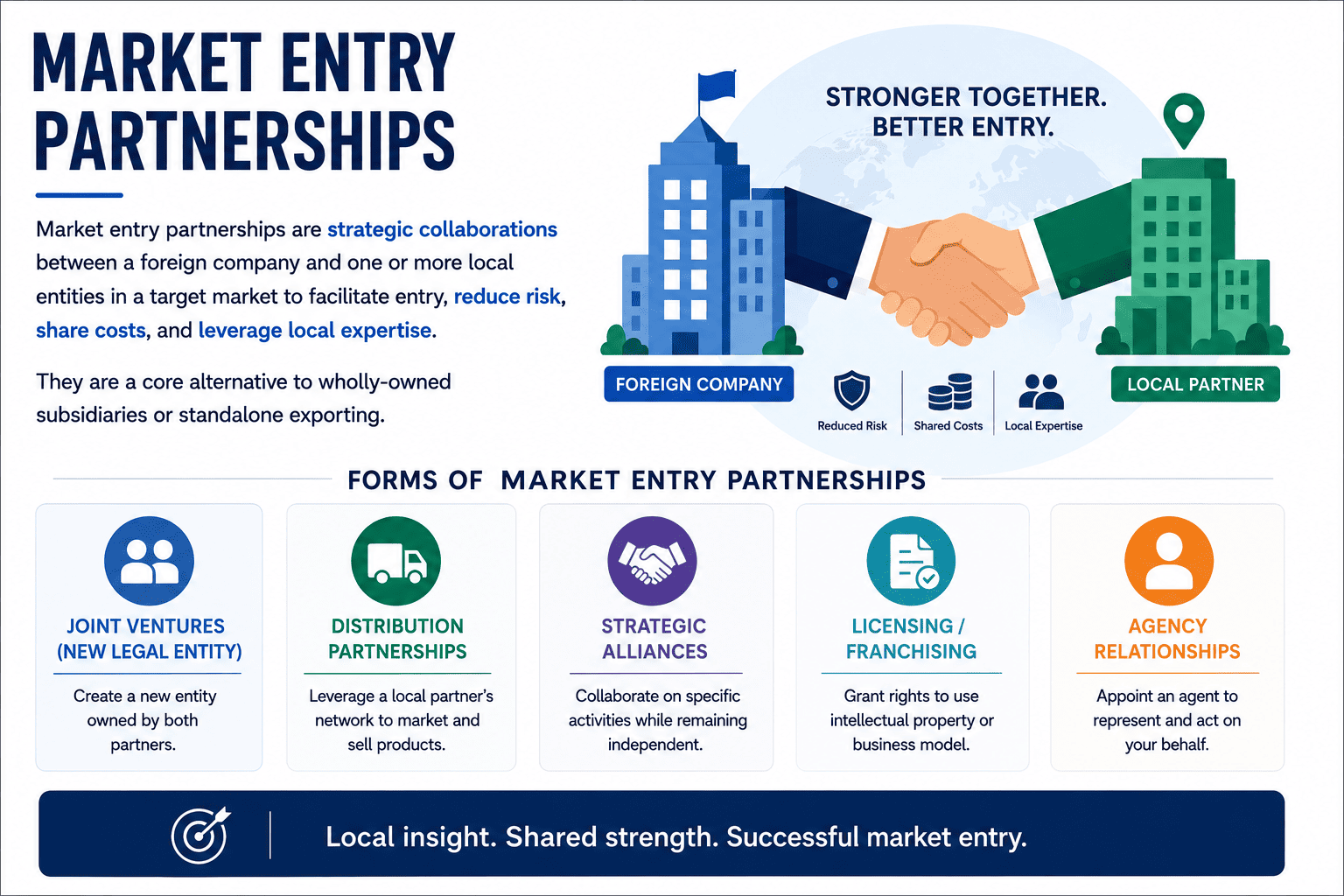
Why Market Entry Partnerships Matter
Expanding into a new market alone is high-risk: 75% of companies that attempt international expansion fall short of expectations, often due to poor market entry strategies. Partnerships mitigate this by providing local market knowledge, established distribution, regulatory navigation, and shared financial exposure. For small and mid-sized enterprises especially, partnerships are often the most viable path to global growth.
📊 Key Statistic
Businesses that leverage local partnerships reduce their market entry failure rate by approximately 40% compared to going it alone, according to industry studies. The right partner provides “on-the-ground” intelligence that no amount of remote research can replicate.
Benefits & Risks of Market Entry Partnerships
| Benefits | Risks & Challenges |
|---|
| Local expertise & cultural navigation | Loss of control over operations or brand representation |
| Reduced capital expenditure & shared costs | Partner misalignment on goals, values, or timelines |
| Accelerated market access (existing networks) | Intellectual property leakage or unauthorized use |
| Risk mitigation (political, regulatory, commercial) | Financial mismanagement or hidden partner liabilities |
| Enhanced credibility through local association | Cultural/communication barriers leading to friction |
| Simplified regulatory & customs compliance | Dispute resolution complexity across jurisdictions |
Types of Market Entry Partnerships
The optimal structure depends on your industry, investment capacity, desired control level, and target market characteristics.
| Partnership Type | Structure | Control Level | Best For |
|---|
| Joint Venture (JV) | New, separate legal entity with shared equity between foreign & local partner(s) | Shared (proportional to equity) | Large-scale commitments, regulated sectors, long-term presence |
| Distribution Partnership | Contractual agreement with local distributor to sell/represent your products | Low to moderate (brand guidelines) | Physical goods, rapid shelf access, tested markets |
| Strategic Alliance | Cooperation agreement without new entity (co-marketing, co-R&D, technology sharing) | Low (activity-specific) | Complementary products, innovation, shared marketing |
| Licensing / Franchising | Local partner pays for rights to use IP, brand, or business model | Low to moderate (via quality controls) | Brand leverage, rapid scaling with less capital |
| Sales Agent / Representative | Independent local agent promotes and sells on commission | Low (agent relationship) | Early market testing, professional services, B2B complex sales |
| Merger & Acquisition (M&A) | Full or partial acquisition of a local company | Full (if majority ownership) | Immediate market share, talent acquisition, competitor removal |
📌 Note on India & Emerging Markets
In markets like India, joint ventures were historically mandatory in many sectors. While 100% FDI is now allowed in most industries, local partners remain critical for navigating state-level variations, distribution networks, and government relations. Many successful entrants (e.g., Starbucks with Tata) used JVs as their primary entry vehicle.
Partner Selection & Process
How to Identify and Select the Right Local Partner
Partner due diligence is the single most important factor in partnership success. Rushing this phase is a common and costly mistake.
1
Define your ideal partner profile
List must-have attributes: market coverage, reputation, financial stability, cultural fit, industry expertise, and strategic alignment with your goals.
2
Source candidates via trusted channels
Use trade associations, chambers of commerce, US Commercial Service, industry trade shows, and referrals from existing business networks.
3
Conduct thorough due diligence
Financial checks, legal standing, reference calls with current/past partners, site visits, and face-to-face meetings (essential in relationship-driven cultures).
4
Negotiate a comprehensive partnership agreement
Define scope, exclusivity, financial terms, IP ownership, governance, dispute resolution (arbitration clause), termination conditions, and exit mechanisms.
5
Start with a pilot or phased commitment
Test the relationship with a limited scope or territory before expanding. Build trust incrementally.
Key Partnership Agreement Elements
Essential Clauses in a Market Entry Partnership Agreement
| Clause | Why It Matters |
|---|
| Scope & Territory | Defines specific products, markets, and activities, prevents partner drift or unauthorized expansion. |
| Exclusivity (or non-exclusivity) | Specifies whether partner has sole rights in a territory. Exclusive arrangements require strong performance obligations. |
| IP Ownership & Licensing | Critical: who owns improvements, trademarks, and technology developed during the partnership. Includes confidentiality provisions. |
| Financial Terms | Pricing, payment schedules, commissions, profit sharing, cost allocation, and currency/transfer pricing rules. |
| Governance & Decision Rights | For JVs: board composition, voting thresholds, veto rights. For contracts: change order procedures. |
| Performance Metrics (KPIs) | Sales targets, market share, customer satisfaction, compliance audits, with consequences for underperformance. |
| Dispute Resolution | Specify governing law, jurisdiction, and arbitration framework (e.g., ICC, SIAC, LCIA) to avoid home-court advantage. |
| Term & Termination | Initial term, renewal conditions, notice periods, and grounds for termination (for cause or convenience). |
Measuring & Managing Success
Key Performance Indicators (KPIs) for Partnership Success
What gets measured gets managed. Establish KPIs upfront and review them quarterly.
| Category | Example KPIs |
|---|
| Commercial | Revenue growth, gross margin, market share, customer acquisition cost, average order value |
| Operational | Lead time, inventory turnover, order fulfillment accuracy, logistics cost per unit |
| Relationship Health | Partner satisfaction score, communication frequency, issue resolution time, joint planning adherence |
| Compliance & Risk | Regulatory audit results, IP infringement incidents, contract renewals, exclusivity adherence |
🤝 Real-World Examples
Starbucks + Tata (India): 50/50 JV gave Starbucks access to Tata’s retail footprint and local supply chain. IKEA + Livspace (Southeast Asia): Strategic alliance for localized home design solutions. McDonald’s + CP Group (Thailand): Master franchise partnership driving rapid expansion.
Risks & Mitigation
Common Partnership Risks & Mitigation Strategies
⚠️
Partner Misalignment on Strategy
Mitigation: Draft a detailed “partnership charter” before signing, covering growth expectations, exit timelines, and investment commitments. Review alignment annually.
⚠️
Loss of Intellectual Property
Mitigation: File IP registrations in target market before disclosing to partner. Use non-disclosure agreements, limit access to core technology, and include IP audit rights.
⚠️
Cultural & Communication Breakdowns
Mitigation: Invest in cross-cultural training for your team. Establish regular in-person meetings, shared communication platforms, and a joint steering committee.
⚠️
Partner Financial Distress or Fraud
Mitigation: Conduct financial due diligence (audited statements, credit checks). Include financial reporting obligations and audit rights in the agreement. Monitor publicly available records.
⚠️
Regulatory Non-Compliance by Partner
Mitigation: Explicitly allocate compliance responsibilities in the agreement. Conduct compliance audits. Include indemnification clauses for regulatory fines caused by partner actions.
FAQ
Frequently Asked Questions, Market Entry Partnerships
QWhat is the difference between a joint venture and a strategic partnership?
A joint venture creates a new, separate legal entity owned by the parent companies, with shared equity, control, and liability. A strategic partnership is a contractual agreement between independent entities to cooperate on specific activities (e.g., distribution, co-marketing) without forming a new entity. JVs involve deeper integration and risk sharing.
QHow long does it typically take to establish a market entry partnership?
Partner identification and due diligence may take 3–6 months. Negotiating and finalizing the agreement can add another 2–4 months. Total timeline from start to operational partnership is often 6–12 months, depending on complexity and market. Rushing this process is a primary cause of failure.
QCan a small business afford a market entry partnership?
Yes, partnerships like distribution agreements, sales agents, or licensing require far less capital than setting up a foreign subsidiary. Many small businesses start with non-equity partnerships to test a market before committing significant resources. The key is finding a partner willing to grow with you.
QHow do I protect my intellectual property when entering a partnership?
Register your IP (trademarks, patents) in the target market before engaging partners. Use strong NDAs, limit disclosure on a need-to-know basis, and clearly define IP ownership in the partnership agreement, including any improvements or adaptations made by the partner. Consider separate IP licensing agreements.
QWhat is the best market entry partnership for India?
India’s diversity often favors joint ventures with established local companies that understand state-level regulations, distribution networks, and cultural nuances. However, for many B2B products, a distribution partnership or sales agent may suffice initially. Government sources (e.g., US Commercial Service India) offer tailored matchmaking services.