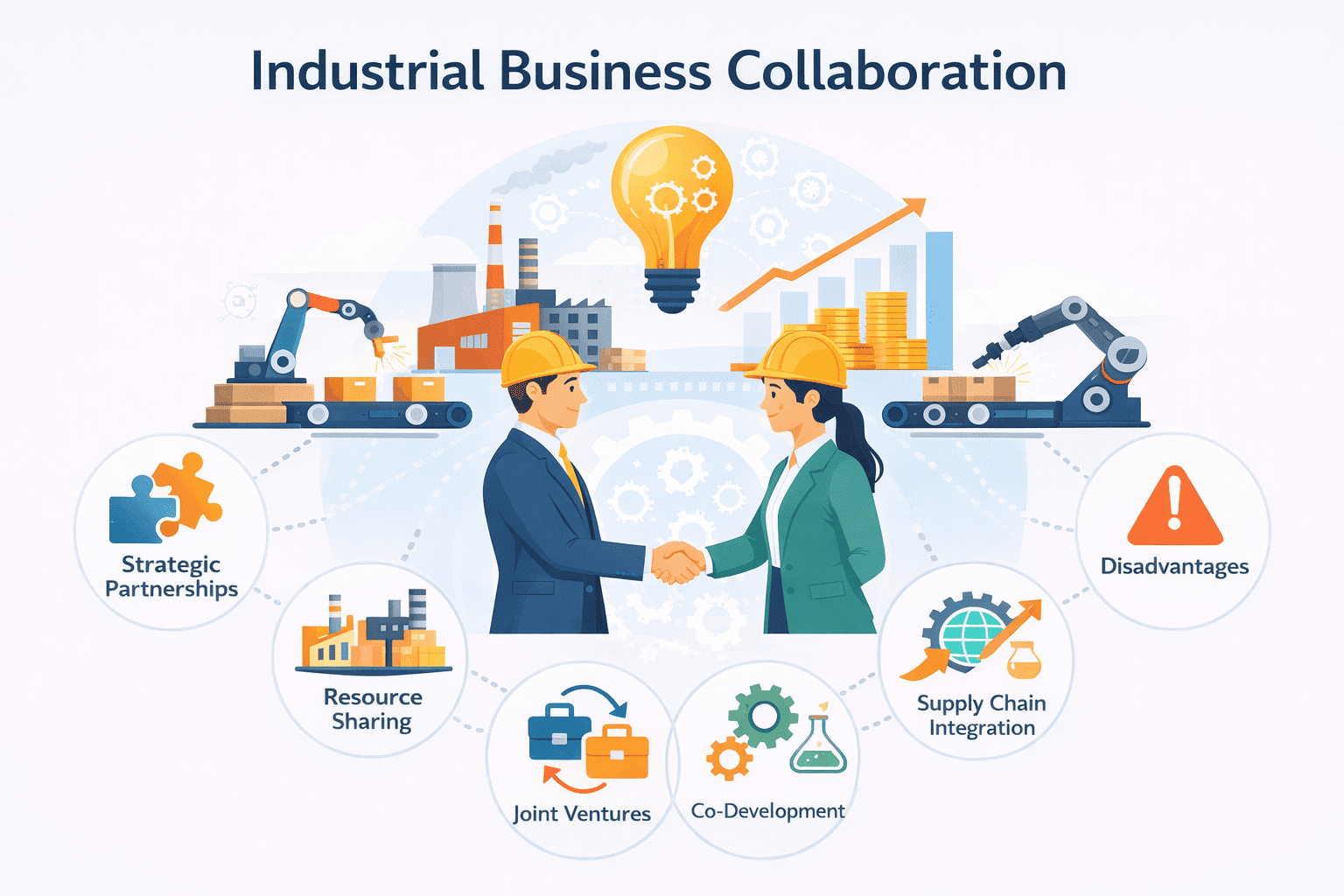
Industrial Business Collaboration, How Manufacturers & Distributors Win Together
Direct answer:Industrial business collaboration is the deliberate partnership between manufacturers, distributors, suppliers, and aligned service partners to share capabilities, shorten time-to-market, and enter new markets faster than either side could alone—especially when growth crosses regions or industries. The highest-leverage form is external collaboration: independent firms combining channels, capacity, data, and expertise under clear goals, governance, and documentation—not informal handshakes. GTsetu helps teams start with verified, better-fit introductions so qualification, legal, and operational integration move faster.
📅 March 27, 2026⏱ 12 min read✍️ GTsetu Editorial Team🔄 Updated regularly
7
Playbook Steps
4
Collaboration Models
100+
Countries on GTsetu
0%
Broker Commission
Growth in industrial B2B increasingly depends on who you can reliably partner with—not only what you manufacture or stock. A plant may have excellent capability but lack local channel depth; a distributor may have coverage but need vetted supply and predictable quality. Industrial business collaboration is how those pieces snap together with repeatable discipline: shared objectives, written rules, phased risk, and tooling that keeps both sides aligned.
This guide synthesises practical themes from manufacturing collaboration and partnership literature into one manufacturer–distributor lens: definitions, value stages, model choice, a seven-step playbook, principles, risks, and where GTsetu fits if you are expanding across borders.
💡 Who This Guide Is For
Manufacturing leaders building or tightening distribution in new regions. Distributors sourcing production partners with the right certifications and capacity. Operations and commercial teams structuring external collaboration (not only internal teamwork). Anyone evaluating international distributors, contract manufacturing overflow, or market entry partnerships.
SECTION 1
1 Quick Answers (Snippets, PAA & AI Overviews)
At a glance
Industrial business collaboration is structured cooperation across firms in the industrial value chain with shared goals, formal agreements, and measurable outcomes.
Question
Answer
What is industrial business collaboration?
Cooperation between makers, distributors, suppliers, or OEMs—typically with contracts, SLAs, and KPIs—not ad hoc deals alone.
Why does it matter now?
Global growth needs local reach, compliant execution, and speed; partners bring networks, market knowledge, and capital efficiency you may lack in-house.
What is the biggest mistake?
Treating collaboration as a handshake: unclear scope, weak IP/data rules, missing phase-gates—then scaling before integration is proven.
SECTION 2
2 Key Takeaways
01
External ≠ internal. The fastest scaling collaborations are between independent firms sharing channels, tech, and risk.
02
Complementarity drives innovation. Adjacent skills and markets often create new SKUs and routes to market.
Fit > fame. Shared vision, complementary strengths, transparent economics, and mutual benefit.
SECTION 3
3 What It Means on the Ground
In practice, industrial collaboration is how you turn a product advantage into a market advantage:
A manufacturer pairs with a distributor or regional integrator for stocking, service, financing, and local compliance.
An OEM works with specialised suppliers or contract manufacturers to flex capacity without fixed overhead.
Technology and operations partners align planning, quality, and logistics so decisions stay synchronized—not trapped in email threads.
Enterprise collaboration definitions emphasise purposeful connections across organisations to combine skills and perspectives; the industrial version simply anchors that idea in orders, forecasts, audits, and service levels.
Widen SKUs, geographies, or co-invest in service/demand.
Treat the relationship as a programme—not a one-off.
SECTION 8
8 Principles Scorecard
Use this as a quarterly health check for any industrial partnership:
Principle
Good signal
Bad signal
Shared goals
One-page joint business plan
KPIs misaligned (volume vs margin vs brand)
Open communication
Ops + exec rhythm
Surprises at quarter-end
Flexibility
Planned pivots after data
Rigid contracts, no change control
Mutual benefit
Transparent incentives
One side captures all upside
Continuous improvement
Blameless reviews after incidents
Same failures every season
SECTION 9
9 Challenges & Fixes
Challenge
Why it appears
What strong partners do
System & process mismatch
Different ERP, QC methods, naming
Integration plan; golden data rules
IP & data sensitivity
Drawings, recipes, customer lists
Tiered access; watermarking; audit logs
Cultural / timezone friction
Different decision speeds
RACI; single-threaded leaders; SLAs
Benefit-sharing disputes
Unclear margins and investments
Transparent true-ups; renewal triggers
⚠️ Don’t skip the pilot
The fastest way to destroy trust is to grant exclusivity, volume commitments, or tooling before day-to-day operations together have been proven.
SECTION 10
10 Why Cross-Industry Thinking Still Matters
Even when your core need is “factory meets distributor,” breakthrough routes to market often sit in adjacent industries: packaging, energy, cold chain, software, or service networks that unlock a new buyer. Keep a lane for small, governed experiments once your primary channel is stable.
Pattern: complementary lanes
📦
Packaging / logistics
Unit economics and shelf-life can change channel fit overnight.
🧊
Cold chain / compliance
Regulated categories need partners—not generic resellers.
🖥️
Data & service
Aftermarket telemetry can bind OEMs and distributors.
SECTION 11
11 GTsetu, Credible Global Introductions
🌐 Platform Spotlight, GTsetu
Industrial Collaboration Starts With the Right Counterparty
GTsetu is built for manufacturing and distribution leaders who need credible introductions across borders—not another generic directory. Collaboration only works when fit, documentation, and phased scale line up; GTsetu helps you start with a higher-quality shortlist so those steps move faster.
🏭
For manufacturersFind distribution, integration, or channel partners aligned with category, compliance, and target markets.
🚚
For distributorsDiscover production partners with capacity, certifications, and credible product–market proof.
🌍
Global expansionReduce cold-outreach cycles; focus on qualification, legal, and operational integration.
✅
6-Point Government Tie-Up VerificationEvery company is verified on Name, Address, Registration Number, Company Status, Company Type, and Date of Certificate of Incorporation using official government registries.
📄
Secure collaborationBuilt-in workflows to protect forecasts, specs, and commercial terms early.
🚫
Zero broker commissionCommercial terms stay between you and your partner.
6-point govt. tie-up verification before disclosure
✓ Mandatory verification
~ Varies widely
Protect IP / forecasts early
✓ Collaboration safeguards
✗ Often ad hoc
Broker fees on partnerships
✓ Zero commission
✗ Common 5–15%
FAQ
? Frequently Asked Questions
QWhat is industrial business collaboration?
It is partnership across industrial firms—especially manufacturers and distributors—to combine capabilities, share risk, and grow in new markets with clear governance and metrics.
QHow is it different from regular teamwork?
Teamwork is mostly internal. Industrial business collaboration is external: legal entities sharing channels, capacity, data, and customer access under agreed rules.
QWhat documents are essential?
At minimum: NDA, commercial or distribution agreement, SOW for pilots, operational SLAs, and IP/data addenda where needed.
QWhat is the #1 scaling mistake?
Skipping the pilot and KPI phase—committing volume, exclusivity, or tooling before the partnership proves it can run operations together.
QWhen does technology matter most?
When forecasts, quality records, and service incidents must be visible to both sides; integrated tooling reduces delay and mistrust.
QHow can GTsetu help?
By focusing introductions on manufacturing and distribution expansion, GTsetu helps teams spend less time on blind prospecting and more on qualification and integration. With 6-point government tie-up verification and zero broker fees, you start with a higher-quality shortlist. Join GTsetu →
Build Industrial Partnerships With Verified Global Counterparties
Join manufacturers and distributors using GTsetu to shorten the path from first meeting to structured collaboration—with 6-point government tie-up verification and zero broker fees.
They represents the product, and research team behind GTsetu, a global B2B collaboration platform built to help companies explore cross-border partnerships with clarity and trust. The team focuses on simplifying early-stage international business discovery by combining structured company profiles, verification-led access, and controlled collaboration workflows.
With a strong emphasis on trust, and disciplined engagement, Team GTsetu shares insights on global trade, partnerships, and cross-border collaboration, helping businesses make informed decisions before entering deeper commercial discussions.