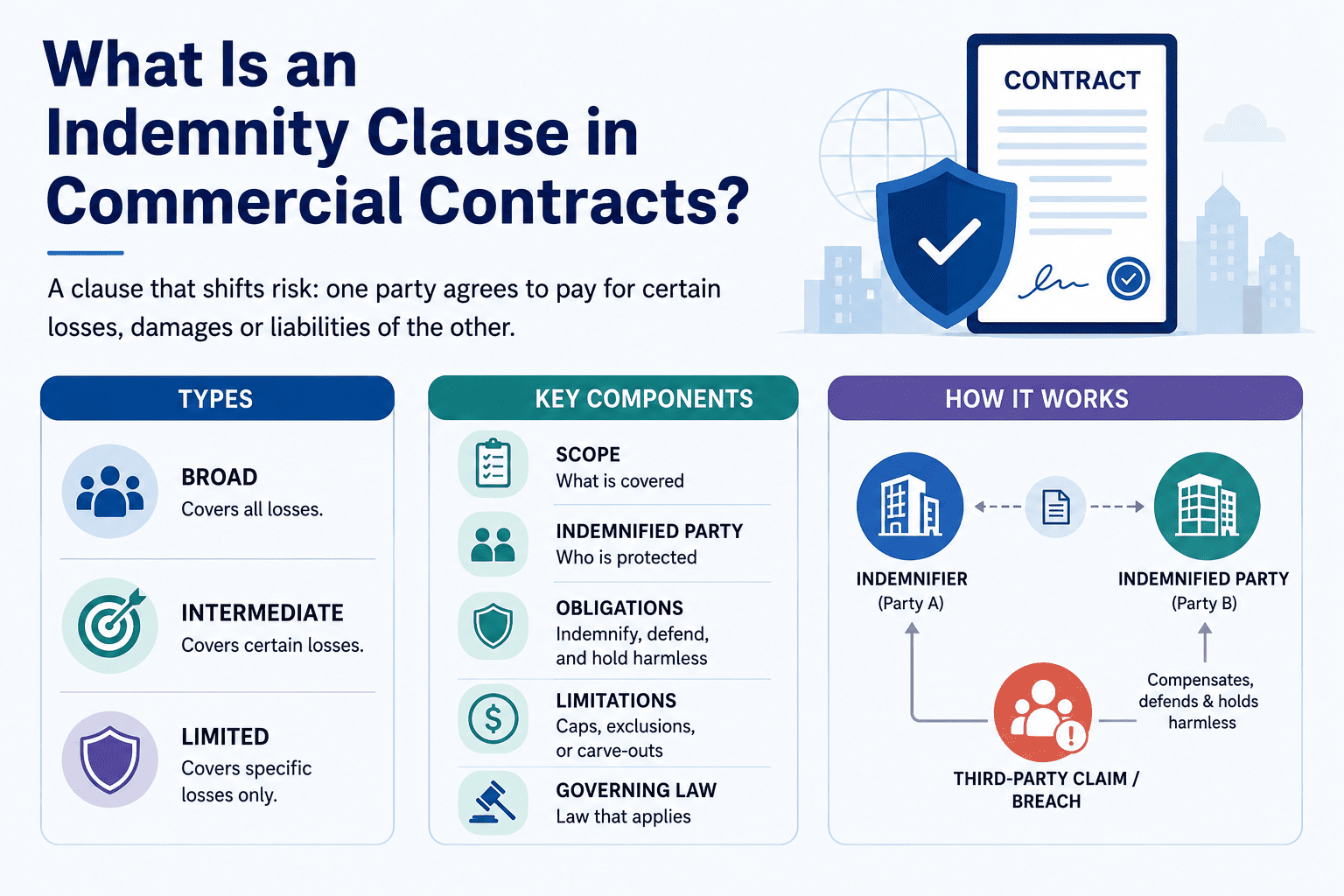
Why Indemnity Clauses Matter in International Business
In cross-border transactions, the party that creates a risk, such as manufacturing defective goods, providing negligent services, or infringing intellectual property, is often better positioned to bear the associated financial consequences. An indemnity clause explicitly shifts that burden, preventing the innocent party from suffering uncompensated loss. Without such a clause, a party might need to rely on common law damages, which can be limited, indirect or unavailable for third-party claims.
Indemnities provide certainty: they define covered losses (attorneys’ fees, settlements, judgments) and create a direct contractual right to recovery. For this reason, they are standard in supply agreements, IT services, M&A, real estate leases, and distribution arrangements.
Common Commercial Scenarios
📦Product Supply
Buyer seeks indemnity from seller for third‑party injury or property damage caused by defective goods.
💻SaaS & IP Licensing
Vendor indemnifies customer against third‑party IP infringement claims arising from use of the software.
🏗️Construction
Contractor indemnifies owner for claims resulting from construction negligence or subcontractor actions.
🤝Joint Ventures
Mutual indemnities for breaches of representations, warranties, or covenants by each party.
🚢Logistics & Warehousing
Logistics provider indemnifies shipper for loss or damage to goods caused by its negligence.
🏢Commercial Leases
Tenant indemnifies landlord for injuries occurring on leased premises due to tenant’s operations.
⚡ Key Principle
Indemnity clauses shift financial risk, not just liability. Even if a claim is groundless, the indemnifier may still owe defense costs if the clause is triggered by “allegations” rather than actual liability.
Components & Structure
Core Components of an Indemnity Clause
✅ Obligation to Indemnify
- Reimbursement for paid losses (judgments, settlements)
- Advance payment for unpaid liabilities or claims
- Usually limited to third-party claims unless drafted otherwise
🛡️ Obligation to Defend
- Pay defense costs (attorney fees, expert witnesses)
- Right to assume and control defence (if provided)
- Triggered by allegation, not ultimate disposition
Other critical elements: Scope of covered losses (direct, consequential, incidental), triggering events (breach, negligence, IP infringement), liability caps (fixed amount or multiple of contract value), exclusions (gross negligence of indemnitee, wilful misconduct), and survival period (often 2–5 years after termination).
Types of Indemnity
Types of Indemnity Clauses
| Type | Description | Common Use |
|---|
| One‑sided (Unilateral) | Only one party (often seller or service provider) indemnifies the other. | Software licensing, manufacturing, distribution. |
| Mutual (Reciprocal) | Each party indemnifies the other for losses arising from its own breach or negligence. | Joint ventures, strategic partnerships, construction. |
| Limited / Proportional | Indemnity applies only to claims caused by the indemnifying party’s negligence, excluding losses from the indemnitee’s own fault. | Service agreements with shared control. |
| Broad Form | Indemnifier covers all liability regardless of fault (often disfavoured or unenforceable). | Historically in some franchise or adhesion contracts. |
| Third‑party indemnity | Covers claims brought by persons not party to the contract (e.g., consumer or regulator). | Product liability, professional services. |
Risks & Pitfalls
Common Risks and Drafting Mistakes
🚩
Uncapped liability
No monetary cap can expose indemnifier to unlimited exposure, dwarfing contract value.
🚩
Indemnifying for indemnitee’s negligence
Clauses that require a party to indemnify the other for the other’s own negligence may be void as against public policy in many states.
🚩
Vague nexus phrases
“Arising from”, “relating to” gives broad coverage; more favourable to indemnitee. Indemnifier should narrow to “directly caused by”.
🚩
No control of defence
Indemnified party may settle without consent, leaving indemnifier to pay unreasonable sums. Always include right to approve settlement.
🚩
Failure to specify survival period
Without express survival, indemnity obligations may expire upon contract termination, leaving post‑termination claims uncovered.
Negotiation & Best Practices
How to Negotiate an Indemnity Clause
01
Define the triggering events precisely
Specify negligence, breach of contract, IP infringement, or bodily injury. Avoid catch‑all “any and all claims”.
02
Set reasonable liability caps & baskets
Cap indemnity at e.g., 100% of annual contract value or a fixed amount. Add a “basket” (minimum loss threshold) to avoid trivial claims.
03
Control defense and settlement
Give indemnifier the right to assume defence and require indemnitee’s consent for settlement, not to be unreasonably withheld.
04
Include survival language
State that indemnity obligations survive termination for a defined period (e.g., 3 years after termination).
05
Exclude consequential damages where possible
Many indemnities are paired with limitation of liability clauses, but the indemnity should carve out third-party claims that would otherwise be excluded.
📘 Jurisdictional nuance
In India, Section 124 of the Indian Contract Act 1872 defines indemnity, while English common law and US state laws vary. Some states (e.g., Texas, New York) have anti‑indemnity statutes restricting broad form indemnity in construction contracts. Always review local law.
FAQ
Frequently Asked Questions
QIs an indemnity clause the same as a “hold harmless” clause?
Often used interchangeably, but “hold harmless” can be broader: it may release the indemnified party from claims or require the indemnifier to protect against lawsuits. Many contracts combine “indemnify, defend, and hold harmless”. In some jurisdictions (California) the distinction matters for defense costs.
QWhat is the difference between indemnity and limitation of liability?
Indemnity is a right to recover specific losses from the other party, usually for third‑party claims. Limitation of liability caps the total amount recoverable (including indemnity). They often interact: parties may cap indemnity liability separately or include it within general liability caps.
QCan an indemnity clause cover direct claims (between the contracting parties)?
Yes, if expressly stated. Most indemnity clauses focus on third‑party claims, but they can be drafted to cover direct claims (e.g., breach of representations, warranty claims). The language must clearly say “direct claims” or “claims between the parties”.