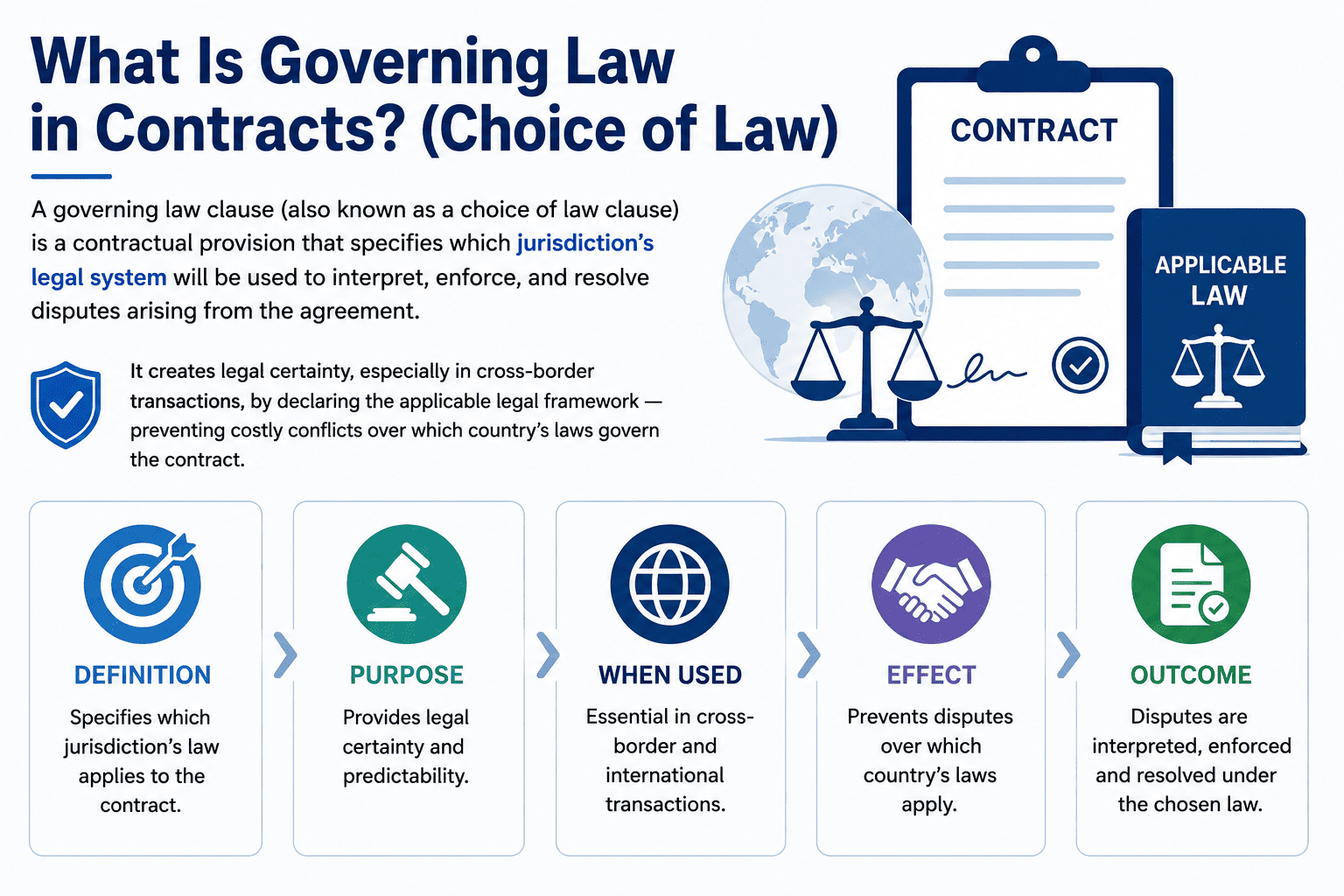
Why Governing Law Matters in Global Contracts
In international trade, parties from different legal systems routinely enter agreements. Without a governing law clause, a dispute leaves both sides uncertain about which country’s contract law, interpretation rules, and enforcement mechanisms apply. This ambiguity leads to litigation over the applicable law itself, driving up costs and delaying resolution by months or years. A clearly drafted governing law clause eliminates that threshold battle, allowing the parties to focus on the substance of the dispute.
Courts in most commercial jurisdictions (including the US, UK, Singapore, and EU member states) respect express choice of law provisions, provided the chosen law has a reasonable connection to the transaction or the parties. This principle, known as “party autonomy,” gives businesses the freedom to select a legal framework that is predictable, neutral, and sophisticated, even if neither party is domiciled there. English law, New York law, and Swiss law are frequent choices for cross-border contracts due to their developed commercial jurisprudence and respect for contractual freedom.
✨ Strategic Note
Selecting the governing law is a business decision, not merely a legal formality. It affects how courts interpret ambiguous terms, the availability of remedies, the treatment of limitation of liability clauses, and even the enforceability of non-compete provisions. Always consult local counsel in the chosen jurisdiction before finalising the clause.
Governing Law vs. Jurisdiction
Governing Law vs Jurisdiction: Critical Distinction
⚖️ Governing Law (Choice of Law)
- Determines which legal system’s statutes and precedents apply
- E.g., “This agreement shall be governed by the laws of England and Wales.”
- Affects contract interpretation, validity, remedies
- Does NOT decide where the case will be heard
🏛️ Jurisdiction (Venue)
- Specifies which court or arbitration tribunal hears disputes
- E.g., “The courts of Paris, France, shall have exclusive jurisdiction.”
- Determines procedural rules, location of hearings, enforcement of judgments
- Can be different from governing law (e.g., New York law, London courts)
Many contracts combine both clauses. For example: “This Agreement shall be governed by the laws of the State of New York. Any dispute arising hereunder shall be submitted to the exclusive jurisdiction of the federal or state courts located in New York County, New York.” Aligning governing law and jurisdiction simplifies proceedings, but mismatches can be workable if the chosen court is competent to apply foreign law.
Risks of Omission
Major Risks When a Contract Lacks Governing Law
🚩
Costly Preliminary Litigation
Parties must first fight over which law applies, expert witnesses on foreign law, jurisdictional challenges, and procedural delays before any merits hearing. Legal costs can spiral before the real dispute is addressed.
🚩
Unpredictable Conflict-of-Laws Rules
Courts apply different tests (Rome I Regulation in the EU, “most significant relationship” in US states). The outcome is uncertain: a contract signed in Singapore but performed in Brazil might be governed by either jurisdiction’s law, depending on judicial interpretation.
🚩
Unfavorable Mandatory Rules
Without a choice of law clause, a court could apply mandatory provisions of a jurisdiction that invalidates key terms (e.g., limitation of liability, non-compete clauses, or arbitration agreements) that would otherwise be enforceable.
🚩
Cross-Border Enforcement Difficulties
If no governing law is chosen, a resulting judgment may face resistance in enforcement proceedings because the original court had to determine applicable law in a way that another country’s courts find inconsistent with public policy.
Popular Legal Frameworks
Why English Law & Other Popular Choices
| Legal System | Key Advantages | Typical Use Cases |
|---|
| English Law | Predictable, respects party autonomy, sophisticated commercial courts, LCIA arbitration preferred worldwide. | International trade finance, shipping, reinsurance, cross-border joint ventures. |
| New York Law | Well-developed commercial code, pro-enforcement of contracts, efficient courts, widely used in finance. | Loan agreements, securities, M&A, US-based cross-border deals. |
| Swiss Law | Neutral, flexible, supports arbitration, strong privacy laws. | Private wealth, intellectual property licensing, pharma contracts. |
| Singapore Law | Common law system similar to English, respected courts (SICC), strong arbitration hub. | Asia-Pacific deals, tech licensing, construction projects. |
📘 Rome I Regulation (EU context)
For contracts concluded from 17 December 2009, EU Regulation (EC) 593/2008 (“Rome I”) gives effect to the parties’ choice of law. In the absence of choice, Article 4 provides default rules (e.g., contract for goods → law of seller’s habitual residence). Post-Brexit, the UK has retained equivalent rules (UK Rome I).
Drafting & Choice Guide
How to Choose & Draft a Governing Law Clause
1
Identify the Connection
Select a law with a genuine link to the transaction or parties (e.g., place of incorporation, performance, or a neutral hub like London). Courts may reject a completely unrelated law as contrary to public policy.
2
Consider Enforceability & Remedies
Compare how different laws treat limitation of liability, indemnities, and termination. English and New York law generally uphold negotiated risk allocation, while some civil law systems impose “cause” standards.
3
Align with Dispute Resolution Clause
Matching governing law with jurisdiction (e.g., English law + English courts) avoids procedural friction. If arbitration, consider LCIA (London), SIAC (Singapore), or ICC rules.
4
Use Clear, Unambiguous Language
State: “This Agreement and any non-contractual obligations arising from it shall be governed by and construed in accordance with the laws of [Jurisdiction].” Avoid vague phrases like “shall be subject to the laws of…” which create ambiguity about whether it’s governing law or jurisdiction.
Example clause (English law, exclusive jurisdiction):
“This Agreement shall be governed by and construed in accordance with the laws of England and Wales. The Parties irrevocably agree that the courts of London, England shall have exclusive jurisdiction to settle any dispute or claim arising out of or in connection with this Agreement.”
FAQ
Frequently Asked Questions
QCan I choose any governing law for my contract?
Generally yes, under the principle of party autonomy. However, courts may refuse to apply a chosen law if it has no connection to the parties or transaction, or if it violates the public policy (ordre public) of the forum. Additionally, certain mandatory rules (e.g., consumer protection, employment law) may override the chosen law if the weaker party is based in a jurisdiction with stricter protections.
QWhat’s the difference between “governed by” and “construed in accordance with”?
While often used together, “governed by” refers to the substantive law that applies to the contract’s validity and performance. “Construed in accordance with” emphasises that the rules of interpretation of the chosen law will apply. Using both phrases is standard to cover all aspects. Some drafts add “… and any non-contractual obligations” to include tort claims related to the agreement.
QDoes a governing law clause also determine jurisdiction?
No, they are separate. Governing law chooses the legal rules; jurisdiction chooses the court. However, many drafters combine them in one “Governing Law and Jurisdiction” clause. To be safe, include both elements explicitly: one sentence for governing law and another for the exclusive or non-exclusive jurisdiction of a named court.
QWhat happens if my contract is silent about governing law but includes an arbitration clause?
Arbitral tribunals also must determine the applicable law. Many institutional rules (LCIA, ICC) give arbitrators the power to decide the governing law directly, often based on the seat of arbitration and the parties’ implied intentions. However, the absence of an express governing law clause still introduces uncertainty and potential satellite disputes. It is best practice to specify the governing law expressly even in arbitration clauses.