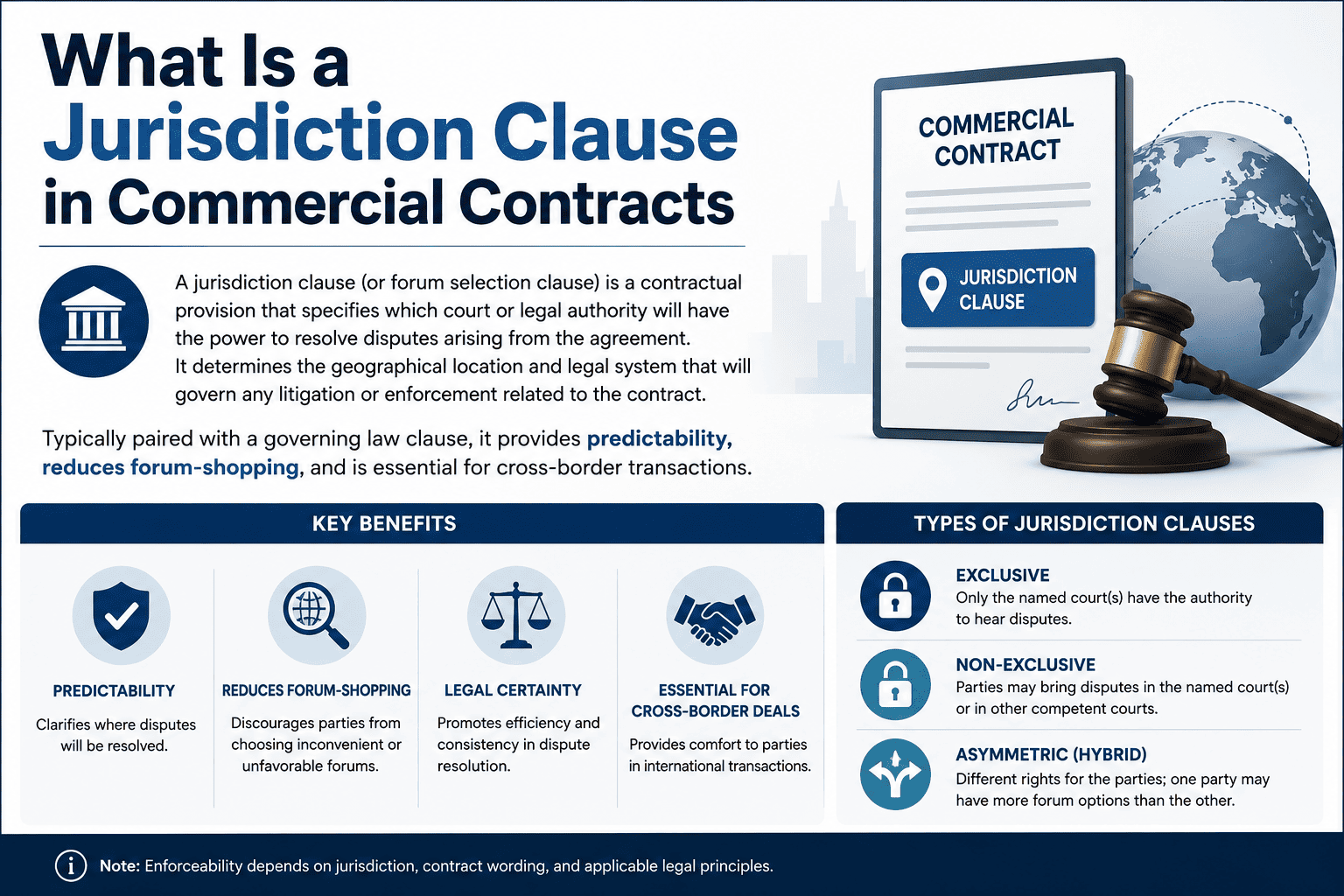
Why a Jurisdiction Clause Is Critical in International Trade
In cross-border contracts, uncertainty over where a dispute will be litigated can lead to costly parallel proceedings, jurisdictional races, and unpredictable outcomes. A well‑drafted jurisdiction clause eliminates that uncertainty by designating a single forum or a set of permissible courts. Without such a clause, parties must rely on national private international law rules (e.g., place of performance, defendant’s domicile, or where the harm occurred), which vary significantly and can produce inconsistent results.
Beyond predictability, jurisdiction clauses facilitate enforcement of judgments. Exclusive jurisdiction clauses that comply with the 2005 Hague Convention on Choice of Court Agreements benefit from mutual recognition and enforcement among contracting states (including the EU, UK, Singapore, and Ukraine). They also help avoid the “torpedo” effect of pre‑emptive litigation in slow or claimant‑friendly jurisdictions.
Typical Commercial Contexts
🌍Cross‑Border Supply Agreements
English or New York courts are often chosen for their efficiency and expertise in commercial disputes.
🏦Loan & Finance Agreements
Asymmetric clauses give lenders the right to sue in any competent court while restricting borrowers to a specific forum.
🤝M&A and Share Purchase Agreements
Exclusive jurisdiction in the seller’s or buyer’s home court, often paired with Delaware or English governing law.
📱Technology & IP Licensing
Courts of the licensor’s country for infringement claims, but non‑exclusive for other disputes.
⚡ Key principle
A jurisdiction clause does not automatically determine the applicable law, that requires a separate governing law clause. Both should be aligned to avoid conflicts.
Exclusive vs. Non‑Exclusive vs. Asymmetric
Types of Jurisdiction Clauses
📍 Exclusive jurisdiction
- Disputes must be brought only in the chosen court.
- Provides maximum certainty and is protected under the 2005 Hague Convention.
- Typical wording: “The courts of England shall have exclusive jurisdiction to settle any dispute.”
- Prevents parallel proceedings and forum shopping.
🌐 Non‑exclusive jurisdiction
- Parties may sue in the chosen court but are not barred from suing elsewhere.
- Offers flexibility, especially where assets are located in multiple jurisdictions.
- Typical wording: “The courts of New York shall have non‑exclusive jurisdiction.”
- Risk of parallel proceedings and conflicting judgments.
Asymmetric (Hybrid) Clauses
These clauses give one party (typically a lender or stronger party) the right to sue in any competent court, while the other party (borrower) is restricted to a single specified forum. They are common in international lending and are generally valid under English law, but face uncertainty in some EU jurisdictions (e.g., France) on grounds of lack of mutuality. Post‑Brexit, English courts continue to enforce asymmetric clauses, but parties should verify local law when counterparties are based in the EU.
| Clause Type | Advantages | Disadvantages |
|---|
| Exclusive | Certainty, Hague Convention enforcement, avoids parallel litigation | Inflexible if assets are located outside chosen jurisdiction |
| Non‑exclusive | Flexibility, ability to sue where assets are located | Risk of concurrent proceedings and inconsistent rulings |
| Asymmetric | Strong protection for lenders/dominant party | Potential unenforceability in some EU states, negative perception of unfairness |
Drafting & Enforcement Pitfalls
Common Risks and Drafting Mistakes
🚩
Conflicting clauses in related agreements
Group companies or master agreements may contain different jurisdiction clauses, leading to disputes over which forum should prevail.
🚩
Failure to use “exclusive” when intended
Omitting the word “exclusive” may result in the clause being interpreted as non‑exclusive, allowing parallel proceedings elsewhere.
🚩
Vague scope language
Clauses limited to “arising under” may miss tort claims or disputes about formation. Use “arising out of or in connection with” to capture all claims.
🚩
No provision for service of process
Without an agent for service of process in the chosen forum, effecting service may be difficult, especially when the counterparty has no local presence.
🚩
Ignoring mandatory local laws
Consumer, employment, or real estate contracts may be subject to mandatory rules that override the chosen jurisdiction (e.g., Brussels Ibis for EU consumers).
Enforceability & International Frameworks
Enforcement of Jurisdiction Clauses and Judgments
Choice of court agreements are generally respected under English common law, the Hague Convention 2005 (for exclusive clauses), and the Brussels Ibis Regulation (for EU member states). Under the Hague Convention, a judgment given by a chosen court in a contracting state must be recognised and enforced in other contracting states without re‑examination of the merits. The UK acceded to the Convention in its own right post‑Brexit, preserving enforcement between the UK and EU member states for exclusive jurisdiction clauses. Non‑exclusive and asymmetric clauses fall outside the Convention and rely on national enforcement regimes, such as the common law action on a foreign judgment or bilateral treaties.
In India, foreign judgments from “reciprocating territories” (e.g., UK, Singapore, UAE) are enforceable directly under Section 44A of the CPC, while judgments from non‑reciprocating territories require a fresh suit on the foreign judgment or original cause of action. Parties should always verify whether the chosen court’s jurisdiction is in a reciprocating territory before drafting.
📘 Indian perspective
Under the CPC, parties to an international commercial contract may choose a foreign court, but the judgment will be conclusive only if it meets the conditions of Section 13 (e.g., not obtained by fraud, rendered on the merits, and by a court of competent jurisdiction). To enable direct execution, choose a court in a reciprocating territory.
Drafting Checklist
How to Draft an Effective Jurisdiction Clause
01
Determine exclusive or non‑exclusive
If you want a single, predictable forum, use “exclusive”. If you may need to sue where assets are located, use “non‑exclusive” and accept the risk of parallel proceedings.
02
Align governing law and jurisdiction
Choose a governing law that is familiar to the chosen court. English law + English courts is the most common combination; New York law + New York courts is another standard pair.
03
Use precise scope language
Cover “any dispute arising out of or in connection with this agreement, including any question regarding its existence, validity, formation or termination (including non‑contractual disputes).”
04
Include consent to jurisdiction and waiver of objections
Add a waiver of immunity, inconvenient forum, and improper venue objections. Also provide for service of process (e.g., an agent or registered mail).
05
Check for treaty protection
For exclusive clauses, ensure the chosen state is a party to the 2005 Hague Convention. For asymmetric clauses, assess local law in the counterparty’s jurisdiction.
FAQ
Frequently Asked Questions
QWhat is the difference between jurisdiction and venue?
Jurisdiction refers to the authority of a court to hear a case (subject matter and personal jurisdiction). Venue refers to the specific geographical location (e.g., Manhattan federal court vs. Albany state court). A jurisdiction clause typically specifies the court or state; venue is often implied or separately agreed.
QCan a jurisdiction clause be overridden by a mandatory law?
Yes. Consumer protection, employment, and certain real estate laws often override choice of court agreements. Under EU law, a consumer cannot be deprived of the protection of his or her home country’s courts. Similarly, some states refuse to enforce clauses that would violate strong public policy.
QWhat happens if my contract has no jurisdiction clause?
The courts will apply the rules of private international law (e.g., Brussels Ibis or common law). This may result in litigation in a jurisdiction neither party expected, often the defendant’s domicile or the place of performance, leading to uncertainty and increased costs.