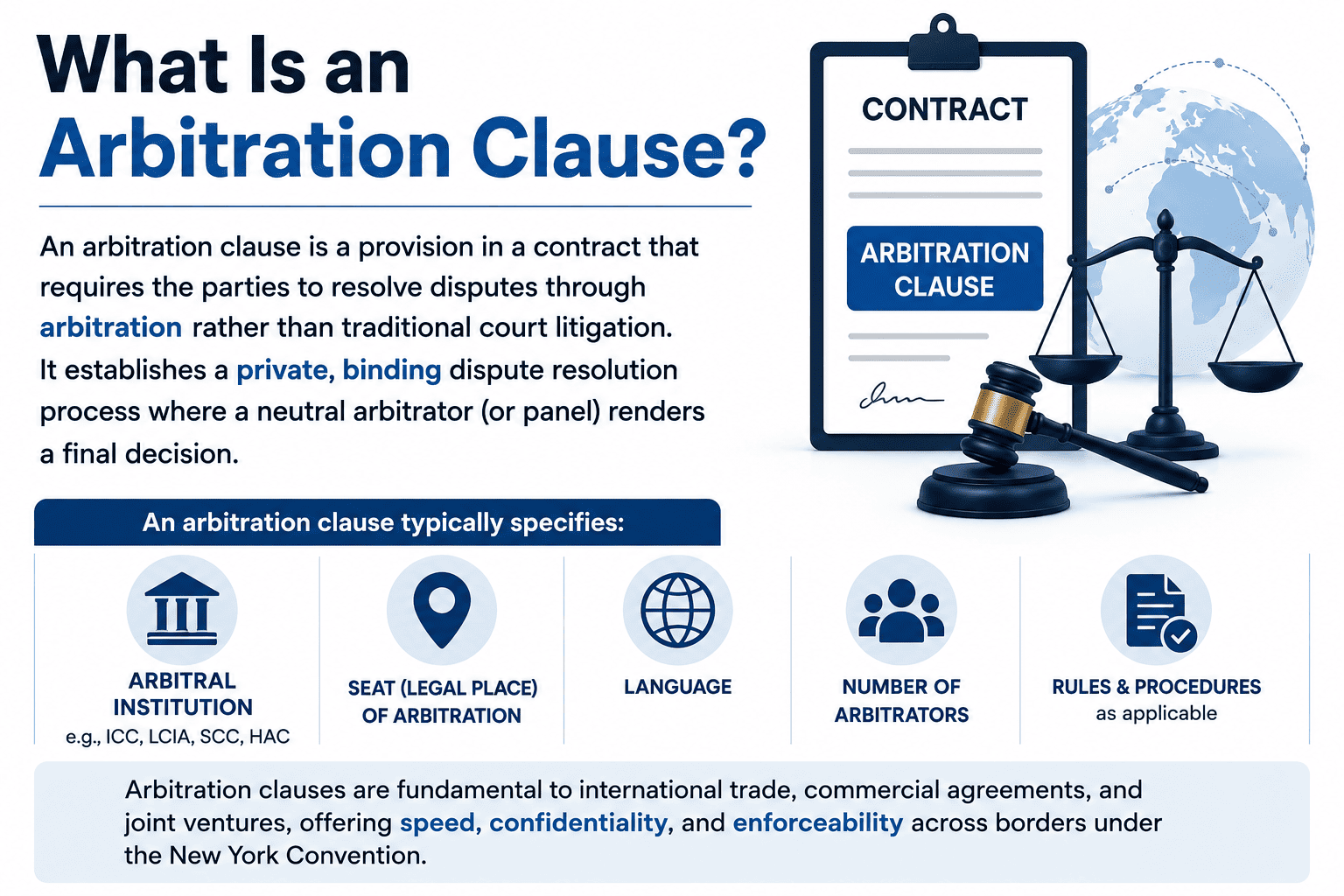
Why Is an Arbitration Clause Essential in Commercial Contracts?
In cross-border trade and complex commercial relationships, court litigation presents serious challenges: unfamiliar legal systems, expensive and slow procedures, public hearings that expose confidential business information, and foreign judgments that may be difficult to enforce. An arbitration clause overcomes these obstacles by offering a private, neutral, and efficient alternative.
Arbitration is particularly valuable in international contracts because arbitral awards are enforceable in over 170 countries under the New York Convention on the Recognition and Enforcement of Foreign Arbitral Awards (1958). Court judgments, by contrast, often require separate recognition proceedings and are not automatically enforceable across borders. For parties from different legal cultures, arbitration also allows them to choose a neutral seat, procedural rules, and arbitrators with relevant industry expertise, ensuring a fair process that neither side dominates.
According to the ICC, LCIA, and SCC, the arbitration clause is consistently the most negotiated dispute resolution term in international contracts, above governing law, jurisdiction, and service of process clauses. A well‑drafted arbitration clause provides certainty, reduces the risk of jurisdictional battles, and ensures that any dispute will be resolved efficiently without derailing the underlying business relationship.
Common Contract Types Where Arbitration Clauses Are Used
🌍
International Sale of Goods
Cross‑border supply agreements, distribution contracts, and agency arrangements often include ICC or LCIA arbitration to avoid unfamiliar foreign courts.
🤝
Joint Ventures & Shareholders’ Agreements
Multi‑party disputes require institutional arbitration with clear rules for consolidation, joinder, and appointment of arbitrators.
🏗️
Construction & Infrastructure
Large projects use multi‑tiered clauses (negotiation → mediation → arbitration) and often ad hoc arbitration under UNCITRAL Rules.
💡
Technology Licensing & IP
Confidentiality is critical; arbitration provides private hearings and sealed awards, protecting trade secrets.
⚡
Energy & Natural Resources
Oil, gas, and mining contracts often specify arbitration in a neutral seat (e.g., Stockholm, London, Singapore) with expert arbitrators.
🏛️
Government & State Contracts
Investment treaties and state contracts frequently provide for ICSID or SCC arbitration to protect foreign investors.
⚡ Key Principle
The arbitration clause is an independent agreement that survives the termination or invalidity of the main contract, known as the principle of “separability” or “autonomy” of the arbitration clause. Even if the underlying contract is void, the arbitration clause remains enforceable, preserving the tribunal’s jurisdiction to decide that very issue.
Binding vs Non-Binding Arbitration
Binding vs Non‑Binding Arbitration: What the Clause Commits You To
Most commercial arbitration clauses provide for binding arbitration, meaning the arbitrator’s award is final and enforceable in court with very limited grounds for appeal (fraud, corruption, or violation of public policy). Non‑binding arbitration is rare in B2B contracts; it is more common in court‑annexed programs or consumer disputes where parties retain the right to a trial. The distinction must be clearly expressed in the clause, ambiguity will typically be resolved in favour of binding arbitration under the governing arbitration law (e.g., Indian Arbitration and Conciliation Act 1996, English Arbitration Act 1996).
✅ Binding Arbitration
- Award is final and enforceable in court
- Waiver of right to trial (parties cannot litigate the same dispute)
- Very limited grounds for setting aside an award (fraud, corruption, public policy)
- Standard for international commercial arbitration
- Provides finality and commercial certainty
- Enforceable under the New York Convention in 170+ countries
⚠️ Non‑Binding Arbitration
- Award is advisory only, no enforceable obligation
- Parties may reject the award and proceed to litigation or a second arbitration
- Often used as a pre‑litigation step in court‑annexed programs
- Rare in commercial B2B contracts
- Can be useful for testing positions before a neutral expert
- Must be explicitly stated as non‑binding; otherwise courts presume binding
✨ Practical Guidance
For commercial contracts, always state clearly that the arbitration is “final and binding” and that the parties waive any right to appeal on the merits of the award. If you intend non‑binding arbitration (rare), make that explicit. The safer and standard approach is binding arbitration under a recognised institutional rule set.
Institutional vs Ad Hoc Arbitration
Institutional Arbitration vs Ad Hoc Arbitration: Choosing the Framework
Arbitration clauses must specify whether arbitration will be administered by an institution (e.g., ICC, LCIA, SCC, HAC, SIAC) or conducted on an ad hoc basis (without an institution, often under UNCITRAL Arbitration Rules). Institutional arbitration provides administrative support, scrutiny of draft awards, and default mechanisms for arbitrator appointment. Ad hoc arbitration offers maximum flexibility but places all procedural management on the parties and the tribunal.
| Feature | Institutional Arbitration | Ad Hoc Arbitration |
|---|
| Administration | Institution manages filings, fees, appointments, and logistical support | Parties and tribunal manage all aspects; no institutional oversight |
| Appointment of arbitrators | Institution appoints if parties cannot agree (default mechanism) | Parties must agree or apply to a court for appointment, delay possible |
| Rules | Published institutional rules (ICC, LCIA, SCC, HAC), predictable and tested | Often UNCITRAL Arbitration Rules; parties may design their own |
| Costs | Higher due to administrative fees (typically 5–15% of arbitrator fees) | No institutional fees; potentially lower cost |
| Scrutiny of award | Institution reviews draft award to ensure enforceability (ICC mandatory) | No scrutiny, tribunal issues award directly; higher annulment risk if procedural errors |
| Typical use cases | High‑value international contracts, state contracts, complex multi‑party disputes | Construction, shipping, or disputes where parties have strong procedural trust |
| Examples | ICC, LCIA, SCC, HAC, SIAC, CIETAC, ICDR | UNCITRAL Rules with appointing authority named (e.g., HAC as appointing authority) |
✨ Recommendation
For most international commercial contracts, institutional arbitration is strongly preferred. The ICC, LCIA, and SCC have proven rules, experienced case management teams, and a global network for enforcement. Ad hoc arbitration may be suitable for highly specialised domestic contracts or where parties have long‑standing relationships and can manage the procedure without institutional support.
Model Arbitration Clauses
Model Arbitration Clauses from Leading Institutions
Using standard model clauses from reputable arbitral institutions is the safest drafting approach. These clauses have been tested in courts worldwide and include all essential elements: agreement to arbitrate, applicable rules, seat, language, and number of arbitrators. Below are recommended clauses from ICC, LCIA, SCC, and HAC.
ICC International Court of Arbitration
All disputes arising out of or in connection with the present contract shall be finally settled under the Rules of Arbitration of the International Chamber of Commerce by one or more arbitrators appointed in accordance with the said Rules.
Recommended additions: The seat of arbitration shall be [City/Country]. The language of the arbitration shall be [ ].
LCIA (London Court of International Arbitration)
Any dispute arising out of or in connection with this contract, including any question regarding its existence, validity or termination, shall be referred to and finally resolved by arbitration under the LCIA Rules. The number of arbitrators shall be [one/three]. The seat of arbitration shall be [City/Country]. The language to be used in the arbitral proceedings shall be [ ]. The governing law of the contract shall be the substantive law of [ ].
SCC Arbitration Institute (Stockholm)
Any dispute, controversy or claim arising out of or in connection with this contract, or the breach, termination or invalidity thereof, shall be finally settled by arbitration in accordance with the Arbitration Rules of the SCC Arbitration Institute. The seat of arbitration shall be [ ]. The language to be used in the arbitral proceedings shall be [ ]. This contract shall be governed by the substantive law of [ ].
HAC (Hyderabad Arbitration Centre), Domestic
Any dispute arising out of or incidental or in connection with this Contract / Agreement, including any question regarding its existence, operation, termination, validity or breach thereof, shall be referred to and finally resolved by Arbitration administered by 'Hyderabad Arbitration Centre' (HAC), in accordance with its Arbitration Rules. The Arbitral Tribunal shall consist of sole / three Arbitrator(s). The seat of Arbitration shall be _________. The Language of the Arbitration shall be _________.
⚠️ Important, Express Opt‑Outs
The ICC Rules include an Emergency Arbitrator provision and Expedited Procedure for lower‑value cases. If you wish to exclude these, you must expressly opt out. For ICC: “The Emergency Arbitrator Provisions shall not apply” and/or “The Expedited Procedure Provisions shall not apply.” For SCC, specify if you prefer the Rules for Expedited Arbitrations instead of the standard Arbitration Rules.
Essential Components
Essential Components of a Well‑Drafted Arbitration Clause
A robust arbitration clause leaves no room for jurisdictional disputes. The following components are widely recognised as essential by the ICC, LCIA, SCC, and leading arbitration practitioners.
01
Clear Agreement to Arbitrate
Use unequivocal language: “All disputes arising out of or in connection with this contract shall be finally settled by arbitration.” Avoid ambiguous phrases like “may be referred” or “could be resolved”, they create jurisdiction battles.
02
Choice of Institutional Rules (or Ad Hoc Framework)
Specify the arbitral institution (ICC, LCIA, SCC, HAC, SIAC, etc.) and the version of its rules. For ad hoc, refer to the UNCITRAL Arbitration Rules and name an appointing authority (e.g., HAC or the Permanent Court of Arbitration).
03
Seat (Legal Place) of Arbitration
The seat determines the procedural law (lex arbitri) and the courts with supervisory jurisdiction over the arbitration. Seats are typically neutral: London, Paris, Geneva, Singapore, Hong Kong, Stockholm, or Mumbai. Do not confuse with “venue” (physical hearing location).
04
Number and Method of Appointing Arbitrators
Odd numbers: usually one (lower value) or three (high value/complex). For three arbitrators, specify that each party appoints one, and the two party‑appointed arbitrators appoint the presiding arbitrator. For sole arbitrator, state whether the institution or the parties will appoint.
05
Language of the Arbitration
Specify the language for pleadings, hearings, and the award. In international contracts, English is the default. For domestic contracts, specify the local language. Failure to specify language can lead to costly translation disputes and delays.
06
Governing Law of the Contract
The substantive law that governs the main contract (e.g., English law, New York law, Indian law) should be stated separately from the seat. The seat determines procedural law; the governing law determines the merits of the dispute.
✨ Drafting Tip, Separability
Include an express statement that the arbitration clause is separable from the main contract: “The arbitration clause shall remain valid and enforceable even if the remainder of this contract is held to be void, voidable, or unenforceable.” While most national laws imply separability, an express statement avoids jurisdictional challenges.
Drafting Pitfalls
Common Drafting Pitfalls and How to Avoid Them
Poorly drafted arbitration clauses are a frequent source of jurisdictional litigation, delay, and added cost. The following pitfalls are consistently identified by arbitration practitioners and courts.
🚩
Ambiguous or Contradictory Language
A clause stating “disputes may be referred to arbitration or litigation” is void for uncertainty. Courts will find no binding agreement to arbitrate. Always use mandatory words: “shall be finally settled by arbitration.”
🚩
Failing to Specify the Seat (Place of Arbitration)
Without a designated seat, there is no lex arbitri (procedural law). This can lead to parallel court proceedings in multiple jurisdictions. Always name the seat: “The seat of arbitration shall be London, United Kingdom.”
🚩
Confusing Seat with Venue
Parties sometimes say “venue” when they mean “seat.” The seat is the legal home of the arbitration; the venue is the physical location of hearings. Specify seat clearly; you may add that hearings may be held elsewhere for convenience.
🚩
Overly Detailed Procedural Requirements
Specifying strict timelines for pleadings, evidence exchange, or award delivery can backfire. If the timeline is impossible to meet, the clause may be unenforceable. Instead, rely on the institution’s rules or the tribunal’s case management powers.
🚩
Failure to Address Multi‑Party and Multi‑Contract Issues
Complex transactions with multiple contracts and parties need express provisions for joinder, consolidation, and concurrent proceedings. Without these, separate arbitrations may produce inconsistent awards and increased costs.
🚩
Reference to Tender Documents Without Express Incorporation
The Supreme Court of India has held (2026) that a general reference to a tender document containing an arbitration clause does not incorporate that clause into the contract. The arbitration clause must be expressly set out or specifically incorporated by reference in the signed agreement.
Multi‑Tiered Clauses
Multi‑Tiered Dispute Resolution Clauses (Escalation Clauses)
Many contracts include a step‑by‑step dispute resolution process, often called escalation, multi‑tiered, or “ADR first” clauses. A typical structure is: (1) good faith negotiations between senior executives, (2) mediation or conciliation, and (3) arbitration as the final binding step. These clauses preserve business relationships by encouraging amicable resolution before arbitration.
📋 Example, ICC Multi‑Tiered Clause
“Any dispute arising out of or in connection with this contract shall be submitted to mediation under the ICC Mediation Rules. If the dispute is not settled within 60 days of the request for mediation, it shall be finally settled under the ICC Rules of Arbitration.”
However, multi‑tiered clauses must be drafted with care. Courts in India and elsewhere have held that pre‑arbitration steps (like negotiation or mediation) are mandatory conditions precedent. In M.K. Shah Engineers & Contractors v. State of M.P. (1999), the Supreme Court of India held that parties cannot bypass agreed negotiation steps to invoke arbitration directly. To avoid delay, specify a clear time limit for each step (e.g., “30 days for negotiation”) and state that arbitration may be commenced thereafter if no agreement is reached.
Non‑Arbitrable Matters
Non‑Arbitrable Matters: What Cannot Be Sent to Arbitration
Not all disputes can be resolved by arbitration. Under Indian law and the laws of most jurisdictions, certain categories of disputes are considered non‑arbitrable because they involve public interest, third‑party rights, or matters requiring judicial supervision.
⚖️
Criminal Offences
Disputes involving criminal liability cannot be arbitrated; only courts have jurisdiction over criminal matters.
🏠
Matrimonial & Guardianship Matters
Family law disputes (divorce, child custody, guardianship) are not arbitrable as they involve public policy and the welfare of minors.
🏦
Insolvency & Winding‑Up
Insolvency proceedings are within the exclusive jurisdiction of courts and tribunals (e.g., NCLT in India).
📜
Trusts & Testamentary Matters
Disputes concerning the validity of wills, trusts, and succession require judicial oversight and are non‑arbitrable.
🏛️
Eviction Under Special Statutes
Tenancy and eviction disputes governed by special rent control statutes are often non‑arbitrable under Indian law.
⚡
Competition & Bribery Matters
Antitrust, competition law violations, and bribery allegations involve public interest and are typically non‑arbitrable.
FAQ
Frequently Asked Questions
QWhat is an arbitration clause?
An arbitration clause is a contractual provision that requires the parties to resolve disputes through arbitration instead of traditional court litigation. It outlines the process, rules, seat (legal place), language, and method for appointing arbitrators. The clause is considered a “final and binding” agreement, meaning the arbitrator’s award is enforceable in court with very limited grounds for appeal.
QWhat is the difference between binding and non‑binding arbitration?
In binding arbitration, the arbitrator’s award is final and enforceable in court, and the parties waive their right to trial. In non‑binding arbitration, the award is advisory; parties may reject it and proceed to litigation or a second arbitration. Most commercial arbitration clauses provide for binding arbitration to achieve finality and efficiency. The Arbitration and Conciliation Act, 1996 (India) and the New York Convention presume binding arbitration unless the parties expressly state otherwise.
QWhat is the difference between institutional and ad hoc arbitration?
Institutional arbitration is administered by an arbitral institution (e.g., ICC, LCIA, SCC, HAC) under its published rules. The institution provides administrative support, appoints arbitrators if parties cannot agree, reviews draft awards, and manages fees. Ad hoc arbitration is conducted without an institution, giving parties complete control over procedure but requiring them to manage all administrative aspects. The UNCITRAL Arbitration Rules are often used for ad hoc arbitrations. Institutional arbitration is more common in high‑value international contracts due to its predictability and administrative support.
QWhat is the seat of arbitration?
The seat (or legal place) of arbitration is the jurisdiction whose procedural law (lex arbitri) governs the arbitration. It determines the courts that have supervisory authority over the arbitration (e.g., to appoint arbitrators, decide challenges, or set aside awards). The seat is distinct from the venue (physical hearing location). Common seats include London, Paris, Geneva, Singapore, Hong Kong, Stockholm, and Mumbai. The seat must be clearly specified in the arbitration clause.
QCan an arbitration clause be included in a contract by reference to another document?
The Supreme Court of India held in 2026 that a general reference to a tender document containing an arbitration clause does not amount to incorporation of that clause into the contract. To be effective, the arbitration clause must be either set out in full in the signed agreement or specifically incorporated by reference using clear language (e.g., “the arbitration clause in Annex X is hereby incorporated”). General references to “terms and conditions” are insufficient.