Why Is an MoU Used in International Business?
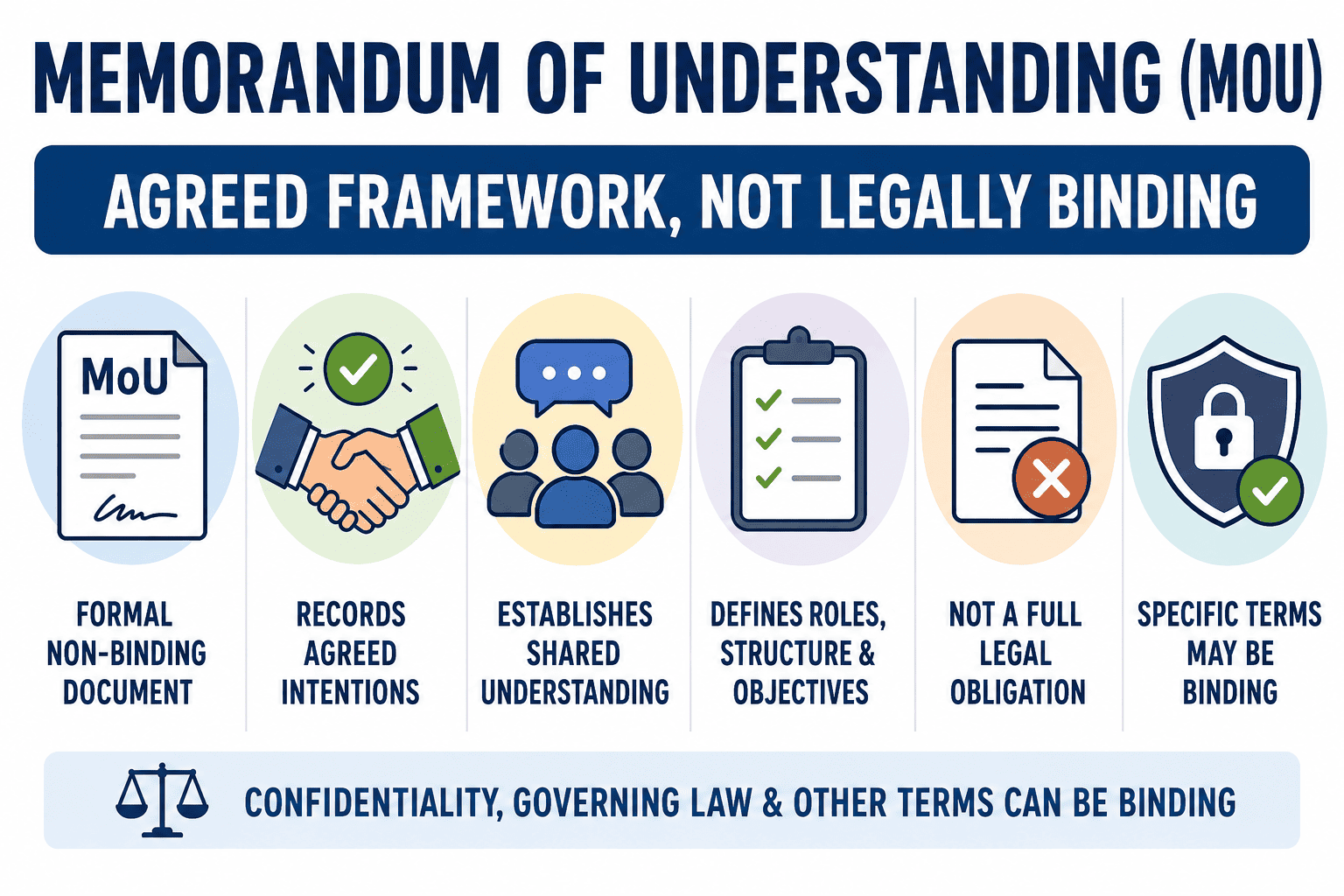
In international trade and cross-border partnerships, the gap between expressing interest and executing a formal binding agreement can be substantial, months of due diligence, legal drafting, regulatory approvals, and commercial negotiation often separate the two. An MoU is the document that bridges that gap: it captures what has been agreed in principle and creates a structured reference point for everything that follows, without forcing either party into binding obligations before they are ready.
The MoU plays a particularly important role when the parties involved come from different legal systems, business cultures, or institutional contexts. In international joint ventures, government-to-government trade cooperation, institutional research partnerships, and early-stage distribution agreements, an MoU provides a written record of mutual intent that both parties can use internally to secure approvals, allocate resources, and plan next steps, before the full legal agreement is in place.
Unlike a Letter of Intent, which tends to be more transaction-specific and deal-focused, an MoU is more relationship-oriented. It defines the framework within which a partnership will operate, roles, responsibilities, principles, and scope, rather than specifying the precise commercial mechanics of a single transaction.
Common Situations Where an MoU Is Used
🤝
Joint Ventures & Strategic Partnerships
Before incorporating a joint venture entity or signing a shareholders’ agreement, parties use an MoU to align on the partnership structure, equity split, governance principles, and contribution framework.
🌍
Cross-Border Distribution Agreements
A manufacturer and a prospective international distributor use an MoU to document territory, product scope, and performance expectations before drafting the full distribution agreement.
🏛️
Government & Institutional Cooperation
Trade ministries, development agencies, and public institutions use MoUs to formalise bilateral cooperation frameworks, trade facilitation commitments, and sector-level collaboration.
🔬
Research & Technology Partnerships
Universities, R&D institutions, and technology companies use MoUs to define intellectual property ownership principles and collaboration scope before formal licensing or joint development agreements are executed.
🏭
Supplier & Manufacturer Onboarding
Before committing to a long-term supply agreement, brands and manufacturers use an MoU to document the agreed principles of quality standards, volume expectations, and exclusivity intent during the evaluation period.
💼
Mergers & Acquisitions (Pre-LOI Stage)
In complex M&A transactions, an MoU may precede even the Letter of Intent, documenting the mutual interest and high-level parameters before the parties commit to a structured due diligence process.
⚡ Key Principle
An MoU is not a soft or informal document simply because it is non-binding. It is a formal record of agreed intent that shapes every subsequent negotiation. The positions parties take in an MoU become the baseline for the binding agreement that follows, making precision in drafting as important here as in the final contract.
Binding vs Non-Binding
Binding vs Non-Binding: What an MoU Actually Commits You To
The most consequential misunderstanding about MoUs is the assumption that “non-binding” means “without legal implications.” In reality, courts in multiple jurisdictions have found MoUs to create enforceable obligations, either because the language was sufficiently certain to constitute a binding agreement, or because the subsequent conduct of the parties indicated an intention to treat the MoU as binding. The non-binding status of an MoU must be deliberately and clearly drafted, not assumed.
✅ Typically Binding Provisions
- Confidentiality and non-disclosure obligations
- Governing law and jurisdiction clause
- Exclusivity or standstill period (if included)
- Dispute resolution mechanism
- Cost allocation and break fee (if included)
- Non-solicitation of employees or customers
⚠️ Typically Non-Binding Provisions
- Partnership structure and ownership framework
- Commercial terms, pricing, and volume commitments
- Roles, responsibilities, and governance principles
- Technology or IP contribution framework
- Timeline and milestone targets
- Final scope, territory, and exclusivity terms
✨ Practical Guidance
Every provision in an MoU should be explicitly labelled as binding or non-binding, do not rely on general header language such as “this MoU is non-binding” to protect all provisions equally. Confidentiality, governing law, and exclusivity clauses in particular should be explicitly stated as binding, while commercial and operational framework terms should be explicitly stated as non-binding. Always engage qualified legal counsel in the jurisdiction of the counterparty before executing an MoU.
Risks & Misunderstandings
Common Risks and Misunderstandings
🚩
Assuming “Non-Binding” Means No Legal Risk
Courts in the UK, India, Singapore, UAE, and other major trade jurisdictions have found MoUs to be enforceable where the language was sufficiently certain or where the parties’ conduct suggested an intention to be bound. “Non-binding” must be clearly drafted for each provision, not assumed from the document title.
🚩
Using an MoU as a Substitute for the Formal Agreement
Parties sometimes begin full commercial operations, sharing resources, making investments, or delivering services, based on an MoU alone, without ever executing the binding agreement. This creates serious legal and commercial exposure if the relationship breaks down, as the MoU typically provides no remedy for breach of commercial terms.
🚩
Vague Language on Scope and Exclusivity
An MoU that describes the partnership scope or exclusivity territory ambiguously creates disputes before the formal agreement is even drafted. Each party may interpret vague MoU language differently, and use those interpretations as their baseline position in subsequent negotiations.
🚩
No Expiry Date or Review Milestone
An MoU without a defined expiry date or negotiation timeline can leave one party in a state of indefinite commitment, unable to pursue alternative partners while the other party delays. Always specify a validity period and the milestones required before the binding agreement must be executed.
🚩
Disclosing Sensitive Information Without Binding Confidentiality
Sharing commercially sensitive information, product pipeline, pricing strategy, customer data, or proprietary processes, in reliance on a non-binding MoU, without a separately executed and binding NDA, leaves that information unprotected if the relationship does not progress to a formal agreement.
🚩
Governing Law Left Unspecified in Cross-Border MoUs
In international partnerships, the absence of a governing law clause means that any dispute about the MoU itself, including whether specific provisions are binding, will be subject to uncertainty about which jurisdiction’s courts and laws apply. This is a particularly common and costly oversight in Asia-Pacific and Middle East cross-border arrangements.
MoU vs LOI vs Term Sheet
MoU vs LOI vs Term Sheet: Key Differences
These three documents are frequently confused, particularly because different industries, geographies, and legal traditions use the terms differently. The distinctions below reflect general commercial practice in international trade contexts.
| Dimension |
Memorandum of Understanding (MoU) |
Letter of Intent (LOI) |
Term Sheet |
| Primary Use |
Institutional partnerships, joint ventures, government cooperation, early-stage cross-border arrangements |
Commercial transactions, supply deals, M&A, distribution agreements |
Investment, financing, venture capital, acquisition deal terms |
| Tone |
Collaborative; relationship and framework-oriented |
Formal; transaction and deal-oriented |
Highly structured; finance and governance-oriented |
| Specificity |
Lower, establishes principles, roles, and framework |
Moderate, outlines specific proposed commercial terms |
High, sets out precise economic and governance provisions |
| Binding Status |
Usually non-binding overall; specific protective clauses binding |
Usually non-binding commercially; select clauses binding |
Non-binding commercially; binding procedural provisions common |
| Typical Length |
2–6 pages |
1–5 pages |
3–10 pages |
| Leads To |
Joint venture agreement, distribution agreement, cooperation deed, formal contract |
Formal supply, distribution, or transaction agreement |
Shareholders’ agreement, investment agreement, or SPA |
| Common in |
Government trade, institutional partnerships, Asia-Pacific and Middle East business culture |
Western commercial transactions, M&A, manufacturing |
Venture capital, private equity, startup funding rounds |
✨ Note on Geographic Convention
In South Asia, Southeast Asia, and the Middle East, MoUs are often used where Western commercial practice would use an LOI, particularly in government-to-government and institution-to-institution contexts. The title matters less than the specific content and provisions of the document. Always review what a document actually says, not just what it is called.
When to Move Forward
When to Move From an MoU to a Formal Agreement
An MoU is a transitional document with a defined purpose: to bridge the period between mutual intent and binding commitment. It should have a clear pathway to the formal agreement, with defined milestones and a validity period. The following steps indicate that a transition to the binding agreement is appropriate.
01
Due Diligence on Both Parties Is Complete
Each party has verified the other’s business registration, financial standing, operational capacity, regulatory compliance status, and authority of the representatives negotiating the agreement. No material issues have emerged that change the agreed framework.
02
Commercial Terms Are Sufficiently Detailed
Pricing, volume or revenue commitments, payment structure, territory, exclusivity conditions, IP ownership, and exit provisions have been discussed and agreed in enough detail to be drafted into binding agreement language by legal counsel on both sides.
03
Internal Approvals Have Been Secured
Both parties have received the internal approvals necessary to execute a binding agreement, board resolutions, investment committee sign-off, government ministry approval, or other institutional authorisation as required by their governance structure.
04
Legal Counsel Has Reviewed and Aligned on Structure
Qualified legal counsel in each relevant jurisdiction has reviewed the proposed agreement structure, confirmed that the binding provisions are enforceable, and resolved outstanding issues around IP ownership, liability caps, and dispute resolution mechanism.
05
The MoU Validity Period Has Not Expired
The formal agreement should be executed before the MoU’s validity period closes. If additional time is needed, the MoU should be formally extended in writing, with both parties’ signatures, rather than allowing it to lapse and continuing to operate informally.
FAQ
Frequently Asked Questions
Q
Is a Memorandum of Understanding legally binding?
An MoU is generally considered non-binding in its commercial and operational terms, meaning neither party is obligated to complete the transaction or partnership. However, specific provisions within an MoU, particularly confidentiality, governing law, exclusivity, and dispute resolution clauses, can be explicitly made binding. Courts in several jurisdictions have also found entire MoUs to be enforceable where the language was sufficiently certain or where the conduct of the parties indicated an intention to be bound. Every MoU should be reviewed by qualified legal counsel before execution.
Q
What is the difference between an MoU and a Letter of Intent?
An MoU and an LOI both serve as pre-contractual documents that record mutual intent before a binding agreement is signed. The key difference is in tone and typical use. An MoU is more relationship and framework-oriented, it establishes the principles, roles, and structure of a partnership without specifying detailed commercial terms. An LOI is more transaction and deal-oriented, it outlines the specific proposed commercial terms of a transaction and is more commonly used in supply agreements, M&A, and distribution deals. In practice, the distinction is often blurred, particularly across different geographies and industries, what matters is the specific content and provisions of the document, not its title.
Q
When should an MoU be used instead of a formal agreement?
An MoU is appropriate when two parties have established mutual intent and need to document a shared framework before the full details of a formal agreement can be negotiated and executed. This is common when either party requires internal approval before binding commitments can be made, when due diligence needs to be completed before commercial terms can be finalised, or when the partnership involves institutional, governmental, or cross-jurisdictional complexity that makes immediate formal agreement impractical. The MoU should always include a defined validity period and a clear pathway to the binding agreement.