Why Is an NDA Used in International Business?
Every meaningful business negotiation involves the exchange of information that one or both parties would not want shared beyond that conversation. Product formulations, pricing structures, supplier relationships, customer data, expansion strategies, and proprietary technology are all examples of information whose disclosure to competitors or the public could cause material commercial harm. An NDA is the legal instrument that makes that exchange possible, by creating enforceable obligations of confidentiality before the information changes hands.
In international manufacturing and distribution partnerships, the NDA performs an especially critical function. A brand sharing its product specification with a prospective manufacturer, a distributor disclosing its channel network to a potential supplier, or two companies exploring a joint venture, all of these require one or both parties to reveal information that defines their competitive position. Without a binding NDA in place before disclosure, that information is shared without legal protection.
The NDA is not a signal of distrust, it is a professional standard. In well-structured international trade relationships, the NDA is executed as a matter of course at the earliest stage of substantive discussion, before any product brief, pricing model, or business plan is shared. Its presence protects both sides and signals that both parties understand how to manage sensitive commercial relationships.
⚡ Critical Distinction from MoU and LOI
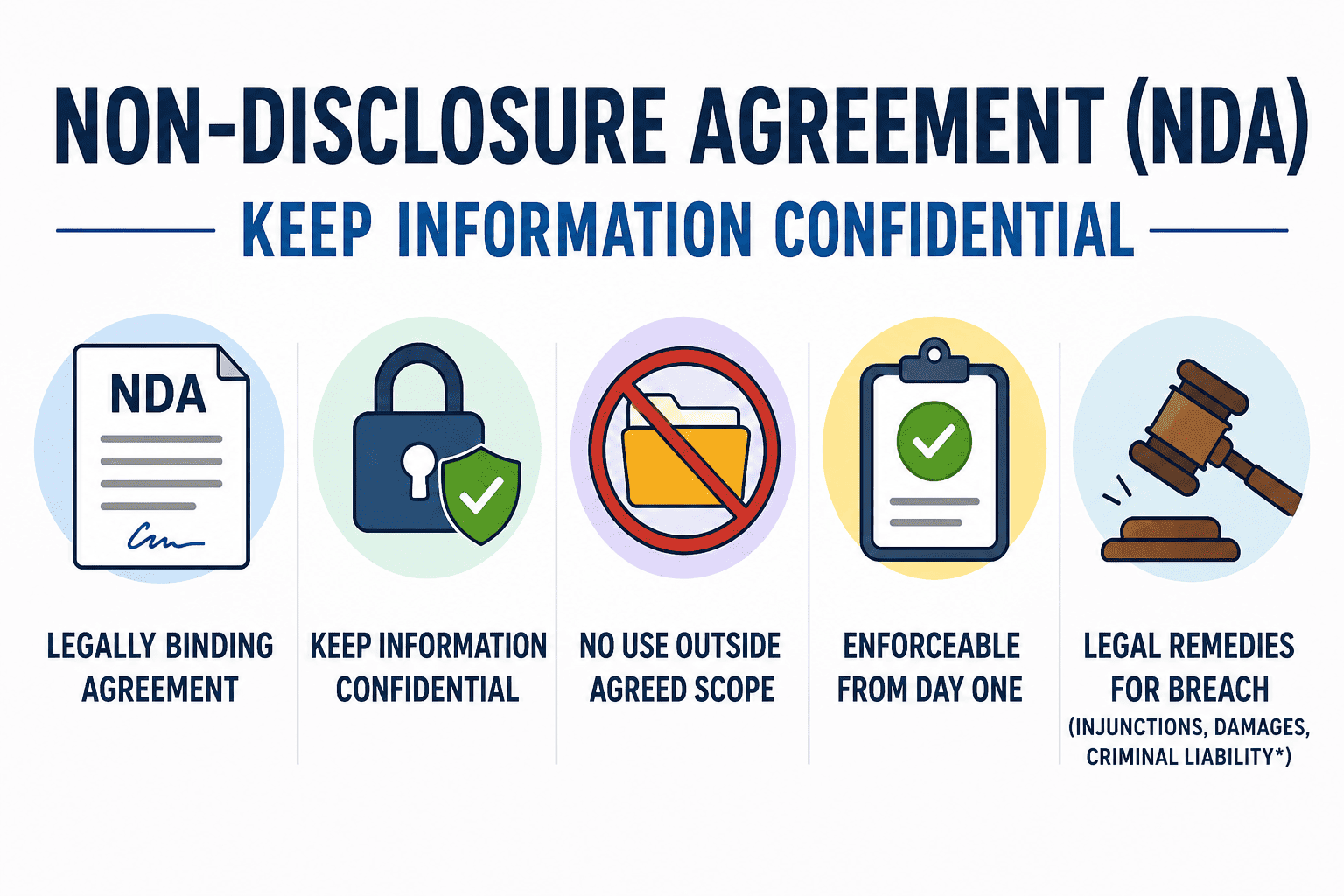
Unlike an MoU or LOI, which are typically non-binding in their commercial terms, an NDA is a fully binding legal contract from the moment of execution. Breach of an NDA is actionable in court and can result in injunctive relief stopping further disclosure, damages for harm caused, and recovery of legal costs. This is why the NDA must be signed before any sensitive disclosure, never after.
Unilateral vs Mutual
Unilateral vs Mutual NDA: Which Type Applies?
The structure of an NDA depends on the direction of information flow between the parties. Getting this wrong, using a unilateral NDA in a situation that requires mutual protection, or a mutual NDA that creates unnecessary obligations, can leave one party exposed or create friction in the negotiation.
→ One-Way Flow
Unilateral NDA
Only the receiving party is bound by confidentiality obligations. The disclosing party shares information freely; the recipient is restricted from disclosing or misusing it.
- Brand sharing product brief with a manufacturer
- Inventor disclosing concept to a potential licensee
- Company sharing business plan with an investor
- Employer sharing trade secrets with a new employee
⇄ Two-Way Flow
Mutual NDA
Both parties are bound by confidentiality obligations. Each party discloses sensitive information to the other and each is restricted from sharing or misusing what they receive.
- Joint venture feasibility discussions
- M&A due diligence between two companies
- Technology licensing negotiations
- Strategic partnership or co-development talks
✨ Practical Guidance
In most early-stage international trade partnership discussions, a mutual NDA is appropriate, even if information flow appears one-directional at first. As the conversation develops, both parties typically disclose commercially sensitive information. Starting with a mutual NDA avoids the need to renegotiate when that happens, and signals equal standing in the relationship.
Key Clauses
Key Clauses Every NDA Should Include
An NDA is only as strong as the precision of its drafting. Vague or incomplete clauses are regularly exploited by parties seeking to avoid confidentiality obligations. The following clauses are essential in any NDA used for international trade or manufacturing partnerships, and each requires careful attention rather than boilerplate language.
| Clause |
What It Must Specify |
Priority |
| Definition of Confidential Information |
Precisely what information is protected, categories, formats (written, oral, digital), and whether residual knowledge from memory is included. Vague definitions are the most common enforcement failure point. |
Critical |
| Permitted Use |
The specific purpose for which the receiving party may use the confidential information. Any use outside this defined purpose, even if the information is not further disclosed, constitutes a breach. |
Critical |
| Exclusions from Confidentiality |
Standard exclusions include information already in the public domain, information independently developed by the recipient, and information received from a third party without restriction. These must be clearly defined to avoid disputes. |
Critical |
| Duration of Obligation |
How long the confidentiality obligation lasts, both during the agreement and after its termination. Trade secret protection may need to survive agreement expiry indefinitely; commercial information typically has a defined post-termination period of 2–5 years. |
Critical |
| Governing Law and Jurisdiction |
Which country’s law governs the NDA and where disputes will be resolved. In cross-border agreements, this determines enforceability, an NDA governed by a jurisdiction with weak IP enforcement provides limited practical protection. |
Critical |
| Permitted Disclosures |
To whom the receiving party may disclose confidential information, typically limited to employees or advisors with a need to know, subject to equivalent confidentiality obligations. This clause should require the recipient to be responsible for their employees’ and advisors’ compliance. |
Standard |
| Return or Destruction of Information |
Upon termination of the NDA or on request, all confidential information, including copies, notes, and derived materials, must be returned or destroyed, with written confirmation. Critical for product specifications and technical documentation. |
Standard |
| Remedies for Breach |
Acknowledgement that breach may cause irreparable harm for which monetary damages are insufficient, preserving the right to seek injunctive relief without having to prove financial loss first. Essential for protecting product specifications and trade secrets. |
Standard |
| No Licence or Rights Granted |
Explicit statement that disclosure of confidential information does not grant the receiving party any licence, ownership right, or IP interest in the information disclosed. Prevents the receiving party from later claiming usage rights based on disclosure. |
Standard |
Risks & Misunderstandings
Common Risks and Misunderstandings
🚩
Signing an NDA After Disclosure Has Already Occurred
An NDA can only protect information that is disclosed after it is executed. Information shared in an initial meeting, email exchange, or product demonstration before the NDA is signed is not covered, regardless of what the NDA subsequently says. Always execute the NDA before any substantive discussion involving sensitive information.
🚩
Using Generic or Unreviewed Template NDAs
Template NDAs downloaded from the internet are frequently inadequate for cross-border manufacturing and distribution contexts. They may use definitions of confidential information that are too narrow, omit jurisdiction-specific enforcement provisions, or fail to address the specific type of information being shared, product formulations, technical drawings, pricing models. Every NDA should be reviewed by qualified legal counsel in the relevant jurisdiction.
🚩
Vague Definition of Confidential Information
An NDA that defines confidential information as “all information shared between the parties” or that relies on case-by-case marking as confidential creates significant enforcement risk. Courts have dismissed NDA claims where the definition was insufficiently precise to establish what information was actually protected. Define categories, formats, and marking requirements explicitly.
🚩
Assuming Enforceability Across All Jurisdictions
An NDA that is fully enforceable in one country may provide limited or no practical protection in another. Some jurisdictions have weak IP enforcement infrastructure, do not recognise certain remedies (such as injunctive relief), or impose limitations on the duration of confidentiality obligations. The governing law clause must be chosen strategically, not by default.
🚩
No Provision for Employee and Advisor Access
If the NDA does not address who within the receiving party’s organisation may access confidential information, and under what obligations, the information can be shared internally without restriction. The NDA should specify that access is limited to those with a genuine need, and that the receiving party is responsible for ensuring those individuals are bound by equivalent confidentiality obligations.
🚩
Perpetual Duration Without Trade Secret Justification
While perpetual confidentiality obligations are appropriate for trade secrets, courts in many jurisdictions consider unreasonably long or perpetual NDA terms for ordinary commercial information to be unenforceable. Matching the duration of the obligation to the nature of the information, and the jurisdiction’s standards, is essential for enforceability.
NDA vs Confidentiality Clause vs CDA
NDA vs Confidentiality Clause vs CDA: Key Differences
Confidentiality protection appears in different forms depending on the stage and structure of a business relationship. Understanding how a standalone NDA differs from a confidentiality clause embedded in another agreement, and from a Confidential Disclosure Agreement, helps ensure the right instrument is used at the right time.
| Instrument |
Form |
When Used |
Key Characteristic |
| Non-Disclosure Agreement (NDA) |
Standalone binding contract |
Before substantive discussion begins; at the outset of any negotiation involving sensitive information |
Fully enforceable from execution; survives the termination of any subsequent agreement; most comprehensive protection |
| Confidential Disclosure Agreement (CDA) |
Standalone binding contract |
Functionally identical to NDA; term is more common in pharmaceutical, biotech, and scientific research contexts |
Same legal function as an NDA; the different name reflects industry convention rather than legal distinction |
| Confidentiality Clause in MoU / LOI |
Provision within a larger document |
When an MoU or LOI includes a binding confidentiality provision covering the pre-contract negotiation period |
Binding only if explicitly stated as such within the MoU/LOI; may not survive termination of the MoU/LOI; scope is typically limited to the negotiation context |
| Confidentiality Clause in Final Contract |
Provision within the binding agreement |
Governs confidentiality of information shared during the course of performing the contract, after the deal is agreed |
Covers the ongoing contractual relationship; does not protect information disclosed before the contract was signed unless the NDA is referenced and incorporated |
⚡ Important
A confidentiality clause in an MoU or LOI only protects information shared during the period covered by that document. It does not replace a standalone NDA. For comprehensive protection across the full lifecycle of a partnership, from initial discussion through contract execution and beyond, a standalone NDA executed at the earliest stage of negotiation remains the most reliable instrument.
When to Execute
When to Execute an NDA in International Trade Partnerships
The timing of NDA execution is not a procedural formality, it is a substantive risk management decision. The following sequence reflects best practice for international manufacturing and distribution relationships.
01
Before Any Product or Business Information Is Shared
Execute the NDA before sharing product specifications, formulations, technical drawings, pricing targets, customer data, supplier names, or any other commercially sensitive information. If the counterparty is unwilling to sign an NDA before receiving this information, treat that as a significant risk signal.
02
Before Due Diligence Information Is Exchanged
When evaluating a manufacturer, distributor, or joint venture partner, both parties will share financial, operational, and compliance information. This phase requires NDA protection from both sides, a mutual NDA should be in place before the due diligence data room is opened or any operational documents are shared.
03
Before LOI or MoU Negotiations Begin in Detail
Even though an MoU or LOI may include a confidentiality clause, a standalone NDA should be executed before detailed LOI or MoU negotiation begins, because those negotiations themselves will require disclosure of commercially sensitive information that the MoU or LOI confidentiality clause may not fully cover.
04
Before Technical or Operational Site Visits
Factory audits, technical site visits, and operational assessments involve exposure to proprietary manufacturing processes, equipment configurations, quality systems, and workforce practices. An NDA covering all information observed or received during such visits should be executed before the visit takes place.
05
Review the NDA’s Survival Provisions Before the Final Agreement Is Signed
When the formal binding agreement is executed, confirm that the NDA’s confidentiality obligations are either incorporated into the final agreement or explicitly stated to survive alongside it. Do not assume that signing the final agreement terminates the NDA, check the survival clause in both documents.
FAQ
Frequently Asked Questions
Q
Is a Non-Disclosure Agreement legally binding?
Yes, an NDA is a fully binding legal contract from the moment it is executed by both parties. Unlike an MoU or LOI, which are typically non-binding in their commercial terms, an NDA creates immediate and enforceable obligations. Breach of an NDA can result in injunctive relief preventing further disclosure, a claim for damages caused by the breach, recovery of legal costs, and in some jurisdictions, particularly for trade secrets, criminal liability. The enforceability of specific provisions depends on the governing law and jurisdiction specified in the agreement.
Q
What is the difference between a mutual NDA and a unilateral NDA?
A unilateral NDA obligates only the receiving party to maintain confidentiality, used when information flows in one direction only, such as a brand sharing product specifications with a manufacturer. A mutual NDA obligates both parties, used when both sides will be sharing sensitive information, such as in joint venture negotiations or M&A due diligence. In international trade partnership discussions, a mutual NDA is generally preferable from the outset, even when information flow initially appears one-directional, since the nature of what is shared tends to evolve as the relationship develops.
Q
When should an NDA be signed in international trade?
An NDA should be signed before any commercially sensitive information is disclosed, including product specifications, pricing, customer lists, supplier relationships, or business strategy. In international manufacturing and distribution partnerships, the NDA should be executed before sharing any product brief, before due diligence information is exchanged, and before any negotiation that requires either party to reveal proprietary commercial data. Signing an NDA after disclosure has already occurred provides no protection for the information already shared.