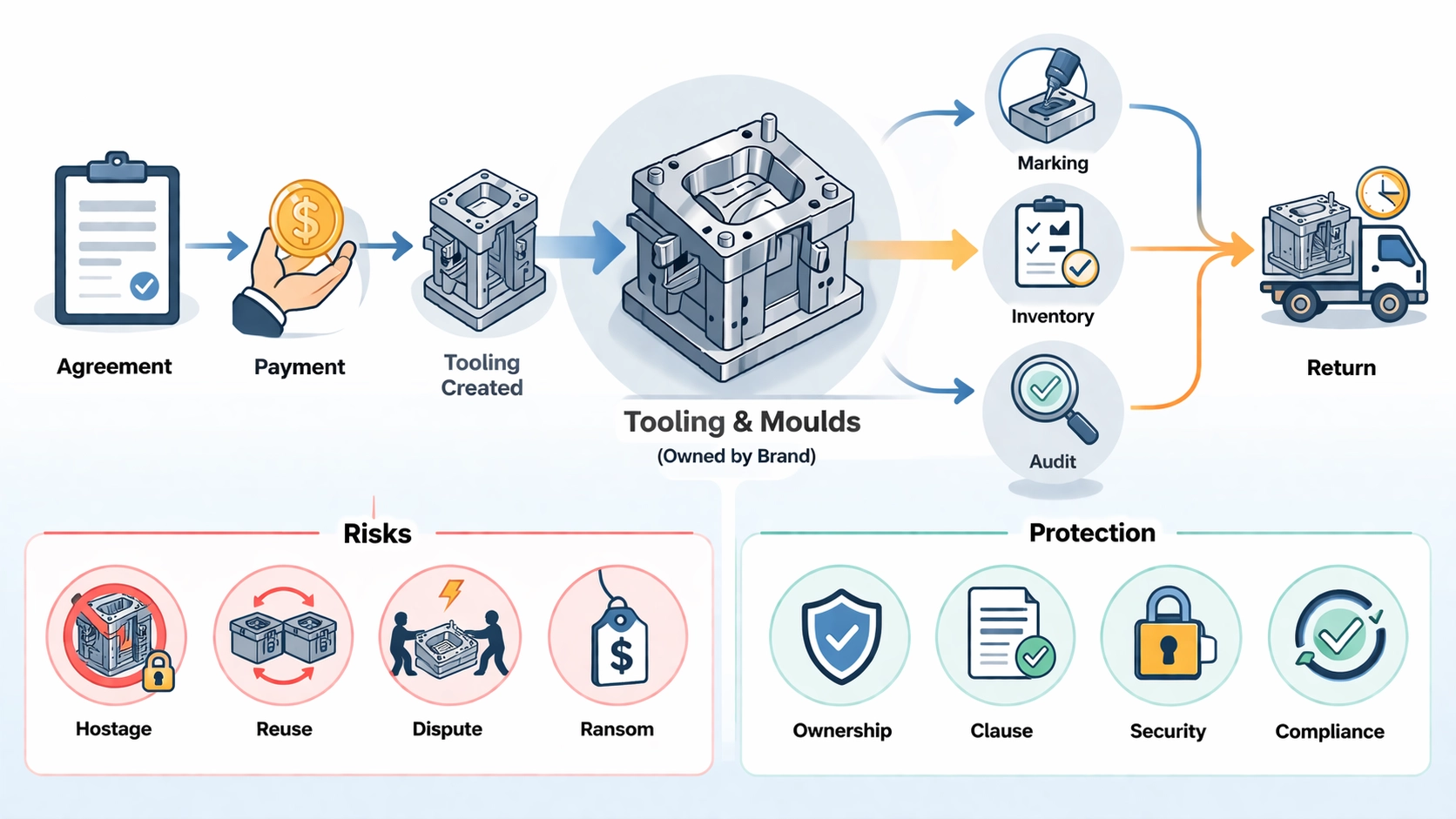
Who Owns Tooling and Moulds in Contract Manufacturing?
Direct Answer: In most jurisdictions, tooling and moulds physically held by a contract manufacturer are treated as the manufacturer’s property by default — regardless of who paid for them — unless a written agreement explicitly assigns ownership to the brand owner. This is one of the most overlooked and commercially damaging gaps in outsourced manufacturing. Without a tooling ownership clause, physical marking requirements, return provisions, and misuse restrictions, the manufacturer you hired can hold your moulds hostage, use them for competitors, or charge you to retrieve assets you already paid for. For brand owners outsourcing production internationally, GTsetu provides verified manufacturer discovery with NDA-first engagement and encrypted document sharing — so your tooling assets are protected from the moment the relationship begins.
📅 April 10, 2026⏱ 15 min read✍️ GT Setu Editorial Team🔄 Updated regularly
$50K–$500K+
Typical Tooling Investment Lost in Disputes
72%
of manufacturing contracts lack explicit tooling clauses
100+
Countries — GTsetu Verified Network
0%
Broker Commission on GTsetu
Tooling and moulds are among the most significant capital investments in product manufacturing — and among the most legally vulnerable. A brand owner may spend $50,000 to $500,000 commissioning custom moulds for a plastic product, ceramic component, or metal part, deliver that investment to a contract manufacturer, and then discover — upon a contract dispute or when switching factories — that the moulds are legally the manufacturer’s property and cannot be retrieved without a court order or a significant additional payment.
This is not a theoretical scenario. It is a recurring commercial reality in contract manufacturing relationships worldwide — most acute in cross-border arrangements with manufacturers in China, Southeast Asia, and other regions where physical possession of tooling is treated as a strong ownership indicator under local commercial practice. The problem is almost always contractual: no explicit ownership clause, no physical marking requirement, no return provision.
This guide covers everything manufacturers and brand owners need to know about tooling and mould ownership — from the legal default position in key jurisdictions, to the specific contractual language that protects your investment, to the practical controls that make ownership enforceable on the factory floor.
💡 Who Is This Guide For?
This article is written for brand owners, product companies, and procurement teams who commission custom tooling as part of their contract manufacturing arrangements — whether in plastics, metal fabrication, ceramics, packaging, or electronics. It is also essential reading for anyone negotiating OEM, ODM, or EMS agreements, white-label manufacturing contracts, or transitioning between manufacturing partners.
SECTION 1
1 What Is Tooling? Types of Manufacturing Tooling Assets
🎯 Definition
Tooling, in the context of contract manufacturing, refers to the custom physical instruments — moulds, dies, jigs, fixtures, gauges, and stamps — specifically designed and fabricated to produce a particular product or component. Unlike general-purpose machinery owned by the manufacturer, tooling is product-specific: it exists solely to produce your design, to your specifications, and is useless to the manufacturer for producing anything else. This product-specificity is what makes tooling ownership both commercially critical and legally contested.
Understanding the different categories of tooling helps clarify the ownership stakes — and the replacement costs if a dispute arises.
🧱
Injection Moulds
Steel or aluminium cavities into which molten plastic is injected to form a part. Used across consumer goods, electronics, medical devices, and packaging. Often the highest-value tooling asset.
Typical cost: $5K–$200K+
⚙️
Dies & Stamping Dies
Precision tools used to cut, shape, or form metal sheet into components — common in automotive parts, appliances, and electronics enclosures. Long lead time and high precision make them costly to replace.
Typical cost: $10K–$500K+
🔧
Jigs & Fixtures
Custom guides and holders that ensure repeatable positioning of components during assembly or machining. Less expensive individually but collectively represent significant investment in production precision.
Typical cost: $500–$20K each
🔁
Casting Moulds
Used in die casting (metal) and rotational moulding. Common in hardware, furniture, and industrial equipment manufacturing. Often represents the only way to produce a specific form factor at scale.
Typical cost: $8K–$150K
📦
Packaging & Blow Moulds
Custom moulds for bottles, containers, and bespoke packaging. Often brand-defining — the shape itself may be a registered trade dress. Loss of blow-mould assets can halt an entire product line.
Typical cost: $3K–$50K
📐
Test & Inspection Gauges
Custom measurement tools calibrated to check whether produced parts meet your specific tolerances. Often overlooked in tooling inventories — but represent significant accumulated investment.
Typical cost: $500–$15K each
⚡ The Replacement Cost Reality
When a brand owner loses access to their tooling — whether through a dispute, a factory closure, or a manufacturer’s refusal to release assets — the replacement cost is not just the financial value of the moulds. It includes the engineering time to recreate design files if originals are not retained, the 8–20-week lead time to fabricate new tooling, the cost of qualification runs, and the lost revenue during the gap in production. In practice, total disruption cost routinely exceeds the tooling value by a factor of 3 to 5.
SECTION 2
2 The Default Ownership Problem — Why Silence Is Dangerous
The single most dangerous assumption in contract manufacturing is that paying for tooling makes you its owner. In most legal systems, possession and creation are strong proxies for ownership — and the contract manufacturer has both. Your payment creates a financial obligation but does not automatically transfer title to physical assets unless a written agreement says so.
72%
of small-to-mid manufacturing agreements contain no explicit tooling ownership clause
3–9 mo
typical production downtime when tooling is disputed and must be recreated
40%
of brand owners discover the tooling ownership gap only when trying to switch manufacturers
The default legal position varies by jurisdiction — but the pattern is consistent: without contractual clarity, the manufacturer wins.
Legal SystemDefault Tooling Ownership RuleRisk Level Without Contract Clause
China
Possessor presumed owner; first-to-register has advantage in disputes. Manufacturers often argue “permanent use rights” even when client paid.
🔴 Critical
India
No specific tooling ownership statute; general property law favours possessor. Contract terms are critical but enforcement is slow.
🔴 High
European Union
Varies by member state; generally more protective of commissioning party — but written agreement still required for certainty.
🟡 Medium
United States
UCC and state law generally allow parties to contract freely; without written ownership clause, possession is strong evidence of ownership.
🟡 Medium
Southeast Asia (Vietnam, Thailand, Indonesia)
Highly variable; local commercial practice often treats physical possession as de facto ownership; enforcement of foreign judgments is difficult.
🔴 High
Mexico / Latin America
Civil law traditions vary; explicit written title transfer required in most jurisdictions; local-language contracts are strongly advisable.
🟡 Medium-High
⚠️ The “Permanent Use Rights” Trap — China Specific
Chinese manufacturers frequently push for contract language granting them “permanent use rights” (永久使用权) over tooling — even when the brand owner has paid the full tooling cost. This clause allows the manufacturer to use your moulds indefinitely for other customers if your commercial relationship ends, or to retain the tooling entirely. Never accept this language. A correctly drafted tooling clause in Chinese (not just an English-language document) is the only reliable protection against this practice.
SECTION 3
3 Tooling Ownership Scenarios: Who Owns What and When
⚠️ No Clause — Dangerous
Brand owner pays for tooling, no ownership clause
Tooling sits in manufacturer’s facility. Upon any dispute or contract end, manufacturer claims ownership based on physical possession. Brand owner has no contractual basis to demand return — replacement is the only option.
⚠️ Vague Language — Risky
“Tooling paid by client” — no title transfer language
Agreement acknowledges payment but does not say who owns the asset. Manufacturer argues payment was a deposit or a loan; brand owner argues it was a purchase. Courts in most jurisdictions split on this — outcome unpredictable.
⚠️ “Permanent Use Rights” — Trap
Manufacturer insists on “permanent use rights” language
Even with brand owner paying 100% of tooling cost, manufacturer retains the right to use the mould for other customers permanently. Your competitor can receive identical components from the same tooling.
✓ Protected — Correct
Explicit ownership clause + title upon payment
Agreement states brand owner holds full title upon payment. Tooling is held in trust by manufacturer for production purposes only. Use for any other customer is prohibited. Return within 30 days of termination is mandated.
✓ Protected — Correct
Physical marking + inventory schedule + audit rights
Each mould is physically engraved with brand owner’s name and serial number. A complete tooling schedule is attached to the agreement. Brand owner has right to inspect tooling quarterly. Manufacturer cannot deny existence of assets.
✓ Protected — Correct
Local-language contract in manufacturer’s jurisdiction
In addition to an English-language master agreement, a Chinese-language (or local-language) contract confirms tooling ownership. Courts in manufacturer’s jurisdiction can rely on local-language document without translation disputes.
SECTION 4
4 The Tooling Hostage Scenario — What It Looks Like in Practice
The tooling hostage scenario is the most commercially damaging outcome of inadequate tooling ownership documentation. It occurs when a contract manufacturer uses physical control over your tooling assets as commercial leverage — in price negotiations, during contract disputes, at termination, or when you attempt to switch to a different manufacturer.
🔴 Most Common
Price Renegotiation Leverage
At contract renewal, the manufacturer demands a significant price increase — and implicitly (or explicitly) signals that tooling will not be released if you switch to a competitor who offers better terms. You pay or face months of production downtime.
🔴 Highly Damaging
Termination Refusal
Upon receiving notice of contract termination, the manufacturer refuses to ship your tooling to a new factory — citing “outstanding balances,” “maintenance costs,” or simply denying the obligation exists. Without a return clause, legal remedies are slow and expensive.
🔴 Commercially Critical
Competing Product Production
Your custom mould is used by the manufacturer to produce for a competing brand — same design, different label. This is especially common in sectors where the product design is not separately patent-protected in the manufacturer’s country.
🟡 Financially Draining
Ransom Fees for Return
Manufacturer acknowledges your ownership but demands payment for “storage fees,” “maintenance costs,” or “release charges” accumulated over the contract period before releasing tooling. No contractual basis to refuse — but no obligation to pay either, creating a standoff.
🔴 Irreversible
Factory Closure / Insolvency
When a manufacturer closes or enters insolvency, tooling held on-site becomes part of the insolvency estate. Without a perfected security interest or registered ownership claim, your moulds may be sold to satisfy the manufacturer’s debts.
🟡 Hidden Risk
Sub-Contractor Exposure
Your primary manufacturer sub-contracts toolmaking or part of production to a third party. That third party holds your moulds and is not party to your ownership agreement. You have no direct legal claim against the sub-contractor.
🚨 Case Study — The $875,000 Tooling Dispute
A US-based consumer goods brand invested approximately $875,000 in custom injection moulds across three product lines with a single Chinese manufacturer over four years. When they decided to move production to a lower-cost facility in Vietnam, the manufacturer refused to release any tooling — citing a verbal understanding that the moulds were co-owned as a result of maintenance work performed over the years. With no written tooling ownership clause in the agreement, no physical marking on the moulds, and no local-language Chinese contract, the brand owner faced a choice: continue paying the original manufacturer’s escalated prices, or write off $875,000 in tooling assets and restart. They restarted — at a total cost, including new tooling fabrication and lost revenue during the 7-month gap, of approximately $2.1 million. The original $875,000 investment was entirely unrecoverable.
SECTION 5
5 Essential Tooling Ownership Clauses in Manufacturing Agreements
A comprehensive tooling ownership framework in a manufacturing agreement is not a single clause — it is a coordinated set of provisions, each addressing a specific vulnerability. Missing any one of them leaves a gap that a manufacturer can exploit. These clauses work in tandem with the broader IP ownership framework discussed in our dedicated guide.
01
Tooling Title Clause — Vesting Ownership Upon Payment
States explicitly that full legal title to all custom tooling — moulds, dies, jigs, fixtures, gauges — vests in the brand owner immediately upon full payment of the tooling cost. The clause should cover all tooling commissioned under the agreement, including any tooling created for engineering change orders or product variants, and should state that title transfer is not conditional on any further act or confirmation by the manufacturer. This is the foundational clause — all others support it.
02
Tooling Schedule / Inventory Annex
A complete schedule attached to the agreement listing every piece of tooling: description, serial number, cavity count, material, estimated replacement value, location, and date commissioned. This schedule should be updated whenever new tooling is commissioned. Without a specific inventory, the manufacturer can dispute which assets are subject to the ownership clause — or claim that certain items were manufactured by the factory using their own resources and are therefore the factory’s property.
03
Exclusive Use Restriction — No Competitor Production
Prohibits the manufacturer from using brand-owner-owned tooling to produce any parts or products for any other party — during the contract period and after termination. This restriction should explicitly cover use by the manufacturer’s affiliates, parent companies, subsidiaries, and any sub-contractors. The clause should specify that any breach triggers immediate right of return and specified liquidated damages — making enforcement financially motivated for the brand owner and financially painful for the manufacturer.
04
Trust and Bailment Declaration
Declares that the manufacturer holds brand-owner-owned tooling as bailee — in trust, for the account of and on behalf of the brand owner — not as owner. This legal characterisation is important in insolvency scenarios: tooling held as bailee by the manufacturer does not form part of the manufacturer’s insolvency estate and cannot be seized by the manufacturer’s creditors. This distinction between “bailee” and “owner” must be explicit in the agreement — courts will not imply it.
05
Physical Marking Obligation
Requires the manufacturer to physically mark each piece of owned tooling — by engraving, stamping, or permanently affixed label — with the brand owner’s name, country of ownership, and a unique serial number corresponding to the inventory schedule. Marking must be completed before first production run and must be maintained throughout the contract period. Physical marking is the single most powerful practical protection against a manufacturer disputing ownership — it transforms a contractual claim into a visible, undeniable physical fact.
06
Maintenance and Liability Clause
Specifies that the manufacturer is responsible for routine maintenance of the tooling at their cost (since tool condition directly affects part quality) — but that any damage caused by negligence or misuse is the manufacturer’s financial liability at replacement cost. The clause should define a maintenance schedule, require maintenance records, and state that the manufacturer bears the risk of loss or damage while tooling is in their possession. A separate insurance requirement for tooling assets held at the manufacturer’s facility provides additional protection.
07
Inspection and Audit Rights
Grants the brand owner (or an authorised third party) the right to inspect all owned tooling at the manufacturer’s facility — on reasonable notice, not less than annually. The inspection right should confirm: that all scheduled tooling is present and accounted for, that physical markings are intact, that maintenance records are current, and that no unauthorised use has occurred. The right of inspection is what makes physical marking meaningful — without it, the manufacturer knows the marking will never be checked.
08
Return and Destruction Clause — Upon Termination
Upon contract termination (for any reason, including expiry), the manufacturer must return all brand-owner-owned tooling within a specified timeframe — typically 30 to 60 days — at the brand owner’s shipping expense (or the manufacturer’s, depending on which party terminates). If return is impractical (tooling is embedded in the manufacturer’s equipment, for example), certified destruction with photographic evidence and written confirmation must be provided instead. A financial penalty for each day of delay beyond the deadline makes compliance financially motivated. See also our guide on termination clauses in trade agreements.
09
Liquidated Damages for Breach
Specifies a pre-agreed financial penalty for breach of any tooling ownership provision — misuse, refusal to return, failure to maintain markings, or production for unauthorised parties. Pre-agreed damages clauses are significantly easier to enforce than damages claims that require proof of loss, particularly in cross-border disputes. Set the liquidated damages at a level that is commercially painful for the manufacturer — typically 150–200% of tooling replacement cost — to make compliance the rational choice.
SECTION 6
6 Physical Controls: Marking, Inventory, and Audit Rights
Contractual ownership clauses are necessary but not sufficient. Without physical controls that establish your ownership visibly and verifiably on the factory floor, the contract exists only on paper — and paper is easily disputed when you are trying to retrieve assets from a factory in a foreign jurisdiction.
🔏
Physical Engraving of Ownership Information
Every mould, die, and custom tool must be permanently engraved (not labelled — labels can be removed) with the brand owner’s company name, country, and a unique serial number. For Chinese manufacturers, include the Chinese-language name of the brand owner. Engraving is performed before first production run and verified by a third-party quality inspector.
Physical
📋
Tooling Register with Photographic Record
A complete tooling inventory register — cross-referenced with the agreement’s tooling schedule — is maintained jointly by brand owner and manufacturer. Each entry includes photographs of the marking, the tool condition, and the storage location. Updated whenever new tooling is commissioned or tooling is modified. Photographic records are critical evidence if a manufacturer later claims a tool doesn’t exist or was never commissioned.
Documentary
🔍
Annual Third-Party Tooling Audit
Annual inspection by an independent third-party quality or supply chain auditor — not the manufacturer’s own team — to verify that all scheduled tooling is present, marked, undamaged, and has not been used for unauthorised production. The auditor produces a signed report. This report establishes an ongoing chain of evidence of possession and condition — essential if a dispute arises years into the relationship.
Audit
🔐
Secure Storage and Access Control at Factory
Require that brand-owner-owned tooling is stored in a designated, locked area — separate from the manufacturer’s own tooling — with access restricted to authorised production personnel. This physical segregation, documented in the factory’s own records, reinforces the legal separation between brand owner’s assets and the manufacturer’s general property.
Operational
📄
Tooling Insurance in Brand Owner’s Name
Require the manufacturer to maintain insurance coverage on all brand-owner-owned tooling — naming the brand owner as loss payee — for full replacement value. In the event of fire, flood, theft, or other damage, insurance proceeds flow directly to the brand owner. The insurance certificate should be provided to the brand owner annually and updated whenever tooling value changes.
Financial
⚖️
Local Registration of Ownership (Jurisdiction-Specific)
In certain jurisdictions — particularly China — consider registering your tooling ownership with a local notary or commercial registry, or have the manufacturing agreement notarised in China. While not legally required, a notarised local-language record of tooling ownership significantly strengthens your position in Chinese courts compared to a foreign-language document authenticated elsewhere.
Legal
SECTION 7
7 Cross-Border Tooling Risks — Jurisdiction by Jurisdiction
Cross-border tooling disputes are fundamentally harder to resolve than domestic ones. Courts in the manufacturer’s country may be reluctant to enforce foreign ownership claims, proceedings are slow, and the practical cost of litigation often exceeds the tooling value. Prevention through contractual and physical controls — not litigation — is the only reliable strategy. For a broader overview of cross-border manufacturing structures, see our guides on cross-border business partnerships and global expansion advantages and disadvantages.
Country / Region
Key Tooling Ownership Risk
Common Manufacturer Tactic
Recommended Protection
China
First-to-possess advantage; “permanent use rights” clauses; local courts favour local manufacturers
Inserting 永久使用权 (permanent use rights) language; claiming co-ownership based on maintenance; refusing to acknowledge foreign-language contract
Chinese-language contract with explicit ownership clause; physical engraving with Chinese name; local notarisation; dispute resolution in Chinese court or CIETAC arbitration
India
Slow enforcement; tooling often treated as chattel with possessor advantage; no specific tooling statute
Claiming lien over tooling for outstanding dues; delaying return pending final invoice settlement
Sub-contracting to unregistered workshops; tooling disappears into informal supply chain
Sub-contractor restriction clause; require direct audit rights over sub-contractors; Singapore arbitration clause for any dispute
Bangladesh / Pakistan
Primarily textile tooling; strong local industry norms that favour manufacturers
Treating brand-provided equipment as operational assets of the factory
Detailed equipment schedule; clear distinction between brand-owned tooling and factory-owned machinery in agreement; quarterly inspections
Eastern Europe (Poland, Romania, Czech Republic)
EU legal framework provides stronger protection but local enforcement still requires local counsel
Generally lower risk — EU consumer protection and commercial law norms apply
Standard tooling ownership clause in local language is generally sufficient; GDPR compliance for any data embedded in tooling records
Mexico
IMMEX program creates specific customs rules for tooling imports; ownership disputes under civil law
Treating imported tooling as “temporarily imported” equipment with different ownership implications
Understand IMMEX classification of tooling; explicit ownership clause in Spanish; Mexican law advice before commissioning tooling
🌏 The China Rule: Register First, Manufacture Second
If you are sourcing from Chinese manufacturers, establish your IP and tooling ownership documentation before your first shipment of samples leaves the factory. This means: signing a Chinese-language contract with explicit ownership provisions, physically marking all tooling before first production, and retaining your own copies of all tooling CAD files and design records. Once a Chinese manufacturer has produced for you for any significant period, their claim to “operational rights” over your tooling becomes harder to dislodge — even with a clean contract. For verified Chinese manufacturers committed to IP respect, GTsetu’s partner network provides compliance-verified options with documented manufacturing practices.
SECTION 8
8 What Happens to Tooling When the Contract Ends?
Contract termination — whether voluntary, for cause, or upon expiry — is the moment when tooling ownership disputes most frequently materialise. A manufacturer who has produced profitably for years may suddenly assert rights over tooling assets the moment they realise the relationship is ending. Understanding exactly what should happen — and having the contractual framework to enforce it — is critical.
Termination Trigger
Tooling Outcome Without Clause
Tooling Outcome With Proper Clause
Timeline to Expect
Brand owner switches manufacturer (voluntary)
Manufacturer refuses release; negotiation or litigation required
Return within 30 days of written notice; daily penalty applies for delay
30–60 days with clause; 6–24 months without
Contract expires (end of term)
Manufacturer claims continued possession right; ambiguity as to next steps
Return timeline triggered automatically at expiry; pre-planned logistics already agreed
Smooth transition with clause; protracted dispute without
Manufacturer terminated for cause (quality failure, delivery default)
Clause should explicitly waive any lien rights; cause-based termination accelerates return timeline to 14 days
2 weeks with strong clause; 12–18 months without
Manufacturer insolvency
Tooling becomes part of insolvency estate; retrieved only through insolvency proceedings
Bailment declaration means tooling is not manufacturer’s property; recovery petition filed with administrator
Still complex but materially better with bailment clause
Force majeure / factory closure
Tooling lost with no recovery mechanism
Insurance in brand owner’s name covers replacement; return obligations survive force majeure event
Insurance claim + new tooling fabrication lead time
The Termination Toolkit — What to Prepare Before You Need It
Experienced brand owners treat tooling retrieval the same way they treat disaster recovery: the plan must exist before the crisis. These are the elements to have in place well before any termination scenario arises:
Retain all original CAD files, drawings, and design files for every piece of tooling — never allow the manufacturer to be the sole custodian of tooling design IP
Maintain a current tooling inventory register with photographs, confirmed at least annually by third-party audit
Know the replacement cost and lead time for every key tooling asset — updated annually as part of risk management
Identify a backup manufacturer who can receive and qualify your tooling — before you need to switch
Understand the logistics of cross-border tooling shipment: export permits required, customs classification, HS codes, carrier requirements for heavy tooling
Have local legal counsel identified in the manufacturer’s country before any dispute arises — not after
Check that tooling insurance is current and brand owner is named as loss payee — annually
⚡ MOQ and Lead Time Context
Tooling retrieval and transfer to a new manufacturer involves significant lead time — 8–20 weeks for qualification runs with new tooling, even if the tooling itself transfers smoothly. Understanding your lead time vs. production time framework is essential for planning any manufacturer transition without stock-out. Similarly, MOQ commitments at a new manufacturer may require renegotiation when transitioning tooling.
SECTION 9
9 How GTsetu Helps Protect Your Tooling from Day One
🔐 Platform Spotlight — GTsetu
Find Verified Manufacturers Who Respect Tooling Ownership Agreements
Tooling ownership disputes most often begin with the wrong manufacturer — one whose identity was never verified, whose commercial practices were never documented, and whose engagement began without any formal confidentiality or ownership framework in place. GTsetu addresses all three: every manufacturer on the platform is compliance-verified before engagement, and every engagement begins with NDA-first document exchange through an encrypted workspace — so your tooling designs, technical drawings, and product specifications are protected from the first conversation.
🏛️
Multi-Layer Manufacturer Verification
Business registration, tax compliance, manufacturing licences, export certifications, and authority letters — all reviewed before any manufacturer engages on the platform. Fake or fraudulent manufacturers cannot join.
🕵️
Anonymous Discovery
Browse verified manufacturer profiles across 100+ countries without revealing your product concept, tooling requirements, or market intent. Your tooling design is private until you are ready to engage.
📄
NDA Before Technical Disclosure
Built-in NDA workflow is triggered before any technical drawings, tooling specifications, or product designs can be exchanged. Your tooling IP is legally protected before it ever leaves your hands.
🔐
Encrypted Technical File Sharing
CAD files, technical drawings, tooling specifications, and quality standards shared via AES-256 encrypted workspace — never via open email or unprotected links. Every access event is logged with timestamp.
👤
Role-Based Access Controls
Define which individuals on the manufacturer’s team can view which technical documents. Tooling drawings go to production engineers — not to the manufacturer’s commercial or competitor intelligence teams.
📋
Full Audit Trail
Every document access event, NDA signature, and communication is logged with timestamp and user identity — providing legal evidence if any tooling ownership or IP dispute arises after the relationship begins.
🌍
100+ Countries
Verified manufacturing partners across Asia, Middle East, Europe, Africa, Australia, and the Americas — with jurisdiction-specific compliance profiles for sourcing decisions.
🚫
Zero Broker Commission
GTsetu never takes a success fee or percentage of your manufacturing contract value. Your production economics remain entirely between you and your verified partner.
Risk of engaging fraudulent or unstable manufacturer
✓ Eliminated — all verified
✗ High — no baseline check
Commission on manufacturing partnerships
✓ Zero — always
~ Agents charge 5–15%
SECTION 10
10 Red Flags in Manufacturer Agreements on Tooling
🚩
No Tooling Clause At All
Agreement is completely silent on tooling. All ownership questions default to local law — which typically favours the possessing manufacturer. Demand a tooling clause before signing anything.
🚩
“Permanent Use Rights” Language
The manufacturer insists on 永久使用权 or equivalent language granting them the right to use your tooling indefinitely — even after the contract ends. This effectively negates your ownership. Non-negotiable: refuse and remove.
🚩
No Tooling Inventory Schedule
Agreement references “tooling” generically but does not list specific assets. The manufacturer can later dispute which items are subject to ownership provisions — or deny entire categories of tooling were commissioned under the agreement.
🚩
No Physical Marking Requirement
No obligation to engrave or permanently mark tooling with ownership information. Without visible marking, a manufacturer can commingle your tooling with their own assets and dispute identification when you attempt retrieval.
🚩
Lien Rights Retained by Manufacturer
Agreement allows the manufacturer to retain a lien over tooling for unpaid invoices. This is a standard mechanism for tooling holdage during disputes — demand an explicit lien waiver for all brand-owned tooling assets.
🚩
Vague or No Return Provisions
No specified timeframe for tooling return, no shipping cost allocation, no penalty for non-return. Without enforcement teeth, the return clause is unenforceable in practice. The manufacturer simply delays indefinitely.
🚩
No Sub-Contractor Restrictions
Manufacturer can freely sub-contract production — and share your tooling — to third parties not covered by your agreement. Your mould could end up in an unknown facility with no ownership documentation in place.
🚩
Local Court Jurisdiction Only
Any tooling dispute resolved exclusively in the manufacturer’s local court — no arbitration option. Cross-border tooling disputes through local courts can take 5–8 years and rarely favour foreign claimants without significant local legal investment.
Tooling Ownership Clause — Complete Checklist
Explicit title vesting clause — full ownership passes to brand owner upon payment completion
Tooling inventory schedule attached to agreement — listing every asset, description, serial number, and replacement value
Exclusive use restriction — tooling may only be used for brand owner’s products
Sub-contractor restriction — tooling may not be moved to sub-contractors without written consent
Bailment declaration — manufacturer holds tooling as bailee, not owner
Physical marking obligation — engraving with brand owner’s name before first production run
Maintenance and insurance obligations on manufacturer — brand owner named as loss payee
Inspection and audit rights — minimum annual, with third-party auditor
Explicit lien waiver — manufacturer waives any lien over brand-owner-owned tooling
Return clause — specific timeframe, cost allocation, and daily penalty for delay
Destruction clause — certified destruction with photographic evidence if return is impractical
Liquidated damages — pre-agreed penalty at 150–200% of replacement cost for breach
Local-language version of agreement in manufacturer’s jurisdiction (especially China)
International arbitration clause — not local court jurisdiction — for any dispute
Brand owner retains all tooling design files (CAD, drawings) — independently of manufacturer
FAQ
? Frequently Asked Questions
Q
Who owns tooling and moulds in contract manufacturing?
By default in most jurisdictions, tooling and moulds physically held by a contract manufacturer are treated as the manufacturer’s property — regardless of who paid for them — unless a written agreement explicitly assigns ownership to the brand owner. Paying for tooling creates a financial obligation but does not automatically transfer legal title to physical assets. This is why a comprehensive tooling ownership clause, backed by physical marking and an inventory schedule, is non-negotiable in any outsourced manufacturing agreement.
Q
What is a tooling hostage scenario?
A tooling hostage scenario occurs when a contract manufacturer uses physical control over your custom moulds and tooling as commercial leverage — to force price increases, resist contract termination, or extract additional payments before releasing assets the brand owner paid for and legally owns. Without a tooling ownership clause and explicit return provisions, the brand owner has no contractual remedy and faces either capitulating to the manufacturer’s demands or abandoning their tooling investment entirely and restarting with a new manufacturer at full cost.
Q
What should a tooling ownership clause include?
A complete tooling ownership clause should include: explicit vesting of full title in the brand owner upon payment; a specific inventory schedule listing all tooling assets; an exclusive-use restriction preventing use for other customers; a bailment declaration (manufacturer holds tooling as bailee); physical marking requirements (engraving brand owner’s name); maintenance and insurance obligations; annual inspection rights; an explicit lien waiver; a return clause with a specific timeframe and daily penalty for non-compliance; and liquidated damages set at 150–200% of replacement cost for any breach. In China and other high-risk jurisdictions, a local-language version of the agreement is also strongly advisable.
Q
Is tooling ownership different in China vs. other countries?
Yes — China presents the most acute tooling ownership risks among major manufacturing jurisdictions. Chinese manufacturers frequently insert “permanent use rights” (永久使用权) language into agreements that effectively allows them to use your moulds indefinitely for other customers. Without a Chinese-language contract with explicit ownership provisions and physical engraving of ownership information on all tooling, enforcing ownership in Chinese courts is extremely difficult. The practical guidance for China is: register ownership, mark tooling physically, and use a Chinese-language agreement — before the first production run, not after a dispute arises.
Q
What happens to tooling when a contract manufacturing relationship ends?
Without explicit contractual provisions, tooling may remain indefinitely with the manufacturer — who may use it to produce for competitors, demand payment for storage or release, or simply retain it during insolvency proceedings. With proper contractual protections in place, the manufacturer must return all tooling within a specified timeframe (typically 30–60 days of termination notice), at the agreed cost allocation, and provide written confirmation of return. A daily financial penalty for non-compliance makes return the commercially rational choice for the manufacturer. For more context on how termination provisions work across manufacturing and distribution agreements, see our termination clauses guide.
Q
Why is physical marking of tooling so important?
Physical marking — engraving the brand owner’s name, country, and a unique serial number on every piece of tooling — transforms a contractual ownership claim into a visible, undeniable physical fact. When a manufacturer disputes ownership, a tooling asset bearing your company’s name engraved in steel is a significantly more powerful piece of evidence than a contract clause alone. Marking also prevents commingling of your assets with the manufacturer’s own tooling, makes theft or misuse more visible to the manufacturer’s own staff, and establishes a clear chain of identity for any third-party auditor or court inspector.
Q
How does tooling ownership relate to IP ownership in contract manufacturing?
Tooling ownership and IP ownership are distinct but deeply connected. The physical tooling asset (the mould or die) must be owned by the brand owner — covered by a tooling ownership clause. But the design IP embedded in the tooling — the CAD files, engineering drawings, and form factor that the tooling produces — must also be separately owned through an IP assignment clause. If the brand owner owns the physical tooling but not the design files, a manufacturer can recreate the tooling from their retained design data. Both protections are required simultaneously. For the full IP framework, see our guide on IP ownership in contract manufacturing.
Q
What is a bailment declaration in a tooling agreement?
A bailment declaration states that the contract manufacturer holds the brand owner’s tooling as bailee — meaning in trust, for the account and on behalf of the brand owner — not as owner. This legal characterisation has two critical practical effects. First, tooling held as bailee does not form part of the manufacturer’s property or insolvency estate — it cannot be seized by the manufacturer’s creditors or sold in insolvency proceedings. Second, it reinforces the ownership claim in any dispute before local courts. The bailment declaration must be explicit in the agreement — courts will not imply it from the surrounding circumstances alone.
Q
How do I protect myself if the manufacturer sub-contracts tooling work?
Include an explicit sub-contractor restriction clause in your manufacturing agreement — prohibiting the manufacturer from moving your tooling to any sub-contractor or third-party facility without your prior written consent. If you do consent to sub-contracting, require that the sub-contractor signs a direct tooling acknowledgment confirming your ownership before any tooling is transferred. Without this provision, your moulds can end up in a facility you have never heard of, with no legal relationship with you and no knowledge of your ownership rights. Sub-contractor transparency is also a key criterion when evaluating manufacturers through GTsetu’s verified partner network.
Find Verified Manufacturers Who Respect Your Tooling Ownership
Join 500+ verified manufacturers and brand owners on GTsetu — with anonymous discovery, NDA-first engagement, encrypted technical file sharing, and zero broker commissions. Protect your tooling from the first conversation.
Team GTsetu represents the product, compliance, and research team behind GTsetu, a global B2B collaboration platform built to help companies explore cross-border partnerships with clarity and trust. The team focuses on simplifying early-stage international business discovery by combining structured company profiles, verification-led access, and controlled collaboration workflows.
With a strong emphasis on trust, compliance, and disciplined engagement, Team GTsetu shares insights on global trade, partnerships, and cross-border collaboration, helping businesses make informed decisions before entering deeper commercial discussions.