Mutual vs One-Way NDA: Key Differences, When to Use Each & What to Include (2026 Guide)
Direct Answer: A one-way (unilateral) NDA protects confidential information flowing in one direction, one party discloses, one party is bound to confidentiality. A mutual (bilateral) NDA protects information flowing in both directions, both parties disclose sensitive information and both are legally bound to keep it confidential. The right choice is determined entirely by which direction information will actually flow in your specific relationship. Using the wrong NDA type creates real legal and commercial risk. This guide explains both types in full, maps them to every major B2B trade scenario, covers what every NDA must include, and shows how GT Setu’s built-in NDA workflow protects your confidential information from the very first partner conversation, before a single sensitive detail is shared.
📅 March 1, 2026⏱ 16 min read✍️ GT Setu Editorial Team🔄 Updated regularly
2
Primary NDA Types in B2B Trade
1st
Document Executed in Any Partnership
6-Point
Govt. Tie-Up Verification
0%
Broker Commission on GT Setu
In international B2B trade, the NDA is not a bureaucratic formality, it is the first line of defence between your competitive advantage and the market. Whether you are sharing a product formulation with a potential contract manufacturer, discussing pricing structures with a prospective distributor, or presenting a co-development proposal to an innovation partner, the conversation cannot start safely without a signed non-disclosure agreement in place.
But which type? The choice between a one-way NDA and a mutual NDA is not cosmetic. It determines who carries the confidentiality burden, what obligations each party accepts, how tightly further disclosure is controlled, and, critically, how exposed your proprietary information is if the relationship does not progress to an agreement.
This guide covers everything: what each type of NDA is, how they differ structurally and legally, which scenarios call for which type across the full spectrum of B2B trade partnerships, and how GT Setu’s platform makes NDA execution a streamlined, auditable, built-in step in every partner conversation, not an afterthought managed through email attachments.
💡 Legal Note
This guide provides general commercial information about NDA types and their use in B2B contexts. It does not constitute legal advice. Always have your NDAs reviewed by qualified legal counsel before execution, particularly for cross-border or high-stakes partnerships.
SECTION 1
What Is an NDA?
🎯 Definition
A non-disclosure agreement (NDA), also called a confidentiality agreement (CA) or confidential disclosure agreement (CDA), is a legally binding contract that governs the disclosure of confidential information between parties. It prohibits the receiving party from sharing that information with third parties, restricts how it may be used, and provides the disclosing party with legal remedies (including injunctive relief and damages) in the event of a breach. Every NDA has at least one disclosing party, who provides sensitive information, and at least one receiving party, who receives and is bound to protect it.
In B2B manufacturing and trade, NDAs are executed before sharing product formulations, pricing structures, production capacities, customer lists, proprietary processes, business strategies, financial data, and any other information that, if disclosed to competitors or the market, would cause commercial harm. The NDA does not prevent you from sharing information, it creates a legal framework within which sharing is safe.
⚖️
What an NDA Actually Does
An NDA creates enforceable obligations, not just a moral understanding. A party that breaches an NDA can be subject to an injunction (a court order stopping further disclosure), financial damages for losses caused by the breach, and in some jurisdictions, criminal liability for misappropriation of trade secrets. The strength of these remedies depends entirely on how well the NDA is drafted and whether it is the right type for the information flow involved.
The Five Types of NDA
➡️
One-Way (Unilateral) NDA
One party discloses; the other is bound to confidentiality. The most common type in B2B trade partnerships where information flows primarily in one direction.
↔️
Mutual (Bilateral) NDA
Both parties disclose and both are bound. Used when information flows in both directions, co-development, merger discussions, joint ventures, and bilateral distribution negotiations.
👥
Employee NDA
Employees agree not to disclose or misuse company information encountered during employment. Often part of the employment contract itself.
🔺
Multilateral NDA
Three or more parties, each agreeing to protect each other’s confidential information. Used in consortium arrangements, multi-party joint ventures, and complex supply chain collaborations.
🏭
Vendor / Supplier NDA
A specialised one-way NDA used when a company shares proprietary product specifications, processes, or pricing with a supplier or manufacturer, without receiving reciprocal sensitive disclosure.
SECTION 2
The Two Main Types: One-Way vs. Mutual NDA at a Glance
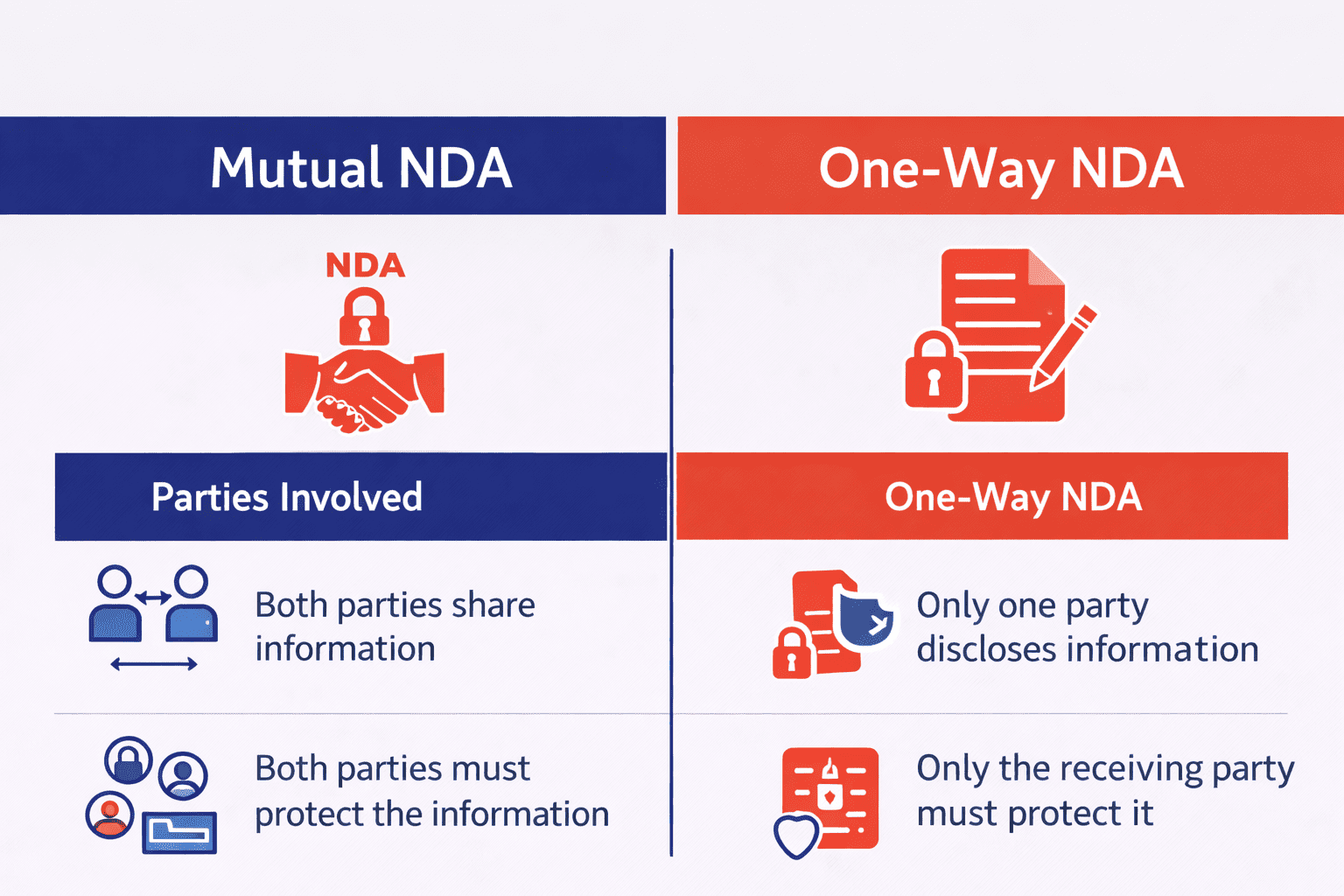
Before diving into the detailed mechanics of each type, here is a clear visual summary of the structural difference between a one-way and a mutual NDA, the single most important distinction to understand before choosing your approach.
➡️
One-Way NDA
Unilateral · One Direction
Party A discloses confidential information to Party B. Only Party B is bound by confidentiality obligations. Party A has no restrictions on what it can disclose about itself, because Party B is not disclosing anything sensitive back.
↔️
Mutual NDA
Bilateral · Both Directions
Both Party A and Party B disclose confidential information to each other. Both parties are bound by equal confidentiality obligations, each must protect what the other shares, and neither may misuse the other’s disclosed information.
⚡
The Single Most Important Rule
Match the NDA type to the actual flow of information in your specific relationship. A mutual NDA where only one party is disclosing gives the disclosing party unnecessary obligations and may dilute their protections. A one-way NDA where both parties are sharing sensitive information leaves one party completely unprotected. Neither type is universally stronger, the right choice is the one that accurately reflects the information exchange reality of your partnership.
SECTION 3
One-Way (Unilateral) NDA: Definition, Structure & Use Cases
A one-way NDA, also called a unilateral NDA or one-sided NDA, is used when only one party is disclosing confidential information to another. The disclosing party shares sensitive information; the receiving party accepts a legal obligation to keep it confidential and to use it only for the defined purpose of the engagement. The disclosing party has no corresponding confidentiality obligations, because they are not receiving anything sensitive in return.
When to Use a One-Way NDA in B2B Trade
🏭 Manufacturer → Contract Manufacturer
When sharing product formulations, process parameters, or quality specifications with a contract manufacturer who will produce goods to your specification.
You share: formulation, process specs, quality standards
They share: nothing sensitive back to you
You need: protection against them replicating or selling your formulation
NDA type: one-way (you are the disclosing party)
💡 Company → Consultant or Contractor
When briefing an external consultant, freelancer, or business development contractor who needs access to internal business strategies, customer data, or financial information.
You share: strategies, financials, customer lists, internal processes
They share: their skills and services, not confidential data
You need: assurance they will not use your information for their benefit or competitors’
NDA type: one-way (you are the disclosing party)
🚀 Startup → Investor
When a startup shares a business plan, technology roadmap, or financial projections with a potential investor who may be evaluating multiple competing opportunities.
You share: technology, business model, financial projections
They share: investment capital (not sensitive IP)
You need: protection against your tech being shared with competitors
NDA type: one-way (startup is the disclosing party)
📦 Brand Owner → OEM / White Label Manufacturer
When sharing proprietary designs, specifications, or branding guidelines with an OEM or white label manufacturer who will produce goods under your brand.
You share: product design, brand standards, technical requirements
They share: their manufacturing capabilities (not secret)
You need: assurance your designs are not manufactured for competitors
NDA type: one-way (brand owner is the disclosing party)
✨ One-Way NDA Best Practice
In a one-way NDA, the disclosing party retains full flexibility, you have no confidentiality obligations restricting what you can say about yourself. This makes one-way NDAs faster to negotiate and execute, with less back-and-forth on scope. Execute them as the first step in any engagement where you are sharing sensitive information with a party who is providing you a service or being evaluated as a supplier. See also: B2B Secure Collaboration: What It Means & Why It Matters.
SECTION 4
Mutual (Bilateral) NDA: Definition, Structure & Use Cases
A mutual NDA, also called a bilateral NDA or two-way NDA, is used when both parties will be disclosing confidential information to each other. Both parties are simultaneously disclosors and recipients, and both accept equal confidentiality obligations. Neither party may disclose the other’s confidential information to third parties, and neither may use what they receive for purposes outside the defined scope of the engagement.
When to Use a Mutual NDA in B2B Trade
🔬 Co-Development Partnerships
When two parties jointly develop a product, technology, or formulation, each contributing proprietary technical knowledge to the programme. See: Co-Development Partnerships Explained.
Party A shares: background formulation IP, R&D data
Party B shares: process technology, manufacturing know-how
Both need: protection for the information they are contributing
NDA type: mutual (both parties are disclosing)
🌍 Distribution Partnership Negotiations
When a manufacturer and a prospective distributor negotiate a distribution agreement, both parties may share confidential financial, market, and customer data. See: Find International Distributors.
When two companies are evaluating a potential joint venture or strategic alliance, due diligence requires both parties to share financials, operations data, and strategic plans.
Both parties share: financial records, customer data, IP assets
Both need: equal protection for the sensitive data they reveal
NDA type: mutual (symmetric disclosure on both sides)
🔗 Technology Transfer Negotiations
When a technology licensor and a potential licensee evaluate a technology transfer, the licensor shares technical IP; the licensee shares their manufacturing capabilities and market positioning.
Licensor shares: technical specifications, IP portfolio details
Licensee shares: production capabilities, market access data
Both need: protection before any agreement is signed
Do not automatically accept a mutual NDA when the other party proposes one as a “standard.” If only you are disclosing sensitive information in the actual engagement, a mutual NDA gives the other party information control and confidentiality rights they do not need, and adds unnecessary legal complexity. Always ask: is the other party actually sharing anything sensitive that requires protection? If the answer is no, insist on a one-way NDA that correctly reflects the information flow.
SECTION 5
Key Differences: One-Way vs. Mutual NDA, Head-to-Head
Co-development, JV discussions, merger due diligence, bilateral distribution negotiations
Appropriate when one party shares nothing sensitive
✓ Correct choice
✗ Unnecessary burden
Appropriate when both parties share sensitive information
✗ Leaves one party unprotected
✓ Correct choice
Preferred by investors / large corporations
✓ Often preferred by investors
~ Depends on context
Risk if wrong type is used
Mutual NDA used when one-way is correct: unnecessary obligations on disclosing party
One-way NDA used when mutual is correct: one party’s sensitive information is completely unprotected
SECTION 6
NDA Type by B2B Trade Scenario: The Complete Reference
Here is the definitive mapping of NDA type to every major B2B manufacturing and trade partnership scenario, the practical reference you need when deciding which type to execute before your next partnership conversation.
What Every NDA Must Include: The 10 Essential Clauses
Regardless of whether you are using a one-way or mutual NDA, the quality of the agreement determines the quality of the protection it provides. Many NDAs in commercial use are dangerously incomplete. Here are the ten clauses that every NDA, in any B2B trade context, must contain to be enforceable and effective.
Clause 01
Definition of Confidential Information
A precise and comprehensive definition of what constitutes confidential information in this specific relationship. Vague definitions (“all information shared”) are broad but create ambiguity. Overly narrow definitions leave gaps. The definition must reflect the actual information that will be shared.
Clause 02
Identification of the Parties
Clear identification of the disclosing party (or parties, in a mutual NDA) and the receiving party (or parties). Include full legal names, registered addresses, and, critically, whether the NDA covers information shared with affiliates, subsidiaries, or advisors of each party.
Clause 03
Permitted Purpose
The specific, defined purpose for which the receiving party may use the confidential information. This is one of the most important clauses, it prevents the receiving party from using your information for any purpose other than the explicitly stated one, even if they do not “disclose” it.
Clause 04
Exclusions from Confidentiality
Standard exclusions that carve out information from confidentiality obligations: information already in the public domain, information the receiving party already knew independently, information received legitimately from a third party, and information the receiving party developed independently without reference to the disclosed material.
Clause 05
Permitted Disclosures
Defines who within the receiving party’s organisation may access the confidential information, typically limited to employees and advisors who “need to know”, and what obligations those individuals must accept (often equivalent to the NDA obligations themselves).
Clause 06
Obligations of the Receiving Party
The specific actions the receiving party must take to protect the confidential information: maintaining at least the same level of care as they apply to their own confidential information (but no less than reasonable care), preventing unauthorised access, and reporting any breach immediately.
Clause 07
Duration of Confidentiality Obligations
How long the confidentiality obligations survive, both during the engagement and after its termination. Trade secrets and formulations may justify indefinite protection; general business information may be limited to 2–5 years post-termination. The duration must match the sensitivity and commercial lifespan of the information.
Clause 08
Return or Destruction of Information
What happens to confidential information if the engagement ends or the NDA is terminated, whether materials must be returned, destroyed, or certified as deleted. Includes digital files, copies, notes, and derivative documents. This clause is often overlooked and is critical for IP protection after a failed partnership discussion.
Clause 09
Remedies for Breach
Explicitly states that the disclosing party is entitled to seek injunctive relief (to stop further disclosure) without proving monetary damages first, this is critical because by the time monetary damages can be assessed, the information is already disclosed. May also include liquidated damages provisions for certain types of breach.
Clause 10
Governing Law & Dispute Resolution
Specifies which jurisdiction’s laws govern the NDA and how disputes will be resolved. For international B2B partnerships, arbitration is strongly preferred over litigation, it is faster, confidential, and more reliably enforceable across borders under the New York Convention on the Recognition and Enforcement of Foreign Arbitral Awards.
✨ Additional Clauses for B2B Manufacturing Context
In manufacturing and trade partnerships, consider adding: non-compete clauses restricting the receiving party from developing competing products using your information; IP ownership clarity (confirming the disclosing party retains all IP rights to the disclosed information); and audit rights allowing the disclosing party to verify compliance. For advanced payment and pricing discussions, an NDA should also cover: pricing structures, payment terms, and volume commitments shared during negotiations.
SECTION 8
Common NDA Mistakes That Create Legal Risk
Even experienced commercial teams make these mistakes when executing NDAs for B2B trade partnerships. Each one creates real legal exposure that a properly drafted and correctly chosen NDA would have prevented.
🚩
Using a Mutual NDA When Only You Are Disclosing
Accepting a mutual NDA “for simplicity” when only your side is sharing sensitive information gives the other party confidentiality rights they don’t need, and creates obligations on you that are unnecessary and potentially limiting.
🚩
Using a One-Way NDA When Both Parties Disclose
The most dangerous error. If your co-development or distribution partner shares sensitive commercial information with you but the NDA only protects your disclosures, they have no legal protection at all, creating immediate trust and legal imbalance.
🚩
Vague Definition of Confidential Information
An NDA that defines confidential information as “any information shared during discussions” may inadvertently protect publicly available information or be so broad as to be unenforceable. A precise, category-specific definition is always stronger.
🚩
No Defined Permitted Purpose
Omitting a clear permitted purpose clause allows the receiving party to use your information for any business purpose, including building a competing product, as long as they don’t technically “disclose” it to a third party.
🚩
Sharing Information Before the NDA Is Signed
The most common practical mistake. Once confidential information is shared verbally or via email before an NDA is in place, it may lose legal protection entirely, because you cannot retroactively apply an NDA to information already in the other party’s possession. Execute first, share second. Always.
🚩
No Return or Destruction Clause
Without a return or destruction clause, the other party may legally retain your confidential information indefinitely after the engagement ends, even if they are no longer permitted to use it. This is particularly dangerous for formulations, pricing data, and customer lists.
🚩
Short or Undefined Duration
An NDA that expires in 1 year provides inadequate protection for formulations or trade secrets with a long commercial lifespan. Match the duration to the sensitivity of the information, indefinite protection for trade secrets and proprietary formulations is legally defensible and commercially appropriate.
🚩
No Jurisdiction Clause for International Partnerships
An NDA without a clearly specified governing law and dispute resolution mechanism is extremely difficult to enforce internationally. Without these clauses, both parties may dispute which country’s courts have jurisdiction, making the NDA practically unenforceable across borders.
SECTION 9
How GT Setu’s Built-In NDA Workflow Protects Your Confidential Information
🌐 Platform Feature, GT Setu
NDA Execution Built Into Every Partner Conversation, Before the First Sensitive Detail is Shared
The most common NDA failure in B2B trade is not a badly drafted agreement, it is the conversation that happens before the NDA is ever executed. A promising introduction over email. A product brief sent “just to evaluate fit.” A pricing discussion “to see if there is a match.” Each of these pre-NDA exchanges exposes confidential information with no legal protection at all.
GT Setu eliminates this risk by making NDA execution a structural step in the partner discovery process, not an afterthought. On GT Setu, no sensitive information is exchanged without a formally executed, timestamped confidentiality agreement already in place. The platform supports both one-way and mutual NDA workflows, matched to the actual information flow of each partnership type, with full audit trails automatically maintained for every document exchange.
📄
Built-In NDA Workflow
Execute one-way or mutual NDAs within the platform, with full digital signatures, timestamped records, and automatic audit trails, before sharing any sensitive details.
🕵️
Anonymous Discovery
Browse verified partner profiles anonymously. Your identity and intent are not revealed until you choose to connect, eliminating pre-NDA information leakage entirely.
🔐
Encrypted Document Workspace
All documents shared after NDA execution, formulations, pricing, specs, roadmaps, are protected in an encrypted workspace with access controls and revocation rights.
✅
6-Point Government Tie-Up Verification
Every party on GT Setu is verified on Name, Address, Registration Number, Company Status, Company Type, and Date of Certificate of Incorporation using official government registries. An NDA with a verified, identifiable party is significantly more enforceable than one with an unverified contact.
📊
Full Audit Trail
Every NDA execution, document access, and communication is timestamped and logged, creating the evidentiary record you need if a breach ever occurs.
🚫
Zero Commission
GT Setu charges no broker fee or commission on any agreement concluded through the platform. Your deal economics, and your IP, belong entirely to you.
Register & Complete 6-Point Government Tie-Up Verification
Your company passes GT Setu’s 6-point verification (Name, Address, Registration Number, Company Status, Company Type, Date of Certificate of Incorporation) via government registries before your profile is active. This means the party you will eventually execute an NDA with is verified on these 6 key data points, dramatically strengthening enforceability compared to an NDA signed with an unknown, unverified entity. See: Business Verification & ID: Why It’s Non-Negotiable in B2B.
02
Browse Partner Profiles Anonymously
Evaluate potential partners, manufacturers, distributors, co-development partners, by reviewing their verified profiles without revealing your identity or sharing any confidential information. At this stage, zero sensitive information has been exchanged and no NDA is yet required.
03
Signal Mutual Interest
Express interest in a shortlisted partner. Your identity is revealed only when the other party confirms mutual interest. This mutual-confirmation model ensures you only proceed to the NDA step with parties who are genuinely interested, not with unqualified parties who will never be a commercial relationship.
04
Select the Right NDA Type and Execute
Based on the partnership type, are you sharing information one-way (e.g., briefing a contract manufacturer), or is this a two-way exchange (e.g., evaluating a co-development partner)?, select the appropriate NDA type and execute it within the platform. Both parties receive a digitally signed, timestamped copy with a complete audit record. The appropriate NDA type from our B2B trade scenario mapping above is built into the workflow suggestions.
05
Share Documents in the Encrypted Workspace
With the NDA formally executed and auditable, share confidential information through GT Setu’s encrypted document workspace. Set access permissions, track who has viewed what, and revoke access at any time. Every document access is logged, creating the evidentiary record you need if the NDA is ever breached.
06
Conclude the Agreement, With Zero Commission
Finalise your distribution agreement, co-development contract, supply deal, or licensing arrangement directly with your partner. GT Setu charges no success fee or commission on any agreement concluded through the platform, your commercial terms and their economics belong entirely to you and your partner.
SECTION 10
Multilateral NDAs: When Three or More Parties Are Involved
In complex B2B arrangements, consortium supply chains, multi-party joint ventures, or group co-development programmes involving more than two participants, a multilateral NDA governs confidentiality among three or more parties simultaneously.
🔺
How Multilateral NDAs Work
A multilateral NDA is a single agreement signed by all parties, under which each party agrees to protect all other parties’ confidential information. It eliminates the administrative complexity of managing separate bilateral NDAs between every possible pair of parties, particularly valuable when there are 3–6 participants who all need mutual protection. The document is more complex to draft but significantly simpler to manage once executed.
Scenario
Number of Parties
Recommended NDA Approach
Two-party distribution negotiation
2
Mutual bilateral NDA (one document, both parties)
Manufacturer + distributor + logistics partner
3
Single multilateral NDA covering all three parties
Multi-party consortium supply agreement
4+
Multilateral NDA; consider whether all information needs to flow to all parties
Manufacturer sharing specs with one CMO
2
One-way unilateral NDA (manufacturer discloses)
Three-way co-development programme
3
Multilateral mutual NDA with IP contribution annexes for each party
SECTION 11
NDA Considerations for International B2B Partnerships
When an NDA governs a cross-border relationship, a manufacturer in India engaging a distributor in the UAE, or a European brand owner briefing a contract manufacturer in Southeast Asia, several additional factors must be addressed that domestic NDAs typically do not require.
⚖️
Governing Law
Specify which country’s laws govern the NDA. Avoid ambiguity, courts in different jurisdictions interpret confidentiality obligations very differently. Choose a jurisdiction with a strong, predictable commercial law system and enforce-ability track record.
🏛️
Dispute Resolution
International arbitration (ICC, LCIA, SIAC, or DIAC) is strongly preferred over litigation for cross-border NDAs. Arbitral awards are enforceable in 172 countries under the New York Convention, far more reliable than court judgments across international borders.
🌍
Language of Agreement
In multi-jurisdiction deals, specify which language version of the NDA is the authoritative text in case of conflict. Always have the NDA professionally translated into both parties’ primary business languages.
📋
Local Enforceability
Verify that the NDA is enforceable as written under the laws of both parties’ jurisdictions. Some countries have mandatory disclosure requirements or trade secret laws that affect how NDA obligations apply locally.
💱
Export Control Compliance
In some industries (defence, advanced technology, certain chemicals), sharing technical information across borders may require regulatory compliance beyond the NDA itself, including export control authorisations. Your NDA should not inadvertently commit you to disclosures that require separate regulatory approval.
🔏
Digital Signature Validity
Confirm that digitally signed NDAs are legally valid in both parties’ jurisdictions. Most major commercial jurisdictions now recognise electronic signatures, but requirements vary. GT Setu’s platform uses digitally signed, timestamped NDA execution that is legally valid across its network.
💡 International NDA and GT Setu
GT Setu’s built-in NDA infrastructure is designed for cross-border B2B trade. The platform’s NDA workflow generates timestamped, digitally executed confidentiality agreements that are valid across its network, making it the fastest and safest way to formalise confidentiality before sharing sensitive information with an international manufacturing, distribution, or co-development partner. See also: Incoterms Explained and Payment Terms in International Trade, additional foundational documents that belong in every international B2B partnership framework.
SECTION 12, FAQ
Frequently Asked Questions
Q
What is the difference between a mutual NDA and a one-way NDA?
A one-way (unilateral) NDA protects information flowing in one direction: one party discloses confidential information and the other party is legally bound to keep it confidential. The disclosing party has no confidentiality obligations under the agreement. A mutual (bilateral) NDA protects information flowing in both directions: both parties disclose sensitive information to each other, and both parties are equally bound to maintain confidentiality. The right type is determined entirely by which direction information will actually flow in the relationship, not by preference, habit, or what the other party proposes as “standard.”
Q
Is a mutual NDA stronger than a one-way NDA?
Neither is inherently stronger, they serve different purposes. A mutual NDA is appropriate and effective when both parties are genuinely disclosing sensitive information. A one-way NDA is equally strong for protecting the disclosing party’s information when information only flows one way. The risk is not using the “wrong strength” of NDA, it is using the wrong type. A mutual NDA where only one party discloses creates unnecessary obligations for the disclosing party without adding protection. A one-way NDA where both parties disclose leaves one party completely unprotected.
Q
Should I use a mutual NDA for a distribution partnership negotiation?
Yes, in most distribution partnership negotiations, a mutual NDA is appropriate. Both the manufacturer and the distributor will typically share sensitive information: the manufacturer shares pricing structures, margin details, product roadmaps, and exclusivity terms; the distributor shares their customer base, market coverage, financial capability, and existing portfolio. Since both parties are disclosing commercially sensitive information, both parties need legal protection, which is what a mutual NDA provides. See: Find International Distributors and Exclusivity Clauses in Distribution Agreements.
Q
What must every NDA include to be legally enforceable?
Every enforceable NDA must include: (1) a precise definition of what constitutes confidential information in this specific relationship; (2) clear identification of the disclosing and receiving parties; (3) the specific permitted purpose for which the information may be used; (4) exclusions from confidentiality (public domain information, independently developed information, etc.); (5) obligations of the receiving party to protect the information; (6) the duration of confidentiality obligations; (7) a clause requiring return or destruction of information on termination; (8) explicit remedies for breach including the right to seek injunctive relief; and (9) governing law and dispute resolution mechanism. For international partnerships, add jurisdiction and export control compliance provisions.
Q
What happens if I share confidential information before an NDA is signed?
Information shared before an NDA is executed may lose its legal protection entirely. Courts in most jurisdictions cannot apply NDA obligations retroactively to information already shared, the receiving party may argue they received the information freely and are not bound to keep it confidential. In practice, this means any formulations, pricing data, product specifications, or business plans shared in pre-NDA conversations, however informal, may be legally unprotected. The single most important NDA rule is: execute first, share second. This is exactly why GT Setu’s platform makes NDA execution a structural requirement of the partner connection process, ensuring no sensitive information is shared before formal confidentiality protections are in place.
Q
Do I need an NDA before discussing pricing and volume commitments with a potential partner?
Yes, pricing structures, margin information, and volume commitment terms are typically highly sensitive commercial information that should be protected by an NDA before being disclosed to any potential partner. This is especially true for discussions involving contract manufacturing pricing, volume commitment structures, and minimum order quantity terms, as this information could be used by the receiving party to gain leverage in competing negotiations or to undercut your market positioning if shared further. Always execute the appropriate NDA, one-way or mutual depending on the information flow, before these discussions begin.
Q
How does GT Setu’s platform protect confidential information in B2B partnerships?
GT Setu embeds NDA execution as a structural step in the partner discovery workflow, preventing the most common NDA failure of sharing information before any agreement is in place. The platform supports both one-way and mutual NDA workflows, matched to the specific partnership type, with full digital signatures, timestamped records, and automatic audit trails. After NDA execution, all documents and sensitive information are shared through an encrypted workspace with access controls, permissions management, and full revocation rights. Combined with GT Setu’s 6-point government tie-up verification of all platform participants (Name, Address, Registration Number, Company Status, Company Type, Date of Certificate of Incorporation), ensuring every party you execute an NDA with is a verified, identifiable legal entity, the platform provides the most complete confidentiality protection framework available for international B2B manufacturing and trade partnerships. Learn more: B2B Secure Collaboration: What It Means & Why It Matters.
Ready to Execute Your NDA with a Verified Global Partner?
GT Setu’s built-in NDA workflow makes confidentiality a structural step, not an afterthought. Connect with companies verified on 6 key data points via government tie-ups across 100+ countries, execute one-way or mutual NDAs within the platform, and share sensitive information safely before any agreement is signed. Zero broker commissions. Full audit trails.
They represents the product, and research team behind GTsetu, a global B2B collaboration platform built to help companies explore cross-border partnerships with clarity and trust. The team focuses on simplifying early-stage international business discovery by combining structured company profiles, verification-led access, and controlled collaboration workflows.
With a strong emphasis on trust, and disciplined engagement, Team GTsetu shares insights on global trade, partnerships, and cross-border collaboration, helping businesses make informed decisions before entering deeper commercial discussions.