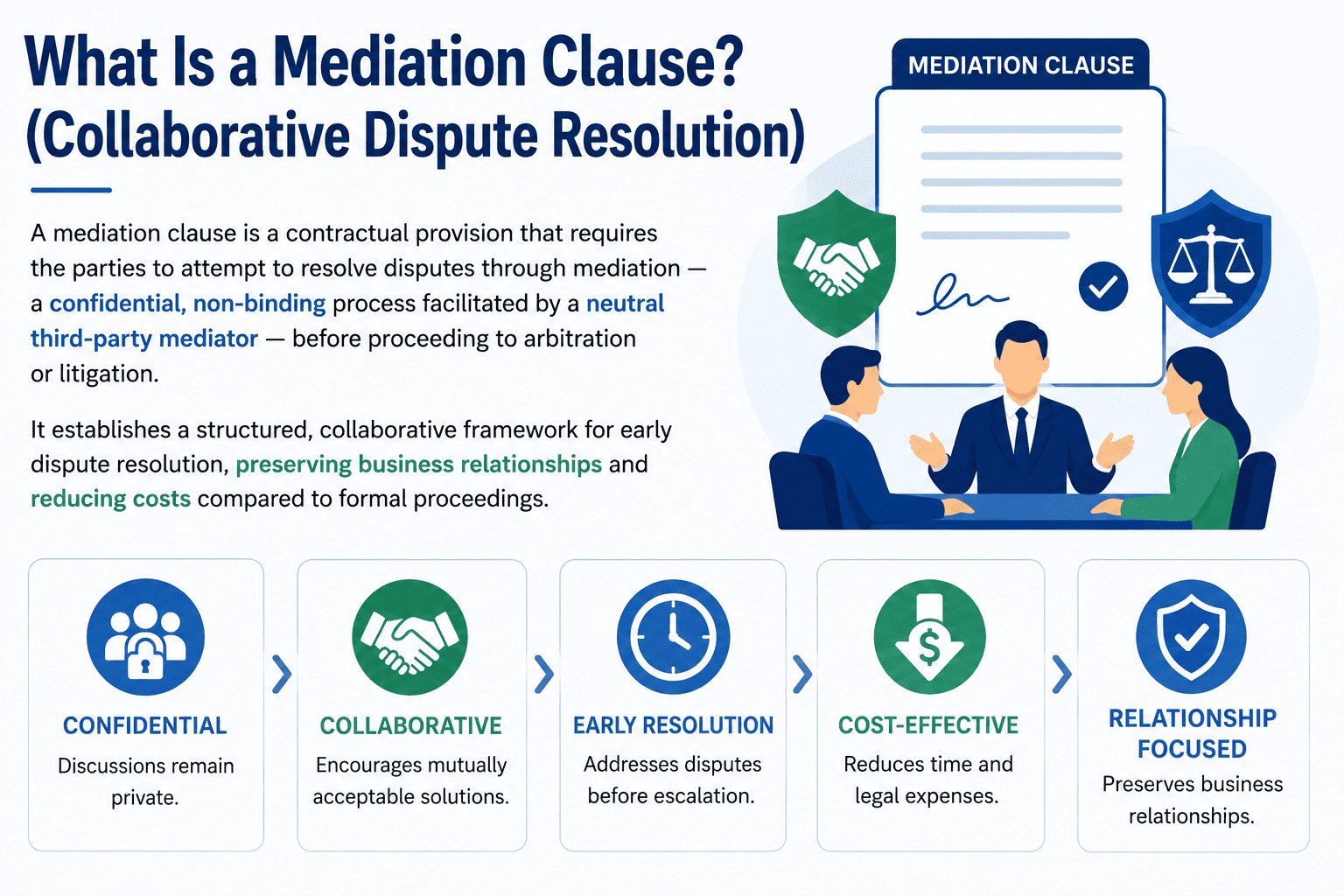
In cross-border trade and complex partnerships, disputes are inevitable. The question is not whether a disagreement will arise, but how it will be resolved. A well-drafted mediation clause transforms dispute resolution from an adversarial battle into a structured conversation. It signals a commitment to good-faith negotiation, preserves valuable commercial relationships, and avoids the high costs, both financial and relational, of immediate arbitration or litigation.
Mediation clauses are particularly valuable in long-term supply agreements, joint ventures, distribution partnerships, and technology licences where ongoing collaboration matters. By requiring the parties to mediate first, the clause creates a cooling-off period and a problem-solving atmosphere. Even when mediation does not result in a full settlement, it often narrows the issues, clarifies positions, and makes subsequent arbitration or litigation more efficient.
✨ Strategic Advantage
Unlike arbitration or litigation, mediation allows the parties to craft creative solutions that a court or arbitrator could not order, for example, adjusting delivery schedules, modifying payment terms, or restructuring a partnership. The mediator’s role is to facilitate, not decide, giving the parties full control over the outcome.
Mandatory vs. Optional
Mandatory Process, Non-Binding Outcome
Understanding the dual nature of mediation clauses is critical: the obligation to participate in mediation is binding and enforceable, but the outcome (any settlement) is binding only if the parties voluntarily sign a written settlement agreement. Courts will typically stay litigation or arbitration proceedings if a valid mediation clause exists and the parties have not yet attempted mediation in good faith.
✅ Binding (Enforceable) Aspects
- Obligation to participate in good-faith mediation before arbitration/litigation
- Confidentiality undertakings
- Cost-sharing provisions (if specified)
- Timelines for initiating mediation
- Stay of other proceedings during mediation
🔄 Non-Binding (Voluntary) Aspects
- The substantive outcome, mediator cannot impose a decision
- Any settlement is binding only if reduced to a signed written agreement
- Parties may withdraw from mediation at any time
- Positions and proposals made during mediation cannot be used later in arbitration or court
Model Clauses & Institutions
Model Mediation Clauses from Leading Institutions
Most international dispute resolution institutions provide model mediation clauses that have been tested and upheld by courts. Using an institutional clause ensures clarity, enforceability, and access to established procedural rules and mediator panels.
| Institution | Model Clause Overview | Key Feature |
|---|
| ICC (International Chamber of Commerce) | Four variants: Option to use (Clause A), obligation to consider (B), obligation to refer with parallel arbitration (C), and sequential mediation then arbitration (D). | Flexible multi-tiered options; 45-day default cooling period in Clause D. |
| WIPO (World Intellectual Property Organization) | Comprehensive clause covering formation, validity, breach, termination, and non-contractual claims. Place and language specified by parties. | Ideal for IP, technology, and licensing disputes; integrates with WIPO Arbitration Rules. |
| AFSA (Arbitration Foundation of Southern Africa) | Med-Arb clause: negotiation → mediation → arbitration. Timelines specified (7+7 days). | Short, strict timelines; suitable for African cross-border contracts. |
| HAC (Hyderabad Arbitration Centre) | Mandatory mediation clause and optional mediation clause. Allows specification of number of mediators, seat, language, and governing law. | Adaptable to Indian and South Asian contracts. |
| VIAC (Vienna International Arbitral Centre) | Mediation clauses under Vienna Mediation Rules. | Neutral European venue; civil law context. |
| IMI (International Mediation Institute) | Model rules with detailed provisions on confidentiality, mediator selection, voluntariness, and liability limitation. | Parties appoint mediator directly; IMI Certified Mediators required. |
Example Clause, ICC Sequential Mediation then Arbitration (Clause D)
“In the event of any dispute arising out of or in connection with the present contract, the parties shall first refer the dispute to proceedings under the ICC Mediation Rules. If the dispute has not been settled pursuant to the said Rules within 45 days following the filing of a Request for Mediation, such dispute shall thereafter be finally settled under the Rules of Arbitration of the International Chamber of Commerce by one or more arbitrators appointed in accordance with the said Rules of Arbitration.”
Essential Components
What a Well-Drafted Mediation Clause Should Include
1
Scope of Disputes
Define which disputes are subject to mediation, “any dispute arising out of or relating to this contract” is broad; parties may also exclude specific issues (e.g., IP ownership, injunctive relief).
2
Mediation Rules & Institution
Specify the institutional rules (ICC, WIPO, HAC, etc.) or ad hoc mediation framework. Institutional rules provide ready-made procedures for mediator appointment, confidentiality, and cost allocation.
3
Mediator Selection Process
Default to the institution’s appointment mechanism, or specify qualifications (e.g., “mediator shall be an attorney with at least 10 years of commercial contract experience”).
4
Timelines & Cooling Period
Set deadlines for initiating mediation (e.g., within 30 days of a dispute notice) and for completing mediation (e.g., 45 or 60 days). This prevents tactics of delay.
5
Confidentiality & Admissibility
Expressly state that all mediation communications are confidential and inadmissible in any subsequent arbitration or court proceeding. This encourages open negotiation.
6
Cost Allocation
Specify how mediator fees and administrative costs will be shared, typically equally, but parties may agree otherwise.
7
Multi-Tiered Escalation
Define the sequence: negotiation → mediation → arbitration/litigation. Avoid drafting that makes arbitration conditional on mediation “failing”, instead use a fixed timeline (e.g., “if not settled within 45 days, either party may commence arbitration”).
Mediation vs Arbitration vs Litigation
Mediation vs. Arbitration vs. Litigation: Key Differences
| Dimension | Mediation | Arbitration | Litigation |
|---|
| Decision-maker | Parties themselves with mediator’s facilitation | Arbitrator (private judge) | Judge or jury (public court) |
| Binding outcome? | Only if parties sign settlement agreement | Yes, arbitral award is final and enforceable | Yes, court judgment enforceable |
| Confidentiality | Generally yes (by contract and rules) | Yes (private proceedings) | Public record (presumption of openness) |
| Cost | Lowest (mediator fees + minimal admin) | Medium to high (arbitrator fees, venue, counsel) | High (court fees, discovery, longer timelines) |
| Speed | Weeks to a few months | Months to a year+ | 1–3 years (or more) |
| Control over process | High, parties shape procedure | Moderate, governed by rules but flexible | Low, court procedural rules apply |
| Relationship preservation | High, collaborative, problem-solving | Moderate, adversarial but private | Low, public, adversarial |
| Remedies available | Creative solutions (any mutually agreed) | Legal and equitable remedies as per law | Legal and equitable remedies as per law |
Common Pitfalls
Common Risks and Drafting Mistakes
🚩
Vague “Good Faith” Language Without Process
Phrases like “the parties shall attempt to resolve disputes amicably” are generally unenforceable as a condition precedent to arbitration. A valid mediation clause must specify the mediation rules, timeline, and mediator selection mechanism.
🚩
No Cooling-Off Period / Indefinite Delay
If the clause says “the dispute shall be submitted to mediation before arbitration” but provides no timeline, one party could delay indefinitely by refusing to conclude mediation. Always include a fixed period (e.g., 45 or 60 days) after which arbitration may commence unilaterally.
🚩
Confidentiality Omitted
Without an express confidentiality provision, statements made during mediation might be admissible in later proceedings. Institutional rules include confidentiality, but ad hoc clauses must state it explicitly.
🚩
Clashing with Emergency Relief Needs
In disputes requiring urgent injunctive relief (e.g., IP infringement, asset dissipation), a mandatory mediation-first clause may be problematic. Include an exception: “…except that either party may seek emergency interim relief from a court or arbitrator without first engaging in mediation.”
🚩
Institutional Rules Not Specified
Ad hoc mediation clauses (without reference to ICC, WIPO, etc.) often fail because the parties cannot agree on a mediator or procedure once a dispute has arisen. Always name an administering institution.
FAQ
Frequently Asked Questions
QCan a party refuse to mediate and instead go directly to arbitration?
If the contract contains a clear, mandatory mediation clause (e.g., “the parties shall first refer the dispute to mediation…”), a court or arbitral tribunal will typically stay arbitration or litigation until mediation has been attempted in good faith. However, if the clause is merely optional or vague, a party may be able to bypass mediation. Drafting precision is critical.
QIs a settlement agreement reached through mediation binding?
Yes, provided it is in writing and signed by the parties. A mediated settlement agreement is a contract and can be enforced as such. Under the Singapore Convention on Mediation (formally the UN Convention on International Settlement Agreements Resulting from Mediation), mediated settlements can be enforced across signatory states, similar to the New York Convention for arbitration awards.
QWhat is the difference between mediation and conciliation?
The terms are often used interchangeably, but a traditional distinction exists: a mediator facilitates negotiation and does not give an opinion on the merits, while a conciliator may propose non-binding settlement terms or actively suggest solutions. In practice, many modern mediation rules (including ICC and WIPO) permit the mediator to provide suggestions, blurring the line. The key commonality is that both are non-binding and party-controlled.
QCan a mediation clause be enforced against a party that refuses to participate?
Yes, courts in most jurisdictions will order specific performance of a valid mediation clause, i.e., require the reluctant party to attend mediation. However, courts cannot force a party to settle. The remedy for breach of a mediation clause is typically a stay of other proceedings and an order to mediate, plus potentially costs sanctions against the refusing party.