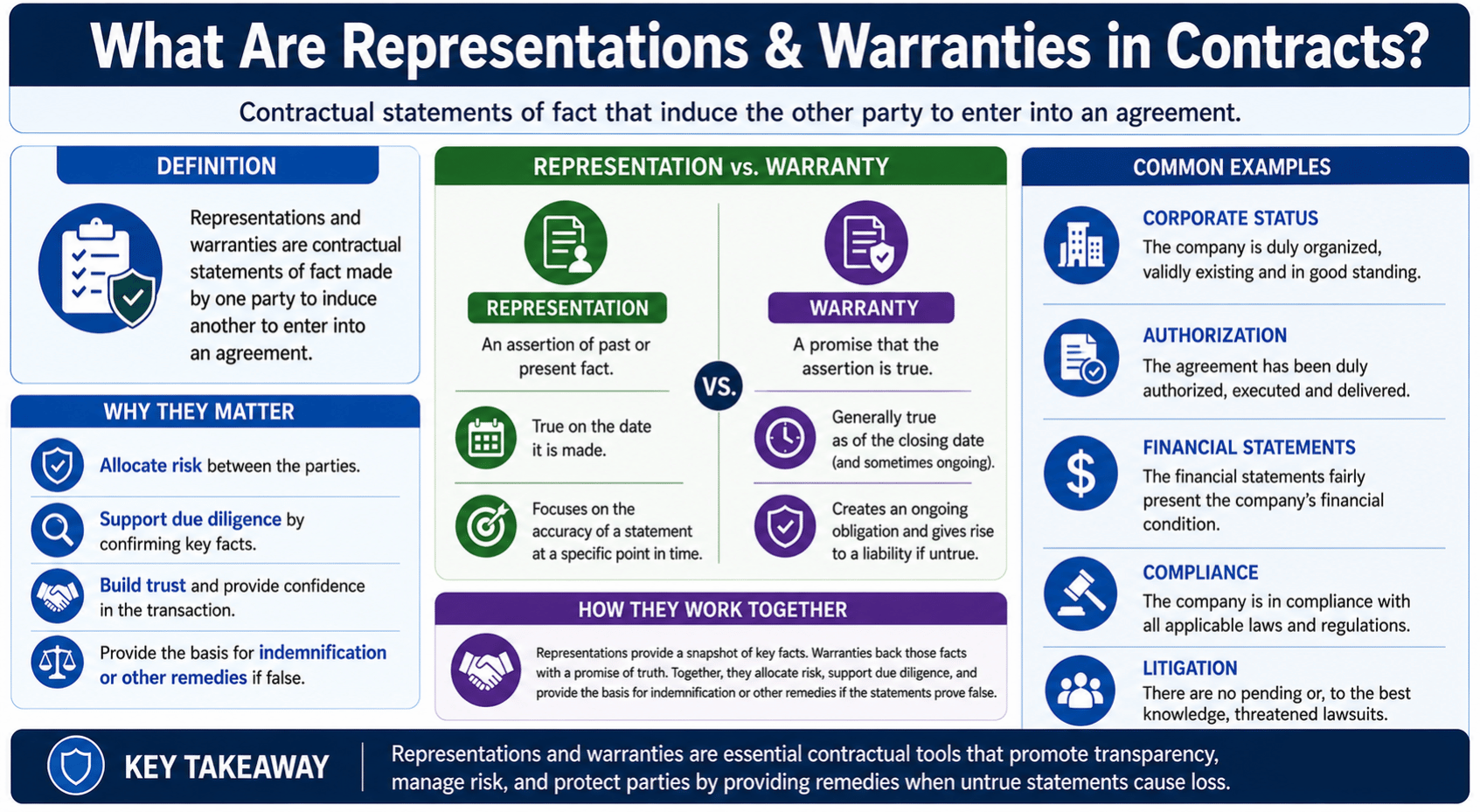
Why Representations and Warranties Matter in Commercial Contracts
Every commercial contract is built on a foundation of facts, about the parties’ authority, the condition of assets, financial health, compliance with laws, and absence of hidden liabilities. Representations and warranties convert those factual assumptions into legally enforceable assurances. They serve three critical functions: (1) they facilitate disclosure, the party giving them must confirm key information; (2) they allocate risk, if a statement is false, the risk of loss shifts to the party that gave the assurance; and (3) they provide a remedial framework, the other party can claim damages, seek indemnification, or in some cases rescind the contract.
In cross-border transactions, M&A, loan agreements, and long-term supply contracts, representations and warranties are heavily negotiated. Sellers and borrowers seek to limit their scope with qualifiers like “knowledge” and “materiality,” while buyers and lenders push for broad, unqualified assurances backed by indemnities and survival periods beyond closing.
✨ Strategic Note
Do not assume that “represent and warrant” language alone creates identical remedies. Under common law, breach of warranty sounds in contract damages, while misrepresentation may allow rescission and tort damages. In many commercial contracts, however, the parties contractually define the remedies, including indemnification, making the formal distinction less significant than the express terms agreed.
Representation vs Warranty
Representation vs. Warranty: Key Differences
📢 Representation
- Assertion of past or present fact
- Given to induce the other party to enter the contract
- If false: may constitute misrepresentation
- Remedies: rescission (void contract) + damages
- Example: “The company has no pending litigation.”
🛡️ Warranty
- Promise or assurance that a fact is true
- Collateral to the main purpose of the contract
- If breached: claim for breach of contract
- Remedies: damages (no right to rescind)
- Example: “The goods will be free from defects for 12 months.”
Under English law and common law systems, the distinction affects remedies. For breach of warranty, the innocent party claims damages but must still perform the contract. For misrepresentation, the contract may be rescinded (treated as voidable) and damages claimed. In M&A and loan agreements, the parties often override these default rules by providing for indemnification and specifying that the only remedy for inaccuracy is a contractual indemnity claim, not rescission.
Common Categories
Typical Representations and Warranties by Contract Type
| Contract Type | Common Representations & Warranties |
|---|
| M&A / Share Purchase Agreement | Title to shares, capitalization, authority, financial statements, no undisclosed liabilities, tax compliance, material contracts, intellectual property ownership, litigation, employment matters, environmental compliance, absence of certain changes. |
| Loan / Credit Agreement | Organization and authority, no conflict, accuracy of financial information, no material adverse change, compliance with laws, litigation, taxes, use of proceeds, absence of defaults. |
| Commercial Supply / Distribution | Good title to goods, conformance with specifications, no infringement of IP, compliance with applicable laws (e.g., product safety, anti-corruption), delivery and performance warranties. |
| Services / Consulting Agreement | Due organization, authority, personnel qualifications, compliance with laws, no conflicts of interest, confidentiality, ownership of deliverables (IP assignment). |
| Real Estate Purchase | Clear and marketable title, no encumbrances, compliance with zoning and building codes, no pending condemnation, environmental condition, tax payments. |
| Intellectual Property License | Ownership or right to license, no third-party infringement, validity of IP rights, no encumbrances, confidentiality. |
The above lists are illustrative, not exhaustive. Each transaction requires tailored representations and warranties based on due diligence findings and the risk profile of the deal.
Remedies & Limitation Provisions
Remedies for Breach & Common Limitations
When a representation or warranty is inaccurate or breached, the aggrieved party’s remedies are typically defined in the contract. The most common framework includes:
1
Indemnification
The breaching party agrees to reimburse the other for losses arising from the inaccuracy. Indemnity provisions often include a “basket” (a threshold before claims can be made) and a “cap” (maximum liability).
2
Survival Period
Reps and warranties do not survive closing indefinitely. Typical survival periods range from 12 to 36 months post-closing. Fundamental reps (title, authority, tax) may survive longer or indefinitely.
3
Knowledge Qualifiers
Sellers often limit liability to breaches of which they had “actual knowledge” or “constructive knowledge” after reasonable inquiry. Buyers prefer objective standards (“to the best of seller’s knowledge” with duty to inquire).
4
Materiality Scrape
Buyers insist that materiality qualifiers (e.g., “in all material respects”) be ignored for purposes of indemnification, i.e., even an immaterial breach gives rise to a claim. This is a common negotiation point.
5
Sandbagging
A “sandbagging” clause permits the buyer to recover for a breach even if the buyer knew of the inaccuracy before closing. An “anti-sandbagging” clause bars recovery for known breaches. Jurisdictions vary on default rules.
Drafting & Negotiation
Drafting & Negotiation Best Practices
Effective negotiation of representations and warranties requires balancing information gathering, risk allocation, and transaction certainty. The following practices are widely adopted.
🛡️ For the Representing Party (Seller/Borrower)
- Conduct internal due diligence before making representations.
- Use knowledge qualifiers (“to the best of [party’s] knowledge”) where appropriate.
- Add materiality qualifiers to avoid trivial breaches.
- Attach disclosure schedules that carve out known exceptions.
- Negotiate a reasonable survival period and financial caps.
- Consider representations and warranties insurance (R&W insurance).
🔍 For the Benefited Party (Buyer/Lender)
- Insist on unqualified fundamental reps (title, authority, capitalization).
- Conduct independent due diligence, do not rely solely on reps.
- Require that materiality qualifiers be “scraped” for indemnification.
- Negotiate a pro-sandbagging clause (preserve remedies for known breaches).
- Obtain indemnity with a low basket and high cap, and require escrow or holdback.
- Extend survival periods for tax, IP, environmental, and litigation reps.
📘 Disclosure Schedules
Disclosure schedules are the seller’s primary risk-limiting tool. They list exceptions to the representations and warranties, e.g., disclosing pending litigation or a tax dispute. Properly drafted, a disclosure schedule modifies the corresponding representation. A buyer should review every disclosure schedule carefully before closing; the seller should ensure that disclosures are specific and complete.
Common Pitfalls
Common Pitfalls & Misunderstandings
🚩
Assuming “Reps and Warranties” Are Always Enforceable After Closing
Reps and warranties do not survive indefinitely. Without a survival clause, they may terminate at closing. Always specify survival periods and carve out fraud or fundamental reps.
🚩
Failing to Update Disclosure Schedules
Disclosure schedules must be accurate as of the closing date. Relying on schedules drafted months earlier exposes the seller to breach claims for intervening events. Use bring-down certificates.
🚩
Over-reliance on Standard Forms
Each transaction has unique risks. Standard-form reps (e.g., “no material adverse effect”) require careful definition. Customize representations based on due diligence findings.
🚩
Confusing “Represent and Warrant” with “Covenant”
Representations speak as of a date (usually closing). Covenants promise future performance. A representation does not create an ongoing obligation, a critical distinction for breach timing.
🚩
Ignoring R&W Insurance
Reps and warranties insurance can shift post-closing risk from sellers to insurers, facilitating cleaner exits. However, policies have exclusions, retentions, and coverage limits that require careful negotiation.
FAQ
Frequently Asked Questions
QWhat is the practical difference between a representation and a warranty in a commercial contract?
Although often used together, the theoretical distinction lies in remedies. A false representation (misrepresentation) may allow the innocent party to rescind the contract and claim damages. A breach of warranty typically allows only damages, not rescission. In many modern commercial contracts, especially M&A and loan agreements, the parties contract around these distinctions by providing for indemnification and specifying that the sole remedy for inaccuracy is a contractual indemnity claim.
QWhat does “survival” of representations and warranties mean?
Survival refers to the period after closing during which a party can bring a claim for breach of a representation or warranty. Without a survival clause, representations may be deemed to “merge” into the closing, terminating on the closing date. Standard survival periods are 12–24 months for general reps, and longer (up to statute of limitations) for fundamental reps like title, authority, and tax compliance.
QWhat is a “materiality scrape” or “materiality scrub”?
Many representations include materiality qualifiers (e.g., “in all material respects” or “that would not have a material adverse effect”). A “materiality scrape” clause provides that for purposes of indemnification, those qualifiers are ignored, meaning even an immaterial breach is actionable. Buyers strongly favour scrapes; sellers resist them unless combined with a deductible or basket.
QIs a representation a warranty under Indian law?
The Indian Contract Act 1872 does not define “representation” or “warranty” for general contracts. However, the Sale of Goods Act 1930 defines warranty, and courts have distinguished them in contexts like insurance. In practice, Indian contracts often use the combined phrase “represent and warrant” and rely on express indemnity provisions to define remedies. Parties should not assume that English common law distinctions automatically apply; clear drafting is essential.
QWhat is representations and warranties (R&W) insurance?
R&W insurance is a specialised policy that indemnifies the buyer (buyer-side policy) or seller (seller-side policy) for losses arising from breaches of representations and warranties. It allows sellers to distribute sale proceeds without a large escrow and protects buyers even if the seller has limited financial means. Policies typically have a retention (deductible) and exclude known breaches, forward-looking statements, and fraud.