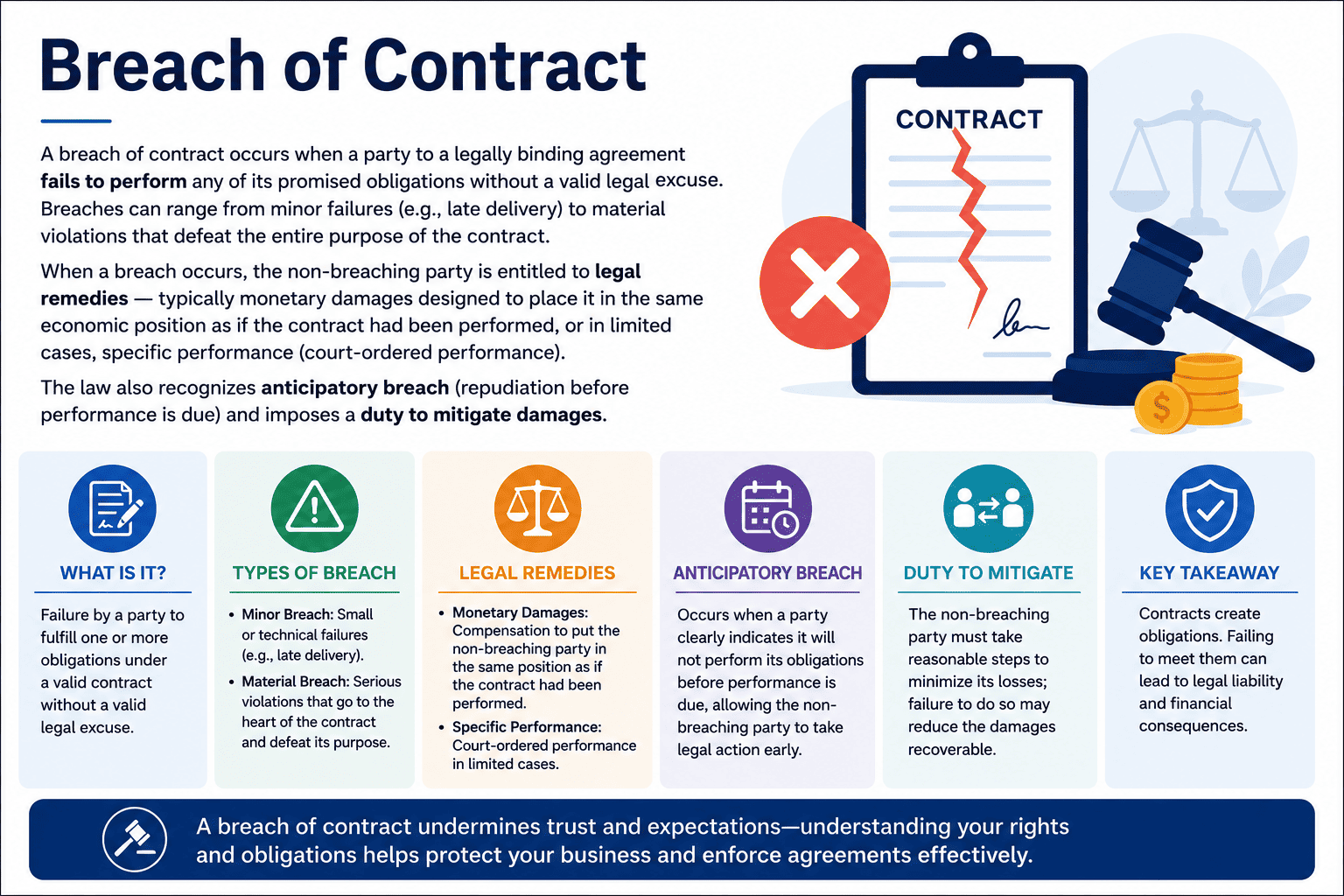
Why Breach of Contract Matters in International Trade
Contracts are the foundation of commercial relationships, from simple supply agreements to complex joint ventures. When a party fails to perform, whether by late payment, non‑delivery, defective goods, or outright repudiation, the other party suffers financial and operational harm. Understanding breach of contract is essential for risk management: it informs how contracts are drafted (e.g., liquidated damages clauses, termination rights), how disputes are resolved, and what remedies are available. In cross‑border transactions, breach issues become more complex due to differing legal systems, choice‑of‑law provisions, and enforcement challenges. For these reasons, commercial contracts almost always include detailed provisions defining what constitutes a breach, notice requirements, cure periods, and available remedies.
⚡ Key Principle: Efficient Breach
The common law theory of efficient breach holds that it may be economically beneficial for a party to breach a contract and pay damages rather than perform, if the cost of performance exceeds the harm to the other party. This is why contract law generally awards compensatory damages (expectation measure) rather than punitive damages or specific performance, to encourage efficient resource allocation. However, this theory does not apply to contracts for unique goods or real estate, where specific performance may be ordered.
Types of Breach
The Four Main Types of Breach of Contract
⚠️
Material Breach
A serious failure that undermines the core purpose of the contract, depriving the non‑breaching party of the benefit it reasonably expected. The non‑breaching party may terminate the contract and sue for all damages.
✔️ Example: Delivering completely wrong goods, abandoning construction halfway
✔️ Remedy: Termination + full compensatory damages
📌
Minor (Partial) Breach
A less serious violation where performance is substantially complete but a minor aspect is defective or late. The contract remains in force, but the aggrieved party can recover damages for the specific deficiency.
✔️ Example: Delivering 2 days late, using slightly different but equally functional materials
✔️ Remedy: Damages only (no termination)
🔮
Anticipatory Breach
Occurs before performance is due when one party clearly indicates (expressly or through conduct) that it will not perform. The non‑breaching party can sue immediately without waiting for the performance date.
✔️ Example: Seller states it cannot deliver goods before shipment date; buyer sells goods to another
✔️ Remedy: Immediate suit for damages or wait for performance date
⏰
Actual Breach
A breach that has actually occurred at or after the performance date, either by non‑performance, defective performance, or conduct that makes performance impossible. The most common and straightforward type of breach.
✔️ Example: Failing to pay on due date, delivering damaged goods
✔️ Remedy: Damages, specific performance, or rescission
⚖️ Material vs. Minor, Practical Distinction
Whether a breach is material or minor depends on factors such as: the extent to which the injured party will be deprived of the expected benefit, whether the breach can be cured, the willfulness of the conduct, and the degree of hardship on the breaching party. Courts are reluctant to find a material breach for minor or technical violations. Contract drafters often include “materiality qualifiers” (e.g., “material adverse effect”) to clarify the threshold.
Legal Remedies for Breach
Remedies for Breach of Contract: Damages, Specific Performance, and More
The goal of contract remedies is to place the non‑breaching party in the position it would have been had the contract been performed (expectation interest), or alternatively, to restore any benefit conferred (restitution interest). Punitive damages are generally not available in contract law, except in rare cases involving independent torts or fraud.
| Remedy | Description | When Available | Typical Limitations |
|---|
| Compensatory Damages | Direct monetary loss caused by breach (expectation damages). Includes lost profits if reasonably foreseeable. | All breach cases, most common remedy | Must be proven with reasonable certainty; subject to duty to mitigate; excludes speculative losses |
| Consequential Damages | Indirect losses from breach (e.g., lost profits from resale, production downtime). | Only if foreseeable at contract formation (Hadley v. Baxendale rule) | Often excluded entirely by contract (limitation of liability clause) |
|---|
| Specific Performance | Court order requiring breaching party to perform as promised. | Only when goods are unique (real estate, rare artwork, business sale) or damages inadequate | Not available for personal services contracts (13th Amendment issue) |
|---|
| Rescission | Contract is canceled; parties restored to pre‑contract positions. | Material breach, misrepresentation, undue influence, or mistake | May be combined with restitution claim |
|---|
| Restitution | Return of any benefit conferred on the breaching party (e.g., deposit, part payment). | When non‑breaching party conferred value before breach | Based on unjust enrichment, not expectation |
|---|
| Liquidated Damages | Pre‑agreed sum specified in contract for certain breaches (e.g., delay penalty). | Where actual damages are difficult to estimate at time of contracting | Clause must be reasonable, not punitive (unconscionability review) |
|---|
📄 Sample Liquidated Damages Clause (Delay)
“If Contractor fails to achieve Substantial Completion by the Completion Date, Contractor shall pay to Owner liquidated damages in the amount of US $1,000 per calendar day of delay, not to exceed 10% of the Contract Price. The parties agree that this amount is a reasonable estimate of the actual damages Owner would suffer from delay and is not a penalty.”
Duty to Mitigate & Legal Defences
Duty to Mitigate and Common Defences to Breach
The non‑breaching party has an affirmative duty to take reasonable steps to reduce its losses. Failure to mitigate will reduce or bar recovery of damages that could have been avoided. Meanwhile, the breaching party may raise certain defences to avoid liability or reduce damages.
🛡️
Duty to Mitigate
The injured party must act reasonably to avoid or minimise damages. For example, if goods are rejected, the seller must attempt to resell them; if an employee is wrongfully terminated, they must seek comparable employment. Any losses that could have been avoided without undue risk or expense are not recoverable.
✔️ Burden of proof rests on breaching party to show failure to mitigate
✔️ Mitigation expenses are recoverable
⚖️
Common Defences to Breach
The alleged breaching party may argue: (1) no valid contract existed (lack of consideration, mutual mistake); (2) contract was frustrated or impossible to perform; (3) non‑breaching party materially breached first (first breach defence); (4) waiver or estoppel; (5) statute of frauds; or (6) unconscionability. Each defence can excuse performance or reduce liability.
✔️ Doctrine of frustration applies when an unforeseen event makes performance impossible or radically different
How to Prove & Handle a Breach
Proving a Breach of Contract: Essential Elements and Best Practices
01
Establish a Valid Contract
Prove the existence of a legally binding agreement: offer, acceptance, consideration, mutual assent, and (if required) writing. Provide signed contract, email chain, or performance evidence.
02
Demonstrate Your Performance or Justifiable Non‑Performance
Show that you performed your obligations (or were ready and willing to perform) unless excused by the other party’s conduct or an external event.
03
Prove the Other Party’s Failure to Perform
Provide documentary evidence: missed deadlines, defective delivery, payment defaults, or explicit repudiation (email, letter, voicemail).
04
Quantify Damages (or Seek Specific Performance)
Calculate the direct losses caused by the breach, including reliance expenses and lost profits (if foreseeable). Document all costs with invoices, receipts, and expert opinions.
05
Show Mitigation Efforts
Demonstrate that you took reasonable steps to reduce loss (e.g., covering contract with alternative supplier, reselling rejected goods). Failure to mitigate bars recovery of avoidable losses.
📄
No Written Contract
While oral contracts are generally enforceable (except for statute of frauds categories), proving terms without a writing is difficult. Courts will look to performance, emails, and witness testimony.
⏳
Statute of Limitations Expired
Each jurisdiction has a time limit for filing breach claims (typically 3‑6 years for written contracts). Late claims are barred. Check applicable limitation period and tolling rules.
🔍
Failure to Preserve Evidence
Without emails, delivery receipts, payment records, or correspondence, proving breach becomes difficult. Maintain organised contract files for at least the limitation period plus any survival period.
⚖️
No Clear Choice‑of‑Law Clause
In cross‑border contracts, uncertainty about which law governs breach and remedies increases litigation cost and risk. Always include governing law and dispute resolution provisions.
FAQ
Frequently Asked Questions
QWhat is the difference between a material and a minor breach of contract?
A material breach is a serious violation that undermines the core purpose of the contract, depriving the non‑breaching party of the benefit it reasonably expected. The non‑breaching party may terminate the contract and sue for all damages. A minor (or partial) breach occurs when a party fails to perform a small aspect of the contract but the overall purpose is still achievable; the non‑breaching party can seek damages but generally cannot terminate the contract. Whether a breach is material is a factual determination based on the severity of the failure and the extent of harm.
QWhat is the difference between an anticipatory breach and an actual breach?
An anticipatory breach (also called repudiation) occurs before performance is due, when one party clearly indicates (through words or actions) that it will not perform its obligations. The non‑breaching party can sue immediately without waiting for the performance date. An actual breach occurs at the time performance is due (or during performance), when a party fails to perform, performs improperly, or makes performance impossible. The key difference is timing, anticipatory breach accelerates the right to sue, while actual breach arises at the performance date.
QWhat remedies are available for a breach of contract?
Common remedies include: (1) compensatory damages (monetary compensation for actual losses suffered, measured by expectation interest); (2) specific performance (court order requiring the breaching party to perform as promised, typically for unique goods or real estate where damages are inadequate); (3) rescission (canceling the contract and restoring parties to pre‑contract positions); (4) restitution (returning benefits conferred on the breaching party); and (5) liquidated damages (pre‑agreed amounts specified in the contract). Punitive damages are rarely available in contract cases, except where the breach also constitutes an independent tort or fraud.
QWhat is the duty to mitigate damages in contract law?
The non‑breaching party has an affirmative duty to take reasonable steps to reduce its losses after a breach. For example, if a seller fails to deliver goods, the buyer should attempt to purchase substitute goods from another supplier (cover). If the buyer fails to mitigate, it cannot recover damages that could have been avoided without undue risk, expense, or humiliation. The breaching party bears the burden of proving failure to mitigate. Reasonable mitigation expenses are themselves recoverable as damages.
QCan a party be excused from performing a contract (defences to breach)?
Yes. Common defences include: (1) impossibility or impracticability (performance becomes objectively impossible due to unforeseen events like destruction of subject matter); (2) frustration of purpose (a supervening event destroys the contract’s underlying purpose); (3) mutual mistake (both parties shared a fundamental error); (4) duress, undue influence, or unconscionability; (5) illegality; or (6) the non‑breaching party’s own material breach (first breach defence). These defences must be raised and proven by the party seeking to avoid performance. Many commercial contracts also include force majeure clauses that excuse performance for specified events.