Why Good Faith Negotiation Matters in International Trade
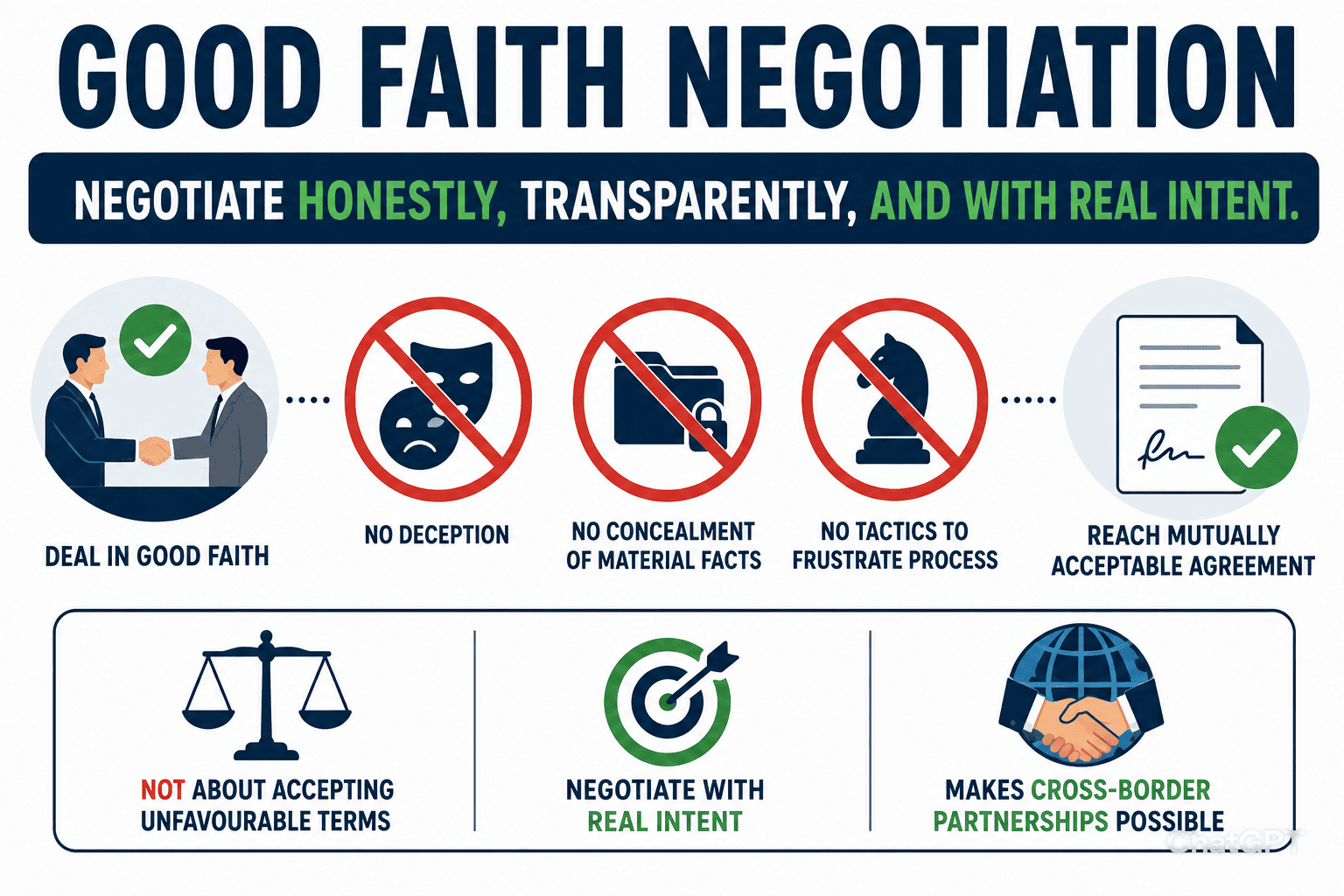
Every commercial partnership, whether a contract manufacturing arrangement, a licensing or distribution deal, a joint venture, or a market entry partnership, begins with a negotiation. The quality and integrity of that negotiation shapes the trust architecture of everything that follows. Good faith is not a courtesy, it is the behavioural foundation without which long-term trade relationships cannot be built, and in many jurisdictions, a legal standard that carries enforceable consequences.
In cross-border manufacturing and distribution partnerships, parties often come from different legal systems, business cultures, and commercial traditions. What one party considers normal negotiating practice, aggressive anchoring, delayed responses, simultaneous parallel negotiations, may constitute bad faith from the perspective of another party’s legal system or cultural expectations. Good faith negotiation provides the common standard that bridges these differences.
The stakes are particularly high when a manufacturer engages in detailed technical discussions for a co-development partnership or shares proprietary process information for a toll manufacturing evaluation. A partner who is simultaneously negotiating with a competitor, who has no real intention of executing the deal, or who is extracting proprietary intelligence can cause significant irreversible harm, harm that is difficult and expensive to remedy across jurisdictions.
Where Good Faith Negotiation Appears in Trade Contexts
🏭
Manufacturing Partner Selection
When evaluating an OEM, ODM, or EMS partner, both parties share sensitive technical and commercial information. Good faith requires honest representation of capacity, capability, pricing, and intent throughout the entire evaluation period.
🌍
Distribution Agreement Negotiations
Negotiating exclusivity clauses, territory scope, and volume commitments requires both parties to represent their market capability and commercial intentions honestly, not inflate projections to secure favourable exclusivity terms they cannot deliver on.
⚙️
Technology & IP Licensing
In technology transfer agreement negotiations, good faith requires full disclosure of known IP encumbrances, pending patent challenges, or third-party licence restrictions that materially affect the deal being discussed.
🏗️
Joint Ventures & Alliances
When structuring a joint venture or strategic alliance, good faith requires honest representation of each party’s financial capacity, regulatory standing, and strategic intentions, particularly regarding change of control scenarios.
🌐
Market Entry & Brand Partnerships
When entering franchise arrangements, white label partnerships, or new market distribution, good faith means accurately representing local market knowledge, existing relationships, and operational infrastructure to prospective partners.
⚡ Key Principle
Good faith negotiation does not mean a party must accept unfavourable terms, make concessions, or abandon their commercial interests. A party can negotiate hard, hold firm on price, push back on scope, and drive a difficult bargain, and still act in perfect good faith. What it prohibits is dishonesty of process: deception, concealment of material facts, and negotiating without genuine intent to reach agreement.
Good Faith vs Bad Faith
Good Faith vs Bad Faith: What Each Looks Like in Practice
The line between vigorous commercial negotiation and bad faith behaviour is not always obvious, particularly across different cultural and legal contexts. The comparison below maps specific negotiating behaviours to their good faith and bad faith equivalents in international trade negotiations.
✅ Good Faith Behaviours
- Disclosing known material issues that affect the deal
- Responding substantively to proposals, even to decline
- Representing capacity, credentials, and authority accurately
- Honouring agreed-in-principle positions unless new facts emerge
- Pausing negotiations if pursuing alternatives, not running both covertly
- Seeking clarification before rejecting unclear proposals
- Providing timely responses to commercial communications
- Sending a representative with genuine authority to bind the company
- Disclosing Incoterms, payment terms, and shipping obligations accurately upfront
🚩 Bad Faith Behaviours
- Concealing known defects, liabilities, or material weaknesses
- Negotiating with no genuine intention to sign the agreement
- Running identical negotiations with direct competitors simultaneously
- Walking back agreed positions without legitimate new justification
- Extracting proprietary information under cover of negotiation
- Artificially delaying to prevent the other party pursuing alternatives
- Misrepresenting financial capacity, regulatory status, or market position
- Sending a representative without actual authority to bind the company
- Renegotiating agreed pricing or MOQ terms at point of contract execution
✨ Practical Guidance
Before beginning substantive negotiations on a manufacturing or distribution partnership, verify the other party’s business identity through official registries, sanctions checks, and document verification, see our guide to business verification ID. An unverified counterparty is an unverifiable good-faith negotiator. Use B2B secure collaboration infrastructure to ensure that any confidential information shared during negotiations is protected regardless of whether the deal is ultimately completed.
Legal Framework by Jurisdiction
The Legal Framework: Is Good Faith Legally Required?
The legal obligation to negotiate in good faith is one of the most jurisdiction-dependent concepts in international commercial law. The same negotiating behaviour that constitutes a clear breach of a legal duty in Germany may create no legal liability in England, unless the parties have expressly agreed to it in their pre-contractual documents.
🇩🇪
Germany & EU Civil Law
Implied by Law
German law (BGB §242) and most EU civil law systems impose a general duty of good faith in pre-contractual dealings. Breaking off negotiations without good cause after inducing the other party to rely on their progress can give rise to damages under culpa in contrahendo doctrine.
🇫🇷
France
Implied by Law
The French Civil Code (Art. 1112) explicitly addresses pre-contractual good faith since the 2016 reforms. Abrupt withdrawal from advanced negotiations, particularly after the other party has incurred costs in reliance, is directly actionable.
🇬🇧
United Kingdom
No General Duty
English law does not recognise a general implied duty to negotiate in good faith (Walford v Miles [1992]). However, express good faith provisions in contracts are enforceable, and courts increasingly recognise good faith obligations in long-term relational contracts.
🇺🇸
United States
Contextual
US law generally does not impose pre-contractual good faith duties in commercial negotiations. The UCC implies good faith in contract performance. Express contractual obligations to negotiate in good faith are enforceable. The NLRA mandates good faith bargaining in labour relations.
🇮🇳
India
Implied in Practice
Indian contract law does not have an explicit pre-contractual good faith doctrine, but the Indian Contract Act imposes disclosure duties in certain contexts, and courts have implied good faith in contract performance under principles of equity.
🇨🇳
China
Implied by Law
Chinese contract law (Civil Code Art. 7, Art. 500) explicitly imposes good faith obligations in pre-contractual negotiations. Deliberate misrepresentation or bad faith withdrawal from negotiations that causes loss gives rise to liability for compensatory damages.
🇦🇪
UAE & GCC
Implied by Law
The UAE Civil Transactions Law (Art. 246) requires contracts to be performed in good faith. Pre-contractual good faith is recognised, and bad faith conduct during negotiations may give rise to tort liability under the UAE Civil Code.
🇸🇬
Singapore
No General Duty
Singapore follows English common law and does not recognise a general implied duty to negotiate in good faith. However, express contractual good faith provisions are enforceable, and the concept is increasingly recognised in relational contracts.
⚠️ Cross-Border Implication
When parties from civil law and common law jurisdictions negotiate together, for example, an Indian manufacturer negotiating a distribution arrangement with a German distributor, their legal systems may impose fundamentally different good faith obligations on the same negotiation. Always specify governing law in any pre-contractual document, and obtain legal advice in both parties’ jurisdictions before executing an MoU or heads of terms.
Good Faith Clauses in Contracts
Good Faith Clauses in Commercial Agreements
In jurisdictions where good faith obligations are not automatically implied, particularly the UK and US, parties to cross-border trade agreements frequently include express good faith negotiation clauses in their pre-contractual documents and final agreements. Understanding what these clauses do, and what they do not do, is essential for manufacturers and distributors negotiating international partnerships.
| Clause Element |
What It Requires |
What It Does Not Require |
| Obligation to Negotiate |
Parties must genuinely engage with and respond to each other’s proposals
| Agreement to any specific terms; acceptance of unfavourable positions
|
| Disclosure Obligation
| Disclosure of material facts known to be relevant to the other party’s decision
| Disclosure of confidential commercial strategy or privileged legal advice
|
| Consistency Obligation
| Not abandoning agreed-in-principle positions without legitimate new justification
| Permanently binding the party to positions taken in early negotiation stages
|
| Exclusivity Obligation
| (If express) Not negotiating identical terms with third parties during the exclusivity period
| Exclusivity on all commercial activity, only on the specific deal scope stated
|
| Effort Standard
| Using reasonable commercial efforts to progress the negotiation toward agreement
| Guarantee that agreement will be reached; unlimited commitment of management time
|
| Remedy for Breach
| Damages for wasted costs incurred in reliance on the other party’s participation
| Specific performance of the underlying deal; forced agreement to terms
|
✨ Drafting Guidance
When including a good faith negotiation clause in an agreement governing a supplier collaboration or manufacturing partnership, make the clause specific: define what the parties are obliged to negotiate in good faith (the scope), the standard of effort required (reasonable commercial efforts vs. best efforts), the duration of the obligation, and whether an exclusivity restriction accompanies it. A vague obligation to “negotiate in good faith” without scope definition creates disputes rather than resolving them. See also our guide on exclusivity clauses in distribution agreements for how exclusivity and good faith obligations interact.
Bad Faith Violations & Consequences
Bad Faith Negotiation: Common Violations and Their Consequences
🚩
Parallel Negotiations Under an Exclusivity Commitment
Continuing to negotiate identical or substantially similar terms with a competing party while holding another party to an exclusivity commitment is among the clearest forms of bad faith. It is particularly common in distribution agreement negotiations. The breaching party typically argues the parallel conversations were “exploratory”, courts in civil law jurisdictions are increasingly unsympathetic to this characterisation.
🚩
Intelligence-Gathering Under Cover of Negotiation
Entering a negotiation not to reach an agreement, but to access the other party’s pricing structures, supplier relationships, product pipeline, or proprietary technical specifications, and then withdrawing once sufficient information has been obtained. Protecting against this requires a binding NDA executed before any disclosure, combined with secure document exchange protocols.
🚩
Misrepresenting Authority to Negotiate
Sending a representative who does not have authority to bind the company, creating the impression of progress while ensuring no agreement can actually be reached without an undisclosed decision-maker who may reject the terms. Always verify that your counterparty’s representative holds genuine authority. GT Setu’s platform confirms representative authority at onboarding, see our business verification guide for the full process.
🚩
Late-Stage Renegotiation Without Justification
Agreeing to commercial terms in principle, on pricing, lead times, Incoterms, or MOQ, and then attempting to renegotiate those terms at contract execution when the other party has no viable alternative. This tactic, sometimes called “salami slicing,” is a standard bad faith marker that sophisticated parties document meticulously and pursue through dispute resolution.
🚩
Concealing Material Facts During Due Diligence
Withholding known information that would materially affect the other party’s willingness to enter the agreement, existing litigation, regulatory non-compliance, capacity constraints, quality failures, or financial distress. In civil law jurisdictions this triggers pre-contractual liability. In common law jurisdictions it may constitute fraudulent misrepresentation or misrepresentation by omission.
🚩
Strategic Delay to Block Alternative Arrangements
Deliberately slowing a negotiation, through non-responses, repeated document requests, or procedural objections, not because of legitimate concerns but to prevent the other party from closing an alternative deal. This is particularly damaging in time-sensitive market entry partnerships where a seasonal window or regulatory approval timeline creates external time pressure.
Protecting Good Faith in Your Negotiations
How to Protect the Integrity of Your Negotiations
Good faith cannot be guaranteed by the other party, but it can be structurally encouraged through the way you organise, document, and frame your negotiations. The following practices apply to any significant commercial negotiation in international trade.
01
Verify the Counterparty Before Disclosing Anything Material
Confirm the company’s legal existence, registration status, and sanctions standing before entering substantive discussions. Confirm that the representative you are dealing with has actual authority to negotiate and bind the company. GT Setu’s pre-verified partner network provides this confirmation at first connection, see our business verification ID guide for the full process including registry checks and authority verification.
02
Execute a Binding NDA Before Any Sensitive Disclosure
Good faith is a behavioural standard, an NDA is a contractual protection. Execute a bilateral NDA with explicit confidentiality obligations, return and destruction provisions, and survival clauses before sharing pricing intelligence, product specifications, technology details, supplier terms, or customer data. Use secure document exchange for all sensitive materials, see our B2B secure collaboration guide.
03
Document Agreed-In-Principle Positions in Writing
After each negotiation session, send a written summary of positions agreed, positions open, and positions rejected, and ask the other party to confirm or correct. This creates a contemporaneous record that makes late-stage bad faith renegotiation much harder to execute and provides the evidentiary foundation for any subsequent dispute about what was committed to and when.
04
Include an Express Good Faith Clause in Pre-Contractual Documents
Include a specific good faith negotiation obligation in any MoU, heads of terms, or letter of intent, specifying the scope, duration, effort standard, and governing law. In jurisdictions without an implied duty (UK, US, Singapore), this creates a contractual obligation and a damages remedy that would not otherwise exist. Ensure the governing law choice reflects a jurisdiction where good faith obligations are clearly enforceable.
05
Use Exclusivity Provisions to Protect the Negotiation Period
For negotiations where you are making significant resource commitments, technical due diligence, legal fees, management time, negotiate a binding exclusivity period during which neither party will negotiate substantively identical arrangements with third parties. Link the exclusivity obligation to a defined negotiation timeline with clear milestones. See our guide on exclusivity clauses in distribution agreements for practical drafting considerations.
06
Engage Commercial Mediation Early if Negotiations Stall
When a negotiation stalls in a cross-border context, consider engaging a neutral commercial mediator before positions harden and the relationship deteriorates irreparably. Mediation conducted in good faith is far more likely to produce a workable commercial outcome than escalation to legal proceedings, and it preserves the commercial relationship that motivated the negotiation in the first place.
Good Faith Across Cultures
Good Faith Negotiation Across Cultures and Markets
What constitutes good faith behaviour in a negotiation is not culturally universal. Misreading cultural negotiating style as bad faith, or missing genuine bad faith because it is disguised as cultural norm, is one of the most common causes of international trade relationship breakdowns. The following distinctions are practically important for manufacturers and distributors entering new markets through international distribution partners.
| Region / Market |
Cultural Negotiation Norms |
Style vs Good Faith Distinction |
Key Watch Points |
| 🇮🇳 India |
Relationship-first; extended deliberation; hierarchical approval processes; flexibility on timelines
| Slow pace is often cultural process, not deliberate delay. Multiple rounds of price discussion is style, not bad faith
| Ensure the person negotiating has board-level authority before committing significant resources or disclosing IP
|
| 🇨🇳 China
| Long relationship-building phase; indirect communication of disagreement; collective decision-making
| “We need more time to study” often signals genuine internal process. Silence on a proposal is not rejection
| Parallel negotiations are common, always confirm exclusivity in writing before disclosing commercial terms or technology details
|
| 🇩🇪 Germany / EU
| Direct, structured, document-heavy; precision in language expected; oral commitments treated as binding
| Directness and criticism of proposals is style, not hostility. Detailed legal documentation requests are normal process
| EU parties may have legally implied good faith obligations, casual verbal representations carry greater weight than in common law contexts
|
| 🇺🇸 USA
| Fast-paced; transactional; high tolerance for positional bargaining; lawyers involved early
| Aggressive anchoring and positional bargaining is cultural style. Rapid escalation to legal review is normal, not adversarial
| No implied pre-contractual good faith duty, express it contractually if you want legal protection for the negotiation period
|
| 🇦🇪 UAE / GCC
| Relationship and trust-first; hospitality extended before business discussed; personal relationships with decision-makers expected
| The social phase before commercial discussion is not delay, skipping it signals disrespect and undermines trust fundamentally
| The person you meet may not be the decision-maker. Confirm who can execute before committing to timelines or disclosing sensitive terms
|
| 🇯🇵 Japan
| Consensus-building (nemawashi); extreme care with language; indirect communication of rejection
| “We will consider this carefully” typically signals rejection. What sounds like continued progress may be a polite decline
| Misreading indirect rejection as ongoing engagement can waste significant management time and delay market entry by months
|
✨ The GT Setu Advantage in Cross-Cultural Negotiations
GT Setu’s verified partner network spans manufacturers and distributors across 100+ countries. Every company on the platform is verified on 6 government-sourced points (Name, Address, Registration Number, Company Status, Company Type, Date of Incorporation) using government tie-ups. Authority confirmation is based on documentation provided by the user. This verification step removes one of the most common structural sources of bad faith behaviour before the first conversation takes place. Explore our supplier collaboration platforms guide for further context on how verified partner networks reduce negotiation risk at scale.
FAQ
Frequently Asked Questions
Q
What does negotiating in good faith mean?
Negotiating in good faith means engaging in a negotiation honestly and transparently, with genuine intent to reach a mutually acceptable agreement. It requires disclosing material information relevant to the other party’s decision, responding substantively to proposals, not making misrepresentations about your position or capabilities, and not using tactics designed to frustrate or delay the negotiation process without legitimate reason. Good faith does not require a party to accept unfavourable terms or abandon their commercial interests, a party can negotiate hard and still act in good faith, so long as they are genuinely attempting to reach agreement rather than going through the motions to extract information or block the other party from pursuing alternatives.
Q
Is good faith negotiation legally required?
The legal obligation to negotiate in good faith varies significantly by jurisdiction. In civil law countries, France, Germany, most of continental Europe, China, Japan, UAE, a general duty of good faith in pre-contractual negotiations is typically implied by law, and breach can give rise to damages. In common law countries, UK, USA, Australia, Singapore, there is generally no standalone implied duty to negotiate in good faith unless expressly included in the contract or pre-contractual document. However, good faith obligations can arise contractually in all jurisdictions through MoUs, heads of terms, or agreements to negotiate, and breaching them can give rise to a damages claim even in common law systems. For cross-border trade agreements, always specify governing law in any pre-contractual document and take legal advice in both parties’ jurisdictions.
Q
What is the difference between good faith and bad faith negotiation?
Good faith negotiation involves honest communication, genuine intent to reach agreement, transparency about material facts, and constructive responses to proposals. Bad faith negotiation involves tactics designed to mislead, delay, or frustrate the other party, such as making offers without intent to perform, concealing material information, deliberately stalling while pursuing alternative deals, walking away from agreed-in-principle positions without legitimate new information, or using the negotiation process to access proprietary information without any genuine interest in completing the deal. The distinction is not about the hardness of negotiating positions, it is about the honesty and genuineness of intent underlying them.
Q
How does good faith negotiation apply in international manufacturing and distribution?
In international manufacturing and distribution, including
contract manufacturing,
OEM/ODM arrangements,
licensing and distribution deals, and
co-development partnerships, good faith is the behavioural foundation that makes cross-border trust possible. It means: accurately representing manufacturing capacity and quality standards; disclosing known regulatory, financial, or compliance issues before they become contractual disputes; not negotiating under exclusivity while simultaneously closing an identical deal with a competitor; ensuring your representative has actual authority to bind the company; and responding substantively to commercial proposals within agreed timeframes. When parties from different legal systems negotiate, good faith is often the only shared behavioural standard they can rely on before their formal agreement is signed.
Q
Can I sue someone for negotiating in bad faith?
In civil law jurisdictions (France, Germany, China, UAE, and others), yes, bad faith conduct during pre-contractual negotiations can give rise to a claim for compensatory damages under pre-contractual liability doctrines (culpa in contrahendo), tort law, or misrepresentation. The typical remedy is reimbursement of wasted costs incurred in reliance on the bad faith party’s apparent commitment, not the full value of the underlying deal. In common law jurisdictions (UK, USA, Singapore), a claim requires either an express good faith clause in the pre-contractual agreement, a separate misrepresentation claim based on specific false statements, or breach of a duty of care in specific circumstances. Courts in common law systems are reluctant to award specific performance of a “duty to negotiate”, the remedy is damages. Always take legal advice specific to the governing law jurisdiction before pursuing bad faith claims internationally.
Q
What commercial terms most commonly become the subject of bad faith disputes?
In international manufacturing and distribution negotiations, the commercial terms most commonly involved in bad faith disputes include:
pricing structures agreed in principle then renegotiated at execution;
exclusivity commitments undermined by parallel negotiations;
volume commitments over-stated to obtain more favourable exclusivity or pricing terms;
minimum order quantities agreed and then disputed;
Incoterms and shipping obligations misrepresented at negotiation but clarified only in the contract fine print; and
payment terms that were described differently in discussion versus contract language. Comprehensive written documentation of all agreed positions during negotiation is the primary protection against these disputes.