Risk Allocation in Cross-Border Deals: Complete Guide for Manufacturers & Distributors | GTsetu
Home ›
Blogs ›
Risk Allocation in Cross-Border Deals
⚖️ Cross-Border Trade Partnerships
Risk Allocation in Cross-Border Deals: Complete Guide for Manufacturers & Distributors
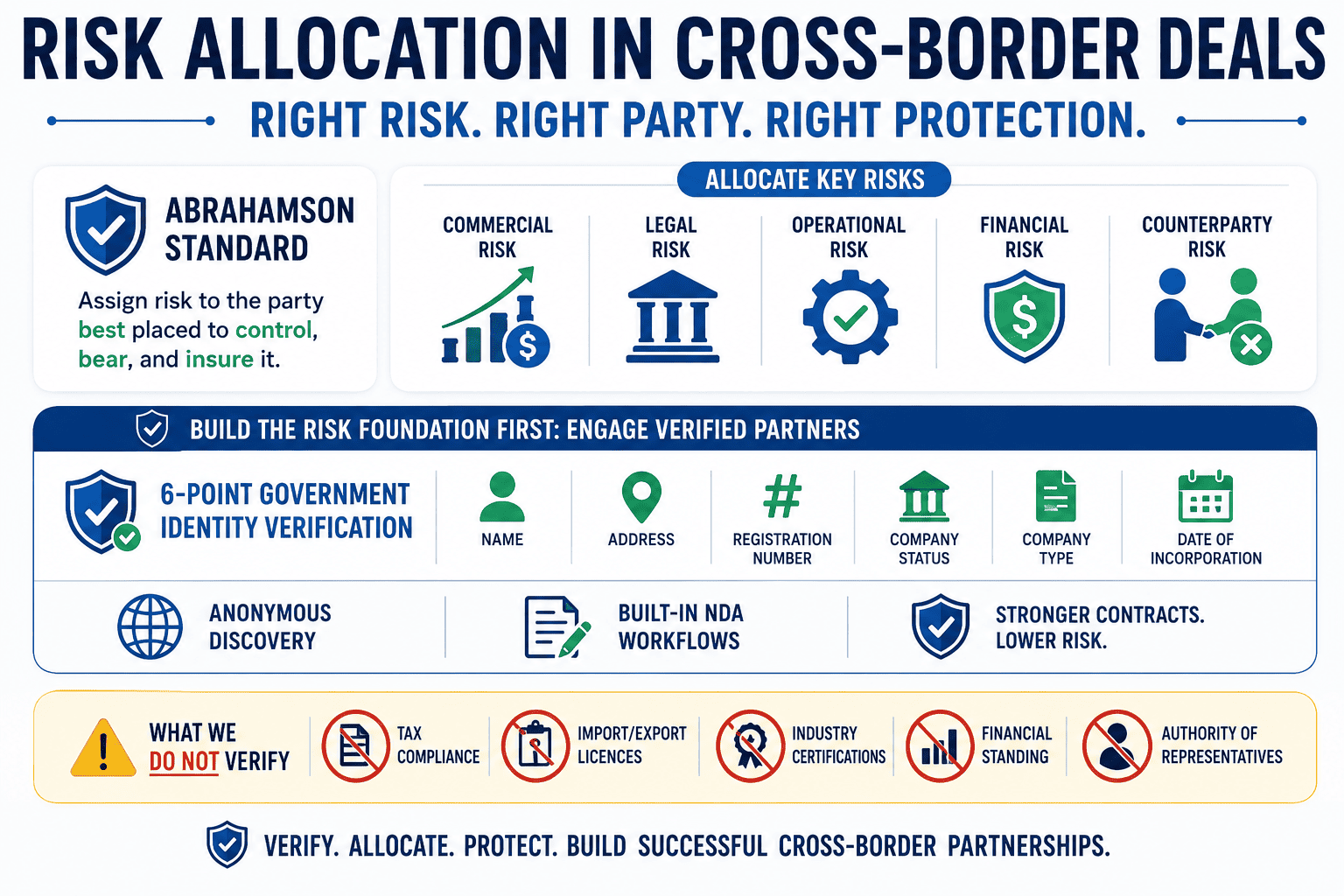
Direct Answer: Risk allocation in cross-border deals is the process of contractually deciding which party, manufacturer or distributor, bears each identified commercial, legal, operational, and financial risk in an international trade partnership. The governing principle is the Abrahamson standard: each risk should sit with the party best placed to control, bear, and insure against it. For manufacturers and distributors, the first risk to eliminate is engaging with an unverified counterparty, which is why GTsetu’s 6-point government identity verification (Name, Address, Registration Number, Company Status, Company Type, Date of Certificate of Incorporation), anonymous discovery, and built-in NDA workflows form the risk foundation before any contractual allocation begins. Note: GTsetu does NOT verify tax compliance, import/export licences, industry certifications, financial standing, or authority of representatives.
📅 February 19, 2026⏱ 18 min read✍️ GT Setu Editorial Team🔄 Updated regularly
7
Risk Categories
100+
Countries Covered
6-Point
Govt Identity Verification
0%
Broker Commission
Every cross-border trade deal between a manufacturer and a distributor involves risk. Prices move. Currencies fluctuate. Regulators introduce new requirements. Logistics chains break. Partners, however carefully selected, sometimes fail to perform. The question is never whether risk exists; it is who bears it, and under what conditions.
Risk allocation is the contractual answer to that question. It is the framework that determines, before any commercial activity begins, which party is responsible for each identifiable risk, and what happens when that risk materialises. Done well, it produces deals that are fair, stable, and resilient to disruption. Done poorly, it produces disputes, financial losses, and broken partnerships.
This guide covers every dimension of risk allocation in cross-border manufacturer-distributor deals: the risk categories you need to plan for, the contractual tools that allocate them, the legal frameworks that make allocations enforceable, and how GTsetu addresses the most foundational risk of all, engaging with an unverified or fraudulent counterparty, before any contractual framework begins.
Risk allocation in cross-border deals is the process of contractually assigning each identified commercial, legal, operational, and financial risk to the party best placed to control, bear, or insure against it. In manufacturer-distributor trade partnerships, it means explicitly deciding, before the agreement is signed, who is responsible if a shipment is delayed, a product is rejected, a regulatory approval fails, a currency moves sharply, or a dispute arises between parties governed by different legal systems.
The fundamental challenge in cross-border deals is that the parties are operating in different legal, commercial, and regulatory environments simultaneously. A manufacturer in India and a distributor in Germany face different tax regimes, different consumer protection laws, different currency exposures, and different court systems. A single contractual omission, failing to specify which country’s law governs the agreement, for example, can render the entire risk allocation framework unenforceable.
Risk allocation is distinct from risk management. Risk management is the operational practice of reducing the likelihood or severity of risks. Risk allocation is the legal practice of deciding who is responsible when risks materialise despite management efforts. Both are necessary. But in cross-border deals, risk allocation in the contract text is the foundation, because management practices cannot substitute for clear legal responsibility.
Risk Allocation vs. Risk Management: The Distinction That Matters
DimensionRisk ManagementRisk Allocation
Primary question
How do we reduce the probability of this risk occurring?
Who bears the cost if this risk materialises?
Where it lives
Operations, logistics, quality systems
The contract, legally binding
Timing
Ongoing, throughout partnership
Pre-deal, agreed before signing
Enforceability
Procedural, based on compliance
Legal, enforceable in courts/arbitration
Can substitute for the other?
✗ Not without contractual clarity
✗ Not without operational controls
Foundation requirement
Verified, trustworthy partner
Verified, trustworthy partner + clear contract
SECTION 2
2 Why Risk Allocation Fails, and When It Matters Most
Most cross-border deal failures are not caused by bad products or bad markets. They are caused by agreements that did not allocate risks clearly enough to withstand the pressures that inevitably arise, currency volatility, regulatory change, supply chain disruption, or a partner who underperforms against their commitments.
63%
of cross-border M&A deals underperform, risk misallocation cited as a primary driver
$4.9M
average cost of a B2B commercial dispute, most attributable to ambiguous contract terms
71%
of international distribution disputes arise from unspecified territory, pricing, or termination risk
Risk allocation matters most at four specific moments in a cross-border trade partnership:
🤝
At Deal Formation
The most leverage either party has is before the contract is signed. Once signed, renegotiating risk allocation is costly and often impossible without commercial concessions.
🌍
On Market Entry
Entering a new territory with a distributor involves regulatory approvals, import licences, and market establishment costs, all of which carry allocation implications before first sale.
⚡
When Disruption Hits
Pandemics, sanctions, tariff changes, and currency crises stress-test every clause. Parties with clear risk allocation survive disruption; parties without it litigate through it.
🚪
At Exit or Termination
How a partnership ends, who bears inventory risk, how customer relationships are handled, what compensation applies, is determined entirely by what the agreement allocated at the start. See also: termination clauses in trade agreements.
💱
Currency Moves
A 15% depreciation in the distributor’s local currency instantly changes the economics of every transaction. Without a clear currency risk allocation clause, disputes follow automatically.
📋
Regulatory Change
New import duties, labelling laws, or safety standards in the distributor’s market shift costs, and the contract must pre-allocate responsibility for compliance adjustment costs.
SECTION 3
3 The 7 Categories of Cross-Border Deal Risk
Effective risk allocation begins with a systematic inventory of all risks present in the deal. In cross-border manufacturer-distributor partnerships, seven categories of risk require explicit contractual treatment.
🔴 Category 1
Counterparty Risk
The risk that your partner is not who they claim to be, fraudulent company registration, fabricated credentials, undisclosed beneficial ownership, or misrepresented financial standing. This is the first risk to eliminate, before any contractual allocation begins.
🔴 Category 2
Commercial / Pricing Risk
Price volatility, margin compression, volume shortfalls against commitments, and competitive pricing pressure from third parties in the territory. See also: pricing structures in contract manufacturing.
🔴 Category 3
Legal & Regulatory Risk
Compliance failures in the target market, export control violations, product registration requirements, anti-bribery obligations, and jurisdictional conflicts between different legal systems.
🔴 Category 4
Financial & Currency Risk
Foreign exchange volatility, payment default, credit risk, withholding tax obligations, and transfer pricing exposure, particularly relevant in deals structured with advance payments or letters of credit. See: advance payment vs LC vs open account.
🟡 Category 5
Operational & Logistics Risk
Supply chain disruption, quality failures in production or delivery, lead time variance, and Incoterm liability transitions during transit. See: Incoterms explained and lead time vs production time.
🟡 Category 6
Geopolitical Risk
Tariff changes, sanctions, export bans, trade embargoes, political instability in the target market, and nationalisation of assets. Increasingly relevant in current deglobalisation trends.
🟡 Category 7
Reputational & IP Risk
Brand misuse by the distributor, product counterfeiting, unauthorised sublicensing, and the long-term reputational consequences of a failed partnership in the target market. Relevant to technology transfer agreements.
⚠️ The Risk Before All Risks
Every contractual risk allocation framework assumes one thing: that your counterparty is a legitimate, legally registered business whose representatives have the authority to bind the company to the agreement. If that assumption is wrong, if you are dealing with a fraudulent entity, a shell company, or an individual without signing authority, then every clause in the contract is worthless. Counterparty verification is the pre-contractual risk that makes all contractual risk allocation meaningful. GTsetu verifies 6 government identity points (Name, Address, Registration Number, Company Status, Company Type, Date of Certificate of Incorporation). Note: GTsetu does NOT verify tax, licences, certifications, financials, or authority.
SECTION 4
4 The Abrahamson Principle: The Gold Standard for Allocation
The most durable and internationally recognised framework for risk allocation is the Abrahamson principle, drawn from construction contract law but applicable to all commercial agreements. It provides a clear, practical answer to the question: who should bear this risk?
📐 The Abrahamson Principle
A risk should be allocated to the party that: (1) can best control it, (2) can best bear it financially, (3) can best insure against it, (4) benefits most from bearing it, and (5) for whom bearing it is most economically efficient. Critically, risk allocation must also be (6) clear and unambiguous in the contract text.
Applied to manufacturer-distributor cross-border deals, the Abrahamson principle produces allocation outcomes that both parties can genuinely accept, because they are grounded in capability and economics, not bargaining power alone.
Neither party fully controls regulatory outcomes; risk of market failure should be shared
Milestone-based payment structure; deal suspension rights; MAC clause
Brand misuse by distributor
Distributor
Controls brand presentation; benefits from brand association; can prevent misuse through operational controls
Brand usage guidelines schedule; IP indemnity; termination right for breach
Supply disruption / force majeure
Shared, suspended obligations
Neither party controls genuine force majeure events; obligations suspended, not allocated
Force majeure clause with defined events, notice periods, and exit rights after prolonged disruption
Third-party IP infringement claims
Manufacturer
Controls product design and IP clearance; best placed to know and manage IP exposure
IP warranty; indemnification against third-party IP claims
🔑 Abrahamson in Practice
The Abrahamson principle is not a rigid rule, it is a framework for negotiation. In practice, parties may deviate from the “optimal” allocation for commercial reasons (a distributor may accept more FX risk in exchange for a lower transfer price, for example). What matters is that deviations are conscious, negotiated, and explicitly stated in the contract, not accidents of omission.
SECTION 5
5 Contractual Tools for Risk Allocation
Risk allocation only becomes enforceable when it is embedded in specific contractual mechanisms. The following tools are the primary instruments through which manufacturers and distributors allocate risk in cross-border trade agreements.
📜
Representations & Warranties
Contractual statements of fact that each party makes about themselves and the subject matter of the deal. False reps and warranties trigger indemnification rights. See Section 6 for full treatment.
Legal Protection
🌐
Governing Law & Dispute Resolution Clause
Specifies which country’s law governs the contract and how disputes are resolved. Without this, risk allocation is unenforceable across jurisdictions. See Section 7.
Enforceability
⚡
Force Majeure & Material Adverse Change (MAC)
Defines which unforeseeable events suspend contractual obligations and what notice and mitigation requirements apply. Critical for geopolitical and pandemic-era resilience. See Section 8.
Disruption
🏦
Escrow & Payment Security Mechanisms
Financial risk instruments including escrow accounts, letters of credit, advance payment structures, and warranty holdbacks that protect against payment default and non-performance. See Section 9.
Financial
🗺️
Territory & Exclusivity Clauses
Defines geographic scope, sub-distribution rights, and exclusivity conditions, including the volume or performance conditions under which exclusivity is maintained or withdrawn. See: territory rights and exclusivity clauses.
Commercial
🚪
Termination & Exit Provisions
Defines conditions for termination, notice periods, post-termination obligations (inventory buyback, IP return, customer transition), and compensation structure. See: termination clauses in trade agreements.
Exit Risk
How These Tools Work Together: The Risk Allocation Stack
Each contractual tool addresses a different layer of risk. Used in isolation, each provides partial protection. Used together, with a verified counterparty as the foundation, they form a comprehensive risk architecture:
🏛️
Partner Verification
Counterparty identity confirmed (6 points) before negotiation.
🔐 GTsetu
📄
NDA Executed
Confidential data protected during due diligence.
🔐 Legal gate
⚖️
Risk Mapping
All 7 risk categories identified and allocated.
🔐 Abrahamson
📜
Reps & Warranties
Legal protection against misrepresentation.
🔐 Indemnity
🌐
Governing Law
Dispute resolution mechanism specified.
🔐 Enforceable
🤝
Agreement Signed
Full risk allocation framework in place.
🔐 Audit trail
SECTION 6
6 Representations, Warranties & Indemnification
Representations and warranties (reps & warranties) are the primary legal mechanism for allocating the risk of unknown or undisclosed problems at the time of deal signing. Each party makes explicit statements of fact, and if any statement proves false, the other party has a contractual right to indemnification or deal rescission.
What Each Party Typically Warrants in a Distribution Agreement
Party
Representation / Warranty
Risk Allocated Against
Consequence if False
Manufacturer
Company is legally incorporated and in good standing
Counterparty / legal identity risk
Agreement void; indemnity for losses incurred
Manufacturer
Products comply with all applicable safety and regulatory standards
Product regulatory risk
Indemnity for regulatory fines, recalls, distributor losses
Manufacturer
Manufacturer owns or has valid licences for all IP in the products
Third-party IP infringement risk
Indemnity for all third-party IP claims against distributor
Manufacturer
No pending litigation, regulatory action, or insolvency proceeding
Financial stability and legal continuity risk
Right to terminate; indemnity for deal-related losses
Distributor
Distributor holds all required import licences and regulatory approvals for target market
Local regulatory compliance risk
Indemnity for shipment delays, fines, and confiscation losses
Distributor
Distributor has the financial standing and infrastructure to perform distribution commitments
Operational performance risk
Right to terminate exclusivity; damages for volume shortfall
Distributor
Distributor will not sub-distribute or assign rights without written consent
Unauthorised distribution / brand risk
Immediate termination right; IP and brand indemnity
Both Parties
The individual signing has full authority to bind the company
Authority / counterparty validity risk
Agreement unenforceable without authority, catastrophic risk
⚡ The Authority Rep: Most Critical, Most Often Missed
The warranty that the signatory has authority to bind the company is the most foundational warranty in any cross-border agreement, and the one most frequently omitted in informally negotiated deals. On GTsetu, authority verification is NOT performed by GTsetu (remains your responsibility). GTsetu does not verify authority of signatories.
Structuring Indemnification in Cross-Border Deals
Indemnification clauses specify the financial remedy when a rep or warranty is breached. In cross-border deals, indemnification must address several additional complexities that do not arise in domestic agreements:
Indemnification Element
What It Covers
Cross-Border Complexity
Standard Approach
Scope of Covered Losses
Direct losses, consequential losses, third-party claims
Consequential loss definitions vary significantly across legal systems
Explicit list of covered and excluded loss categories; cap on consequential loss
Indemnification Cap
Maximum total indemnification liability per party
Without a cap, indemnification exposure can exceed deal value many times over
Cap at deal value or a specified multiple; carve-outs for fraud and wilful misconduct
Time Limit (Survival)
Period after signing during which warranty claims can be made
Different jurisdictions have different limitation periods, choice of law affects survival
Explicitly specified survival period (typically 12–36 months); longer for tax and IP
Basket / De Minimis
Threshold below which no indemnification claim can be brought
Transaction costs of pursuing minor cross-border claims often exceed their value
De minimis per-claim threshold + basket (aggregate) before indemnity is triggered
Currency of Payment
Which currency indemnification is paid in
Payment in a depreciating local currency may leave the claimant under-compensated
Specify hard currency (USD, EUR, GBP) for indemnification payments regardless of local currency
A risk allocation framework is only as strong as its enforceability. In cross-border deals, enforceability depends entirely on the governing law clause and the dispute resolution mechanism. Parties who negotiate detailed risk allocations but fail to specify these fundamentals have built an elaborate framework with no foundation.
Choosing Governing Law for Cross-Border Trade Agreements
Governing Law Option
Key Advantages
Considerations
Best For
English Law
Highly developed commercial law; predictable contract interpretation; global enforcement recognition; large body of trade case law
Costly litigation in English courts for smaller disputes
High-value deals; parties comfortable with common law; international transactions with European nexus
Singapore Law
Asia-Pacific hub; neutral jurisdiction; strong IP and commercial law; efficient courts; SIAC arbitration integration
Less familiar to European parties
Asia-Pacific cross-border deals; manufacturers/distributors in ASEAN, India, or Middle East
~ Higher upfront; lower total for complex disputes
✅ Standard for Cross-Border Trade
For manufacturer-distributor deals across different jurisdictions, international arbitration is the standard recommendation. The New York Convention (1958) ensures that an arbitral award from ICC, SIAC, LCIA, or UNCITRAL proceedings can be enforced in 172 countries, making it the most practical dispute resolution mechanism for cross-border commercial relationships. Always specify the arbitral institution, seat of arbitration, number of arbitrators, and language of proceedings in the contract.
SECTION 8
8 Force Majeure, MAC Clauses & Exit Provisions
Force majeure and material adverse change (MAC) clauses address the risks that contractual allocation cannot assign to either party, events so unforeseeable or overwhelming that standard indemnification frameworks are inadequate responses. For cross-border deals in the current geopolitical environment, these clauses have become among the most commercially significant in any agreement.
Force Majeure: What It Covers, and What It Doesn’t
Force Majeure Element
Standard Position
Cross-Border Specific Issue
Drafting Guidance
Definition of Qualifying Events
Natural disasters, war, pandemic, government action beyond parties’ control
What counts as “government action” varies across legal systems and jurisdictions
Use an illustrative list + a general catch-all; explicitly include/exclude sanctions and tariff changes
Effect of Force Majeure
Suspension of affected obligations, not termination
Neither party should be enriched by a force majeure event that only affects one side
Suspension only; no damages for suspended period; obligations resume when event ends
Notice Requirements
Prompt written notice required to invoke force majeure
Time zone, language, and communication infrastructure differences can delay notice
Define “prompt” explicitly (e.g., 5 business days); specify acceptable notice channels
Mitigation Obligation
Affected party must take reasonable steps to mitigate impact
What is “reasonable” differs across legal systems and economic contexts
Specify minimum mitigation steps; require progress updates during the force majeure period
Termination Right
If force majeure persists beyond a specified period, either party may terminate
Without a time limit, parties can be trapped in an indefinitely suspended agreement
Specify cut-off (e.g., 90/120/180 days); include mutual termination right without damages after cut-off
Geopolitical Events
Varied, sanctions, embargoes, and tariff changes are contested inclusions
Increasingly critical in current trade environment, deglobalisation creates new geopolitical risks
Explicitly include sanctions and export bans as force majeure events; distinguish from commercial tariff changes
⚠️ The COVID Clause Lesson
The pandemic exposed a critical gap in most distribution agreements: force majeure clauses that had not been updated since the 1990s. Many agreements listed earthquakes and wars but not pandemics. Many did not distinguish between supply-side force majeure (manufacturer cannot produce) and demand-side force majeure (distributor cannot sell). The result was years of litigation over which events qualified. Any cross-border agreement written today should explicitly address: pandemic and public health events, government-mandated market closures, sanctions imposed on either party’s country, and geopolitical disruptions to trade routes.
Material Adverse Change (MAC) Clauses
MAC clauses allow a party to suspend or exit a deal if a fundamental change in circumstances occurs, distinct from a specific force majeure event. In manufacturer-distributor agreements, MAC clauses typically address:
A material deterioration in the financial condition of either party (insolvency risk)
A regulatory change that makes the distribution arrangement commercially impractical or illegal
A change of control of either company (relevant to joint ventures and strategic partnerships)
A sustained currency depreciation beyond a specified threshold that makes pricing economics nonviable
A product recall or safety event affecting the manufacturer’s product line in the territory
Loss of a key regulatory licence or certification by either party
SECTION 9
9 Escrow and Financial Risk Mechanisms
Financial risk, the risk that a counterparty does not pay, cannot pay, or disputes the value of what was delivered, is one of the most practically significant risks in any cross-border trade deal. Escrow and related financial instruments are the primary tools for managing it.
When to Use Escrow in Cross-Border Trade Deals
Scenario
Escrow Application
How It Allocates Risk
Release Conditions
Advance payment for first order
Distributor pays advance into escrow; released on confirmed shipment
Manufacturer protected against non-payment; distributor protected against non-delivery
Bill of lading + quality inspection certificate
New market entry, phased investment
Manufacturer contributes market development funds to joint escrow; released on milestone achievement
Shared risk on market development costs; distributor incentivised to achieve milestones
Volume targets, brand activation deliverables, or timeline milestones
Post-delivery quality warranty
Portion of invoice (5–15%) held in escrow for 90–180 days post-delivery
Manufacturer retains payment risk for warranty period; distributor protected against defective goods
No valid warranty claim within retention period; or resolution of outstanding claims
Exclusivity fee or territory premium
Distributor pays exclusivity fee to escrow; released on minimum volume achievement over Year 1
Manufacturer compensated if exclusivity underperforms; distributor protected if manufacturer breaches
Annual volume target achieved; manufacturer performance of supply obligation
Partnership exit / termination
Inventory buyback value held in escrow during transition period
Distributor protected against manufacturer refusing buyback; manufacturer protected against inflated inventory claims
Independent inventory count and valuation; agreed buyback formula applied
Beyond escrow, the choice of payment mechanism in cross-border trade has significant risk allocation implications. See our detailed comparison of advance payment vs letter of credit vs open account for a full analysis of how each payment structure allocates financial risk between manufacturers and distributors.
🔑 Escrow Providers for Cross-Border Trade
For cross-border trade deals, escrow should be held by a neutral third-party institution, typically a bank or licensed escrow provider in a neutral jurisdiction. The escrow agreement itself should specify: the escrow agent’s identity and jurisdiction, the exact release conditions (objective, not subjective), the timeline for resolution of disputed releases, and the governing law for the escrow arrangement (which may differ from the main agreement’s governing law).
SECTION 10
10 Partner Verification: The Risk That Comes Before Contracts
Every section of this guide has assumed one thing: that you are dealing with a legitimate business whose representatives have authority to enter the agreement. That assumption is not automatically true in cross-border trade, and when it is wrong, every contractual risk allocation mechanism in the world becomes worthless.
🚩
Fraudulent Company Registration
A “distributor” presents fabricated business registration documents. Every warranty they give is worthless. No indemnification can be enforced against a shell entity.
🚩
Misrepresented Financial Standing
A distributor claims financial stability to secure exclusivity, then cannot fund market development or pay for inventory. Indemnification rights are hollow if the counterparty is insolvent.
🚩
No Signing Authority
The individual who signs the agreement lacks authority to bind the company. The entire agreement, including all risk allocations, may be unenforceable as a result.
🚩
Sanctions List Exposure
Engaging with an entity on OFAC, EU, or UN sanctions lists, even unknowingly, creates criminal liability for both parties. No risk allocation clause provides protection against sanctions violations.
🚩
Undisclosed Beneficial Ownership
A competing manufacturer owns a beneficial interest in the “independent” distributor. All commercial intelligence shared under the agreement flows directly to your competitor.
🚩
Fabricated Compliance Certifications
A distributor claims import licences or industry certifications they do not hold. Regulatory risk that was contractually allocated to them cannot be managed or enforced.
⚡ The Due Diligence Minimum Standard
Before any risk allocation negotiation begins, manufacturers and distributors should verify: (1) business registration documents from the relevant national registry, (2) tax registration and standing, (3) import/export licences relevant to the product category, (4) industry certifications claimed by the partner, (5) authority documentation for the individual negotiating the deal, and (6) sanctions and prohibited party screening. This is the baseline. GTsetu verifies 6 government identity points (Name, Address, Registration Number, Company Status, Company Type, Date of Certificate of Incorporation). Tax, licences, certifications, financials, and authority remain your responsibility to verify independently. See: business verification & ID in B2B.
SECTION 11
11 How GTsetu Reduces Risk in Cross-Border Trade Partnerships
🔐 Platform Spotlight, GTsetu
The Verified Platform Where Risk-Reduced Cross-Border Partnerships Begin
GTsetu was built for manufacturers and distributors who understand that the most dangerous risk in any cross-border deal is not currency volatility or regulatory change, it is engaging with an unverified counterparty. Before any contract is drafted, before any risk is allocated, GTsetu helps eliminate basic counterparty identity risk at source through 6-point government identity verification and structural security infrastructure. Note: GTsetu verifies 6 points only (Name, Address, Registration Number, Company Status, Company Type, Date of Certificate of Incorporation). Tax, licences, certifications, financials, and authority remain your responsibility.
🏛️
6-Point Government Identity Verification
Name, Address, Registration Number, Company Status, Company Type, Date of Certificate of Incorporation verified against official registries using government ties.
🕵️
Anonymous Discovery
Browse verified partner profiles across 100+ countries without revealing your market expansion strategy. Your identity and intentions stay private until you choose to engage.
📄
Built-In NDA Workflow
Digital NDA execution with timestamped signatures before any sensitive commercial information is exchanged, including the pricing and product data that forms the basis of risk allocation negotiations.
🔐
Encrypted Document Workspace
All due diligence documents, commercial proposals, and draft agreements exchanged through end-to-end encrypted channels. No plaintext email exposure of sensitive deal terms.
📋
Full Audit Trail
Every access event, document exchange, and NDA signature logged with timestamps, providing documentation that supports your partner selection records.
🚫
Zero Commission
GTsetu takes no success fee or broker commission. Your deal economics, including all risk allocation frameworks, remain entirely between you and your partner.
🌍
100+ Countries
Active verified network of manufacturers and distributors across Asia, Middle East, Europe, Africa, Australia, and the Americas, for cross-border deals with identity-verified counterparties.
⚖️
NDA-Protected Engagement
Every commercial discussion begins with a mutual NDA, protecting your confidential information before any assets are shared.
GTsetu verifies six specific data points using government ties: Company Name, Registered Address, Registration Number, Company Status, Company Type, and Date of Certificate of Incorporation. GTsetu does NOT verify tax compliance, import/export licences, industry certifications, financial standing, or authority of representatives. These remain your responsibility to verify independently. GTsetu provides an encrypted workspace where you can request these documents from partners and review them securely, with full audit trail.
Risk GTsetu Addresses vs. Risk the Contract Addresses
Risk allocation in cross-border deals is the process of contractually assigning each identified commercial, legal, operational, and financial risk to the party best placed to control, bear, or insure against it. In manufacturer-distributor trade partnerships, it means explicitly deciding, before the agreement is signed, who is responsible if a shipment is delayed, a product is rejected, a regulatory approval fails, a currency moves sharply, or a dispute arises between parties governed by different legal systems. The governing framework is the Abrahamson principle: risk should rest with the party best able to control, bear, and insure against it.
Q
What are the main categories of risk in cross-border trade deals?
The seven main categories are: (1) counterparty risk, the risk of engaging with a fraudulent or unverified entity; (2) commercial/pricing risk, price volatility and volume shortfalls; (3) legal and regulatory risk, compliance failures and jurisdictional conflicts; (4) financial and currency risk, FX volatility and payment default; (5) operational and logistics risk, supply chain disruption and quality failures; (6) geopolitical risk, sanctions, tariffs, and political instability; and (7) reputational and IP risk, brand misuse and product counterfeiting. Each requires explicit contractual treatment in a well-structured cross-border agreement.
Q
What is the Abrahamson principle in risk allocation?
The Abrahamson principle is the foundational framework for risk allocation in contract law, holding that each risk should be assigned to the party that can best control it, best bear it financially, best insure against it, and for whom bearing it is most economically efficient. It also requires that all risk allocations be stated clearly and unambiguously in the contract. Originally developed in construction contract theory, the Abrahamson principle is now applied broadly in international commercial agreements, including manufacturer-distributor trade deals, as the standard for producing fair and durable risk frameworks.
Q
How do representations and warranties protect parties in cross-border deals?
Representations and warranties are contractual statements of fact made by each party about their company identity, legal standing, regulatory compliance, and the subject matter of the deal. If any representation proves false, the affected party has a right to indemnification or deal rescission. In cross-border trade, they are particularly important for: confirming company identity and registration (counterparty risk), confirming regulatory compliance and licence status, confirming IP ownership, and confirming the authority of the signatory. The indemnification right triggered by a false rep or warranty is only valuable if the counterparty is a legitimate, financially capable entity, which is why verification before signing is the prerequisite.
Q
Why does governing law matter in cross-border deals?
Governing law determines which country’s legal system interprets the contract, resolves ambiguities, and provides remedies in a dispute. Without a specified governing law, courts in both countries may claim jurisdiction, producing parallel proceedings, contradictory judgments, and unenforceable awards. Choosing a neutral, internationally recognised governing law, English law, Singapore law, or Swiss law, combined with international arbitration under ICC, SIAC, or LCIA rules is the standard approach for cross-border manufacturer-distributor agreements. The New York Convention ensures that international arbitral awards can be enforced in 172 countries, making arbitration the practical dispute resolution choice for cross-border commercial relationships.
Q
What should a force majeure clause cover in a cross-border trade agreement?
A cross-border force majeure clause should cover: (1) an explicit list of qualifying events including natural disasters, war, pandemic, government-mandated shutdowns, and sanctions, with clarity on whether tariff changes qualify; (2) the effect of force majeure, typically suspension of obligations, not termination; (3) notice requirements, how promptly and through which channels notice must be given; (4) mitigation obligations, what steps the affected party must take to limit the impact; and (5) a termination right if force majeure persists beyond a specified period (typically 90–180 days). Post-pandemic drafting should explicitly address public health emergencies, geopolitical trade disruptions, and government-imposed export or import bans as qualifying events.
Q
How does escrow work in cross-border trade partnerships?
Escrow in cross-border trade involves a neutral third party holding funds until specified conditions are met by both sides. It protects against payment default, non-delivery, and warranty disputes. Common applications include: advance payments released on confirmed shipment (protecting both sides from non-delivery and non-payment risk), warranty retentions held for 90–180 days after delivery (protecting the distributor against defective goods), and market development fund contributions released on milestone achievement (aligning incentives on market entry investments). Escrow should be held by a neutral financial institution, with objective release conditions specified in advance and a dispute resolution mechanism for contested releases.
Q
How does GTsetu help manage risk in cross-border trade partnerships?
GTsetu reduces the foundational risk in any cross-border trade partnership: engaging with an unverified or fraudulent counterparty. By requiring 6-point government identity verification (Name, Address, Registration Number, Company Status, Company Type, Date of Certificate of Incorporation) before any company can engage on the platform, GTsetu helps reduce basic identity fraud risk. Built-in NDA workflows provide legal protection before sensitive commercial information is exchanged. Anonymous discovery prevents premature market strategy disclosure. A complete audit trail of the partner selection process supports your documentation requirements. Zero broker commissions mean deal economics, including all risk allocation frameworks, stay between the parties. Note: GTsetu does NOT verify tax compliance, import/export licences, industry certifications, financial standing, or authority of representatives. Those remain your responsibility.
Q
What is the difference between risk allocation and risk management?
Risk management is the operational practice of reducing the likelihood or severity of a risk materialising, through quality controls, logistics planning, hedging, and compliance programmes. Risk allocation is the legal practice of contractually deciding who is financially responsible when a risk materialises despite management efforts. Both are necessary: risk management reduces the probability that the contractual allocation is triggered; risk allocation determines the legal and financial consequence when it is. In cross-border trade partnerships, risk management cannot substitute for clear contractual allocation, because management practices are not enforceable in courts, and contract clauses cannot substitute for operational controls that prevent the risk from occurring in the first place.
Q
How does risk allocation differ across different cross-border deal structures?
Risk allocation varies significantly depending on the deal structure. In a pure distribution agreement, the distributor typically bears more operational and regulatory risk in their territory in exchange for commercial exclusivity. In a joint venture, risk is shared according to equity participation. In a technology transfer agreement, IP risk sits primarily with the licensor. In contract manufacturing, operational and production risk sits with the manufacturer while commercial and market risk sits with the brand owner. Understanding which deal structure you are using is the first step in determining the appropriate risk allocation framework. See also: OEM vs ODM vs EMS explained.
Q
What does GTsetu actually verify about potential trade partners?
GTsetu verifies six specific data points using government ties: Company Name, Registered Address, Registration Number, Company Status, Company Type, and Date of Certificate of Incorporation. GTsetu does NOT verify tax compliance, import/export licences, industry certifications, financial standing, or authority of representatives. Those remain your responsibility to verify independently. GTsetu provides an encrypted workspace where you can request these documents from partners and review them securely, with full audit trail.
Find Identity-Verified Trade Partners and Build Risk-Managed Cross-Border Deals
Join 500+ verified manufacturers and distributors building cross-border partnerships on GTsetu, with 6-point government identity verification (Name, Address, Registration Number, Company Status, Company Type, Date of Certificate of Incorporation), anonymous discovery, built-in NDA workflows, and zero broker commissions. Note: Tax, licences, certifications, financials, and authority are not verified by GTsetu and remain your responsibility.
They represents the product, and research team behind GTsetu, a global B2B collaboration platform built to help companies explore cross-border partnerships with clarity and trust. The team focuses on simplifying early-stage international business discovery by combining structured company profiles, verification-led access, and controlled collaboration workflows.
With a strong emphasis on trust, and disciplined engagement, Team GTsetu shares insights on global trade, partnerships, and cross-border collaboration, helping businesses make informed decisions before entering deeper commercial discussions.