Why Is a Limitation of Liability Clause Essential?
In any commercial transaction, uncertainty about potential losses can kill a deal before it starts. Without a limitation of liability clause, a party could be exposed to unlimited liability, including consequential damages far exceeding the original contract value. Consider a SaaS vendor providing a $50,000 annual subscription. A software bug could cause a client to lose $2 million in revenue. Under default contract law, the vendor could be held liable for the full amount, threatening its survival.
The limitation of liability clause solves that problem by creating predictability. It acts as a financial guardrail: both parties know the worst‑case scenario before signing. This predictability is particularly important in international trade, where legal systems differ and litigation costs are high. According to World Commerce & Contracting, limitation of liability is consistently the #1 most negotiated term in commercial contracts, above indemnification, pricing, and termination.
Beyond risk management, the clause also makes innovation and competition possible. Small vendors can serve large enterprises without betting the entire company on perfect performance. Customers gain access to a wider range of suppliers, while vendors price their services according to a defined risk profile.
Common Contract Types Where Limitation of Liability Appears
☁️
SaaS & Software Licensing
Caps tied to 12 months of subscription fees; excludes consequential damages; data breach often carved out with a separate super cap.
📦
Supply & Distribution Agreements
Limits liability for defective goods, late delivery, or quality issues, often to the invoice value of the affected shipment.
🏗️
Construction & Engineering
Total liability capped at the contract price; liquidated damages for delay are often treated separately.
💼
Professional Services (Consulting)
Liability limited to fees paid for the specific engagement, excluding third‑party claims unless indemnified.
🚢
International Trade & Logistics
Carriage contracts limit liability per kilogram or per shipment, often aligning with international conventions (CMR, Hague‑Visby).
⚡
Energy & Infrastructure
High‑value projects include uncapped carve‑outs for IP infringement, gross negligence, and environmental damage.
⚡ Key Principle
A well‑drafted limitation of liability clause does not eliminate accountability, it ensures that accountability remains proportional to the value and risk profile of the transaction. The goal is fairness and predictability, not immunity from consequences.
Liability Cap vs. Exclusion of Damages
Two Core Components: The Cap and the Exclusion
Most limitation of liability clauses contain two distinct mechanisms. First, a liability cap sets a maximum amount of money that can be recovered. Second, an exclusion of certain types of damages, especially consequential or indirect damages, removes entire categories of loss from recovery, regardless of the cap amount. Understanding the difference is critical.
💰 Liability Cap (Monetary Limit)
- Fees paid, e.g., “total fees paid in the preceding 12 months” (common in SaaS)
- Fixed amount, e.g., “$500,000” (used in high‑value transactions)
- Multiple of fees, e.g., “2x the total contract value”
- Insurance‑linked, cap tied to available product liability coverage
- The greater of options, e.g., “$1 million or fees paid, whichever is higher”
🚫 Excluded Damages (Removed Entirely)
- Consequential / indirect damages (lost profits, reputational harm)
- Incidental damages (administrative costs, overhead)
- Punitive or exemplary damages
- Special damages (unique losses not generally foreseeable)
- Loss of data, loss of business, or interruption of business
✨ Drafting Tip
A waiver of consequential damages is often more important than the liability cap itself. Without it, even a capped contract could expose a party to massive lost‑profit claims that are excluded from the cap. Always include explicit, mutual waivers of consequential damages, and define what “consequential damages” actually means in your governing jurisdiction.
Carve‑Outs & Exceptions
Critical Carve‑Outs: When the Cap Does Not Apply
No limitation of liability clause is absolute. Carve‑outs are specific types of claims that are excluded from the cap, meaning liability for those claims is either uncapped or subject to a separate, higher limit. Carve‑outs are where negotiations become most intense because they represent the risks that one party cannot afford to limit.
🔓
Fraud, Gross Negligence & Willful Misconduct
Most jurisdictions refuse to enforce liability caps for intentional harm or reckless disregard for safety. Courts view these as matters of public policy, you cannot contractually immunise yourself from bad faith conduct.
🤐
Breach of Confidentiality
Leaking trade secrets or customer data often carries uncapped liability because damages are difficult to quantify and the harm can be existential for the injured party.
💡
Intellectual Property Infringement
If a vendor’s product infringes a third‑party patent, the customer will typically demand that IP indemnity obligations be carved out from the liability cap.
🛡️
Indemnification Obligations (Third‑Party Claims)
Liability for defending and paying third‑party lawsuits, such as regulatory fines or IP claims, is often subject to a separate, higher cap or no cap at all.
💥
Data Breaches & Security Failures
Increasingly, contracts include a separate “super cap” for data breaches, often 2x or 3x the standard cap, or treat data breach liability as uncapped, particularly under GDPR or similar regimes.
⚖️
Death or Personal Injury
Under laws such as the UK Unfair Contract Terms Act 1977, any clause attempting to exclude liability for death or personal injury caused by negligence is void.
LoL vs Indemnification
Limitation of Liability vs Indemnification: Two Different Tools
These two provisions are often confused, but they serve opposite functions. Limitation of liability caps direct claims between the contracting parties (a shield). Indemnification transfers liability for third‑party claims from one party to the other (a sword). Many contracts include both, with indemnity obligations often carved out from the standard liability cap.
| Aspect |
Limitation of Liability (LoL) |
Indemnification |
| Primary function |
Caps damages between the two parties to the contract |
Transfers liability for third‑party claims (lawsuits from outsiders) |
| Simple analogy |
Shield, protects you from the other party |
Sword, protects you from the rest of the world |
| Typical scope |
Direct damages, sometimes also caps on indemnity |
Legal defence costs, settlements, judgments, regulatory fines |
| Common exclusions |
Gross negligence, fraud, IP infringement, data breach |
Often carved out of the cap, subject to separate limits or uncapped |
| Example |
“If our software fails and you sue us directly, we pay you max $50k.” |
“If a third party sues you because our software infringes their patent, we pay your legal fees and any judgment.” |
| Negotiation dynamic |
Vendors want low cap, customers want high cap or broad carve‑outs |
Vendors resist broad indemnity; customers demand it for key risks (IP, data, bodily injury) |
✨ Practical Insight
Do not rely on a liability cap alone to protect against third‑party claims. If a third party sues your customer because of your product or service, the customer will look to your indemnification provision, and many indemnities are drafted to be uncapped or subject to a separate, much higher limit. Always align your indemnity cap with your insurance coverage.
Enforceability
Is a Limitation of Liability Clause Enforceable?
Generally, yes, limitation of liability clauses are routinely enforced in commercial contracts between sophisticated parties. However, enforceability depends on the jurisdiction, the clarity of the clause, and whether the limitation is reasonable. Courts will not enforce a clause that attempts to limit liability for intentional harm, and they scrutinise clauses that appear unconscionable or that exploit unequal bargaining power.
01
Clarity and Unambiguous Language
The clause must be prominent, clearly drafted, and use plain language. Hidden boilerplate or ambiguous terms (e.g., “any and all damages” without distinguishing direct vs consequential) invite judicial interpretation against the drafter.
02
Reasonableness and Proportionality
A cap of $100 on a $500,000 contract is likely unreasonably low. Courts ask whether the cap bears a reasonable relationship to the contract value and the potential losses. Tying the cap to fees paid or a multiple of fees is considered reasonable.
03
Equal Bargaining Power
Clauses in adhesion contracts (take‑it‑or‑leave‑it) or those imposed on consumers or small businesses face stricter review. In B2B agreements between sophisticated parties, courts are far less likely to intervene.
04
Public Policy Limits
No jurisdiction enforces limitations for fraud, willful misconduct, death, or personal injury. In India, the Supreme Court in Central Inland Water Transport Corp. v. Brojo Nath Ganguly held that unconscionable clauses exploiting unequal bargaining power are void under Section 23 of the Contract Act.
05
UK: UCTA “Reasonableness” Test
Under the Unfair Contract Terms Act 1977, any limitation of liability for negligence or breach of contract must satisfy the reasonableness test, considering factors such as bargaining power, ability to insure, and whether the clause was brought to the other party’s attention.
What If There Is No Clause?
What Happens If There Is No Limitation of Liability Clause?
Without a limitation of liability clause, the default rules of the governing law apply, and those rules are almost always unfavourable to the party that would have wanted a cap. Under common law, the non‑breaching party can recover all direct, indirect, and consequential damages that were reasonably foreseeable at the time of contracting. This includes lost profits, reputational harm, and downstream business interruption.
Consider a logistics provider that loses a single shipment worth $10,000. Without a liability cap, the provider could be sued for $2 million in consequential damages if that shipment was critical to the customer’s production line. Most logistics contracts therefore include per‑kilogram or per‑shipment caps derived from international conventions (CMR, Montreal Convention, Hague‑Visby). Without such a clause, the provider faces existential risk.
For any business, operating without a limitation of liability clause means accepting unlimited and unpredictable financial exposure. That is why World Commerce & Contracting reports that limitation of liability has been the most negotiated term for over 20 consecutive years.
⚠️ Critical Warning
Never rely on the absence of a clause to protect you. If you are the vendor or service provider, always propose a clear, mutual limitation of liability clause with a reasonable cap and a waiver of consequential damages. If you are the customer, ensure that key risks (IP infringement, data breach, confidentiality) are carved out from the cap.
FAQ
Frequently Asked Questions
Q
What is a limitation of liability clause?
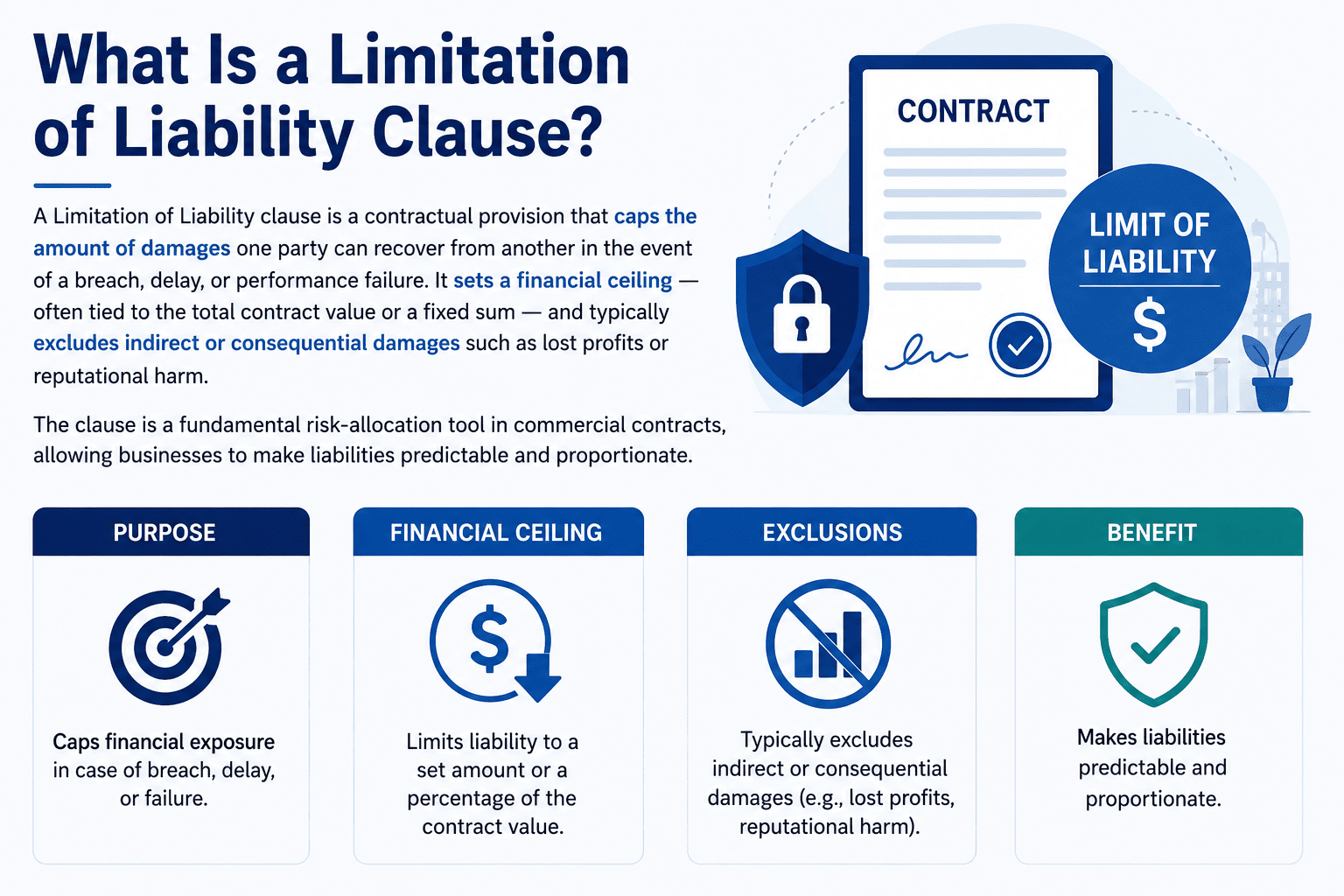
A limitation of liability clause is a provision in a contract that caps the amount of money or damages one party can recover from another for breaches or performance failures. It sets a financial ceiling, often tied to the contract value, and typically excludes indirect or consequential damages such as lost profits. The clause helps businesses manage risk by making potential losses predictable and proportionate to the deal.
Q
Is a limitation of liability clause enforceable?
Generally, yes, but enforceability depends on jurisdiction, clarity, and reasonableness. Courts enforce limitation clauses in commercial contracts between sophisticated parties when the language is clear and the cap is proportionate. However, most jurisdictions refuse to enforce limitations for fraud, gross negligence, willful misconduct, or personal injury. In India, for example, clauses that exploit unequal bargaining power or impose unreasonable caps may be struck down under Section 23 of the Contract Act as against public policy. In the UK, the Unfair Contract Terms Act 1977 requires that such clauses pass a reasonableness test.
Q
What is the difference between limitation of liability and indemnification?
Limitation of liability acts as a shield: it caps the damages one party owes the other directly under the contract. Indemnification acts as a sword: it transfers liability for third‑party claims, such as lawsuits from customers or regulatory fines, from one contracting party to the other. Many contracts include both provisions: limitation caps direct claims, while indemnity covers external claims, often without being subject to the same cap.
Q
What are typical carve‑outs from a limitation of liability clause?
Common carve‑outs include fraud, gross negligence, willful misconduct, breach of confidentiality, intellectual property infringement, indemnification obligations (third‑party claims), data breaches, and death or personal injury. These risks are considered too serious or too unpredictable to cap, so they are either excluded entirely from the cap or subject to a separate, higher “super cap.”
Q
How should a liability cap be calculated?
The most common approach in recurring service and SaaS agreements is to tie the cap to the fees paid over a defined period, usually the preceding 12 months. For one‑time transactions, a fixed amount or a multiple of the contract value is typical. The cap should be proportional to the deal size and the risk profile. A $500 cap on a $1 million contract would likely be deemed unreasonable. Insurance‑linked caps (e.g., “the amount of product liability insurance maintained by the vendor”) are also common in supply and manufacturing contracts.