Why Consequential Damages Matter in Commercial Contracts
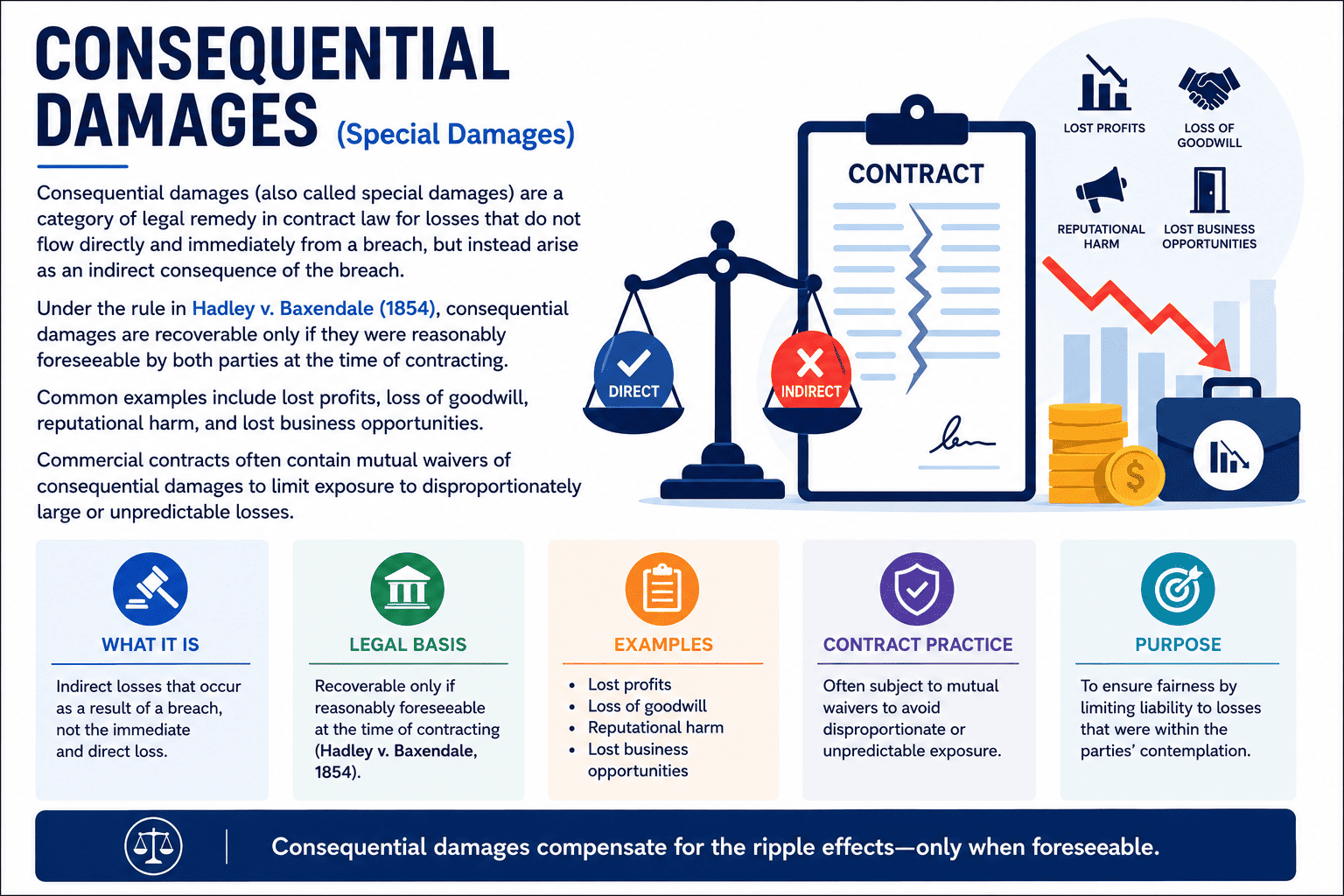
Consequential damages are one of the most heavily negotiated issues in commercial contracts, particularly in construction, technology, manufacturing, and supply agreements. The reason is simple: consequential damages can vastly exceed the value of the underlying contract. For example, a one‑week delay in delivering a critical machine part could shut down an entire factory, causing millions in lost profits far beyond the part’s purchase price. Without a waiver or cap, the breaching party could be held liable for those indirect losses. Conversely, the non‑breaching party may need to recover such losses to be made whole. Understanding the distinction between direct and consequential damages, and the foreseeability test, is essential for drafting enforceable limitation‑of‑liability clauses and for assessing risk in any transaction.
⚡ Key Principle: Hadley v. Baxendale (1854)
The English case of Hadley v. Baxendale established the modern rule: damages for breach of contract are recoverable only if they (1) arise naturally from the breach in the ordinary course of things, or (2) were within the reasonable contemplation of both parties at the time of contracting as a probable result of the breach. This two‑part test remains the foundation of consequential damages analysis in common law jurisdictions worldwide.
Direct vs. Consequential Damages
Direct Damages vs. Consequential Damages: Key Distinctions
📌
Direct Damages
Losses that flow naturally and immediately from a breach, the inherent, ordinary consequence of non‑performance. Direct damages are generally easier to prove and do not require special foreseeability analysis beyond the natural course of business.
✔️ Examples: cost to repair defective goods, additional expense to complete unfinished work, difference in market value
✔️ Typically recoverable without special proof of foreseeability
🔄
Consequential (Special) Damages
Indirect losses that result from the breach but are not an automatic or necessary outcome. Recovery requires proof that the damages were reasonably foreseeable to both parties at contract formation.
✔️ Examples: lost profits from production shutdown, loss of business goodwill, reputational harm, lost opportunities, lost rent or revenue
✔️ Often waived or capped in commercial contracts
| Aspect | Direct Damages | Consequential Damages |
|---|
| Nature of loss | Immediate, natural, ordinary | Indirect, special, collateral |
| Cause‑and‑effect | Directly caused by breach | Remote or secondary consequence |
| Foreseeability requirement几乎是Presumed (natural course) | Must be proved (reasonable contemplation) |
| Typical examples | Repair costs, completion costs, price differential | Lost profits, lost goodwill, reputational harm |
| Proof required | Basic factual showing | Detailed evidence, expert analysis, notice of special circumstances |
📄 Sample Mutual Waiver of Consequential Damages (Construction Contract)
“Notwithstanding anything to the contrary in this Agreement, neither party shall be liable to the other for any indirect, incidental, special, punitive, or consequential damages, including but not limited to loss of profits, loss of revenue, loss of use, loss of goodwill, or business interruption, arising out of or relating to this Agreement, regardless of the form of action (whether in contract, tort, negligence, strict liability, or otherwise). This waiver shall not apply to (a) either party’s indemnification obligations under Section X, (b) breach of confidentiality, (c) infringement of intellectual property rights, or (d) intentional misconduct or fraud.”
Foreseeability Test: Hadley v. Baxendale
The Foreseeability Test: When Are Consequential Damages Recoverable?
Under the rule from Hadley v. Baxendale, consequential damages are recoverable only if they satisfy one of two alternative tests. The first test is objective (damages arising naturally from the breach in the ordinary course of things). The second test is subjective (damages that were specifically within the contemplation of both parties as a probable result of the breach, requiring special knowledge communicated before contracting). In practice, the second test is more relevant to consequential damages, if the breaching party knew, or had reason to know, of special circumstances that would expose the non‑breaching party to extraordinary losses, those losses may be recoverable as consequential damages.
🌿
First Limb (Natural Course)
Damages that flow naturally from the breach in the ordinary course of events, what any reasonable person would expect. These are typically direct damages, not consequential damages.
✔️ Example: If a supplier fails to deliver raw materials, the buyer’s cost to purchase substitute materials from another supplier is a natural consequence.
💡
Second Limb (Special Circumstances)
Damages that do not flow naturally but were within the reasonable contemplation of both parties at the time of contracting, based on special knowledge communicated by the non‑breaching party.
✔️ Example: Buyer informs seller that the goods are needed for a specific profitable resale contract. If seller fails to deliver, the lost profit from that specific resale may be recoverable as consequential damages.
✨ Drafting Tip: Defining Consequential Damages in Contracts
To avoid uncertainty, sophisticated commercial contracts often define which specific categories of damages are treated as “consequential” and therefore waived or capped. Common defined categories include: lost profits, loss of revenue, loss of use, business interruption, loss of goodwill, and reputational harm. However, courts may interpret differently, some treat lost profits as direct damages when they are the primary purpose of the contract (e.g., a revenue‑sharing agreement). Clear, explicit language is essential.
Examples of Consequential Damages
Common Examples of Consequential Damages in Practice
📉
Lost Profits
The most frequently claimed consequential damages. When a breach prevents the non‑breaching party from using goods, services, or facilities to generate revenue, the foregone profits may be recoverable, if foreseeable.
✔️ Example: Delayed delivery of seasonal goods results in lost sales during peak season.
🏭
Business Interruption & Downtime
Costs incurred when a breach shuts down operations, including idle labor, overhead, and lost production capacity.
✔️ Example: Defective machine part causes assembly line shutdown for three days.
💔
Loss of Goodwill & Reputation
Damage to business relationships or brand value caused by the breach. Particularly relevant in consumer‑facing industries or long‑term supply relationships.
✔️ Example: Supplier’s failure to deliver on time causes buyer to miss delivery to its own customers, harming buyer’s reputation.
📄
Loss of Other Contracts
When a breach prevents the non‑breaching party from pursuing or performing other business opportunities.
✔️ Example: Contractor’s delay on one project prevents it from bidding on a subsequent project.
Waivers, Carve‑Outs & Limitations
Consequential Damages Waivers: Standard Language and Carve‑Outs
Most commercial contracts include a provision waiving or limiting consequential damages to provide cost certainty and avoid catastrophic liability. However, these waivers almost always contain exceptions (carve‑outs) for certain types of claims where consequential damages are considered essential to the bargain. The most common carve‑outs are for indemnification claims, breach of confidentiality, intellectual property infringement, and willful misconduct or fraud. The enforceability of a consequential damages waiver depends on whether the clause is clear, conspicuous, and not unconscionable; many states enforce such waivers freely between sophisticated commercial parties.
“The waiver of consequential damages shall not apply to claims arising from a party’s gross negligence, fraud, or willful misconduct.”
| Carve‑Out Category | Rationale | Typical Language Example |
|---|
| Indemnification Obligations | Indemnity already shifts third‑party claims; excluding from waiver ensures full protection | “This waiver shall not apply to either party’s indemnification obligations under Section X.” |
| Breach of Confidentiality | Confidentiality breach often causes irreparable harm; damages may include lost trade secrets | “The parties agree that a breach of confidentiality may cause irreparable harm for which monetary damages are inadequate, and this waiver shall not limit either party’s right to seek equitable relief.” |
| Intellectual Property Infringement | IP claims often involve lost market share and reputational harm that are inherently consequential | “Nothing in this Agreement shall limit a party’s liability for infringement of the other party’s intellectual property rights.” |
| Gross Negligence / Willful Misconduct一方面是Public policy disfavors waivers for intentional or reckless conduct |
Risks & Common Misunderstandings
Common Pitfalls in Consequential Damages Clauses
📝
Ambiguous Definition of “Consequential Damages”
Courts disagree on whether “consequential damages” includes lost profits. Some jurisdictions (including many U.S. federal courts) treat lost profits as direct damages when profit is the primary purpose of the contract. To avoid uncertainty, drafters should explicitly list excluded categories (e.g., “lost profits, loss of goodwill, business interruption”).
⚖️
One‑Sided Waiver May Be Unenforceable
A waiver that protects only one party (e.g., buyer waives consequential damages but seller does not) may be challenged as unconscionable in some jurisdictions, especially in consumer or adhesion contracts. Mutual waivers are more likely to be enforced.
🛡️
Failure to Carve Out Indemnity & IP Claims
Without explicit carve‑outs, a broad waiver could inadvertently bar recovery for indemnification claims or intellectual property infringement, results that are almost never intended. Always list specific exceptions.
📋
Conflicting Provisions (Liquidated Damages)
If the contract includes liquidated damages for delay, a consequential damages waiver may be interpreted to preclude recovery of those liquidated damages if they are classified as consequential. Drafters should coordinate the two provisions.
🌍
International Contracts: Civil Law Jurisdictions
The common law distinction between direct and consequential damages is not recognised in many civil law systems (e.g., France, Germany). Under the CISG (United Nations Convention on Contracts for the International Sale of Goods), Article 74 imposes foreseeability limit but does not use the “consequential” label. International contracts should be drafted with applicable law in mind.
FAQ
Frequently Asked Questions
QWhat is the difference between direct and consequential damages?
Direct damages (also called general damages) flow naturally and immediately from a breach of contract, such as the cost to repair defective goods or the additional expense to complete unfinished work. Consequential damages (special damages) are indirect losses that result from the breach but are not an automatic or necessary outcome, for example, lost profits when a delayed machine shutdowns a production line, or lost business opportunities. Direct damages are generally easier to prove and do not require special foreseeability analysis beyond the natural course of events. Consequential damages require proof that the loss was reasonably foreseeable by both parties at the time of contracting.
QWhen are consequential damages recoverable?
Under the rule from Hadley v. Baxendale (1854), consequential damages are recoverable only if they were reasonably foreseeable by both parties at the time the contract was formed. Two tests apply: (1) damages arising naturally from the breach in the ordinary course of things (objective standard, typically direct damages), or (2) damages that were specifically within the contemplation of both parties as a probable result of the breach (subjective standard, requiring special knowledge communicated before contracting). Even if foreseeable, recovery may be barred by a mutual waiver of consequential damages in the contract.
QWhy do commercial contracts often include mutual waivers of consequential damages?
Mutual waivers of consequential damages are common in commercial contracts (especially in construction, technology, and supply agreements) because consequential damages can be disproportionately large compared to the contract value and may be difficult to insure against or predict. A single delay could cause millions in lost profits far exceeding the contract price. Both parties waive their right to recover indirect, special, or consequential damages, typically excluding certain carve‑outs such as indemnification claims, breach of confidentiality, or intellectual property infringement. This waiver provides cost certainty and limits exposure to remote or catastrophic losses, allowing parties to price risk more accurately.
QCan lost profits be direct damages rather than consequential?
Yes, in certain contexts. When the very purpose of the contract is to generate profit (e.g., a revenue‑sharing agreement, a distribution agreement where the distributor’s profit is the primary measure of value), lost profits may be treated as direct damages. The distinction depends on whether the profit was the promised performance itself or merely a collateral consequence. Courts analyze the nature of the contract, the parties’ expectations, and whether the profit was within the reasonable contemplation of both parties. Drafters can clarify by explicitly stating which categories of damages are waived.
QHow do limitation of liability clauses interact with consequential damages waivers?
A limitation of liability clause caps the total aggregate liability of a party (e.g., “total liability shall not exceed the amount paid under this contract”). A consequential damages waiver is different, it removes entire categories of damages from recovery, regardless of whether they would fall under the cap. The two provisions can overlap. If a contract includes both, the waiver may bar consequential damages entirely, and the cap may limit any remaining direct damages. However, some jurisdictions have interpreted liability caps as not applying to claims that are specifically carved out of the consequential damages waiver (e.g., indemnification, IP infringement). Drafters should state clearly whether the cap applies to indemnity and other carved‑out claims.