Why Liquidated Damages Matter in Commercial Contracts
In any commercial transaction, the possibility of breach, delayed delivery, defective goods, or non-performance, carries financial risk. Proving actual loss in court can be expensive, time‑consuming, and uncertain, especially where loss is indirect or difficult to quantify. Liquidated damages clauses solve this by fixing an agreed amount or calculation method at the time of contracting. They provide both parties with predictability, reduce evidentiary burdens, and act as a deterrent against casual breach. For these reasons, they are standard in construction contracts, IT service agreements, supply arrangements, and infrastructure projects across India and internationally.
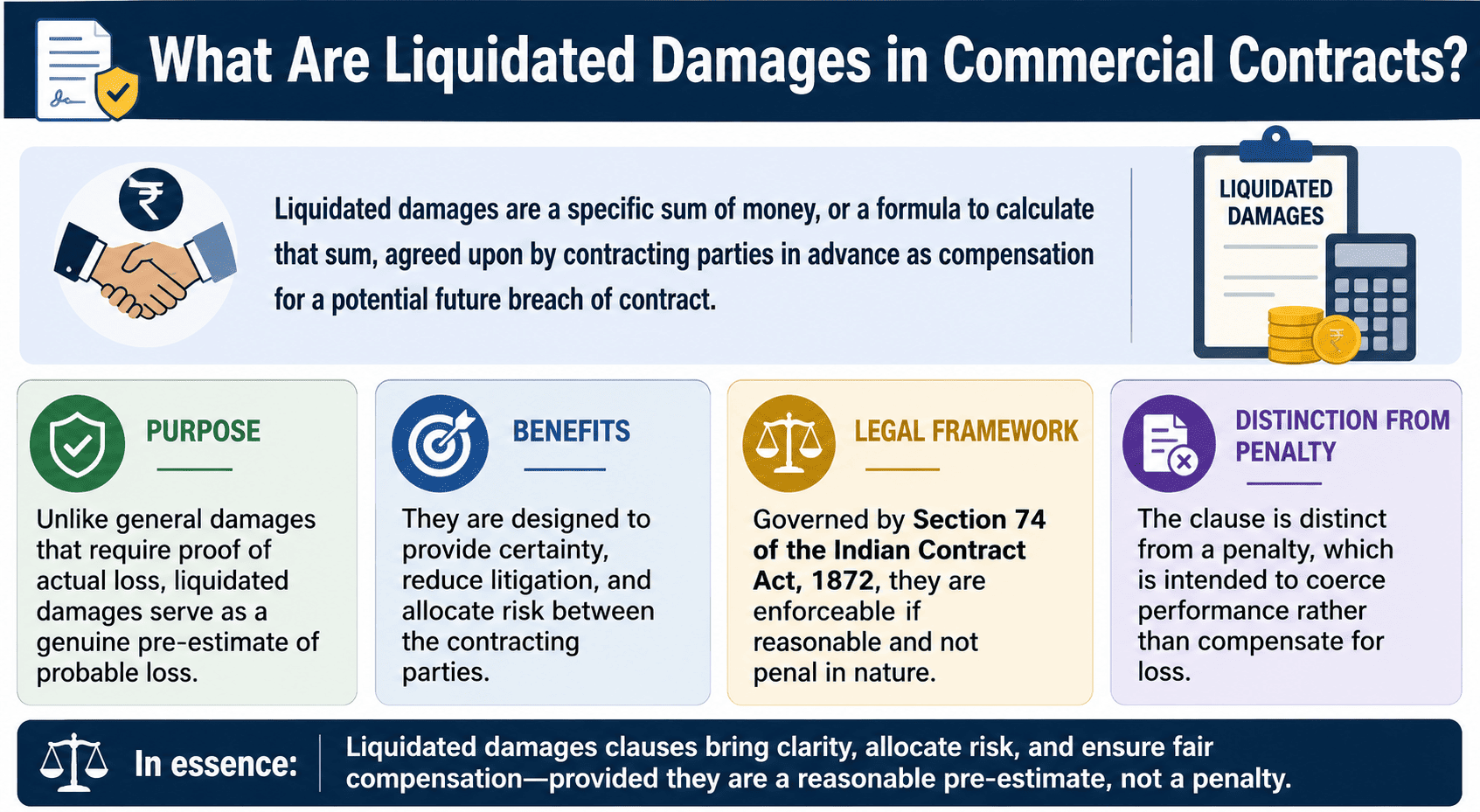
Under Indian law, the enforceability of such clauses is governed by Section 74 of the Contract Act, which empowers courts to award “reasonable compensation” not exceeding the stipulated amount, regardless of whether actual loss is proved. However, the clause must represent a genuine pre‑estimate of loss, not a penalty.
Typical Commercial Contexts
🏗️Construction & Infrastructure
Daily or weekly rates for delay in project completion, often expressed as a percentage of contract value.
📦Supply & Procurement Contracts
Fixed sum for late delivery of goods, ranging from 0.5% to 1% of order value per week of delay.
💻IT & Software Development
Damages for missed milestones or go‑live dates, often capped at a percentage of the total contract price.
🔐Confidentiality & Non‑Compete
Fixed amount for unauthorised disclosure or breach of restrictive covenants.
⚡ Key principle
A liquidated damages clause is not a free pass to claim any amount. The sum must be a reasonable pre‑estimate of loss at the time of contracting. If it is extravagant or unconscionable, courts will treat it as a penalty and may refuse to enforce it entirely or reduce the amount to reasonable compensation.
Liquidated Damages vs. Penalty
Liquidated Damages vs. Penalty: The Critical Distinction
✅ Liquidated Damages
- Genuine pre‑estimate of probable loss
- Proportionate to the legitimate interest protected
- Enforceable under Section 74, subject to reasonableness
- Provides certainty and avoids litigation over quantum
- Example: 0.5% per week delay damages on a commercial project
⚠️ Penalty
- Extravagant, unconscionable, or in terrorem (intended to intimidate)
- No reasonable relationship to potential loss
- Unenforceable; court may award lesser reasonable compensation or ignore clause
- Example: ₹1 crore flat sum for a one‑day delay on a ₹10 lakh contract
Under English common law, the distinction was rigid: a penalty was irrecoverable in full, whereas liquidated damages were fully recoverable. India, through Section 74, has taken a more flexible approach: even if a clause is called a penalty, the court will award only “reasonable compensation” not exceeding the stipulated amount. The label used by parties is not conclusive; the court will examine the substance of the clause and the surrounding circumstances at the time of contract formation.
| Feature | Liquidated Damages | Penalty |
|---|
| Purpose | Compensate for genuine loss | Coerce performance / punish |
| Basis of amount | Reasonable pre‑estimate at time of contract | Arbitrary, extravagant, or disproportionate |
| Enforceability in India | Enforceable to the extent reasonable | May be reduced or ignored; no automatic invalidity |
| Burden of proof | Non‑breaching party need not prove actual loss if clause is genuine | Breaching party can argue unreasonableness |
Legal Framework in India
Section 74 of the Indian Contract Act, 1872
Section 74 provides: “When a contract has been broken, if a sum is named in the contract as the amount to be paid in case of such breach, or if the contract contains any other stipulation by way of penalty, the party complaining of the breach is entitled, whether or not actual damage or loss is proved to have been caused thereby, to receive from the party who has broken the contract reasonable compensation not exceeding the amount so named or, as the case may be, the penalty stipulated for.”
Key takeaways from judicial interpretation:
- No strict proof of loss required, especially where loss is difficult to quantify (e.g., delay in infrastructure projects).
- Court has discretion to award less than the named sum if it finds the sum unreasonable.
- Burden of proof shifts to the breaching party to show that the amount is a penalty or unreasonable (ONGC v. Saw Pipes).
- Breach is a prerequisite, no breach, no claim for liquidated damages (Kailash Nath Associates v. DDA).
- Prevention principle, a party cannot claim liquidated damages if it caused or contributed to the breach.
📘 Landmark judgments
Fateh Chand v. Balkishan Das (1964): The Supreme Court held that Section 74 applies to all stipulations naming a sum for breach, whether by way of penalty or liquidated damages. The court will award only reasonable compensation.
ONGC v. Saw Pipes (2003): Expanded enforceability, where loss is difficult to quantify, the named sum can be awarded without proof of actual loss, provided it is a genuine pre‑estimate.
Kailash Nath Associates v. DDA (2015): Reiterated that proof of actual loss is not mandatory, but breach must be established. The party claiming damages must also not be in default.
Risks & Drafting Pitfalls
Common Risks and Drafting Mistakes
🚩
Arbitrary or round figures
Using a flat sum like ₹1 crore with no correlation to contract value or potential loss. Courts view such amounts with suspicion as potential penalties.
🚩
Boilerplate without context
Copying a clause from another agreement without adjusting for the specific transaction’s risk profile and commercial reality.
🚩
Failure to specify a cap or exclusions
Uncapped liquidated damages may be viewed as unreasonable. Also, lack of clear exclusions (force majeure, mutual delays) can lead to disputes.
🚩
No recording of pre‑estimate rationale
Courts look for evidence that parties applied their minds. Internal notes or recitals explaining the basis of the sum strengthen enforceability.
🚩
Applying liquidated damages where actual loss is easily provable and small
If the actual loss is, say, ₹10,000 but the clause stipulates ₹1 lakh, a court may reduce the amount. Use the clause where loss is genuinely hard to quantify.
Enforceability & Evidentiary Issues
Enforcement: Proof of Loss and Burden of Proof
One of the most misunderstood aspects of Section 74 is the requirement of proving actual loss. The Supreme Court in ONGC v. Saw Pipes clarified that the phrase “whether or not actual damage or loss is proved” means that a plaintiff is not always required to prove actual loss to claim reasonable compensation. However, the court also held that where loss is capable of proof (e.g., a simple sale of goods where market rates are available), a party may be expected to adduce some evidence. In cases of delay in construction, supply of specialised goods, or IP infringement, courts are more willing to enforce the pre‑agreed sum without detailed evidence.
The burden of proving that the clause is a penalty or that the stipulated sum is unreasonable lies on the party who committed the breach. This shift in onus is a significant advantage for the non‑breaching party and encourages parties to include well‑drafted liquidated damages clauses.
⚡ Practical tip
If you are the party drafting the contract, include a recital or background note stating: “The parties acknowledge that the loss arising from delay in completion is difficult to quantify accurately and that the liquidated damages set out herein represent a genuine pre‑estimate of probable loss.” This strengthens the clause against a penalty challenge.
Drafting Checklist
How to Draft an Enforceable Liquidated Damages Clause
01
Identify the specific breach
Do not use a blanket clause covering “any breach”. Specify which obligations (e.g., timely delivery, confidentiality, performance milestones) trigger liquidated damages.
02
Choose a reasonable calculation method
Use a percentage of contract value per week/month (e.g., 0.5% per week, up to a maximum of 10% of the contract price). Avoid flat sums unless justified by a clear rationale.
03
Include a cap
Set a maximum liability for liquidated damages (e.g., 10% or 20% of the total contract value). This demonstrates reasonableness and is standard in commercial contracts.
04
Add exclusions and exceptions
Exempt cases of force majeure, acts of the other party, or events beyond the breaching party’s control. This protects against claims when the delay is not the breaching party’s fault.
05
Combine with a limitation of liability clause
Ensure consistency between the liquidated damages clause and the general limitation of liability clause, so that one does not contradict the other.
FAQ
Frequently Asked Questions
QCan I claim liquidated damages if I suffered no actual loss?
Under Section 74, you may still be entitled to reasonable compensation even if no actual loss is proved, provided the clause represents a genuine pre‑estimate of probable loss. However, where loss is easily quantifiable and you have suffered none, a court may award only nominal damages or reject the claim. The key is whether the clause is reasonable and whether loss was difficult to pre‑estimate.
QWhat happens if the liquidated damages clause is held to be a penalty?
Unlike English law, under Section 74, a penalty clause is not automatically void. The court will still award “reasonable compensation” not exceeding the stipulated amount. However, if the amount is manifestly unreasonable, the court may reduce it drastically or even award nothing if no loss is proven. Thus, a penalty label is not fatal, but an unreasonable amount is.
QIs it necessary to have a separate clause for liquidated damages in every contract?
No, it is not mandatory. Section 73 provides for unliquidated damages (actual loss) without any pre‑agreed sum. However, including a liquidated damages clause is advisable where loss is uncertain, litigation cost is a concern, or you want to impose a clear deterrent against delay or non‑performance.