Why Is an Assignment Clause Essential in Commercial Contracts?
Contracts are built on trust, performance capability, and the specific identity of the parties. A company enters into an agreement with a particular counterparty because of that counterparty’s reputation, financial stability, technical expertise, or creditworthiness. If that counterparty could freely transfer the contract to an unknown third party without consent, the original party would lose all control over who it is dealing with, potentially facing an assignee with poor performance records, inadequate resources, or conflicting interests.
The assignment clause solves this problem by establishing clear rules for transfer. It answers a fundamental question: can the contract move from one party to another? This matters enormously when a business is acquired, a vendor is replaced, an affiliate takes over operations, or a company restructures. Without an assignment clause, rights are generally assignable under common law, meaning your counterparty could transfer its right to receive payment to a third party without telling you. With an assignment clause, you can require consent, block transfers entirely, or carve out exceptions for specific situations like mergers.
Assignment clauses are particularly critical in M&A transactions, where the buyer needs to know which contracts the target company can transfer to the acquiring entity. A contract that prohibits assignment without consent and does not except “change of control” could be unassignable, requiring costly third‑party consents for each agreement.
Common Contract Types Where Assignment Clauses Appear
🏢
Commercial Leases
Tenants may assign lease to a subtenant or buyer of a business; landlords typically require consent and often include recapture rights or conditions.
🤝
M&A & Stock Purchase Agreements
Assignment clauses determine whether contracts transfer automatically to the buyer or require separate consents; change‑of‑control provisions are critical.
☁️
SaaS & Software Licenses
Vendors strictly control assignment to prevent customers from transferring licences to competitors or unaffiliated entities without payment.
💰
Loan & Credit Agreements
Lenders frequently assign loan participations or the entire loan; borrowers typically cannot assign without lender consent.
📦
Supply & Distribution Agreements
Manufacturers restrict distributors from assigning the agreement to ensure quality control and territorial integrity.
🎨
IP & Licensing Agreements
Licensors prohibit assignment of patent, trademark, or copyright licences without consent to maintain control over who exploits the IP.
⚡ Key Principle, Assignment vs. Delegation
Assignment refers to the transfer of rights or benefits (e.g., the right to receive payment). Delegation refers to the transfer of duties or performance obligations (e.g., the obligation to provide services). Rights are generally assignable unless the contract prohibits assignment. Duties are not delegable if the contract depends on the personal skill, expertise, or trust of the original party. Many contracts address both concepts together, using language like “assign or delegate.”
Assignment vs. Delegation
Assignment vs. Delegation: Two Different Concepts
These terms are often used interchangeably, but they have distinct legal meanings and consequences. Understanding the difference is critical when drafting or reviewing an assignment clause, especially because some clauses inadvertently prohibit assignment but say nothing about delegation, creating a loophole.
📤 Assignment (Rights)
- What is transferred: Contractual rights, benefits, or choses in action (e.g., right to receive payment, right to enforce the contract)
- Effect on assignor: Assignor transfers its right to receive performance or payment; assignor typically remains liable for its own duties unless novation occurs
- Effect on assignee: Assignee steps into the assignor’s shoes to receive the benefit; assignee does not perform the assignor’s duties
- Consent required: Under common law, rights are generally assignable unless the contract prohibits assignment or the right is personal in nature
- Typical clause language: “Neither party may assign this Agreement or any rights hereunder without the other’s prior written consent.”
🔧 Delegation (Duties)
- What is delegated: Contractual duties, obligations, or performance responsibilities (e.g., obligation to deliver goods, provide services)
- Effect on delegator: Delegator remains primarily liable for performance unless the other party agrees to a novation releasing the delegator
- Effect on delegatee: Delegatee performs the duties on behalf of the delegator, but the delegator guarantees performance
- Consent required: Duties are not delegable if the contract involves personal skill, trust, or unique expertise. Otherwise, delegation may be permitted
- Typical clause language: “Neither party may delegate its obligations under this Agreement without the other’s prior written consent.”
✨ Drafting Tip, Cover Both Assignment and Delegation
Many disputes arise because a clause prohibits “assignment” but does not mention “delegation.” A party could argue that it is delegating its duties (not assigning rights) and therefore the restriction does not apply. To close this loophole, use comprehensive language: “Neither party may assign this Agreement or any rights hereunder, nor delegate any duties or obligations hereunder, without the prior written consent of the other party.”
Types of Assignment Clauses
Types of Assignment Clauses: Prohibited, Conditional, and Permitted
Assignment clauses fall into several common categories, ranging from blanket prohibitions to free assignment. The choice depends on the nature of the contract and the parties’ need to control counterparty transfers.
| Type | Description | Typical Language | Common In |
|---|
| Prohibited (Anti‑Assignment) | No assignment permitted without prior written consent; consent may be given or withheld in sole discretion | “Neither party may assign this Agreement without the prior written consent of the other party.” | SaaS, service contracts, IP licences, personal service agreements |
| Conditional (Consent Required) | Assignment permitted only with consent; often adds that consent “shall not be unreasonably withheld, conditioned, or delayed” | “Neither party may assign this Agreement without the other’s prior written consent, which consent shall not be unreasonably withheld.” | Commercial leases, supply agreements, distribution contracts |
| Permitted with Exceptions | General prohibition but carves out specific permitted transfers (affiliates, M&A, corporate reorganization) | “No assignment without consent, except that either party may assign to an affiliate or in connection with a merger or sale of substantially all assets.” | Commercial contracts, M&A‑sensitive agreements, SaaS (customer‑friendly) |
| Free Assignment | No restriction; party may assign at any time without consent or notice | “Either party may assign this Agreement in whole or in part without the other’s consent.” | Financial instruments, some loan participations, certain commodity contracts |
| Novation Only | Assignment does not release assignor; only novation (new agreement) releases the original party | “No assignment shall release the assigning party from any obligation hereunder unless the other party agrees in writing to a novation.” | High‑risk contracts, government contracts, construction |
✨ Negotiation Tip, “Reasonable Consent” Standard
If you are the party potentially needing consent to assign (e.g., a tenant or a business that may be acquired), negotiate for the clause to state that consent “shall not be unreasonably withheld, conditioned, or delayed.” This prevents the other party from arbitrarily blocking a commercially reasonable assignment. However, note that some contracts (e.g., personal services) legitimately allow absolute discretion because the identity of the performing party is fundamental.
How Assignment Works
How Assignment Works, The Transfer Process
The mechanics of assignment involve several steps, from reviewing the contract to documenting the transfer and notifying the counterparty. The following steps illustrate the standard workflow.
01
Review the Contract for Assignment Restrictions
Check whether the contract has an assignment clause. If it prohibits assignment without consent, you must obtain consent. If it is silent, rights are generally assignable under common law, but duties may not be delegable if they involve personal skill or trust.
02
Request Consent (If Required)
If the clause requires consent, send a written request to the non‑assigning party. Provide sufficient information about the proposed assignee (financial standing, qualifications, relevant experience) to demonstrate that the assignee can perform the obligations.
03
Draft an Assignment and Assumption Agreement
The assignor and assignee execute an assignment and assumption agreement, which formally transfers the assignor’s rights and (if applicable) delegates the assignor’s duties. The assignee agrees to assume the obligations and be bound by the contract terms.
04
Provide Notice to the Non‑Assigning Party
Even if consent is not required, provide written notice of the assignment to the non‑assigning party. This ensures that the non‑assigning party knows who to pay and who to hold responsible for performance. Failure to give notice may allow the non‑assigning party to continue performing for the assignor (e.g., paying the assignor).
05
Consider Novation If Release Is Desired
If the assignor wants to be completely released from liability, the parties must execute a novation agreement, a new contract that substitutes the assignee for the assignor and releases the assignor from all future obligations. Without novation, the assignor typically remains secondarily liable.
📋 Sample Assignment and Assumption Language
ASSIGNMENT AND ASSUMPTION AGREEMENT

For good and valuable consideration, Assignor hereby assigns to Assignee all of Assignor's right, title, and interest in and to the Agreement dated [Date] between Assignor and Counterparty. Assignee hereby assumes all of Assignor's duties and obligations under the Agreement arising from and after the effective date of this Assignment. Assignor remains liable for any obligations arising prior to the effective date. This Assignment is subject to the consent of Counterparty attached hereto as Exhibit A.
Anti-Assignment Clauses & Change of Control
Anti‑Assignment Clauses and Change of Control: Critical M&A Implications
One of the most overlooked risks in mergers and acquisitions is how anti‑assignment clauses interact with change‑of‑control transactions. A typical clause stating “neither party may assign this Agreement without the other’s consent” may be interpreted by courts to include a change of control, meaning that if the counterparty undergoes a merger or is acquired, the contract may be deemed assigned by operation of law, triggering a breach and potential termination.
To avoid this risk, sophisticated contracts include a specific carve‑out: “Notwithstanding the foregoing, either party may assign this Agreement without consent to an affiliate or in connection with a merger, acquisition, corporate reorganization, or sale of substantially all of its assets.” This is often called a “change‑of‑control exception” or “M&A carve‑out.” Without it, a friendly acquisition could become a contractual breach.
✨ M&A Due Diligence Checklist
In any transaction where a company is being acquired, review all material contracts for assignment clauses. Flag any contract that:
- Prohibits assignment without consent and does not except change of control
- Defines assignment to include “assignment by operation of law” or “any change in control”
- States that any attempted assignment in violation of the clause is “void” or “a material breach”
- Requires consent that is “non‑assignable” or cannot be “unreasonably withheld”, but the counterparty may still block a change of control
These contracts will require third‑party consents before closing, which can delay or derail the transaction.
Sample Assignment Clauses
Sample Assignment Clauses from Commercial Contracts
The following sample clauses illustrate common assignment provisions, ranging from simple prohibitions to complex provisions with exceptions and consent standards.
Simple Prohibition (Consent Required)
Neither party may assign this Agreement or any rights or obligations hereunder without the prior written consent of the other party. Any attempted assignment in violation of this Section shall be null and void.
Consent Not Unreasonably Withheld
Neither party may assign this Agreement without the other party's prior written consent, which consent shall not be unreasonably withheld, conditioned, or delayed. The assigning party shall provide the non‑assigning party with information about the proposed assignee sufficient to demonstrate its ability to perform.
M&A and Affiliate Exception
No assignment without consent, except that either party may assign this Agreement (a) to an affiliate or (b) in connection with a merger, acquisition, corporate reorganization, or sale of all or substantially all of its assets, provided that the assignee agrees in writing to be bound by this Agreement. The assigning party shall provide written notice of any such assignment.
Full Prohibition (No Exceptions)
This Agreement is personal to the parties. Neither party may assign, delegate, or otherwise transfer this Agreement or any right, duty, or obligation hereunder, whether voluntarily, by operation of law, or otherwise, without the other party's prior written consent, which may be withheld in its sole and absolute discretion.
Alternatives to Assignment
Alternatives to Assignment: Novation, Subcontracting, and Licensing
If a contract prohibits assignment or consent cannot be obtained, other legal mechanisms may achieve a similar commercial result. Understanding these alternatives is critical for M&A, restructuring, and operational flexibility.
| Mechanism | Description | Effect on Original Party | Consent Required? |
|---|
| Novation | A new contract that substitutes one party for another, with the original party fully released | Original party is completely released from all future obligations | Yes, requires consent of all parties (including counterparty) |
| Subcontracting | The original party hires a third party to perform some or all of its duties, but remains primarily liable | Original party remains fully liable for performance; delegatee performs but is not a party to the main contract | Check contract, many prohibit or restrict subcontracting without consent |
| Licensing (IP) | IP owner grants a licence to use the IP without transferring ownership | Owner retains title and can terminate the licence for breach | Typically no consent from prior licensees, but contract may restrict sublicensing |
| Secondment | An employee is assigned to work for another company, but remains employed by the original entity | Original employer remains the legal employer; secondment agreement governs the arrangement | Usually by agreement between the companies, not typically restricted by assignment clauses |
| Equitable Assignment | Transfer of beneficial interest in a contract without a formal legal assignment (e.g., a declaration of trust) | Assignor retains legal title but holds it for the benefit of the assignee | May not require consent, but courts scrutinise equitable assignments to avoid circumventing anti‑assignment clauses |
⚖️ Novation vs. Assignment, Key Distinction
In an assignment, the assignor remains liable unless the counterparty agrees to a release (which is rare without a novation). In a novation, the original party is fully released and a new contract is formed with the substitute party. Novation requires the express agreement of all three parties (assignor, assignee, counterparty). Most commercial parties prefer assignment because it preserves their ability to look to the original party for recourse if the assignee fails to perform.
Common Pitfalls
Common Drafting Pitfalls and How to Avoid Them
Poorly drafted assignment clauses lead to disputes, blocked transactions, and unintended consequences. The following pitfalls are consistently identified by contract lawyers and courts.
🚩
Failing to Address “Assignment by Operation of Law”
A merger, acquisition, or bankruptcy can transfer a contract without the parties actively “assigning” it, this is assignment by operation of law. If your clause only prohibits “voluntary assignment,” it may not cover an acquisition. Add: “whether voluntarily, by operation of law, or otherwise.”
🚩
Prohibiting Assignment but Saying Nothing About Delegation
As noted earlier, a party may argue that it is delegating its duties (not assigning rights) and therefore the restriction does not apply. Cover both: “Neither party may assign any right or delegate any duty under this Agreement without consent.”
🚩
No Exception for Change of Control in Commercial Contracts
Many commercial contracts fail to include an M&A carve‑out. When the counterparty is acquired, the acquirer discovers that the contract is unassignable and must seek consent, which may be withheld or granted only for a fee. Always negotiate a change‑of‑control exception if your business may be sold or merged.
🚩
Unclear Whether Consent Can Be Withheld Arbitrarily
A clause requiring “consent” without qualification gives the non‑assigning party absolute discretion to block any assignment. This can be exploited. Negotiate “consent shall not be unreasonably withheld, conditioned, or delayed” unless there is a legitimate reason to retain sole discretion (e.g., personal services).
🚩
Failing to Specify Effect of Unauthorised Assignment
Is an unauthorised assignment void? Voidable? Does it give the non‑assigning party a right to terminate? Specify: “Any purported assignment in violation of this Section shall be null and void and shall constitute a material breach of this Agreement, entitling the non‑breaching party to terminate this Agreement.”
🚩
No Notice Requirement for Permitted Assignments
Even if a contract permits assignment to affiliates without consent, it should require notice. Without notice, the counterparty may continue paying the original party, creating confusion. Add: “The assigning party shall provide written notice of any permitted assignment within ten (10) days.”
Governing Law & Enforceability
Enforceability of Assignment Clauses Under Governing Law
Assignment clauses are generally enforceable, but courts impose limits. Under common law (and the Uniform Commercial Code in the US), parties may freely restrict assignment of rights, but there are exceptions:
- Fully prohibitive clauses are generally upheld in commercial contracts between sophisticated parties.
- Clauses that attempt to prohibit assignment of the right to receive money are often void under UCC § 9‑406 and similar laws, a debtor cannot restrict assignment of the right to payment (to protect the free flow of credit).
- Restrictions on delegation of duties are enforceable, especially where performance involves personal skill, trust, or expertise.
- “Consent not to be unreasonably withheld” clauses create a duty of good faith; courts may find a breach if consent is denied without a legitimate reason (e.g., assignee’s financial instability or inability to perform).
- Indian law under the Contract Act 1872 and Transfer of Property Act 1882 recognises assignments but also respects anti‑assignment clauses. The Supreme Court in Kapilaben v. Ashok Kumar (2019) held that assignment of obligations without consent is not valid, and assignability depends on the terms of the contract and the parties’ intention.
✨ Jurisdictional Note, Receivables Assignment
Under the UCC (US) and similar laws in other common law jurisdictions, a contractual term that prohibits assignment of the right to receive payment (a “receivable”) is generally ineffective. The assignee takes free of the restriction. However, the assignor may still be in breach of contract for violating the prohibition, but the assignment itself is valid. This does not apply to delegation of duties or assignment of non‑payment rights.
FAQ
Frequently Asked Questions
QWhat is an assignment clause in a contract?
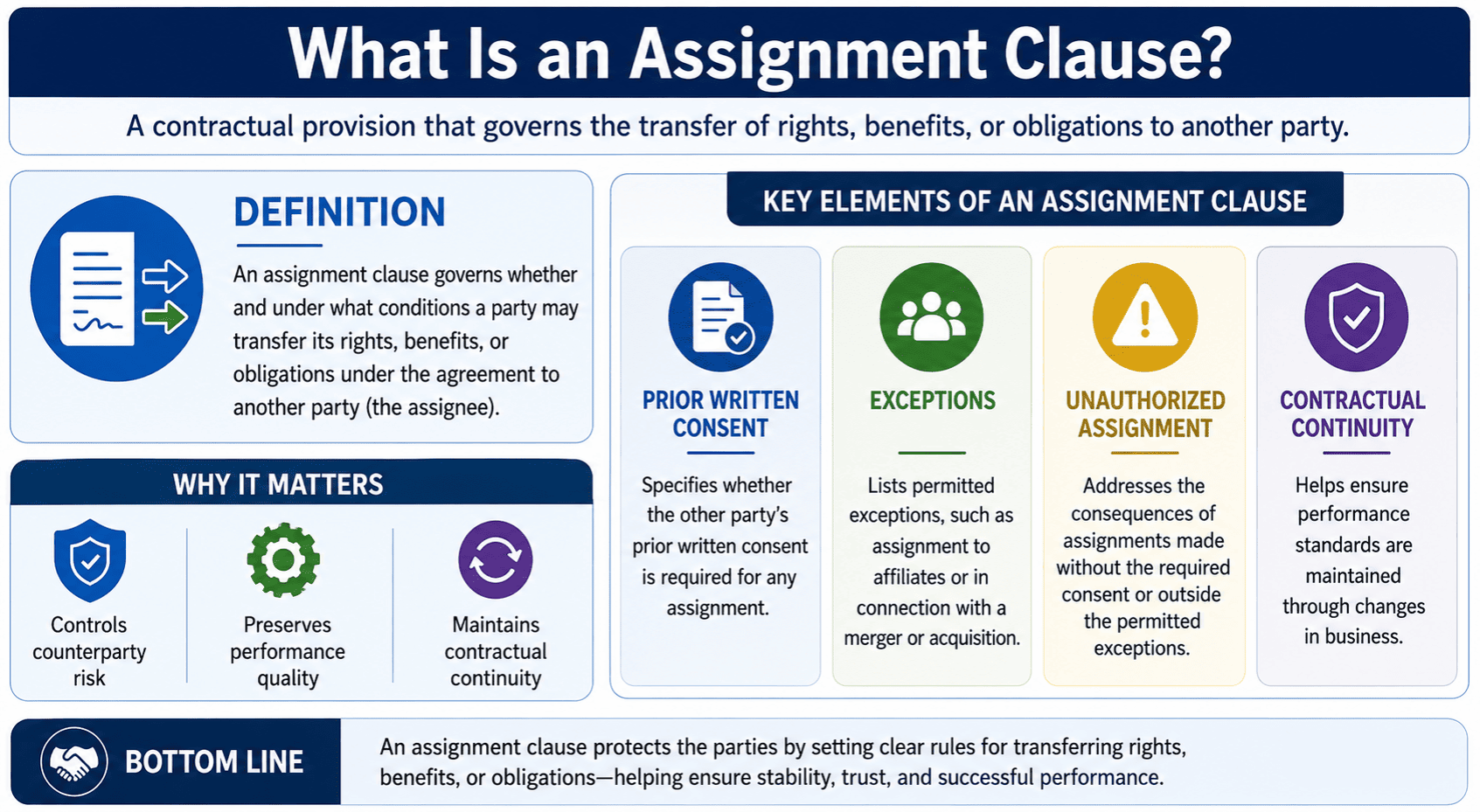
An assignment clause is a contract provision that determines whether a party can transfer its rights, benefits, or obligations under the agreement to another party. It typically specifies whether consent is required, lists exceptions (e.g., assignment to affiliates or in connection with a merger), and states the consequences of unauthorised assignment. The clause helps parties control who they are contracting with and manage risk.
QWhat is the difference between assignment and delegation?
Assignment refers to the transfer of contractual rights or benefits (e.g., the right to receive payment). Delegation refers to the transfer of contractual duties or performance obligations (e.g., the obligation to provide services). While rights are generally assignable unless the contract prohibits it, duties are not delegable if the contract depends on the personal skill, expertise, or trust of the original party. Many contracts address both concepts together in a single clause using language like “assign or delegate.”
QCan a contract be assigned without consent?
It depends on the language of the contract. If the contract contains an anti‑assignment clause prohibiting assignment without prior written consent, then assignment without consent is a breach and may be void. If the contract is silent, rights are generally assignable under common law, but duties may not be delegable if they involve personal skill. Many commercial contracts require consent for any assignment, with exceptions for transfers to affiliates or in connection with mergers and acquisitions.
QDoes a merger or acquisition count as an assignment?
Yes, in many cases. A change of control through a merger, acquisition, or sale of substantially all assets is often treated as an assignment “by operation of law.” If the contract prohibits assignment without consent and does not include an exception for change of control, the transaction could constitute a breach and give the other party a right to terminate. This is why M&A carve‑outs are critical in commercial contracts.
QWhat is the difference between assignment and novation?
In an assignment, the assignor transfers its rights and (if permitted) delegates its duties, but the assignor typically remains secondarily liable if the assignee fails to perform. In a novation, the original party is fully released and a new contract is formed with the substitute party. Novation requires the express consent of all three parties (assignor, assignee, counterparty). Novation is common in M&A when the buyer wants the seller to be completely removed from the contract.