Why the Air Waybill Is Essential in Air Freight
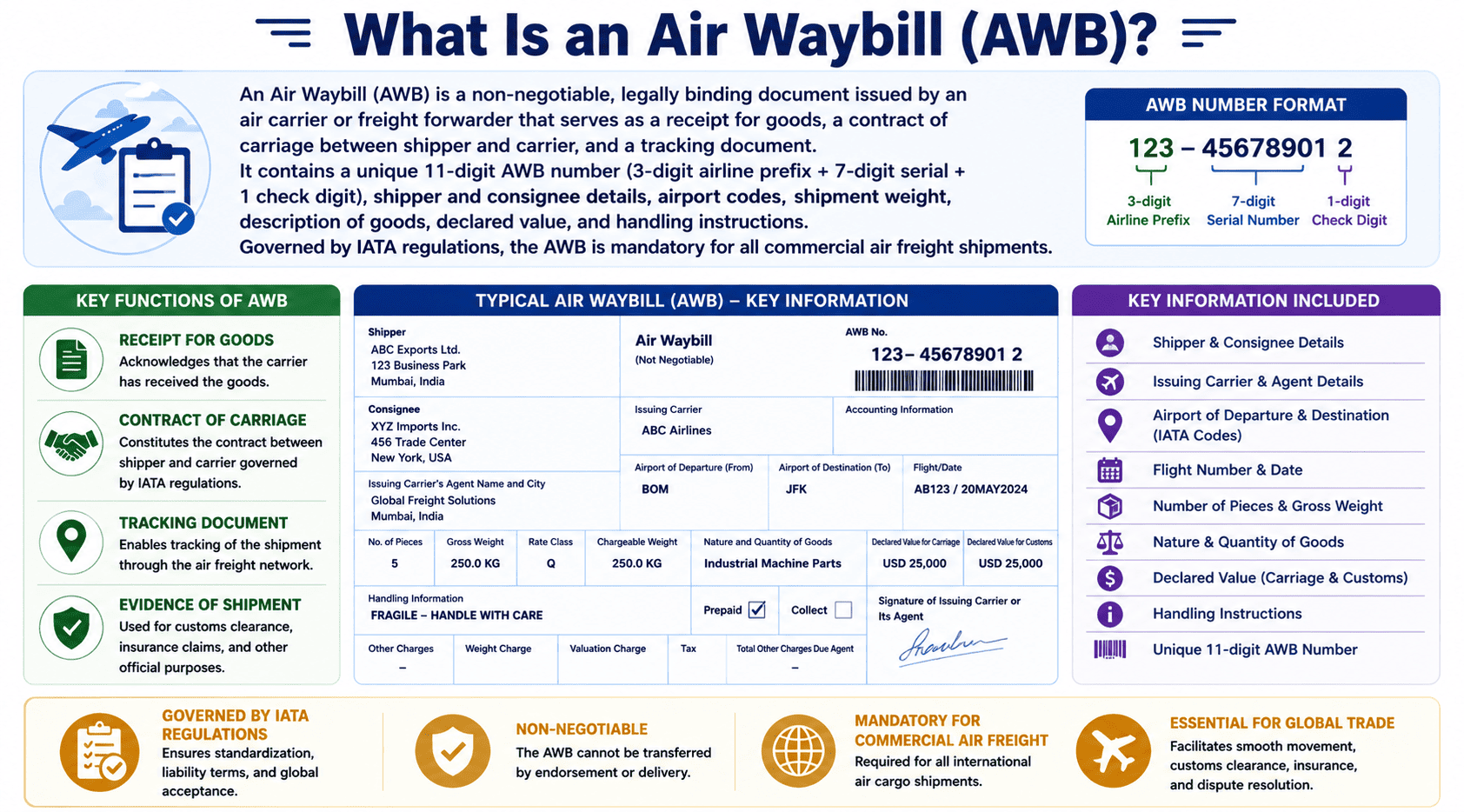
An Air Waybill is not merely a label or tracking number, it is the foundational document for any commercial air shipment. Without a valid AWB, an airline will not accept cargo. The AWB performs multiple critical functions: it confirms the carrier has received the goods, it sets out the terms and conditions of transport, it provides customs authorities with the data needed for clearance, and it enables real‑time tracking using the unique AWB number. For shippers, freight forwarders, and consignees, understanding the AWB is essential to avoid delays, disputes, or non‑delivery.
⚡ Key Principle
The AWB is non-negotiable. Unlike an ocean Bill of Lading, it does not represent title to the goods, nor is it required for the consignee to take delivery. The named consignee can claim the shipment upon proof of identity without presenting the original AWB. This makes air freight faster but also requires careful attention to consignee details.
AWB Functions & Information
Key Functions of an Air Waybill
📋
Receipt of Goods
Confirms that the airline has taken possession of the shipment from the shipper at the origin airport, including package count, weight, and apparent condition.
✔️ Evidence for insurance claims
✔️ Proof of handover to carrier
⚖️
Contract of Carriage
Legally binding agreement between shipper and carrier, outlining each party’s rights, liabilities, and the applicable IATA terms and conditions.
✔️ Governs liability limits
✔️ Dispute resolution basis
🔍
Tracking & Visibility
The unique AWB number enables real-time tracking from acceptance to delivery, providing status updates to shipper, forwarder, and consignee.
✔️ 11-digit AWB number
✔️ Integrated with carrier systems
🛃
Customs Clearance
Provides customs authorities with essential data: shipper/consignee details, HS codes, declared value, weight, and commodity description for duty assessment.
✔️ Required for import/export
✔️ Supports electronic filing (e-AWB)
Master AWB vs House AWB
Master Air Waybill (MAWB) vs House Air Waybill (HAWB)
In air freight, two types of AWBs are commonly used when a freight forwarder consolidates multiple small shipments. Understanding the distinction is critical for correctly assigning responsibility and tracking.
| Feature | Master Air Waybill (MAWB) | House Air Waybill (HAWB) |
|---|
| Issued by | Airline (carrier) | Freight forwarder |
| Covers | Consolidated shipment (multiple individual shipments combined) | Individual shipment from one shipper |
| Contract between | Freight forwarder and airline | Shipper and freight forwarder |
| Relationship | One MAWB corresponds to one HAWB or many HAWBs under consolidation | Each HAWB references the MAWB number of the master consolidation |
| Usage scenario | Forwarder consolidates cargo from various shippers into one airline shipment | Individual shipper contracts with forwarder for door-to-door or airport-to-airport |
| Number of copies | Issued in set of 3 originals + copies (IATA standard) | As determined by forwarder, typically 3 originals |
✨ Practical Insight
As a shipper, you will usually receive a HAWB from your freight forwarder. The HAWB contains your specific shipment details, while the forwarder uses the MAWB with the airline. Always confirm that your HAWB number is traceable and that the forwarder has provided the MAWB number for tracking the consolidated master shipment.
AWB vs Sea Waybill vs Bill of Lading
How an Air Waybill Differs from Sea Waybills and Bills of Lading
While all three documents serve as receipts and contracts of carriage, only the ocean Bill of Lading (B/L) is negotiable and serves as a document of title. This distinction has significant legal and practical implications for payment terms (e.g., letters of credit) and ownership transfer.
| Feature | Air Waybill (AWB) | Sea Waybill (SWB) | Ocean Bill of Lading (B/L) |
|---|
| Mode of transport | Air | Ocean / sea | Ocean / sea |
| Negotiable? | No (non-negotiable) | No | Yes (can be negotiable or non-negotiable) |
| Document of title? | No, does not transfer ownership | No | Yes, can be used to transfer ownership and as collateral |
| Required for delivery? | No, consignee can claim with ID | No, similar to AWB | Yes, original B/L must be surrendered (if negotiable) |
| Issued by | Airline or freight forwarder | Shipping line | Shipping line or NVOCC |
| Number of originals | 3 original copies (IATA standard) | Typically 1 original | Typically 3 original negotiable copies |
| Use with letters of credit? | Acceptable (but non‑negotiable) | Acceptable | Most common (negotiable B/L required for many L/Cs) |
Electronic Air Waybill (e-AWB)
Electronic Air Waybill (e‑AWB): The Digital Standard
The electronic Air Waybill (e‑AWB) is the digital equivalent of the paper AWB, replacing the traditional 8‑copy multi‑color form with an electronic data interchange (EDI) message. IATA has promoted e‑AWB adoption globally, with most major airlines and forwarders now using e‑AWB as the default. The e‑AWB eliminates manual data entry, reduces paperwork errors, speeds up customs processing, and provides real‑time data exchange between shipper, forwarder, carrier, and customs authorities. A paper AWB may still be required for certain destinations or specific commodities, but the industry standard is increasingly paperless.
01
Data Creation
Shipper or forwarder enters shipment data (shipper/consignee, weight, HS code, value) into a digital freight platform.
02
EDI Transmission
Data is transmitted electronically to the airline’s cargo system as an IATA-standard e-AWB message.
03
Electronic Contract
The e‑AWB becomes the legally binding contract of carriage without any paper copy being printed or exchanged.
04
Digital Tracking & Customs
All parties access the same real‑time data; customs authorities receive pre‑arrival data for risk assessment and clearance.
💡 e‑AWB Adoption
As of 2025, over 80% of international air freight shipments are covered by e‑AWB agreements. Shippers should confirm with their forwarder whether e‑AWB is available for their trade lanes. Even when e‑AWB is used, a contingency paper AWB may be required for certain regulated goods or destinations with limited digital infrastructure.
FAQ
Frequently Asked Questions
QWhat is the difference between a Master Air Waybill (MAWB) and a House Air Waybill (HAWB)?
A Master Air Waybill (MAWB) is issued by the airline to a freight forwarder and covers a consolidated shipment containing multiple individual shipments. A House Air Waybill (HAWB) is issued by the freight forwarder to each individual shipper and provides the specific details of that single shipment. The HAWB is the contract between shipper and forwarder, while the MAWB is the contract between forwarder and airline. The HAWB number is often different from the MAWB number, but the HAWB will reference the master number for tracking.
QIs an Air Waybill a negotiable document of title?
No. An Air Waybill (AWB) is non-negotiable and does not serve as a document of title. This means that unlike an ocean Bill of Lading (B/L), the AWB cannot be used to transfer ownership of goods, nor is it required for the consignee to take delivery. The consignee named on the AWB can claim the goods upon proof of identity without presenting the original AWB. This is a key distinction that affects payment terms, letters of credit, and risk of fraud.
QWhat information is required on an Air Waybill?
An Air Waybill must include: the unique 11-digit AWB number (3-digit airline prefix + 7-digit serial + 1 check digit); shipper (consignor) name and address; consignee name and address; origin and destination airport codes (IATA three‑letter codes); airline carrier name; number of packages; gross weight (kg); description of goods (including HS code at least at the 6-digit level); declared value for carriage and for customs; special handling instructions (e.g., “perishable”, “fragile”, “dangerous goods” with proper class); and billing/payment information (who pays freight, charges, taxes).
QCan I track a shipment using the AWB number?
Yes. The unique 11-digit AWB number is the primary tracking reference for air freight. You can enter the AWB number on the airline’s tracking portal, or on a forwarder’s platform if they have integrated tracking. Most major carriers (FedEx, DHL, UPS, Delta Cargo, Maersk Air Freight, etc.) provide public tracking by AWB number. Note that for HAWB numbers (issued by forwarders), tracking may require the forwarder’s system or may reference the underlying MAWB.
QWhat is an e-AWB (electronic Air Waybill)?
An electronic Air Waybill (e‑AWB) is the digital replacement for the paper AWB. It uses electronic data interchange (EDI) messages to transmit the contract of carriage data between shipper, forwarder, airline, and customs authorities. The e‑AWB is legally equivalent to the paper AWB under IATA resolutions and national laws that recognize electronic contracts. Benefits include faster processing, elimination of manual data entry errors, reduced paper handling, and real‑time visibility. Most major airlines have e‑AWB adoption rates above 80% for eligible shipments.