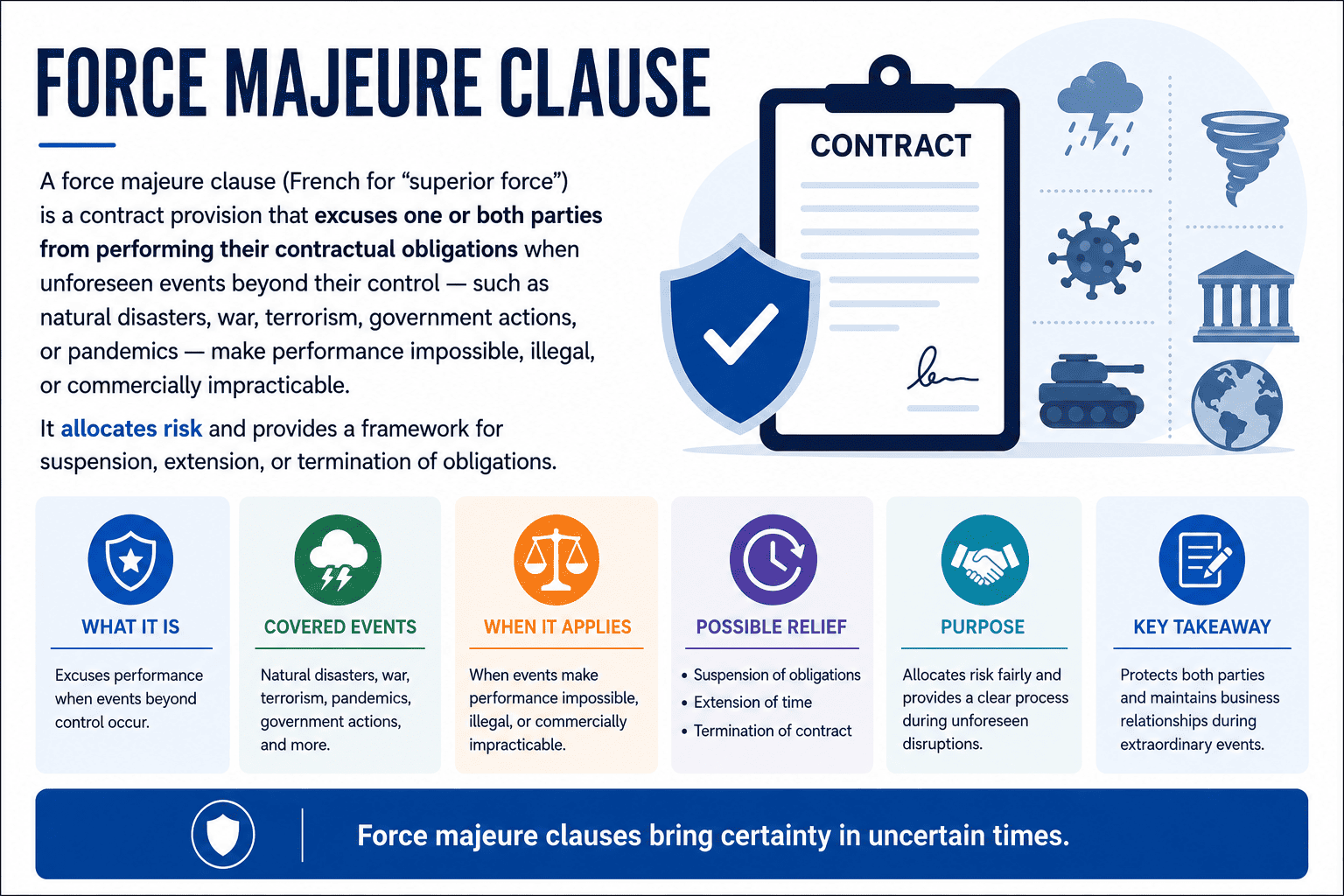
Why Force Majeure Matters in Contracts
Force majeure clauses serve a critical function in commercial contracts: they provide certainty and fairness when the unexpected occurs. Without such a clause, a party prevented from performing by a hurricane, war, or pandemic would be in breach of contract, potentially liable for substantial damages. Common law doctrines of “impossibility” and “frustration of purpose” offer limited relief, courts apply them narrowly, and they rarely excuse performance. A well-drafted force majeure clause, by contrast, gives parties clear guidance on what events qualify, what notice must be given, and what happens to the contract during and after the event.
The COVID-19 pandemic brought force majeure clauses into sharp focus. Thousands of contracts were invoked, leading to litigation over whether “pandemic” was explicitly listed, whether government lockdown orders qualified as “government action,” and whether mere economic hardship (reduced demand) was sufficient. The lesson: specificity matters. Courts interpret force majeure clauses narrowly, giving effect only to events expressly listed or clearly within the clause’s scope.
⚡ Key Principle
Force majeure is not automatic. The party seeking relief must prove: (1) a qualifying event occurred, (2) the event was unforeseeable and beyond its control, (3) it could not have mitigated the impact, and (4) performance was actually prevented, not merely made more difficult or expensive. The burden of proof lies on the party invoking force majeure.
Qualifying Events
What Events Typically Trigger Force Majeure?
🌊
Natural Disasters (Acts of God)
Earthquakes, floods, hurricanes, tornadoes, wildfires, droughts, volcanic eruptions, and severe storms. These are the most commonly listed events and are generally accepted by courts.
⚔️
War & Military Actions
War (declared or undeclared), invasion, armed conflict, terrorism, sabotage, civil war, rebellion, revolution, and military coup. Often includes threats of war.
🏛️
Government Actions
Embargoes, sanctions, export/import restrictions, new laws or regulations, expropriation, nationalisation, closure of borders, and mandatory business shutdowns.
🦠
Pandemics & Epidemics
Widespread disease outbreaks (COVID-19, SARS, Ebola), government-imposed lockdowns, quarantine orders, and travel bans. Many contracts now explicitly list “pandemic.”
🚧
Labour Disputes
Strikes, lockouts, work stoppages, and labour shortages. Often excludes strikes specific to the party or its subcontractors (i.e., those within control).
🔥
Other Events
Fire, explosion, nuclear or chemical contamination, cyber-attacks, widespread IT outages, supply chain failures (if beyond control), and transportation curtailment.
⚠️ Critical: What Is NOT Force Majeure
Courts consistently hold that the following do NOT qualify unless expressly listed: economic downturns, market price increases, currency fluctuations, reduced demand, increased costs of raw materials, supplier insolvency (unless due to a force majeure event), and general business slowdowns. Mere impracticability or unanticipated difficulty is not enough, the event must make performance objectively impossible.
Essential Clause Elements
What a Well-Drafted Force Majeure Clause Must Include
1. Definition of Force Majeure Events
A specific list of qualifying events (natural disasters, war, government action, pandemic, etc.) plus a catch-all phrase like “or any other event beyond the reasonable control of the party.”
2. Notification Requirements
Specify timeframe (e.g., “within 7 days of occurrence”), content of notice (description of event, expected impact, estimated duration), and method (written notice).
3. Mitigation Obligations
The affected party must use reasonable efforts to mitigate the impact of the force majeure event and resume performance as soon as practicable.
4. Suspension of Obligations
Clearly state which obligations are suspended (e.g., delivery deadlines, payment terms) and for how long. The contract is not terminated but paused.
5. Payment During Force Majeure
Address whether payments continue (e.g., in long-term supply or construction contracts). If no performance is possible, usually payment obligations are suspended as well.
6. Termination Rights
If the force majeure event continues beyond a defined period (e.g., 30, 60, or 90 days), either party may terminate the contract without liability.
7. Threshold of Impact
Define the degree of impact required: “prevents” (strict), “hinders,” “delays,” or “makes commercially impracticable.” Lower thresholds give more protection but are harder to enforce.
8. Governing Law & Dispute Resolution
Specify which jurisdiction’s law governs the interpretation of force majeure, critical because civil law systems (France, Germany) treat force majeure more expansively than common law systems (US, UK).
Sample Clause Language
Real-World Example: Comprehensive Force Majeure Clause
📄 FORCE MAJEURE CLAUSE (Supply Agreement Context)
Neither party shall be liable for any delay or failure in performance resulting from causes beyond its reasonable control, including, without limitation: acts of God; natural disasters (earthquakes, floods, hurricanes, fires); war, terrorism, civil unrest, or military action; government orders, laws, regulations, embargoes, or sanctions; pandemics, epidemics, or widespread disease outbreaks; strikes or labour disputes (excluding those specific to the party’s own workforce); and curtailment of transportation facilities. The affected party shall: (i) provide written notice within 7 days of the event, (ii) use commercially reasonable efforts to mitigate the impact, and (iii) resume performance as soon as practicable. If the force majeure event continues for more than 30 consecutive days, either party may terminate this Agreement without liability. Payment obligations shall be suspended for the duration of the force majeure event to the extent corresponding performance is suspended.
✨ Drafting Tip
Always include a catch-all phrase (“or any other event beyond the reasonable control of the party”) to cover unforeseen events not explicitly listed. Without it, courts will interpret the clause narrowly, applying the principle expressio unius est exclusio alterius (the express mention of one thing excludes others). For contracts likely to be affected by government actions, explicitly list “changes in law,” “export/import restrictions,” and “tariffs.”
Legal Standards & Jurisdictional Differences
How Courts Interpret Force Majeure Clauses
Interpretation of force majeure clauses varies significantly by jurisdiction. Understanding these differences is essential for cross-border contracts.
| Jurisdiction | Approach | Key Considerations |
|---|
| United States (New York) | Narrow interpretation | Courts only excuse performance if the specific event is listed. General language like “any event beyond control” is insufficient. Kel Kim Corp. v. Central Markets, Inc. COVID-19 was recognized where “natural disaster” was listed (JN Contemporary Art LLC v. Phillips Auctioneers). |
| England & Wales | Contractual interpretation | No common law doctrine of force majeure, only what is written in the contract. If no clause, parties must rely on narrow “frustration” doctrine. Courts interpret clauses strictly but give effect to express terms. |
| France (Civil Law) | Broader doctrine | Force majeure is implied by law (French Civil Code, art. 1218). Requires event to be unforeseeable, unavoidable, and external, making performance impossible. No need for explicit clause, though clauses are common. |
| Germany | Similar to France | Doctrine of “Störung der Geschäftsgrundlage” (disruption of basis of transaction), broader than common law impossibility. Party may request contract adaptation if circumstances fundamentally changed. |
| International Arbitration | ICC, UNCITRAL, UNIDROIT Principles | UNIDROIT Principles Article 7.1.7 recognises force majeure as “an impediment beyond its control” that could not be foreseen or overcome. Tribunals assess reasonableness in context. |
Invocation Process
How to Properly Invoke a Force Majeure Clause
01
Assess Whether Event Qualifies
Review the clause: Is the event explicitly listed or within a catch-all provision? Is performance truly prevented (not just delayed or more expensive)? Document the impact.
02
Provide Timely Written Notice
Notify the counterparty within the timeframe specified (typically 7–14 days). Include: description of the event, its impact on performance, expected duration, and steps being taken to mitigate.
03
Mitigate and Document
Take reasonable steps to reduce the impact. Keep records of all communications, costs incurred, and efforts made. Failure to mitigate may waive force majeure protection.
04
Regular Updates
Provide ongoing updates on the status of the event and expected resumption of performance. Silence may be interpreted as waiver or abandonment of the claim.
05
Resume Performance Promptly
Once the force majeure event ends, notify the counterparty and resume full performance. If the clause allows termination after a period, decide whether to terminate or continue.
Force Majeure vs Other Doctrines
Force Majeure vs Impossibility vs Frustration of Purpose
| Aspect | Force Majeure (Contractual) | Impossibility (Common Law) | Frustration of Purpose |
|---|
| Source | Express contract clause | Common law doctrine (judge-made) | Common law doctrine |
| Standard | As defined in clause, typically “prevents,” “hinders,” or “makes impracticable” | Strict, performance must be objectively impossible, not merely difficult or expensive | Radical change in circumstances renders performance worthless to one party |
| Burden of proof | Party invoking clause proves event qualifies under clause language | High, must show impossibility was not self-induced and could not have been foreseen | Very high, courts rarely find frustration |
| Effect | Suspension, extension of time, or termination as provided in clause | Excuses performance entirely; contract terminated | Contract terminated; parties discharged |
| Typical outcomes | Often successful if clause well-drafted | Rarely successful, e.g., destruction of subject matter, death of person needed for performance | Very rarely successful, e.g., coronation cases (renting flat to watch parade that was cancelled) |
COVID-19 & Modern Lessons
Lessons from the COVID-19 Pandemic
The pandemic triggered thousands of force majeure claims and produced important guidance for drafters:
- Explicitly list “pandemic” or “epidemic”: Contracts that listed “pandemic” or “disease outbreak” had clear coverage. Those with only “act of God” or “natural disaster” faced disputes over whether COVID-19 qualified.
- Government action clauses are essential: Lockdown orders, business closure mandates, and travel bans were often the direct cause of non-performance. Clauses covering “government orders” or “changes in law” provided clearer protection.
- Supply chain disruption: Many contracts failed because they did not explicitly cover supplier failures due to force majeure. Consider “failure of suppliers or subcontractors due to force majeure” as a separate event.
- Economic hardship is not enough: Courts consistently rejected claims based solely on reduced demand, lower prices, or inability to find customers. The event must prevent performance, not merely reduce profitability.
- Notice deadlines matter: Parties that delayed notifying counterparties of COVID-19 impacts often lost the right to invoke force majeure, even if the event otherwise qualified.
📋 Post-COVID Drafting Checklist
Add to your force majeure clauses: (1) “pandemic, epidemic, or widespread disease outbreak,” (2) “government-imposed quarantine, lockdown, or business closure,” (3) “travel bans or border closures,” (4) “failure of key suppliers due to force majeure,” and (5) “cyber-attack or widespread IT infrastructure failure.” Also consider adding a “material adverse change” clause for economic impacts not covered by force majeure.
FAQ
Frequently Asked Questions
QWhat is the difference between force majeure and act of God?
An “act of God” is a subset of force majeure referring exclusively to natural events beyond human control (earthquakes, floods, hurricanes, lightning strikes). Force majeure is broader, including human-caused events like war, terrorism, strikes, government actions, and pandemics. Most commercial force majeure clauses cover both natural and man-made events, while “act of God” clauses are limited to natural disasters. Always use the broader term “force majeure” with a specific list.
QDoes force majeure excuse economic hardship or market changes?
Generally, no. Courts consistently hold that economic downturns, price increases, currency fluctuations, reduced demand, or increased costs of raw materials do not qualify as force majeure. Mere impracticability or unanticipated difficulty is not enough, the event must make performance objectively impossible. However, if a contract explicitly lists “supply chain disruptions” or “tariff changes” or “raw material shortages,” those may qualify. For pure economic hardship, consider a separate “hardship clause” or “material adverse change” clause.
QWhat should a force majeure clause include?
A well-drafted clause should include: (1) a clear definition of qualifying events (specific list plus catch-all), (2) notification requirements (timing and content), (3) mitigation obligations, (4) suspension of performance and extension of deadlines, (5) payment obligations during the event, (6) termination rights if the event persists beyond a defined period (typically 30–90 days), (7) allocation of costs incurred during the event, and (8) governing law. Without these elements, the clause invites dispute.
QCan force majeure be invoked if the event was foreseeable?
Under civil law systems (France, Germany), unforeseeability is a requirement. Under common law systems (US, UK), the contract controls, if the clause does not require unforeseeability, the event may still qualify even if it was foreseeable (e.g., hurricane season in Florida). However, many common law courts read an implied requirement of unforeseeability into catch-all phrases like “events beyond reasonable control.” To avoid ambiguity, state explicitly: “whether foreseeable or not” if you want coverage regardless of foreseeability.
QWhat happens if a contract has no force majeure clause?
Parties must rely on common law doctrines of impossibility or frustration of purpose, which are interpreted very narrowly and rarely succeed. In England, force majeure is purely contractual; without a clause, there is no relief. In the US, some courts may imply a force majeure-like defense under the UCC (commercial impracticability under § 2-615), but only for the sale of goods and only if a contingency was “basic assumption” of the contract. Drafting an express clause is always preferable.
QDoes force majeure excuse payment obligations?
It depends on the clause. Many force majeure clauses suspend only performance obligations (delivery, services), but require payment to continue. Others suspend payment obligations as well if the corresponding performance is suspended. The safest approach is to specify: “Payment obligations shall be suspended to the extent corresponding performance is suspended.” In the absence of express language, courts generally hold that money debts are not excused by force majeure, only non-monetary performance.