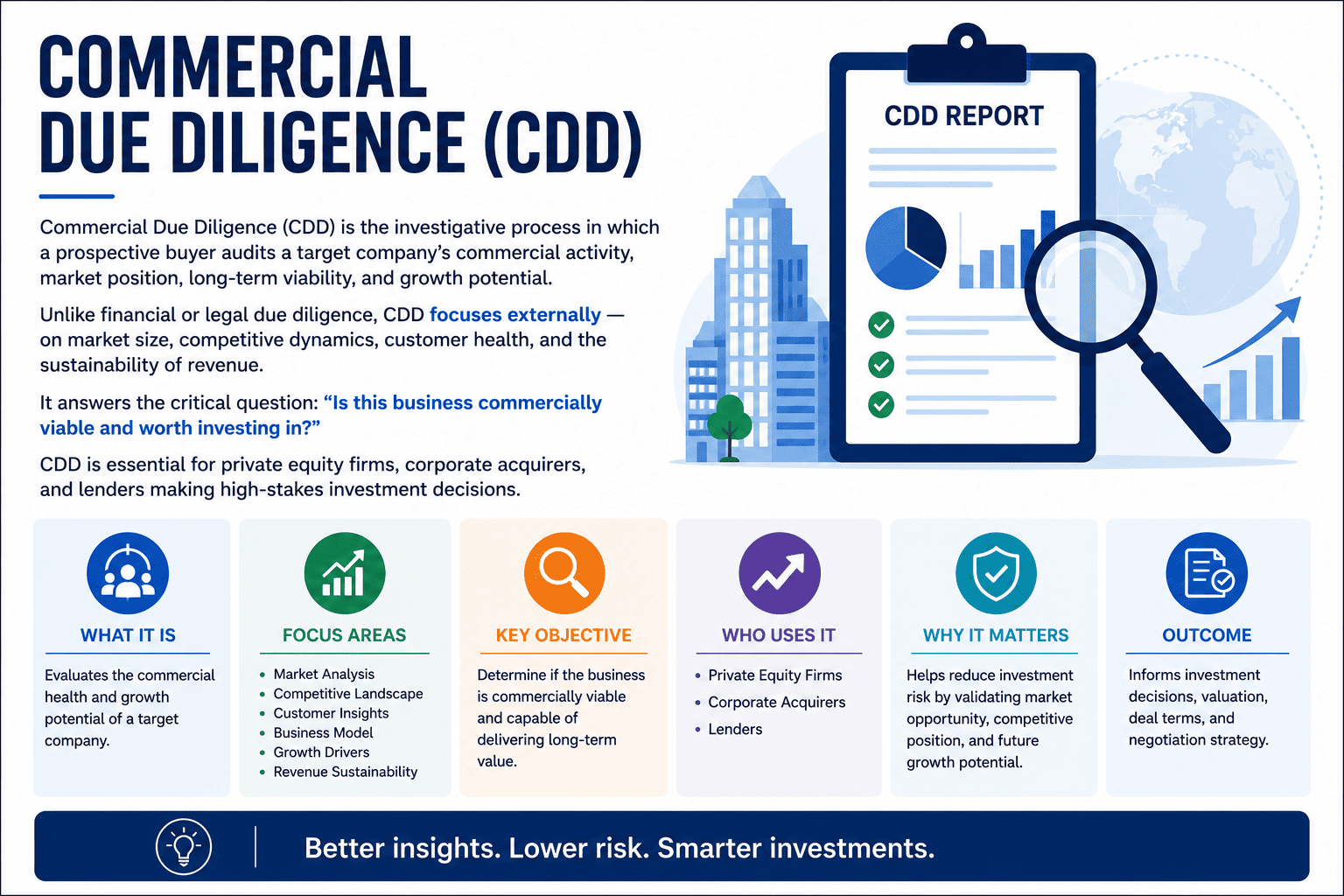
Why Is Commercial Due Diligence Critical in M&A?
In mergers and acquisitions, financial statements tell you what happened in the past. Commercial due diligence tells you what is likely to happen in the future. A target company may have pristine financials, but if its market is shrinking, customers are defecting, or competitors are gaining ground, the investment may fail. CDD validates or challenges the investment thesis by providing an independent, fact-based view of the target’s commercial reality.
For private equity firms, CDD is particularly vital. PE investors typically hold assets for 3-7 years and need to project exit valuations. CDD helps them understand growth levers, identify value creation opportunities, and spot risks that could impair the exit. For corporate acquirers, CDD informs integration planning and synergy assessment.
⚡ Key Principle
Commercial due diligence is not a simple market report, it is a rigorous, hypothesis-driven investigation that combines primary research (customer interviews, competitor analysis) with secondary data to stress-test management’s business plan and forecast assumptions.
Four Types of Commercial Due Diligence
Types of Commercial Due Diligence
🎯 Buyer-Initiated CDD
- Commissioned by the potential acquirer
- Deep-dive into target’s market, competition, customers
- Validates investment thesis before final offer
- Identifies risks and value creation opportunities
🏷️ Vendor-Initiated CDD (VCDD)
- Commissioned by the seller pre-sale
- Anticipates and addresses buyer concerns proactively
- Reduces management time during buyer diligence
- Can increase sale value and accelerate process
🚩 Red Flag CDD
- Expedited, high-level assessment
- Focuses on major deal-breakers only
- Typically 20-50% of full CDD cost
- Used for screening or smaller transactions
🔍 Top-Up CDD
- Supplements existing CDD with specific deep-dives
- Targets unresolved questions after initial diligence
- Usually occurs during exclusivity period
- Focuses on specific markets, segments, or risks
✨ Best Practice
For mid-market and large-cap deals, a full-scope CDD is recommended. For smaller transactions or first-pass screening, a red flag CDD may be sufficient. Vendor-initiated CDD is increasingly common for competitive auction processes, it builds buyer confidence and can justify a higher valuation.
CDD vs Financial vs Legal Due Diligence
How CDD Differs from Other Diligence Streams
| Aspect | Commercial DD | Financial DD | Legal DD |
|---|
| Primary Focus | Market, competition, customers, growth potential | Historical financials, earnings quality, net debt, working capital | Contracts, litigation, compliance, IP, regulatory |
| Key Question | Will the business succeed in its market? | Are the numbers accurate and sustainable? | What are the legal risks and liabilities? |
| Time Horizon | Forward-looking (3-5+ years) | Historical + near-term forecast verification | Historical and ongoing compliance |
| Typical Provider | Strategy consulting firms (L.E.K., EY-Parthenon, OC&C) | Accounting firms (Big4, mid-tier) | Law firms (external counsel) |
| Output | Market model, competitive positioning, customer insights | Quality of Earnings report, net debt analysis | Legal risk register, contract review summary |
The Commercial Due Diligence Process
CDD Process: From Kick-Off to Final Report
01
Kick-Off & Hypothesis Formation
The CDD team aligns with the client on the investment thesis, key questions, and areas of focus. A work plan is developed outlining primary and secondary research streams.
02
Secondary Research
Analysis of market reports, competitor financials, industry publications, and regulatory data to size the market (TAM, SAM, SOM) and map the competitive landscape.
03
Primary Research (Customer & Competitor Interviews)
15-30+ interviews with customers, former customers, competitors, distributors, and industry experts to gather unfiltered insights on the target’s reputation, switching costs, and value proposition.
04
Management Review & Business Plan Stress-Testing
Interviews with target management to understand strategy, sales pipeline, and forecasts. The team stress-tests key assumptions against market reality.
05
Synthesis & Report Delivery
All findings are synthesized into a final report covering market attractiveness, competitive position, customer dynamics, and actionable recommendations on valuation and deal structure.
What a CDD Report Includes
Core Components of a Commercial Due Diligence Report
Market size (TAM, SAM, SOM) and growth projections
Market drivers and structural trends
Competitive landscape and market shares
Customer segmentation and concentration analysis
Customer churn, retention, and lifetime value
Value proposition and differentiation
Pricing analysis and margin benchmarking
Sales channel effectiveness and go-to-market strategy
Unit economics (CAC, LTV, contribution margin)
Regulatory and market entry barriers
Synergy identification (for corporate buyers)
Management quality and depth assessment
Benefits of Commercial Due Diligence
📉
Risk Mitigation
Identifies market, competitive, and customer risks before commitment
💪
Informed Negotiation
Provides leverage to adjust valuation or deal terms based on commercial realities
📈
Value Creation Blueprint
Outlines specific initiatives to drive growth post-acquisition (pricing, cross-selling, new markets)
🏦
Financing Support
Lenders increasingly require CDD to underwrite acquisition financing
🚀
Exit Preparation
For PE firms, CDD shapes the story for future buyers and validates growth projections
Common Pitfalls
Common Mistakes in Commercial Due Diligence
🚩
Over-Reliance on Management Data
Taking management’s market size or growth projections at face value without independent validation. Always triangulate with third-party sources.
🚩
Insufficient Customer Interviews
Fewer than 10-15 customer interviews rarely provides reliable insights. Competitor and former customer interviews are equally critical.
🚩
Ignoring Channel and Distributor Dynamics
For B2B companies with indirect sales, channel partners hold crucial information about margins, incentives, and customer reach.
🚩
Confirmation Bias
Seeking evidence that confirms the investment thesis while ignoring contradictory signals. The best CDD teams actively try to disprove the thesis.
🚩
Static Market Analysis
Markets evolve rapidly. A point-in-time snapshot is insufficient, the CDD must assess momentum, emerging competitors, and potential disruption.
FAQ
Frequently Asked Questions about Commercial Due Diligence
QWhen should commercial due diligence be conducted?
Typically after a Letter of Intent (LOI) is signed and exclusivity is granted, running in parallel with financial and legal due diligence. For competitive auctions, vendor-initiated CDD may be conducted pre-process. Red flag CDD can be done earlier as a screening tool.
QHow much does commercial due diligence cost?
Costs vary widely based on scope, geography, and complexity. A full-scope CDD for a mid-market target typically ranges from $50,000 to $200,000. Red flag CDD may cost $20,000-$50,000. Vendor-initiated CDD is often comparable to buy-side costs.
QHow long does a commercial due diligence engagement take?
Full-scope CDD typically takes 4-8 weeks from kick-off to final report. Red flag CDD can be completed in 2-3 weeks. Timing depends on availability of management for interviews, complexity of primary research, and the number of markets/segments analyzed.
QWho performs commercial due diligence?
Specialist strategy consulting firms with dedicated transaction advisory practices: L.E.K. Consulting, EY-Parthenon, OC&C Strategy Consultants, Kearney, CIL Management Consultants, and others. Some large accounting firms also offer CDD through their strategy arms.
QIs commercial due diligence only for private equity?
No. Corporate acquirers use CDD to validate strategic fit, assess integration risks, and negotiate better terms. Lenders (banks, credit funds) increasingly require CDD for large acquisition financing. Family offices and infrastructure funds also commission CDD.