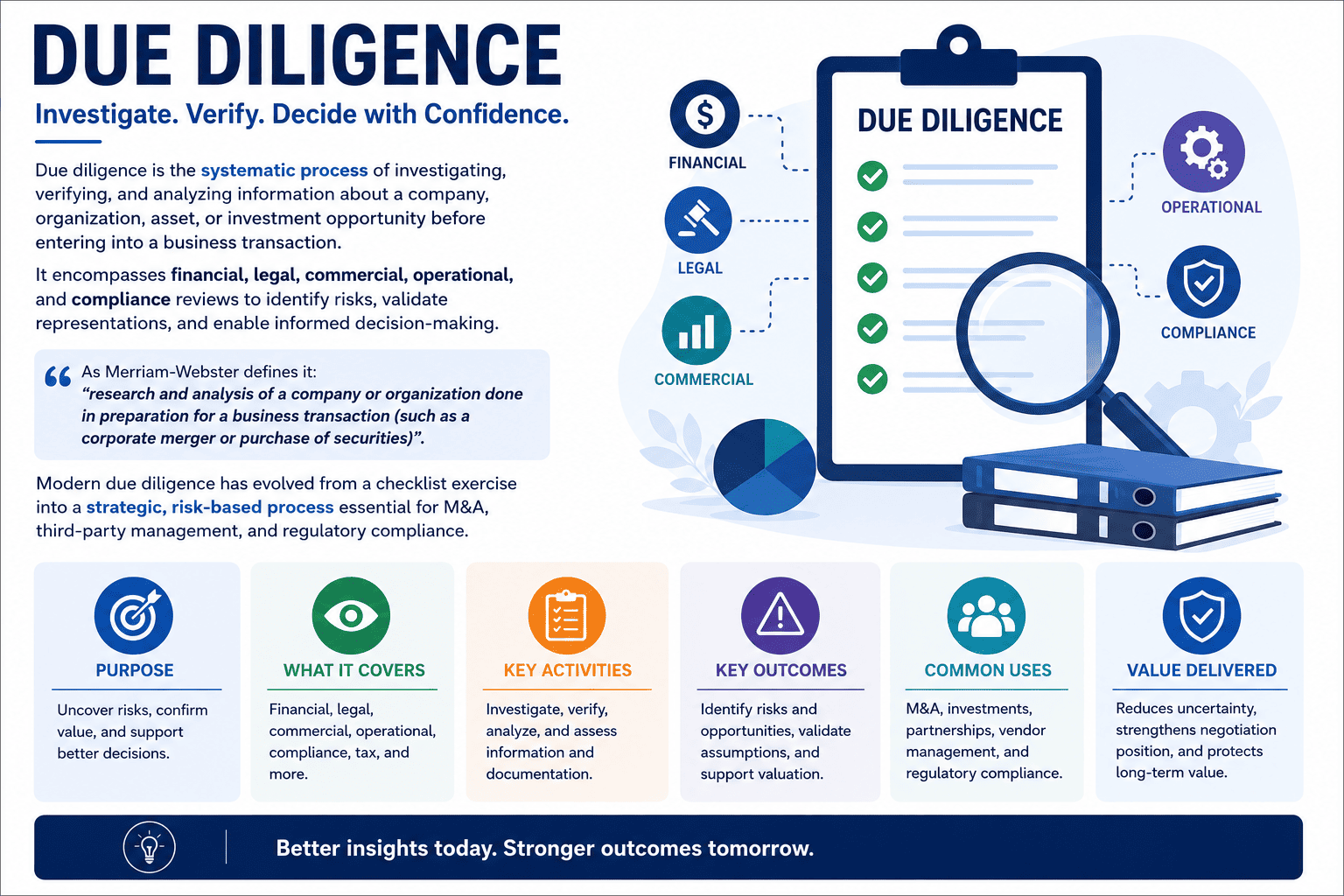
Why Does Due Diligence Matter?
Between 70% and 90% of M&A transactions fail to deliver their expected value, and inadequate due diligence is consistently cited as a primary cause. Due diligence is the essential safeguard: it uncovers hidden liabilities, validates financial and legal representations, and provides decision-makers with the facts needed to negotiate confidently. Beyond M&A, due diligence is now a regulatory requirement in many jurisdictions, from anti-money laundering (AML) customer checks to the EU’s Corporate Sustainability Due Diligence Directive (CSDDD). In an era of complex supply chains and heightened scrutiny, due diligence is not optional; it is a core governance function.
⚡ Key Principle
Due diligence is not about finding a reason to say “no”, it’s about understanding what you’re buying into, pricing risk appropriately, and planning for successful integration or ongoing relationship management. The best due diligence identifies both risks AND opportunities.
12+ Types of Due Diligence
Major Types of Due Diligence
💰 Financial DD
Review audited financials, quality of earnings, net debt, working capital, off-balance-sheet liabilities, and financial forecasts.⚖️ Legal DD
Examine contracts, litigation history, intellectual property, regulatory compliance, corporate structure, and employment agreements.📊 Commercial DD
Analyze market size (TAM/SAM/SOM), competitive positioning, customer concentration, pricing power, and growth sustainability.🌿 ESG DD
Assess environmental footprint, labor practices, supply chain ethics, governance structures, and compliance with CSDDD or similar regulations.🔐 Cyber & IT DD
Evaluate cybersecurity posture, data protection (GDPR), system architecture, software licenses, and incident response capabilities.🏭 Operational DD
Review supply chain resilience, production capacity, key supplier dependencies, logistics, and operational KPIs.
✨ Enhanced Due Diligence (EDD)
For high-risk scenarios, such as clients in sanctioned jurisdictions, politically exposed persons (PEPs), or complex ownership structures, Enhanced Due Diligence applies. EDD requires deeper investigation, often involving adverse media searches, source-of-funds verification, and third-party intelligence reports.
The 5-Step Due Diligence Process
How to Conduct Due Diligence: Step-by-Step
01
Scope & Objectives Definition
Define the transaction type, risk tolerance, and key questions. Determine which diligence streams (financial, legal, commercial, etc.) are necessary based on deal size and industry.
02
Information Collection & Document Request
Use a virtual data room (VDR) to securely collect and organize documents: financial statements, contracts, tax records, customer lists, IP registrations, compliance policies, and more.
03
Analysis & Verification
Cross-reference information, conduct interviews with management and customers, perform site visits, and use AI tools for contract review and anomaly detection.
04
Risk Assessment & Reporting
Synthesize findings into a due diligence report, categorizing risks (high/medium/low), highlighting red flags, and providing actionable recommendations on valuation, deal terms, or compliance.
05
Continuous Monitoring
Due diligence does not end at closing. Implement ongoing monitoring for vendors, third parties, or acquired entities to detect sanctions changes, ownership shifts, or emerging risks.
Key Areas of Investigation (Checklist)
Audited financial statements (3-5 years)
Quality of Earnings (QoE) report
Tax returns and outstanding liabilities
Material contracts (customer, supplier, lease)
Litigation history and pending cases
Intellectual property registrations and disputes
Customer concentration and top 10 customers
Employee agreements, retention plans, and benefits
Cybersecurity policies and past breaches
Environmental permits and compliance history
Supply chain mapping and key dependencies
Regulatory licenses and sanctions screening
Common Red Flags & Pitfalls
What to Watch For: Due Diligence Red Flags
🚩
Inconsistent or Missing Documentation
Repeated delays in providing requested documents or inconsistencies between versions often signal hidden problems. A clean data room should contain organized, complete records.
🚩
Unusual Ownership or Legal Structure
Opaque holding companies, offshore entities, or frequent changes in legal form may indicate attempts to obscure true beneficial ownership or avoid liabilities.
🚩
High Customer or Supplier Concentration
A single customer representing >30% of revenue or one exclusive supplier creates significant business risk. Loss of that relationship could be catastrophic.
🚩
Frequent Accounting Changes or Restatements
Multiple auditor changes, repeated earnings restatements, or aggressive revenue recognition practices are serious financial red flags.
🚩
Untimely or Incomplete Responses
When management is slow to answer diligence questions or provides evasive answers, it often means they are hiding something or are poorly organized, both are risks.
Technology & Modern Due Diligence
How AI and Software Transform Due Diligence
According to Bain research, 58% of M&A practitioners using generative AI apply it to the due diligence stage, making due diligence the most common M&A process for AI deployment. Modern due diligence software (virtual data rooms, contract analysis AI, risk screening tools) reduces review time by 30-50%, improves accuracy, and enables real-time collaboration across deal teams.
| Traditional Approach | Technology-Enabled Approach |
|---|
| Manual contract review (weeks) | AI-powered contract analysis extracts key clauses and anomalies (hours/days) |
| Disconnected email and file sharing | Centralized virtual data room with permission controls and Q&A |
| Periodic risk checks at onboarding only | Continuous monitoring of sanctions, adverse media, and ownership changes |
| Spreadsheet-based checklists | Automated workflows with audit trails and reporting dashboards |
FAQ
Frequently Asked Questions about Due Diligence
QWhat is due diligence in simple terms?
Due diligence is the homework you do before making a major business decision. Just as you would inspect a house before buying it, due diligence means investigating a company’s finances, contracts, customers, and risks before acquiring it or signing a major contract.
QWhat is the difference between due diligence and an audit?
An audit is typically a historical, compliance-focused examination of financial statements according to accounting standards. Due diligence is broader: it is forward-looking, encompasses legal, commercial, operational, and IT areas, and is performed for a specific transaction or partnership decision.
QWho pays for due diligence?
In an M&A transaction, the buyer typically pays for due diligence (buy-side diligence). However, in competitive auctions, sellers may commission vendor due diligence (VCDD) to speed up the process and increase buyer confidence. For third-party risk management, the hiring company bears the cost.
QIs due diligence a legal requirement?
In many contexts, yes. Anti-money laundering (AML) regulations require customer due diligence (CDD) and enhanced due diligence (EDD) for financial institutions. The EU’s Corporate Sustainability Due Diligence Directive (CSDDD) mandates human rights and environmental due diligence for large companies. Public companies have fiduciary duties to conduct due diligence before major transactions.
QWhat are the 3 principles of due diligence according to the UN?
The UN Guiding Principles on Business and Human Rights establish three core principles: 1) Identify and assess actual or potential adverse impacts; 2) Prevent and mitigate those impacts; and 3) Account for how those impacts are addressed. These principles now underpin ESG due diligence frameworks worldwide.